

Quick view:
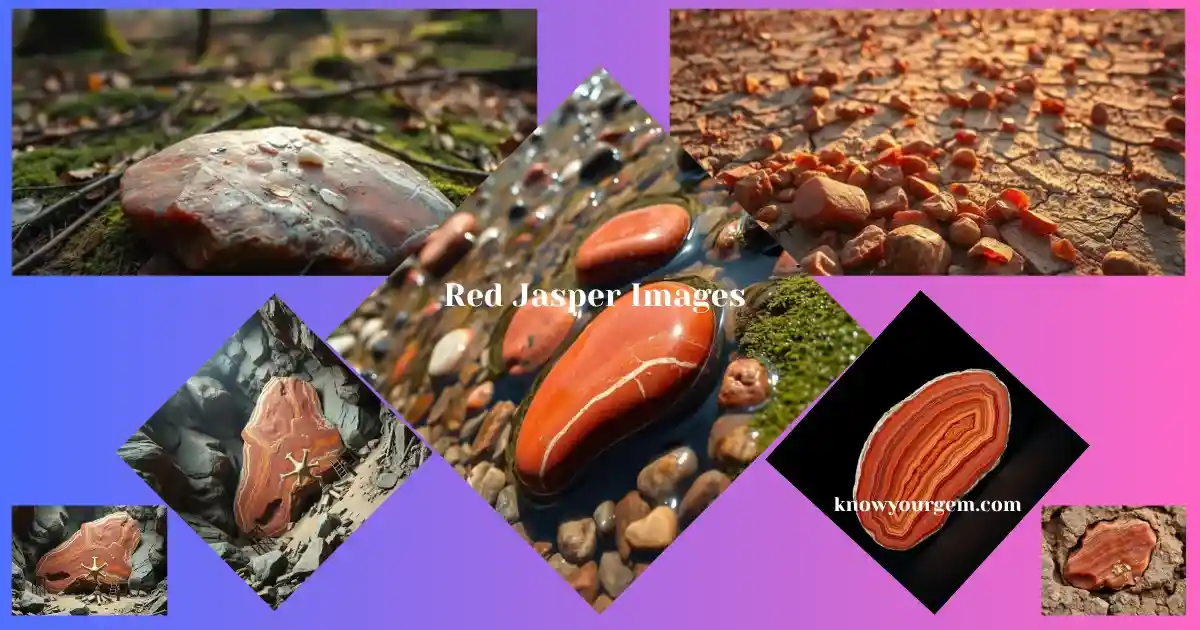
Red Jasper is an opaque chalcedony gemstone relates to quartz family, it is recognized for its brick-red to brownish colors that are created by iron oxide. It is 6.5-7 mohs scale of hardness, it is durable for daily wear and ornamental use. It is found in Brazil, India, Australia and the U.S.A. It remains abundant, affordable, and valued at $1 to $30 that hinging on quality.
Jasper is not hardest gem if you are interested to know about top 10 hardest gemstones You can explore complete guide.
I. what is red jasper?
Red jasper is a type of opaque of chalcedony belongs to quartz family, recognized for its rich, iron-red color. It is not same as clear quartz crystal but it has fine grained, tightly packed structure that gives it a soft, waxy shine.
From a gemological standpoint, sard stone is classified as a chalcedony gemstone under the quartz mineral family. Since, it is recognized by organizations like the Gemological Institute of America (GIA) as a distinct gemstone variety, suitable for use in fine fashion alike. It is not same synthetic imitations, genuine red jasper is a natural gemstone formed over millions of years through geological processes.
Mineral Classification:
Jasper sits within the following mineralogical hierarchy:
- Mineral Group: Silicates
- Division: Tectosilicates
- Mineral Species: Quartz (SiO₂)
- Variety: Chalcedony → Jasper → Red Jasper
This classification believes to confirm the stone’s relationship to other well recognized chalcedony gemstones like as carnelian, agate, bloodstone, and onyx. All this minerals share micro-crystalline quartz structure but differently through their color, pattern, and opacity.
Chemical composition:
The chemical composition of Red Chalcedony is silicon dioxide like (SiO₂) with iron oxide inclusions primarily hematite like ,(Fe₂O₃) which give this stone a distinctive red color. Small amounts of other minerals like, goethite can introduce brownish or yellowish undertones in certain specimens. Technically, a stone must contains at least 20% foreign material within its silica matrix to be classified as jasper rather than pure chalcedony.
Crystal structure:
Jasper red stone is a sparkling quartz crystal you can recognize, quartz in the shape of amethyst or rock crystal. Instead of forming sharp points or facets, it is made up of countless tiny quartz grains. So, small they can be seen through microscope. Since this tightly packed structure gives it the solid, opaque look and smooth feel. Its shape into carve, cabochon, or bread make it jasper red.
II. Physical and visual properties of red jasper:
Its physical and visual properties are as follows:
Color variations:
The most knowable characteristic of sard jasper stone is its rich red coloration. Hinges on source location and precise mineral composition, red jasper color can be ranged across:
- Deep brick red (it is most common and most cherished)
- Dark brownish-red ( it is higher geothite content)
- Mottled red and yellow (it is banded red jasper)
- Red with black veining (It is red vein jasper)
- Red with green mineral inclusions (it is red and green jasper)
- Dark red with gray patches (it is dark dark red jasper)
Highly valued Red Chalcedony gemstone own deep even brick-reddish color with having a little to no pattern. Since, patterned types, like banded or red vein jasper, are also cherished by collectors for their unique and beautiful look.
Patterns and inclusions:
Jasper is treasured for its variety of patterns: Some of the common patterns as follows:
- Uniform: Single color, red tone is commonly found in jewelry that have reddish jasper.
- Banded: Alternating stripes of red and other colors( banded red jasper)
- Brecciated Jasper: It is made by broken iron jasper pieces that are joined together, and gives it a bold, patchy look.
- Orbicular Jasper: It has round or circular patterns, since this is rare in pure red Chalcedony.
- Veined Jasper: It showcases thin lines or veins of other minerals running through the stone.
Brecciated Sard stone is a fascinating variety work nothing. Since, it forms when the stone cracks under natural geological pressure and later heals as silica or other minerals fill in the gaps. This process creates a striking mosaic of red fragments outlined by contrast veins, that gives the stone bold, artistic look that makes it especially popular for decorative pieces and handcrafted jewelry.
Hardness and durability:
Red jasper is 6.5 to 7 on the mohs scale , as similar to other types of Chalcedony. Since this level of hardness means that:
- It is scratch resistance by most common materials (steel files, coins, glass)
- It can be scratched by harder materiel like quartz and topaz.
- It is suitable for everyday wear jewelry including red jasper ring and bracelet.
- Its toughness makes it scratch resistance due to its compact microcrystalline structure
The strength and durability of this stone make it reliable gemstone for everyday wear.
Luster and transparency:
Iron jasper displays dull to waxy luster on the natural surfaces. When it is polished as a cabochon or in tumbled form (red jasper tumblestone), the surface becomes smooth and glassy, and enhances color depth. It is not same as carnelian, red jasper is fully opaque, it allows light to pass through even in thin sections. This opacity is a key distinguishes feature when it is compared with carnelian vs red Chalcedony in the identification process.
Red Jasper vs similar gemstones: Comparison table
| Property | Red Jasper | Carnelian | Bloodstone |
| Mineral Family | It belongs to Chalcedony (Quartz) family | It belongs to Chalcedony (Quartz) family | It belongs to Chalcedony (Quartz) family |
| Color | Its color is deep brick-red | Its color is orange-red to red | It owns dark green with red spots |
| Hardness (Mohs) | It owns 6.5 – 7 | It owns 6.5 – 7 | It owns 6.5 – 7 |
| Pattern | Its color pattern is uniform to banded | Its color pattern is translucent solid | Its color pattern is Opaque spotted |
| Luster | Its luster is dull to waxy | Its luster is waxy | Its luster is resinous |
| Opacity | Its opacity is Opaque | Its opacity is translucent to opaque | Its opacity is Opaque |
| Iron Content | High (hematite) | Moderate | High (hematite) |
| Price Range | It commands prices from $1–$15/piece | It commands prices from $2–$20/piece | It commands prices from $5–$30/piece |
| Primary Use | Jewelry, decor | Jewelry, carvings | Jewelry, collectibles |
Red Jasper vs carnelian:
Various people mix up sard stone and Carnelian because both are red stones. Since the difference is easy to spot once you know that carnelian is seen thorough and has orange-red brownish-red tones, while iron jasper isn’t only seen thorough and has a deeper, solid brick-red color. They both are related but not the same. Carnelian usually commands bit more cost because it is transparent, but both are beautiful and affordable gemstones.
Red Jasper vs Bloodstone:
Boodstone also named as heliotrope is a darker green chalcedony with having distinctive re spots caused by iron oxide which is the same responsible for red jasper’s color. Both gemstones are varieties of opaque but they own different color base dramatically.
Difference between red coral and red jasper:
A common identification difference between red coral and red Chalcedony. Red coral is an authentic gemstone formed by marine organisms and is significantly softer and owns 3-4 mohs scale of hardness with a finely textured, porous surface. Iron jasper is a mineral silicate gemstone with having smooth, compact texture and much greater hardness. Whether red coral has a distinctive branch structure visible in raw form; that jasper doesn’t .
III. Geological formation and global sources:
Each piece of this stone carries story which has written by the earth. Its journey from volcanic plains reveals the incredible diversity of nature’s artistry.
How Is Red Jasper Formed?
Iron jasper formation lies through two primary geological processes: sedimentary deposition and volcanic activity. While understanding how red jasper is formed and helps to explain both its widespread global distribution and its chemical composition.
Sedimentary formation:
Red Jasper forms when silica-rich water fills cracks in the rocks and gradually convert into quartz.
Volcanic formation:
In volcanic areas, silica-rich flow through cracks and gas bubbles inside like basalt and rhyolite. Since, these fluids deposit micro-crystalline quartz as they cool and depressurize. Although iron oxide from the volcanic host rock introduce the characteristic red coloration. This process is responsible for various high quality specimens, including Arizona reddish jasper from volcanic terrain in the southwestern United States.
Iron oxidation explanation:
Red chalcedony gets its color from iron which naturally rusts the stone. This process produces hematite, and that give jasper a reddish color. Whenever more iron or goethite presents, the color gets more deepen look brownish to dark red.
Major global sources:
Iron Jasper is the most usual gemstone found in nearly worldwide . It exist on almost every continent, that’s why it is so affordable and easy to find in markets everywhere.
Brazil:
Brazil is the world’s largest producer of red chalcedony and numerous other quartz-family gemstone. Since, Brazilian red jasper typically displays rich , uniform color and exported worldwide in the form of rough material, tumbled stones, cabochons, and finished jewelry. The Brazilian state of Rio Grande do Sul is particularly notable source.
India:
India produces significant quantities of jasper from multiple geological zones. Since, Indian specimens frequently display banded patterns and are widely used in the domestic gemstone carving and beadmaking industries. India produces significant quantities of red chalcedony from multiple geological zones. Red jasper beads and cabochons from India are among the most commonly traded on international gemstone markets.
Australia:
Australian red chalcedony including material from Western Australia and Queensland is treasured for its rich color and pattern variety. Some Australian specimens contain dramatic banding and are highly loved by collectors. Since, Australian red jasper sometimes lies alongside agate and other quartz varieties in the same deposits.
USA -Arizona Red Jasper:
Iron jasper from Arizona is regionally significant variety sourced from the desert Southwest of the United States. It is formed in volcanic terrain, Arizona’s specimens display deep, saturated color with minimal banding. Sard stone from other US states including Oregon and California also reaches commercial markets, in smaller quantities.
Other notable sources:
- Madagascar: Known for high-color-saturation material
- South Africa: Produces brecciated jasper vs red jasper varieties
- Russia (Ural Mountains): Historic source of decorative jasper stone
- Germany: Historically important in European decorative arts
- Egypt: Ancient source closely linked to historical use
IV. Historical and cultural significance:
Jasper is considered as the oldest gemstone. Since, Archaeological discoveries have displayed that it has been used more than 4,000 years ago by ancient civilizations.
Ancient Egypt:
In ancient Egypt, Reddish jasper has treasured for its protective and spiritual energy. Since, Artisans have carved it into amulets and small figures that symbolized blood, life, and strength.
It was sometimes referred to as a “sardine stone,” a term from old texts believed to describe deep red chalcedony from Sardinia that covers both reddish jasper and Carnelian. Egyptains often used to placed red jasper amulets with deed during burial to safeguard their passage to the afterlife.
Ancient rome:
In past Rome time, gem-cutters believed to use this gemstone to create intricate intaglios engraved gemstone for seals and signet rings. Its fine texture and durability made it perfect for detailed carving.
Roman soldiers also wore this stone as protective amulets in battle, they were believing that its deep red has symbolized with blood, courage, and strength of Mars, the god of war.
Mesopotamia and the ancient near east:
In Mesopotamian cultures, red chalcedony has appeared in cylinder seals, small curved stones have used to authenticate documents by rolling the seal across clay tablets.
Native American and indigenous traditions:
Multiple native American tribes have incorporated iron jasper into ceremonial objects, tools, and southwest regions. Red colored jasper arrowheads have been found at numerous archaeological sites, and valued both for stone’s workability and its symbolic connections with strength and protection.
Symbolism: Strength, protection, and grounding
Throughout history, people from diversified cultures have seen Red colored Jasper as a symbol of strength, courage, and protection. It is also recognized as a grounding stone that connects us to the earth’s energy. Even today, various people believe it enhances vitality and stability.
Its deep red color naturally brings to mind blood, life, and the power of nature that means that have appeared again in Egyptian, Roman, Native American, and Asian traditions.
V. Uses of red jasper:
Iron jasper has treasured for its beauty and rich red color. From old carvings and royal to the modern wellness practices, this timeless stone continues to inspire creativity, style, and a sense of spiritual balance.
A. Jewelry:
In this current era, red colored jasper is most widely used in jewelry. Its durability, beautiful color, and affordability make it popular choice for wide range of styles and designs.
Red Jasper Necklace:
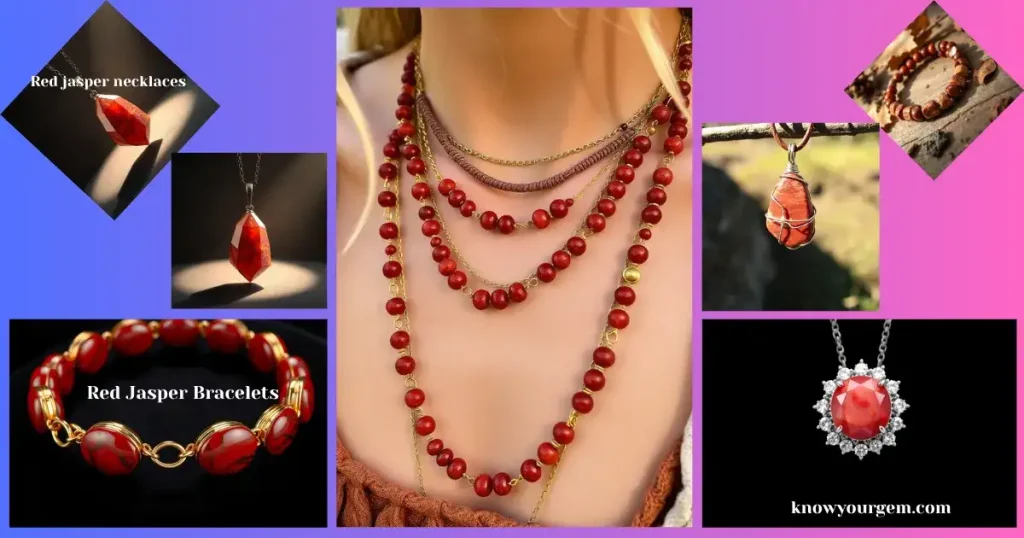
A red jasper necklace generally features a single polished pendant which often looks iron jasper heart pendant, teardrop, or freeform cabochon or a strand of red jasper beads.
Since the deep red color is paired effectively with silver and gold settings, as well as natural materials like leather and wood cord. Reddish jasper bead necklaces are among the most accessible forms of the stone, with having single strand designs widely available at the low price points.
Red jasper bracelet:
Iron jasper bracelets are extremely famous in both fashion and metaphysical markets. The most common form an elastic stretch bracelet comprising smooth 6mm to 10mm reddish beads hematite and red jasper, or green aventurine and reddish jasper bracelet designs.
A tiger eye iron jasper bracelet is another popular combination. Since, these bracelets are worn for aesthetic appeal as well as their perceived grounding and energizing properties.
Red Jasper Ring:
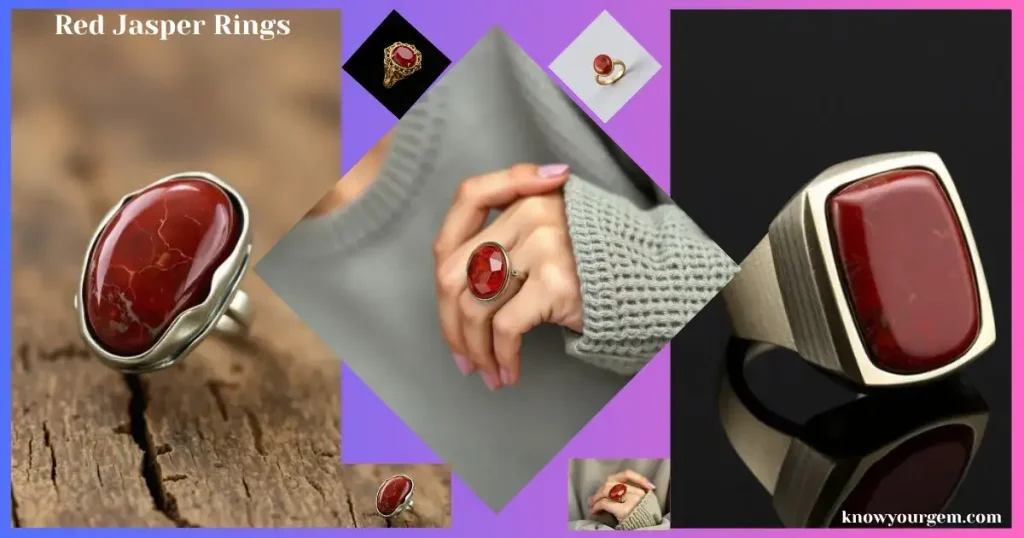
Reddish jasper rings most generally feature oval or round cabochons set in sterling silver. The stone’s deep color creates a bold statement piece.
Whether it isn’t typically used in engagement rings due to its moderate hardness relative to diamond, reddish jasper appears in artisan-crafted rings, including a iron jasper engagement ring by independent jewelers who are seeking for unconventional, nature inspired designs.
Red jasper earrings:
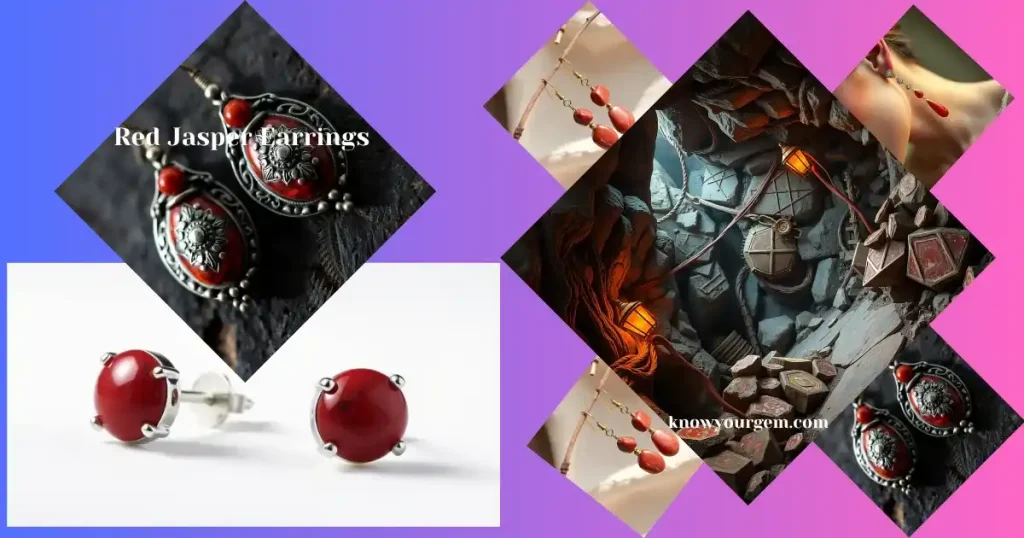
Red jasper earrings range from simple stud designs that feature small polished cabochons to the larger drop and dangle styles incorporating carved or faceted reddish jasper.
Faceted iron jasper are less common than cabochons that have given the stone’s opacity which appear in contemporary designer jewelry for its light catching geometric facets.
Red jasper heart pendant:
Carved red chalcedony hearts are among the most famous forms of the stone in the retail market.
It is sold as standalone collectibles and pendant settings, reddish jasper heart stone are typically 30-50mm in size, hand curved, and highly polished. They appear prominently in gift and wellness markets.
B. Decorative objects and collectibles:
Reddish jasper serves as a famous material for jewelry and decorative art. Its warm color and easy to shape texture make it ideal for establishing home and art pieces. Craftsmen frequently shape this stone into bookends, vases, bowls, polished spheres, and heart shaped stones for decor.
C. Lapidary and craft uses:
Reddish jasper is a beginner friendly lapidary stone because of it hardness like 6.5-7, predictable fracture behavior, and wide availability. Since reddish jasper cabochons are standard project for new lapidary students.
The stone cuts and polishes well using standard silicon carbide and diamond lapping equipment. Inron jasper beads are produced in significant quantities for jewelry making and bead craft industries.
D. Metaphysical and crystal healing uses:
Red colored jasper owns essential place in contemporary crystal healing and metaphysical practices. It is must to note that its usage reflects cultural and personal belief systems rather than scientifically validated medical claims.
Red Jasper root chakra connection:
In order to chakra healing, red colored jasper is associated with the root chakra, that plays the role of grounding energy and stability. Several users use it during meditation to get feel like balanced.
Red jasper properties in crystal healing:
Iron jasper properties are attributed to it in metaphysical traditions including:
- Grounding and stabilizing energy
- Enhancing physical endurance and stamina
- Supporting emotional balance during stress
- Stimulating motivation and determination
- Fertility associations (red jasper fertility) in some traditions
In crystal healing circles, red colored jasper is recognized for emotional balance, physical vitality, and spiritual grounding, can’t be compared with medical treatments.
Iron jasper spiritual meaning:
The red jasper spiritual meaning across traditions centers on themes of courage, endurance, and earthly connection. Since, the stone is sometimes called stone of endurance or the warrior’s stone in metaphysical traditions, that reflect its historical associations with military strength and physical vitality.
In contemporary spiritual practice, iron jasper is treasured for its stabilizing influence on scattered or anxious energy, that makes it a popular choice for daily wear or meditation use.
Red chalcedony and compatible stone combinations:
Crystal practitioners have paired it with other stones to create complementary effects and enhance entire energy.
- Iron jasper and hematite: Both stones are grounding energy of wearer
- Iron jasper and hematite together: It is a common protective combination
- Red chalcedony and carnelian: They are combined for motivation and vitality
- Sard stone and amethyst together: They are combined for balancing and grounding energy
- Amethyst and Iron jasper: It is a popular combination for meditation
- Iron jasper and turquoise together: This combination contrast red and blue-green stone for balance
- Red jasper agate: Sometime they are found as co-occuring minerals
- Red jasper and black tourmaline: Red color jasper and black tourmaline can be well paired they both can be helpful to balanced your emotion and ground your energy.
Zodiac and astrological associations:
Reddish jasper holds multiple astrological associations in crystal traditions:
- Red jasper Aries: the energy of courage and action of the stone can align with bold, pioneering Aries archetype
- Red jasper for Scorpio:
- Scorpio’s intensity and themes of transformation resonate with thoroughly with grounding, protective depth of red jasper.
- Red jasper for Leo: Jasper’s energizing association amplifies the vitality and strength
- Red jasper for Capricorn: A grounded, practical nature of Capricorn is aligned with jasper’s stabilizing properties
Red Jasper birthstone:
Red colored jasper is not actually considered as traditional modern or ancient birthstones for any month. Since, it appears in some alternative birthstone lists for March alongside bloodstone. It is more commonly used as a general purpose grounding stone rather than a birth month crystal.
Red jasper affirmations:
People often use this stone affirmations that focus on safety, strength, and stability. Common examples include phrases like “ I am safe, I am strong, I am grounded,” which means to promote balance and inner strength.
Red jasper element:
In elemental crystal systems, red colored jasper is linked with the earth element, that reflects its deep soil-red color. Its geological origin in iron-rich sedimentary and volcanic rock, and its traditional role as a grounding and stabilizing stone make it an ideal choice for each and everyone.
VI. Value, pricing, and investment potential:
Red colored jasper can not be as like rival rubies at the auction, however its warm, earthy beauty makes it quietly valuable favorite among collectors and crystal lovers. It offers striking appeal at accessible prices, that make it most approachable gemstone on the market.
Is red jasper valuable?
Red jasper isn’t just seen as uncommon or precious gem in the traditional sense because it still carries real commercial and collectible appeal.
Generally this gemstone is not pricier because it is widely available on gemstones market as compared to ruby, sapphire, or other top qualitative gemstones.
Factors affecting red Jasper value:
Following are the key quality factors that determine red colored jasper:
- Color: Deep, uniform brick-red commands highest prices; mottled or washed out specimens are less valuable.
- Clarity (of Pattern): Clean, even color or visually striking patterns can increase a value of gemstone.
- Polish: High mirror polish includes value; natural/ unpolished red colored jasper is usually less expensive.
- Size: Larger specimens of uniform color are proportionally more valuable.
- Origin: Some origins like Arizona’s red color jasper, Australian specimens) command modest premium prices.Form: Finished jewelry adds significant value over raw material
Is red jasper rare?
Red colored jasper is not actually rare or uncommon. It is one the most geological abundant gemstones ever found on the earth. The stone occurs across several continents in large quantities. This abundance is preeminently reason for its low price point.
How rare is red jasper?
It among commercially traded gemstones, it is widely available on retail market. So it is best to say that is common gemstone not rare.
Since its rarity doesn’t apply to the standard commercial grade material, however it owns exceptionally fine specimens with unusually rich color or distinctive patterns can be considered rare in the collector market.
Red Jasper price range table:
| Form | Size/Weight | Price Range (USD) | Notes |
| Raw/Rough Stone | Around 100 to 500g of carat weight can command | Prices $1 to $8 | While having natural surface, unpolished red colored jasper can command cost like that |
| Tumbled Stone | Approx 20 to 50g of carat weight can command | Prices from $1 to $5 each | Red colored jasper tumblestone, smooth finish can command price like that |
| Cabochon | Around 10 to 30mm of carat weight can command | Prices from $2 to $15 | It is most common in jewelry with red colored jasper |
| Beads (strand) | Around 6 to 10mm of carat weight can command | Price from $5 to $20/strand | Red jasper beads for bracelets |
| Carved Pendant | Around 30 50mm can command | Price from $8 to $30 | Red jasper heart, red jasper necklace |
| Bracelet | Single strand can command | Price from $5 to $25 | Red jasper bracelet, finished jewelry |
| Sphere/Egg | Around 80mm | Price from $10 to $40 | Decorative collectible grade |
| Large Slab | Around 200 ro 500g | Price from $20 to $80 | Display/decor piece |
Investment perspective:
From an investment standpoint, red colored jasper is not high return gem like diamond or ruby, but its abundance and low cost create a stable, low risk market with steady, modest appreciation more time.
- Its demand is consistent in the global jewelry and crystal markets
- This stone owns growing interest in natural gemstones and crystal healing internationally
- It owns stable pricing without the volatility and is also seen in rarer colored stones
- Low entry cost for collectors and hobbyists
For those buyers who are interest in jasper stone cost relative to other gemstones, red colored gemstone embodies an excellent value for money, high aesthetic quality at very accessible prices. It is better seen as a long term stable craft and collectible material than a speculative financial asset.
VII. Buying Guide: How to buy red jasper:
Red colored jasper is hugely available, but choosing the right piece means knowing what to look for and where to buy.
How to identify real red jasper:
Understanding how to spot whether red colored jasper is realistic or fake is more essential for buyers. The most common substitutes and imitations include dyed agate, dyed howlite, and synthetic red glass.
Visual identification:
To spot a realistic red colored jasper:
- You must need to check for opacity, since genuine red colored jasper is fully opaque with no transparency
- Always look for natural color variation, since pure single color samples without any tonal variation are sometimes dyed.
- You must need to examine the surface for pattern, because flow lines, mineral inclusions, and subtle color shifts are signs of authenticity.
- You have to inspect the red colored jasper under bright light, because realistic red colored jasper has depth; glass or dyed stones often appear flat or too vivid.
Physical tests:
For those buyers who learn how to identify jasper more rigorously:
- Hardness: Gently try to scratch it with a steel knife realistic red colored jasper won’t scratch, whether glass or softer imitations will.
- Temperature and weight: Natural red colored jasper feels cool and solid in the hand; plastic fakes warm up quickly and often feel unusually light.
- Luster: Under a loupe, genuine polished red color jasper has smooth, waxy to glassy shine, whether dyed agates can showcase trapped dye in tiny cracks.
Quality indicators for buyers:
When you are evaluating quality in polished red color jasper:
- Color: Rich, even brick-red is the highest quality for standard material; vivid color throughout without pale patches
- Surface finish: High mirror polish free from scratches, pits, or grinding marks
- Cut: Well proportioned cabochons with having a smooth dome and flat, polished base
- Pattern: Either clean single color or visually distinctive banding/breciation
Where to buy red jasper:
Red colored jasper is available through a wide range of retail channels:
- Specialist gem and crystal retailers: Best qualitative assurance and variety; staff can verify authenticity
- Lapidary and mineral shows: They are excellent for evaluating specimens firsthand and speaking directly suppliers can be more reasonable
- Online marketplaces (Etsy, eBay, Amazon): Wid selection and competitive price it holds; so, buy it from established sellers with strong review histories
- Wholesale gem suppliers: Best value for buyers who purchase it in bulk amount for jewelry making or retail
- Local crystal and wellness shops: Convenient for individual pieces; quality varies
Red flags to avoid:
Watch for these warning signs whenever you buy red colored jasper:
- Unnaturally vivid or perfectly uniform color across larger quantities of supposedly natural stone
- Prices far below market rate on supposedly high quality polished pieces
- Sellers unable or unwilling to identify the stone’s ethical origin or provide basic information
- Stones are described as red colored jasper translucent, genuine red jasper is opaque
- Imperial blue jasper or fancy jasper are sold as red colored jasper, these are distinct jasper varieties
Caring for red jasper jewelry:
If you want to maintain a natural sparkle of your jewelry you must need to follow the given below maintenance key takeaways:
How to cleanse red jasper in a practical, physical sense?
You should use lukewarm water for cleaning and for dry use soft cloth because hard things can diminish its sparkle.
Can red jasper get wet?
Yes briefly, but don’t use ultrasonic cleaners, steam cleaning, and prolonged water immersion, because they can gradually dull the polish and reduce the natural sparkle a gem.
How to charge jasper metaphysically?
In crystal healing traditions, red colored jasper is charged by placing it on soil or natural earth, since, leaving it in sunlight for few hours, or surrounding it with selenite. These practices are personal and cultural rather than mineralogically necessary.
VIII. Expert insights and scientific notes:
This section blends hard gemology with the honest science, so you can appreciate red colored jasper both as a natural stone and as a cultural symbol.
Gemological observations:
Gemologists classify re colored jasper as a type II gemstone,which means that it naturally contains inclusions like color banding, iron oxide concentrations, and occasional micro fractures, these are normal features of its formation, not defects.
Industry insights:
Within the gem and mineral trade, red colored jasper is treated as a volume stone: it moves it large quantities at low to mid range prices, majorly to jewelry, bead, and crystal retailers. Since, the global market for it has grown steadily materials become more popular in fashion jewelry and as interest in crystal healing expands, with Brazil and India remain the main wholesale sources.
Scientific context of crystal healing claims:
Science and medicine don’t recognize as red colored jasper provides proven treatment , and there’s no solid clinical evidence that can be worn or carried means improving physical or mental health.
GIA is the most trusted and one of the best lab which provides certificate for all authentic gemstones you can learn how to get iron jasper certificate before buying it.
Key takeaways:
- Red jasper is a gemstone belongs to quartz family.
- Its rich red coloration is made by iron oxide (hematite) inclusions within its silica structure.
- While having 6.5-7 mohs scale it is durable enough for daily wear jewelry.
- Its major ethical sources are including Brazil, Australia, USA and Madagascar.
- The stone is affordable, it is hugely available in jewelry market and it is commonly used in jewelry, carvings, and decorative pieces.
- Jasper owns a strong cultural and symbolic significance in old Egypt, Rome, and various indigenous traditions.
- Its connection with root chakra makes it especially popular in metaphysical and crystal healing practices.
Quick questions and answer:
1. Is red jasper rare?
No, red colored jasper in most common gemstone on the earth, it is found in various countries. Its abundance is tends to stay it very affordable.
2. Can red jasper go in water?
Yes, reddish jasper believes to get briefly wet, it is hard enough to handle short rinses or soaks. You must need to avoid long soaking or harsh cleaning methods, that can dull its polish.
3. How to tell if red Jasper is real?
Realistic red colored jasper is opaque, cool to the tough, and can resist scratches with a steel knife. Imitations often look to uniform, too light or slightly see through.
4. What is red jasper worth?
Red colored jasper commands prices from $1 to $30, but hinges on size, finish , and quality. Since, larger or uncommonly patterned specimens now make place in collector’s mind.
5. Where to buy Red Jasper?
You can find it at gem shops, crystal stores , lapidary showcases, and online marketplaces like Etsy, eBay, or Amazon. Since, purchasing it from reputable sellers with having clear sourcing and good reviews is your safest bet.
6. What chakra is Red Jasper associated with?
In order to crystal healing red colored jasper is deeply related to the root chakra and it is often used to support feelings for safety, stability, and being grounded.
7. What is Red Jasper good for in jewelry?
Reddish jasper is good for great everyday wear jewelry due to having its durability and attractive red color.
8. What is the difference between red jasper and brecciated jasper?
A consistent red colored jasper looks like smooth and fair even color, in contrast breciated jasper showcases framenst reshaped by nature and then cemented back together.
9. What is the red jasper element?
In metaphysical systems, red jasper is connected to the Earth element. Its rich, soil, like color and grounding reputation fit perfectly with that association.
10. What is red jasper used for?
Jasper red stone is generally used in jewelry like necklace, bracelet, ring, and earring as well as also used in decorative carvings, cabochons, and collectibles. It is also popular in crystal practices, where it is valued for having ability to grounding energy.
11. Is red jasper a real gemstone?
Yes, red jasper is a genuine, naturally formed within the surface of earth. It is an opaque variety of chalcedony, and microcrystalline form of quartz and has recognized and used in gemology and jewelry for thousands of years ago.
12. Where is red jasper found?
Jasper red stone is basically found worldwide. Its major sources including, Brazil, India, Australia, and the USA (including Arizona jasper), Madagascar, South Africa, and Russia.
13. Is red jasper valuable?
Natural jasper red stone is usually affordable rather than rare or expensive. Most pieces command few dollars to around $30 that totally hinges on quality, finish, and form. Since, high quality polished pieces with having rich, uniform color command higher prices.
14. Can red jasper go in water?
Yes, red jasper can be placed in water for short period due to having 6.5 to 7 mohs scale which allows it to be placed the stone for short period of time rather than long period.
This content is written by gemstone enthusiast KamilHussain!

Welcome to KnowYourGem.com! your ultimate destination for uncovering the fascinating world of gems and their secrets! I'm Kamil Hussain, a passionate blogger with a Master’s degree in Economics, dedicated to bringing you insightful, well researched content that blends the beauty of gemstones with the art of storytelling. With a keen analytical mind and a love for discovering hidden treasures, I created this platform to help you explore the brilliance, history, and value of every gem.

