
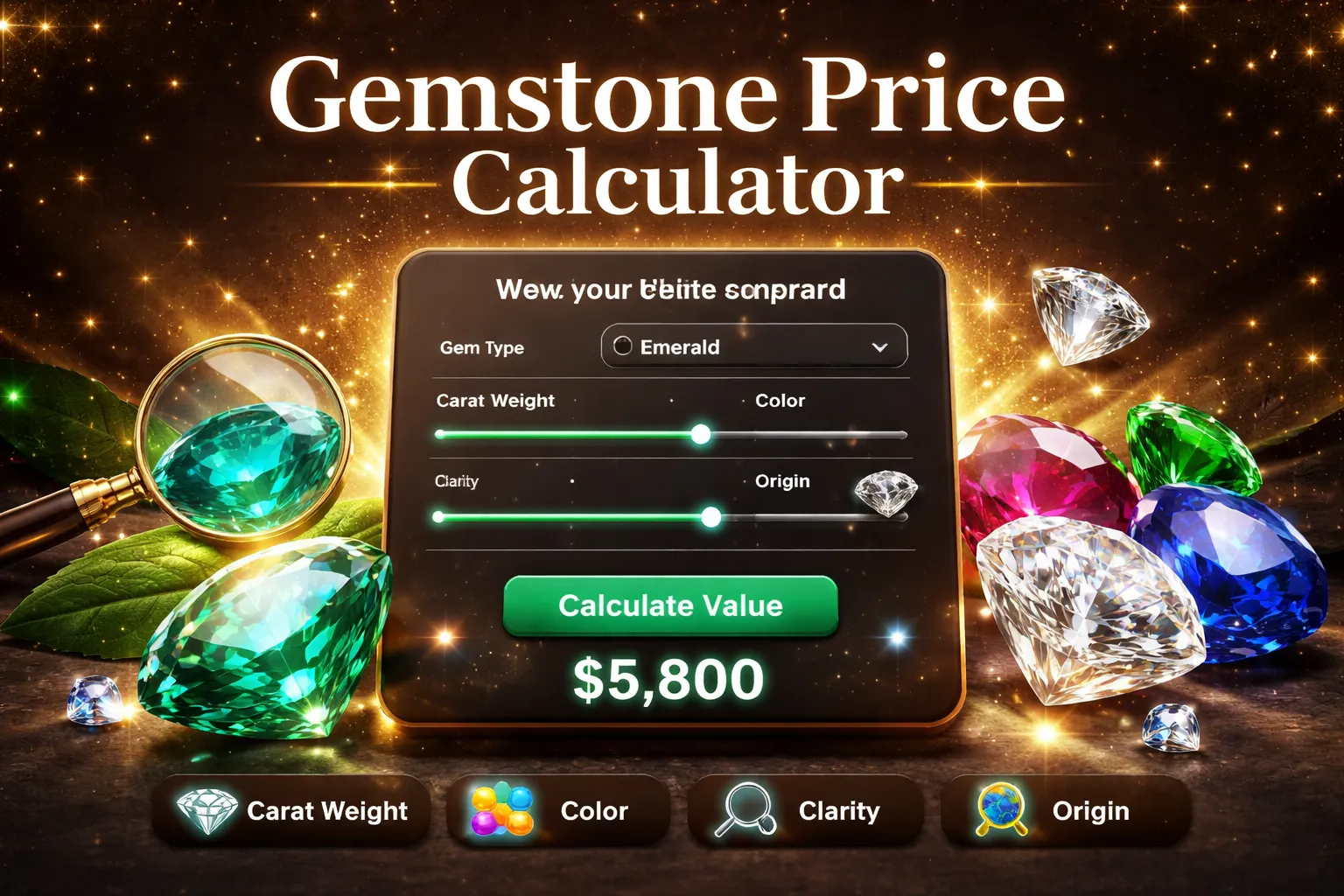
Gemstone Price Calculator – Calculate Ruby Sapphire, Emerald & Diamond Value Instantly
This automated Gemstone price calculator brings realistic current market prices of gemstones. Now you can calculate what the worth of your gemstone is; while using real market pricing factors like color quality, carat weight, clarity, geographic origin, and treatment status.
How does gemstones price calculator calculate?
The gemstone price calculator tool produces each gemstone price estimate while following a transparent, market-derived formula. Not like a black box, just the same logic as professional dealers apply at auction.
In this gemstone price calculator, variables are believed to contribute a multiplier that either inflates or deflates the ultimate gemstone cost.
A vivid, untreated, Burmese ruby can be worth ten times higher than a per-carat standard, heat-treated stone of identical weight, the formula grabs exactly which things are different and gemstones price calculator displays authentic results on the bases of such factor.
| Factor | What It Measures | Multiplier Range | Example |
|---|---|---|---|
| Base Price per Carat | Starting market value by gem type | Fixed by type | $2,000 (Ruby), $6,000 (Diamond) |
| Carat Weight | Physical mass of the stone | 1× – 2.8× | 1 ct = 1×, 5 ct = 2×+ |
| Color Grade | Saturation, hue, and tone | 0.8× – 1.8× | Vivid red = 1.8×, pale = 0.8× |
| Clarity Grade | Inclusions and transparency | 0.7× – 1.4× | Eye-clean = 1.15×, flawless = 1.4× |
| Geographic Origin | Mine or country of origin | 1.0× – 1.7× | Burma, Kashmir, Colombia = 1.7× |
| Treatment Status | Heat, filling, or no treatment | 0.6× – 1.3× | No treatment = 1.3×, fracture filled = 0.6× |
Key Price Factors at a Glance
- In gemstone price calculator, Color drives the biggest emotional premium prices: vivid, saturated colors in ruby and sapphire, which can push their per-carat values to record auction prices.
- In this gemstone price calculator Carat weight holds non linear size premium: Since, a 5 carat ruby is worthy than five 1 carat ruby of equal quality.
- In this gemstone price calculator, carat weight holds a non-linear size premium: Since, a 5-carat ruby is costlier than a 1-carat ruby of equal quality.
- According to the gemstone price calculator, Clarity matters vary across various gem types: emerald is graded more leniently than diamond due to having natural inclusions ("jardin") that are expected.
- The gemstone price calculator guide says Treatment disclosure is legitimately and ethically mandatory in most fundamental markets. Undisclosed treatments void value claims.
Compare Gemstone Prices by Type
Since gemstones price calculator brings different results for each gem and this gemstone price comparison chart introduces a reliable benchmark for natural gemstone values across the most traded gem categories. These are market-derived ranges; they don't belong to actual retail markups.
Ruby
Sapphire
Emerald
Diamond
Market Price Range by Gemstone
| Gemstone | Base Price | Color Range | Clarity Multiplier | Avg Market Price/Carat | Top Origin |
|---|---|---|---|---|---|
| Ruby | $2,000 | Good – Premium | 0.7 – 1.4× | $2,500 – $18,000 | Burma, Mozambique |
| Sapphire | $1,500 | Good – Vivid | 0.7 – 1.4× | $1,800 – $15,000 | Kashmir, Ceylon, Burma |
| Emerald | $2,500 | Standard – Premium | 0.7 – 1.4× | $3,000 – $20,000 | Colombia, Zambia |
| Diamond | $6,000 | Standard – Premium | 0.7 – 1.4× | $6,500 – $50,000 | South Africa, Botswana |
| Alexandrite | $8,000 | Good – Exceptional | 0.8 – 1.5× | $15,000 – $70,000 | Russia (Ural), Sri Lanka |
| Tanzanite | $900 | Standard – Vivid | 0.7 – 1.3× | $1,200 – $8,000 | Tanzania (Merelani) |
| Yellow Quartz | $12 | Pale – Vivid | 0.8 – 1.2× | $10 – $60 | Brazil, Madagascar |
How to use the Gemstone Price Calculator
A free tool like the gemstone price calculator is basically designed for collectors, buyers, sellers, and investors. They should consider the following seven steps for an accurate price estimate in under 60 seconds.
Select Gemstone Type
The gemstone price calculator lets you select gemstone types like Ruby, Sapphire, Emerald, Diamond, Alexandrite, Tanzanite, or Yellow Quartz. Each and every gem type has a distinct base price per carat, which is derived current wholesale markets.
Choose Color Quality
The gemstone price calculator also lets you pick up your color grade, like standard, good, vivid, or premium/exceptional. Since color saturation, hue purity, and tone depth each influence this multiplier significantly.
Select Clarity Grade
In the existing gemstone price calculator, clarity grade indicates whether the gem is heavily included, eye-clean, or loupe clean. For colored stones, eye-clean is often the practical threshold for investment quality.
Select Geographic Origin
The gemstone price calculator provides you with options like standard, premium, or exceptional ethical origin, such as Burmese, which produces ruby, Kashmir, which is known for supplying sapphire; and Colombia, which provides emerald. All of these ethically originated gemstones earn the highest premium up to 1.7x the base value.
Select Treatment Status
The gemstone price calculator provides you with options like standard, premium, or exceptional ethical origin, such as Burmese, which produces ruby, Kashmir, which is known for supplying sapphire; and Colombia, which provides emerald. All of these ethically originated gemstones earn the highest premium up to 1.7x the base value.
Enter Carat Weight
The gemstone price calculator provides a blank box to input the exact gemstone weight in carats. Since larger stones look more attractive. Since a 5-carat stone is not simply five times the value of 1-carat equivalent.
Click Calculate
Press Press the calculator button. The gem estimator instantly outputs an estimated market value plus the low-to-high price range, that reflects typical real-world deal spread.
What Affects Gemstone Prices?
While recognizing all these six pricing pillars can transform you from a casual buyer into an informed investor. Each and every factor independently shifts gemstone value, and together all six can determine whether a stone is worth hundreds of thousands of dollars per carat.
Color: Saturation, Hue & Tone
Color is the dominant value for nearly all colored gemstones. Since gemologists evaluate three dimensions: hue (the primary color), saturation (intensity), and tone (lightness to darkness). The ideal ruby is believed to showcase a "Pigeon blood" red, vivid, slightly purplish red with having strong saturation and medium dark tone. A sapphire achieves the peak value at "royal blue," a deeply saturated, pure blue without grey overtones.
Even small shifts in saturation can move per carat values by 20-40%. Since premium and exceptional color grades command multipliers of 1.4x to 1.8x, whether pale or brownish stones trade below base price.
Clarity: Inclusions & Transparency
Clarity standards are significantly different between gem types. For example, diamonds follow a strict GIA clarity scale from flawless (FL) to included (I3). While, colored stones, particularly emeralds, are evaluated more leniently because natural inclusions, called "jardin," is inherent to their crystal structure.
For ruby and sapphire, eye-clean quality marks the investment-grade threshold. Stones with having heavy inclusions that can affect transparency receive a 0.7x discount, whereas flawless loupe-clean specimens earn 1.4 premium.
Carat weight & Size Premium
In the gemstones price calculator, carat weight measures the mass; one carat equals 0.2 grams; however, its impact on price is emphatically non-linear. Since fine gemstones more than 3 carats are exceptionally rarer than the smaller stones of the same quality, and the market rewards that rarity aggressively.
A 5-carat untreated Burmese ruby must be traded at 2-3x the per-carat price of 1-carat stone with having an identical grade. That's why the gem carat weight calculator applies a size premium multiplier that scales with the weight, not just a flat rate. Must use the gemstone size conversion chart to cross-reference millimeters with carat equivalents for a common gem cut.
Geographic Origin & Mine Premium
Where a gemstone forms an inseparable from its value narrative. Certain mines are believed to produce stones with having signatures like, infinitesimal element profiles, fluorescence patterns, and inclusion characteristics that are consistently superior in a color and transparency. Such provenance premiums are well documented at the major auction houses.
Premium origins and their typical multipliers:
- Burma (Myanmar) Ruby: 1.5× – 2.0× over standard origin
- Kashmir Sapphire: 1.6× – 2.5× (due to extreme rarity)
- Colombian Emerald (Muzo): 1.4× – 1.8×
- Russia (Ural) Alexandrite: 1.5× – 2.0×
- Ceylon (Sri Lanka) Sapphire: 1.2× – 1.4×
Ethical Origin must be always verified by reputable labs like, GIA, Gübelin, SSEF, or AGL not by seller attestation alone.
Treatment Methods & Disclosure
Gemstone treatment status is the most commercial significant and most frequently misrepresented value factor in the trade. While recognizing treatment methods are essential in a gemstone price calculator to calculate accurate results:
- No treatment (untreated): Highest premium 1.3× multiplier. A lab certificate confirming "no evidence of heat treatment" dramatically increases value and liquidity.
- Heat treatment (mild): Industry-standard for sapphires and some rubies. Widely accepted. Applies a 0.85× – 1.0× adjustment.
- Glass or resin fills fractures to improve apparent clarity. Heavily discounted — 0.6× — and must be disclosed
- Beryllium diffusion: Alters surface color. Controversial and must be lab-detected and disclosed.
Market Trends & Historical Auction Data
Gemstone prices are not static. Over the past two decades, fine colored stones have achieved higher values, which have been driven by growing wealth in Asia a diminishing mining supply, and increased investor recognition of tangible assets ever found. Ruby has outperformed nearly all colored stone categories at the major auction houses.
Price trend worth is tracked in 2026: Alexandrite values are usually seen to climb as Ural mine production that remains dormant. Tanzanite supply from Merelani, which is a finite resource, is estimated to last another decade. Since yellow quartz per carat remains accessible and widely available, that makes it a popular choice for commercial jewelry but not a serious investment.
Gemstones as an Investment in 2026
Fine gemstones have delivered compelling long-term capital appreciation for investors who recognize that gold and silver both are different metals. Top quality silver colored stones are not commodities but they are unique objects with provenance, rarity, and irreplaceable natural character.
Burmese Ruby
Usually untreated Burmese ruby has achieved some of the highest prices ever recorded at the auction. Supply from the Mogok Valley remains constrained. Therefore, verified origin and treatment status from GIA or Gübelin is mandatory for serious investment.
Kashmir & Ceylon Sapphire
Sapphire from Kashmir has been commercially mined for decades with almost no new supply means this sapphire is truly rare. Ceylon sapphire from Sri Lanka offers better availability with the reliable quality and strong secondary market liquidity, that makes it an accessible entry point.
Colombian Emerald
Emeralds from Colombia, particularly from the Muzo and Chivor mines, can lead the world market in color saturation. While treatment-free specimens with having strong saturation and minimal inclusions are usually seen with price consistency and appreciation which has driven by collector demand in the Middle East and Asia.
Fancy Color Diamond
Colorless diamonds own pricing pressure from lab grown alternatives. However, fancy colored diamonds with having vivid pink, red, blue, and green color remain strictly natural in investment value terms and have shown a strong performance at Sotheby's and Christie's.
Alexandrite
Alexandrite is famous for its color-changing factor from green in daylight to red in incandescent light which is among the rarest gemstones in the world. Since Russian Ural origin stones usually command exceptional prices. However, fine specimens more than 2 carats are genuinely scarce at auction.
Liquidity vs Gold & Silver
Gemstones are less liquid than bullion but offer superior portability, no counterparty risk, and potential emotional value. Not the same as cryptocurrencies, they carry no technology obsolescence risk. Investment-grade gems should embody a diversification component, not a core position.
Gemstone Price Calculator FAQs
Gemstone Price Data Tables & Downloadable Resources
The natural gemstone value chart consolidates price per carat range across color, clarity, and origin which gives you a complete gemstone guide for buying, selling, and appraisal reference 2026. EarlyHunt is a platform where you can list your product but I listed this masterpiece their because that platform has many searches for free tool like gemstone price calculator that can help them know what is actual price of the gem that they bought.
Ruby Price Guide by Quality Tier
| Quality Tier | Color | Clarity | Origin | Treatment | Est. Price/Carat |
|---|---|---|---|---|---|
| Commercial | Standard | Included | Standard | Heat Treated | $400 – $1,200 |
| Fine | Good | Eye-Clean | Mozambique | Heat Treated | $2,500 – $6,000 |
| Premium | Vivid | Eye-Clean | Burma | Heat Treated | $8,000 – $14,000 |
| Investment | Pigeon Blood | Loupe-Clean | Burma (Mogok) | No Treatment | $18,000 – $100,000+ |
Sapphire Price Calculator Reference Table
| Quality Tier | Color | Clarity | Origin | Treatment | Est. Price/Carat |
|---|---|---|---|---|---|
| Commercial | Standard Blue | Included | Thailand / Africa | Heat Treated | $300 – $900 |
| Fine | Good Blue | Eye-Clean | Ceylon / Burma | Heat Treated | $2,000 – $6,000 |
| Premium | Royal Blue | Eye-Clean | Ceylon Unheated | No Treatment | $7,000 – $15,000 |
| Investment | Royal / Cornflower | Loupe-Clean | Kashmir | No Treatment | $30,000 – $150,000+ |
Emerald Price Calculator Reference Table
| Quality Tier | Color | Clarity | Origin | Treatment | Est. Price/Carat |
|---|---|---|---|---|---|
| Commercial | Light Green | Heavily Included | Brazil / India | Fracture Filled | $150 – $800 |
| Fine | Medium Green | Moderately Included | Zambia | Minor Oil | $2,500 – $7,000 |
| Premium | Vivid Green | Slightly Included | Colombia | Minor Oil | $9,000 – $20,000 |
| Investment | Vivid / Intense Green | Eye-Clean | Muzo, Colombia | No Treatment | $20,000 – $80,000+ |
Free Gemstone Price Guide 2026
This comprehensive reference covers price per carat ranges for ruby, sapphire, emerald, diamond, alexandrite, and tanzanite that are based on color grade, clarity, origin, and treatment. Including a gemstone price comparison chart for quick reference at auctions and dealer visits.
⬇ Download Price Guide PDFUse our free gemstone price calculator — no signup required. Explore our expert guides below for deeper research.
⚡ Calculate Now