
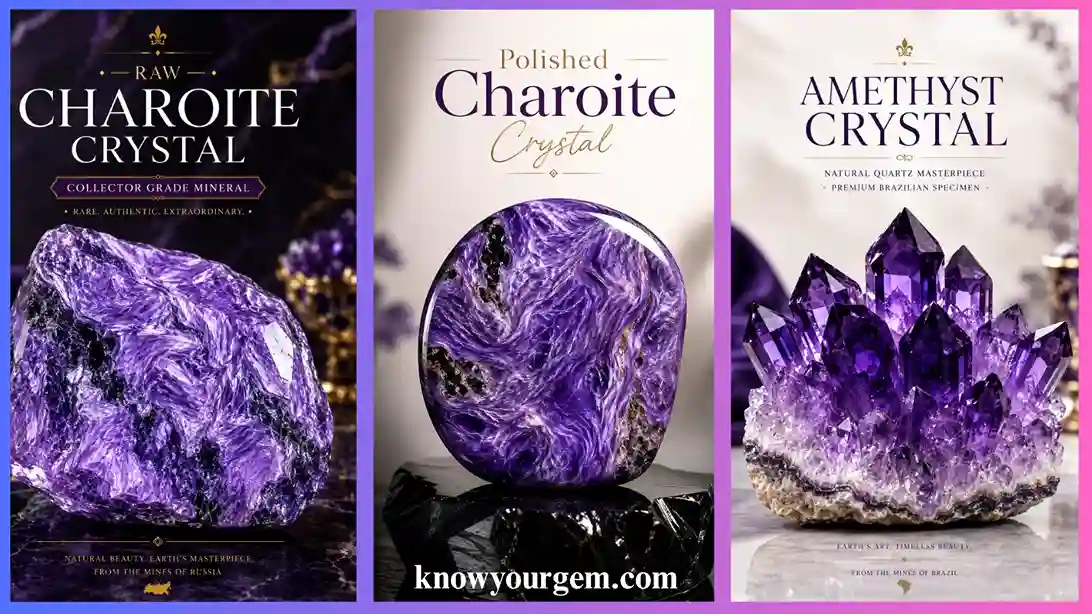

Charoite is a rare purple colored silicate mineral mining exclusively in Siberia, Russia. It is valued for its swirling violet patterns, spiritual associations with transformation and healing, and status as a collector’s gemstone. While having 5-6 mohs scale, this gemstone is suitable enough for jewelry when it is set protectively. Its price range starts from $5 to $150+ per carat totally hinges on quality.
Charoite doesn’t belong to the same mineral family which produces Amethyst:

What is charoite?
Chroite is a fascinating potassium-sodium-calcium silicate mineral, with having a chemical formula like K(Ca,Na)₂Si₄O₁₀(OH,F)·H₂O.
It belongs to the phyllosilicate family and forms through metasomatism, where steamy, material is packed fluids from a hot alkaline intrusion, they transform nearby limestone into something extraordinary.
This process creates charoite’s signature interlocking fibers that swirl and flow and flow with chatoyancy, that gives it a hypnotic, one of a kind that look no other stone can match. Geologyin+2
Its crystal system is monoclinic, but it rarely showcases distinct crystals instead, of it grows in massive, fibrous masses. When it is polished, those interwoven bundles disclose a silky, almost liquid like movement across the surface, like purple rivers that are captured in stone.
While having 5-6 mohs scale Lilac Stone is softer than quartz but tough enough for cabochons, beads or jewelry in protective settings. Its specific gravity sits in between 2.54 and 2.78, that makes it a lightweight yet substantial choice for collectors. Gemtselect +1
Charoite stone meaning:
Lilac Stone gets its name from Chara River which is existing in Russia’s remote Sakha Republic, right near where it was first discovered. Although, the stone was officially named and described as a new mineral species in 1978, it is one of the youngest additions to the gemstone world, pretty recent in geological terms!
Charoite: The stone of transformation
Lilac stone is a purple rock and it is often seen as a companion for personal growth. People who usually use this stone, believe that it helps them to release fear, welcome change, and align your everyday drive with a bigger purpose. Its swirling violet patterns feel like almost a reminder that life is always shifting between the recognized and the mysterious.
Spiritual connection:
The stone is spiritually linked with the third eye crown chakras, which makes it popular for:
- Clearing away mental fog
- Boosting intuition
- Deepening spiritual insight
Energy & feel:
Its violet glow is similar to amethyst, however many people describe charoite’s energy as more lively energizing like a wake up call for the soul rather than gentle nudge.
Think of Lilac Stone as a stone that encourages you to trust your internal wisdom and step confidently into new chapters of your like. It is like holding a little reminder that transformation doesn’t has to be scary, it can be empowering.
Healing Properties:
Following as the key properties that describe the stone in depth:
Emotional healing:
Charoite is majorly used in crystal healing to help reduce stress and increase calmness. People say it can quite enhance think ability, control on emotions, and gives them inner strength when life feels overwhelming.
It is especially cherished during big transitions like coping with the lose, changing careers, ending a relationship, or starting a new chapter because it is seen as a steady, supportive presence which helps you to feel frozen of the unrecognized.
Although, its vibes with higher chakras acts as a grounding ally to anchor a realistic transformation so it sticks, not just sparkle fleeting inspiration. Practitioners reach for it especially when people feel frozen of the unrecognized.
Spiritual and metaphysical properties:
Charoite’s metaphysical properties center on accelerates spiritual growth. The stone is deeply linked with meditation states, enhanced dream recall, and the development of psychic sensitivity.
For third eye activation work, many practitioners layer charoite with amethyst or pair seraphinite a green chlorite mineral to balance spiritual opening with the heart centered awareness.
Its energy is described as rapid and sometimes intense, that’s why some traditions recommend gradual introduction rather than prolonged daily wear at the heart.
Sleep support:
Before sleeping keep this stone somewhere near to your bed and see the magic. If you place it near your bed or under your pillow it will help you to reduce nightmares, will make calm an overactive mind, and encourage deeper, more restful sleep, especially if you are anxiety patient.
Chakra alignment:
Lilac Stone is naturally connected with the third eye (crown chakras). Because of the connection of this stone with crown chakras, your awareness can be enhanced, it can clear blockages, and can also bring spiritual clarity.
Zodiac Compatibility:
In Zodiac compatibility this stone is connected with Scorpio and Sagittarius;
- Scorpio: It resonates with the charoite’s themes of transformation and emotional depth.
- Sagittarius: It benefits from its support in spiritual exploration and the sear for higher truth.
Charoite vs Amethyst:
At first glance, Charoite and amethyst can look same because both are purple stones tied to the spiritual practices. But once you look closer, they will be showcase different shapes.
Amethyst is a variety of quartz which found all over the world, from Brazil to India. Although, it is hard and durable, with have a clear, glassy look. Its purple color comes from tiny amounts of iron which is mixed with natural radiation because it is so common, even highly qualitative amethyst is generally affordable.
Whether, Charoite is a rare stone only comes from Siberia, Russia. Instead of being clear, charoite has a silky, pearly sheen with swirling fibrous patterns that make it instantly recognizable. Its purple color come from the way its mineral structure forms, nor from impurities. According to the rarity of charoite, it is expensive than amethyst.
Charoite vs Sugilite:
Sugilite is the closest visual competitor to Charoite Both are uncommon purple gemstones with having metaphysical significance, and both are popular among collectors. The differences matter for buyers.
Sugilite is a cyclosilicate mineral which is primarily sourced from South Africa’s Wessels Mine. Its purple tones tend toward magenta, violet, and deep grape often richer and more uniform than Charoitite’s swirling patterns. Sugillite is typically slightly harder owns 5.5-6.5 mohs scale and often opaque.
Charoite typically displays more complex patterning swirls, fibrous streaks, and inclusions of black aegirine, white feldspar, and occasionally orange tinaksite. This visual complexity is one of its distinguishing signatures. Sugilite tends toward cleaner color distribution.
Price wise, fine sugilite often exceeds fine charoite, particularly the deep vivid purple grades. Both are considered genuinely rare gemstones with having limited global supply.
Price & value guide:
The price per cart of Lilac stone is totally hinges on several quality factors like saturation, pattern, complexity, surface polish, translucency, and the presence or absence of discarding inclusions
Entry level this is lighter purple, visible cracks, or heavy black inclusions, sells for $50 to $20 per carat. Since, mid grade material with having clear swirling patterns and good saturation ranges from $20 to $60 per carat.
Top grade charoite with having deep violet color, high transparency, fine silky sheen, and intricate patterning can exceed $100 to $150 per carat, occasionally more for exceptional collector pieces.
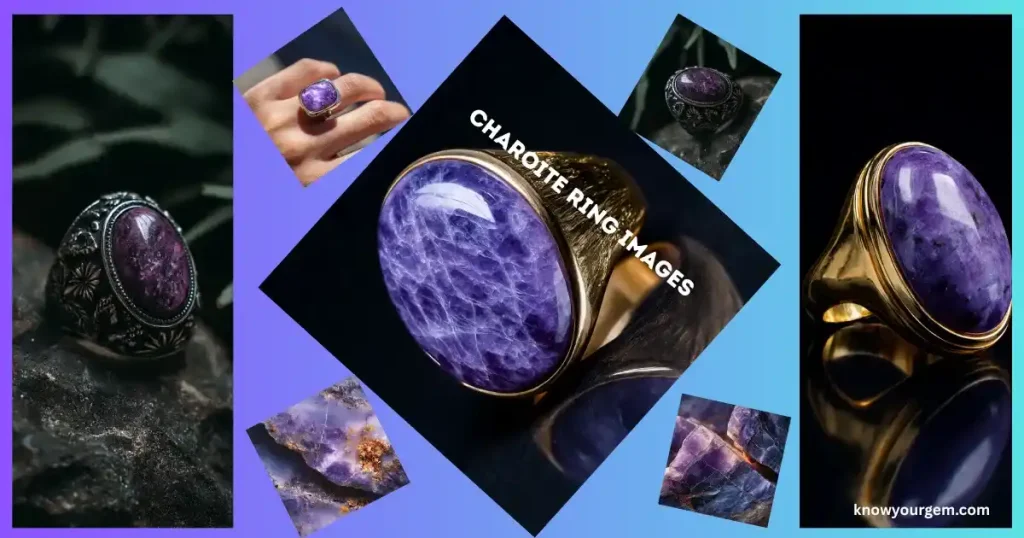
Its jewelry pieces like, rings, earrings, bracelets, and pendants, vary considerably in retail price hinging on the quality of the stone and the setting. A charoite ring in sterling silver with a quality cabochon typically sells between $50 and $300. Since, fine charoite set in gold, particularly a charoite engagement ring, can reach $500 to $2,000 or more.
Market value trends for Charoitite have remained stable to modestly appreciating. As the only recognized deposit is geologically limited, long term supply constraints support sustained or rising prices for quality material.
Charoite is not considered dangerous in any meaningful sense. It contains no toxic elements concentrations hazardous to normal wear or wear handling.
You are right the pricing section was written prose paragraphs, that make it harder to scan and compare at a glance. Given below is a proper pricing table for charoite:
Charoite Price & value guide:
| Grade | Color & Pattern | Inclusions | Price Per Carat | Typical Use |
| Entry | Light lavender, faint swirl | Heavy black inclusions, visible cracks | Command prices like $5 to $20 | Tumbled stones, raw specimens |
| Mid | Medium violet, clear swirling pattern | Moderate aegirine, minor flaws | $20 to$60 | Beads, cabochons, silver jewelry |
| High | Deep violet, complex fibrous pattern | Minimal, well-distributed | $60 – $100 | Quality jewelry, pendants, rings |
| Collector | Collector’s color like rich violet, exceptional transparency, silky sheen | Is a very minor or enhancing | Can command $100 – $150plus | Fine jewelry, collector pieces |
Jewelry retail price ranges:
| Jewelry Type | Setting | Estimated Retail Price |
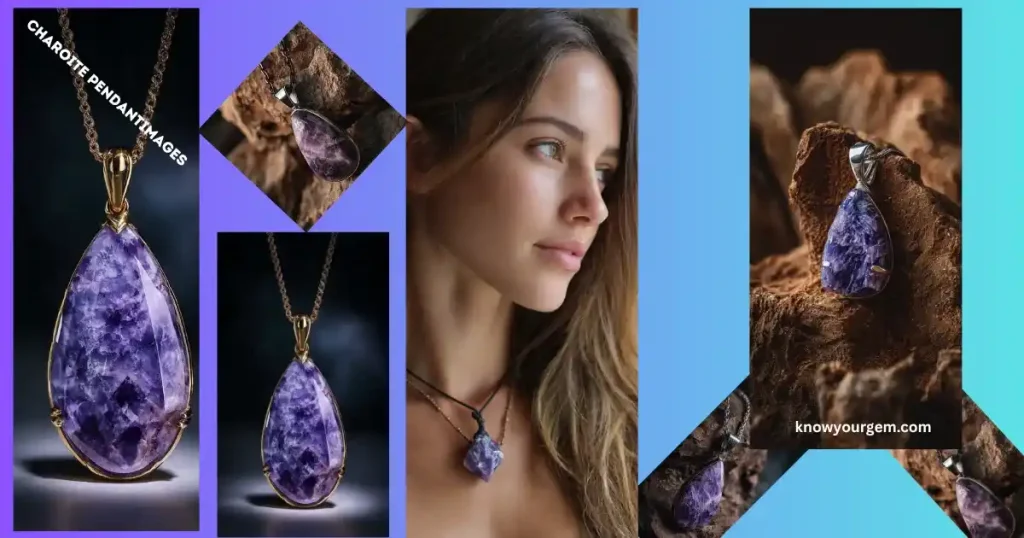
| Charoite pendant | Charoite pendant like sterling silver setting r | Commands $30 to $150 |
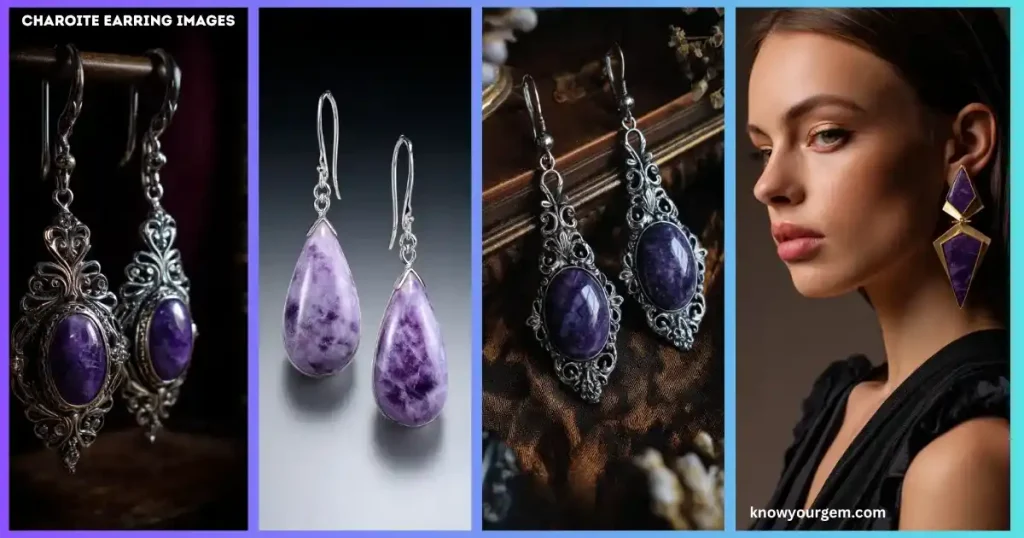
| Charoite earrings | Charoite earrings like sterling silver setting | Can command$40 to $180 |
| Charoite bracelet | Charoite bracelet sterling silver/ beaded setting | Commands $50 to $250 |
| Charoite ring | Sterling silver | $50 to $300 |
| Charoite ring | Gold | $300 to $1,000plus |
| Charoite engagement ring | Gold with protective setting | $500 to $2,000plus |
How to identify real Charoite:
Real Lilac stone has set of a visual and physical properties which distinguish it from imitations.
- Pattern: Geniune Charoitite gemstone exhibits complex swirling fibrous patterns in shades of violet, lavender, and purple. Hence, these patterns are produced by the interlocking crystal structure and appear three dimensional under light.
- Inclusions: Natural Charoitite usually contains inclusions of black agrine like, white, gray feldspar, and occasionally orange thinaksite. A piece with a perfect, unblemished purple and no mineral inclusions deserves scrutiny.
- Luster: Real charoiote has a silky, pearlescent luster not glassy. If the surface has a high glassy shine without the silky depth, it can be dyed synthetic material or glass.
- Temperature: It is like most natural stones, charoite feels cool to the touch initially and warms gradually. Glass or plastic imitations warm quickly.
- Hardness test: At 5-6 Mohs scale, charoite scratches with a steel knife blade with moderate effort. Glass sits at around 5.5 Mohs, so this test alone is not conclusive look for it in combination with pattern and luster.
- Weight: Lilac stone has a specific gravity of 2.54-2.78. It feels noticeably heavier than plastic and similar to glass.
Jewelry Guide:
Given below is the complete jewelry guide can explore it:
How to wear Charoite Jewelry:
A purple stone is well suited to pendants , earrings, bracelets, and cabochon rings, particularly in protective settings that limit direct impact. Because its Mohs scale is 5-6 means that the stone is more vulnerable to scratching than quartz-based stones and shouldn’t be worn alongside harder gemstones without physical separation.
Purple stone earrings and pendants are safest jewelry, they hardly ever bang into the hard surfaces. While Bracelets need extra TLC, especially if you are wearing them all day on the move. For rings you should go with bezel settings or anything protective to shield the stone from knocks.
Purple shines with a silver metals; since, sterling silver, white gold, or platinum all play nice with its violet hues without stealing the show. It also loves oxidized or rustic finishes that highlight its wild, ,earthy vibe.
Charoite as an engagement ring stone:
Its engagement rings are meaningful choice for jewelry enthusiasts who are seeking for something rare and symbolic, but buyers should understand the durability trade off. At 5-6 mohs, Charoitite is softer than the standard recommendation of 7+ for daily wear engagement rings.
A protective setting like, full bezel, halo, or recessed setting significantly extends its lifespan. For someone who works hands on daily, a Lilac stone engagement ring is better reserved for occasional wear
Purple gemstone Jewelry context:
In the world of purple gemstone jewelry, Charoitite stands out uniquely. It is rarer than amethyst, the way it is more affordable than alexandrite or top tanzanite , and has a look all its own makes it a wonderful choice for modern jewelry. For people who are looking for something beyond everyday purple stones, charoite realistic at a reasonable price.
Care & cleaning:
To maintain stone natural glow as existing a gentle cleaning is usually demanded check the given below cleaning techniques:
Can Charoite get wet?
Quick washes with water during cleaning is fine for this stone but put it water for long term is not recommendable because water can seep into its fibers and make it weak over time. So, it is recommend to always wear-off charoite jewelry before swimming, bathing, or washing dishes.
Cleaning instructions:
Must clean this stone with lukewarm water, and soft cloth to rough dry on it. Dry immediately and thoroughly. Avoid ultrasonic cleaners, steam cleaning, and harsh chemical cleaners, because all these chemicals can damage the surface or cause structural stress along the fibrous crystal boundaries.
Store charoite separately from harder gemstone to resist surface scratching. A fabric lined box or individual pouch will work well.
How to cleanse Charoite spiritually:
In crystal healing traditions, this purple stones is cleaned energetically rather than physically using several methods: While placing it on selenite charging plate, surrounding it with dry brow overnight, or setting it under moonlight during a full moon.
Don’t put your stone in-front of sunlight or avoid expose it to UV radiations because they can gradually fade stone’s color saturation over years of regular exposure.
Origin & Rarity:
Source is certified Siberian charoite from reputable dealers that offer GIA or IGI reports to ensure authenticity amid fakes from treated materials.
Charoite mining location:
Charoite hails from only a single spot on the Earth; the Murun massif in Russia’s Saka Republic, near the Chara River in Siberia. No other commercially visible deposits have turned up anyelse where which makes it rarest gemstone with having a single ethical origin like Larimar from the Dominican Republic.
The Siberian deposit geology involves an unusual alkaline intrusion that contacts Cambrian age limestone, creating the specific metasomatic conditions that are required for charoite formation.
The Siberian deposit geology involves an unusual alkaline intrusion contacting Cambrian-age Since, the geological window that has produced charoite is neither widespread nor easily replicated, that’s why no secondary deposit has emerged despite decades of geological exploration.
Why Charoite is rare:
Charoite’s rarity stems from three compounding factors; its single geological location, the precise and unusual conditions are required for its formation, and the finite nature of the existing deposit.
Mining operations are regulated by Russian authorities, and export quantities are controlled, which limits global availability further.
Charoite from Australia, the United States, or other regions are not currently a commercial reality. Any material is labeled as like warrants verification, so, for those people who are looking to global availability, the honest answer is all the genuine charoites originate from a single location in Siberia.
Is it worth buying?
Charoite is worth buying for buyers who value genuine rarity, with having visual distinction, and symbolic meaning over conventional gemstone prestige. It is one of relatively few minerals that can be called both scientifically unique and visually extraordinary, a combination that justifies serious collector and jewelry interest.
For metaphysical buyers, charoite offers a specific energetic profile centered on transformation, spiritual growth, and emotional resilience that various people find difficult to replicate with other stones.
For jewelry buyers, charoite provides purple gemstone beauty at price points well below tanzanite or fine amethyst alternative, with the added dimension of single source rarity.
The primary consideration is durability. Buyers who understand its care requirement and select appropriate setting will find charoite a deeply satisfying long term purchase. Buyers who want a low maintenance everyday stone without restrictions should consider harder alternatives.
GIA is a the most the most trusted source where you can get more authentic results about all gemstones.
Frequently Asked Questions:
1. What is charoite used for?
Charoite well suits jewelry like ring, earring, pendant and bracelet. Although, people use it for crystal healing like, transformation, stress relief, spiritual growth and collect it as a mineral specimen
2. Is charoite expensive?
It commands prices from $5-$150 plus per carat only based on quality. As compared to pricier rarities like tanzanite or alexandrite, charoite is solid, accessible choice for serious buyers.
3. Where does charoite come from?
Entirely this gemstone comes from only single spot: the Murun massif near the Chara River in Siberia’s Sakha Republic, Russia. No other commercial deposits exist worldwide for this stone.
4. Is charoite the same as amethyst?
No, both are totally different gems. Although Amethyst is a variety of quartz; whether charoite is a unique potassium-sodium-calcium silicate. Both stones own different hardness, origin, structure, look, and formation.
5. Can charoite go in water?
Short wash for cleaning are okay, but avoid long soaking because water can seep into its fibers and weaken it. Dry it right away.
6. Is charoite dangerous?
Not at all, no toxic elements in levels that matter for handling or wearing.
7. How do I know if my charoite is real?
Check for swirling purple fibers, like silky pearlescent sheen, black aegirine flecks, and cool to touch feel. Watch out for flat color, glassy luster, or warm plastic vibe that screams fake.
8. What chakra is charoite associated with?
Its is majorly linked to third eye (crown chakras), and great for meditation on intuition, clarity, and higher awareness.
9. Can charoite be used daily?
Yes if you give it a gentle care. Steer clear of bangs, scratches, avoid putting it on water for long term, chemicals protective settings make it last.
10. What stones pair well with charoite?
It can be well paired with amethyst to feel protective, pair with seraphinite for heart balance, or black tourmaline/Obsidian for grounding positive energies.
This comprehensive guide is written and published by gemstone enthusiast KamilHussain!

Welcome to KnowYourGem.com! your ultimate destination for uncovering the fascinating world of gems and their secrets! I'm Kamil Hussain, a passionate blogger with a Master’s degree in Economics, dedicated to bringing you insightful, well researched content that blends the beauty of gemstones with the art of storytelling. With a keen analytical mind and a love for discovering hidden treasures, I created this platform to help you explore the brilliance, history, and value of every gem.

