
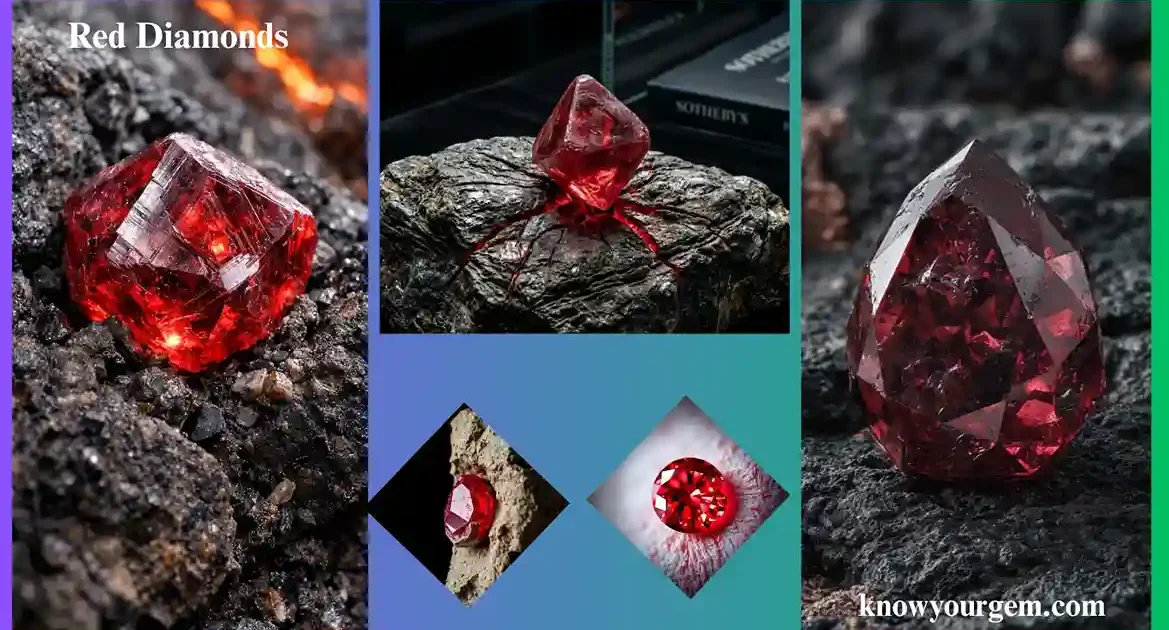

Natural red diamonds are usually considered as the rarest, most expensive gemstones produced by earth. They command prices which frequently exceed like $1,000,000 to $4,500,000 per carat. Not same as white white diamonds or other fancy colored diamonds that derive color from chemical impurities, red diamonds obtain their color from internal crystal structural distortion caused by immense geological pressure.
Get information and pricing guide about white diamonds, their meaning, symbols, chakra connection, benefits, buying guide and investment just in one click.
Introduction:
From collectors choices to their rarity all are guided below:
Why red diamonds Fascinate collectors?
Among all natural colored diamonds, this fancy red colored diamond carries almost mythical status among diamond collectors and alternative asset investor. Its deep, striking color evokes a sense of raw geological power and profound luxury that other stone don’t replicate.
A big difference between red diamond and white diamond is that white diamonds dominate mass consumer jewelry markets, whether red diamonds occupy an elite tier of the luxury gemstones sector, and appearing almost exclusively at high profile diamond exclusively at high profile diamond auctions or inside private.
How rare they really are?
To appreciate diamond rarity, you must look at the macro numbers of global mining. Out of every million carats of rough diamonds have pulled from the Earth, only a fraction of a percent are classified as rare colored diamonds. Within that tiny margin, red is the absolute statistical ghost.
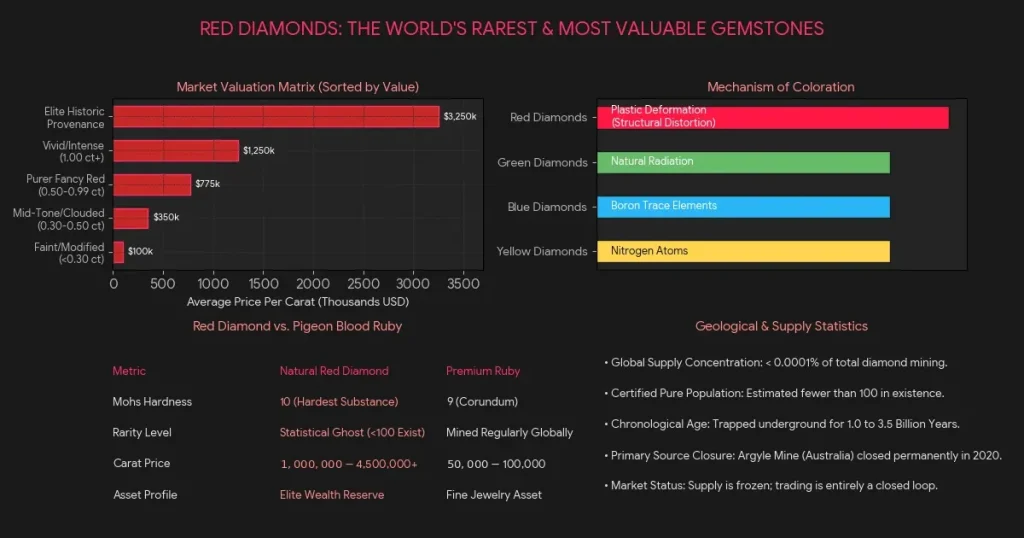
Gemologists estimate that fewer than 100 naturally occurring, purer red diamonds with GIA certification exist in the entire world. They embody the rarest structural anomaly in gemology.
Current market value:
The intersection of near to zero supply and intense collector competition can make red diamonds the undisputed king of gemstone investment returns. Whether a high grade colorless diamond command few thousand dollars per carat, the current market valuation for a certified natural colored diamond of a deep hue sits firmly between $1,000,000 and $4,500,000 plus per carat. They are pound for pound, among the most concentrated forms of wealth on the planet.
What is a red Diamond?
Red diamonds are natural carbon crystal that displays a primary red color when they are viewed under standardized grading light. Although the Gemological Institute of America (GIA) classifies these stones under the official umbrella of fancy color diamonds, and strictly assign the singular grade of “Fancy Red” when the diamond is entirely free of secondary modifying colors.
Difference from white diamonds:
Traditional white diamonds are graded on a scale from D (which is noted completely colorless) to Z (light yellow or brown). Their value hinges on absolute absence of color. In-contrast red diamonds completely invert this grading philosophy. Both belong to particular, specialized classification system where the presence, depth, and purity of the red color drive the valuation, completely overshadowing traditional white diamond metrics like clarity.
Difference from other fancy colored diamonds:
Other prominent fancy colored diamonds, yellow diamonds, or green diamonds owe their vibrant colors to foreign chemical elements trapped inside the crystal structure during formation. Whether, Red diamonds don’t fit this profile. They contain no chemical impurities. As well as they share a closer structural relationship with deep pink diamonds, and sit at the absolute pinnacle of color saturation for that specific geological family.
Why are red diamonds so rare?
The conditions needed to generate a red diamond are textbook definition of geological perfect storm. Its needs a flawless balance of carbon purity, exact directional tectonic forces, and rapid transport to the surface of the Earth where modified crystal lattice can relax or correct itself. This precise confluence of events have helped so infrequently during the earth’s formation that red diamonds are considered an evolutionary fluke.
Extremely limited discoveries:
For anyone who follows the gem world, find a pure red diamond that still feels like a headline that makes miracle. Since, big mining companies can run giant open pits for years, sometimes decades without ever turning up one.
When red diamonds finally show up, they usually minuscule thing often under 0.20 carats. So, if one ever reaches a full carat or more, they are far more than rare; they feel like a moment frozen in time, the sort of discovery collectors and miners talk about for years.
Global supply statistics:
The total number of red diamonds ever found is almost unbelievably tiny. Records showcase that at the height of production from the world’s main colored diamond mine, red stones made up less than 0.0001% of everything that pulled from the earth.
In years the world saw only one or two gem quality red colors and sometime none so the supply has essentially been frozen by time and chance.

What causes red diamonds?
The crimson hue of red diamond is a masterclass in structural lattice. In red diamonds, this perfect geometric alignment is permanently altered. Since, the color that we perceive is not a reflection of material content, however a visual byproduct of a deformed molecular structure.
Plastic deformation explained:
During diamond’s long journey within the Earth’s mantle, it undergoes a process that is recognized as plastic deformation. Intense, localized tectonic shear stress forces rows of carbon atoms to slightly slip out of alignment along parallel structural planes.
Thus, this permanent deformation distorts the stone’s internal architecture without breaking the atomic bonds. When light passes through this distorted lattice, the structural anomalies absorb specific wavelengths of light, especially green and transmit a brilliant red wavelengths to the eye.
Why no trace elements create the color?
To fully grasp what makes these stones unique, it helps to compare them to their colored peers:
- Blue Diamonds: Their color is produced by infinitesimal trace amounts of boron that replace carbon.
- Yellow Diamonds: Their color is created by nitrogen atoms trapping light.
- Green Diamonds: Their color is made by natural underground alpha radiation exposure.
- Red Diamonds: They contain zero trace element impurities; the color is entirely structural.
How are red diamonds formed?
Their natural formation process, pressure and conditions everything is guided below in depth:
Geological formation process:
Red diamonds are naturally formed deep within the earth’s upper mantle, roughly counted as 90 to 150 miles below the surface. Carbon deposits were subjected to a violent environment where shifting cratons (noted as the ancient, stable cores of continents) have provided the precise horizontal compression needed to induce the necessary lattice slipping.
Pressure and temperature conditions:
Red diamonds form under the extreme conditions. They need very high temperatures (about 1,050-1,3°C) and enormous pressures that is roughly counted as 45,000-60,000 atmospheres. If conditions aren’t just right, the carbon becomes graphite or doesn’t undergo the needed to produce the red color.
Millions of years underground:
Red diamonds remained trapped in the Earth’s deep mantle for anywhere from 1 billion to 3.5 billion years. They were eventually propelled to the surface through explosive, supersonic volcanic eruptions of kimberlite or lampproite magmas. Therefore this rapid ascent cooled the stones quickly, locking the distorted crystal into place permanently.
Where are red diamonds found?
The global home of red diamonds is extremely limited, because they come from just few specific places across three continents.
- Australia: It is historically considered as a primary epicenter for the finest, most intensely saturated specimens.
- Brazil: It is a legacy source considered for producing occasional alluvial red diamonds from riverbeds, that often posses distinct purplish or brownish secondary modifiers.
- Africa: Poradic discoveries have emerged from deep primary mines in South Africa, Tanzania, and the democratic republic of Congo, since these finds remain highly unpredictable.
Red diamonds Australia: The Argyle mine story
Such mining center is located in the east Kimberley region of western Australia, the Rio Tinto-owned Argyle Diamond mine completely revolutionized the world’s understanding of natural colored diamonds.
I was opened in 1983, this single lampriote pipe became the world’s benchmark producer of high intensity pink, violet and legendary Argyle red diamond specimens.
Closure in 2020:
After 37 years of consistent production, the Argyle mine has eventually stopped in November 2020 when its economically viable deposits were exhausted. After all this iconic site abruptly extinguished more than 90% of the world’s primary supply saturated pink and red diamonds, fundamentally reshaped the global luxury market overnight.
Impact on prices:
The closure has triggered an immediate supply shock. Since 2020, the valuation of Argyle certified stones have climbed aggressively. Because there is no active primary mine capable of replacing Argyle’s distinct geologic output, secondary trading, estate sales, and prestigious tender auctions dominate the market, and pushed prices past historic thresholds.

Are red diamonds natural?
Most red diamonds are naturally formed gemstones; however, synthetic red diamonds with having similar appearance are also sold in the market. Collectors should verify stones through GIA certification for authenticity. Given below is a complete guide you must not miss.
Natural vs. treated diamonds:
Because of the extreme value, the market sees various treated gemstones that are designed to mimic authentic reds. Untreated, completely natural red diamonds are exactly as the came from the ground, with having zero alternation beyond cutting and polishing.
Conversely, treated stones are low value white or brown diamonds as subjected to artificial laboratory processes such as high pressure high temperature (HPHT) annealing, multi energy electron irradiation, or artificial surface coatings to force a red appearance.
Certification requirements:
For safe navigation in this market, a definitive independent laboratory report is required. Buyers should insist on non-compromised diamond certification from the Gemological Institute of America (GIA).
A valid GIA report will especially state the stone’s origin as “Natural” and its color origin as “Undetected” or “Natural,” provides absolute verification against dangerous treatment or enhancements.
About synthetic red diamonds:
Below guide is all about synthetic diamond how they are created and what things are use to grow them:
Lab grown alternatives:
Labs can now make synthetic red diamonds while using two methods: such as chemical vapor deposition (CVD) and high-pressure, high temperature (HPHT) techniques. Since, these lab grown stones match realistic red diamonds in chemistry, structure, and appearance. Technicians grow them inside special reactors that build up carbon layers over days or weeks.
How they are different from natural stones:
While a synthetic stone shares the same physical properties that look identical to the untrained eye, its internal microscopic growth patterns, lack of natural inclusions, and uniform fluorescence properties easily give it away under advanced gemological laboratory testing.
Crucially, lab grown stones completely lack the foundational element of geological history, finite supply, and intrinsic rarity that makes natural stones valuable.
Market prices:
The price structure of natural and synthetic red diamonds sit in entirely different universes. A high quality lab grown red diamond can be purchased on the retail market for roughly $5,000 to $50,000 per carat hinging on the producer.
They don’t hold secondary market value and operate purely as fashion jewelry components rather than serious investment assets.
Red Diamond Price Guide:
Red diamonds have flexible prices you can see below:
Red diamond price per carat:
The price per carat for genuine red diamonds are strictly non linear. Because larger stones are exponentially rarer, the value spikes dramatically with every fraction of a carat gained.
The following index outlines showcase the current per carat market valuation bands across different sizes and qualities:
| Diamond Specification & Size | Estimated Price Range Per Carat (USD) | Market Liquidity & Availability |
| Faint/Modified Red (<0.30 carat) | Can command price from $50,000 – $150,000 | Limited availability; accessible entry tier |
| Mid-Tone/Clouded Red (0.30 – 0.50 ct) | Can command price from can command price from $200,000 – $500,000 | Highly sought after by boutique collectors |
| Purer Fancy Red (0.50 – 0.99 ct) | Is sold for $600,000 – $950,000 | Extremely scarce; major auction interest |
| Vivid/Intense Fancy Red (1.00 ct+) | Commands prices like $1,000,000- $1,500,000+ | Near-zero availability; requires private broker |
| Elite Historic / Iconic Provenance | Commands prices from $2,000,000 – $4,500,000+ | Available only via global auction house tenders |
Factors affecting value:
Several distinct variables govern where a stone falls within this million dollar price spectrum:
- Color saturation (which is considered as a primary factor): Stones that display pure, vivid red can command absolute top tier premium prices.
- Secondary modifying hues: The presence of secondary colors alter value. Since, purple or pink modifiers can create beautiful hues (such as purplish red) that remain highly valued, whereas brown or orange overtones significantly depress the stone’s ultimate market price.
- Carat weight: Due to an extreme weight scarcity, a 1.05 carat red diamond can easily command triple the per carat price of an otherwise identical 0.51 carat specimen.
- Provenance: Stones carry documented Argyle mine lineage or an iconic historic ownership history routinely capture massive premiums at auction.
Auction records:
The history of international diamond auctions highlight this upward price trajectory. Over the decades, premium red diamonds have shattered records at Christite’s and Sotheby’s. Notably, wonderful specimens have crossed the block at valuations that translates to more than $2,000,000 per carat, cementing their reputation as premier alternative wealth reserves.
Famous Red Diamonds in history:
Following guide showcases the famous history of red diamonds you can see below:
Moussaieff Red Diamond:
Red diamonds were first discovered by an alluvial miner in Brazil in the 1990s as a 13.90 carat rough crystal, the Moussaieff Red is the absolute benchmark of this gemstone family. Cut into a flawless triangular brilliant (trilliant) shape that weighing 5.11 carats, they are officially certified by the GIA as a Fancy Red stone. They stand as the largest internally flawless red diamond recognized to mankind.
Hancock red Diamond:
In 1987’s sale of the Hancock red diamonds are the landmark event that permanently woke the world up to the investment potential of fancy colors.
Weighing a modest like 0.85 carats, this round brilliant-cut, purplish-red stone are sold at Christie’s for a staggering $880,000. This single transaction shattered all existing per carat records at the moment, fundamentally alter the colored diamond investment landscape.
Kazanjian Red Diamond:
Diamonds were discovered in Lichtenburg, South Africa, in 1927 as 25 carat rough, the Kazanjian Red is and 5.05 carat emerald cut masterpiece with having deep, historic ruby like hue. They have confiscated by the Nazis during World War II and later recovered in a salt mine by Allied forces, this legendary stone eventually found its way back into private hands, that remain a testament to the survival and timeless appeal of historic gems.
Difference between Red Diamond vs. Ruby:
A common point that create confusion for high net worth buyers is distinguishing a top grade natural red diamond from a premium pigeon blood ruby. Whether both display a magnificent crimson appearance, they are entirely different mineral species.
Hardness:
Red diamond ranks on the top means 10 on the Mohs scale of hardness, that makes them hardest reputable natural substance on the Earth. Whether ruby is a variety of corundum family, and owns 9 Mohs means exceptionally durable, but ruby is substantially less scratch resistant than diamond, that features an atomic structure roughly four times tougher than corundum.
Rarity:
High quality rubies more than 5 carats are incredibly uncommon, however they are still mined regularly across Myanmar, Mozambique, and Madagascar. Natural red diamonds are on an entirely different level of scarcity; finding a stone more than 1 carat is a generational even, that makes red diamonds thousands of time rare than fine rubes.
Value:
A top tier, unheated Burmese ruby can command an impressive price like $50,000 to $100,000 per carat. However, an authentic natural red diamonds start at roughly $1,000,000 per carat for similar color purity. The entry level price for red diamonds eclipses the absolute ceiling of the ruby market.
Investment Potential:
Rubies offer an excellent long term value retention within the colored gemstone sector. However, red diamonds provide an unparalleled degree of geopolitical portability, asset concentration, and a proven track record of recession-proof capital protection due to their absolute physical supply cap.
Red diamond meaning and symbolism:
Red diamonds are naturally occurring rare gemstones, they are well known for their meaning and symbolism that are as follows:
Relation with Love:
Traditional white diamonds own symboism like eternal commitment. Since, deep red diamonds can showcase love at their most intense and rare the ultimate, ultra exclusive declaration of lifelong devotion.
Relation with passion:
The fiery crimson body color of the stone mirrors the element of fire. Historically, collectors view it as a physical encapsulation of untamed creative energy, internal passion, and relentless drive.
Connection with Wealth:
Holding natural red diamonds is considered as elite status symbol. Because these gemstones are rare that even most multi-millionaires can’t acquire one, these stones serve as subtle, unmistakable marker of generational wealth and ultimate financial refinement.
Boosting power:
Across ancient tales, red diamonds have adorned emperors and warriors as talismans against harm and as symbols of triumph. In the current era that same symbolism lives on red gemstones now signal personal authority and unmistakable corporate or social power.
Red Diamond Rings:
Following detailed red diamond rings design showcase their rarity, their authenticity and their importance in this modern world:
Red Diamond engagement Rings:
While selecting a realistic red diamond for engagement ring can make a unique statement, because red diamonds are so uncommon they are usually set in secure specialized settings that both protect the stone and maximize its sparkle.
Solitaire rings:
A classic solitaire setting hinges on minimalist design principles, while using clean platinum or 18k white gold prongs to suspend the diamond. This enables unimpeded light entry from all angles, that showcase the stone’s unique plastic deformation lines and pure body without visual distraction.
Custom designs:
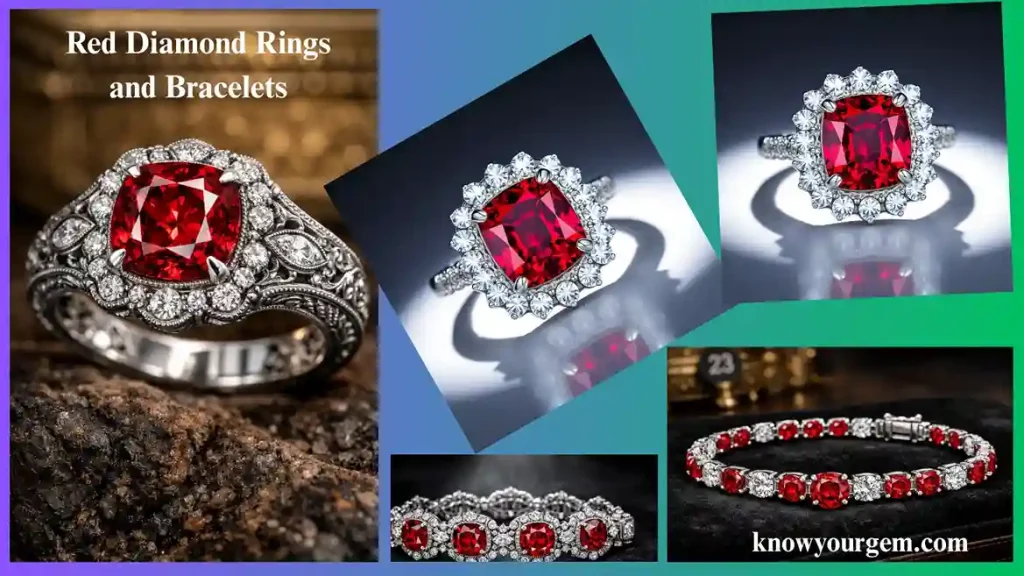
Mostly collectors choose bespoke custom designs. Jewelers frequently surround a central red diamond with having a contrast halo of colorless, VVS clarity ideal cut white diamonds or delicate pin diamonds. The deliberate color contrast dramatically accentuates the deep crimson hue of the center stone that make it appear even more vibrant.
Red Diamond Jewelry guide:
While having extreme value and rarity, red diamonds jewelry items are custom crafted, high jewelry masterpieces that are designed for museum display or high security gala wear:
- Necklaces: They usually feature a singular, certified red diamond and acting as a dramatic focal pendant, surrounded by exceptional colorless marquise or pear shaped diamonds.
- Earrings: Finding as matching pair of natural red diamonds is an incredibly difficult gemological feat that can take a broker years to assemble; consequently, red diamond earrings, command immense premium prices.
- Pendants: A popular choice for collectors who are looking to wear their investment safely, often utilizing a secure three prong or bezel setting to keep the stone flush against the skin.
- Bracelets: Extremely rare statement items, typically constructed as tennis bracelets interspersed with alternating white diamonds and small, fancy modified red diamonds.
Red diamonds as an investment:
Red diamonds can be an investment choice, but for very informed, long term, high budget collectors.
Historical Appreciation:
Over the past three decades, naturally colored diamonds have outpaced nearly all the traditional asset classes, including gold, fine art, and major equity indexes. Red diamonds have shown an incredibly steady upward trajectory, experiencing virtually zero downward price volatility even during major global economic recessions.
Collector demand:
The market is driven by an expanding demographic of ultra high net worth individuals, sovereign wealth funds, and private family offices that competing for a fixing pool of stones. Since this structural supply demand imbalance guarantees deep, highly competitive bids whenever a certified stone becomes available on the secondary market.
Future outlook:
With the primary production pipeline from the Argyle Mine completely gone and no new red bearing geological formations will discovered anywhere on the Earth, the future outlook points to continued price appreciation. They remain a premium option for wealth preservation and alternative portfolio diversification.
Red Diamonds in India:
Below is the complete guide for mining red diamonds in India :
Market demand:
Wealthy buyers in India, especially in Mumbai and New Delhi, are driving strong demand for top tier luxury gemstones. Since, high net worth families are actively shifting part of their wealth from bullion into highly portable assets like investment grade diamonds.
Luxury buyers:
The elite tier of Indian industrial magnates, Bollywood icons, and generational tech founders are driving this niche market. They view these ultra stones as the ultimate heirloom assets, that incorporate them into custom bridal jewelry or holding them loose within private bank vaults.
Availability:
While India’s cutting and polishing capital in Surat that processes more than 75% of the world’s traditional white diamonds, the actual retail availability of physical natural red diamonds within India is exceptionally tight. While sourcing these stones can require private client brokers to tap into international auction Pipelines in Geneva, Hong Kong, or New York.
How to buy a red Diamond:
To buy red diamonds can require an extraordinary level of due diligence. Buyers must abandon traditional retail buying habits and treat the acquisition like a major corporate or fine art transaction.
GIA certification:
Don’t purchase a red diamond without an non-compromised, verifiable grading report must explicitly confirm the stone’s color origin as completely natural and verify that no artificial treatments have occurred. Cross reference the report number directly with the GIA online database.
Color grading:
It examines the exact wording on the report. A stone certified simply as “Fancy Red” is the gold standard of purity. If modifying hues are present, can ensure they are stable colors look like purple (notably “Fancy purplish Red”, and verify that the price has been adjusted downward to reflect the presence of that secondary modifier.
Provenance checks:
Trace the stone’s ownership and mining history. If the stone claims an Argyle origin, demand the original Argyle Diamond Mine certification paperwork and laser inscription verification. A documented history protects the stone’s value and ensures an easier liquidation process when it is selling down the road.
Red diamonds GIA grading explained:
Following GIA certification explanation can help red diamond enthusiasts to buy authentic pieces rather than fakes:
Fancy Red classification:
The GIA believed to use highly sophisticated color grading for colored stones. Whether white diamonds receive grades accordingly their structural clarity, fancy color diamonds are evaluated on three distinct visual dimensions like, (the actual color family), tone (how light or dark the color is), and saturation (the strength or purity of the color.
Not same as like colored diamonds that can receive grades like Fancy Light, Fancy Intense, or Fancy Vivid, a pure red diamond can only receive one single grade: Fancy Red. This is because the narrow window of tone and saturation that defines “red” in demand is already at the absolute limit of the color spectrum.
Intensity grades:
If red diamonds display even slightly shifts in tone or saturation outside of that narrow window, the GIA will immediately apply an intensity modifier alongside a secondary color name:
- Fancy Purplish Red: A highly attractive, vivid variation with having a rich purple undertone.
- Fancy Orangy Red: A warmer variation that showcases a subtle orange flash.
- Fancy Brownish Red: A deeper, darker variation with reduced saturation, that sits at a more accessible investment tier.
Certification examples:
A typical premier investment grade GIA report will feature a full color plot diagram of the stone, an explicit statement of “Natural Color Origin,” and a clarity analysis (that often falls into the VS or SI ranges due to the natural graining lines that are caused by the plastic deformation process.
Are there still red Diamonds in the world?
Yes there is a how demand of natural most rare and stunning red diamonds you can learn below in depth:
Remaining supply:
Yes, red diamonds are still existing, but the physical volume is available for active purchasing is strictly capped, because primary mining has ceased at their main historic source, the global supply is essentially a closed loop. The market hinges almost entirely on the re-circulation of existing stones.
Private collections:
The vast majority of the world’s red diamonds are locked protectively inside highly secure private collections, institutional museum archives, or generational family trusts. Since, these entities rarely sell, while keeping the broader market in a state of permanent, structural under supply.
Future discoveries:
Whether exploratory mining continues across parts of Canada, Africa, and Siberia using advanced satellite and AI mapping, no new lamproite or kimberlite deposit has discovered to date has shown any indication of hosting a reliable concentration of red diamonds. Barring an unprecedented geological discovery, they world’s current inventory is all there will ever be.
FAQ:
1. Is red diamond expensive?
Red diamonds are among the rarest gemstones on the Earth. While having a red vivid color and extreme scarcity they are considered as most expensive as compared to other diamonds.
2. How much are red diamonds worth?
Fine natural red diamonds usually reach prices in the high six to seven figures per carat, with even small stones that are often valued far above typical colorless diamonds.
3. Are red diamonds real?
Yes, red diamonds natural and real diamond gemstones made of carbon, and they are formed deep within the earth, with their red color and this color is caused by rare distortions in the crystal structure rather than added treatments.
4. Why are red diamonds the rarest?
Red diamonds are usually considered as rarest among other diamonds. Since, red diamonds are formed by extraordinary rare distortion elements.
5. What is the average price of a red diamond?
Fine natural red diamonds usually command price like, $1,000,000 to $3,500,000 plus per carat, whether smaller or modified colored stones are sold for $50,000 to $150,000 per carat.
6. Are natural red diamonds real?
Natural red diamonds are realistic carbon crystals formed deep within the Earth. Although their red color comes from unique distortions in the crystal lattice not from treatments or enhancements..
7. Why did the Argyle Mine close, and how does it affect red diamond investments?
The Argyle Mine has closed in November 2020 when its reserves were exhausted, while cutting off the most world’s colored diamond supply and creating lasting scarcity that supports ongoing price growth for existing red diamonds.
8. How can I verify if a red diamond is authentic?
You can verify authenticity while checking an original report from a respected lab like GIA that clearly lists the color origin as “Natural” and showcases no indication of treatments or lab grown origin.
9. Can red diamonds be grown in a lab?
Yes, labs can create synthetic red diamonds while using HPHT or CVD, and whether they resemble natural diamonds chemically, they lack true rarity, hold limited investment value and can be identified with advanced testing.
Conclusion:
Natural red diamonds embody an absolute pinnacle of gemstone rarity and geological history. They are forged under extreme mantle pressures through internal deformation, these ultra exclusive crystals are highly valued assets within the global luxury market.
Buying considerations:
When you enter this high stakes market, working with vetted elite brokers is essential. Prioritize the absolute purity of the hue, insist on an non-compromised GIA certificate that verifies completely natural origin, and focus heavily on securing clean provenance documents to safeguard your capital.
Investment outlook:
With the landmark Argyle Mine permanently closed and global supply strictly capped within the existing private collections, the investment outlook for natural red diamonds that remain exceptionally strong. They continue to serve as a secure, highly portable, and historically resilient vehicle for long term generational wealth preservation.
Always verify red diamonds with reputable source like GIA to spot authentic pieces: Gem Enthusiast KamilHussian!

Welcome to KnowYourGem.com! your ultimate destination for uncovering the fascinating world of gems and their secrets! I'm Kamil Hussain, a passionate blogger with a Master’s degree in Economics, dedicated to bringing you insightful, well researched content that blends the beauty of gemstones with the art of storytelling. With a keen analytical mind and a love for discovering hidden treasures, I created this platform to help you explore the brilliance, history, and value of every gem.


