
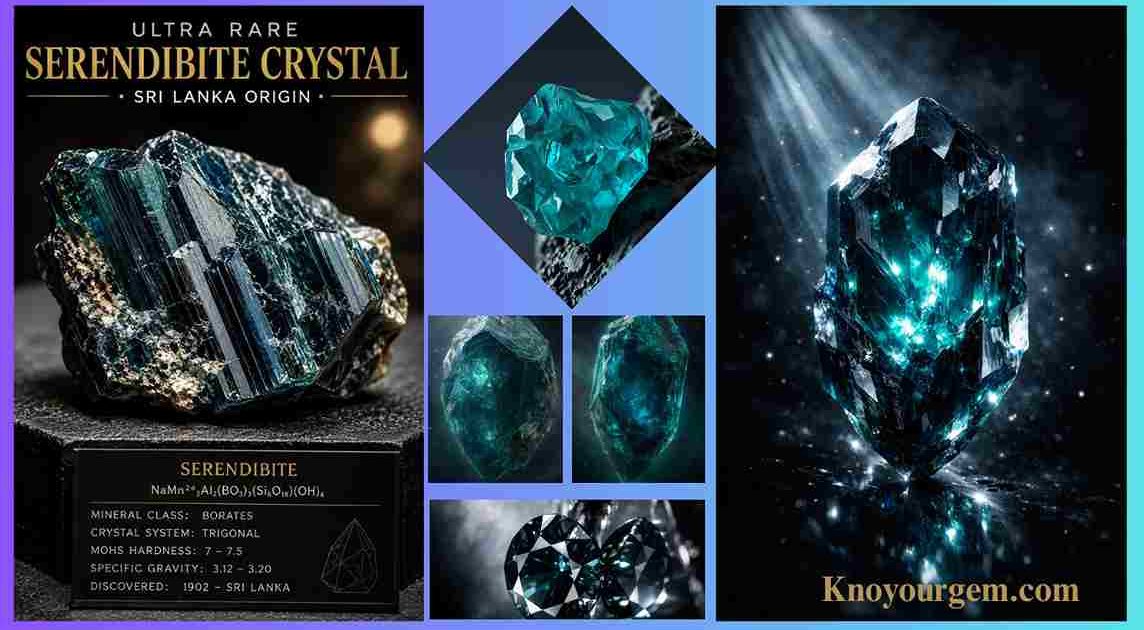

Serendibite is the most rare gemstone on the Earth, made of borosilicate mineral. It was first discovered in Sri Lanka which produces it in colors like deep blue-green to near-black. Gem quality specimens are extraordinary scarce, and collector prices routinely exceed several thousand dollars per carat, that make this stone a genuine prize for advanced collectors and serious gem investors.
Know about the top 10 hardest gemstones how they look in jewelry, their rarity, origin, meaning, symbolism, price and jewelry.
What Is Serendibite?
Serendibite is an ultra rare crystal belongs to borosilicate mineral that forms only under very specific metamorphic conditions. This gemstone is well known for its deep color, glassy shine, and extreme scarcity, with having gem quality pieces being almost impossibly hard to find.
Discovery and History of Serendibite:
Serendibite’s story is as fascinating as the stone itself. Its name came from “Serendib,” the old Arabic word for Sri Lanka, which traces back through persian “Sarandib” to the Sanskrit “Simhaladvipa,” means Island of Lions.”
It was first described as a new silicate mineral from Sri Lanka in the early 20th century. For much of that time, it remained a scientific curiosity, with no known gem quality material available. Only in recent decades, due to improved mining and renewed interest in rare gemstones, have faceted specimens begun to appear in the gemstone market and private collections.
Why Serendibite Is So Rare?
Serendibite’s rarity is found in three intersecting factors that make a gem not same almost any other gemstone in the market.
- Geological rarity: Serendibite forms in too specific environments, where boron rich metamorphic conditions interact with chemical composition like, calcium and aluminum bearing rocks under sustained heat and pressure. Such conditions are largely uncommon, and have only limited supply.
- Limited gem-quality material: Most specimens of Serendibite are found as opaque, which are too small for faceting. Transparent to translucent gem quality material is exceptionally rare, and clean faceted stones more than two carats are considered as outstanding.
- Collector demand: In the high end collector market, ultra rare minerals can command strong premiums and known as scarcity drivers. As awareness of Serendibite has increased among specialist collectors, demand has grown whether supply remains extremely limited, can create strong scarcity pressure.
Serendibite at a Glance:
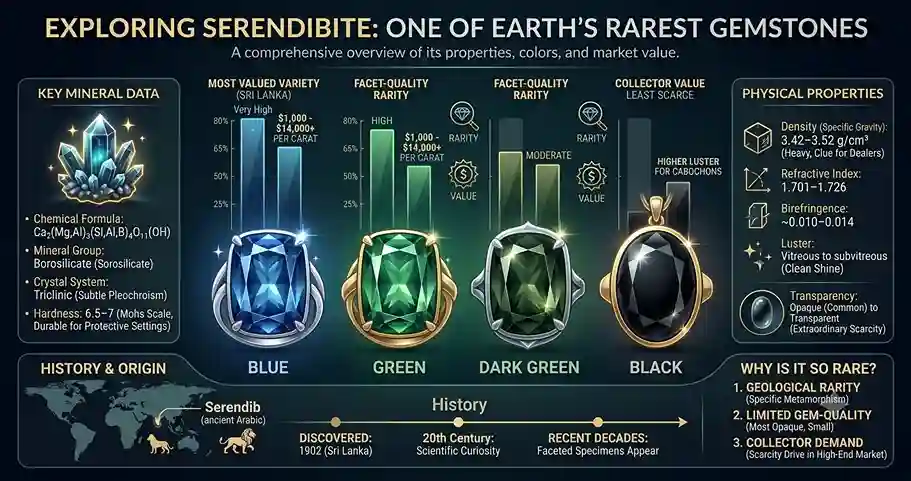
Borolsilicate mineral is first found in SriLanka since 1902. It showcases deep blue to near – black colors, and owns 6.5-7 , Mohs scale and a triclinic crystal system. Density stones around 3.42–3.52 g/cm³, are considered quality mineral that extremely scarce and command prices like, $1,000–$14,000+ per carat.
Serendibite Mineral and Gemological Properties:
Serendibite’s unique chemistry gives the stone striking look and its high value. Although, its rare mineral makeup makes the stone visually distinctive and sets it apart as a valued investment piece in any gem collection.
Serendibite Chemical Composition:
Serendibite is a part of sorosilicate group with having chemical formula of Ca₂(Mg,Al)₃(Si,Al,B)₄O₁₁(OH). And its boron bearing silicates are very rare make the stone very special.
The balance of magnesium and aluminum can shift naturally between specimens, that’s why its colors and densities vary form stone to stone.
Crystal Structure and Formation:
Serendibite forms in the tricilinc crystal system, it is the lowest symmetry type, with three unequal axes that don’t meet at right angles. Since, this structure gives the stone pleochroism subtle shifts in depending on the viewing angle.
It develops through contact metamorphism, especially is skarn zones where boron rich fluid believed to meet carbonate rocks near igneous intrusions. Because this process demands high heat and very specific chemical conditions, Serendibite’s formation is geologically rare and limited to only few places worldwide.
Serendibite Hardness on the Mohs Scale:
Serendibite holds 6.5-7 mohs scale of hardness which is close to quartz and a bit tougher than feldspar. Which makes it durable enough for daily wear jewelry but with protective settings like, bezels or halos and well handed with care like other moderately hard gems.
Density and Specific Gravity of Serendibite:
Serendibite is a heavy gemstone, owns specific gravity of 3.42-3.52 g/cm³. That is noticeably denser than quartz (2.65) and close to tourmaline (3.00-3.26). Its weight is often a quick clue for killed dealers when handeling loose stones.
Refractive Index of Serendibite:
The refractive index this stone falls in the range of 1.701–1.726, and with having birefringence around 0.010–0.014. This moderate birefringence is linked to its triclinic crystal system, that gives translucent stones subtle depth and shifting tones that cutters prize.
Transparency, Luster, and Inclusions:
Serendibite owns glassy to sub luster, that gives well cut stones a clean shine. Its transparency varies widely pieces of opaque, some are translucent, and only a rare few are truly transparent, that makes them the most valuable tag.
It carries common inclusions fibers, fluid pockets, fractures, and growth zones that can showcase faint color banding, with heavily included material far more common than eye clean gems.
Serendibite Mineral Data Table:
| Property | Value |
| Chemical Formula | Ca₂(Mg,Al)₃(Si,Al,B)₄O₁₁(OH) |
| Mineral Group | Sorosilicate (Borosilicate) |
| Crystal System | Triclinic |
| Mohs Hardness | 6.5–7 |
| Specific Gravity | 3.42–3.52 g/cm³ |
| Refractive Index | 1.701–1.726 |
| Birefringence | ~0.010–0.014 |
| Luster | Vitreous to sub vitreous |
| Transparency | Opaque to transparent |
| Cleavage | Imperfect / indistinct |
| Primary Colors | Blue, blue green, dark green, near black |
| Known Deposits |
Serendibite Colors and Varieties:
A stone doesn’t occur in a single uniform color. The mineral’s chromophores like iron, titanium, and variable magnesium aluminum ratios produce a spectrum of hues different specimens and deposits.
So, understanding these color varieties can help buyers target material that suits their goals.
Blue Serendibite:
Blue serendibite is the most valued variety, owns color saturation like pale steely blue to rich deep blue with violet undertones. Transparent blue stones from SriLanka are the rarest fetch the highest prices.
Green Serendibite:
Green Serendibite commonly showcases muted, olive-like tones with an earthy feel. Whether less flashy than the blue variety, fine transparent green stones are still sought after by collectors who want a complete color set.
Dark Green Serendibite:
Dark green serendibite is widely available than transparent blue, but facetable quality is still uncommon. Although, its deep color often hides internal detail under normal lighting, and most stones in this variety are translucent rather than fully transparent.
Black Serendibite:
Black serendibite is the most common variety, since still rare overall. Generally opaque, it is valued more by collectors, but stones with having strong luster can make striking cabochons.
Blue-Green Serendibite:
Blue-green serendibite sits in between the gem’s main color types and is often the most eye catching. Clean teal or peacock blue green stones are mostly valued since that shades are rare in the gem world and hard to match with their minerals.
Imperial Serendibite:
Imperial Serendibite is a dealer’s nickname for the finest transparent stones which owns vivid blue or blue-green color, high clarity, and expert cutting. It is not an official gemological term, but signals top tier material usually over one carat.
Which Color Is the Most Valuable?
Top quality transparent stone with having blue or blue to green shades fetches the highest prices. This mostly valued gem showcases vivid but balanced color eye, clean expert faceting, and SriLanka origin.
Where Is Serendibite Found?
Its deposits are geographically limited and poorly distributed. The mineral has been confirmed on only a small of locations globally, and gem quality material comes from an even smaller subset of those.
Serendibite in Sri Lanka:
Sri Lanka is the primary and original source of Serendibite, with the Gangapitiya area near Kandy producing is most popular to have specimens. Stones from here showcase the finest blue and carry the strongest collector value.
Myanmar Serendibite Deposits:
Myanmar’ Mogok region produces Serendibite, usually darker and less transparent as compared to Sri Lankan stones. Rare gem quality examples from this legendary mining area are highly valued for it provenance.
Madagascar Sources:
Madagascar is a newer source of this stone, with having material range from gem quality to lower transparency. Its stones are considered less rare than Sri Lankan or Myanmar examples but have entered collector market in recent decades.
Other Known Locations:
Trace finds of Serendibite have been noted in Russia, Canada, and other metamorphic zones. These are scientifically interesting but haven’t produced facetable gem material in meaningful amounts.
How Serendibite Forms Geologically:
The stone forms in skarn environments when boron rich magmatic fluids react with carbonate rocks under heat and pressure as we mention it above.
The rare mixture of boron supply, host rock, and sustained metamorphism produces crystals alongside garnet, diopside, and vesuianite that explain why significant deposits are so uncommon.
How Rare Is Serendibite?
Its rarity is absolute not marketing hype. Facetable stones number only in the dozens or low hundreds worldwide, that make it one of the scarcest gem quality minerals in existence.
Is Serendibite Rarer Than Diamond?
Serendibite is far rare than diamond. Diamond is mined in millions of carats yearly, whether gem quality, Serendibite appears only in single carat amounts, with the total facetable supply small enough to fit on a table.
Serendibite vs Other Rare Gemstones:
Among ultra rare gemstones like Painite, Grandidite, Benitoite, Musgravite, and Jeremejevite, this stone ranks as most the rarest facetable than these stones. It shares its traits of tiny deposits, minimal yearly output, and demand far beyond supply.
How Many Gem-Quality Serendibites Exist?
Expert estimates suggest fewer than few hundred faceted Serendibite stones exist worldwide. Gems showcase two are rare enough to be individually tracked, whether clean, transparent pieces more than three carats are extraordinary.
Why Collectors Pay Premium Prices?
Collectors pay premium prices for this stone because its supply is fixed, its usual chemistry and origin add narrative depth, and owns one of only few hundred faceted stones is fundamentally different rarity than common gems like sapphire.
How to Identify Serendibite?
Correct identification of this gemstone requires full gemological testing. Visual inspection alone is unreliable, as the stone has often been mistaken for tourmaline, chlorite, sapphire, and other blue green silicates.
Key Visual Characteristics:
Visually, this stone showcases deep blue , blue-green, spectrum, or near to black tones with a vitreous luster. Transparent, well cut stones can reveal subtle pleochroic color natural zoning under magnification.
How to Identify Serendibite Stone at Home?
At home, you can identify vitreous luster, color zoning, and relative density with a loupe and water displacement like (SG ~3.42–3.52). These are only preliminary definitive identification that require laboratory gemological testing.
Common Inclusions and Internal Features:
Under magnification, the stone showcases silicate inclusion, like fluid pockets, growth planes, and color banding. These natural features help gemologists separate genuine stones from dark silicate look alike.
Gemological Tests Used by Experts:
Professional identification of this stone relies on refractive index , specific gravity, and spectroscopic implements. Definitive confirmation comes from XRD or EDS, that verify boron content and crystal structure tests which major labs like GIA, and Gübelin performs them.
Signs of Fake or Misidentified Serendibite:
The most common misidentifications of this stone are dark tourmaline, sapphire or synthetic spinel. Since reliable indemnification requires RI and SG within range plus reputable lab certification without it, treat any stone offered with caution.
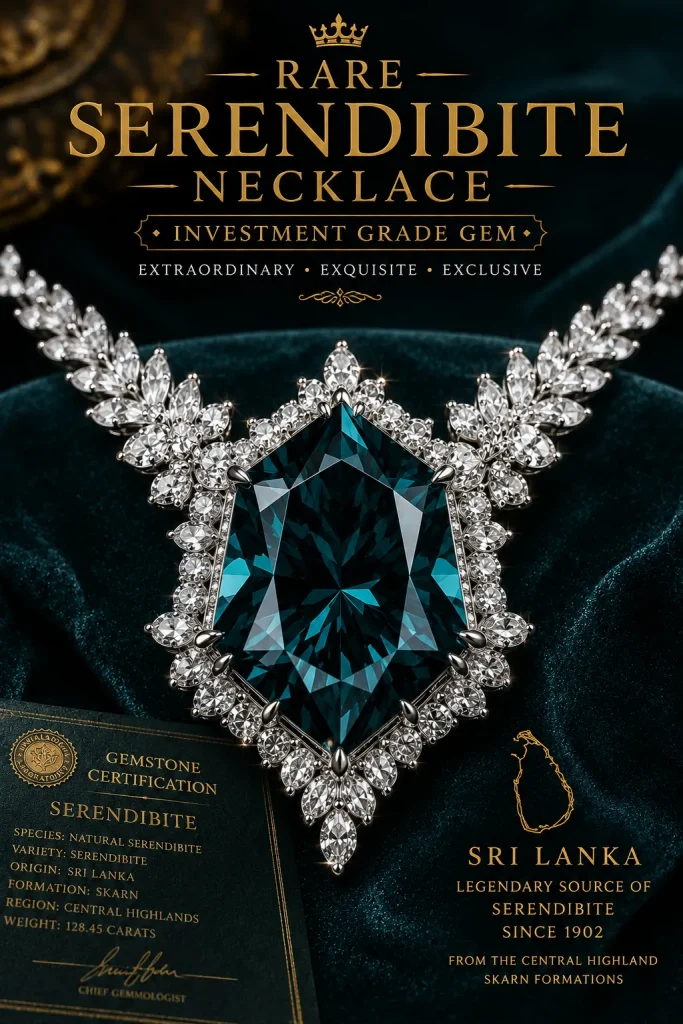
Serendibite vs Diamond and Other Gemstones:
Exacty comparison is the clearest way to showcase where this gemstone sits relative to mainstream gems like diamond and other ultra rare stones. Lets breakdown it below.
- Serendibite is rarest gemstone on the Earth. Gem quality faceted stones are extremely scarce only few hundred exist worldwide.
- Best use: This stone is specialist collector piece and long term alternative investment. Not a mainstream, highly liquid market like diamond or sapphire.
- Top qualities to pay for: Transparent blue or blue-green color, eye clean clarity, one carat or larger, and a laboratory certificate from a trusted labs like (GIA, Gübelin, SSEF) much matters.
How Serendibite compares to common gems?
- Diamond: It is much harder owns 10 mohs of hardness whether Serendibite has 6.5-7 mohs hardness and is far more liquid. Dimaond is driven by branding and larger markets. Whether other is far rare, its value comes from scarcity and collector demand.
- Sapphire: It is harder owns 9 mohs and more brilliannt. Sapphire is abundant as compared to the above stone. Which only wins on rarity and uniqueness, but sapphire wins for everyday wear and recognition.
- Alexandrite: Both stones are rare and collector focused. Since Alexandrite’s color change visually dramatic; whether borosilicate is rare overall. Both suit sophisticated collectors.
- Tanzanite: It owns a single source called Tanzania but supply of it in large amounts. More well known and easier than the borosilicate.
- Obsidian: It has volcanic glass, common, and low value. Can’t be comparbale except by superficial color.
Guide for Rarity, price, liquidity:
- Rarity: It has extreme facetable, transparent that are measured in single carats per year.
Prices (very approximate):
- Opaque black mineral specimens can command price like, $100–$500/ct
- Translucent dark material is sold for $500–$2,000/ct
- Transparent included can command price like, $2,000–$6,000/ct
- Eye clean top blue/blue-green are sold for $6000-$4,000 plus per carat
- Liquidity: Very low, except long holds and private sales; auction can be unpredictable.
What makes a Serendibite valuable?
- Color: Deep color saturated blue or blue green is usually best variety.
- Clarity: Eye clean stones are uncommon and much more valuable than others.
- Cut: Well emerald cut emphasizes depth of color and is preferable.
- Origin: Only SriLanka and Myanmar typically brings premium quality.
- Size: Larger stones are exceptionally rare more valuable.
- Certification: Reputable sources like, GIA, Gübelin, or SSEF are important for buying purpose.
Buying and verifying Serendibite:
- Specialist dealers, like Tucson, Munich, Vicenza, are hold top auction houses like (Christie’s, Sotheby’s, Bonhams), showcase major mineral and they own specialist online marketplaces.
How to verify:
- Verification of a gemstone requires an independent lab report (GIA, Gübelin, SSEF preferred).
- Always ask for documented origin, treatment disclosure, and a return policy if independent testing disputes identity.
Red flags:
- No lab report, unexplained low price, unwillingness to provide provenance, or pressure to purchase quickly.
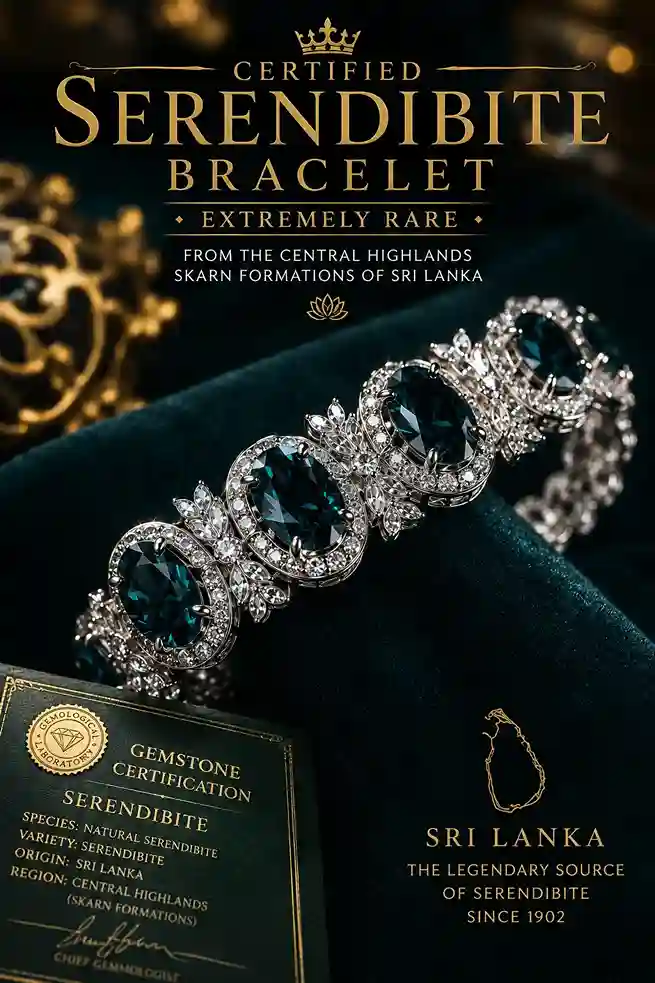
Jewelry and care Guide:
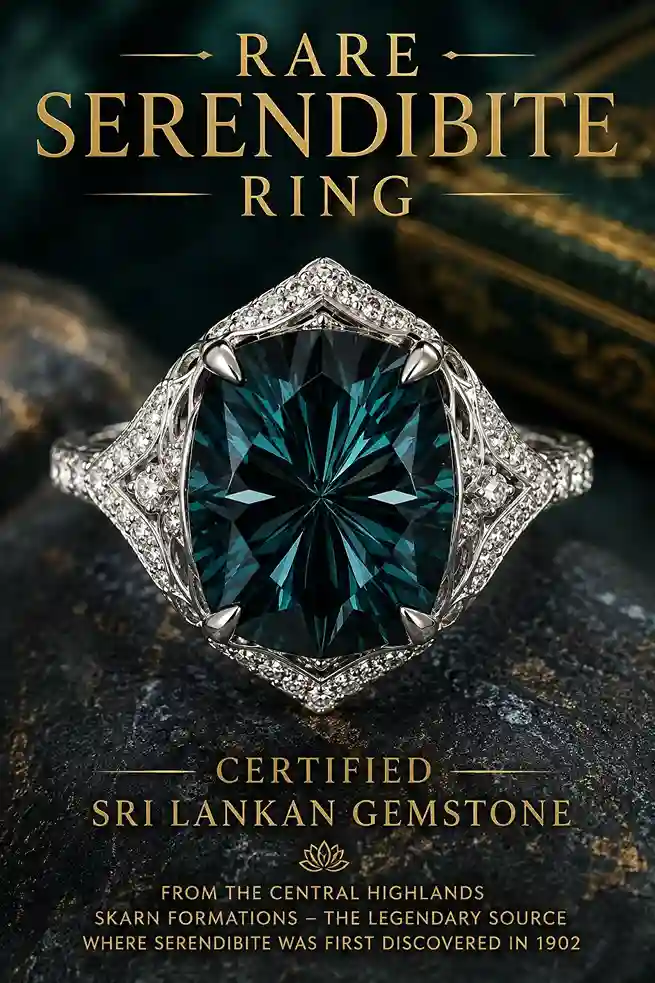
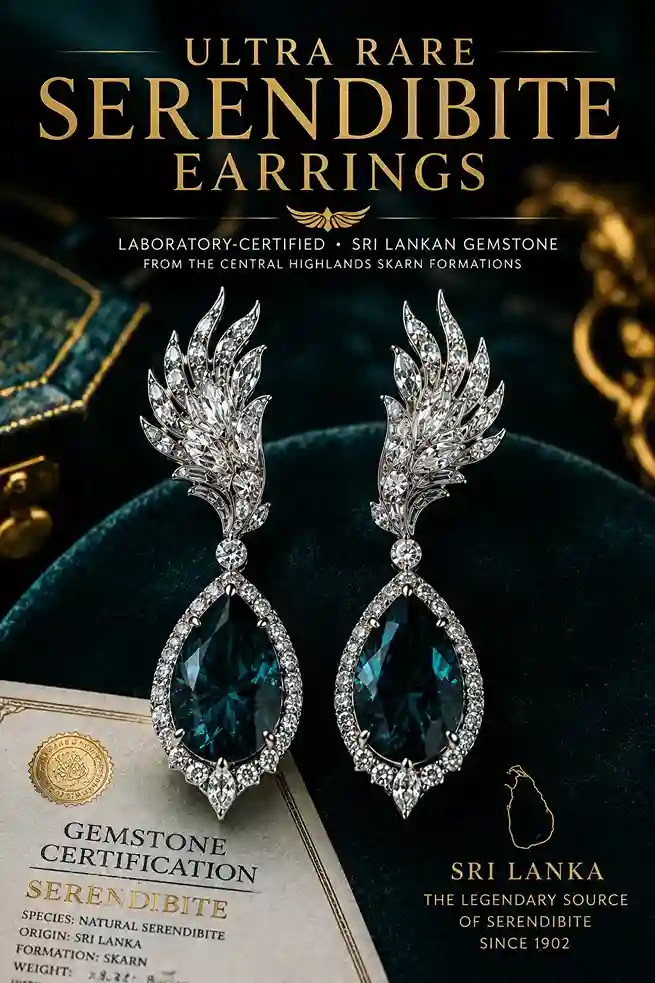
- Jewelry: Mostly custom pieces like Rings pendents, and earrings are common formats; bracelets with matched stones are very rare.
- Settings: Use protective settings like bezel or halo for rings because Serendibite owns 6.5-7 mohs, wearable but softer than sapphire and diamond.
- Cleaning: Use warm water and a soft brush. Do not apply ultrasonic cleaners unless the stones is confirmed fracture free. And store your separately from harder stones.
Investment considerations:
- Pros: Fixed and tiny supply, growing collector interest, portable physical asset, historical price appreciation for top pieces.
- Cons: The stone has very iliquid market, small buyer pool, no standardized grading system, is risk of mis-identificaction, possible price swings if new material is discovered.
- If investing: Stick to certified, transparent, colored stone like 0.5-1.0 ct plus, buy since reputable dealers be prepared for long holding periods.
Practical buying checklist:
- Always get lab report from trusted source that are named by GIA, Gübelin, SSEF.
- Always confirm origin and treatments.
- Must compare price to known benchmarks for color/clarity/size.
- Must check return policy which is tied to independent verification.
- Must prefer dealers who own references from specialist collectors.
- For first timers, start with small certified piece (0.25–0.5 ct) to learn the market.
Common myths, briefly:
- It is more valuable than diamond, sometimes a top serendibite can exceed many diamonds by price per carat, but diamonds are far more liquid and mainstream.
- Not every black stone is Serendibite, because many black mineral exist on the earth. Only lab testing can confirm identity.
- You can find it easily in the field very unlikely, because its confirms, rare geological environments.
Quick questions and answers:
1. What is Serendibite?
It is a rare borosilicate mineral, triclinic, owns colors like blue, blue-green, dark green, near black.
2. How rare Serendibite is ?
It is extremely rare quality stone number in the low hundreds globally.
3. Where this stone comes from?
It primarily comes from Sri Lanka, Myanmar, Madagascar, occasionally found in other locations.
4. How expensive serendibite much?
The stone can command $100 per carat for opaque specimens and up to $6k-$14kplus per carat (top faceted stones).
5. Is it good for investment?
Only patient, knowledgeable investors or buyer who accept illiquidity and specialist risk can keep this stone as investment.
6. What jewelry is preferable for Serendibite?
It usually requires protective settings for all jewelry types, especially custom pieces.
One quick buying example:
If you are starting to buy a certified 0.3-0.5 ct transparent blue Serendibite from a reputable dealer with having GIA or Gübelin report is best. Whether if you are excepting to pay several thousand dollars per carat that depend on color and clarity. Use this purchase to learn the market and meet other collectors.
GIA reports are more valuable than other! Gemstone Enthusiast KamilHussain

Welcome to KnowYourGem.com! your ultimate destination for uncovering the fascinating world of gems and their secrets! I'm Kamil Hussain, a passionate blogger with a Master’s degree in Economics, dedicated to bringing you insightful, well researched content that blends the beauty of gemstones with the art of storytelling. With a keen analytical mind and a love for discovering hidden treasures, I created this platform to help you explore the brilliance, history, and value of every gem.

