

📗 In This Guide
- What Is Demantoid Garnet?
- Rarity & Investment Potential
- Origins & Mining Locations
- Color Guide & Best Hues
- Horsetail Inclusions Explained
- Gemological Properties
- vs Tsavorite, Emerald & Diamond
- How to Identify Real Demantoid
- Price Per Carat & Value Factors
- Jewelry Styles & Settings
- Buying Guide & Trusted Tips
- Symbolism & Healing Beliefs
- Care & Maintenance
- Frequently Asked Questions
👉 Read also: Top 10 Hardest Gemstones in the World
Demantoid Garnet Facts:
Recognizing Demantoid Garnet:
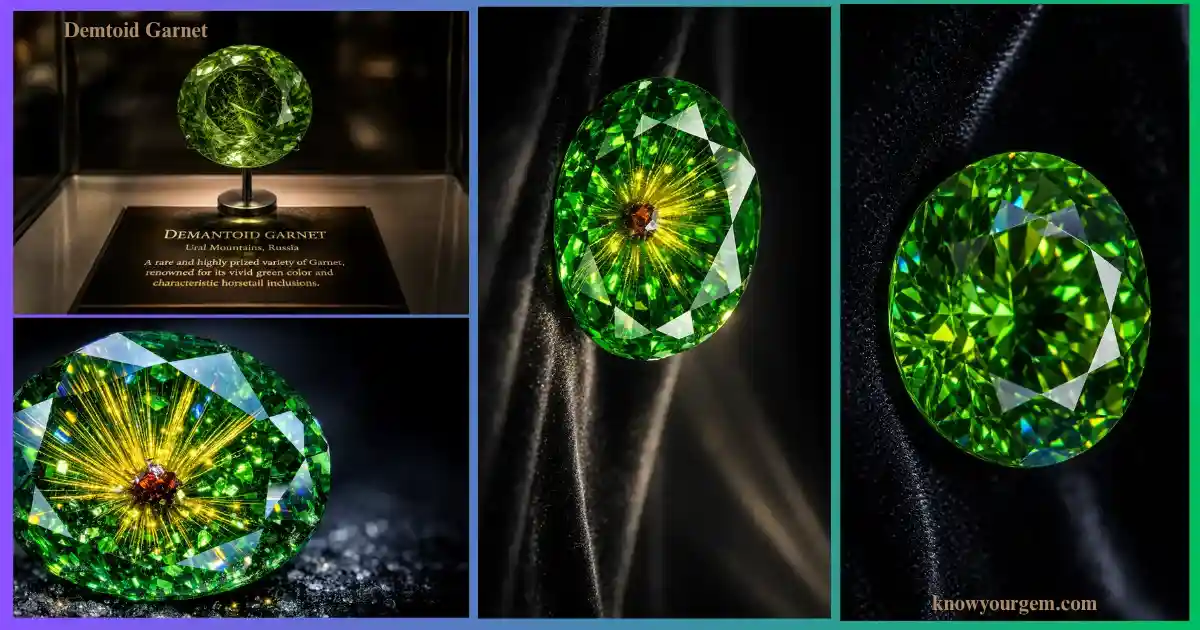
Demantoid garnet is naturally rare stone a part from garnet family. Although, its glowing vivid green fire can outshine diamond genuinely. As well as its brilliance and signature horsetail inclusions increase its value among collectors.
Collectors value this gemstone for its beauty and scarcity, with fine Russian stones fetch thousands per carat gem of connoisseurs and high jewelry.
Demantoid a rare green garnet, is glowing from soft yellow-green to the rich emerald. Its facets burst into rainbow flashes, a fiery brilliance called dispersion, that tell it is one of the most dazzling gems in fine jewelry.
Demantoid Garnet Meaning:
The name demantiod comes from the Dutch word “demat” and its combination with the Greek suffi-oid, is literally looking like diamond. It achieved this title in 19th century Europe, where jewelers were dazzled by its brilliance and fiery sparkle that rivaled diamond itself.
Gemologist Nils Gustaf Nordenshiold formally applied the same name around 1854 after examining Russian specimens, he was cementing demantoid’s identity as one of the most stunning and rare green gems.
Therefore demantoid truly lives up to its name in small sizes, a rare feat for a colored gem. As well as its fiery brilliance, pairing with vivid green hues make the stone unforgettable.
Demantoid Andradite Garnet Deep Guide:
Demantoid is the andradite garnet, owns the chemical formula like, Ca₃Fe₂(SiO₄)₃. Demantoid’s value outperformed other varieties like, melanite , topazolite, and schorlomite. Because of its vivid green color that mainly belongs to chromium, with iron adding yellow-green tones.
Not every andradite qualifies as a demantoid. The name applies only to the transparent, gem quality green andradite that meets the color and clarity standards for faceting. Opaque or low clarity gemstones from the similar family are simply called andradite.
History of Demantoid Garnet:
Demantoid was first discovered in Russia’s Ural Mountains in the early 1850s, and by the 1870s it was tied to enchanted Russian royalty and Faberge who used it in his imperial Easter eggs. That legacy still gives Russian origin stones a special prestige today.
Throughout the history of early 20th century, Russia’s demantoid supply collapsed, were leaving antique pieces that were highly valued. New deposits in Namibia and Afghanistan then revived the market decades later, they were bringing fresh gems to collectors and jewelers.
Why It Is Called “Demantoid”
Because demantoid’s diamond like name and vibes come from its dispersion like, 0.057 as compared to diamond’s (0.044). That is nearly 30% higher, meaning than diamond. Since, a well cut demantoid can showcase even more fire than similar size of diamond.
Why Demantoid Garnet Is So Rare?
Demantoid Garnet Rarity Guide
Because demantoid garnet forms under very specific geological conditions which other stones don’t. Only a small fraction showcase the vivid green and clarity that is needed for fine jewelry.
Even in active mines, fine demantoid is seldom and this stone more than one carat with having strong color and clarity are hard to find. More than two carats, investment grade gems are genuinely scarce worldwide.
Is Demantoid Garnet Rare?
Demantiod garnet is genuinely far rarer than other trading stones like, emerald, tsavorite, or sapphire. With Russia’s deposits exhausted, new finds in Namibia and Afghanistan provide material, but fine stones more than one carat remain uncommon, and jewelers can handle dozens of sapphires before seeing a single high quality demantoid.
Which Is the Rarest Garnet?
A fine commercial quality of demantoid garnet is far harder than ethically sourced stones. Other rare types like color change garnet, mali garnet, or select spessartine exist, but they can’t compete this premium gem.
Why Collectors Value Demantoid Garnets
collectors value demantoid garnet for most impactful reasons like, its unique horsetail inclusions that serve as natural provenance. So, together such qualities make this stunning stone more satisfactory and more desirable.
Investment Potential of Demantoid Garnet
Demantoid garnet is a niche investment because its owns vivid green fire, and historic prestige that make it highly valuable. Since, fine stone more than one carat command strong premium prices, though supply is limited and resale markets are smaller than sapphire or emerald.
Demantoid Garnet Origins and Mining Locations
Where Is Demantoid Garnet Found?
Demantoid garnet has determined in many regions, however only few locations produce true gem quality stones. Origin is crucial, such as deposits in Russia, Namibia, and Afghanistan carry top qualitative gems with having distinct colors, inclusions, and values, make provenance a key factor in the market.
Russia (Ural Mountains)
Mines in Russia are known for their originality and their quality. The source Producers vivid green stones with having the signature chrysotile horsetail inclusions. So stones from this source are most qualitative and can command premium prices.
Afghanistan
Afghanistan is the another primary source which produces high quality rare Demantoid garnet. This ethical source produces vivid green stones, that owns horsetail inclusions, and is now the most important modern source of collect grade gemstones.
Namibia
Demantoid garnet has been a steady source since the mid 1990s, yielding bright yellow-green to stones. Not same as Russian gems, these usually don’t showcase the classic horsetail inclusions.
Madagascar
Madagascar usually contains small deposits which produce lighter green demantoid. These stones are more common in the commercial trade but less sought after in the premium collector market.
Australia
Demantoid garnet from minor deposits is too rare. Since, this source usually produce lighter green stones of lower lower quality, so they are seldom seen in the commercial gem trade and play little role in the premium collector market.
Canada
Small traces of demantoid type andradite have been found in British Columbia and Quebec, but the stones are too few and low in quality to matter for the gem trade.
Russian Demantoid Garnet:
Russian demantoid from the Ural Mountains is considered as the classic standard. The old Bobrovka River deposit neat to Nizhny Tagil has produce top qualitative stones in the early 1800s and in 1900s. They showcase vivid “glass green” color and almost always carry the chrysotile horsetail that disclose their Russian identify.
Modern Russian demantoid production is too small, because it has limited artisanal mining. Since, Antique stones from Victorian and Edwardian jewelry are rare treasures, and they are often sold for much more than African or Afghan material.
Ural Mountains Deposits:
The Ural Mountains deposits stretch into Perm and Sverdlovsk, that are formed in serpentinite rock. Since, this unique setting gave Russian demantoid garnet vivid “grass green” color and chrysotile horsetail, a mix no other source has matched
Afghan Demantoid Garnet:
Afghanistan had become a demantoid source in the early 2000s, with Baluchistan and Badadkhsan that had been producing vivid green gems that often showing horsetail inclusions.
Namibian Demantoid Garnet:
Namibia’s Green Dragon mine, has found in the mid 1990s, this mining brought demantoid back to the market. This source used to produce stones in yellow-green colors, usually without horsetail inclusions, but they are clean, bright, and this ethical source also produced at scale that was giving buyers excellent quality at prices below Russian or Afghanistan gems.
Madagascar Demantoid Garnet
Madagascar produces lighter green demantoid garnets, often yellowish-green or lime in tone. However they lack the deep saturation of Russian or Afghan stones but offer brighter fire at more affordable prices, that make them a smart choice for budget minded buyers.
Australian and Canadian Deposits
Australia owns only trace of green andradite in New South Wale and elsewhere, with having no gem quality output. Whether Canada showcases similar occurrences in British Columbia and Quebec, but neither country produces enough quality stones as compared to Australia.
Demantoid Garnet Color and Appearance
Best Demantoid Garnet Color:
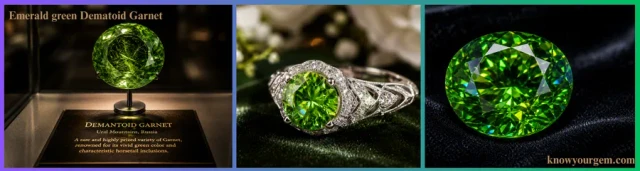
The most valued demantoid garnet color is a vivid medium dark “grass green” with rich saturation and having no gray or brown tones. Stones that showcase this color, look like eye clean or with a graceful horsetail, that sit at the very top of the market brilliance and rarity.
Slightly yellowish-green demantoid garnets come next in appeal, that often charms in older cuts. Since, very dark stones lose brilliance, while pale “champagne demantoids” trade at a steep discount.
Emerald Green Demantoid Garnet:
True emerald green demantoid garnet is considered as meaningful stone because it has pure, cool, slight blushing green tone that matches the color of a fine Colombian emerald which is exceedingly seldom and can command the highest prices in both the collector and fine jewelry markets.
Factors Affecting Color Value:
The most affecting factor that increase gem’s value is color value which comes in three things hue, saturation and tone, if any stone owns these things it considered as most value.
- Hue: Pure green > slightly yellowish-green > yellowish-green
- Saturation: Vivid and intense commands the highest premium
- Tone: Medium-dark is ideal; very dark stones lose fire, very light stones lose presence
- Color origin: Russian and Afghan stones more likely to hit ideal hue
- Cut quality: A well-cut stone maximizes color appearance
Chromium and Iron Influence:
The color of this Demantoid comes from chromium and iron. Chromium gives the vivid “grass green” and prized in Russian and Afghanistan stones, whether iron adds yellow or brown tones that mostly showcase a mixture of both influences.
Horsetail Inclusions: The Signature Feature
What Are Horsetail Inclusions?
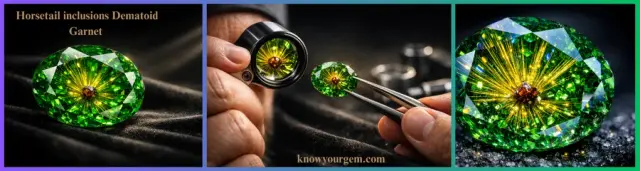
Horsetail inclusions are fine crysotile fibers that fan oouot from a central point inside demantoid garnet, forming a graceful, tail like pattern. Under magnification, these inclusions appear as golden threads that curving from a tiny nodule, instantly recognizable and unlike any other gem inclusion.
How Horsetail Inclusions Form?
Horsetail inclusions use to form when crysotile fibers are trapped as the garnet grows. In Russian serpentine, this process creates stress fractures that believed to enhance the sweeping, tail like pattern.
Why Collectors Love Horsetail Demantoid Garnets:
In most gemstones, inclusions get lower value, however inclusions like horsetail in demantoid garnet raises it. Collectors vale demantoid garnet as a natural provenance marker that is tied to Russian and Afghanistan origins, and as an infinitesimal artwork under the loupe that also signals authenticity and freedom from treatment.
Do Horsetail Inclusions Increase Value?
Yes a well formed horsetail generally enhances a demantoid’s value as compared to a similar stone without having such inclusions. In Russian or Afghan material, it can add 10-30% or more to the price, since heavy inclusions can hurt brilliance or durability will still be destroyed.
Natural vs Synthetic Identification
There are synthetics, so a horsetail is a proof of natural origin. Since, stones without such inclusions are still genuine demantoid garnets, however they lose this unique authentication edge.
Demantoid Garnet Properties and Specifications:
Chemical Composition:
Demantoid owns chemical composition like calcium iron silicate with chromium usually give its green look. Since, its structure explains the high refractive index and heavier specific gravity.
Hardness on Mohs Scale:
Demantoid garnet is a soft stone ranks 6.5 to 7 on the mohs scale of hardness.
Refractive Index:
Its high refractive makes it brilliant and more adorable than diamond.
Specific Gravity:
It has 3.82-3.85 of specific gravity, that gives it a heavier feel than most gems. Dealers often spot it by left, since it outweighs emerald or tsavorite of the similar size.
Fluorescence:
Demantoid garnet typically showcases no fluorescence under UV light, that helps to separate it from green glass or synthetics. Rarely, some can showcase a faint yellowish glow under SW- UV, a detail noted in lab reports.
Dispersion and Fire:
Demantoid’s dispersion is 0.057, higher than diamond or zircon. That’s why a well cut stone bursts with rainbow fire in dim light.
Why Demantoid Sparkles More Than Diamond:
Demantoid outshines diamond in fire due to having higher dispersion, but having lower RI and hardness limit day wear. It dazzles most in pendant or earring, where movement showcases its rainbow flashes.
Demantoid Garnet vs Other Green Gemstones:
Demantoid is usually compared with expensive gemstones like tsavorite ,emerald, green sapphire, and diamond for its high dispersion. Given below table showcases its unmatched markup:
| Feature | Demantoid | Tsavorite | Emerald | Diamond (Green) |
|---|---|---|---|---|
| Mineral Species | Andradite Garnet | Grossular Garnet | Beryl | Carbon |
| Color Range | Can be Yellow-green to vivid green | Medium to vivid green | Light to deep green | Pale to fancy vivid green |
| Mohs Scales are | 6.5–7 | 7–7.5 | 7.5–8 | 10 |
| Refractive Index are | 1.888 | 1.74 | 1.57–1.58 | 2.417 |
| Dispersion of all are (Fire) | 0.057 ⭐ Highest | 0.024 | 0.014 | 0.044 |
| Typical Inclusions | Horsetail (unique) | Usually clean | Jardin (common) | Variable |
| Is Treatments Common? | No (rarely treated) | No (rarely treated) | Yes (oil/resin common) | Yes (irradiation) |
| Price per Carat | $1,000 to $10,000+ | $500 to $8,000+ | $500 to $100,000plus | $50,000plus (fancy) |
| Daily Wear Suitability | Moderate (care needed) | Good | Good in settings | Excellent |
| Rarity | Very high | High | High (varies by quality) | Extremely high (green) |
Demantoid Garnet vs Tsavorite:
Tsavorite and demantoid both ow high qualitative green color and belong to garnet family. Since, demantoid owns strong fire, whether tsavorite is harder and easier to mind. As well as tsavorite suits everyday jewelry whereas demantoid shines for their rarity and also for their brilliance.
Demantoid Garnet vs Emerald:
Emerald is valued for prestige, but mostly in treated condition. Whereas demantoid offers natural brilliance and fire in totally untreated condition that makes it more trusted choice for buyers.
Demantoid Garnet vs Diamond:
Demantoid beats diamond only in fire, because of high dispersion which gives it stronger rainbow flashes. In all other ways, diamond is superior harder, more durable, and far rare in green.
Demantoid Garnet vs Green Sapphire:
Green sapphire is more durable than demantoid, however its color is often muted as compared to demantoid. On the other hand demantoid shines brighter, with having vivid fire and rarity which make it and ideal choice for collectors.
How to Identify Genuine Demantoid Garnet:
Visual Characteristics
A genuine demantoid exhibits warm to vivid green, but stronger fire with rainbow flashes with having facet double. These traits set as like emerald, peridot or tourmaline.
Horsetail Inclusion Test:
Russian or Afghan demantoid usually showcases horsetail inclusions, means natural marks no stimulant can copy. However stones from Namibia or Madagascar are genuinely too, but they are found usually horsetail free.
Refractive Index Testing:
The most reliable way to identify demantoid is with refractometer, that shows its distinct single refraction. And specific gravity checking can add confirmation.
Professional Certification:
For any major demantoid purchase, asking trusted lab certification is essential because it confirms an identity, treatment, origin, and provides trusted record for insurance, resale, or estate.
GIA and Laboratory Reports:
Most reliable and top rated labs for demantoid including GIA, SSEF, Gübelin, and AGL. Always ensure the certification must match the stone’s weight and dimensions for authenticity.
Demantoid Garnet Price and Value:
How Much Is Demantoid Garnet Worth?
Demantoid garnet is one of the most expensive colored varieties of garnet, due to having far high price than most gems it could made place in the list top pricier gems. Fine pieces of this stone can vary widely by origin, color, clarity, and size, but Russian stone usually command the highest premium price.
Demantoid Garnet Price Per Carat:
Per carat prices are rising sharply with size because larger, fine demantoid garnets are so rare. While stones in small size having vivid color can easily be found and are affordable than larger sizes.
Factors Affecting Value:
- Color: Vivid, pure green vs yellowish-green this big difference is a single huge value dirver
- Origin: Stones from Russia, Afghanistan, Namibia, & Madagascar command premium prices.
- Carat weight: Is an exceptional premium more 1 carat for top quality material
- Clarity: Means eye clean stone can command premium prices, even horsetail inclusion are acceptable
- Cut quality: A well proportioned cuts can maximize fire, whether poor cuts waste both color and brilliance
- Treatment status: Untreated stones are more valuable than treated stones
- Certification: Presence of a respected lab report can add tangible market value
Russian vs African Pricing:
Russian demantoid holds 20-50% more prices for its prestige, scarcity, and horsetail inclusions. Whether Afghanistan stones can trade slightly lower but are seen as stronger alternatives whether Namibian and Madagascan gems sit in lower tiers due to less vivid color.
High-End Collector Stones:
At the very top of the market, Russian demontoid garnets at Sotheby’s and Christe’s often in antique Fabergé settings. Since, certified matching pairs more than two carats with having horsetial inclusions are noted as too rare, they are so called collectors stones.
Investment Grade Demantoids:
Demantoid garnet is as like a store of value, so always choose Russian or Afghan stones more than 1 carat with having proper GIA or SSEF certification.
Demantoid Garnet Jewelry Guide:
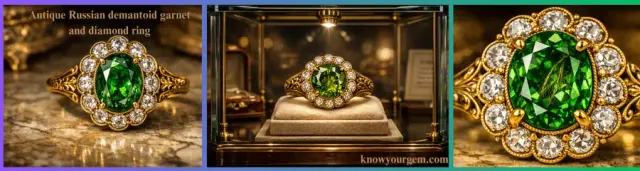 Demantoid garnet ring paired with diamonds in fine jewelry design
Popular Demantoid Garnet Jewelry Styles:
Demtantoid garnets are most popular in fine jewelry. But in Victorian times, it was glowing with its warm yellow gold and also was shining with crisp contrast in white metals. Whether its green fire feels at home both antique treasures and sleek modern designs.
Demantoid Garnet Rings:
Demantoid rings are most popular, however their moderate hardness means they need protective designs like, Bezel, and halo settings guard the edges, while prongs though riskier for daily let the gem’s fire blaze brilliantly in occasional cocktail pieces.
Demantoid Garnet and Diamond Rings:
Rings that own Dementoid and diamond can be timeless pair, and born Fabergé era, where green fire interacts with the white brilliance in stunning harmony.
Antique Demantoid Garnet Rings:
Antique demantoid rings are valued for their Russian stones with having golden horsetail inclusions. Their old gold setting and vintage cuts make them valuable but authenticity matters.
Demantoid Garnet Bracelets:
Demantoid works beautifully in bracelets, since the stones are safe than setting in rings. Flexible bezel set designs let the green fire sparkle as the bracelet shifts in light.
Tennis Bracelets:
A demantoid tennis bracelet is seldom and stunning , with matched green gems that sparkle in a continuous line. Because sourcing uniform stones are so hard, these bracelets are scarce, costly, and truly special.
Necklaces and Pendants:
Demantoid shines well in pendant , where movement lets its fire catch the light from every angle. Since, a single gem, alone or with diamond makes a striking centerpiece, while multi stone necklaces are rare but spectacular.
Stud Earrings:
Demantoid stud earrings are simple, everyday way to enjoy the gem’s green fire. A matched pair around 0.3-0.5 carats can sparkle beautifully, with Namibian stones and offer great value for budget minded buyers.
Buying Guide: How to Buy Demantoid Garnet:
What to Look for Before Buying?
Before buying demantoid, you should decide whether you want this stone for your jewelry or collecting, weigh origin versus appeal, and set a firm budget clarity saves you from paying extra for features that don’s matter to your usage.
Best Color and Clarity:
For demantoid, the goal is to own vivid green without yellow or brown. So, you should pick color over size, aim for eye clean clarity, and value horsetail inclusions only when they add beauty, not when they could the stone.
Importance of Certification:
For any demantoid more than $500, a lab certificate is must because it can confirm the gem as natural dematoid garnet, records weight and treatments, and if origin matters, GIA, SSEF, or Gübelin are the trusted labs for that work.
Trusted Sellers:
Reputable demantoid sources including trusted colored-stone dealers, major auction houses like Christie’s or Sotheby’s , and specialist retailers who disclose origin, treatments, and certification. Whether, Industry groups like AGTA add accountability, though membership alone doesn’t guarantee quality.
Online Buying Tips
Always ask for a lab certificate, demand clear photos or video in vary lights, and confirm details on origin, treatments, and returns because a reputable seller must answers openly, whether vague ones should be avoided.
Demantoid Garnet Benefits and Symbolism:
Traditional Symbolism:
Garnet has held meaning for centuries, and green demantoid garnet is tied to the growth, renewal, and vitality. In Russia it is symbolized refinement, whether Victorian jewelry used it to showcase memory and emotional depth.
Metaphysical Beliefs:
This stone is traditionally believed to share positive vibes and brings protective qualities to wearer, whether its green color is linked to the heart chakra.
Birthstone Associations:
This stone is a part of January’s birthstone traditionally, and offers a seldom, more attractive distinctive choice than the usual red garnet. Although, it honors the custom while giving January or Aquarius buyers a gem that feels individual and refined.
Modern Interpretations:
Demantoid appeals to the modern buyers as a natural, rare gem that stands apart from synthetics. Although, its horsetail inclusions and scarcity give it value that can’t be manufactured as finite, beautiful, and truly unique.
Care and Maintenance of Demantoid Garnet Jewelry:
Cleaning Methods:
This stone requires safe cleaning like warm water with mild soap for soaking, soft toothbrush for removing dust, and soft cloth for pat drying.
You should avoid ultrasonic or steam cleaners as they damage the stone internally and externally. Safe way clean this stone and jewelry just using lukewarm water nothing else.
Storage Recommendations:
Keep stored your stone separately from hardest gems like diamond and sapphire as they damage the stone internally and externally.
Protecting Antique Jewelry:
Antique demantoid jewelry looks like delicate, thin gold, old prongs, and aging solder requires special care.So, an annual inspection with specialist jeweler can make your jewelry more attractive and beautiful.
Quick Answers About Demantoid Garnet:
Conclusion
Key Takeaways:
- Demantoid garnet garnet is rare and most valuable gem, it is mostly valued for its vivid green color, fiery brilliance and scarcity.
- Its dispersion is 0.057, which is considered as higher than diamond’s dispersion (0.044) that make the stone most fiery transparent and usable for daily wear jewelry.
- The horsetail inclusions, are unique to demantoid, they prove natural origin and add collector value than reducing it.
- Russian Ural Mountains material can command the highest premiums, whether Afghan demantoid is the most essential contemporary source for fine collector stones.
- Fine quality stones can range from $2,500 to $10,000 plus per carat; as investment grade Russian specimens can exceed this at auction.
- Buy this stone from retailers who have taken certification from trusted like GIA, and SSEF.
- This stone can be worn as daily wear jewelry like earring, pendant and bracelet buy wearing it as ring can require protective setting.
- This stone owns long term outlook positively, and its supply is structurally limited as collector love to own it in bulk quantity.
Demantoid is scarce yet extraordinary, integrating vivid fire, rare geology, and prestige a gem that outshines diamond in dispersion and rewards those who truly understand it.
Demantoid Garnet at a Glance: Gemological Reference:
Given below table summarizes the key gemological specifications for demantoid garnet, useful for identification, comparison, and laboratory reference.
| Property | Value / Description | Significance |
|---|---|---|
| Mineral Species | Andradite (Garnet Group) | Identifies gemological family |
| Chemical Formula | CF (Ca₃Fe₂(SiO₄)₃ | Calcium iron silicate with Cr trace |
| Color Range | Yellow-green to vivid emerald green | Chromium content determines intensity |
| Mohs Hardness | Mh 6.5 to 7 | Moderate; requires protective settings |
| Refractive Index | RI~1.888 (singly refractive) | Key lab identification value |
| Specific Gravity | SG 3.82 to 3.85 | Higher than most colored gems |
| Dispersion | 0.057 (highest of gem-quality stones) | Responsible for extraordinary fire |
| Fluorescence | None (typically inert) | Helps distinguish from simulants |
| Cleavage | None; irregular fracture | Less brittle risk than cleavage stones |
| Crystal System | Cubic (isometric) | Produces singly refractive optics |
| Signature Inclusion | Chrysotile horsetail (fibrous serpentine) | Unique natural origin proof |
| Primary Sources | Russia, Afghanistan, Namibia | Origin affects value significantly |
| Treatment Status | Rarely treated; untreated is standard | High trust compared to emerald |
| Typical Price Range | $200 to $15,000+ per carat | Varies by origin, color, size, cert |

Welcome to KnowYourGem.com! your ultimate destination for uncovering the fascinating world of gems and their secrets! I'm Kamil Hussain, a passionate blogger with a Master’s degree in Economics, dedicated to bringing you insightful, well researched content that blends the beauty of gemstones with the art of storytelling. With a keen analytical mind and a love for discovering hidden treasures, I created this platform to help you explore the brilliance, history, and value of every gem.

