

Quick Answer:
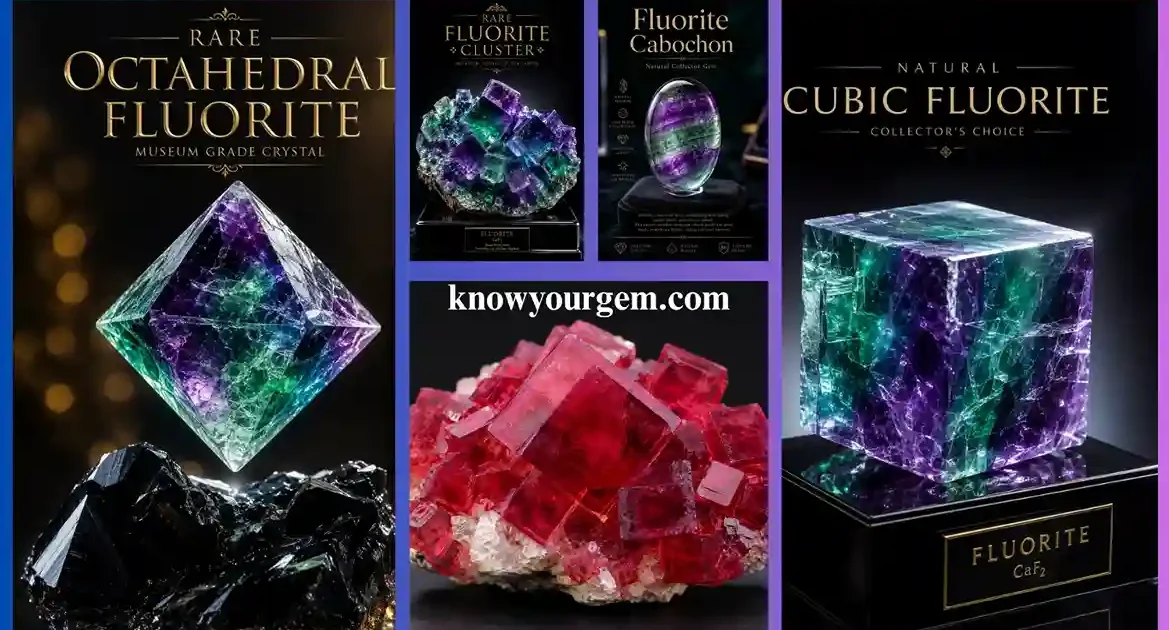
Fluorite is a bright mineral that displays different coloration in vivid shades; its color and crystal itself form in a shiny cubic crystal system. It is made of calcium fluoride(CaF₂); usually, this mineral is considered as softer due to having 4 Mohs hardness. Its softness makes it less desirable for everyday wear jewelry.
Most hardest gemstones complete guide.
Key Takeaways:
- Chemical formula: CaF₂
- Mohs scale: 4 on Mohs scale, too soft for daily-wear rings
- Color Saturation: A mineral which nearly displays every color; especially under UV light, it glows blue or violet.
- Primary Origins: It is generally found in China, Mexico, and England.
- Fluorescence: Its some varieties glow blue or violet under UV light.
- Its Uses In the Industrial Sector: It is important to use in industry for making steel, aluminum, and glass.
- What Cleavage It Has: A mineral contains perfect octahedral cleavage, which makes it more softer than quartz and other strong minerals.
- Its Birthstone Status: Traditionally, it wasn’t set for any birth month because it has unique traits.
- Its Usage In Jewelry: It looks best in pendants and earrings only.
- Its Key Value Factors: Its price is set accordingly its key factors like color, clarity, and crystal shape.
Introduction:
Fluorite is a mineral highly rated for its brilliant color display. In rock shops, you can see cubes and clusters that usually shift from purple-green-blue but sometimes all in one piece. Due to having less durability, it doesn’t fit for everyday jewelry like rings; collectors still love this stone because it displays various color shades instead of only one.
Is Fluorite a Gemstone or a Mineral?
Fluoride is naturally noted as a mineral. But when it is cut and polished, it becomes a gemstone and is suitable for jewelry. Moderate collectors often prefer raw materials over cut or polished pieces.
Fluorite vs Fluorspar:
Fluorspar is the industrial name of “fluorite” when fluoride is mined in a wide range for factories instead of jewelry. Both are the same mineral, but the only difference among them is quality.
Fluorspar is considered a lower-grade ore used for acid, ceramics, or metal work, however, fluoride is a naturally well-shaped mineral that collectors and jewelers usually desire to own.
Why Fluorite Matters:
Because fluoride is unusual and it usually bridges two worlds. Firstly, it is a vital industrial mineral used to make steel, aluminum, and glass.
Secondly, this mineral is one of the few minerals can claim a place both in heavy industry and in museum display cases.
Fluorite Meaning:
A deep guide about its meaning and symbolism below covers all clearly:
Historical Meaning:
Fluorite has been valued since ancient civilization. However, Roman artisans popularly carved banded fluoride into vessels that were called Murrhine, and valued for their glow and color-shifting property.
Its name basically comes from Latin Fluere, which appeals to flow, like a nod to its historic role as a flux in metal smelting, where it helped lower the melting point of ores.
Symbolism:
In Moderate collectors’ thoughts and metaphysical circles, fluoride owns symbolism like mental clarity, focus, and order, likely a reaction to its highly structured, geometric crystal habit that forms this mineral.
Its color-banded varieties are sometimes linked with balance, since a single piece can display various colors that can work together.
Modern Significance:
It is often considered as a stone that contains clarity and focus. Although its geometric crystal shapes are used to give it a sense of older thought, while the color-banded varieties are associated with balance and showcasing different colors while working together in one piece.
Fluorite Colors:
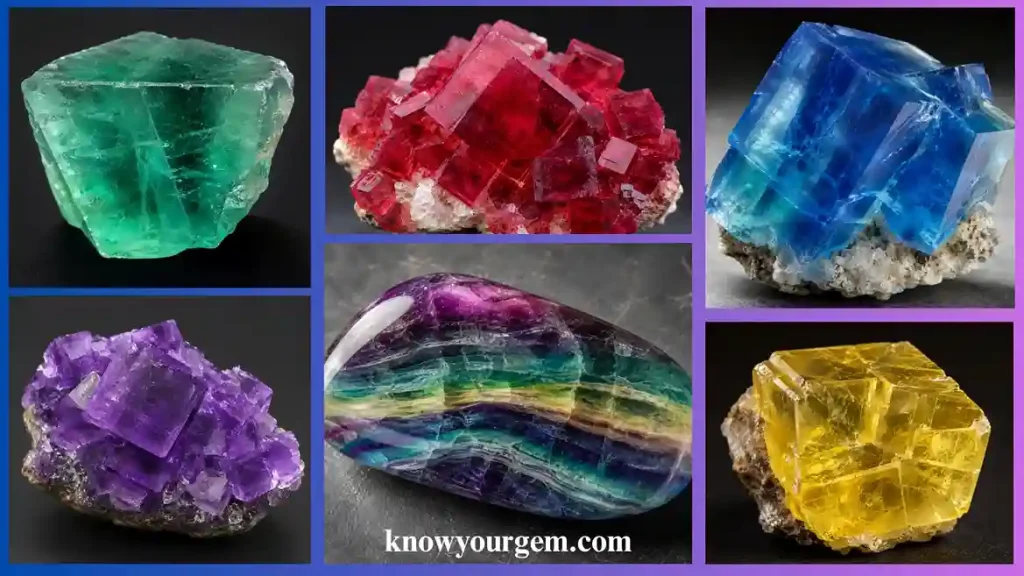
Color is the mandatory pick that makes one piece of fluorite stand out from another. Its color spectrum generally comes from infinitesimal elements.
Rainbow color:
Why it is rainbow? Because it displays different colors only in a single piece.
Purple color:
Purple variety is the most popular color in this stone. Since a mineral forms when radiation connects to elements like yttrium or other rare crystals that are exist on Earth. A mineral contains a deep, rich purple color that comes from well-recognized localities.
Green color:
Green color is basically associated with trace iron; it shows shades from soft mint to emerald. It is more usual and more affordable over purple fluoride, which makes it a famous starting point for collectors.
Blue color:
It is rarer than purple or green varieties. When it is cut, it can look very similar to aquamarine or blue topaz.
Since fine blue pieces, especially those which are located in well-known deposits in England and China, are highly valued and sell as premium pieces with high cost.
Pink color:
Pink fluorite is also rarely found piece and usually appears in soft, pale shades rather than vivid tones. As strong pink pieces are so scarce, well-colored specimens are mostly valued for their size.
Yellow color:
Its yellow type is generally available in soft lemon shades to warm amber. It is less usual than purple or green, so it draws moderate interest among collectors.
Clear color:
Colorless, or water-clear stone is primarily valued for its exceptional transparency and is occasionally faceted for collectors who love to show off optical properties.
Black color:
A black variety commonly gets its dark, nearly opaque look from dense radiation or smoky quartz at first glance, but its cubic crystal shapes disclose what it really is.
Red color:
It is the rarest natural color. Since true red pieces are highly valued by serious collectors, but most “red” fluorite on the market is actually a deep reddish-orange rather than pure red.
Where Is Fluorite Found?
Deposits of this stone lies worldwide, but a handful countries dominate both stone-quality specimen production and industrial fluorspar output.
| Country | Known For |
| China | It is the world’s biggest fluorspar producer; it majorly produces much rainbow and green varieties. |
| Mexico | It produces fine purple and colorless crystals, especially such stones are formed in Coahuila. |
| England | It provides historic blue “Blue John” vatrietes. |
| Namibia | It owns purple and blue-green cubic crystals. |
| Morocco | It has well-formed green and purple crystal clusters. |
| United States | Its states like Illinois and Kentucky historically own fluorspar. |
| South Africa | It is a significant industrial fluorspar producer. |
| Germany | It has historic localities in the Black Forest region. |
| Spain | Its Asturias region is known for producing green cubic crystals |
How It Forms?
It starts forming in hydrothermal veins when hot, stone-rich fluids crack and slowly cool while leaving calcium fluoride crystals.
The speed of crystal growth and the surrounding chemistry decide both size and color of the crystals. Moreover, fluoride usually forms together quartz, calcite, galena, and barite as well as such partner minerals can help geologists and collectors trace a specimen’s origin.
Raw Fluorite:
Raw fluorite showcases natural cubic or octahedral shapes, but only clear, fracture-free rough mineral is suitable for cutting.
Fluorite Gemological Properties:
| Property | Value |
| Crystal | Fluorite mineral |
| Composition | Chemical for of CaF₂ (Calcium Fluoride) |
| Mohs scale | Rate at 4 on Mohs hardness |
| Crystallizes | In Cubic crystal system |
| Cleavage | Having perfect, octahedral cleavage means softer |
| Luster | Its luster is Vitreous |
| Transparency | It is transparent to translucent |
| Density | 3.18 g/cm.³ is its density |
| SG | 3.01-3.25 is its Specific Gravity |
| RI | 1.433-1.435 is its Refractive index |
| Dispersion | 0.007 |
Fluorite Hardness:
While having 4 Mohs hardness, it is softer than a steel knife. Moreover, quartz and other harder stones’ dust can scratch this mineral, so it is very softer.
Fluorite Density:
Its density like 3.18 g/cm³, tells us it is a moderately weighted stone when it is held in the hand.
Fluorite Refractive Index:
It displays a refractive index of about 1.433–1.435, which is low as compared to many gems. That’s why cut fluorite, even with good color, can’t sparkle as like harder stones.
Fluorite Specific Gravity:
A mineral owns specific gravity of 3.01 to 3.25. And gemologists use this along with its RI to tell fluorite apart from other stones.
Fluorite Under UV Light:
Fluorite gave a single word called “fluorescence” in the 1850s, that same specimen now glows blue-violet color under UV light from rare-earth elements or inclusions.
Fluorite Types:
It has some most popular varieties that are deeply discussed below:
- Rainbow Mineral: It is banded with multiple colors.
- Optical Mineral: It is very clear variety and is used in camera and telescope lenses.
- Banded Mineral: It has layered color zones, and it is often cut into cabochons or decorative carvings.
- Blue John: It is a historic purple and yellow banded variety found only in Derbyshire, England.
Fluoride Value:
Its value hinges seriously on color, clarity, and crystal shape over carat weight. A mineral doesn’t meet to the characteristics of harder gemstones. It is a big specimen that displays pale or flawed that can be sold for less than smaller piece with having rich, even color and sharp crystal faces.
Rare colors matter too. True red and vivid pink fluorite command much higher prices than the more common greens and light purples, when size and clarity are equal.
Fluoride Price:
| Category | Typical Price Range (USD) |
| Rough/tumbled stones | Can command prices like $1-$15 per piece |
| Small collectors grade stones | Are usually sold for $10-$75 |
| Fine museum-grade minerals | Command prices like $200-$5,000plus per carat |
| Faceted gemstones | Can be sold for $2-$15 per carat |
| Fluorite jewelry (silver settings) | Can be sold for $20-$120 |
| Fluorite jewelry (gold settings) | Are sold for $80–$400 |
Prices of this mineral are different based on origin, color, cut, and clarity.
Is Fluorite Expensive?
It is not as expensive as other gemstones like amethyst, tourmaline, or sapphire with the same size.
Its appeal only comes from the wide color range and crystal character, that keeps its entry-level prices more affordable.
High Quality Fluorite:
Premium pieces generally exhibit rich, even color, high clarity, sharp crystal faces, and sometimes a clean UV glow. In which collectors also value such pieces that could be clear in eye view, especially from localities.
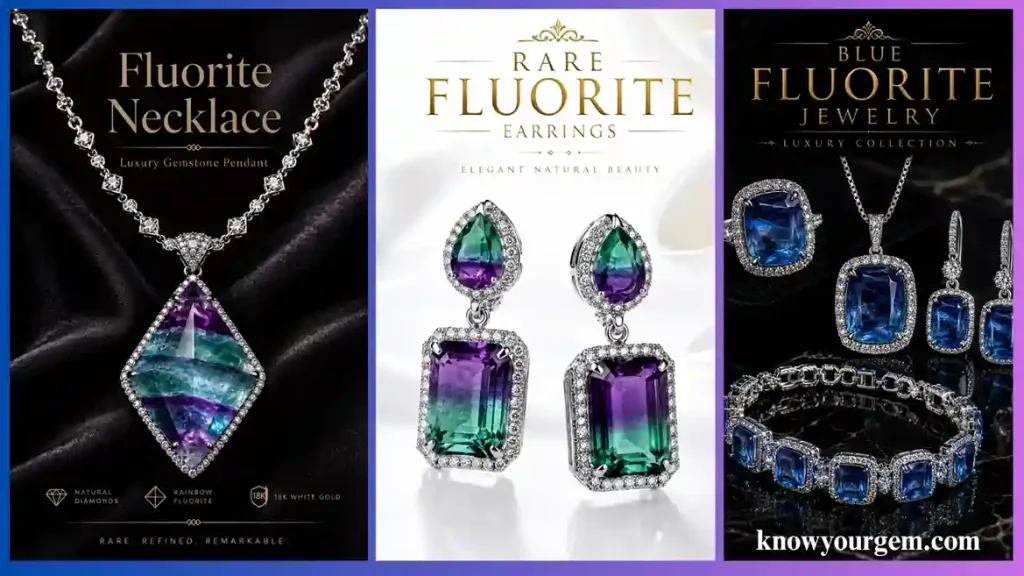
Fluorite Jewelry:
Its brilliant color display and low cost make this stone more attractive for jewelry; however, its softness limitations require safe wear.
Designers commonly use this mineral in protective settings like a bezel instead of open prongs to prevent chipping.
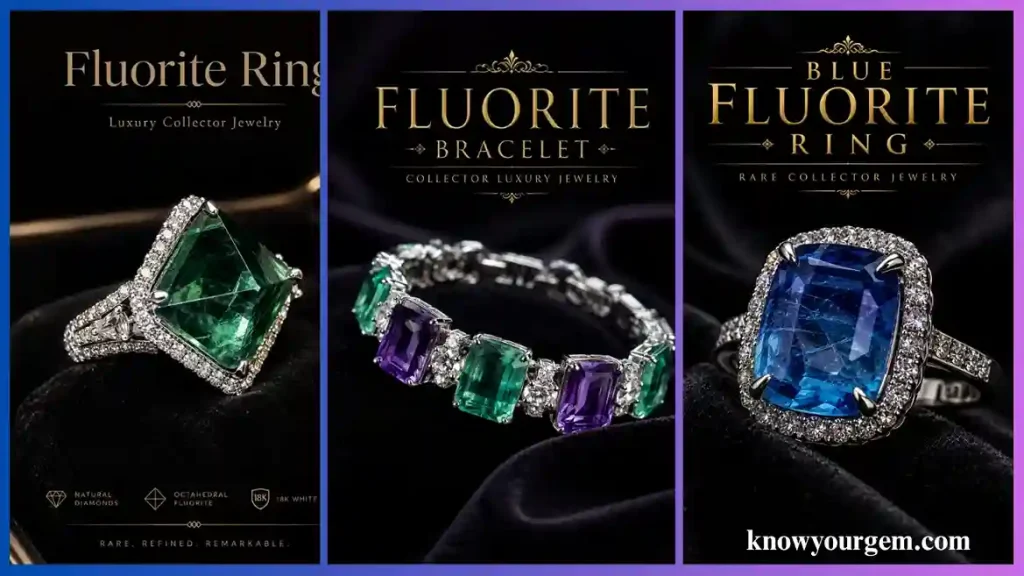
Fluorite Ring:
Fluorite rings can work best for occasions; they can’t be considered as daily wear jewelry, as this mineral is less durable and can easily chip or damage. Only a bezel setting can protect this mineral from scratching.
Fluorite Necklace:
Necklaces and pendants of this stone are safe way to wear, since this stone hangs freely and avoids most scratches or chips during daily activity.
Fluorite Pendant:
Pendant-cut fluoride is often shaped free-form or as cabochons; they showcase a stone’s color zoning beautifully.
It is also another safer way to wear while accepting rings.
Fluorite Bracelet:
Its beaded bracelets are most famous in the wellness and crystal jewelry market, however they require gentle handling. They chip more easily over metal or harder-stone bracelets.
Fluorite Earrings:
Earrings are considered as the most protective jewelry for this mineral, because they don’t contact hard surfaces. This makes them considered a low-risk jewelry choice as compared to rings or bracelets.
Fluorite Beads:
Beaded fluoride strands are usual in both fine and costume jewelry, and they are valued for their color-shifting property in a single piece.
They are especially famous because they usually offer that variety at an accessible price point.
Is Fluorite Good for Everyday Wear?
Fluoride is not suitable for daily wear jewelry, because it has low durability and contains perfect cleavage that make it near to scratch and chip.
How to Tell If Fluorite Is Real?
While recognizing whether a mineral is genuine involves some straightforward gemological checks:
- Hardness test: A stone can easily scratch because it rates 4 on the Mohs scale as like steel and a blade.
- UV reaction: Many pieces of this gem glow under UV light due to absence of fluorescence.
- Refractive index: Gemological experts quickly identify stone’s RI through refractometer.
- Inclusions: Natural color zoning and mineral inclusions are usual in this specimen and are difficult to convincingly fake in glass imitations.
- Lab testing: For higher-value specimens, a gemological laboratory can identify through spectroscopy and refractive index testing.
Fluorite Certification:
Reputable sources like GIA, IGI, and Gem-A didn’t set any grade for this gem; because it mainly considered as collector-grade gem. So nor and neither certification is issued for this gem from trusted labs.
Fluorite vs Similar Stones:
| Comparison | Key Difference |
| vs Quartz | Quartz is harder rate at 7 on the Mohs hardness as compared to Fluoride and is durable enough for jewelry |
| vs Calcite | Calcite is softer than fluoride with having 3 Mohs hardness |
| vs Amethyst | Amethyst is a kind of quartz and also harder than fluoride. |
| vs Glass | Glass has no cleavage but fluoride contains cleavage and typically shows swirl-like bubbles under magnification. |
| vs Opal | Opal has ability to play-of color from internal structure; whether fluorite’s color comes from the mineral body itself. |
| vs Labradorite | Labradorite displays adularescence but fluoride doesn’t. |
Fluorite Uses
A complete guide below showcases the uses of this mineral:
Jewelry:
This gem can be cut into cabochon, bead, and occasionally faceted to use in pendant and earrings.
Industrial Uses:
Fluorspar is vital in steel making, in which it acts as like flux to mitigate impurities. It is also the key raw material for producing hydrofluoric acid, that is an essential chemical.
Optical Uses:
A stone contains low dispersion, which makes it suitable for using in camera lenses and scientific optics to mitigate chromatic aberration.
Decorative Uses:
Banded fluoride has been curved into vases, bowls, and ornaments as Roman times, valued for its layered colors that glow when it is polished thin.
Collector Uses:
Well-formed fluoride crystal clusters and twinned specimens are valued worldwide, as well as valued much for their striking geometry as for their color.
What Is Fluorspar Used For?
Fluorspar usually supports a wide range of heavy industry applications, jewelry, and display:
- Steel production: It is used as a flux to improve slag fluidity and mitigate impurities
- Aluminum production: It is a source component in certain aluminum smelting processes.
- Glass and ceramics manufacturing: It is added to improve clarity and workability.
- Hydrofluoric acid production: It is the primary industrial source of fluorine chemicals
- Cement manufacturing: It is used in smaller quantities as an additive.
Fluoride Healing Properties:
Its healing properties are related to traditional and cultural significance rather than scientific researches. Practitioners usually connect these beliefs to its ordered crystal structure and wide range color.
Fluoride Chakra:
- Crown Chakra: Its purple variety is traditionally connected to spiritual awareness.
- Third Eye Chakra: Indigo or deep blue fluorite is linked with intuition.
- Heart Chakra: Green variety is connected to emotional balance.
Fluoride Zodiac:
Traditionally this gemstone doesn’t belong to any birthstone. But practitioners tie it with Capricorn and Pieces, only based on spiritual belief rather than scientific law.
Fluorite Benefits:
In cultural belief, it is often linked to mental focus and decision-making and calming over stimulation; such claims rooted in metaphysics can’t compete with scientific solutions.
Can Fluorite Get Wet?
Briefly handling with fresh water contact is fine, but soaking it for prolonged in water can wet.
Users should also keep away saltwater, chlorine, perfume, and cleaners, from this stone as they can dull or damage the stone.
Care & Cleaning:
To clean this soft stone, use mild soap and a soft cloth.
- Only use a soft cloth with fresh water to clean.
- Add a drop of mild soap.
- Wash it gently across the surface.
- Avoid prolonged soaking or submerging.
Pros & Cons:
| Pros | Cons |
| It is natural and has color-changing properties. | But it contains softer Mohs |
| It is affordable as compared to relative stones. | But while having perfect can chip or dull easily. |
| Collector’s demand is strong for it. | But it is not suitable for everyday wear jewelry |
| It showcases fluorescence under UV. | But it is sensitive to heat, as sudden temperature changes, and chemicals. |
| Its supply is abundant, which keeps its prices accessible. | It is lower resale/investment value than harder gemstones. |
Buying Guide:
Always choose fluorite with having strong, even color and minimal fractures, and look for sharp crystal faces in specimens.
For jewelry, protective settings and documented locality should be added for both durability and value.
Market Trends:
Collector demand for fine fluorite specimens that keep are increasing, boosted by trends and natural crystals in home decor.
Rainbow and banded fluoride are most desirable after, while in jewelry settings.
Frequently Asked Questions:
1. What is fluorite?
It is calcium fluoride, which forms in cubic crystals where it gets its color-shifting property.
2. Is fluorite a gemstone?
It is a mineral, but becomes a gemstone after cutting and polishing.
3. Is fluorite rare?
It is not rare, a common mineral but its red variety and vivid pink are rare.
4. Is fluorite expensive?
It is generally affordable; however museum specimens can be costly.
5. Is fluorite safe in water?
Water is generally safe for this mineral but prolonged soaking won’t work.
6. Can fluorite go in salt water?
Don’t let salt water to touch this mineral, as salt water can damage its surface.
7. Can fluorite be worn daily?
It is not ideal for daily wear jewelry.
8. Does fluorite glow?
Yes, many pieces of this stone glow under UV light.
9. Why does fluorite fluoresce?
Due to trace elements and natural inclusions; and it starts re-emitting in visible light.
10. How is fluorite formed?
It basically forms in hydrothermal veins and limestone deposits.
11. Where is fluorite found?
It is mainly found in China, Mexico, England, and the USA.
12. How hard is fluorite?
It rates 4 on the Mohs scale.
13. Is fluorite natural?
Yes, though imitations exist.
14. Does fluorite fluoresce?
Many specimens do, intensity varies by locality.
15. What is optical fluorite?
Optical pieces look exceptionally clear, and they are used in lenses.
16. How much is fluorite worth?
Usually small pieces of this stone can worth few dollar whether larger size stones can cross thousands of dollars per carat.
17. How do you clean fluorite?
It should only be cleaned with a soft cloth and mild soap in warm water.
18. What chakra is fluorite?
Its purple kind is linked to the crown chakra; blue is tied to the third eye, and green is connected to the heart chakra.
19. Can fluorite scratch glass?
Fluorite can’t damage glass because of having very low hardness.
20. Is fluorite good for jewelry?
It is genuinely suitable for jewelry like pendants and earrings only.
21. How to identify real fluorite?
You should check its hardness, refractive index, UV light reaction, and natural inclusions for clear identification.
22. What color is fluorite?
A stone shifts its colors from purple-green-blue- yellow.
23. Which fluorite is rarest?
Red and vivid pink types of fluoride are rare.
24. Is fluorite good for investment?
Fine gems are usually considered good investment, but their can’t increase as harder.
25. Difference between fluorite and fluorspar?
Both are the same mineral; but the only difference is that fluorite is used in sector, and the other is used in jewelry.
26. Can fluorite be dyed?
Yes, lower-quality stones can be dyed.
27. Does fluorite need special storage?
Store this stone separately from harder stones for scratch resistance.
Conclusion
Fluorite shines in two ways; firstly collectors value its vivid colors and its formation, and secondly industrial sectors value it for its utility. Buyers can enjoy this stone as a display piece or for occasional wear if they are focusing on its vivid colors, clarity, and careful handling.
Gem Enthusiast KamilHussian!

Welcome to KnowYourGem.com! your ultimate destination for uncovering the fascinating world of gems and their secrets! I'm Kamil Hussain, a passionate blogger with a Master’s degree in Economics, dedicated to bringing you insightful, well researched content that blends the beauty of gemstones with the art of storytelling. With a keen analytical mind and a love for discovering hidden treasures, I created this platform to help you explore the brilliance, history, and value of every gem.

