
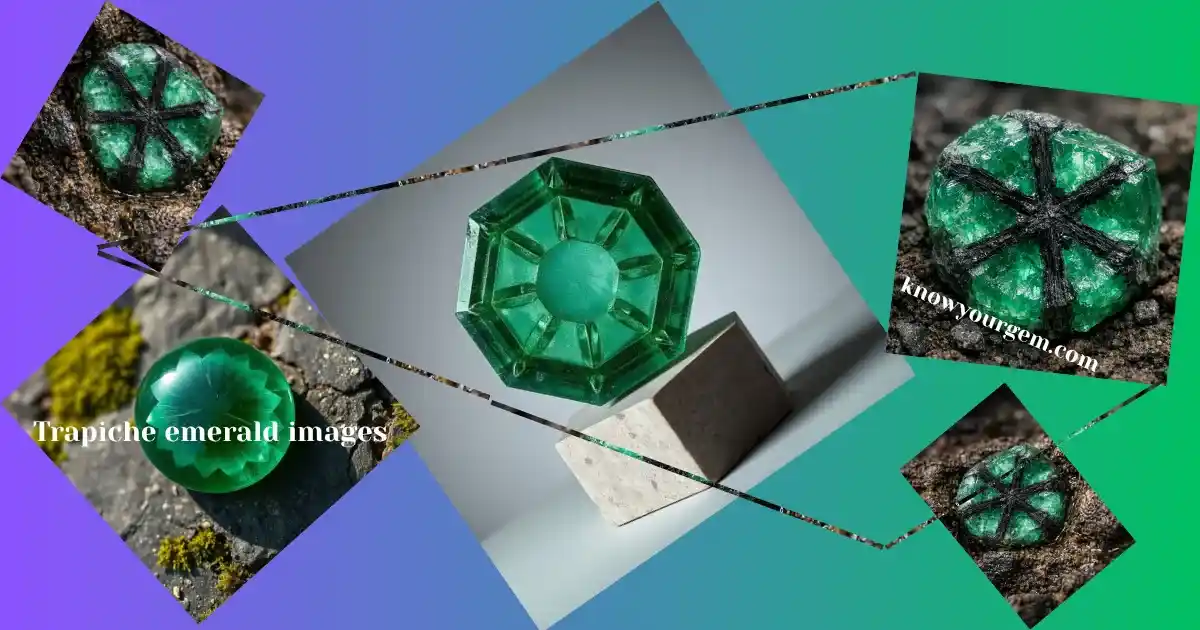

Summary:
A trapiche emerald is a rare form of emerald. A gem contains internal pattern of six spokes or a wheel pattern due to the crystal growth arrangement. Majority of this stone is produced in the western emerald region of Columbia. The pattern is not a light effect but rather a fixed geological feature. And Collectors, and buyers love the rarity, strong visual signature, and originality of the place of origin of this stone.
Emeralds are the most loving stones due to having natural sparkle, rarity, moderns jewelry seekers prefer these gemstones over traditional stone like diamond and sapphire.
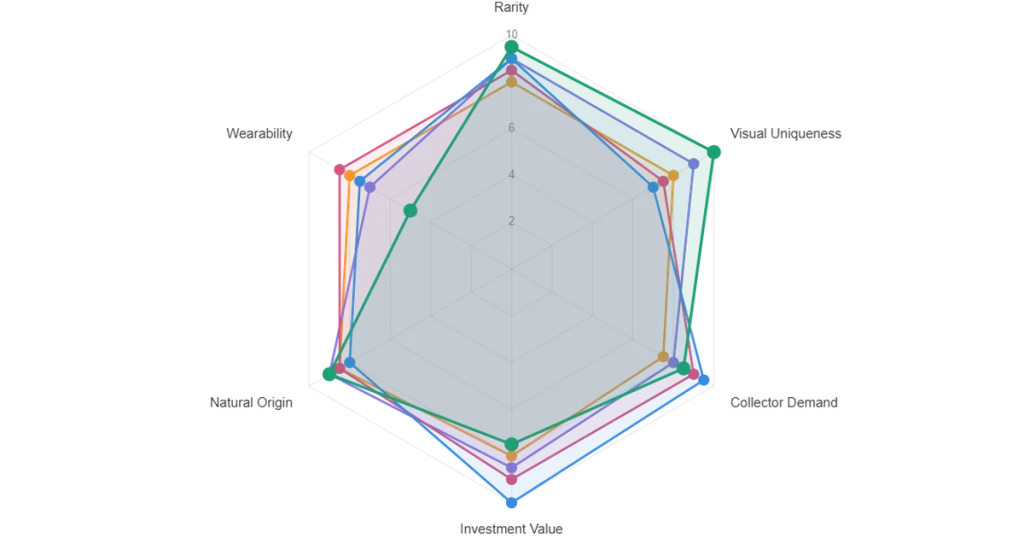
It is a radar chart that compares the Trapiche Emerald with four of the most desired collector gemstones in the world based on six meaningful qualities based on the article and general gem trade attributes.
What is a Trapiche Emerald?
Trapiche is a kind of emerald gemstone, its deep guide below showcases how it belongs to the emerald family:
A simple definition:
A trapiche emerald is a natural emerald that has a characteristic internal structure of six dark rays going outwards around a center and the rock is cut into six green segments. This is a pattern that is created in the crystal growth deep in the earth and forever entrenched in the structure of the gem.
A trapiche emerald is a natural emerald which has a permanent, six-spoke wheel-like form due to its growth structure – not a surface treatment, coating, or optical effect.
The name Trapiche:
Trapiche is a Spanish word that is used to denote the cogwheel or grinding wheel in the traditional South American sugar mills.
The form of the six spokes of that mill is more or less like the internal ray design in these emeralds. That is the comparison and the name which was given by Colombian miners who were the first to see these strange stones and name them.
Trapiche Emerald vs. Standard Emerald:
Emeralds are all trapiche emeralds – they are beryl minerals, and are green by virtue of chromium and vanadium, as any other emerald. The visual structure is the critical difference.
Since, ordinary emerald is more valued because of its transparency, color purity and lack of disruptive inclusions. A trapiche emerald, in its turn, carries a pattern within it, which is makes the stone most unique and more rare than regular emerald.
Not all emeralds are trapiche. Even among Colombia emeralds, natural trapping patterning is rare. When a buyer decides on one of the two he is in effect making a decision on two varying aesthetic and collector propositions.
Trapiche Emerald and star gems:
Trapiche patterning is not asterism. Star gems, e.g. star sapphires and star rubies, exhibit a floating, moving light effect known as a star when observed under a direct source of light. The cause of that effect is the reflection of light to the surface by needle-like inclusions.
The pattern of a trapiche emerald is motionless, does not drift, does not change with the obliquity of light. It is an inherent structural characteristic that is seen through the body of the stone.
The two phenomena appear shallowly the same in photographs, but are geologically and optically different in all the significant aspects.
| Feature | Trapiche Emerald | Star Gem (e.g., Star Sapphire) |
| Type of pattern | Fixed growth pattern | Moving reflected light (asterism) |
| Cause | Crystal sector boundaries | Needle-like rutile inclusions |
| Pattern moves? | No | Yes — turns with angle of light |
| Ordinary cuts | Cabochon, slice | Cabochon |
| It belong major emerald mineral like | Beryl (emerald) | Corundum (sapphire, ruby) |
The origin of Trapiche Emeralds:
There are only three origins of Trapiche emerald, that a explained below.
The Localities of the Classic sources of Colombia.
Columbia produces the world’s finest trapiche emeralds. And the largest deposits occur in three major spots within the western Emerald belt, nestled along the Eastern Cordillera mountain range in Colombia’s Boyacá and Cundinamarca departments.
- Muzo: It is the most crucial Columbian emerald mine in historical times, and a major source of trapiche specimens. Muzo is often warm green in color.
- Coscuez: This is another of the large producing mines of the western emerald zone, which is also said to produce trapiche stones.
- obj. Peñas Blancas: A third notable locality, the material of which is recorded in gemological literature.
The Gemological Institute of America (GIA) has extensively studied trapiche emeralds, and its research point outs Colombia as the classic and most valued source of the gem.
Are Trapiche Emeralds found outside Colombia?
Classic trapiche emerald literature focuses on Colombia. Growth patterns of emerald crystals, however, have also been reported in trapiche-type in the Swat Valley of Pakistan.
These Pakistani specimens have certain structural resemblances with Colombian material, but are different in their geological setting and, in the trade, are not so striking as Colombian specimens.
There is no other source that has matched the frequency, documentation and market recognition as Colombia.
When it is merely mentioned that a particular trapiche is emerald, and no more, the implication is almost always that it comes out of Colombia, though must always be checked, not guessed.
The forming of a Trapiche Emerald:
You can study a thorough guide about the formation of this gemstone:
Sectors of Growth and the Six-Spoke Pattern:
A trapiche emerald starts with a hexagonal crystal of beryl that develops in a hydrothermal condition. As the crystal grows, it takes over six principal growth sectors relative to the six faces of the hexagonal structure.
Among those sectors, there are formed boundary zones where foreign material is formed, which is not part of the emerald crystal itself.
These inter-sector boundaries take the form of dark rays in case the stone is cut perpendicular to its crystal axis. Its center is a small separate core of colorless beryl.
And the six rays spread away-ward about the center to the periphery of the crystal. So, the wheel or star like pattern that makes the stone to be named so.
The separating material in the spoke zones can be either colorless or pale beryl, dark carbonaceous material, or almost black albite feldspar. Based on that particular conditions at the time of growth, and the mineral chemistry at that site.
The black shales and structural geology.
Colombian emeralds, like trapiches, are in black shales- dark, carbonaceous sedimentary rocks. Although, tectonic activity in the Eastern Cordillera offered to deform these shales.
GIA has documented its formation in detail through its gemology publications. Since, Tectonic fracturing, hydrothermal fluid movement, and the chemistry of the host shale drive emerald formation in Colombia. These same geological processes also create the distinctive trapiche pattern.
Why no two Trapiche Emeralds do not exactly resemble each other:
Pattern sharpness varies. In other stones the six spokes are sharp, distinct and spaced evenly. They are sporadic, weak, or uneven in others.
The central core can be exposed and visible, compressed and opaque, or completely absent. As it depends on where the original crystal is sliced.
The place and inclination under which the cut is made through the rough crystal also dictate the appearance of the pattern in the finished stone. The classic radial wheel is observed in a slice made oriented perpendicular to the c-axis.
A small angle cut is a distortion of the symmetry. And two trapiche emeralds of other crystals, (not of the same crystal,) will not bear the same pattern. This uniqueness is an important component of their collector interest.
What is the value of a Trapiche Emerald?
Its valuation is explained below extremely you can study:
Pattern sharpness and symmetry:
Pattern is the distinguishing feature, and quality is more of a value-creating force than most other considerations. A trapiche with well drawn, and evenly spaced spokes, the rays are sharp and the six sectors distinct. As it is much more interesting than the rays are faint in the stone.
Symmetry matters too. A stone, on which the six spokes are almost equal in breadth and distance, centred on a core which is well concentrated, will have a more visually resolved effect, and will be more desirable among collectors and purchasers.
Color, transparency, and contrast:
The areas between the spokes are green, and their quality of the color counts. The pattern is more striking with a vivid, saturated green, either the warmer or cooler green, of Colombian origin, which has visual contrast against the dark material used in the spokes.
Openness in the green sectors also helps in attraction. The best visual contrast is accomplished by a stone on which the green spaces are clear enough to reveal depth, with a very strong defined dark pattern.
Green sectors that are very heavy on the colors lessen this contrast and bring down the effect, though the pattern is technically present.
The size, origin and rarity:
Large trapiche emeralds having bold patterns are really rare. The bulk of the trapiche is made in small to medium slices or cabochons. A stone of more than a few carats having a pretty design in it and a good green colour is of a value such as to bear a real premium.
Colombian origin is a first hand value signal in the market. Provenance is related to resale, collector documentation and certification. A Colombian trapiche emerald that has a provenance report by an independent gemological laboratory is more credible and can have greater market value than an unreported one.
Treatments and their impact on price:
Similar to the vast majority of natural emeralds, trapiche emeralds can be impregnated with oils or resin to enhance the apparent clarity of the green portions of the gems.
This is known as the practice of clarity enhancement and is common in the emerald trade and not necessarily disqualifying though it should be stated.
The level of improvement is normally measured through a scale:
- ·F1 (or none/insignificant): No detectable treatment or a trace of negligible value. Most valuable.
- ·F2 (or minor/moderate): there is a certain improvement, but very satisfactory to most buyers at a suitable price.
- F3 (or significant/heavy): Massive treatment. Reduced price, must be disclosed.
A trapiche emerald with a powerful pattern and color, untreated, or treated very slightly, is a far better thing than a highly-oiled specimen of the same nature.
Disclosure of treatment is not a choice of the reputable seller of a product, or of the reputable lab report, which records the fact.

To know whether a Trapiche Emerald is genuine or not:
You should study the guide below if you want to pick a genuine piece rather than fake one:
Evidence of a natural Trapiche Pattern:
The pattern of a true trapiche emerald is a component of its crystal structure. And the features of the geological growth boundaries, irregular edges, inclusions in the environment of the host rocks.
And the continuation of the pattern into the depth of the stone, as opposed to being merely on the surface, are visible under magnification in the spoke zones.
A fake or deceptive stone can bear a painted or printed design on the surface or on a flat slice. That has been made to look like the real stone. Signs of warning include surface-only, idealized computer-like exactness, and patterns that fade under intense direct light.
With that said, such precise identification involves equipment and knowledge. The purchase decision should not be based on a mere visual examination, particularly when the price is very high.
The importance of a lab report:
The best option to prove that a trapiche emerald is real is through an independent gemological laboratory report. A qualified laboratory is able to:
- Confirm that the stone is not a synthetic or fake beryl (emerald), but a natural one.
- Determine the presence or absence of the trapiche pattern as genuine and growth-related.
- Identify the nature and extent of any clarity treatment.
- In others, give an origin identification that is Colombian or other provenance.
GIA point outs emerald varieties, treatments, and origins. Which are not same as diamond, it does not assign standard color of clarity grades to emeralds. Its reports are highly respected in the gemstone trade.
Other trusted labs including Gübelin Gem Lab and SSEF. Both are especially respected for Colombian emerald origin reports.
Red flags in listings.
When considering any trapiche emerald up on sale, watch out for these red flags:
- No laboratory report on a stone cost over a few hundred dollars
- Vague statements of origin like the Colombian style or natural looking that are not documented.
- No revelation of treatment, these all natural emeralds demand.
- Price that appears unrealistically low of an allegedly rare, Colombian, patterned specimen.
- Photos of one angle only, and so there is no opportunity to gauge the pattern by means of the stone.
- Synthetic or simulant risk objective As synthetic emeralds are known to be produced in the lab, you can not be sure of a natural source unless it is stated.
Best cuts, Jewelry uses, and who buys them:
Keep an eye on the given below deep best cuts, jewelry uses, who buys them:
The reason cabochons and slices are so widespread.
The trapiche pattern is most ideally retained and exhibited in cuts which keep a broad and flat viewing surface perpendicular to the axis of the crystal.
Cabochons smooth domed cuts with no facets depict the pattern clearly and guard the stone. The pattern can be observed through transmitted light using thin slices, usually polished flat on both sides, making it possible to see the entire radial structure with astounding clarity.
Facets are also not frequently employed with trapiche emeralds as they tend to cut up the visual field and hide the pattern. Other artisans work with pairs or groups of slices in order to make symmetrical jewellery pieces in which the stones have mirror-image designs.
Collector stone vs. jewelry stone:
Most trapiche emeralds are used as collector pieces instead of jewellery. Exceptionally defined pattern stones of unusual size or known provenance are frequently moved to the personal gem collection or a museum, instead being set in rings or pendants.
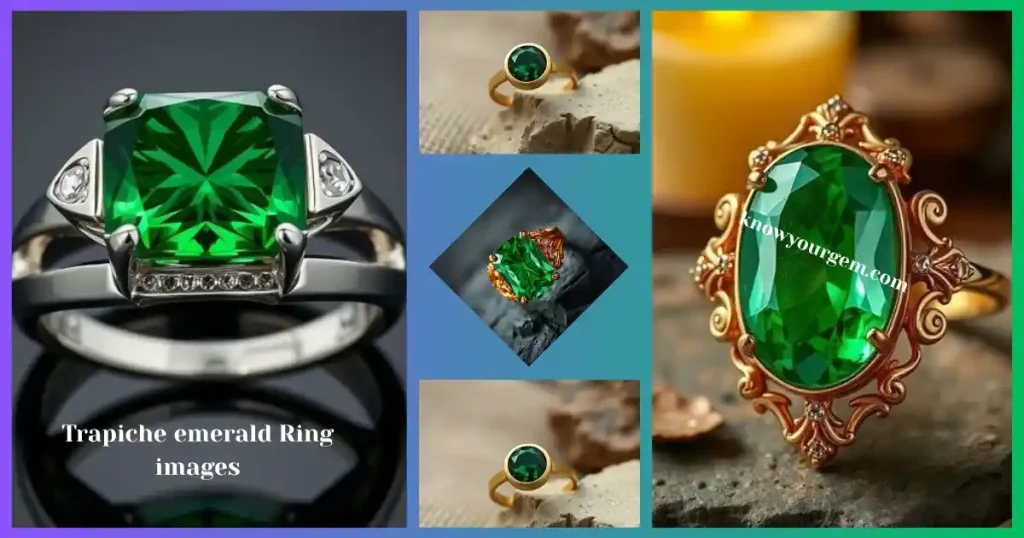
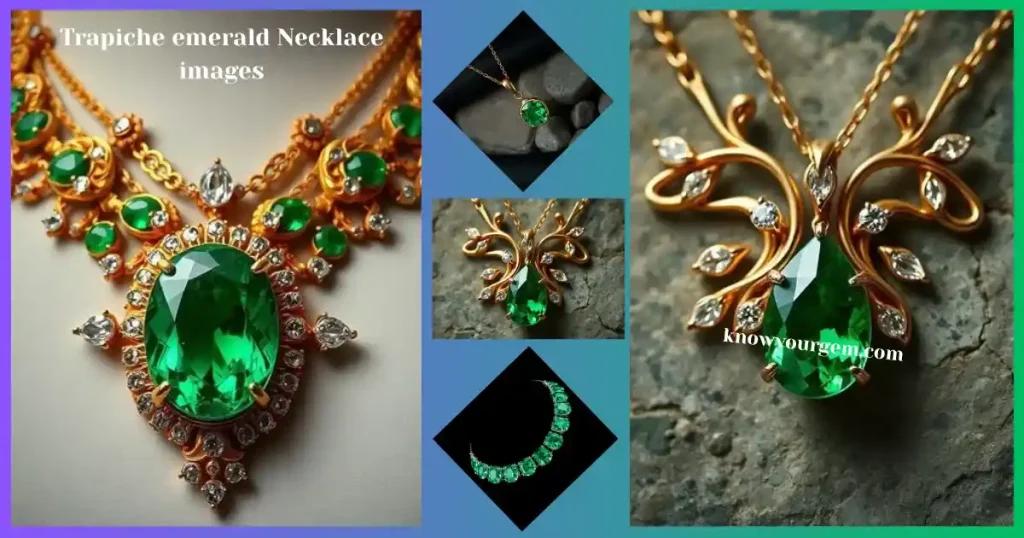
Smaller, stronger trapiche cabochons set in bezes are suitable in wearable jewelry. Bezels cover the sides of the stone and secure cabochons. A trapiche emerald in a ring or pendant provides a conversation-generating image that cannot be matched by an ordinary emerald.
Who should buy one?
A trapiche emerald fits into a number of different types of buyers:
- ·The collector seeking a documented rarity, of geological provenance and visual originality.
- Observer the stone lover who wants to have a gem that has a history beyond the usual beauty standards.
- oven the jewelry customer requiring something different than the ordinary colored stones, whereby no other gem has the visual mark that identifies it.
- The gift-giver who is seeking something really special, something that is not ordinary, and is likely to be a significant gift to a person who already has standard, fine jewelry.
The trapiche emeralds are not the correct option to the customer who values the utmost brilliance, light-play in facets, or the gemological transparency of a high grade faceted emerald. They are popular with those who prefer nature to refined beauty.
The care of a Trapiche Emerald:
If you want do a gentle care of your stone must follow this :
Safe cleaning:
To clean trapiche emerald gently, you must need to use warm water, mild soap, and a soft brush then wash it thoroughly and pat dry with a lint free cloth because this method is safe and non invasive, for preserving the stone and any natural oil treatments it might have.
Use no harsh cleaners, harsh domestic chemicals, and long soaking. Keep the stone apart with the harder gems – diamonds and sapphires will cut an emerald.
The importance of treatments to care:
In case a trapiche emerald is treated with oil or resin to improve its clarity (as a large portion of natural emeralds are), some cleaning techniques will destroy or remove this treatment. Specifically:
- Ultrasonic cleaners have the ability to loosen or dissolve fillings and form or increase fractures.
- The high heat and pressure applied by the steam cleaners to the stone may expand or discolour fillings.
- Solvents like alcohol or acetone have the capacity to dissolve oil based treatments.
- Heat used by jeweler to reset or repair will cause harm to both the stone and treatment.
When a jeweler has to do any repairing, resizing, or setting, always tell him it is an emerald,–a treated one, too,–first. Every honest jeweler dealing in colored stones will be aware of precautions to take.
Questions to ask before purchasing a Trapiche Emerald:
Must consider given below questions before purchasing your jewelry or gem:
Essential pre-purchase questions
The following are questions that should be asked and answered properly before engaging in any purchase of trapiche emerald:
- .Is it a natural emerald? Not artificial, not a fake, not a painted rock.
- Does it contain a separate laboratory report? Yes, what lab, and what does it say regarding species, origin, and treatment?
- What have been the treatments used? In particular, what level of clarity improvement none, slight or substantial?
- What is the mentioned source? Is it recorded as Columbian or is it a matter of unverified origin?
- Why would this particular stone be desirable? Is it the quality of the pattern, the color, its size, its origin documentation or a combination of them?
- What is the policy of the seller? An established seller has a return period, particularly in high-value items.
When to pay more:
An increased price will be reasonable when the stone provides a significant blend of the following:
- ·Powerful pattern symmetry- clear spokes evenly spaced and radiating around an apparent center.
- Attractive green color- vivid, saturated, and well distributed in sectors between spokes.
- Minimal or non-treatment F1 or none/insignificant on a laboratory report.
- Certified Colombian origin-certified by a known gemological lab.
- Credible seller – known reputation, clean disclosures, professional photography and clear return policy.
- Independent lab report of a known organization – GIA, Gubelin, SSEF or similar.
Do not pay a premium to ambiguous provenance, or seller certificates, or stones in which the pattern is slight and the color mediocre. The value attached to a trapiche emerald is gained by known rarity, and not by classification.
FAQS:
1. What is a trapiche emerald?
A trapiche emerald is a natural emerald that has an inscribed, six-spoke wheel-shaped pattern that is created in the growth of the crystal. The sector boundaries of the crystal of beryl form the pattern, frequently stuffed with the dark minerals like albite or carbonaceous matter. It is no coat on the surface, or optical effect.
2. What is the reason why a trapiche emerald has six spokes?
The crystal is produced since the emerald (beryl) crystallizes in a hexagonal system. Six sector boundaries form between the principal growth faces of the crystal as the crystal grows. Foreign material – such as the dark minerals of the host rock the surrounding rock – will settle into those boundaries forming the characteristic six dark rays which are visible in cross section.
3. Are the trapiche emeralds necessarily Colombian?
The most recorded and predominant source is Colombia, especially the Muzo, Coscuez and the Peñas Blancas mines. Colombian material dominates the market with the study reporting trapiche-type emerald crystals to have been found in the Swat Valley of Pakistan. A laboratory report must always be treated as the origin and not based on what the seller describes it to be.
4. Are there trapiche emeralds which are treated?
Most of them are, as natural emeralds more generally. The most common treatment is clarity enhancement with oil or resin. The extent of treatment goes either way without treatment to material treatment and is expected of any reputable seller. A lab report will show the presence and extent of treatment. Good color and strong patterns in untreated trapiche are more valuable and are rarer.
5. Will you know whether a trapiche emerald is a true one or not?
True stones display a structure that runs through the body of the crystal, and geological properties are evident with the help of a magnifying glass – irregular edges, growth-related inclusions, depth. Caution is necessary when there are surface-only patterns or implausibly perfect geometry. An independent laboratory report of a reputed institution like GIA, Gubelin or SSEF is the most certain.
6. Are trapiche emeralds more expensive than normal emeralds?
Not automatically. The price is determined by the quality of pattern, color, size, level of treatment, origin documentations, and market demand. An excellent Colombian emerald, well treated but of a fine, highly faceted, and rare color, may be of more value than a small, dark, and greasy trapiche. The pattern is a value addition to the price of similar stones; although it has to be clear, and the other factors of the quality should favor the price.
7. What are the cleaning instructions of a trapiche emerald?
Use lukewarm water, mild dish soap and a soft brush for gentle cleaning. Wash carefully and blot. Do not use ultrasonic cleaners, steam cleaners, solvents, and heat – all these are likely to damage the stone or otherwise clean off any clarity treatment that it might have. When any setting or any repair work is to be done on a stone, always inform a jeweler that it is a treated emerald.
8. How rare is Trapiche Emerald?
Trapiche emeralds are considered one of the rarest gem-stones in the world, and only a small percentage of Colombian emeralds display the rare six-spoke pattern. They are also crystallized under very specific conditions and intact crystals are exceedingly rare outside of Muzo-area mines.
9. What is a trapiche emerald?
A trapiche emerald is a rare type of emerald with a six-rayed star shape of dark inclusions between sectors of green emerald, as the spokes of a wheel. It is made of a central core and clear green interspersed arms and opaque boundaries of carbon or clay amongst others.
10. Where is emerald found in Pakistan?
The major sources of emeralds in Pakistan are Swat Valley (Fizagat near Mingora), Malakand, Mohmand, Bajaur, and Khaltaro. Swat is a company that manufactures high quality and transparent stones using deposits of Himalayan edges, which has a history dating back to more than 2,500 years. 1 Carat Emerald Value.
11. How much is 1 carat of emerald worth?
1 carat is generally between 100 and 5000 and above USD, depending on color, clarity, source and inclusions. Colombian stones of high quality sell between 2000 to 8000 per carat and treated or low grade stones begin at 100 to 500
The comprehensive guide is written and published by gemstone enthusiast Kamilhussain while using research published in GIA (gemology) and is based on generally accepted standards in the colored-stone industry. In buying important stones, you should always seek an independent laboratory report of a recognized gemological institution.

Welcome to KnowYourGem.com! your ultimate destination for uncovering the fascinating world of gems and their secrets! I'm Kamil Hussain, a passionate blogger with a Master’s degree in Economics, dedicated to bringing you insightful, well researched content that blends the beauty of gemstones with the art of storytelling. With a keen analytical mind and a love for discovering hidden treasures, I created this platform to help you explore the brilliance, history, and value of every gem.

