

QuickCheck:
Kyanite is primarily a blue colored aluminum silicate stone, good-noted as unusual trait: Its hardness often changes, but it depends on which direction you scratch it. And this single insight drives nearly everything about how kyanite is cut, worn, and valued.
A perfect look at the science, the stories, and the shopping side of kyanite. We covered what makes the stone unique in mineralogy, its meaning, that covers how meaningful this stone is for collectors and jewelry buyers. As well as the full spectrum of colors you can find on the market and the practical things to recognize before buying kyanite jewelry.
What Is Kyanite?
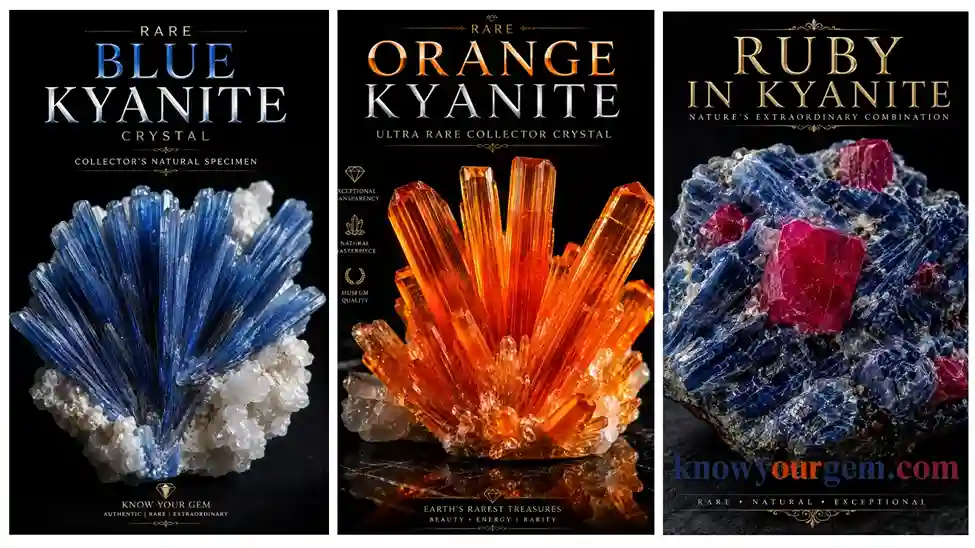
Kyanite is basically an aluminum silicate mineral, which is instantly recognizable for displaying a deep blue color and also for rare directional hardness. The stone doesn’t relate to quartz and garnet, which grow in neat cubes or hexagons; it grows in a long, blade-like crystal system.
Chemistry & Polymorphs:
The chemical formula of Al₂SiO₅ this stone has and this formula is shared with two different minerals named by andalusite and sillimanite. Such are polymorphs: with holding the same chemistry, different structures. The stone forms under high pressure and heat, while andalusite grows under low pressure, and sillimanite under high heat.
Crystal System:
The stone crystallizes in the triclinic system, which is the least symmetrical considered crystal system. And that low symmetry generally describes why the stone behaves differently, hinging on the angle whether you are cutting, scratching, or watching light that pass through it.
Name & History:
Historical confirmation disclosed that Kyanite is related the Greek word “kyanos”(dark blue), which is the root of “cyan.” German mineralogist Abraham Gottlob Werner kept its name in early 1789, since the stone was used long before. Throughout history, its older name was disthene, which reflected its variable hardness and still appears in some European texts.
Kyanite At A Glance:
| Property | Detail |
|---|---|
| Chemical Formula | Al₂SiO₅ (Aluminum Silicate) |
| Crystal System | Triclinic |
| Mohs scale | 4.5–5 parallel to the crystal, 6.5–7 across it |
| Refractive Index | 1.716–1.731 |
| Specific Gravity | 3.53–3.70 |
| Cleavage | Perfect in one direction, good in another |
| Luster | Vitreous to pearly |
| Common Colors | Blue, green, orange, black, white, gray, colorless |
| Transparency | Transparent to translucent |
| Birthstone Status | Not an official birthstone |
| Major Sources | Brazil, Nepal, India, Kenya, Tanzania, Switzerland, Myanmar, USA |
| Typical Price Range | US$5–50 per carat for most faceted stones; fine rare colors can exceed US$100 per carat |
| Common Uses | Rings, pendants, earrings, necklaces, carvings, and mineral collections |
| Treatments | Typically untreated |
| Durability | Moderate; best suited for jewelry with protective settings due to perfect cleavage |
Kyanite Meaning:
Scientific importance and modern symbolism both point to the blue stone.
Scientific Meaning:
Based on science and gemological view, the stone is found in the rocks. Finding it in between the rocks resonates with its formation under certain pressure and temperature; its presence acts as a marker of ancient metamorphic conditions.
Historical Meaning:
The blue stone’s shorter history describes that it is a totally different gem than others. It was mistaken as sapphire and used decoratively before blue gem’s classification in the late 1700s.
Modern Symbolism:
The modern blue stone is generally associated with the symbols of calm, clarity, and honesty. Its associations are inspired by its cool blue tone. And all the symbolism relates to cultural and traditional significance; they don’t compile scientific facts.
Blue Kyanite Meaning:
Blue stone has successfully made a good impression in jewelry and wellness circles. Its well-described symbolism and spiritual healing properties usually help to communicate openly, generate calmness, and clarity as well.
Blue Kyanite Spiritual Meaning:
Blue Kyanite is traditionally and geologically connected to the throat and third eye energy centers. Its well-supporting open communication and mental clarity factors make it more reasonable for wearing as jewelry.
Kyanite Properties:
Not the actual hardness this stone carries, but it is the best thing that every collector sees in it. Kyanite’s striking optical traits and its formation in the Earth make it more unique and useful.
Physical Properties:
It doesn’t stay at a single hardness of 4.5- 5, but it suddenly jumps to 6.5- 7 Mohs, which is a big magic. Its old nickname, disthene, meaning “two strength,” has risen due to the fluctuating hardness. One direction indicates it has perfect cleavage, and another tells the stone has good cleavage tha made it fragile.
Its glassy luster genuinely shows off, and the cleavage surface looks pearly on facet-cut stone. Usually, its crystals grow up as like long blades or columns, but sometimes they form in the shape of fan-like clusters.
Geological Properties:
Kyanite’s specific gravity 3.53-3.70 makes it feel heavier when it is held and compared with quartz. Due to having an extra weight, it is distinguished from lighter blue stones in a simple test report generated by gemologists.
Optical Properties:
1.716 to 1.731 refractive of Kyanite is close to tourmaline. However, its biaxial negativity splits light into two rays that are called birefringence.
And its pleochroism generally adds visual interest that depends on the angle, where blue kyanite can appear colorless, in blue color or violet-blue.
Metaphysical Properties:
Kyanite is traditionally and culturally linked with symbolism like calmness, clear communication, clarity, and emotional balance. But darker blues support grounding positive energies.
Chemical Formula & Classification:
Because of its Al₂SiO₅ chemical composition, the stone fortunately finds a place in the nesosilicate group. The formula indicates that Kyanite shares chemistry with andalusite but in a different structure. Collectors can skip that its colors are made by trace elements like iron, chromium, titanium, or manganese.
How Kyanite Forms:
The metamorphic rocks named schist and gneiss develop the stone under heat and pressure. Due to its formation in a narrow pressure and temperature range, gemologists use it as an index mineral to locate Earth’s metamorphic history. When staurolite, mica, and quartz, and in rare cases near corundum, start to produce ruby-in-kyanite, then the gem appears in garnet.
Colors of Kyanite:
Not even display a single color, but it rules in wide colorations; each color is shaped by distinct trace elements and geological conditions. Such variations valuably give collectors and jewelers plenty of reasons to discover different varieties.
Blue Kyanite:
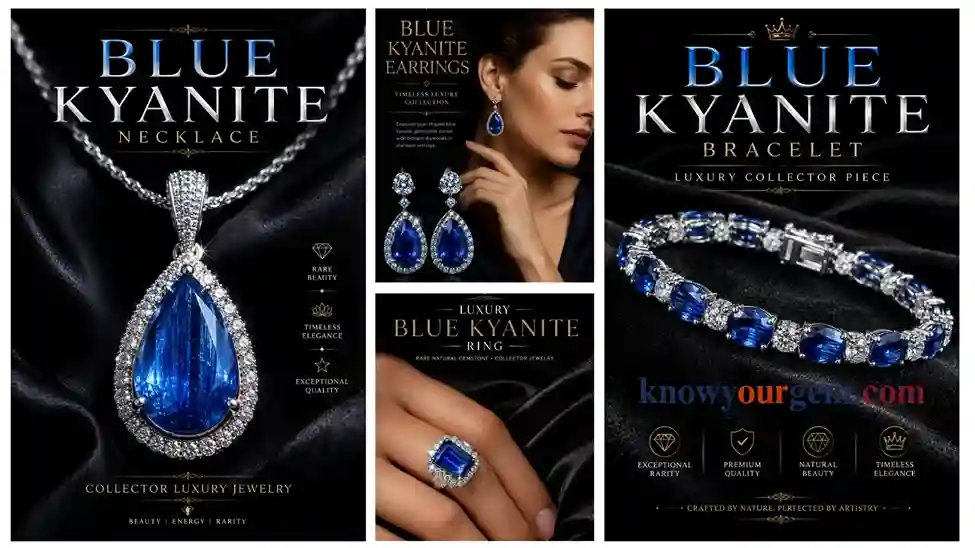
The most iconic and commercially important variety of this stone is blue stone. Trace iron and titanium together produce this color in a range from soft powder blue to deep indigo. Its best pieces are likened to fine sapphire; that is the reason the stone could successfully made attention in jewelry markets.
Green Kyanite:
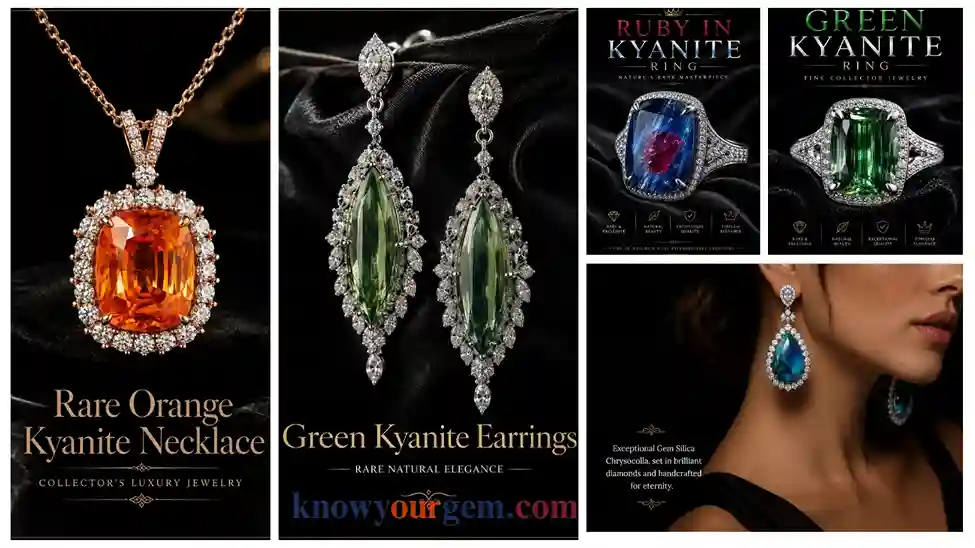
Chromium or vanadium trace elements left a green color glow in the stone. Which is totally different from tourmaline and tsavorite, as its green tones are more muted and earthy. A variety is less commonly found in jewelry, which makes it more interesting to collectors to see as their jewelry, because they usually enjoy unusual mineral colors more than quick finds.
Orange Kyanite:
It can’t be wrong if we call it one of the rarest varieties. Its first discovery in Tanzania around 2011 and still alive with few deposits reasonably make it rare. A warm peach to orange hue on this gem genuinely comes from manganese within the crystal lattice. Due to having few finds and limited supply, its prices touch to the peak.
Black Kyanite:
Natural dense inclusions are generally found in this variety with opaque transparency. Its opaque transparency generally makes the black stone more common in raw or tumbled form than faceted gems. Beaded jewelry especially contains this variety, and metaphysical markets also, where the stone is associated with grounding positive energies.
White, Gray & Colorless:
Generally, this white variety lacks the trace elements which create color. Because of the absence of trace elements, the stone appears white or gray, but sometimes fully colorless. Collectors say that such pale varieties look less striking visually, but collectors rate the purity of these lighter forms.
Rainbow Kyanite:
The most descriptive variety is rainbow because it displays multiple colors in a single body. Mostly blue blends into black or gray is found in the stone. The shifting of trace elements during crystal growth usually affects the colors. This makes it a unique rainbow specimen that can especially appeal to one-of-a-kind jewelry.
Ruby in Kyanite:
This makes a dramatic combination where red corundum crystals grow inside a blue-green matrix, often with green fuchsite mica. No doubt the appearance can be widely different, from scattered red flecks to ruby crystals set that can go against vivid backgrounds. Cabochons, beads, or carvings are reasonably related to the stone rather than faceted gems.
Since ruby is opaque but value depends on its cutting. All these indicate that ruby in kyanite and ruby zoisite look similar but don’t form in a green zoisite host.
Kyanite Mining Locations:
Deposits of this stone can be found on almost every continent; a small number of locations supply qualitative gems that can be sold in the market in high prices.
India:
Particularly fine blue material is found in deposits in states like Andhra Pradesh, and it is also a key source of ruby-in-kyanite matrix material; that’s why it is often called one of the most significant sources that provides fine gems.
Brazil:
It is the hub of producing some of the most saturated, jewelry-grade blue kyanite, with material from Minas Gerais frequently reaching international cutting centers.
Nepal:
A well-known source for producing blue crystals, it could also successfully make its importance known among other sources for providing collector-grade, clear material.
Kenya and Tanzania:
Both sources are part of the East African geological belt. They supply notable kyanite material part of the same East African geological belt, supply notable kyanite material, but Tanzania is specifically responsible for the rare orange variety.
The United States:
In the USA, specifically North Carolina and Georgia, there have been historical deposits for these stones that were mined for industrial purposes in the twentieth century, when gem-quality material was less common, and the current market also couldn’t find it commonly.
Switzerland:
Particularly Alpine metamorphic zones in Switzerland produce well-formed Kyanite crystals that are valued more by mineral specimen collectors than the cut-stone jewelry market.
Zimbabwe:
The location beats the list of significant producers because it contributes both gem-grade and industrial-grade material to the global supply.
Kyanite Value & Price Guide:
The pricing structure of this stone is driven by the same core factors that usually affect most colored gemstones, but with a few Kyanite-specific wrinkles worth understanding before shopping.
Color:
A single and biggest considerable thing that can increase price. For example, the highest prices are considered for stones that display vivid saturated cornflower or sapphire-like blue color. However, less considerable stones show pale or grayish color. Orange or well-saturated green colors are rare; they often command a higher price than mid-tone blue simply due to scarcity.
Transparency and clarity:
These are the most important factors commonly found in a genuine gem, as natural kyanite contains visible fibrous inclusions and internal fractures related to cleavage that make the stone softer.
However, eye-clean transparent material is generally complicated to mine in larger sizes, which often pushes prices up.
Origin:
Ethical origin matters more for genuine gemstones, as Nepal and Brazil deposits are recognized for providing exceptionally saturated, clean blue material that trades at premium prices compared to commercial-grade stones.
Cut quality:
It is a big effect on gemstones’ value; it means a well-cut stone can command higher prices compared to uncut stones. A precisely cut stone accounts for the material’s pleochroism and avoids the cleavage planes that reflect real cutting skill.
Carat weight:
It generally follows the casual gemstone pattern of non-linear pricing, where clean stones can cost disproportionately more per carat compared to smaller ones.
Demand:
The demand for this blue variety is increasingly getting more attention among collectors and alternative-gemstone jewelry buyers, because this stone also offers a sapphire-like blue glow at a low price.
| Quality Tier | Typical Price per Carat (Faceted) |
|---|---|
| Commercial Grade | US$5–15/ct – Included stones with pale or uneven blue color. |
| Good Grade | US$15–35/ct – Moderate clarity with attractive medium-blue color. |
| Fine Grade | US$35–75/ct – Eye-clean stones with vivid, well-saturated blue. |
| Exceptional Grade | US$75–150+/ct – Large, clean gemstones with outstanding color and brilliance. |
| Rare Colors | US$50–200+/ct – Fine orange and vivid green variety command premium prices. |
| Ruby in Kyanite | US$10–80 per cabochon/piece – Value depends on ruby definition, size, polish, and overall appearance. |
The figures in the above chart reflect typical market pricing structure and will shift with market conditions, so treat them as a general reference rather than a fixed price list.
How To Buy High-Quality Kyanite?
The following are the considerations each collector or jewelry buyer must acknowledge before making any buying decision:
Look for even color Saturation:
A collector’s priority for this stone should be its color glow because this stone is pleochroic. But a poor cut can look patchy or washed out. So, rotating the stone under visible light, its blue should stay consistent.
Check for visible fractures, not just Inclusions:
Natural mineral inclusions are generally fine, but fractures and cleavages together can hurt durability. They should affect both price and buying choice.
Ask directly about Treatments:
Genuine sellers don’t hesitate to reveal treatments, especially for high-quality gems, so it is a smart confirmation.
Watch for imitations and Mislabeling:
A gem is usually confused with sapphire or tourmaline. Reputable sellers identify this stone correctly and can provide lab reports.
Favor cuts that respect the rough crystal’s natural shape:
Emerald and cushion cuts generally highlight its color and pleochroism beautifully, so generally look for cutters who follow the grain to get better results.
For collectors, consider sourcing by locality:
Collectors should also consider origin, which adds documentation and value. Stones from Nepal, Brazil, or India generally give a clear sense of what they buy.
Kyanite Jewelry Guide:
The guide below showcases how this stone fits jewelry:
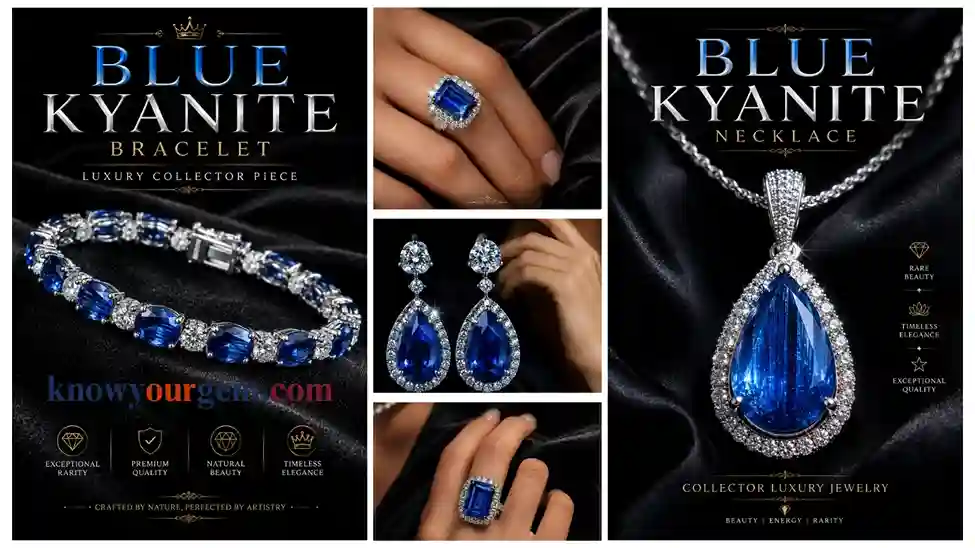
Kyanite Ring:
It is daily-wear jewelry that usually highlights kyanite’s sapphire-like blue color but needs care. Bezel settings protect better than prongs against chips.
Kyanite Earrings:
Drop and dangle designs usually show off color and pleochroism well. As earrings face more wear than rings, that makes them safer.
Kyanite Necklace:
This is among the safest formats because it avoids impact. Bezel pendants add an extra layer of long-term security.
Kyanite Bracelet:
Beaded styles in bracelets take more knocks and friction than other jewelry. It is suitable for occasional wear.
Kyanite Beads:
Blue and black varieties are usually found in beads, which are considered more affordable.
Is Kyanite Durable for Everyday Wear?
Due to its moderate risk, this stone isn’t suitable for daily wear because it has variable hardness and perfect cleavage. It can get scratched and damaged easily compared to sapphire or topaz, and especially in daily wear, rings have a higher risk. Pendants, earrings, and even bracelets are safer formats.
Rings must be fitted in bezel or prong settings that can really protect the stone, but mindful wear is the key advantage to protect the stone.
Raw Kyanite vs Polished Kyanite:
The stone generally forms as natural long blade-like crystals, and that is the genuine thing collectors and buyers often love. These raw stones are usually sold in affordable prices.
However, polished stones like Tumbled, cabochon, or faceted can be treated to boost luster and color while removing surface irregularities, but faceted pieces normally embody the highest tier.
Kyanite Thin Section:
Its thin section is called a rock slice, contains about 30 microns, and mounts on glass for studying under a polarizing microscope. This method is called the petrographic method, which lets geologists confirm a mineral by its optical behavior in polarized light rather than just visible color or shape.
Kyanite and Black Tourmaline:
Black tourmaline and kyanite both can’t form together in nature, but they can be paired in jewelry for contrast. They make a cool blue or black tone which sits against tourmaline’s deep black, which makes this combo popular in beaded bracelets and layered necklaces.
The blue stone kyanite generally links with symbols like clarity and calm communication, while tourmaline has the ability to ground positive energies.
Industrial Uses of Kyanite:
The stone is more suitable for industries compared to jewelry because heating the stone can transform the mineral into mullite, which is more valued heat resistance and stability, and that suits industry rather than jewelry. This property makes ceramics and refractories, which are used for kiln furniture, bricks, and linings.
The stone also plays a big role in spark plug manufacturing, where mullite’s combination of heat resistance and electrical insulation is essential for surviving repeated combustion cycles. In raw shape, these industrial applications draw from the gem market, while showing its versatility.
How to Care for Kyanite:
- Hand cleaning: Using warm water, mild soap, and a soft brush can be an ideal method for cleaning this stone, and avoiding ultrasonic or steam cleaners should be safe.
- Separate storage: It is essential to keep this stone away from harder gems like sapphire or diamond while using a soft pouch or lined box.
- Remove before activity: Wearing off rings and bracelets before engaging in heavy activities like exercise or manual work is the best way to keep the stone safe from scratches.
- Avoid temperature shocks: Avoiding exposure it to sudden temperature changes is usually considered the best method.
- Travel padding: Wrapping each particular piece individually when packing to stop items from knocking against each other.
Frequently Asked Questions:
1. Can kyanite get wet?
The stone can survive a brief rinse, but prolonged soaking in water can wet.
2. Can kyanite go in water?
A short rinse is generally acceptable, but swimming or long submersion can hurt the stone.
3. Does kyanite need to be cleansed?
It doesn’t require cleaning in scientific point of view, but spiritual and traditional practices allow it.
4. What are kyanite energy properties?
The stone has symbols of calm, clarity, and open communication that make it energetic.
5. Is kyanite rare?
Its orange variety is truly rare; however, blue is common, and clean, faceting material is scarce.
6. Is kyanite expensive?
Common stones are generally affordable, but rare stones can be worth it.
7. Can kyanite scratch glass?
The stone can damage glass because it has moderate hardness.
8. Is kyanite suitable for engagement rings?
The stone is not perfect for engagement rings because it contains cleavage and softness, but it is possible with gentle wear.
9. How can you tell if kyanite is real?
Because authentic stones showcase pleochroism and weight; gemologists confirm that with RI tests.
10. What chakra is kyanite associated with?
Its association with the throat and the third eye makes it a spiritual healer.
11. Does kyanite fade in sunlight?
It can fade color under extreme heat but normal light is fine.
12. Can kyanite break easily?
Because of containing prefect cleavage, the stone can break or chip easily.
13. Which color of kyanite is the rarest?
Orange color is genuinely rare in this stone, which only comes from Tanzanian deposits.
14. What minerals occur with kyanite?
Minerals like garnet, staurolite, sometimes Miza, Quartz, and corundum occur in this stone.
15. What is the difference between kyanite and sapphire?
A huge difference between them is their hardness; sapphire carries 9, and kyanite shows 6.5-7 but sometimes low; colors are similar.
16. What is the difference between kyanite and tanzanite?
Tanzanite is a zoisite, which usually displays a violet-blue color shift, while kyanite is made of aluminum silicate with moderate hardness.
17. What is the difference between kyanite and blue topaz?
A big difference between them is Mohs hardness; Since Topaz sits at 8 and kyanite has no fixed hardness.
18. Is kyanite a birthstone?
There is no astrological announcement for it as a birthstone, but it is suggested as September’s alternative to sapphire.
19. Can kyanite be found in the US?
Yes, it is found in the US in North Carolina and Georgia, mainly for industrial use.
20. Does kyanite have healing properties?
Belief-based its healing properties are useful but not scientifically proven.
21. Can you facet raw kyanite at home?
No, it can’t be done because of cleavage and hardness variation; it is best for skilled cutters.
22. Is kyanite magnetic?
it is not itself, but inclusions can cause a weak magnetic response.
23. How is kyanite different from andalusite?
Due to having a chemical formula of (Al₂SiO₅) it is different from andalusite.
24. What metals pair well with kyanite?
The stone can be paired well with silver and white gold, which can enhance its cool blue, but yellow gold can create a warm contrast.
25. Can kyanite rings be resized?
It is risky because of having cleavage; only attempt with an experienced jeweler.
26. Does kyanite come in synthetic form?
It doesn’t come in synthetic form; only natural supply is visible
27. How do gemologists distinguish kyanite from tourmaline?
The stone is distinguished from tourmaline through RI and specific gravity tests.
28. Is kyanite linked to zodiac signs?
The stone is sometimes linked to Libra and Aries in belief systems, not a scientific perspective.
29. Can kyanite be dyed or treated?
It is rarely found in treated or dyed shapes, since the natural color range makes alteration uncommon.
Final Buying Advice and Key Takeaways:
Kyanite offers a sapphire-like blue color at a more affordable price and also with realistic mineral character; this stone successfully draws more attention among collectors and jewelry buyers. Wearing this stone as a ring generally requires bezel or prong protective settings. However, necklaces and earrings are more suitable and safer.
When you shop it you must give priority to factors like color saturation, transparency, and orientation-aware cutting over only selecting based on carat weight. Smaller, well-cut stones generally outshine larger, flawed ones.
Always verify gems with trusted labs like GIA, IGS, SSEF for authenticity, ethical sourcing and Mohs hardness. Gems Enthusiast KamilHussain!

Welcome to KnowYourGem.com! your ultimate destination for uncovering the fascinating world of gems and their secrets! I'm Kamil Hussain, a passionate blogger with a Master’s degree in Economics, dedicated to bringing you insightful, well researched content that blends the beauty of gemstones with the art of storytelling. With a keen analytical mind and a love for discovering hidden treasures, I created this platform to help you explore the brilliance, history, and value of every gem.

