

Quick Insights:
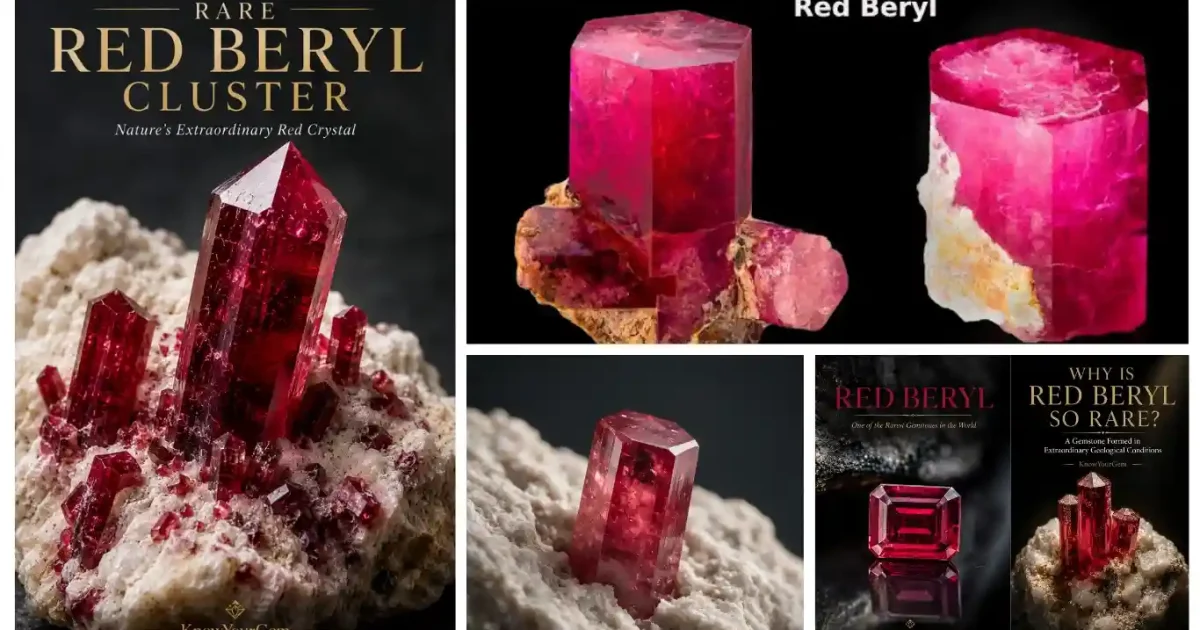
Red beryl is rare on Earth since it is part of the rare beryl crystal family; although its red luminescence is usually associated with emerald and aquamarine, its particular chemical composition causes it to differ from ruby. The stone has a saturated raspberry-red to purplish-red colour which is similar to that of natural ruby but is not original.
Because it is small in size and because of its limited availability together with the scarcity of facetable rough material, it is generally rather attractive to collectors when compared to other colours. In the Wah Wah Mountains in Beaver County (Pennsylvania, USA), materials of commercial grade that are under one carat are found, the crystals being of topaz rhyolite shape.
The guide takes into account the properties, colour, way in which it is formed, places where it is found, rarity, value, methods of identification, its synthetic equivalents, the care required for jewellery made from it, and the factors to consider when buying it.
Red Beryl at a Glance:
| Family | The stone belongs to the Beryl family |
| Type | It is a Red colored beryl, historically called Bixbite |
| Composition | Be₃Al₂Si₆O₁₈ is red colored beryl’s chemical formula |
| Forms in | Hexagonal crystal system |
| Color saturation | It glows purplish red, raspberry red, red, and orange-red |
| Trace element | Red colored beryl is made of Manganese, especially Mn³⁺ |
| Mohs scale | 7.5–8 |
| RI | Approximately 1.564–1.574 |
| SG | Approximately 2.65–2.72 |
| Birefringence | Usually about 0.004–0.008 |
| Luster | Vitreous |
| Pleochroism | It has a moderate to strong ability to show off different colors at different angles |
| UV fluorescence | Generally inert |
| Principal commercial source | Ruby-Violet mine, Wah Wah Mountains, Utah |
| Host rock | Topaz-bearing rhyolite |
| Typical faceted size | Small; larger clean stones are exceptionally rare |
What Is Red Beryl?
A so-called rare variety of beryl which also contains other minerals, like emerald, morganite, heliodor, and goshenite. The beryl family group is made of beryllium silicate and crystallizes in the hexagonal system.
The main beryl is known for appearing in different colours, such as red, green, blue, pink, yellow or colorless are produced by small quantities of other elements which exist within the crystal. Although manganese plays a main role in producing the red colour in rare cases.
The oxidation state of manganese, Mn3+, usually has an important effect on giving the material its reddish-purple-red look. Iron and other negligible elements can also affect the intensity and shade of the colour. Bixbite is the preferred moderate name, but the older literature and mineral dealers can use bixbite, a historical name that was introduced in honour of Maynard Bixby.
Red beryl vs emerald:
The stone has a similar glow to emerald with the same species, but their colors are produced by different trace-element systems:
- The red colour of Bixbite comes from manganese metal.
- The green emeralds generally come from a chromium-vanadium combination.
Beryl generally forms in rhyolite but emerald grows in hydrothermal settings. Both are tough, often with (7.5–8 Mohs), and ideal for everyday jewelry.
Red beryl vs ruby:
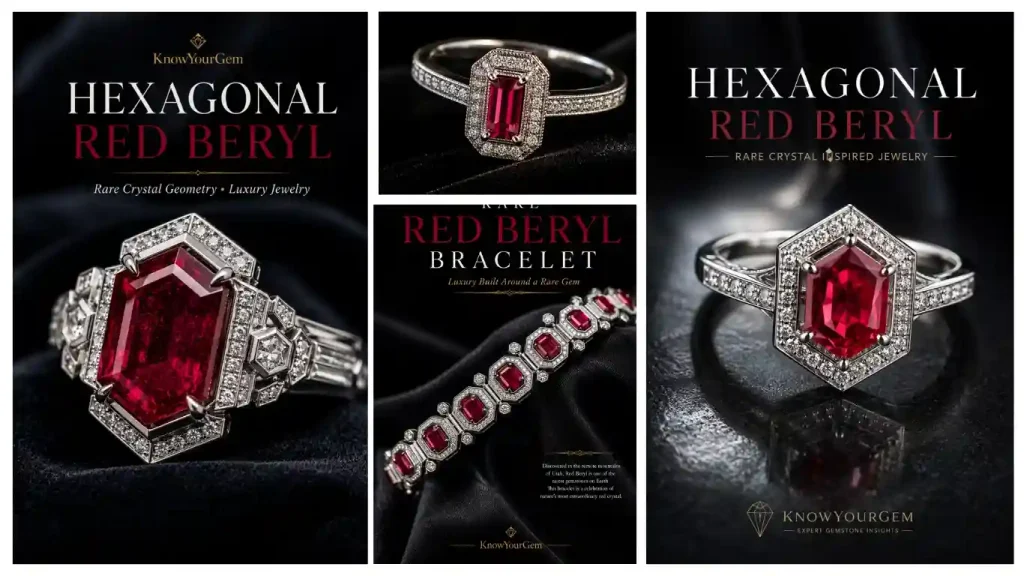
Both stone can look the same in color but they have different mineral compositions. Ruby is a part of corundum, and Bixbite is belongs to the beryl family.
Their color also comes from different elements, since ruby gets its red from chromium and beryl’s red comes from rare tiny amounts of manganese. On is only found in the Utah mountains; another can be in some different areas. Their refractive, Mohs, and inclusions also vary.
Why Is Red Beryl So Rare?
Forming a rare stone requires an extremely unusual combination of conditions. The process by which the gem-quality crystals are formed needs:
- Fluids high in beryllium as they move through the rock.
- Something that provides manganese and which can cause the red color.
- Spaces that are open, such as cavities or fractures, are suitable for crystal development.
- Rather than the granite component found in most pegmatites, the setting is volcanic and consists generally of topaz-bearing rhyolite.
- It requires the right temperature and pressure.
Red beryl is seldom. It is tough to find it with all these factors are the reason for its rarity also. The specific areas where we can only find gem-quality pieces of this rare material.
Is red beryl rarer than diamond?
Based on gemological perspective and collectors point of views Bixbite is generally considered as a rarer than diamond, but its chemical composition hinges on the context. However, the hardest variety of diamond is usually mined in large amounts, especially colorless diamonds.
But due to limited deposits, Bixbite is generally encountered in small pieces, including natural inclusions to allow faceting. The Utah Geological Survey has given an estimate stating that there is about one red beryl crystal for every 150,000 diamonds that are recovered.
It should be regarded as an illustrative estimate of rarity rather than as a universally verified ratio of global production. geology. The most defensible conclusion is that facetable red beryl is considerably rarer than ordinary gem-quality diamond, in particular in larger sizes and with strong colour.
Why are large red beryls uncommon?
Red beryl crystals usually do not offer a sufficient amount of unblemished rough material for large faceted stones, since many of them are only a few millimetres in size and even the larger ones can have fractures or opaque areas of growth.
In order to eliminate the damaged sections, cutters generally remove a large amount of the rough material and arrange the most solid colour to face the direction for different angle views.
Red Beryl Color and Appearance:
A single variety appears in different color saturation from pinkish-red and raspberry to purplish-red.
What is the best red beryl color?
The finest color is generally described as:
- Vivid.
- Strongly saturated.
- Even in the case of the face-up view.
- Red, ranging from raspberry to a purplish red.
- Without excessive brown, gray, or orange tinting.
The assessment of colour is subjective and varies according to the lighting, the cutting style, the colour of the stone, and its transparency; a stone which seems richly red in one kind of lighting can appear more purple or pink in another.
Why is red beryl red?
Because its red color comes from rare tiny amounts of manganese metal which exist inside the stone. The color glow depends on how much the mangense is there, more manganese makes a pinkish-red, raspberry, or purplish-red glow.
Color zoning:
Color zoning is a feature found in many red beryls. Certain crystals have bands or patches with different concentrations of the elements which cause the colour. When the rough stones are cut, the orientation can be arranged so that the most intense colour appears in the face-up direction.
Well-cut stones usually show an attractive, vivid color, and their noticeable areas can’t be pointed out or dark regions distracting. So due to its rarity, gem cutters generally compromise for its color, clarity, and weight retention.
Transparency and clarity:
Transparent red beryl is rare. Most of the crystals are either full of inclusions or broken, and material that is strongly saturated can be less transparent than pale material.
Eye-clean red beryl is rather valuable since clarity of this kind is not normal for the variety; inclusions shouldn’t be regarded as defects in a gemstone collected for its collection value, though fractures close to the surface can have an effect on durability.
Red Beryl Gemstone Properties:
Chemical composition:
Its chemical composition Be3Al2Si6O18\mathrm{Be_3Al_2Si_6O_{18}}Be3Al2Si6O18 makes it one of the rarest minerals in gemology. As well, manganese is the crucial element that is responsible for the stone’s red color.
Crystal system and habit:
Red beryl has a crystal structure that is hexagonal, and its natural crystals generally take the form of elongated prisms having a six-sided cross-section. While crystal habit helps to identify it, especially in the case of specimens.
Hardness:
It is hard with 7.5-8 Mohs and suitable for daily-wear jewelry but if the stone contains inclusions and fractures naturally, then protective settings like bezel and halo are necessary for rings.
Refractive index:
The figures given by different sources vary slightly depending on the specimen and the method of testing. The values reported are approximately:
- nen_ene: 1.560–1.570. nωn_\omeganω:
- 1.567–1.572.
- Its total measured refractive index is 1.564 to 1.574.
Birefringence:
It displays a weak birefringence like about 0.004 to 0.008. But its exact value depends on the specimen and the method of measurement, which means how it can be measured.
Specific gravity:
Red beryl has a specific gravity of 2.65–2.72, which makes it heavier, and especially stones from Utah can contain around 2.66–2.70. The specific gravity combined with refractive index can help to identify authenticity but it is not reliable on its own.
Pleochroism:
The stone carries moderate to strong pleochroism, and it showcases colors from purplish-red, orange -red to brown-red based on different directions. Cutters can use pleochroism to ensure that the rough stone is oriented so that the most attractive face-up colour is shown.
This orientation process consists of balancing the intensity of the colour against the amount of weight that is retained and the clarity.
Luster:
When it has been polished, red beryl has a vitreous or glassy appearance which is typical of beryl.
Fluorescence:
Natural red beryl stays the same under UV light; however, rubies often glow with strong red fluorescence. This is a huge difference can help gemologists to separate the two minerals.
How Does Red Beryl Form?
It is formed in a particular volcanic environment which is connected with topaz rhyolite igneous rock a high in silica and can contain cavities and fractures that are caused by gas expansion cooling.
In the last phase of cooling, hot vapours or liquids containing beryllium passed through these areas; red beryl then formed when they came into contact with material containing manganese under the appropriate chemical conditions.
The crystals are usually found along fractures, such as those filled with clay, and also appear in the cavities of the rhyolite; this is different from the pegmatitic environments which produce many aquamarines and other beryls.
Minerals associated with red beryl:
Depending on locality, associated minerals may include:
- Topaz.
- Bixbyite.
- Spessartine or related garnet.
- Hematite.
- Pseudobrookite.
- Quartz.
- Feldspar.
Minerals of this kind are useful for the study of coarse specimens or for determining geological provenance. However, on their own they cannot prove that a cut stone is natural red beryl.
Where Is Red Beryl Found?
Red beryl has been found at only a very limited number of localities, with significant occurrences in parts of Utah and New Mexico, although commercial gem production is mainly linked to one deposit in Utah.
Wah Wah Mountains, Utah:
The mine known as the Ruby-Violet, or the Red Beryl mine, located in the Wah Wah Mountains in Beaver County, is the main instance of gem-quality red beryl being obtained commercially and is generally considered to be the definitive source of facetable material.
Red beryl at this site is found in topaz rhyolite, mostly occurring along fractures and in cavities. Although a great deal of it is too small or embedded to be cut, the deposit has yielded the finest faceted examples that are known.
Thomas Range, Utah:
Red beryl was first identified in the Thomas Range in Juab County, Utah, and the region is still of historical significance since it contains red beryl crystals, though a great deal of the material is small or not suitable for faceting.
Black Range, New Mexico:
The Black Range in New Mexico is also said to be a case of this kind. Since the stones from New Mexico are generally of less significance to the international gem trade than those produced in the Wah Wah Mountains, they are not as important.
Is Utah the only source?
Not at all; red beryl has been found in places other than Utah, such as in New Mexico. Yet Utah particularly the Wah Wah Mountains is the area most closely associated with commercially valuable gem-quality material.
Red Beryl Size and Rarity
The rarer red beryl becomes the greater its carat weight and the higher its clarity.
| Finished Size | General Market Significance |
| 0.05-0.10 ct | In such weights only small specimens are found. |
| 0.10-0.25 ct | Stones with these sizes are ideal for collectors and jewelry. |
| 0.25-0.50 ct | They are noticeably scarcer when they contain a strong color and good transparency. |
| Above 1 ct | This type stone is rare, particularity when the color look more strong and clarity looks best. |
| Above 2 ct | They are exceptional pieces and usually sell expensively with documentation. |
Is a one-carat red beryl rare?
Yes, a one-carat red beryl that is natural, transparent, and well-coloured is an exceptional gemstone for collectors. The price will vary according to the stone’s real quality, its cut, the documentation and the seller not just its weight.
Red Beryl Inclusions and Clarity
Common inclusions and internal features include:
- Fractures.
- Fluid inclusions.
- Cavities.
- Color zoning.
- Growth tubes.
- Mineral inclusions.
- Internal stress features.
The fact that they have these features shows how difficult the conditions were which led to the crystals being formed; furthermore, they can assist a laboratory in telling natural red beryl apart from synthetic material.
Just because a stone has no fractures doesn’t mean that it is natural, and likewise just because a stone contains inclusions doesn’t mean that it is genuine. Identification can only be made on the basis of the full combination of optical, microscopic, spectroscopic, and chemical evidence.
How to Identify Red Beryl?
Instead, a gemologist should carry out various tests when identifying red beryl rather than depending on its appearance. Visual examination
Visual examination:
The initial examination may consider:
- Raspberry-red to purplish-red color.
- The crystal has a hexagonal habit and is rough.
- Strong pleochroism.
- Typical inclusions and zoning.
- Inert UV behavior.
It is possible that these observations indicate red beryl, but they cannot establish its identity.
Refractive-index testing:
A refractometer results for the stone 1.564 and 1.574 refractive indices, which is compatible with red beryl and differentiates it from ruby, which has a much higher refractive index.
Specific-gravity testing:
A specific gravity within the range of 2.65 to 2.72 is consistent with the stone being beryl. This test should be understood in conjunction with the refractive index, birefringence, and microscopic evidence.
Dichroscope examination:
The stone shows different color variations if it is seen from different angles. It looks in purplish-red, orange-red, or even orange-red. It’s helpful for identification, but not strong enough on its own to prove what the gem is.
Microscopic examination:
- A laboratory may examine:
- Natural growth zoning.
- Fluid inclusions.
- Fracture patterns.
- Mineral inclusions.
- Crystal-growth morphology.
- Characteristics related to the treatment or the synthesis.
Spectroscopy and chemical analysis:
Absorption spectroscopy can be used to identify manganese-containing red beryl, and more advanced laboratories can make use of chemical analysis and infrared spectroscopy in order to tell natural material apart from synthetic material.
Laboratory reports:
If you are making a worthwhile purchase, get a report from a reputable gemological laboratory, and the report should clearly state:
- Whether the stone is natural or artificial.
- The identified gem variety.
- Whether treatment is present.
- Comments concerning the origin or any unusual features.
- Natural and Synthetic Red Beryl
Natural and Synthetic Red Beryl:
Does synthetic red beryl exist?
Yes, hydrothermal synthetic red beryl has been produced, including specimens linked to the Institute of Crystallography in Moscow. The GIA looked at synthetic stones that varied from red to orange-red and were considerably larger than many of the natural faceted ones.
How is synthetic red beryl identified?
GIA reported several features that can help identify hydrothermal synthetic red beryl:
- Crystals in table form with square cross-sections.
- Chevron-like or wavy patterns in internal growth zoning.
- There are fewer inclusions than in ordinary natural material.
- There are strong absorption bands associated with cobalt.
- The presence of cobalt and nickel.
- Water-related infrared absorption features.
The fact that cobalt and nickel are present in the right analytical context may indicate that the material is synthetic, but it is up to a qualified laboratory to reach final conclusions rather than an assessment by an informal seller.
Is synthetic red beryl common?
Synthetic ruby and synthetic emerald are far more common in the market than it is. The low demand for the material and its specialist character have kept its commercial presence limited. Yet because it exists, it is important to have laboratory records for valuable stones.
Can Red Beryl Be Treated?
Red beryl treatment information must be handled with care, since unlike that of ruby and sapphire the red beryl does not have a large and well-established treatment market with generally accepted commercial practices.
A seller must make known any treatment that is known to them, and buyers should not suppose that a stone with no documentation has not been treated just because the seller calls it “natural”. For a significant purchase, ask the laboratory to state:
Whether the material is natural or synthetic.
Whether treatment is detectable.
Whether or not the stone has been made clearer, filled, coated, or in some other way altered.
How Much Is Red Beryl Worth?
The prices for red beryl vary from case to case and there is no price list that is generally accepted and applies to all stones. Value depends on:
- Color saturation.
- Hue and modifying tones.
- Transparency.
- Clarity.
- Carat weight.
- Cut quality.
- Natural or synthetic status.
- Treatment disclosure.
- Laboratory documentation.
- Provenance.
- Seller reputation.
- Current collector demand.
Red beryl price per carat:
Current market states that high-quality rough stones large enough to be faceted could yield finished stones that sell for as much as about US$2,000 per carat. However, this figure is historical and only indicative, not a guaranteed current market price.
| Material and quality | Approximate 2026 price |
| Common rough or specimen material can command prices like | US$1–50 per carat |
| Small included faceted stones are sold for | About US$1,000–4,000 per carat |
| Fine 0.20–0.50 ct stones with vivid color generally command | About US$4,000–12,000 per carat |
| Exceptional, clean natural stones charge | US$12,000–50,000+ per carat |
| Large collector-grade stones over 1 ct | Individually negotiated; potentially much higher |
Current pricing should be discussed using quality categories rather than a fixed universal range:
| Quality category | Typical description | Pricing tendency |
| Commercial | These stones are Pale, heavily included, or poorly cut | contain lower value |
| Fine | They are attractive in color with having moderate inclusions | They are collectors pieces |
| Extra Fine | They have vivid color, good transparency, and attractive cut | And are considered as premium quality |
| Exceptional | They are usually found large in size with vivid, clean, natural and are verified | Individually negotiated pieces |
| Museum-grade | Extraordinary size, color, clarity, and provenance | Rarely offered publicly |
What makes red beryl expensive?
The key factor in determining value is the limited availability of appealing natural materials; this effect is even more pronounced when rarity is combined with:
- The colour is vivid and raspberry or purplish-red.
- Good transparency.
- Eye-clean clarity.
- Strong face-up appearance.
- Well-proportioned cutting.
- A report issued by a reputable laboratory.
- A documented Utah provenance.
Is red beryl more expensive than diamond?
Yes. Red beryl is far more expensive than commercial-grade diamonds, but their difference shouldn’t lie in price, as even diamonds are found in much larger sizes and in a more standardized international market. High-quality diamonds should be sold more expensively than red beryl when we look at the absolute pricing structure.
Red Beryl Buying Guide:
What should be checked before buying:
Ask the seller for:
- Exact carat weight.
- Measurements.
- Natural or synthetic status.
- Treatment disclosure.
- Laboratory report.
- The stated location together with the evidence in support of it.
- Use clear photographs or videos taken in neutral lighting.
- Remove the cut style and any visible windowing.
- Return policy.
- Seller credentials and references.
Warning signs
Be cautious when a listing:
- Refers to the stone as “red emerald” without providing any explanation. Makes extreme rarity claims but does not provide a report.
- Does not state the exact carat weight.
- It displays only photographs that have been heavily edited.
- Make a specific claim regarding a mine for which there is no provenance. Does not answer questions about treatment or making something.
- The price of a small included stone is that of an exceptional collector’s gem.
- Provides a “laboratory certificate” from an organization that is either unknown or not verifiable.
Is origin important?
While the origin of a stone can increase interest among collectors, a locality claim should not be accepted outright. Determining the geographic origin might necessitate sophisticated laboratory testing, and not all laboratories provide an opinion regarding the origin of red beryl. A report which identifies the stone as natural red beryl is usually more significant than an unbacked mine claim.
Is red beryl a good investment?
No doubt red beryl is a rare mineral, it attracts collectors, but it is too early and might be wrong to say that the stone is surely an investment piece because of small market where public price data, and resales could take a long time. Collectors should prioritize:
- Natural status.
- Strong color.
- Transparency and clarity.
- Attractive cutting.
- Laboratory documentation.
- A reputable purchase source.
A price that can be considered justified without having to depend on claims of exaggerated rarity.
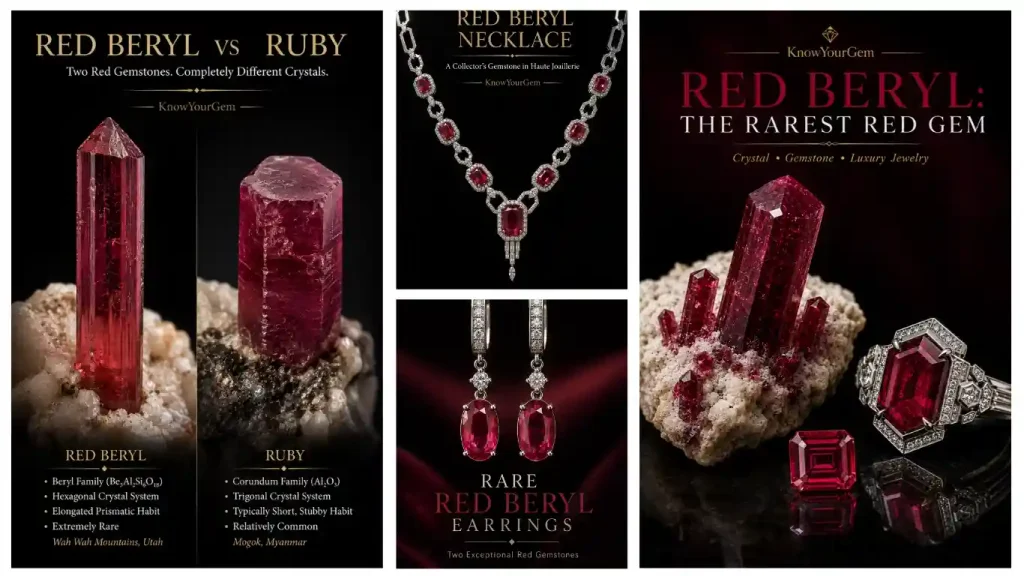
Red Beryl in Jewelry:
Is red beryl suitable for rings?
Yes the stone best matches everyday-wear rings because it has 7.5-8 Mohs hardness. But sometimes its specimens come with inclusions and fractures that can need of protective settings like bezel and halo to prevent scratches.
Remove a red beryl ring during:
- Manual work.
- Sports.
- Gardening.
- Household repairs.
Things that involve impact or pressure.
Red beryl engagement rings:
In an engagement ring the stone can look more attractive and can glow with a more reddish sparkle but it is not as strong as sapphire and diamond it needs proper care and also requires protective settings, especially for daily use.
The person who is buying it should pick a stone that is durable, steer clear of obvious fractures, and select a setting which guards the girdle and the corners. Since large faceted stones are rare, a great many red beryl engagement rings have a small central stone or a cluster design.
Earrings and pendants:
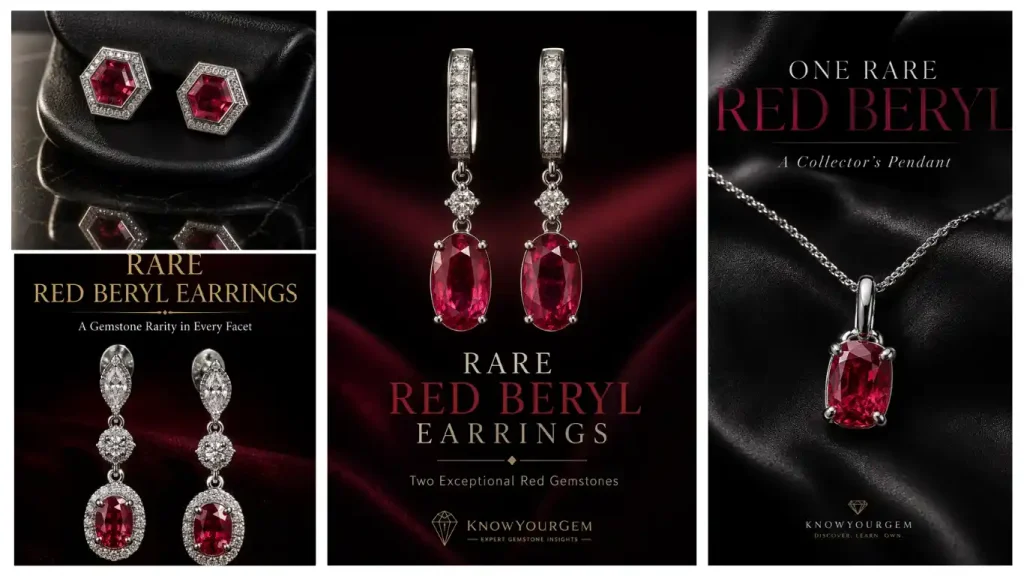
Earrings and pendants are a practical option since they suffer less impact than rings and their styles also suit the small sizes in which red beryl is most often available.
Cabochons:
Rough that is included or translucent can be cut into cabochons; such stones have the advantage of showing attractive colour and offer a more accessible method of obtaining red beryl, although cabochons should not be priced as if they were fine transparent faceted gems.
Red Beryl Care and Cleaning
Clean red beryl with:
- Lukewarm water.
- Mild soap. A soft brush.
- A soft, lint-free cloth.
Avoid:
- Steam cleaners.
- Ultrasonic cleaners.
- Sudden temperature changes.
- Harsh chemicals.
- Abrasive powders.
- Contact with harder gems like diamond, ruby, and sapphire.
Ultrasonic or steam cleaning shouldn’t be avoided for every piece, but some specimens can contain inclusions, and fractures can get damaged when you use ultrasonic or steam cleaners; so be alert for that purpose.
Red beryl must be stored separately from harder gemstones to keep prevent its natural sparkle.
Red Beryl Versus Ruby:
| Property | Red Beryl | Ruby |
| Family | Beryl | Corundum |
| Composition | Be₃Al₂Si₆O₁₈ | Al₂O₃ |
| Colored by | Manganese | Chromium |
| Habits | Hexagonal | Trigonal |
| Mohs scale | 7.5–8 | 9 |
| RI | About 1.564–1.574 | About 1.762–1.770 |
| SG | About 2.65–2.72 | About 3.97–4.08 |
| Pleochroism | This stone has moderate to strong, colors like purplish-red to orangy-red | While it has variable, often distinct |
| UV response | Generally inert | Often shows red fluorescence |
| Typical availability | Extremely limited | Much more widely available |
| Typical faceted size | Usually small | Available in a wide range of sizes |
Which is rarer?
Its facet pieces are rarest because they are less commonly found in specific deposits compared to ruby. Especially in large sizes, transparent specimens are even more seldom.
Which is harder?
Ruby is harder than all beryl varieties and is also a better option for everyday wear without any protective settings.
Which is more valuable?
Ruby is a highly valuable gemstone it is found in large and small sizes, but the value is only imposed based on how large the stone is. That’s why gemologists always say ruby is more valuable than red beryl.
Red Beryl Versus Other Red Gemstones:
| Gemstone or Material | Main Distinguishing Feature |
| Ruby | It is a red stone variety of corundum gets its color from chromium. |
| Red Spinel | A red stone as like ruby with no typical ruby-like pleochroism. |
| Rubellite | A rare red-to pink tourmaline variety with having strong |
| Garnet | It is a strong silicate mineral with different optical properties. |
| Red Glass | It is an Amorphous material, it doesn’t crystallize in crystal system. |
| Synthetic Ruby | It is lab-grown materiel and alternative of natural ruby but is sold for price less. |
| Red Beryl | The rare variety of beryl which gets red color from manganese metal. |
Red Beryl Meaning and History:
In addition to its mineralogical importance, red beryl has become a symbol for today’s world. It is known by the name of bixbite after Maynard Bixby, who discovered minerals in Utah in the early days of Utah’s history.
In order to avoid being confused with the mineral bixbyite, it is now called simply red beryl. In some forms of crystal-healing or spirituality, red beryl is thought to contain the passion, courage, vitality, motivation and emotional strength of those who wear or hold it. These are mere cultural associations.
Frequently Asked Questions:
1. Is red beryl rare?
Yes. it is a fact that red beryl is a rare mineral; especially its gem-quality specimens are seldom found in Utah’s Wah Wah Mountains.
2. Is red beryl rarer than a diamond?
Yes, its facetable varieties are significantly rarer than diamond, especially it is tough to find them in large sizes.
3. What’s the value of red beryl?
The stone’s value totally depends on its key factors like color, size, quality, and flaws. Smaller specimens usually bring lower prices, however, vivid, clear, more saturated ones can be sold for premium prices.
4. What’s the value of a one-carat red beryl?
There isn’t a set value. A single-carat natural vivid and transparent red beryl is evaluated on a case-by-case basis.
5. Is red beryl more expensive than a diamond?
The finest red beryl can easily exceed diamond prices per carat, but values can vary across different markets. Where
6. can you find red beryl?
Ruby-violet red beryl can be found in the Wah and Thomas ranges of Utah and the Black Pikes in New Mexico.
7. What is the Ruby-Violet red beryl mine?
It’s the main commercial source of gem-quality ruby-violet red beryl, located in Utah’s Wah Wah Mountains.
8. What does red beryl look like?
It typically displays a color range from raspberry to orange-red, and the faceted stones are often on the smaller side.
9. What gives red beryl its color?
A rare metal, manganese, which is generally present in its crystal system, gives it its red glow.
10. Does red beryl fluoresce?
Natural ruby-violet red beryl doesn’t show fluorescence.
11. Is red beryl classified as an emerald?
No you can’t classify red beryl as emerald, because both are separate minerals with different colors, chemical composition, and crystal system.
12. Is red beryl considered a variety of ruby?
You can’t consider red-colored beryl as a variety of ruby because they both are different varieties that belong to different mineral families.
13. Can jewelry be made from red beryl?
Yes, you can wear it as jewelry as well as daily-wear rings, but protective settings are needed.
14. Should red beryl be used for an engagement ring?
It is possible with protective settings like bezel and halo, but if you want an engagement ring without a protective setting, then you should go with sapphire and ruby.
15. Can you create red beryl artificially?
Yes, but it requires lab conditions with traces of either cobalt or nickel. How can you distinguish red beryl?
16. Is it safe to use an ultrasonic cleaner for red beryl?
Ultrasonic cleaners are generally safe for normal specimens but stones with inclusions and fractures can be washed or cleaned with warm water, gentle soap, and a soft brush.
Final buying advice:
The most safe approach when buying red beryl is to view it as a gemstone for specialist collectors rather than as a standard commodity. You should concentrate initially on its natural status, colour, clarity, the way it’s cut, and the laboratory documentation. Mine claims, comparisons with regard to rarity, and any promises concerning investment should be treated with caution unless they are backed by reliable evidence.
Sources and further reading:
The mineralogical and gemological information in this guide is based primarily on research and educational material from the Utah Geological Survey and the Gemological Institute of America, including studies of red beryl from Utah and documented hydrothermal synthetic red beryl.
Written and published by Gem enthusiast KamilHussain!

Welcome to KnowYourGem.com! your ultimate destination for uncovering the fascinating world of gems and their secrets! I'm Kamil Hussain, a passionate blogger with a Master’s degree in Economics, dedicated to bringing you insightful, well researched content that blends the beauty of gemstones with the art of storytelling. With a keen analytical mind and a love for discovering hidden treasures, I created this platform to help you explore the brilliance, history, and value of every gem.

