
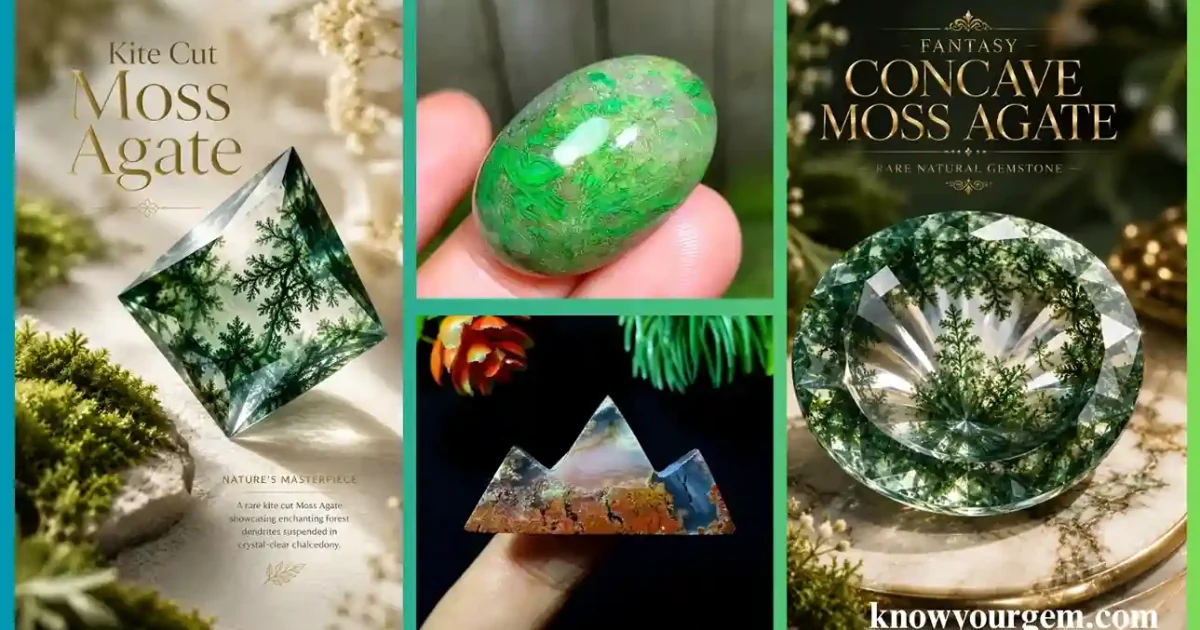

Quick Answer:
Moss Agate is a natural form of quartz that contains internal deposits that resemble moss forms. Each is individual, almost like miniature maps. It must be an interesting choice for an engagement ring because of its nature, organic and mysterious appearance.
It is easy to wear due to the stone’s hardness of 6.5-7 on the Mohs scale and its natural resilience, when properly cared for. Costs are level with many everyday stones, normally between $5-$50 per carat, but with added costs for rings of designer choice.
Key Takeaways:
- Hardness: A stone is hard. 6.5- 7 Mohs
- Formation: The formation of this stone occurs when groundwater that contains silica enters the abundance of cavities in a volcanic rock and then deposits more minerals in them for billions of years.
- Durability: Relatively durable compared to other harder gemstones such as sapphires. Usually needs a setting to ensure it is protected.
- Jewelry: It is generally used in jewelry; popular items are rings, necklaces, bangles, earrings, and necklaces covering the neck, in particular the nature-inspired design.
- Meaning: Commonly accepted to represent growth, abundance, and earth energies, it is fundamentally based on belief and can not stand up to scientific studies.
- Benefits: The stone is looked upon favorably for its uniqueness in design, symbolic value, and low cost, as opposed to any demonstrated health effect.
- Price: Moss agate is relatively inexpensive; it is generally priced at a few dollars a carat for rough-cut material, but will fetch a premium price for a high-quality cabochon with a well-developed pattern.
Introduction:
The ring has moved from being in a niche in the collectors’ market and is now a hot trend. The ring is a favorite of designers, as each individual ring has a different mossy pattern, so ‘every ring is different’.
Moss agate engagement rings: couples select these as a means of emphasizing one’s personal excellence and character as opposed to emphasizing the uniformity in diamonds.
It also has symbolic meaning. It’s associated with nature, development, and earthy forces, so because of that it has a symbolic value to just its visual qualities. The beauty of it isn’t the only aspect people buy into.
What Is Moss Agate?
Moss Agate is natural variety of Quartz and displays bright green moss-like shapes within it, reminiscent of minuscule plants. In spite of the name referring to Agate, it generally does not have the crystallized bands seen in true Agate, and the name has just been retained due to the old naming habits of the gem collectors, tradesmen, and jewelers.
The design depicts the illusion of plant life trapped in glass, but it is a fact to be aware of. Cabbage leaves are not represented on the surface of this mineral, as they are purely the way the minerals are deposited or form.
There is some argument among gemologists as to whether it should be classed as “realistic agate”, however, this trade name has been in operation officially for many years! Buyers can therefore have no panic over using this as a recognized classification for Moss Agate.
Moss Agate Formation:
Moss Agate is a type of chalcedony quartz that displays green moss or plant-like inclusions within a clear stone. The name is used more out of convention than of true gemology as agates are systematically banded as per classical definitions.
Its patterns give the appearance of shrubbery lodged within the glass, yet, once examined, the stone reveals itself as devoid of any tangible moss or flora, only minerals are present. This creates a misconception for many first-time purchasers.
Whether or not it is “realistic agate” is a matter for the gemologists; however, the trade name has been in use for hundreds of years. For practical purposes, Moss Agate is one sector of the wider range of semiprecious stones, and a buyer can be assured of purchasing as one.
Moss Agate Inclusions:
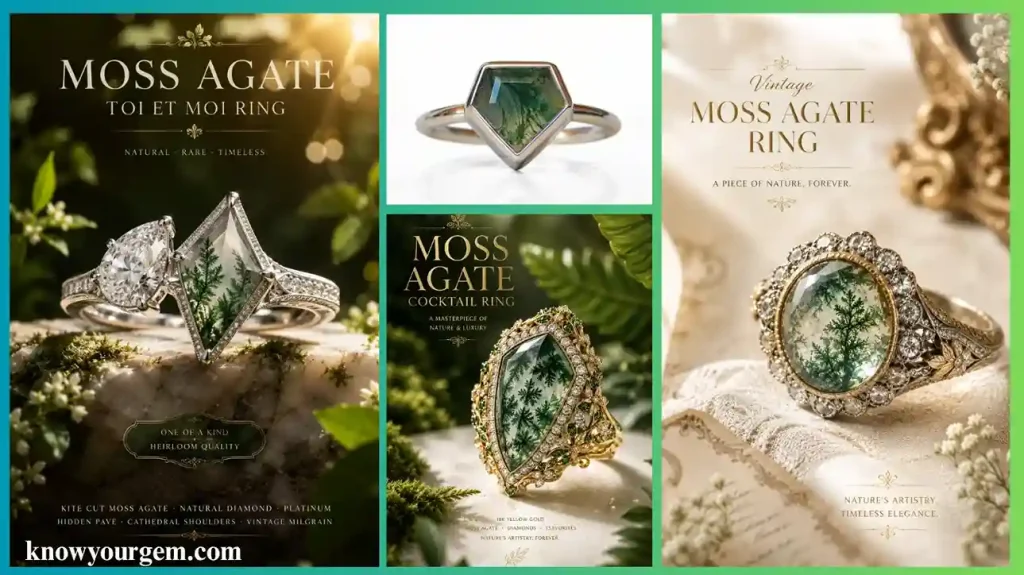
The moss-like inclusions result from dendritic inclusions and tiny branching deposits of iron and manganese oxides which pervade the quartz. The minerals are fractal and tree-like in their growth patterns rather than random inclusions, hence the fine fluer-escque veining of the stone.
Iron oxides produce mostly the Moss agate’s greenish hues, while manganese oxides produce darker blackish branches. The presence of enough of both can result in the stone feeling airy and sparse with ghostly wispy shapes, or full and flourishing.
Moss Agate Facts:
A few little facts sure do help to distinguish truth from myth. As its name suggests, Moss Agate isn’t made from moss or any other organic matter; all the green is mineral in origin.
Each piece of stone is truly one of a kind, as it’s impossible to duplicate in two pieces of rough the exact pattern of deposits of iron and manganese.
It has a long history of usage in jewelry and art. Since in ancient times, Roman and other civilizations generally appreciated this stone for winning battles in war and its organic appearance, long before it made its way onto hundreds of thousands of engagement rings.
It has symbolized growth and connection to nature for a very long time, and that message is beginning to resonate in the jewelry industry today.
Moss Agate Meaning:
Moss Agate: represents growth, abundance, and nature. Due to its plant-like markings, it is often used by individuals wishing to begin new jobs or fresh starts and is therefore associated with growth and development.
It has always had links with agriculture and good luck; it was regarded as an amulet for fertile land and high yield. Its links with farming continue to influence the way the stone is perceived even today.
The stone is also said to bring emotional balance; it is said to be a very calm stone and bring balance. Science has not proven this to be true, but it does add to the popularity of the stone.
Moss Agate Spiritual Meaning:
In spiritual and cultural traditions, individuals have been known to characterize this stone for its grounding energies that allow its wearers to remain grounded and connected through shifting times.
Harmony: Yet another well-recognized quality associated with this stone is that of harmony between body, mind, and environment.
Abundance and renewal also are key for symbolism. The plant-like inclusions evoke new life, and the links to land that was famous for its fertility emphasize prosperity meaning.
Moss Agate Chakra:
Moss Agate: represents growth, abundance, and nature. Due to its plant-like markings, it is often used by individuals wishing to begin anew, such as new jobs or fresh starts, and is therefore associated with growth and development.
It has always had links with agriculture and good luck; it was regarded as an amulet for fertile land and high yield. Its links with farming continue to influence the way the stone is perceived even today.
The stone is also said to bring emotional balance, it is said to be a very calm stone and bring balance. Science has not proven this to be true, but it does add to the popularity of the stone.
Moss Agate Benefits:
Actually, the best thing about Moss Agate is how it looks; every piece is different, and this personal touch in jewelry is what most people are after, having a piece with lots of character and not just a reasonably ‘standard’ stone.
This stone is also popular with the collectors. This is particularly true in the case of rings or stones exhibiting strong, compact, clearly defined moss images resembling a small countryside, which will sell at good prices.
In addition to its symbolism, it also has a realistic value; it is a financial way of owning a unique naturally formed jewel without having to pay for a precious one.
Moss Agate Healing Properties:
Old, dated beliefs. Moss Agate is said to be a stone of emotional balance, stress relief, and connection to nature. Statements such as these can only come from the enthusiast and the metaphysical theorist. There is no clinical evidence that gemstones are able to give off a healing medical or physical effect.
For those who seek the above, the attraction of Moss Agate is in its symbolism and aesthetic qualities, not scientifically confirmed effects. It is most suited to being appreciated as a beautiful, natural gemstone and should not be used as an alternative to health care.
Moss Agate Properties:
| Property | Value |
| Mineral species is | chalcedony (quartz) |
| Chemical formula is | silicon dioxide (SiO₂) |
| Crystal system is | Trigonal |
| Transparency | It usually looks translucent to semi-transparent and showcases its green, plant-like inclusions. |
| Luster | Vitreous to waxy |
| Mohs | It has 6.5-7 Mohs hardness |
| Specific gravity | Approximately 2.58-2.64 |
Moss Agate Hardness:
Moss Agate is a greenish Quartz with a hardness of 6.5-7 Mohs, and the moss appearance of its pattern is formed from mineral deposits in the rock composition rather than organic material. It does not have the banding associated with true agate, but the term is commonly used by tradition.
The design of the mossy look is created by internal oxidation of the stone by iron and manganese oxides to produce a tree-like design. Each part of the stone is unique from others because the design was not duplicated.
How Strong Is Moss Agate?
From the viewpoint of gemology, toughness is the resistance of a stone to being scratched. As this stone has a moderate toughness, it is stronger than opal, yet less impact-resistant than jadeite or sapphire.
Is Moss Agate Durable?
Yes. It is a resilient material suitable for everyday wear, but we recommend watch and exposure protective settings such as a bezel since it has a softer (hence more scratchable)quality than a sapphire or ruby.
Is Moss Agate Water Safe?
Daily contact with normal water such as rainwater or hand washing water can generally be fine, but prolonged water exposure is bad.
Fake Moss Agate:
Dye agate, glass and resin are the most common Moss Agate fakes. Dye agate has an unnaturally unvarying bright green color, glass can be recognized by the trapped air bubbles and lightness of weight and resin is the cheapest but also the most fragile.
How to Identify Real Moss Agate:
Real MossAgate has true inclusions, with unexpected, irregular shapes and branching, never repeating, where resin or printed fakes always appear flat and completely uniform.
At magnification, you can see tiny, hair-like deposits at various depths that provide believable translucency to a genuine stone, whereas in newer fakes it’s all on one flat plane.
A gemstone lab certificate is a confirmation from a gemological laboratory that the piece is natural chalcedony, and provides some reassurance, as this is far less common on the less expensive Moss Agate.
Moss Agate Jewelry:
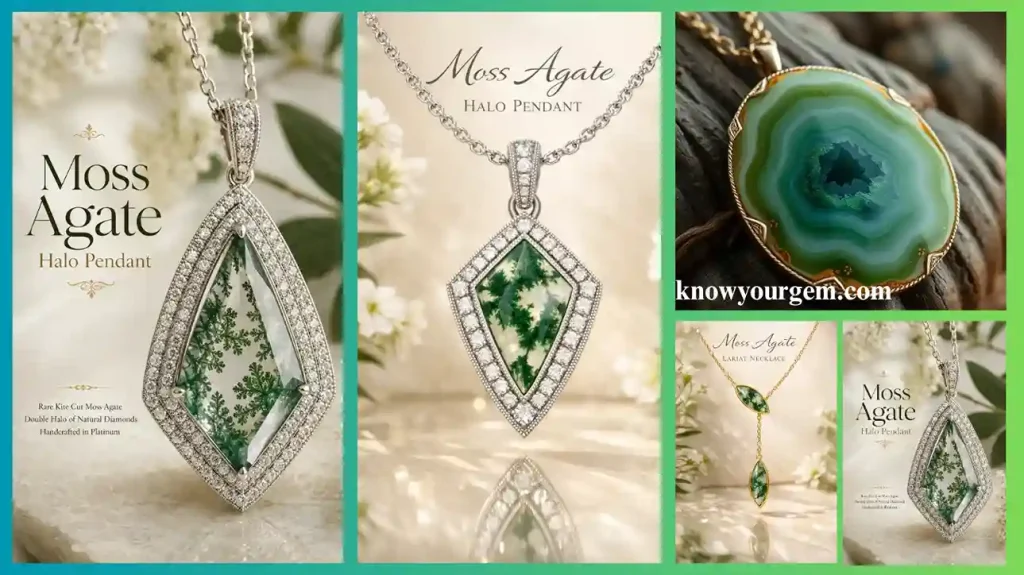
The stone is commonly used in all types of jewelry. It is prized for its earthy, natural appearance. More people seem to use it for rings than any other piece of jewelry, as the jewelry itself shows off the pattern. All other pieces of jewelry also reveal the pattern well, however.
Moss Agate Ring:
Ring styles of this stone range from very basic solitaires to more elaborate settings that include diamond accents. Gold colorings are prevalent, and the use of a bezel protects the stone while maintaining its natural appeal.
Moss Agate Engagement Ring:
It is a well-known option for an unusual non-diamond engagement ring. It costs less and is unique, but requires safety-heavy settings and careful usage.
Moss Agate Wedding Ring:
The wedding bands are more plainer; they may be worn in a set with other bands. Some couples may choose to add Mos Agate details that are symbolic of their relationship.
Moss Agate Wedding Band:
Among the various color options, gold tones are the most popular, particularly to match your engagement ring. The comfort fit band is the preferred style for daily wear.
Moss Agate and Diamond Engagement Ring:
Diamonds add sparkle to Mos Agate’s organic look. Halo, three-stone, and accent designs balance with the natural patterns.
Vintage Moss Agate Ring:
A quick sparkle from diamonds works well with the organic look of Mos Agate. Halo, three-stone, and accent styles can all be contrasted with the naturalistic patterns.
Hexagon Moss Agate Engagement Ring:
Magic fills the studio with the sulfuric aroma of sighing dragons. These hexagon cuts are innovative and visually dramatic, displaying unconventional shapes and contrasting fluid patterns with clean, stripped-down settings.
Moss Agate Necklace:
Necklaces vary from one-ended pendants to multi-ended ones. But the single-stone pendant is still the most popular one to reveal the patterns.
Moss Agate Gold Necklace:
Yellow and rose gold convey Yellow rose agate’s earthy warmth, while white gold accents provide a cooler, more contemporary touch.
Therefore, yellow and rose gold are ideal for natural shades, while white gold is excellent for clean modern styles.
Moss Agate Pendant:
Pendants can be relatively basic bands or as detailed and creative as works of art. The most common gift in modern times for pendants is gift-giving, usually with the themes of growth and new beginnings.
Moss Agate Earrings:
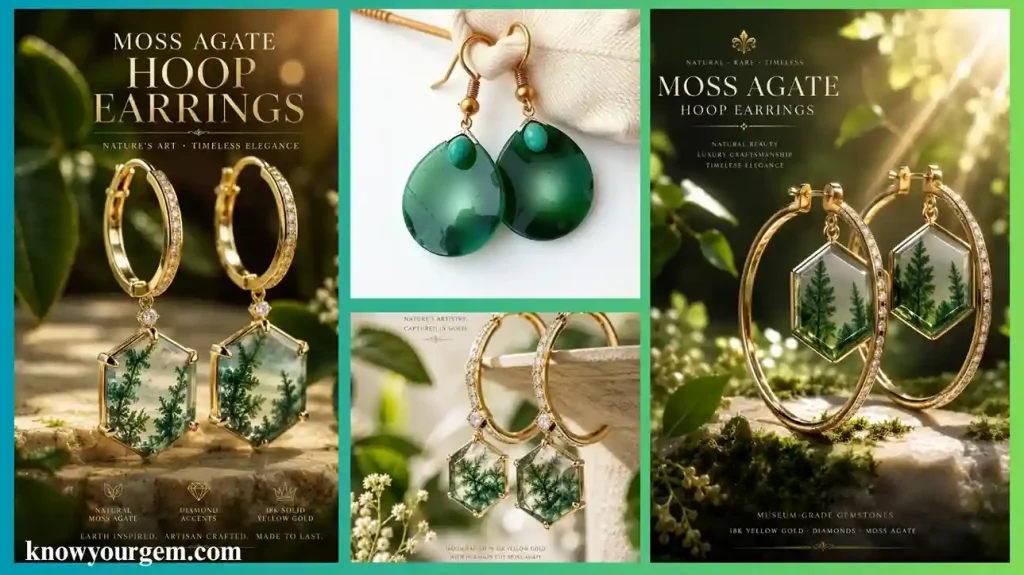
Studs are a more delicate adornment, whereas drops and hoops display bigger motifs. Designs combine natural appeal with contemporary outlines.
Moss Agate Drop Earrings:
Drop earrings tend to feature single stones in gold or silver settings. Circular or asymmetrical designs accentuate the individuality of the Moss Agate.
Moss Agate Bracelet:
However, beaded bracelets are a lot more inexpensive and walk the streets much more. Chain and cuff styles just have Moss Agate used as accents or as the main attraction.
Moss Agate Cabochon:
Cabochons, being the most common, amplify mossy inclusions, whilst intricate patterns often fetch higher prices.
Moss Agate Faceted:
Faceted cuts turn up the sparkle, but they are attractive only on the more transparent areas of the stones. They are used to create accents or pieces with a statement, such as in cabochons that take up the center stones.
How Much Is Moss Agate Worth?
Moss Agate is one of the cheapest gemstones available, and the rough or low-quality material is available at prices of as low as one or two dollars per carat in some cases. Premium cabochons with clear, balanced Moss images can fetch between $20-$50 per carat or higher.
Quality is a compulsory value driver. Also much more valuable stones are those showing definite, artistic moss patterns rather than stones with free or muddy inclusions. Origin in itself may also command a small premium, since historic origins such as India are sometimes preferred.
As with a lot of other cheaper gems, color and clarity don’t play a big role in the pricing of Mos agate, but instead it is the pattern that most influences the price. Cheap Settings of silver rings or pendants are all under $100, but as soon as you move into gold and set diamonds as accents, they climb into the hundreds.
Is Moss Agate Expensive?
Great value for money, definitely, especially compared to precious stones such as emerald, sapphire, diamond, and so on.
Opal is closer in terms of accessibility, as good quality opal with good play of color can still be worth more than this.
Moss Agate is more affordable for those buyers who are looking for a one-of-a-kind natural gem.
Buying Guide:
Before buying Moss Agate jewelry, must consider following buying tips:
- Always look for crisp, well-defined moss inclusions. Muddy or indistinct patterns can decrease both value and appeal.
- Clarity: The internal moss should be visible and clear. Stones that are too cloudy or opaque hide the very feature buyers want.
- Color: Natural Moss Agate showcases uneven green tones. An overlay of uniform or saturated color can suggest dye treatment.
- Cut: Cabochons much better display moss structures. However, faceted cuts will show more sparkle, which will detract from the ability to see inclusions.
- Location: Protective environments such as bezels are best suited to everyday-wear rings, as the hardness of Moss Agate is considerable but not as durable as the majority of precious stones.
- Natural vs Dye: Always confirm disclosure of treatment. Dyed stones should be priced accordingly and tend to need different care.
Such factors thus make up the two factors.
Care & Cleaning:
- Cleaning: Cleaning mos agate is easily accomplished while using warm water and a gentle soap, soft brush to remove dust, and a soft cloth to dry.
- Water exposure: Normal handwashing is acceptable; however, excess soaking should be avoided as an everyday occurrence.
- Chemicals: Do not expose your stone to chlorine, harsh chemicals and perfumes that can be harmful and dye on treated stones.
- Storage: Keep this gem apart from harder ones to prevent scratching; an appropriate soft pouch or lined jewelry box would be just right.
Expert Buying Tips:
- Pattern quality: the more clearly delineated the moss inclusions of a smaller stone, the more expensive it is likely to be, compared to a larger stone with a more uniform color.
- Natural vs treatment: Always ask what sort of provenance; seller must disclose if going to be dyed or treated. It is the seller‘s responsibility to offer the disclosure.
You should look for settings that can provide maximum protection for engagement rings.
Pros & Cons:
| Pros | Cons |
| The stone has truly individual design in all its stones | But softer than precious gems of sapphire or diamond. |
| Available in every quality level | But the stone chips more easily than the others if it is not protected by a setting. |
| Can be made available in large variety of jewelry styles | However, presence of fake and dieased imitations is very common in market. |
| The stone is highly symbolic and free from “artificial” nature | Yet, its value does not reflect the fact that other and rarer stones can be more expensive. |
| Water is safe for usual, external contact, but must be handled | Carefully where chemicals or strong cleaning materials are involved. |
Conclusion:
It is highly prized for its unique moss like inclusions that make each piece naturally individual. It is unique to each stone, no other gemstone can replicate these beautiful markings.
Moss Agate is ideal for use in rings, pendants and bracelets. However with an average hardness of 6.5–7 on the Mohs scale, it must be set in a protective bezel for rings that will be worn daily.
Though many a can easily be swayed by its symbolism, associated with growth and nature, ultimately the fundamentals to a confident purchase, are stone quality, craftsmanship and the long term care.
FAQs:
1. What is Moss Agate?
It is a form of chalcedony quartz that has deposits of green, moss-like mineral inclusions of iron and manganese oxide that makes each stone’s inclusions.
2. What does Moss Agate mean?
In the past, it expressed ideas like growth, well-being, and rapport with nature – those ideas were related to the rosettes inside the glass (plant-like element).
3. Is Moss Agate durable?
Yes, it is hard, as of a stone with 6.5-7 Mohs hardness but nevertheless still need a protective setting for the use in daily-wear jewelry.
4. Is Moss Agate expensive?
No, this is not an expensive stone but less costly than precious stones.
5. Is Moss Agate water safe?
Yes, it‘s normal such contact e.g. Handwashing as should be avoided any extended submersion and aggressive chemicals.
6. How strong is Moss Agate?
Moderate toughness, less chip resistant than opal, but more impact resistant than sapphire or ruby.
7. What are Moss Agate benefits?
Its primary. advantages include a truly distinctive look, a cheaper price tag, and an inextricable link to the ideas of prosperity and growth.
8. What are Moss Agate healing properties?
It is essentially beliefs, and depends a lot upon traditions and believes of the person. As other traditions expect the same of itself, culture as training is expected with emotions and grounded.
9. What chakra is Moss Agate associated with?
Is mostly related to the Heart Chakra, and sometimes in the chakra practice to the Root Chakra.
10. How much is Moss Agate worth?
Moss agate tends to be marketed in dollars per carat; with the minimum value being around $20 to $50 per carat for the top quality and best patterned cabochons.
11. Is Moss Agate good for engagement rings?
Yes, it good for engagement rings if it is bezel set in a protective bezel setting in order to protect its moderate durability from chipping.
12. What is a Hexagon Moss Agate Engagement Ring?
A contemporary ring design from the current collection featuring a hexagon-cut piece of Moss Agate as the main stone, often bought because of the interesting combination of geometric form and natural material.
13. What is a Vintage Moss Agate Ring?
A ring in the typical Art Deco or Victorian style, with intricate metal work that works with the pattern within the stone.
14. What is a Moss Agate Cabochon?
This is a smooth, domed, faceted cut which displays the stone‘s internal moss-like pattern to its best advantage.
15. What is the difference between faceted and cabochon Moss Agate?
Cabochons, on the other hand, show the characteristic mossy patterns of Agate with a highly polished dome while fascinated cuts are comparatively rare and shine less due to the difference in the clarity of stones.
16. How can you identify fake Moss Agate?
Always be on the lookout for a too uniformly pale color, air bubbles (which are a telltale mark of glass) and printed levels, (rather than constructed internal levels), when examined under magnification.
Always confirm authenticity, refractive index, specific gravity and ethical sourcing with GIA or IGS certification! Gem Enthusiast KamilHussain

Welcome to KnowYourGem.com! your ultimate destination for uncovering the fascinating world of gems and their secrets! I'm Kamil Hussain, a passionate blogger with a Master’s degree in Economics, dedicated to bringing you insightful, well researched content that blends the beauty of gemstones with the art of storytelling. With a keen analytical mind and a love for discovering hidden treasures, I created this platform to help you explore the brilliance, history, and value of every gem.

