

Identification • Value • Properties • Jewelry • Investment
Summary Answer: What Is Kornerupine?
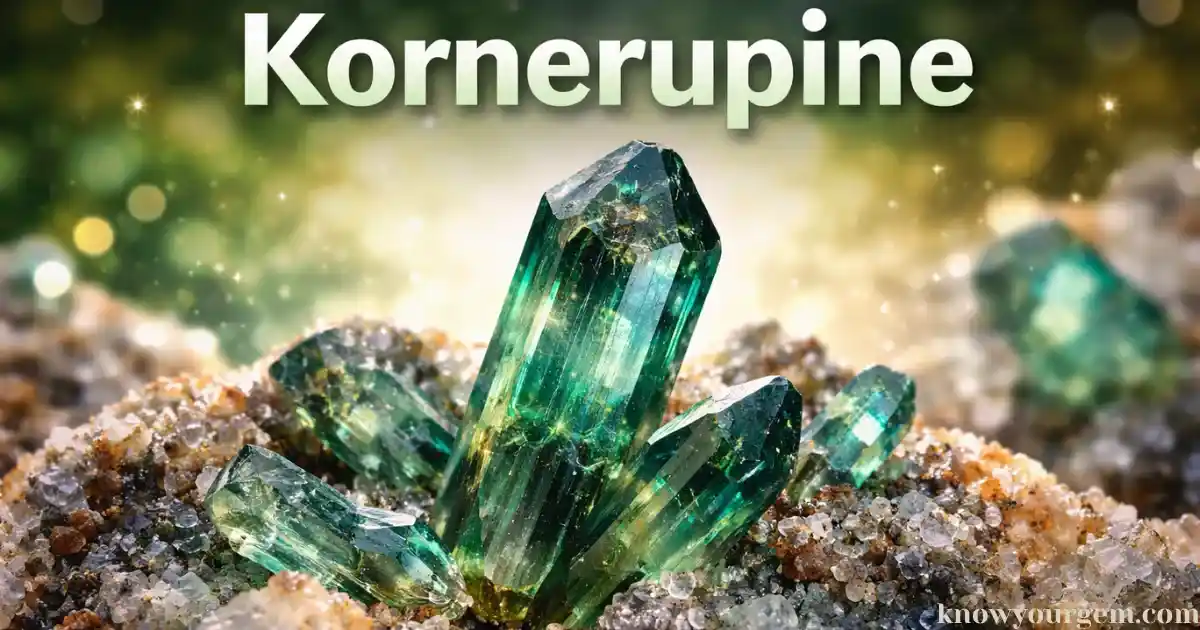
Kornerupine is a rare boron rich silicate green gemstone mostly loved for its striking pleochroism and vivid color range that spans from green, brown, and yellow. The stone forms within metamorphic rocks and primary deposits which are occurring in Madagascar, Sri Lanka, and Tanzania. Nowadays collectors and investors cherish the stone highly for its optical uniqueness, limited availability, and increasing demand in the gemstone market.
Quick Facts: Kornerupine at a Glance
Use the given below reference table while identifying or researching kornerupine gemstone properties.
| Property | Details |
| Mineral Type | Mineral relates to Borosilicate family |
| Hardness | It owns 6.5-7 mohs scale of hardness |
| Crystal System | The crystal system is Orthorhombic |
| Refractive Index | Its refractive index is 1.66–1.68 |
| Specific Gravity | Its specific gravity is 3.27–3.45 |
| Major Sources | The stone is found in major sources like Madagascar, Sri Lanka, Tanzania, Greenland |
| Rarity | It is a rare gemstone having a limited supply |
| Pleochroism | Its parochialism is strong (green, brown, yellow shift by angle) |
| Luster | Vitreous (glassy) |
| Transparency | Transparent to translucent |
| Cleavage | Poor |
What Is Kornerupine?
Kornerupine is a rare borosilicate mineral comes from a small group of boron bearing silicates. It forms as prismatic crystals with an orthorombic crystal system and is best recognized for its exceptional pleochroism, which is a property that causes the stone to showcase vary colors which hinge on the viewing angle. Gemologists and mineral collectors recognize it as more unusual entries in the world of fine gemstones, that sit within a category dominated by better known stones like tourmaline and sapphire.
The name of this gem has taken by the Danish geologist and explorer Andreas Nikolaus Kornerup, who first documented specimens during a scientific expedition to the greenland in late 1870s. The mineral was formally described and named in his honor, a tradition in mineralogy that recognizes a significant contributions to geological discovery. Kornerup’s work helped establish the stone’s identity within the broader family of silicate minerals, that are distinguishing it from similar species like tourmaline and andalusite.
The gem has classified under the borosilicate mineral group, and it shares certain structural minerals like enstatite, yet its unique chemical composition, primarily magnesium,aluminum, silicon, and boron sets apart. Whether tourmaline also contains boron, it belongs to a distinct mineral group with a vary crystal structure and far greater color diversity. Andaliusite, is another pleochroic gemstone, which differs significantly in crystal form and optical character that makes Kornerupine identifiable to trained gemeologists through a combination of optical and physical testing methods.
Geological Formation of Kornerupine:
Kornerupine forms preeminently in high grade metamorphic rocks, particularly those rocks which have been subjected to intense heat and pressure over geological timescales. The mineral needs boron rich conditions to develop, and its formation is closely tied to the presence of the specific metamorphic environments where boron-bearing fluids interact with aluminum-rich rocks. This relatively rare geological scenario explains why Kornerupine deposits are geographically restricted and why the gemstone remains so scare in the global market.
The crystal growth process for Kornerupine occurs within granulities and pegmatites, that often alongside other high temperature metamorphic minerals. Individual crystal can grown as elongated prisms or tabular forms, and gem quality specimens are typically found in alluvial deposits, secondary placer deposits are formed when primary rock weather and erodes over millions of years. The secondary occurrence in river gravels and coastal sands is the primary source of facet-able kornerupine rough for the gem trade.
Where Is Kornerupine Found?
The most significant sources of gem quality kornerupine are as follow:
- Madagascar: It is an Island nation that produces some of the finest and most richly colored specimens, particularly green and chrome rich varieties that command premium prices.
- Sri Lanka: It is long recognized as a source of fine colored gemstones, Sri Lanka yields Kornerupine from its classic gravels, and the gemstone price in Sri Lanka reflects both local demand and export interest.
- Tanzania: It has East African deposits, specifically from the Tunduru and Umba regions, have contributed facet grade Kornerupine rough to the international market.
- Greenland: It is the organic discovery location, because of considering it as non major commercial source today.
- Kenya and Myanmar: These minor but historically noted sources.
Collectors who are seeking for rough Kornerupine must note that gem quality material having suitable facet is uncommon even within these localities. Since, most crystal specimens have covered from these regions are too included or fractured for cutting, that makes clean, transparent, rough particularly valuable.
Kornerupine Color Varieties:
Its wide range of body colors and its strong pleochroism is one the most compelling characteristics of it. The stone naturally occurring shades of green, yellow-green, olive green, brown, and occasionally colorless. Among all these options, green and blue-green kornerupine, especially chrome kornerupine draws the greatest collector and investor attention because of its rarity and visual appeal.
Main Color Categories:
| Color Type | Description | Relative Rarity |
| Green Kornerupine | The stone carries vivid to medium green, often with yellow-green undertones | Uncommon |
| Chrome Kornerupine | This owns saturated green which is caused by chromium; most valuable variety | Very Rare |
| Blue Kornerupine | It has color like blue visible from certain angles; rarely pure blue | Rare |
| Yellow / Brown | It has warm golden to olive brown tones; most commonly encountered | Less Rare |
| Colorless | It is extremely rare; minimal collector demand | Very Rare |
Pleochroism in Kornerupine is strong and easily observeable. A well cut gem can display a distinct green color when it is viewed down one axis and shift to the brown or yellowish-brown when it is rotated 90 degrees. In chrome Kornerupine, this can be particualrly dramatic, transitioning between rich green and deep brownish-green. Since, skilled gemstone cutters orient the rough deliberately to maximize the most desirable color in the finished stone, which influences the final kornerupine price per carat.
The term “cat’s eye Korerupine” refers to the specimens that showcase chatoyancy which is a silky, reflective band that moves across the surface of a cabochon cut stone. Kornerupine cat’s eye pieces are especially sought after by collectors of phenomenal gemstones and can command significantly higher than comparable faceted material.
Physical and Optical Properties of Kornerupine:
While understanding the physical and optical properties of kornerupine enables gemologists to accurately identify and differentiate it from visually similar stones. The Gemological Institute of America (GIA) recognizes the gem as a distinct mineral species with well defined optical constants that support reliable identification.
| Property | Description |
| Transparency | The gem is transparent to translucent |
| Luster | It has vitreous luster (glassy) |
| Cleavage | It has poor cleavage one direction, rarely observed |
| Fracture | It can get fracture like conchoidal to uneven |
| Pleochroism | It has strong trichroism like green, brown, yellow |
| Refractive Index | Its refractive index is 1.660–1.682 (biaxial negative) |
| Birefringence | It owns birefringence like, 0.013–0.017 |
| Specific Gravity | Specific gravity of Kornerupine is 3.27–3.45 |
| Hardness (Mohs) | Kornerupine owns 6.5–7 mohs scale of hardness |
| Crystal System | It is Orthorhombic crystal system |
| Crystal Habit | Prismatic, striated lengthwise |
| Fluorescence | It has fluorescene like weak to inert under UV light |
The Kornerupine refractive index of 1.66-1.68 makes place it within a range shared by several other gemstones, that’s why gemologists rely on the combination of RI, birefringence, specific gravity, and pleochroism together for definitive identification. Since, the strong trichroic nature of the mineral meaning it showcase three distinct colors along its three crystallographics axes is one of fits most diagnostic features and helps to separate it from doubly refractive look alike.
The inclusions of this stone commonly include needle like rutile crystals (which can create the cat’s eye effect), healing fractures, and occasional two-phase inclusions. Not same as other gemstones, it is rarely undergoes treatment, which makes untreated stones the norm rather than exception and a positive attribute for buyers concerned about gem enhancement.
How to Identify Kornerupine: Step-by-Step
To identify Kornerupine demands a systematic approach that combines visual observation and instrument based testing. Follow the given below steps that have used by professional gemologists:
- Observe Pleochroism Under Light: Rotate your stone under a strong source or dichroscope. Since, strong color shift from green to brown or yellow confirms a strong trichroism, which is a hallmark of kornerupine.
- Check the Refractive Index: Use a standard refractometer to check the refractive index of the gem Kornerupine which reads in between 1.660 and 1.682 with a birefringence of 0.013-0.017. This biaxial negative reading can help narrow identification.
- Measure Specific Gravity: Hydrostatic weighing places Kornerupinein the 3.27-3.45 range. This distinguishes it form the lower density look alikes.
- Examine Crystal Structure and Inclusions: Under 10x loupe magnification, always look for prismatic form, parallel striations, and needle like inclusions. The presence of rutile needles can indicate cat’s eye potential.
Kornerupine vs. Similar Gemstones
Because of having pleochroism and green-brown color range, Kornerupine has mistaken for several other minerals. The given below table outlines showcase the key differences for collectors and buyers:
| Gemstone | Key Difference from Kornerupine | Hardness | Refractive Index |
| Kornerupine | It has strong trichroism; rare borosilicate; orthorhombic crystal system | It owns 6.5–7 mohs scale | Its refractive index is 1.660–1.682 |
| Tourmaline | It has wider color range; higher color saturation; trigonal crystal system; more treatments | It owns 7–7.5 mohs scale | Its refractive index 1.614–1.666 |
| Andalusite | It has distintive cross like pleochroism (chiastolite variety); orthorhombic but lower RI | It owns 7–7.5 mohs scale | Its refractive index is 1.629–1.650 |
| Sapphire | It belongs to Corundum group; which is much harder; typically blue; no boron content | It is 9 on the mohs scale | Its refractive index is 1.762–1.770 |
| Enstatite | It relates to Pyroxene group; similar colors but much weaker pleochroism; different inclusions | It owns 5–6 mohs scale | Its refractive index is 1.663–1.673 |
| Idocrase (Vesuvianite) | It has tetragonal; similar green color; weaker pleochroism; different SG | It owns 6–7 mohs scale | Its refractive index is 1.700–1.752 |
Kornerupine Price and Value:
The price per carat of this stone varies considerably based on a combination of quality factors. Not same as more established gemstones that have standardized pricing, Kornerupine remains a specialty collector’s stone where market knowledge and source verification play significant roles in determining fair value.
Key Pricing Factors
- Color: Chrome Kornerupine and vivid green Kornerupine both command the biggest prices. Pure, saturated colors with having minimal brown modifier attract a premium in both retail and auction markets.
- Clarity: An eye clean specimens with having minimal visible inclusions are considerably more valuable than included material. Cat’s eye Kornerupine can retain value even with inclusions if the chatoyancy is sharp and well defined.
- Carat Weight: Faceted Kornerup more than 5 carats increases substantially as size increases.
- Origin: Madagascar and Sri Lankan ethical origins tend to command stronger premiums, particularly for chrome-rich material from Madagascar
- Cut Quality: Well proportioned faceted maximizes color whether minimizing window effect adds significant value to finished stones.
- Treatment Status: Natural, untreated kornerupine is the norm and is preferred by collectors. Any disclosure of the heat treatment or other enhancement reduces value.
| Quality Grade | Estimated Price Range (Per Carat) | Notes |
| Commercial / Lower Clarity | Commands prices from $20 – $80 USD | Brown, included, smaller sizes |
| Mid-Grade Green | Can command prices like $80 – $300 USD | Good color, eye-clean, 1–3 carats |
| Fine Green / Cat’s Eye | Commands prices like $300 – $800 USD | Strong color, sharp eye, clean |
| Collector Chrome Kornerupine | Can be sold from $800 – $2,500+ USD | Chrome-rich, Madagascar, large sizes |
| Exceptional / Investment Grade | Must be sold for $2,500 – $5,000+ USD | Top chrome, 5+ carats, certified |
Kornerupine gemstone prices in Sri Lanka are generally more accessible at the source level, as local dealers offer rough and cut material directly from mining communities. However, export and certification costs can bring international retail prices significantly higher. Since, buyers at source in Sri Lanka or Tanzania should still request a proper documentation and gemological certification.
Is Kornerupine Rare?
Yes, the Yes borosilicate mineral usually ranks among the genuinely rare gemstones available in today’s market. Thus, its rarity is not only a marketing claim but a reflection of the real geological and commercial constraints. The mineral forms only in the particular metamorphic environments where boron concentrations are sufficient, and even within recognized deposit areas, gem quality material embodies a small fraction of the total recovery.
As compared to the sapphire, which is mined commercially in dozens of countries across multiple continents, Kornerrupine’s production volumes are small enough that a single fine specimen above 10 carats can attract significant attention at specialist auctions. The collector market for rare gemstones have grown steadily, and stones like borosilicate mineral with documented rarity, unique optical properties, and limited supply have benefited from increased interest among sophisticated buyers who are looking beyond the traditional big four gemstones like (diamond, ruby, emerald, sapphire)
The small production volume also means that borosilicate mineral jewelry and loose circulate through specialist gem dealers, estate sales, and collector focused auction houses rather than through conventional retail channels.
Kornerupine in Jewelry:
Borosilicate can be household name in jewelry, however when it is carefully designed and set, it can looking dazzling and hold its own in fine pieces. Although, its hardness like 6.5-7 mohs scale is adequate for the most jewelry applications with appropriate care, because it falls short if the durability standards required for everyday rings without protective settings.
Popular Jewelry Applications:
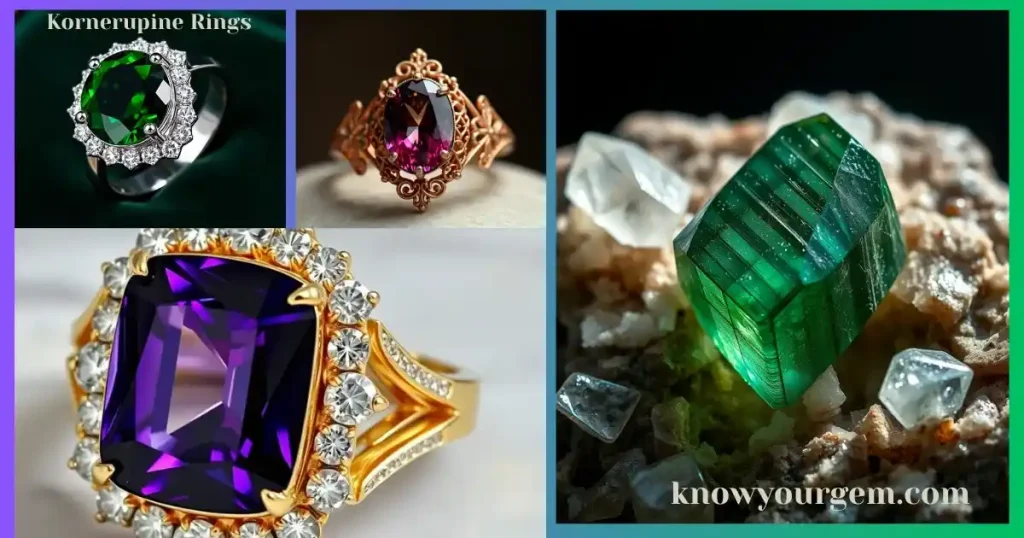
- Kornerupine Ring: Custom and artisan jewelers are in favor of this stone for statement rings. Since, Kornerupine ring typically features protective bezel settings or halo designs that shield the gem from direct impact. For korneupine engagement ring, buyers should opt for designs with raised bezels or protective prong arrangements to minimize exposure.
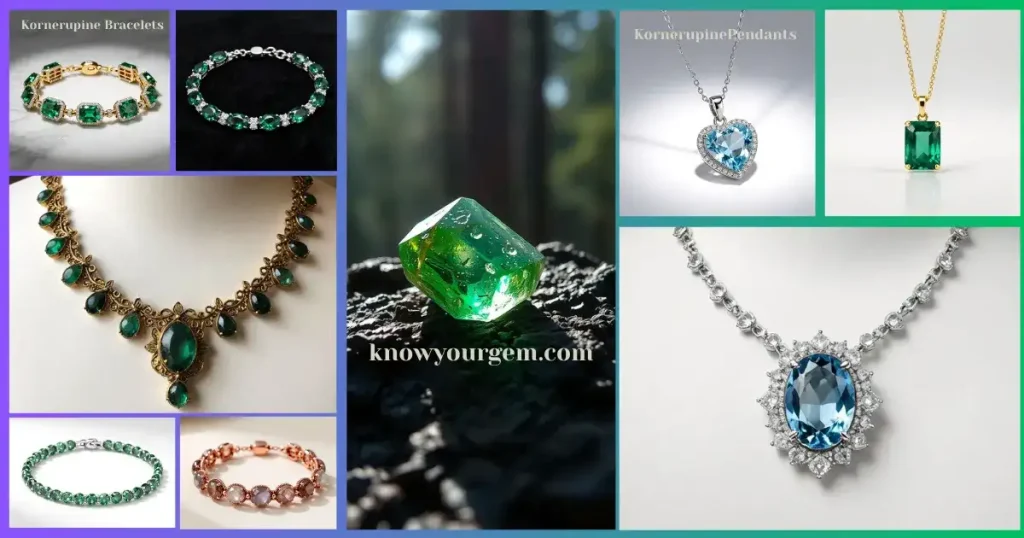
- Kornerupine Pendant and Necklace: Pendants and necklaces embody the ideal setting for this gemstone because they experience minimal abrasion as compared to rings. A kornerupine pendant enables the stone’s pleochroism to be appreciated as the light hits it from different angles during the movement.
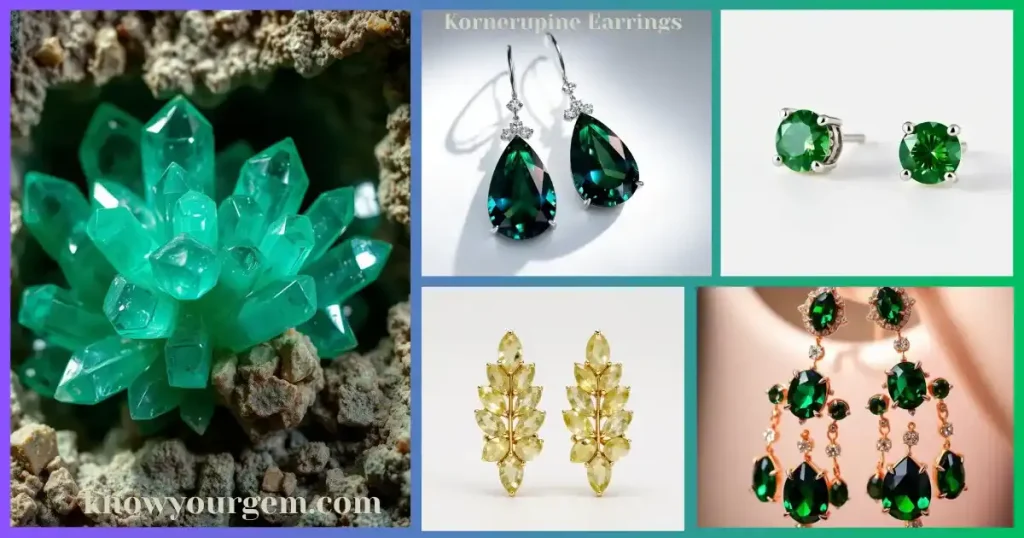
- Kornerupine Earrings: Earrings are among the safest jewelry formats for medium hardness gemstones. Since, Kornerupine earrings showcase the stone’s color beautifully with minimal risk of scratching.
- Kornerupine Bracelet: Bracelets carry more risk than earrings or pendants due to frequent contact. A Kornerupine bracelet benefits from protective settings and should be removed that risk impact.
Maintenance and care for stone:
- Clean your stone while using warm soapy water and a soft brush however using an ultrasonic cleaners, can stress the crystal structure.
- Keep stored your gem jewelry separately in soft pouches, since gathering with harder gemstones can damage the stone internally and externally both.
- Remove Kornerupine rings and bracelets before doing physical activity, like gradening or housework.
- Keep away prolonged exposure to harsh household chemicals or strong acids.
- Inspect settings periodically for loosening, particularly in prong set designs.
Investment Potential of Kornerupine:
The investment case for this gemstone rests on several covered-up factors that apply broadly to the rare gemstone sector. Since, fine gemstones with having documentation scarcity, aesthetic appeal, and growing collector awareness have historically appreciated in value when supply remains constrained.
Kornerupine believes to meet with several criteria that gemstone investors look for: a genuine geological rarity, limited mining geography, having no large stockpiles is held by the major mining corporations, and increasing visibility through specialist publications and auction house interest. The rise of alternative categories has brought new buyers into the fine gemstone space, and stones with having strong narratives unique origins, unusual optical effects, and connection to specific localities tend to perform well as collector interest intensifies.
Chrome Kornerupine from Madagascar, in particular, has attracted getting rapid attention at specialist gem auctions, with prices for the top quality certified stones that showcase upward movement over the past decade. Since, buyers entering this market should focus on well documented stones with gemological certification, clean rarity, strong color saturation, and provenance documentation. As alternative investments, Kornerupine should embody a diversified component of broader strategy rather than a sole holding.
One important note: the gemstone investment market rewards patient. Since, rare gemstones often appreciate meaningfully over periods of five to ten more, particularly when their supply diminishes as mines are exhausted or access becomes restricted.
How to buy Kornerupine Safely:
Purchasing Kornerupine demands greater diligence over buying more common gemstone because the market is smaller, dealer expertise varies widely, and misidentification is possible without proper testing. Follow given below guidelines to buy with confidence:
- Request a Gemological Certificate: Always request for a certificate from trusted labs like, GIA, SSEF, or Gübelin because they verify the gem’s identity, weight, and any treatments.
- Verify Treatment Disclosure: Ask the seller directly whether the stone has been subjected to heat treatment or any other enhancement. Since, untreated gem is standard, and undisclosed treatment is a red flag.
- Buy Kornerupine Rough Carefully: If you are purchasing this gem in rough form for cutting, verify origin documentation and request testing finalizing the transaction. Since, rough identification is more complex than finished stones.
- Work with Specialist Dealers: Dealers who are specializing in rare and collector gemstones have the expertise to source, identify , and accurately embody this stone.
- Compare Market Prices: Check Kornerupine prices from reputable dealers and auction platforms before purchasing. If the price below market value, be cautious.
- Check for Return Policies: Reputable specialist dealers typically offer return windows that contingent on independent gemological verification. This protection is essential when your are buying online.
Kornerupine Metaphysical and Spiritual Properties:
According to its physical characteristics, it carries significance in crystal healing and metaphysical traditions. While these properties are not scientifically validated, but they are part of this stone’s appeal to significant segment of the gemstone buying community.
In crystal healing, this stone is seen as a stone of clarity, truth, and emotional balance. Its pleochroism, the ability to showcase vary colors from different angles are linked to the idea of viewing situations from multiple perspectives to gain deeper understanding. Spiritually, it’s also connected with communication, intuition, and harmonizing intellect with emotion.
However the benefits of this gemstone in metaphysical practice is said to include supporting honest self expression, reducing anxiety around change, and helping individuals to align their deeper valuer. Some practitioners use this stone during meditation practices to get their focus on the throat and heart chakras. People usually associate the green varieties with the heart centered energy and the blue pleochroic flashes with throat chakra activation.
The properties of this gem, as described in crystal lore, also include grounding energy, support during transitional life periods, and enhancement of focused thinking. These associations make the stone appealing beyond the traditional collector and investor audience, that expand its market across wellness and spiritual communities globally.
Final Thoughts: Why Kornerupine Deserves Attention
Kornerupine occupies a unique and underappreciated position in the world of fine gemstones. It combines genuine geological rarity, striking optical properties, and a growing collector who seeks unusual specimens, an investor looks for rarity driven value, or a jewelry lover searching for something truly distinctive, this gemstone rewards careful attention.
The integration of strong pleochroism, limited production, untreated status as the norm, and increasing visibility in specialist markets make this stone worth understanding deeply. As the rare gemstone market consistent to mature and more buyers move beyond the traditional choices, Kornerupine’s distinctive character and documented scarcity position it well for continued appreciation both in beauty and in value. Always purchase your gem from specialist dealers, request gemological certification, and take time to educate yourself on the optical and physical properties that define truly fine stone which makes a significant acquisition.
References & Further Reading:
- Gemological Institute of America (GIA): It is the gem identification resource and mineral database.
- Gübelin Gem Lab: It is a researcher of colored stone and origin determination.
- International Colored Gemstone Association (ICA): It trades standard and gemstone education.
- American Gemological Laboratories (AGL): It is a treatment disclosure and gemological reporting
- Mindat.org: It collect kornerupine mineral data, locality information, and crystallographic parameters
Frequently Ask Questions and answers:
1. What is kornerupine gemstone?
It is a rare boron-rich silicate mineral cherished as a collector’s gemstone for its strong pleochroism and attractive green, yellow, and brown color range. It forms in metamorphic rocks high heat and pressure, and gem quality specimens that are preeminently sourced from Madagascar, Sri Lanka, and Tanzania. It is named after Danish geologist Andreas Nikolaus kornerup.
2. Is kornerupine rare?
Absolutely, this gem is gem genuinely rare. It forms only in specific boron-rich metamorphic environments are found in a limited number of locations worldwide. Annual production is small, facet-grade rough is uncommon even at recognized deposits, and stones five carats are exceptional. Its rarity is well documented in gemological literature and contributes directly to its collector and investment value.
3. Where is kornerupine found?
The preeminent sources for gem quality from Madagascar, Sri Lanka, and Tanzania. Since, Madagascar produces the most valuable chrome-rich green specimens. While Sri Lanka’s classic gem gravels have yielded notable material for decades. In-contrast Tanzania contributes material from its eastern gem origins. Minor historical sources including Greenland(the original discovery site), Kenya, and Myanmar.
4. How much is kornerupine worth?
The stone value hinges factors like color, clarity, carat weight, and origin. Since, commercial-grade brown or included material can be sold for $20 to $80 per carat, whether fine green specimens reach $300 to $800 per carat. Exceptional chrome Kornerupine from Madagascar with having strong saturation and large size can command $2.500 to $5,000 or more per carat at specialist auctions.
5. Is kornerupine good for jewelry?
The stone works well in jewelry with appropriate design choices. Its hardness of 6.5-7 makes it suitable for pendants, earrings, and protective set rings, because it requires more care than harder gemstones. Everyday wearing rings need bezel or halo settings. With proper maintenance and thoughtful design, Kornerupine jewelry makes a distinctive an rare personal statement.
6. What is kornerupine cat’s eye?
Kornerupine cat’s eye is a phenomenal variety that displays chatoyancy and a moving band of reflected light across of a cabochon cut stone. This effect results from parallel needle like inclusions within the crystal. Cat’s eye is especially rare and commands premium prices among collectors of phenomenal gemstones, often exceeding prices for clean faceted material of comparable size.
7. What is the kornerupine family?
This stone belongs to the broader borosilicate mineral group within the silicate mineral family. It is closely related to prismatine, which is an iron-bearing variety of the similar mineral series. The stone group is a part of the larger class of orthosilicates, and the mineral shares structural characteristics with other chain silicates whether remaining chemical and optically distinct from more common gemstones.

Welcome to KnowYourGem.com! your ultimate destination for uncovering the fascinating world of gems and their secrets! I'm Kamil Hussain, a passionate blogger with a Master’s degree in Economics, dedicated to bringing you insightful, well researched content that blends the beauty of gemstones with the art of storytelling. With a keen analytical mind and a love for discovering hidden treasures, I created this platform to help you explore the brilliance, history, and value of every gem.

