
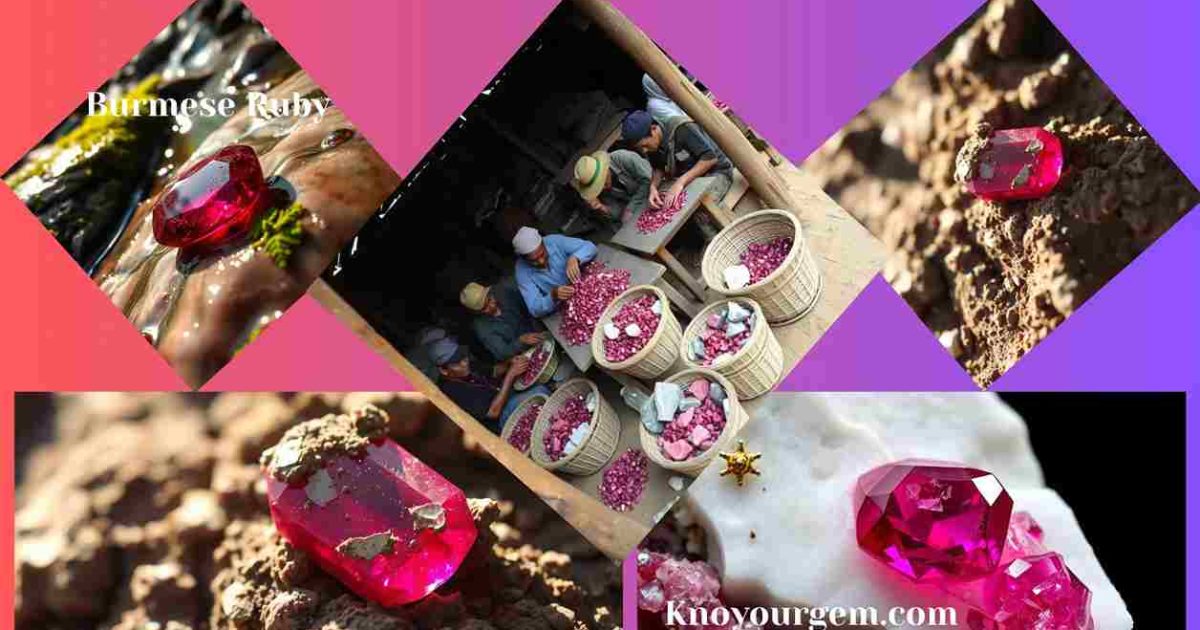

| Quick Answer: A Burmese is a red gemstone belongs to corundum family, it is primarily found in Myanmar’s Mogok Valley, renowned for its exceptional pigeon blood red colour and fluorescent glow. It is considered as the world’s finest natural ruby, it commands premium prices. Since, unheated certified stones regularly fetch tens of thousands of dollars per carat at auction that makes it one of the most valuable gemstones for collectors, jewelers, and investors alike. |
Introduction:
Definition of Burmese Ruby:
Burmese ruby is a family member of corundum with having chemical formula like (Al₂O₃). Its vivid glowing red color is created by infinitesimal elements that are locked inside the crystal structure make the stone stunning. When people talk about the gem, they mean rubies come specially from Myanmar (formerly Burma). This finest specimens believe to display a structured, glowing ruby red colour described by gem traders as pigeon blood red’s a pure intense crimson with a faint blue undertone.
Significance in Gemology and Culture:
Burmese ruby carries truly special place in gemology and culture. Recognized by institutions like GIA as a mar of an exceptional quality, it regularly sets to records at Sotheby’s and Christie’s auctions. Still its value isn’t only financial for centuries it has been revered in Burmese royal court, Hindu traditions, and European jewelry as symbols of passion, protection, and power.
Why collectors and Investors value Burmese Rubies:
Collectors highly treasured this gemstone for its deep, vibrant color, its natural glow, and its rarity. Since, untreated stones with having certification from labs like, GIA, SSEF, or AGL, can confirm the origin of and lack of treatment. Mostly these rubies have steadily increased in value, and auction results at Christie’s and Sotheby’s that showcase a certified “pigeon blood red” Burmese ruby that doesn’t just carry unmatched prestige but also consistently outperforms rubies from other sources in resale value.
Quick Facts Table — Gemological Properties:
| Property | Detail |
| Mineral species | Related to Corundum family (Al₂O₃) |
| Hardness | Burmese Ruby owns 9 mohs scale, just one step below the Diamond in hardness |
| Colour range | It can be displayed by colors like Pink-red to vivid pigeon blood red |
| Refractive index | It is calculated in between 1.762 – 1.770 |
| Specific gravity | It owns 3.99 – 4.00 specific gravity |
| Crystal system | IIt is a Trigonal (hexagonal) crystal system |
| Fluorescence | The stone carries strong red under long-wave UV |
| Primary mining location | Its primary mining locations are, Mogok Valley, Myanmar |
| Secondary locations | It secondary mining locations are, Mong Hsu, Namya (Myanmar); globally in Thailand, Sri Lanka, Madagascar, Mozambique |
| Key certifying bodies | Its key certifying bodies like, GIA, SSEF, AGL, Gübelin Gem Lab |
What Is a Burmese Ruby?
Burmese rubies are rare gemstones primarily mined in Mayanmar’s Valley Mogok. They renowned for their vivid “Pigeon blood red” colors.
Characteristics & Distinct Features:
Various set a genuine Burmese ruby apart from rubies but comes from other origins. The most defining is its colour because an ideal Burmese specimen radiates a vivid, medium to dark red. Since the celebrated pigeon blood red Burmese ruby hue with having an outstanding saturation and a glowing inner luminescence looks more attractive and desirable. The glow results from strong chromium that includes red fluorescence which actually amplifies the stone’s apparent colour under daylight conditions, that makes even relatively small stones appear breathtakingly vibrant.
The structure of crystal like Mogok rubies also tend to produce distinctive silk inclusions. Since, fine rutile needles are arranged in interacting patterns that scatter light internally and contributes to the stone’s characteristic velvety appearance. This ‘silk ‘ can, in modest amounts, boost the natural glow and is considered as a positive identity market by gemologists.
How It Differs from Other Rubies:
The primary difference between Burmese ruby and usual ruby is they both come from other origins, Both own different colour characters and chemical environment. Mogok’s marble-hosted deposits believe to create rubies with having very low iron content, which means the stones don’t absorb red light (as iron rich rubies do). Since, the result is a purer, brighter, more intensely fluorescent red that is simply unachievable in most other geological settings. Whether thai rubies, contain more iron and showcase a darker, slightly brownish-red tone. African from Mozambique can rival Burmese colour but generally showcase less fluorescene.
History and Origin:
Burmese rubies trace their origin to Myanmar’s Mogok valley, which is often called “Valley of Rubies,” With a history stretching back more than 2,000 years. These stones have been treasured for unmatched pigeon blood red colour and cultural significance by royalty, and collectors.
Ancient Mining History in Myanmar:
The Mogok Valley in Myanmar has been the world’s most popular source of fine centuries. For nearly 1,000 years and possibly as far as 2,500 years, this organized mining has taken place there. The Burmese monarchy once controlled the mines, kept the stones for the crown and offered them as gifts to foreign rulers. Since, over time trade routes have carried these rubies to India, the middle East, and Europe, where the became cherished in royal jewelry and church ornaments.
Burmese Ruby in Royal and Cultural History
Across South and Southeast Asia, burmese ruby was the “king of gems.” In Burmese culture, warriors have inserted rubies under their skin that believe the stones conferred invulnerability in the battle. Hindu tradition, the ruby (Manik) is the gemstone of the Sun and remains worn today for its purported protective properties. Since, European royalty including the Mughal emperors and several British monarchs has cherished Burmese rubies above all other coloured gems. The stones featured prominently in the crown jewels of multiple nations and in historic pieces now display in the world’s great museums.
Modern Mining Trends:
Commercial ruby mining in Mogok has intensified after Myanmar’s independence, with both state and astisanal miners that are extracting stone from marble bedrock and alluvial gravel. A second significant Burmese deposit was discovered at Mong Hsu since, 1990s, producing large quantities of rubies which were though most required heat treatment to improve colour and were therefore considered lower in value than unheated Mogok material. Today, Myanmar ruby continues to command a global premium despite competition from new African sources and ongoing international scrutiny of Burmese gemstone trade practices.
Major Mining Locations:
The world’s finest come majorly from Myanmar’s Mogok Valley, which is famous for its pigeon blood red gems. Other essential sources including Mong Hsu in Myanmar. Since, Mozambique in Africa, Thailand, and Sri Lanka, each produces rubies with having distinctive colour and quality differences.
Mogok Valley, Myanmar:
The Mogok Valley, is situated approximately 200 kilometers northeast of Mandalay , is the undisputed epicentre of fine ruby production. This ethical source is enriched by mountains, the valley’s unique marble geology creates the low iron, chromium rich conditions that produce the world’s most coveted rubies. The term “Burma ruby” on any gemological report is shorthand for a stone of an exceptional provenance. Mogok also yields other gemstones like, spinel sapphire, and Peridot but ruby remains its defining treasure. The Burmese ruby crowns and state regalia historically featured Mogok stones of extraordinary size.
Secondary Mining Sites Globally:
Beyond Mogok, Myanmar’s Mong Hsu and Namya districts believes to produce significant columns of ruby. Internationally, notable sources including, Sri Lanka which produces lighter pink-red stones historically called ‘Ceylon rubies, Thailand which produces darker, iron rich stones formerly the dominant global supply before Thai mines were largely exhausted, Madagascar, and Mozambique whose Montepuez deposit now supplies large quantities of commercial grade ruby. Vietnam and Tanzania also contribute to global supply.
Mining Techniques and Ethics:
Traditional ruby mining in Mogok depends of sinking shafts and tunneling into the marble rich rock, which is followed by washing and hand sorting the gravel to find gems. Mostly mining work is done by artisanal and small scale miners, who are often organized through family chains. In this currant era, international buyers and ethical jewelers increasingly demand transparency and proof of responsible mining practices before purchasing Burmese rubies, which especially given the geopolitical issues that affect Myanmar’s gemstone exports.
Gemological Properties:
Burmese rubies basically belong to the corundum family and are mostly cherished for their exceptional qualities. Typically they showcase a pigeon blood red colour with having a strong chromium induced fluorescence, that gives them a glowing intensity under daylight. Their crystal structure often contains rutile silk inclusions, which scatter light and create a soft, velvety texture and admired by gemologists.
Color Grading & Transparency:
Burmese ruby color is evaluated on saturation, hue and tone. The pinnacle grade of pigeon blood red describes a stone of vivid, highly saturated red with slightly purplish-red secondary hue and minimal brown modifier. Since, GIA grades ruby color using hue, tone, and saturation terminology, whether SSEF and Gübelin Gem Lab specifically use the term ‘pigeon blood’ on their reports for the most exceptional examples. Whether their transparency ranges from transparent (most valuable) to translucent; opaque stones that are typically fashioned into cabochon cuts and can exhibit astersim (the star ruby phenomenon).
Ruby can be pink but it totally hinges on chromium concentration and saturation thresholds. Gemologicaly, pink corundum becomes “ruby” when chromium saturation is sufficient to qualify as red which is an exact boundary slight varies by laboratory and jurisdiction.
Crystal Structure & Inclusions:
Ruby belongs to the trigonal crystal system. Since, Burmese specimens from Mogok frequently contain rutile silk inclusions, short crystals, fingerprint inclusions (healed fractures filled with liquid), and sometimes solid mineral like, calcite (from the marble host rock) or spinel. These internal features are essential for certification by GIA or SSEF.
Treatments & Enhancements:
Heat treatment is the most general enhancement applied to ruby. Since heating at temperatures of 1,000-1,800°C can improve colour and reduce the appearance of inclusions. Mostly rubies on the market, including many Burmese examples have been heat treated. An unheated Burmese ruby of fine quality is significantly rarer and commands a substantial price premium over a comparable heated stone. Since, fracture filling with glass or lead glass is another treatment, considered more significant and potentially damaging to the long term value.
How to spot Burmese Ruby:
Burmese ruby is recognized for its pigeon blood red colour, it is a vivid, glowing red with having strong fluorescence. It often showcases fine silk inclusions that creates a velvety texture, that makes it brighter and more vibrant than rubies from other regions.
Visual Characteristics:
While spot a genuine ruby begins with understanding natural ruby’s visual signatures. An authentic natural display a vivid, warm red with having strong fluorescence, and the glowing ruby effect visible even in subdued lighting. Under magnification, look for the characteristic silk inclusions, growth zoning, and natural crystal features that have described above. Since, stone that appear unnaturally perfect while lacking inclusions entirely, or display a flat, uniform colour are likely synthetic. Consumers often ask how to tell if ruby is Burmese specifically. While visual assessment by an exceptional gemologist can suggest Burmese origin, definitive confirmation demands laboratory testing. No visual test alone can guarantee provenance with certainty.
Refractive Index, Spectroscopy:
Professional gemological identification occurs on several instruments. A refractometer confirms the refractive index of 1.762–1.770, which is consistent with corundum and inconsistent with common simulants. UV-Vis spectroscopy discloses chromium absorption bands characteristic of ruby. Raman spectroscopy identifies the mineral species definitively. For ethical origin determination, laboratories use a combination of trace element analysis (measures iron, chromium, gallium ratios via LA-ICP-MS), inclusion examination under darkfield microscopy, and UV fluorescence testing.
Distinguishing from Synthetic or Treated Rubies:
Lab grown rubies look like natural ones however they lack the unique inclusion “fingerprint.” Verneuil synthetics showcase curved growth lines and gas bubbles, while heat treated natural rubies can have altered silk or healed fractures. Lead glass filled rubies disclose a blue or orange flash and feel lighter. The only best way to confirm ruby is a genuine, is through certified gemological lab report.
Burmese Ruby Price and Value:
Burmese rubies are among the most valuable gemstones in the world, their prices charts can hinge on the factors like, quality, size, clarity, carat wight .
Price per Carat by Quality Grade:
The price of a Burmese ruby can vary enormously based on size, colour, clarity treatment status, and certification. The given below chart reflects approximately retail/wholesale market values in the United states for GIA or SSEF certified natural Burmese Rubies:
| Quality / Treatment Status | Price per Carat |
| Commercial grade, heated | $500 to $3,000 |
| Fine quality, heated, <1 ct | $3,000 to $10,000 |
| Fine quality, heated, 1–2 ct | $8,000 to $25,000 |
| Fine quality, unheated, 1–2 ct | $15,000 to $60,000 |
| Unheated pigeon blood, 2–5 ct | $50,000 to $200,000+ |
| Unheated to pigeon blood,5+ ct | $200,000 to $1,000,000+ |
A fine 5 carat Burmese ruby that has been heat treated can command prices from $40,000 to $125,000 in total. By contrast, 5 carat unheated “Pigeon blood” ruby can reach around $500,000. For certified 6 carat fine ruby , unheated quality demands $30,000 and $120,000 that totally depends on colour grade and provenance documentation.
Auction Records and Market Trends:
Auction records endow the clearest benchmark for what the market considers a fair burmese ruby worth. Christie’s and Sotheby’s regularly achieve seven figure prices for an exceptional Burmese rubies. Collectors and viewers of Antiques Roadshow will recognize that even modest antique burmese ruby pieces carry significant appraised values when origin can be verified.
Factors Affecting Valuation (Size, Color, Origin, Certification):
- Colour – The vivid pigeon blood red color commands the highest premium.
- Origin – Stones from Myanmar, especially Mogok hold unmatched prestige.
- Treatment Status – An unheated destination dramatically increases value.
- Certification – Reports from labs like GIA, SSEF, or per carat worth compared to uncertified stones.
Burmese Ruby in Jewelry:
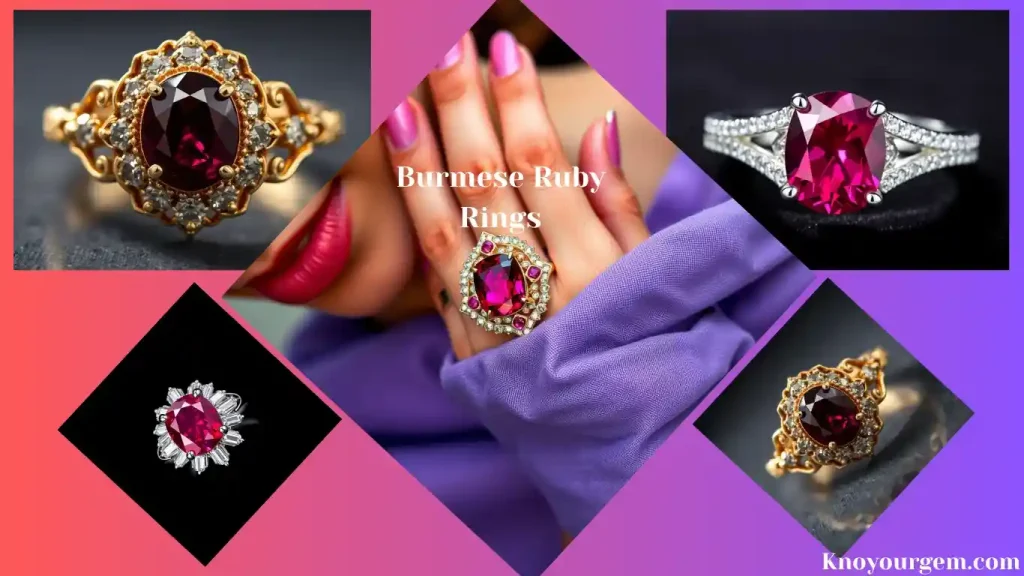
Burmese rubies are treasured centerpieces in rings, necklaces, and royal regalia, regalia, treasured for their vivid pigeon blood red glow. Their rarity and prestige make them a symbol of luxury, often reserved for high end, heirloom, and investment grade jewelry.
Popular Jewelry Types:
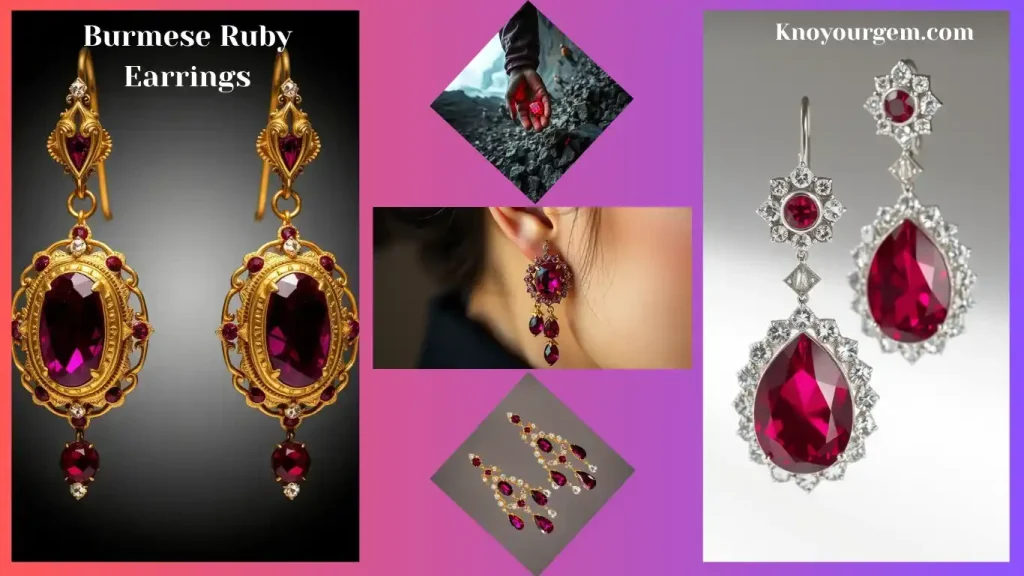
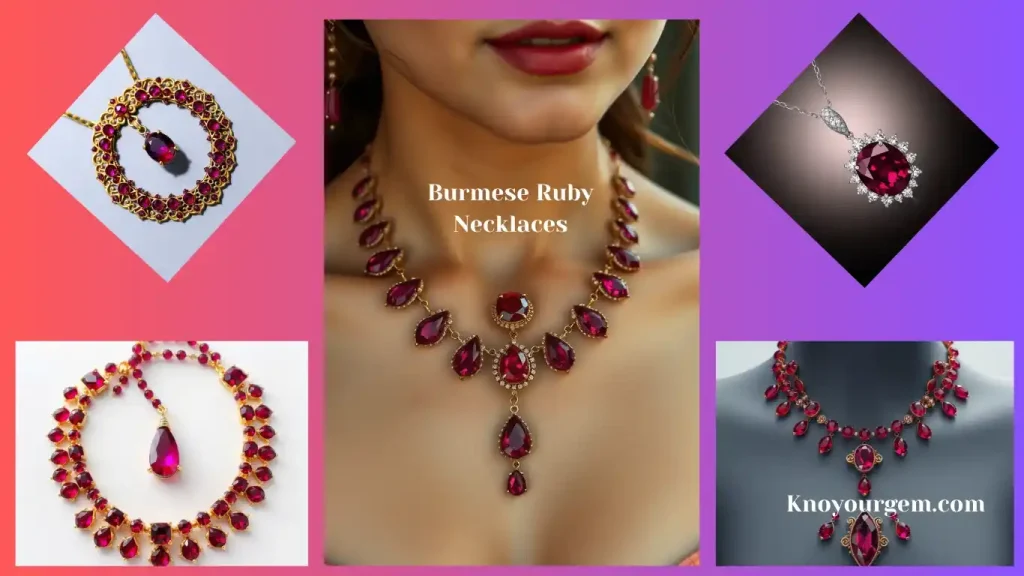
The versatility of Burmese rubies tell that they appear across a wide range of fine jewelry forms. Since a burmese ruby ring remains the most popular setting, with the ruby ring tradition spans centuries from ancient Mughal rings to contemporary burmese ruby engagement rings that favoured by buyers who want a distinctive, meaningful alternative t diamonds. Ruby and Diamond necklace is a staple of high jewelry houses, pairs the ruby’s vivid red with the brilliance of white diamonds. Ruby necklaces, pendants, earrings, and bracelets are all produced in significant volume by major luxury houses.
The Burmese ruby pendant is particularly famous as a wearable investment piece, a single fine ruby in a simple gold setting showcases the stone maximally whether retaining high liquidity. Whether Emerald cut Burmese rubes have gained traction with collectors who prefer modern, architectural look while sustaining visual depth.
Historical & Modern Designs:
Antique burmese ruby jewelry embodies a distinct collecting category. Since, antique burmese ruby ring from the Victorian or Edwardian era, particularly one set in antique gold ruby ring style with rose cut demands and milgrain detail can command premiums more than the stone’s intrinsic value for its historical significance and craftsmanship. Antique burmese rubies jewelries from Art Deco period, characterized by geometric platinum settings, are especially desirable at auction and in modern design ruby makes the top place.
Care and Maintenance Tips:
Ruby owns 9 mohs scale which means that it is highly durable, and suitable for daily wear rings and bracelets. However, it still requires a gentle care. It is must to clean your stone with warm soapy water and a softer brush; and avoid steam cleaners if the stone is filled with fracture.
Ultrasonic cleaners are generally safe for untreated or heat only treated rubies.
It is must to keep Ruby separately from other gemstones to safe other softer gems from it. Inspect settings annually, particularly; prong set stones , to ensure the metal holds the ruby securely.
Treatments and Enhancements:
Burmese rubies are often heat treated to improve colour and clarity, whether lower qualitative stones can be lead-glass filled, showcasing flashes of blue or orange and reduced durability. Untreated, certified rubies remain the most valuable and sought after.
Heat Treatment:
Heat treatment is the oldest and most widely accepted ruby enhancement. When it applied to ruby, it controls high temperature heating can dissolve silk inclusions, improve colour saturation practice, and most laboratories disclose it without implying fraud. However, the premium for unheated stone of equivalent quality is substantial, typically 2x to 5x the price of heated counterpart, sometimes more for an exceptional examples.
Dyeing or Diffusion:
Beryllium diffusion treatment involves heating ruby with beryllium-contain compounds at very high temperatures to alert colour. Since, Berrylike-diffused rubies appear far more vivid than their natural colour warrants and can only be detected by specialized chemical analysis. This treatment is generally considered as a significant disclosure item and must be declared by sellers. Since, surface diffusion is also encountered, because less common in ruby than in sapphire. Both treatments are detectable in competent laboratory analysis.
How Treatments Affect Value:
Treatment status is arguably the single most impactful factor on burmese ruby cost beyond the stone’s intrinisc quality. The market hierarchy is clear: unheated natural Burmese commands the highest values; heat treated natural burmese is valuable but discounted significantly; beryllium-diffused or fracture-filled stones are worth a fraction o comparable material; and synthetic rubies own only manufacturing cost. Since a certified burmese ruby with having explicit treatment disclosure form GIA or SSEF is therefore an essential for any serious purchase above few thousand dollars.
Burmese Ruby vs Other Rubies:
Comparison Table: (Origin, Color, Price, Rarity)
| Origin | Typical Color | Fluorescence | Relative Price | Rarity |
| Burmese (Mogok) | It owns vivid pigeon blood red | Having Very strong fluorescence | It has highest relative price | Extreme |
| Burmese (Mong Hsu) | It towns medium-dark red | It has moderate fluorescence | High (if heated well) | High |
| Thai Ruby | It has dark brownish-red colors | It has weak fluorescene | It owns moderate relative price | Moderate |
| Sri Lankan | It has Pink-red / light red | It owns strong fluorescence | It owns moderate-high relative price | Moderate |
| Mozambique | Vivid red | It has moderate strong fluorescence | It has high relative price | Moderate-high |
Burmese vs Thai, Sri Lankan, African Rubies:
In burmese ruby vs Mozambique comparison, Mozambique material, especially from the Montenpuez region comes closest to rivaling Burmese colour, with having some specimens achieve pigeon blood’ designation from leading laboratories. However, Burmese origin still commands a consistent auction premium which has driven by historical prestige and the cultural cachet of the Myanmar provenance. Since, Sri Lankan rubies are generally lighter and pinker, classified as ‘Ceylon ruby.’ Thai rubies lack the intense fluorescence that makes the glowing ruby characteristic of Mogok stones so visually compelling.
Synthetic Ruby Comparisons:
Lab grown rubies share the chemical and optical properties of the natural ruby, the same refractive index, hardness, and colour range, but are created in laboratory conditions more days rather than geological timescales of millions of years. They hold no rarity premium and retail for tiny fraction of natural ruby prices. Consumers should understand that terms like ‘lab-created ruby’ all refer to the same manufactured product. A genuine, natural Burmese ruby particularly an unheated example with provenance documentation is in an entirely different value category.
Investment Potential:
Follow the given bellow guide which tells how good investment this gem is:
Historical Appreciation:
The Burmese ruby investment case rests on three pillars: scarcity, is sustained demand, and portability of value. Although, Mogok’s marble deposits are finite and aging, they are meaningful new discoveries within the valley and rapidly rare. At the same time, demand from collectors in Asia, the middle East, and the west continues to growing up. Historical auction data spans four decades showcases consistent appreciation for the top quality certified Burmese rubies, with flagship auction records in any given year setting new benchmarks. The Myanmar ruby trajectory at the top end of market has consistently outperformed many traditional asset classes.
Investment Tips and Risks:
Serious investors should adhere to the following principles for making buying decision of bumese ruby:
- Certification: Always purchase gem with having a certificate from GIA, SSEF,AGL, or Gübelin Gem Lab confirming origin and treatment status.
- Treatment: Prioritize unheated stones, the price differential over heated material has widened historically.
- Size: Focus on stones more than 2 carats where the per carat value premium accelerates meaningfully.
- Provenance: It is must to buy a gem from reputable dealers who have verifiable provenance and transparent trade practices.
- Liquidity: It is must to understand gemstone investment is illiquid. Since, primary exit routes are auction house and specialist dealers.
- Risk: Consider geopolitical and sanctions risk associated with Myanmar origin for certain markets.
Auction & Certification Insights:
Christie’s and Sotheby’s jewelry auctions in Geneva, Hong Kong, and New York are the preeminent price revealing venues for investment grade Burmese rubies. Pre-sale estimates published in auctioin catalogues accompanied by GIA or SSEF certificates, provide reliable market benchmarks. Buyers should review hammer prices than estimates. Auction results for antique burmese ruby pieces from storied collections like the Antiques Roadshow burmese appearances demonstrate sustained collector interest in provenance rich stones.
Buying Guide:
Given below the comprehensive buying guide follow it:
Where to Buy Certified Burmese Rubies:
When you are buying a genuine certified burmese ruby, stick to the trusted paths like established auction houses that include gemological certificates, reputable gem dealers offer GIA, SSEF, or AGL certs with every stone, or high end jewelers who can prove their inventory’s origin. Online, buying always demand to see the original lab certificate not just a scan verify its number directly on the lab’s site and only pay once confirmed.
Key Considerations: (Grading, Certification, Seller Reputation)
A burmese ruby engagement ring or investment purchase more than $5,000 should never be made without a certificate. Understand that the certificate should specify: mineral species (corundum), variety (ruby), geographic origin (Myanmar/Burma), and treatment disclosure. Always ask the seller that why burmese is so expensive in the context of its specific characteristics, a knowledgeable dealer will explain the origin premium, treatment status, and colour grade clearly.
Online vs In-Person Purchase:
When you are buying ruby, the experience differs hinges on whether you are shopping in person or online. It is must to look for firsthand stone which lets you judge its color, glow, and brilliance under proper lighting qualities that define ruby’s true value. Since, online platforms, offer more varieties and certificates directly with the issuing lab, and check that a return policy is in place.
Burmese Ruby Meaning and Benefits:
Burmese ruby is cherished for its beauty and also for its deep cultural meaning. Several traditions believe to see it as a symbol of energy, courage, and love.
The ruby color itself red, the colour of blood and fire is universally associated with the life force and power. In the burmese royal tradition, the ruby was called the drop of heart’s blood of Mother Earth, a phrase that captures the emotional intensity that continues to make this gem so compelling to collectors, jewelry designers, and wearers worldwide.
The burmese ruby cabochon, a smooth, domed cut rather than a faceted one is traditionally used for star rubies, that display a six-rayed asterism caused by intersecting silk inclusion. Cabochon rubies also appear frequently in antique and South Asian jewelry designs. The burmese ruby crown is historically associated with the jeweled regalia of burmese kings, who embedded the finest Mogok rubies into their ceremonial headdresses as symbols of divine right and power.
Expert Summary:
Gemologist Key Takeaways
- Burmese rubies come from Mogok remain the global standard for finest quality, they are defined by pigeon blood red colour and strong chromium fluorescence.
- Certification from GIA, SSEF, or AGL is non negotiable for serious purchases, it is only reliable proof of origin and treatment status.
- Unheated, natural Burmese rubies command the highest market prices and have demonstrated the powerful long term value appreciation.
- Buyers should educate themselves on the treatment types like, heat treatment, beryllium diffusion, and fracture filling, as each has dramatically vary implications for value.
Recommended Resources:
For deeper study on Burmese rubies, here are some trusted resources to explore:
- GIA (gia.edu): Learn gemological fundamentals and verify certificates, they are recommendable.
- SSEF Swiss Gemological Institute (ssef.ch) and AGL (aglgemlab.com): They are specialized for checking reports and standards.
- Sotheby’s & Christie’s auction archives: Review They review have reviews of past sales for price benchmarks.
- Gems & Gemology (GIA’s journal): They have an access to peer reviewed research on ruby deposits, treatments, and detection methods.
Future of the Burmese Ruby Market:
The global Burmese ruby market analysis points to continued strong demand for the top quality alongside growing supply from Mozambique and other African sources provide volume at the commercial grades. As Mogok’s finest accessible age and high quality rough becomes scarcer, the premium for certified, unheated, Mogok origin rubies will likely intensify. Responsible sourcing and supply chain transparency are now becoming increasingly important to international buyers, that drive demand for fully documented, certified natural burmese rubies from verifiable origins.
Quick Answers:
1. What makes a Burmese ruby valuable?
Burmese ruby is most valuable because of having combination of vivid pigeon blood red colour, strong chromium fluorescence, extreme rarity, and prestigious geographic origin. Unheated specimens with GIA or SSEF certification that confirms Mogok provenance and no heat treatment carry the highest premiums. Since, the finite supply from aging Mogok deposits, are combined with robust global collector demand, consistently drives prices upward for the top quality examples.
2. How to identify an authentic Burmese ruby?
Authentic identification demands laboratory testing. Since, visual cues including vivid red fluorescence, natural silk inclusions under magnification, and characteristic growth zoning You can also identify it through Professional gemological analysis which includes, refractive index measurement, UV-Vis spectroscopy, and trace element analysis confirms both species and geographic origin. Always request a GIA, SSEF, or AGL certificate for any significant purchase.
3. Are Burmese rubies a good investment?
Top qualitative, certified, unheated burmese rubies have demonstrated consistent long term appreciation and make a credible alternative investment for high net worth buyers. They are portable, non correlated with the traditional financial markets, and in finite supply. They are illiquid assets with having high transaction costs and requires specialist knowledge to buy and sell wisely.
4. What is the difference between Burmese and other rubies?
Burmese rubies particularly from Mogok have much lower iron content, that produce a purer, more intensely fluorescent red than from Thailand Africa, or Sri Lanka and the Pigeon blood colour grade, is combined with Mogok origin and it is considered as premium.
5. How much does a Burmese ruby cost?
Burmese rubies price span an enormous range. Since, commercial grade heated start below $1,000 per carat. While 2 carat fine unheated burmese rubies typically command prices from $30,000 and $120,000. And 5 carat burmese rubies with having pigeon blood unheated specimens can command $500,000. Whether r6 carat burmese rubies at the major auction for top quality material has surpassed $1 million. So, price fluctuation can hinge on colour, clarity, treatment, status, size and certification.
6. Why is a Burmese ruby so expensive?
Because an exceptional quality is usually rare. The Mogok Valley’s geological conditions produce the world’s finest rubies, but high quality stones are tiny fraction of all material extracted. Combine finite supply with relentless global demand from collectors, investors, and luxury jewelers plus the prestige of the origin and the reflects both genuine and centuries of the cultural reverence.
7. Can rubies be pink?
According to the gemological perspective, the line between pink ruby and pink sapphire is drawn by colour saturation. Both are corundum by chromium, however stone must achieve a minimum saturation threshold to be classified as ruby. Different laboratories draw this line differently. For example GIA uses the term “pink sapphire” for lighter stones.
8. What is pigeon blood red?
Pigeon blood red is the highest color grade for ruby, which describes a vivid, highly saturated red with having a slightly purplish-red secondary hue and minimal brown modifier as comparable to the red of pigeons’s eye. The term is originated in the Burmese gem trade and was formalized by leading gemological laboratories including SSEF and Gübelin Gem Lab.
This content is written by gemstone enthusiast “Kamil Hussain”

Welcome to KnowYourGem.com! your ultimate destination for uncovering the fascinating world of gems and their secrets! I'm Kamil Hussain, a passionate blogger with a Master’s degree in Economics, dedicated to bringing you insightful, well researched content that blends the beauty of gemstones with the art of storytelling. With a keen analytical mind and a love for discovering hidden treasures, I created this platform to help you explore the brilliance, history, and value of every gem.

