


Summary Answer:
| Hessonite Garnet is like a fire trapped in earth, while having honey-orange to the deep brown this stone showcases warm, mysterious glow. It is primarily found in Sri Lanka, Tanzania, and Madagascar, it is tough enough with having 6.5-7.5 mohs scale of hardness and suitable for daily wear jewelry. In Vedic astrology, it is cherished as a gem of clarity and prosperity. In fine jewelry, it is valued for its rich, glowing beauty and it is more than just a stone , it carries symbols like grounding, and timeless allure. |
Get more details about tsavorite garnet:
Quick facts: Hessonite Garnet at a Glance
| Property | Details |
| Mineral Family | It belongs to Garnet family |
| Variety | It is a variety of Grossular Garnet |
| Chemical Composition | It carries chemical formula like Ca3Al2(SiO4)3 — Calcium Aluminum Silicate |
| Color | The stone has color range of Honey, orange, reddish-brown, yellow, green, red |
| Hardness | Hessonite is tough enough for daily wear jewelry because it owns 6.5-7.5 mohs scale of hardness. |
| Crystal System | It forms in cubic crystal system (Isometric) |
| Refractive Index | The stone owns 1.72 to 1.74 refractive index |
| Specific Gravity | The stone have 3.57 to 3.73 specific gravity |
| Main Sources | It is primarily found, Sri Lanka, Tanzania, Madagascar, India and Brazil |
| Also Known As | The gem is also recognized as Gomed, Cinnamon Stone |
| Birthstone Association | The stone is associated with birth month of January (Garnet family) |
| GIA Recognition | Yes classified as grossular garnet |
What Is Hessonite Garnet?
Hessonite is a mineral called calcium aluminum silicate and a variety from garnet family. The chemical formula \ceCa3Al2(SiO4)3\ceCa3Al2(SiO4)3, which deeply belongs to the forming of this crystal. Not same as other garnets like yellow, red, or green, hessonite stands out with its warm honey, orange, or reddish-brown colors.
The name hessonite has take from the Greek word hesson, which means “inferior.” a nod to its lower density as compared to other garnet types. Yet despite this etymology, hessonite is anything but inferior, it is cherished gemstone with strong commercial, spiritual, and collector appeal.
Geological Formation of Hessonite Garnet:
Hessonite Garnet forms through the intense forces of regional and contact metamorphism, in which exciting rocks are transformed under extreme heat and pressure for more than millions of years.It crystallizes within metamorphic environments like, schist, gneiss, and skarn deposits, especially where calcium-rich settings meet aluminum-bearing minerals.
Its signature warm colors come from substitutions of manganese and iron within the crystal lattice. These trace elements shift the gem’s palette from pale yellow-orange to the deep reddish-brown, with the most treasured specimens glowing in a rich honey-orange tone and displays exceptional clarity.
Ceylon hessonite garnet , is sourced from Sri Lanka, forms in gem-bearing gravels recognized locally as illam. These alluvial deposits concentrate gemstones eronded from ancient metamorphic parent rocks, that’s why Sri Lanka remains the world’s most profile source of high quality hessonite rough garnet and faceted specimens.
Physical and Optical Properties of Hessonite Garnet:
| Property | Value |
| Mohs scale | Hessonite owns 6.5-7.5 mohs scale of hardness |
| Crystal System | This stone born in cubic crystal system(Isometric) |
| Cleavage | It has no cleavage (Indistinct parting) |
| Fracture | Conchoidal to uneven |
| Luster | Vitreous to resinous |
| Transparency | It is transparent to translucent |
| Refractive Index | It owns refractive index about 1.72 – 1.74 |
| Specific Gravity | Its specific gravity like 3.57 – 3.73 |
| Pleochroism | None |
| Fluorescence | None to weak orange |
Hessonite showcase no cleavage, that makes it especially durable for use in jewelry. Instead of having breaks with fracture, it have smooth and curved pattern typical of cubic garnets, that give cutters a consistent surface to work with. Another defining trait is its lack of pleochroism, the stone displays the similar rich color from every angle. This uniformity not only enhances its beauty but also simplifies the process of color grading, and ensures that its warm honey-to-reddish tones remain strikingly consistent.
One of the most diagnostically significant optical features of this gemstone is its characteristic like heat shimmer or oily appearance when it is viewed under magnification. Since this visual effect, is caused by internal stress patterns and included apatite and diopside crystals, distinguishes hessonite from other similarly colored garnets and simulants.
Color and Appearance: The Spectrum of Hessonite Garnet
The color of hessonite garnet spans a broad and warm spectrum. The most desirable and valuable shade is a rich honey-orange with having deep saturation, sometimes it is described as the color of fresh cinnamon or clover honey. Since, this signature tone gives the stone’s alternative name, cinnamon stone.
Brown hessonite exhibits garnet exhibits earthier, more muted tones, whether red hessonite showcases deeper, ruby adjacent color that can sometimes be mistaken for spessatite garnet. Whether orange hessonite garnet with having high clarity and strong saturation commands the highest prices in the market.
Yellow hessonite is rarer and lighter, displays a golden to pale amber appearance. Whether green hessonite exists as an uncommon variety recognized for its vivid green color.
Color zoning, visible bands or patches of vary color intensity is common in natural hessonite and serves as one of the several markets that help gemologists and buyers identify the stone as genuine rather than synthetic or treated.
Major Mining Locations: Where Is Hessonite Garnet Found?
Hessonite is found across several continents, however each region produce stones with slightly characteristics.
- Sri Lanka (Ceylon): Sri Lanka is popular for producing the best hessonite gemstones. Stones from this country called Ceylon hessonites, and that are recognized worldwide for their honey-orange color, clear, quality patterns inside the stone.
- Tanzania: Tanzania is most recognizable producer hessonite garnet. Umba Valley and Tunduru regions of Tanzania produces stones. Whether stones from these deposits often display, richer reddish-brown tones that other origins lack.
- Madagascar: Madagascar supplies a consistent volume of hessonite garnet rough and faceted stones, with having colors range from orange to brownish-red.
- India: India, Particularly the states of Rajasthan and Andhra Pradesh, produces hessonite which is preeminently used in the Vedic astrological jewelry market. Indian-marker Gomed stone are widely traded across South Asia.
- Brazil and Other Sources: Brazil, Canada, and parts of Europe also yield hessonite in smaller quantities. However Brazilian specimens tend toward yellow-orange colors.
Historical Significant of Hessonite Garnet:
- In old Greece and Rome, the stone was curved into intaglios and signet rings, it has often used to showcase gods and mythological scenes due to it has its warm glow.
- In South Asia, it has recognized as Gomed in Sanskrit and appears in old texts on gemology and astrology. The people of South Asia consider it as a part of the sacred Navaranta in Hindu and Buddhist traditions, embodies the lunar node Rahu. This link has kept hessonite in demand in the region for centuries.
- In medieval Europe, people have believed it is a “cinnamon stone” could protect against the plague and improve mental clarity. Today crystal healers still associate hessonite with similar benefits.
Hessonite Garnet Benefits:
Hessonite garnet is mostly valuable gemstone because it provides strength, clarity, and emotional balance. From astrology to healing practices, people value this stone as supporter for body, mind, and many positive ways.
Physical Healing Properties:
Hessonite healing properties are considered as supporter for the immune system, digestive health, and hormonal balance. Although crystal practitioners link the stone’s warm energy with simulating metabolism and improving circulation. Its grounding quality benefits to those who are recovering from illness or managing chronic fatigue.
Emotional and mental benefits:
Hessonite garnet often controls on emotion and clears the mind to get positive thinking. It is better known to reduce fear, confusion, and anxiety and enhancing confidence, clarity.
Spiritual and Metaphysical benefits of hessonite:
The stone is spiritually connected to the scaral chakras. It is also known as a stone of manifestation, and said to align personal willpower with higher purpose. Since, Vedic tradition believes that the gem neutralize the negative effects of Rahu that reduces confusion, addictive behavior, and irrational fear when it is worn correctly.
What Is Hessonite Garnet Good For?
Hessonite is basically recognized as a gem which helps to ground scattered energy, gives stability for goals and spiritual growth. The stone has especially valued by those people who face multiple challenges in their relations, finances or mental health, and is also used in meditation to deepen focus awaken hidden potential.
Hessonite Garnet in Astrology:
In Vedic astrology, hessonite garnet is recognized as Gomed which is a gemstone mostly prescribed for Rahu, the shadow planet or north lunar node. Rahu’s presence in a birth chart is associated with ambition, obsession, illusion, and transformation. While Rahu is considered malefic or poorly placed, astrologers traditionally recommended to hessonite for balancing its influence and reduce negative effects.
The month January is primarily connected to the stone Hessonite as birthstone through its membership in the garnet family, which makes it meaningful gift for those people who born at the start of the year. However, in Vedic tradition, the stone is assigned only based on astrological charts rather than birth month alone.
In astrology, hessonite is worn in a very particular way. The stone should be natural, untreated, it is set in silver or in panchdhatu. It is usually worn on the middle finger of the right hand.
Who should wear Hessonite Garnet?
In Vedic astrology, hessonite is especially helpful for people whose birth charts showcase Rahu in a strong or difficult position. It is must recommendable to wear this stone for those people who hold a sign of Aquarius (Kumbha) or Gemini (Mithuna) ascendants, whether Rahu is most essential there.
Instead of just astrological thoughts, the stone can also support for everyday life. It is often cherished by people who want clearer thinking, emotional balance, or a stronger sense of stability.
It is especially well suited for professional life, entrepreneurs, and spiritual seekers who need focus, confidence, and drive to follow through an ambition goals.
Hessonite Garnet Jewelry Uses:
- Versatile gem: Hessonite’s warm color, good hardness, availability in large, clean which makes stones clean and flexible choices for jewelry in many styles.
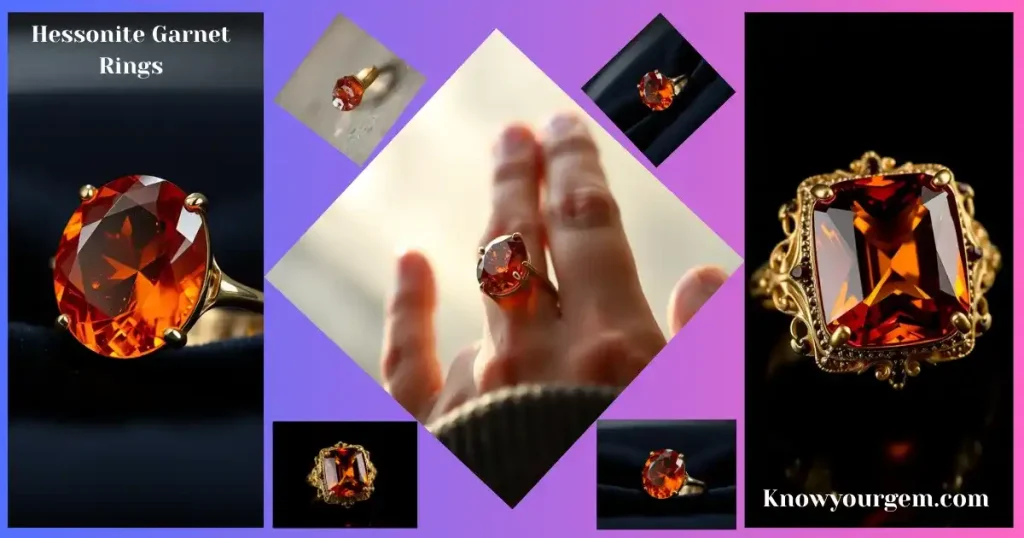
- Rings: The most popular way to wear hessonite is in rings, generally they are set in gold or silver with bezel or prong settings.
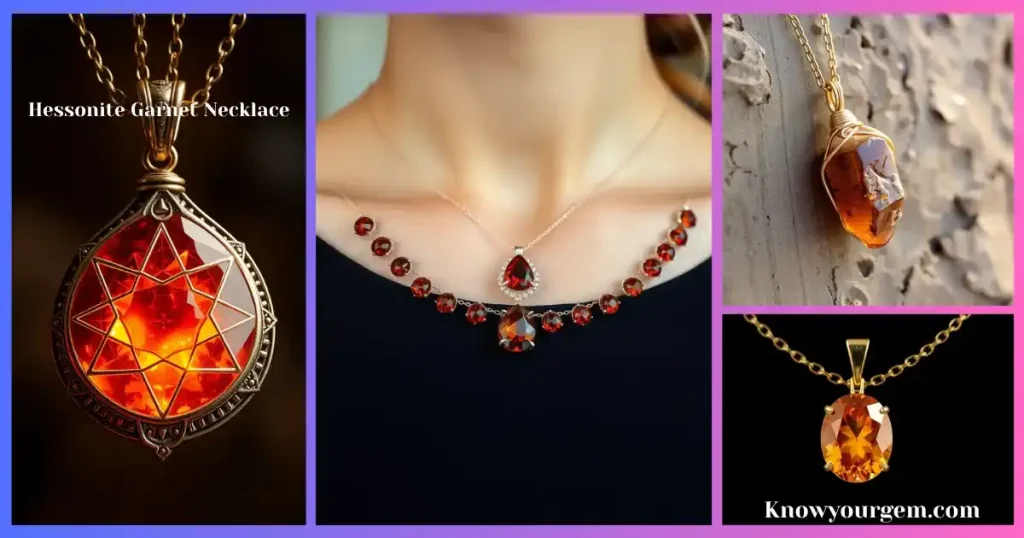
- Necklaces & pendants: These are worn on both special every day and special occasions. When they set in a yellow metal, hessonite’s honey tones glow perfectly.
- Bracelets: They are of made with a faceted beads or smooth cabochons in metal links. Bead bracelets are especially common for healing or astrological use.
- Cabochon cuts: These are best for stone that have strong color but less clarity. This cut highlights hessonite’s unique “heat shimmer,” the glow effect inside the gem.
Hessonite Garnet vs Other Gemstones:
Given below multiple charts showcase the difference between hessonite Vs other gemstones:
Hessonite vs Ruby:
| Feature | Hessonite Garnet | Ruby |
| Color | Hessonite gem owns colors like, Honey, orange, reddish-brown | Whether Ruby carries red to pinkish-red |
| Mineral Family | Hessonite belongs to the garnet family | While Ruby is related to the Corundum |
| Hardness | Hessonite owns 6.5 – 7.5 Mohs scale | Whether ruby is 9 on the Mohs scale of hardness |
| Price per Carat | Hessonite commands prices from $10 – $300+ | Whether Ruby commands prices from $500 – $15,000+ |
| Astrological use | Rahu (Vedic) | Sun (Vedic) |
| Inclusions | It has inclusions like, heat shimmer, apatite | Silk, needles |
Hessonite vs Ruby is a common comparison in Vedic astrology, where both stones are prescribed vary planets. Since, ruby is associated with the Sun and is significantly harder, rarer and more expensive. However, Hessonite is far more accessible and offers warm color which is alternative for collectors who appreciate orange brown tones.
Spessartite vs Hessonite Garnet:
| Feature | Hessonite stone | Spessartite stone |
| Chemical Family | Hessonite is from Grossular (Ca-Al) | Whether Spessartine is from (Mn-Al) |
| Color Range | It owns colors like, Honey, orange-brown, reddish | It owns Orange to red-orange |
| Typical Clarity | It is Included by (heat shimmer) | It is eye-clean possible |
| Price | It commands lower to moderate prices | It commands moderate to high prices |
| Key Identifier | I has oily/heat shimmer inclusions | It has clean, vivid orange |
The spessartite vs hessonite garnet distinction that matters significantly for buyers. Whether both display orange hues, spessartite tends toward cleaner, more vivid orange, whereas hessonite characteristically contains internal heat shimmer and has warmer, honey amber quality. Chemical testing or refractive index measurement definitively separates the two.
Hessonite and Garnet Difference:
The difference among hessonite and garnet lies in specificity: garnet is a broad mineral group that comprises more than twenty species, whether hessonite is garnet. The garnet family also includes almandine, pyrope, tsavorite, spessartite, demantoid, and rhodolite, each distinct in chemistry , color, and value.
Hessonite Garnet Price Guide:
The price of of this stone is influenced by its color, quality, clarity, origin, cut, and carat weight. Since, Sri Lankan (Ceylon) hessonite consistently commands premium prices because of its superior color and established provenance
| Quality Tier | Price Per Carat (USD) | Description |
| Low Grade | The lower grade price of hessonite from $5 – $20 | Because the stone contains heavy inclusions, poor color, commercial grade |
| Commercial Medium | The commercial medium prices from $20 – $60 | Because the gem owns moderate clarity, acceptable color, standard cut |
| Fine Quality | The fine quality demands prices from $60 – $150 | Because of having good clarity, rich honey-orange, well cut |
| Premium / Ceylon | The premium/Ceylon stones charge prices from $150 – $400+ | High clarity, vivid honey-orange, Because they produced by certified origin |
| Imperial Hessonite | Imperial hessonite commands prices from $400 – $1,000+ | Because of having an exceptional clarity, top color, collector grade |
Factors Affecting Hessonite Garnet Value:
- Color: Rich, saturated honey-orange is the most valuable color considered in stone. Whether pale or overlay brownish stones grade lower.
- Clarity: Despite hessonite’s characteristic inclusions, stones with minimal eye-visible flaws command premium pricing.
- Origin: Ceylon hessonite garnet from Sri Lanka is most valuable stone than the same stone from other places. It usually commands 20%-40% higher prices because of its special origin.
- Carat weight: Prices per carat inclined non linearly more than 5 carats, as large clean hessonite specimens are rare.
- Certification: Certification from GIA or GRS for stones reports achieve higher resale values.
- Cut quality: Precision cut stones with having proper proportions maximize brilliance and command higher prices than commercial cuts.
The worth of garnet slightly depends on the specific variety. Whether common red almandine garnet commands prices from $1 to $5 per carat, whether imperial hessonie at the top quality commands price more than $1000, or more per carat for an exceptional specimens with documented Sri Lankan origin.
How to Identify Real Hessonite Garnet:
While identifying a genuine hessonite demands examining several physical, optical, and visual characteristics. Given below the primary identification markers are used by gemologists:
Visual and Optical Tests
- Heat shimmer / oily appearance: An authentic display of a characteristic roiling, heat haze like shimmer visible through a loupe at 10x magnification. This effect, is caused by apatite and diopside inclusions under the stress, is highly diagnostic.
- Color zoning: Natural hessonite generally displays bands or patches of uneven color intensity. It perfectly uniforms color throughout can indicate synthetic or treated material.
- Refractive index: Hessonite can be tested between 1.72 and 1.72 on a refractometer which is a narrow range that distinguishes it from glass simulants (typically 1.50) and other garnets.
- Specific gravity: A hydostatically measured specific gravity 3.57 to 3.73 of this stone confirms its identity and separates it from citrine (2.65) and synthetic substitutes.
- Hessonite garnet inclusions: Under magnification, look for the needle like apatite crystals, diopside inclusions, and internal stress patterns. These natural inclusions are positive indicators of authenticity.
Certification and GIA Standards:
The identification of Hessonite garnet by GIA follows standard gemological testing protocols. The lab classifies hessonite as grossular garnet and issues grading reports that confirm its identity, origin, and treatment status. Since, for high value purchases, must request a GIA or AGL report which is strongly advisable.
Buyers should be cautious of glass filled stones or synthetic orange garnets that are marketed as hessonite. A qualified gemologist can distinct these materials through refractive index testing, spectroscopic analysis, and microscopic inclusion examination.
Hessonite Garnet Raw and Rough Specimens:
Rough hessonite and raw speciemens are famous among collectors, lapidaries, and crytsal healers who prefer uncut stones. Since Raw hessonite from SriLanka typically displays dodecahedral or trepezohedral crystal forms the classic rounded, faceted crystal shapes that are associated with the garnet family.
The color of raw hessonite often appears more muted than polished faceted stones, because surface oxidation and matrix material can mask the stone’s internal clarity and color distribution carefully deciding on the optimal orientation and cut style.
Rough hessonite is sold by weight in Kilograms for commercial grades and by individual piece for high clarity collector specimens. Since, Sri Lankan alluvial rough tends to be water worn and rounded, whether rough from primary deposits in Tanzania can be more angular with visible crystal faces.
How to Care for Hessonite Garnet Jewelry:
Follow the given below methods to take care of your jewelry:
Cleaning Methods:
Hessonite is relatively with having hardness of 6.5 to 7.5 mohs scale, which makes it suitable for most jewelry applications. To clean this stone’s jewelry, use warm water with having small amount of mild dish soap and a soft bristle brush. Wash out it thoroughly and dry it with a lint free cloth.
Don’t use ultrasonic cleaners for hessonite garnet jewelry, especially for stones which have significant inclusions, because ultrasonic vibrations can propagate fractures along internal planes.
Storage tips:
- Must store your hessonite jewelry separately from other harder gemstones like, diamond, sapphire, and ruby to resist surface scratches.
- Keep away prolonged direct sunlight from your gem, because can negatively affect due to having extended UV rays.
- Remove hessonite garnet and bracelets before engaging in any physical activity and avoid exposure to harsh chemicals.
Durability notes:
Hessonite is a practical choice for rings and bracelets that are worn regularly, and require reasonable care. Its lack of cleavage reduces the risk of splitting under impact, because conchoidal fracture means a sharp blow can chip the stone’s edges. Protective settings like bezel or halo deigns are recommended for rings that are used in daily wear.
Hessonite Garnet Properties Summary
| Category | Detail |
| Hessonite Garnet Properties | Hessonite forms in cubic crystal system and owns hardness like 6.5-7.5 Mohs scale, refractive index is tested between 1.72–1.74, specific gravity 3.57–3.73 |
| Hessonite Garnet Spiritual Meaning | Root and sacral chakra activation, grounding, manifestation, courage |
| Hessonite Garnet Healing Properties | It supports supports immunity, digestion, hormonal balance, mental clarity |
| Hessonite Garnet Metaphysical | The stone dissolves fear and confusion, amplifies willpower and focus |
| Hessonite Garnet Birthstone | Hessonite is mostly considered as January birthstone (Garnet family); Vedic: Rahu gemstone |
| Hessonite Grossular Garnet | Grossular garnet is distinguished by its honey orange color and glowing heat shimmer inclusions. |
| Ceylon Hessonite Garnet | It is the highest quality originated stone only found in Sri Lanka |
| Imperial Hessonite Garnet | It has top tier collector grade; exceptional clarity, rich color, premium price. |
Conclusion:
Hessonite is a stunning gemstone comes from garnet family. The stone is recognized for its honey-orange to reddish-brown color and its unique “heat shimmer” effect. It also holds deep meaning in Vedic astrology, where it is valued as the Gomed stone.
People who are looking for vary reasons, its beauty in jewelry, its astrological role, its grounding energy, or simply as a collectible natural grossular garnet, they should acquire right knowledge of its qualities, origins, and authenticity.
Stones from Sri Lankan gravels to the South Asian jewelry markets and beyond, hessonite continues to attract buyers to , astrologers, healers, and collectors.
Get buying detailed guide about Hessonite Garnet from GIA:
FAQS:
1. What is Hessonite Garnet used for?
Hessonite is commonly used in fine jewelry like, ring, necklace, pendant, bracelet and cabchon setting which can be daily use-able . In astrology, the stone is worn as the Gomed to mitigate the effects of Rahu. Crystal healers usually use it for make themselves grounded, emotional stability, and enhancing mental focus.
2. Is Hessonite a rare gemstone?
Hessonite is neither only considered as the rare in commercial terms, as Sri Lanka, Tanzania and Madagascar produce consistent supplies. Since, high qualitative imperial hessonite with having deep honey orange color, excellent clarity, and documented Ceylon origin is uncommon and commands significant collector premium prices.
3. Where is Hessonite Garnet found?
Its primary ethical resources are Sri Lanka, Tanzania, Madagascar, India, Brazil, and Canada. However stones from Sri Lanka can be reasonable for having quality, transparency, and provenance value.
4. How much does Hessonite Garnet cost?
Hessonite commonly commands prices from $5 per carat for lower grade but higher graded stones can be sold for $1,000 per carat. Whether fine mild stones are commonly sold for $60-$150 per carat, with the value which is driven mainly by origin, color and certification.
5. What is the difference between Hessonite and Garnet?
Garnet itself the largest family, it owns various types. However Hessonite is the special variety from the grossular group of garnet. Whether Garnet owns types like almandine, pyrope, spessatite, and tsavorite. But the warm honey-orange color and heat shimmer inside the stone, which gives its glow make hessonite wonderful stone.
6. How do I identify genuine Hessonite Garnet?
Genuine hessonite is identified by its characteristic heat shimmer or oily appearance under magnification, refractive index is tested between 1.72 to 1.74, natural apatite inclusions, and warm honey orange to reddish -brown color with having visible color zoning. Since, GIA certification can confirm grossular garnet identity is the most reliable authentication method for high value purchases.
Written by Gemstones Enthusiast Kamil Hussain !

Welcome to KnowYourGem.com! your ultimate destination for uncovering the fascinating world of gems and their secrets! I'm Kamil Hussain, a passionate blogger with a Master’s degree in Economics, dedicated to bringing you insightful, well researched content that blends the beauty of gemstones with the art of storytelling. With a keen analytical mind and a love for discovering hidden treasures, I created this platform to help you explore the brilliance, history, and value of every gem.

