


Editing: Gemological material checked against the GIA and International Gem Society reference material.
Quicker: A star sapphire is a corundum gemstone, which has a domed surface with a brilliant six-rayed star visible when directly lighted; a phenomenon known as asterism. The star is created by the aligned needle-like inclusions within the stone and the gem has to be cut in the form of a cabochon in order to see the effect. Not all star sapphires are precious: the cost varies based on the sharpness of the star, centering, body color, transparency, size, treatment status and the material is natural or man-made.
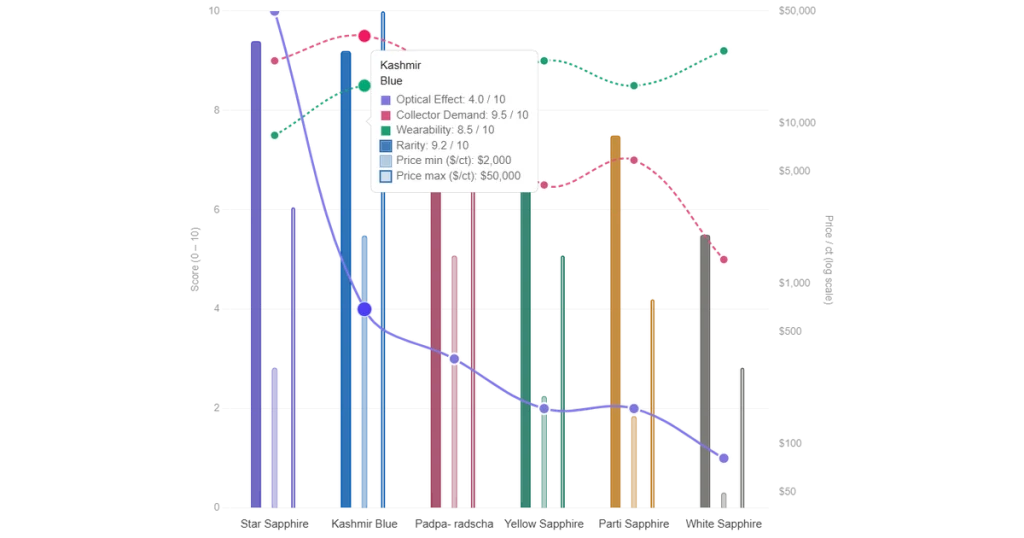
This is one unified chart with a dual-axis architecture everything lives together with no clutter. The left axis runs the 0–10 score scale shared by four metrics: the bars show Rarity per variety (colored distinctly), while three overlaid lines trace Optical Effect, Collector Demand, and Wearability across all six varieties. The right axis runs a logarithmic price scale so Kashmir Blue’s $50,000/ct ceiling doesn’t crush the others the thin bars behind each variety show the min-to-max price range.
Sapphire star in a single sentence:
Given below detailed case study about star sapphire put your eye on it:
Definition:
Asterism A star sapphire is a type of sapphire, and thus a corundum, which shows a star-shaped optical effect known as asterism on its polished dome. The majority depicts a six ray star. Stars that are twelve-rayed are rare. The gem has to be cut in a smooth cabochon so that the star can come out right on its face.
Why the star comes out:
Extremely fine needle-like inclusions, usually rutile, oriented in three intersecting directions which reflect the internal crystal structure of corundum are what create asterism in a blue star sapphire. As the direct light passes through the dome it falls upon this exact grid of needles all at once and is refracted into six bright crossing rays which seem to hover upon the surface.
Black star sapphires do not act in the same way. They may have a dark body and star effect with either hematite or ilmenite with or without rutile giving a bright silver or gold star on a near opaque dark ground.
What is a good star sapphire?
It is good for many reason you can study them below:
The star itself:
Quality of the star is the most important factor of any star sapphire. One of these stars is a premium star, and is placed in the centre of the dome, and is kept sharp and bright in the ordinary direct light–not in an extreme spotlight–and exhibits all six rays running through the whole length and breadth of the stone. According to gemologists, this is referred to as rays running girdle to girdle.
Wavy rays, broken, irregular of brightness, pale, or wanting on one side, all devalue. A misplaced star is even more detrimental since the misplacement is eminent when the gem is fixed in a ring or pendant.
Contrast and color of the body:
The color of the body also plays a big role, despite the fact that the star is the center of the visual focus. Blue is the most commercially significant color of star sapphires. The phenomenon is dramatic in appearance as it is contrasted by a saturated blue body and bright white rays of stars.
Star sapphires are also available in pink, purple, yellow, gray and near-colorless varieties- all natural and collectible. Black star sapphires are in a category of their own: the almost opaque composition of the rock forms a completely new visual effect, which the star itself is a unique source of light on a dark background instead of a bright ray pattern on a transparent gem.
Transparency, dome and cut:
Star sapphires are not faceted but cut en cabochon because the star effect is only produced using a smooth, rounded dome to focus reflected light to the inclusion grid. Faceting would completely diffract those reflections and annihilate asterism.
The height of the dome should be adjusted. A dome which is too flat gives a weak, diffuse star. An excessively high dome may make the stone look too dark or may give setting problems. The cutter also needs to have the base of the cabochon directly facing the optical axis of the crystal–when the orientation is incorrect the star is wandering out of center or not fully formed and no polish will work to fix the situation.
Size and rarity:
There are big star sapphires–some stones which have been well known in history weigh hundreds of carats–but size is not a measure of value. A weak, fuzzy or off-center star on a large stone is less valuable than an exceptionally asterism and strong color stone of a smaller size. The controlling factor is fine quality regardless of the carat weight. Stones bigger than ten carats that are a combination of excellent colour, good asterism and little treatment have a significant per-carat premium in the certified natural star sapphire market, whereas size alone does not.
Natural, treated or artificially grown?
A thoroughly case study about difference between natural and synthetic stone:
Natural star sapphire:
In gem purchase, natural is the stone that would have been created wholly in the earth without being man-made. A natural sapphire sapphire can be treated even after mining- naturalness and treatment status are two different questions. When a dealer refers to a stone as natural, enquire whether it is also untreated, or not treated to a degree, and insist on an independent laboratory statement to prove the two.
Common treatment questions:
The most commonly used intervention on sapphires in the world is heat treatment. The moderate heat treatment is tolerated in the trade and is generally stable and its impact on value is known to experienced dealers. A few star sapphires, however, are diffused in beryllium, or coated on the surface to change color, or filled with glass in order to make them look clearer.
Stones with heavy fillings need much more treatment and may be permanently spoilt by ultrasonic cleaners, steam or harsh chemicals. It is a right of a buyer to disclose treatment. Any respectable vendor must be clear on the treatment that a stone has undergone. In case a listing does not include treatment language, inquire directly prior to buying. A laboratory report of GIA, AGL, Gubelin, or SSEF will determine treatment status in addition to the stone species.
There are star sapphires that were grown in laboratories:
There are synthetic star sapphires available in the market and they have been extensively reported by GIA. Lab-grown corundum is chemically equivalent to natural sapphire, but not rare, and has a value a fraction of a similar natural mineral. Online retailers have synthetic specimens that are presented on a regular basis, and in some instances not clearly indicated.
Do not use photographs to determine the difference between a natural and a synthetic sapphire star. Both of them may appear totally believable in pictures. The only sure way of buyers who are not trained gemologists is through qualified gemological laboratory report.
The question of knowing whether a star sapphire is worth purchasing or not:
Given below the five points must need to consider them:
Fast 5-point shopper survey:
Purchase five questions that one should go through before committing to any star sapphire purchase:
- Is it a star with the dome as the center? A star that is not at the center suggests that there is a cutting issue or incorrect crystal orientation.
- Do the six rays all straight, complete and approximately equal in intensity? The quality and value are diminished by incomplete or wavy rays.
- Is the body color good even when it is not under a spotlight? Good color in ambient conditions is important in daily use.
- Has the seller clearly and in writing disclosed the treatment status? The lack of treatment language is an issue and not a neutral indication.
- Does it have an independent laboratory report on natural origin and treatment results? A report is required in any purchase made over a few hundred dollars.
Red flags on product listing:
Watch for these warning signs before buying a loose star sapphire gemstone or a set piece:
- A description that refers to a stone as natural and has no gemology laboratory report.
- The asking price of a large stone was a very low price showing the quality as fine and natural.
- Advertisements that do not mention a treatment language whatsoever even a statement that the stone is untreated.
- The photographs of products are made with the help of a strong spotlight and only one angle that makes even a poor star seem sharp.
- No pictures of the dome profile, the stone in various angles, or the gem in natural light.
What a lab report can substantiate:
An independent gemological laboratory report verifies three facts which interest a buyer: the nature versus synthetic character of the stone, the species and variety of the gem, in this case corundum, sapphire, and any apparent treatments. Some laboratories also comment on geographic origin (with its own pricing implications) when purchasing much important material, well documented Sri Lankan or Kashmir material.
One does not need gemology training to read a lab report. Check the term natural under origin, a treatment mark of either none detected or what was detected, and assurance that the stone is not glass or some other simulant.

There are three tabs that can be used to switch in the chart:
- With a selection of variety and quality display the price of all the major star sapphire varieties, including natural blue treated and untreated, black, pink, purple, gray, and lab-grown, divided into entry, mid, and fine/collector grades.
- By carat size illustrates the price-per-carat of natural blue star sapphires by weight, visually showing a bar chart comparison, and visually breaking it down into treated, untreated, and lab-grown at each size level. Price factors is a summary of the six variables that determine the most price variations between the stones with similar amounts of carats.
Some of the insights into the data:
Natural blue star sapphires can be as cheap as 20 per carat in small and weakly-colored stone to as much as 1200 per carat in the 1-5 carat range in excellent grade. Gem Rock Auctions Stones of exception Gemstones sold at auction, can be sold above $10,000 per carat, and average fine blue star sapphire is between $500 and 5,000 per carat in the current market. In 2025, the price of Farmonaut High-quality black star sapphires is between $500 and $3,000 per carat. Farmonaut Laboratory Lab-grown stones occupy a tiny portion of those on the entire spectrum of size
Star sapphire and blue sapphire:
Given below the difference between star sapphire and blue sapphire:
Visual difference:
An ordinary faceted blue sapphire is appreciated mostly because of the color saturation and brilliance. Its appearance is color-sensitive and light-dynamic and varies and flashes with the change of the viewing angle. A sapphire, cut in a smooth cabochon is not a sparkling star. The peculiarity of it lies in the shining star that walks round the dome with the change of light source or sight of the observer- a living, moving optical effect which no facet stone can imitate.
Cut difference:
Cabbochon star sapphires and faceted blue sapphires must be cut in opposite manners. Faceting improves the brilliance and color by means of the angular geometry. Cabochon cutting engulfs facet-generated brilliance completely to produce the smooth dome geometry that concentrates asterism. The phenomenon would disappear by faceting the star sapphire rough, leaving the rutile inclusions intact but to appear as cloudiness, not an organized star.
Buyer difference:
Classic luxury investments, engagement ring center stones, and heirloom jewelry Fine faceted blue sapphires, especially certified untreated stones of Sri Lanka or Kashmir, are bought. Star sapphires appeal to collectors who appreciate optical rarity, jewelry customers who desire a ring or a pendant that is noticeably different, and individuals who are attracted to a lengthy history of the gem in royal and estate jewelry.
A well-cut faceted stone must be chosen by buyers who want to maximize the brilliance and light-return of a sapphire. Star sapphires will please buyers who desire something special in optical effect–and who will not insist that cabochon-cut gems will shine like stars.
The origin of great sapphires of the stars:
Here is ready to explore complete guide about its origins:
Sri Lanka’s importance:
Historically referred to as Ceylon in the gem business, Sri Lanka is the most popular source of fine blue star sapphires and is still identified closely with the gem in both the collector and consumer markets. Some of the most renowned star sapphires have been made in the country. The Star of India is a 563.35-carat blue-gray star sapphire currently on exhibit in the American Museum of Natural History in New York, which first grew in Sri Lanka. The Sri Lankan material is generally linked with the blue color which is well saturated and enough to be transparent to enable the star and body color to complement each other.
Other significant source contexts:
In gemological coverage, black star sapphires are found in Australia, Thailand, and Kenya. Myanmar and Cambodian material adds sapphires to the world supply, star varieties being found with other corundum. Place of provenance can affect price when stones have laboratory proven provenance, yet origin is not a determinant of quality, asterism, color and treatment status are the key notions of value, irrespective of origin.
Care guide on a star sapphire:
Keep in mind how to take care of this stone as:
Routine care:
Due to having 9 mohs scale sapphires are tough or durable enough for scratch resistance and well suited for everyday wear as jewelry like ring earring, bracelet. Still they require a gentle care for keep shining their natural glow and things like ultrasonic cleaner, or extreme temperature which can remove the glamour of the stone.
In cases of extra caution:
The above advice on routine care is applicable to untreated or traditionally heat-treated star sapphires. Glass-filled or surface-coated stones are much more dangerous. Ultrasonic cleaners, steam cleaners and harsh chemicals may destroy or loosen fillings in treated stones, permanently changing their apparent clarity and colour. When there is no knowledge of treatment status or a record of treatment with surface filling, wash by hand only very lightly and keep the stone separate of other jewelry or it will abrade.
Who is to purchase a star sapphire?
This type if sapphire is currently trending in modern jewelry so, you can discover who can purchase it :
Best for collectors:
An untinted, natural sapphire with severe asterism and with good body color is a very rare object indeed. Star sapphires are one of the most historically important and visually impressive gems that collectors who specialize in phenomenal gemstones, i.e. gemstones that exhibit optical effects such as asterism, adularescence or color change. Authenticated specimens in their original state with provenance are of long-term collector value and are hard to duplicate with a more convincing treatment or synthesis.
The jewellery shopper would like it best:
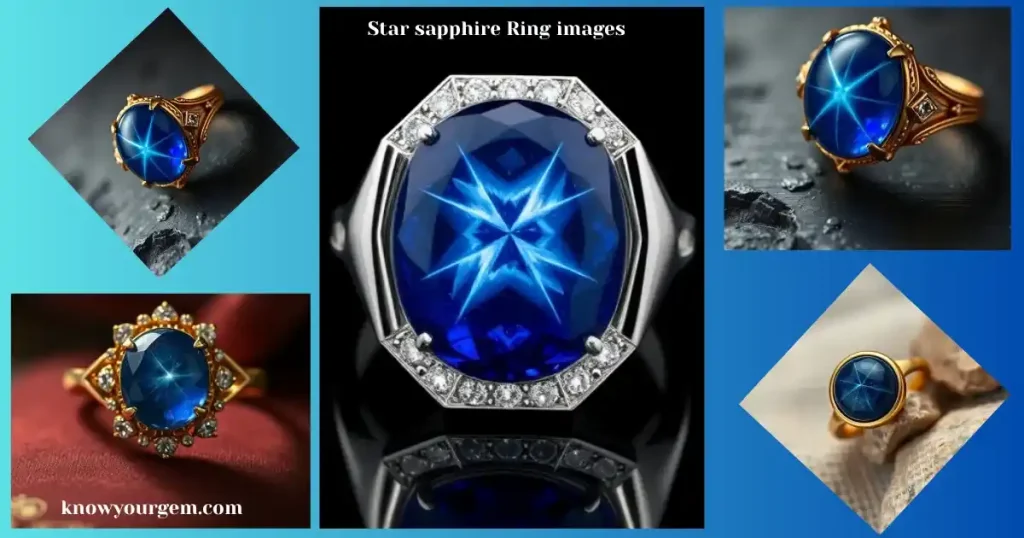
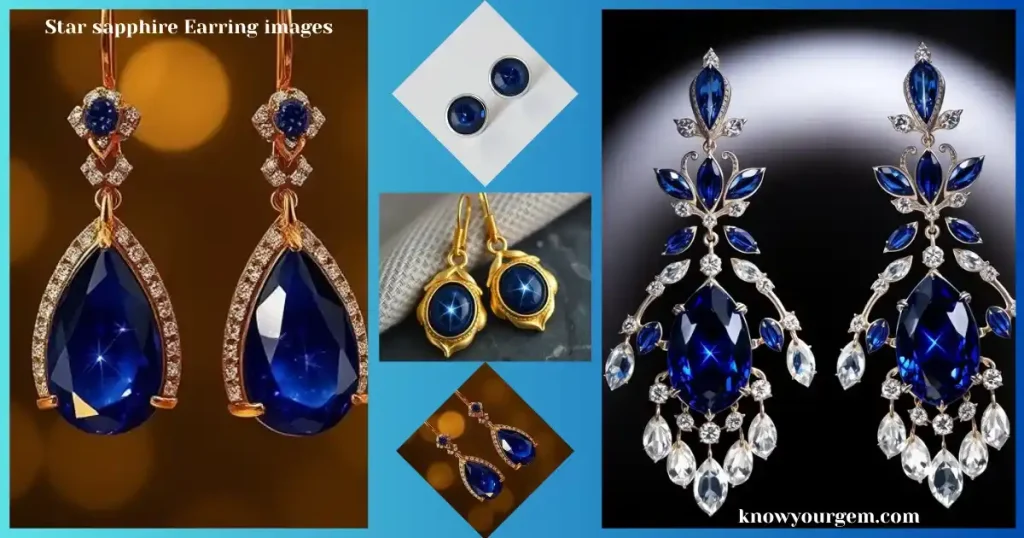
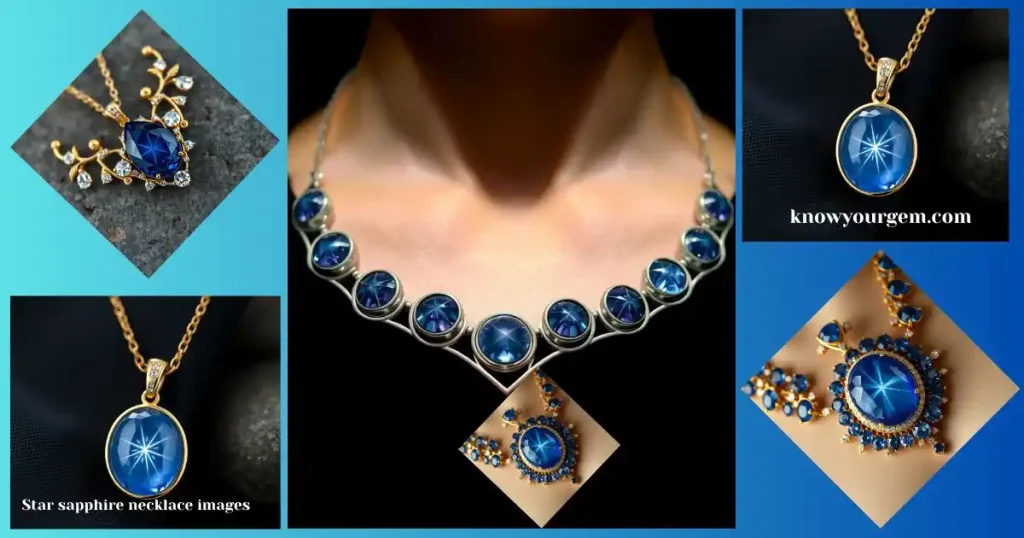
Star sapphire shines as dazzling centerpiece in ring, pendant, or bracelet. Since, sapphire necklaces or bracelets with it create instantly eye-catching unforgettable jewelry. The moving star refracts light in different angles and as a result, the stone is visually dynamic in a manner that a faceted gem cannot have. One of the oldest and timeless designs is a star sapphire and diamond ring with the diamonds offering extra glitter to the cabochon center. Art Deco and mid-century vintage and antique star sapphire rings are always in demand due to the popularity of the gem during the two periods and the shape of the ring fitting the domed shape of the gem.
Not suitable to all:
A consumer who desires the greatest brightness and light dispersion out of a sapphire ought to purchase a well cut faceted blue sapphire as opposed to a star sapphire. The cabochon-cut stones lack the sparkle which the faceted gems have– this is a physical effect of the cut, and not a blemish in the material. Shoppers whose eyes are all about color intensity can also discover that the inclusions that are necessary to create the star add a bit of milkiness or less transparency than a faceted stone of the same colour with no inclusions. By comprehending this trade off prior to buying, dissatisfaction is avoided.
FAQS:
1. What is a star sapphire?
This a type of corundum mineral which displays a dazzling six-rayed star across its polished dome, we are grateful to artersim. The effect comes from tiny, parallel needle like inclusions that reflect light rays when the stone cuts into a smooth cabochon.
2. What causes the star in a star sapphire?
Very fine rutile needles aligned to three intersecting directions, which are corresponding to the crystal structure of corundum, reflect light at the same time and form a star with six rays. Hematite or ilmenite inclusions may also play a part in black star sapphires.
3.Are star sapphires genuine sapphires?
Yes, star sapphires are genuine corundum while belonging to the same mineral family as all sapphires related. An Artisim is, their optical star effect, that doesn’t change the stone’s nature.
4. Are star sapphires natural or lab sapphires?
Star sapphires may be either. Natural star sapphires are formed in the earth during geologic time. Synthetic star sapphires are manufactured in laboratories and have been commercially available and documented by GIA for decades. The only sure method of differentiating between one and the other is by an examination in a good gemological laboratory.
5. Are star sapphires valuable?
Value is not the phenomenon itself but quality. A natural sapphire star with a fine sharp cut, centered star, strong color and limited treatment can be worth several thousand dollars per carat. A stone of poor or off-centered star, ugly color, or artificial provenance, has much lower prices. So, it is must to consider that valuation of the stone totally hinges on lab reports, quality of stars, their treatment condition and ethical origin.
6. What can you do to know whether a star sapphire is good?
Assess five criteria: the star must be centered, sharp and visible in natural direct light, and all six rays must travel across the dome; body color should be appealing and well-saturated; transparency must allow the star to float against the body clearly; status of treatment should be disclosed in writing; and independent laboratory report must confirm natural origin and treatment result.
7. What is the cleaning of a star sapphire?
In the case of untreated or traditionally heat treated stones, warm water with mild soap and soft brush is safe. Wash well and dry using soft cloth. Use no ultrasonic cleaners, steam or rough chemicals, especially with the glass-filled or heavily treated stone since these may cause permanent damage to fillings.
8. What are the origins of the Star Sapphires?
This stone is majorly found in sources like, Sri Lanka which is well known with Star of India, 563 carats, Myanmar, Australia they are recognized for black star of Queensland and Thailand. Since the best blue specimens are found in Sri Lanka; with hematite stars that occur in Australia and Myanmar.
9. How can define the rarity of Star Sapphires.
Very rare because of strict rutile orientation required to produce a sharp, centered six-ray star-less than 1 percent of sapphires are suitable. Classic mine top translucent examples fetch premiums; mass production not present.
10. How much is a Star Sapphire Worth?
Price are slightly different can range from $20–$1,200/ct for blue (under 1ct: $20–$100; 1–5ct: $300+); fancy colors $100–$500/ct; black $13–$30/ct. Since, extraordinary items as auction stars or big clean cabochons are priced in thousands depending on the sharpness of a star, color, and size.
11. What are the significant uses of star sapphire ?
It embodies Godly guidance, safety of the traveler, and linking with the higher haven; that has been used in history as amulets against evil. It was thought to bring clairvoyance, forewarn danger through changes of the stars, bring hope, dreams, spiritual consciousness.
This comprehensive guide is well researched, written and published by crystal enthusiast KamilHussain!

Welcome to KnowYourGem.com! your ultimate destination for uncovering the fascinating world of gems and their secrets! I'm Kamil Hussain, a passionate blogger with a Master’s degree in Economics, dedicated to bringing you insightful, well researched content that blends the beauty of gemstones with the art of storytelling. With a keen analytical mind and a love for discovering hidden treasures, I created this platform to help you explore the brilliance, history, and value of every gem.


[…] its color varieties are blue, pink, yellow, orange, purple, green, and rare color-change or star sapphires but among them blue is more […]