


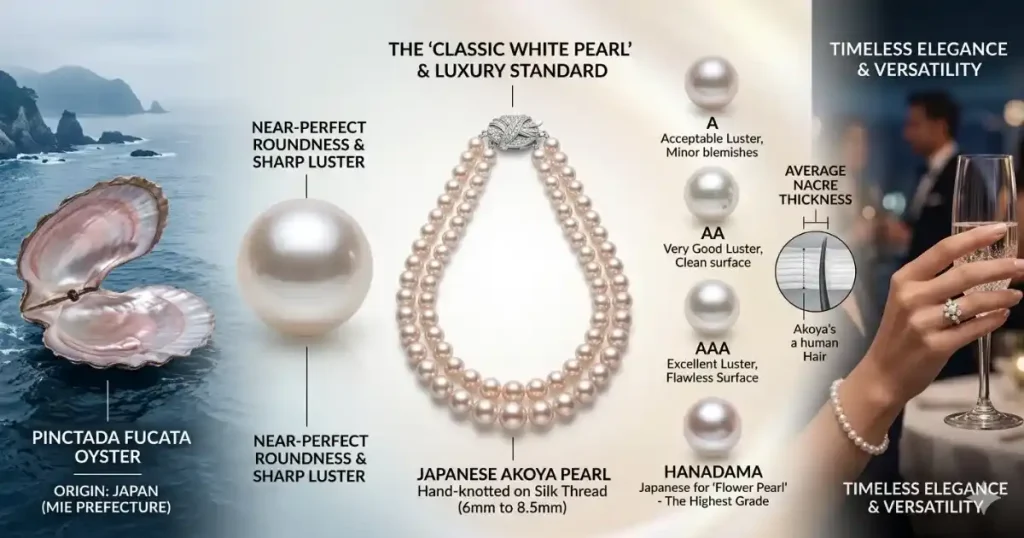
Akoya pearl are cultured saltwater pearls primarily grow in Japan and China by the Pinctada fucata martensii oyster. It is renowned for its near perfect roundness, sharp mirror like luster, and classic white color, it is the definitive fine pearl of luxury jewelry market and the standard against which that all other cultured pearls are measured.
You can also explore a deep pricing guide about Tahitian pearls:
1. Introduction:
Akoya pearl is a kind of pearl gemstone it is usually considered as cultured saltwater, and basically found its location in Japan and China:
What is an Akoya Pearl?
Akoya pearl is a cultured saltwater pearl gemstone comes from Pinctada fucata martensii oyster, it is majorly farmed in Japan and China. Technicians implant a bead nucleus and mantel tissue, that the oyster coats with nacre for its signature luster and color.
Why Akoya Pearls are the “Classic White Pearl”
They were pioneered by Kokichi Mikimoto in early 20th century Japan, Akoyas revolutionized pearls, that make them accessible beyond aristocracy. Although, their white hue, perfect roundness, and sharp luster set as the enduring standard for fine pearls.
Importance in fine Jewelry:
Ayoyas dominates formal, bridal, and luxury collections from Mikimoto to Tiffany &Co., drives the global pearl trade with consistent quality and classic appeal.
How they differ from other pearls:
They are actually smaller and rounder than South Sea or Tahitian pearls, with having brighter luster than freshwater types. It is limited to the white, cream, or silver no dark Tahitian hues or South Sea golds that prioritize precision over size or drama.
2. Origin & formation:
Given below is the detailed guide about its origin and formation you can explore:
2.1 Where Akoya Pearls come from:
Japan’s Mie prefecture (Ago Bay) sets the quality benchmark with more than a century of expertise. China produces the most mid-tier volumes since the 1980s; Australia offers smaller scale, clean surfaced pearls. Whether Japanese Akoyas fetch premiums for cold water superiority and strict controls.
2.2 The Akoya Oyster:
The Akoya oyster is a delicate little thing which is top out at just 8cm, so it naturally produces those smaller, dainty pearls that are compared to the giants from South Sea or Tahitian farms. The crafting of super fine nacre crystals through Akoya oyster gives Akoya pearl razor sharp, mirror like luster.
2.3 Culturing Process:
Juneiles grow 18-24 months pre-nucleation. Skilled techs implant shell bead nucleus + donor mantle into the gonad. Oysters hang in sea panels, monitored closely poor nucleation risk rejection.
2.4 Growth conditions:
Cold Japanese waters gradual nacre deposition, building dense, lustrous layers. Warner Chinese farm speed growth but thin nacre, dulling luster.
2.5 Timeline & scale:
10-18 months from nucleation to harvest . Since, high mortality (30-50%) limits yields despite Japan’s efficient infrastructure.
Akoya origins trace to Japan’s masterful cold water farms, where small oysters craft superior luster. Scale favors volume, but quality hinges on expertise and environment.
Physical & structural characteristics:
Given below are the physical and cultural characteristics you can study enjoy:
3.1 Nacre thickness:
Akoyas average sizes in between 0.35-0.7mm nacre (up to 1mm+for premium Japanese), thinner than South Sea/Tahitian due to a short growth . Thin nacre looks chalky; thick delivers deep, dimensional luster.
3.2 High luster:
Top Akoyas boast “mirror” luster sharp reflections from fine aragonite crystals. No other pearl matches this brightness at Akoya’s production scale.
3.3 Perfect roundness:
Spherical nucei + cold water growth yield <2% diameter variati. They are ideal for matched strands.
3.4 Size range:
2-10mm, is peaking at 6-9mm commercially; sizes like 9mm are rare and own premium prices. Oyster size caps potential vs, larger pearl types.
3.5 Surface quality:
Minor spots/pinpricks common; top grade <10% blemished, and commercial materials are up to 60%. Hidden flaws minimize impact.
Akoyas excel in luster, since roundness, and precision within their compact size hallmarks of structural superiority.
4. Akoya Pearl colors & overtones:
Given is the ultimate coverage of Akoya pearl colors and overtones:
4.1 Classic white Akoya pearls:
White is the hallmark body color, which often looks “snow white” or “pure white,” it is evoking timeless elegance for bridal and formal jewelry. This bright, clean base enhances overtones, that makes this stone stand out for classic strands.
4.2 Cream, silver, and Rose overtones:
Overtones are subtle translucent layers that shifts with light; rose like (pinkish, most valued for skin flattering warmth), silver (cool,icy modern vibe), cream (soft, golden undertone). Premium combos like white plus rose create a visual depth, that separate fine gems from basic beads rose commands 20-30% higher prices.
4.3 Blue Akoya Pearls:
Naturally rare steel blue to the silver blue from cold water farms; a bold alternative to whites. High luster naturals appeal to collectors, but verify through GIA/IGI certs mild treatments exist, impacting resale.
4.4 Black Akoya Pearls:
Never natural; achieved via dyeing/irradiation (unlike true Tahitian blacks). Widely available and budget friendly, but treatment disclosure is key values drop 40-50% vs. Naturals; are ideal for fashion, not investment.
4.5 Most valuable color grades:
Peak; bright white body plus vivid rose overtone (rose white), it is also considered as a luxury benchmark, highest retail premiums. Since, natural blues with having mirror luster fetch collect prices; cream/silver solid but secondary. Buyer tip; match overtone to skin for max anneal.
5. Grading system & quality evaluation:
Given below is the grading system and quality evaluation in detailed:
5.1 AAA / AA / A grading system:
No single international grading standard govern Akoya pearl quality, however most reputable retailers use three tie system:
- AAA (Top Grade): An exceptional luster, a surface that is 95% or more free of blemishes, and production and are the standard for luxurious jewelry.
- AA (High Commercial Grade:Very good luster, a surface that is 75–95% clean, and excellent roundness. The majority of high-quality retail Akoya jewelry uses AA-grade pearls.
- A (Commercial Grade): An acceptable luster with having up to $40 visible surface blemish, and good shape. It is suitable for entry level jewelry and fashion pieces.
5.2 Key Value Factors:
- Luster is the preeminent value driver in Akoya pearls, the stone contains it more than other pearl types. A dull Akoya pearl, regardless of its size or cleanliness believe to hold minimal market value. So, buyers should always evaluate luster first.
- Surface cleanliness It directly multiplies or reduces price because this type of pearls with having top luster and clean surface can be pricier dramatically the same pearl with having the visible blemish.
- Shape In Akoya pearls means roundness. Since, non round Akoya pearls like“drops barques) are uncommon and generally trade at lower prices because the market expects Akoya pearls to be round.
- Size It adds value exponentially, not linearly. A 9mm Akoya pearl can command cot significantly more per pearl than a 7mm pearl because of its relative rarity in the production cycle.
- Overtone quality It is particularly the presence and intensity of rose overtones which adds a premium prices fro pieces where the warmth and complexity of the pearl’s surface are clearly visible.
5.3 How professionals evaluate Akoya Pearls:
Professional evaluators examine Akoya pearls in both natural daylight and directional light to assess luster and surface quality. Although, they use calipers to confirm size and roundness measurements. Since, color grading requires neutral backgrounds, like typically gray or white to eliminate color contamination from surroundings. Nacre thickness can be assessed by examining drill hole cross sections or, for undrilled evaluation for strands that require comparing dozens to hundreds of pearls simultaneously for consistency of color, size, and luster.
6. Akoya vs. Tahitian Pearls:
Akoya and Tahitian pearl both gemstones carry vary color wheel; one is bright and other is bold and exotic:
- Colors: Akoya shines in white, cream, or silver. Whether Tahitian for dark and dramatic think charcoal, green, blue, or eggplant purple.
- Size: Akoya pearl’s output at 10mm (dainty and elegant). Tahitian start with the bigger, at 8mm+ (statement makers).
- Luster (that shiny glow): Both are dazzling, but Akoya has crisp and reflective like a mirror; Tahitian has deep and sanity, with more depth.
- Price: Similar for the top quality, but it jumps with the size and grade. Akoya feels timeless; Tahitian add edge.
Akoya vs. South Sea Pearls:
South pearl farms in big oysters in Australia, Indonesia, and the Philippines are luxury giants larger, silkier and pricier.
- Colors: It holds white, silver, or warm golden hues.
- Size: It is huge in size like 10-20mm (think pinky and nail big satin).
- Luster and Build: It has a super silky glow with thick nacre layers like a plush velvet coat vs Akoya’s sleek satin). Takes years longer to grow.
- Price: A way more expensive for matching quality due to rarity and size. Akoya gives South Sea vibes on a budget.
Akoya vs. freshwater Pearls:
Freshwater pearls mostly comes from China are the everyday heroes, they are cheap, tough and super versatile.
- Colors and Shapes: Pastels in all shapes and sizes like baroque twists included.
- Build: Solid nacre not fake core, so they are durable but with having softer glow.
- Luster: Akoya win with sharper, brighter shine; freshwater feel more diffused.
- Price and Use: Freshwater are wallet-friendly and fun for casual wear. Akoya step up for polish and formality.
Quick winner summary:
| Feature | Akoya Wins | Others Win |
| Roundness | Perfectly precise | – |
| Luster | Sharp & bright | South Sea/Tahitian (deeper) |
| Size | Up to 10mm classic | South Sea/Tahitian (bigger) |
| Price | Balanced access | Freshwater (cheapest) |
| Best For | Formal, versatile jewelry | Bold statements or variety |
Akoya pearls are the little black dress, of pearls elegant, reliable and priced for every budget.
6. Jewelry Applications:
Study out a complete guide line below which is all about what jewel is suitable for the stone:
Timeless Akoya necklaces:
Nothing can beat a classic Akoya strand because it is a pearl necklace everyone take its pictures first. Think 7-8.5mm Japanese whites with that subtle rose glow, knotted on silk, ending in a gold or diamond clasp.
- Go-To Lengths: Since Chokers (14-16”) hold huge neck bold looks; princess (17-1919”) drapes perfectly over collars; ropes (like 44” Mikimotos) double up for versatility.
- Style Hack: It is graduated one (99mm center tapering to 7mm) give that vintage heirloom vibe without trying too hard.
Studs and drops for earrings:
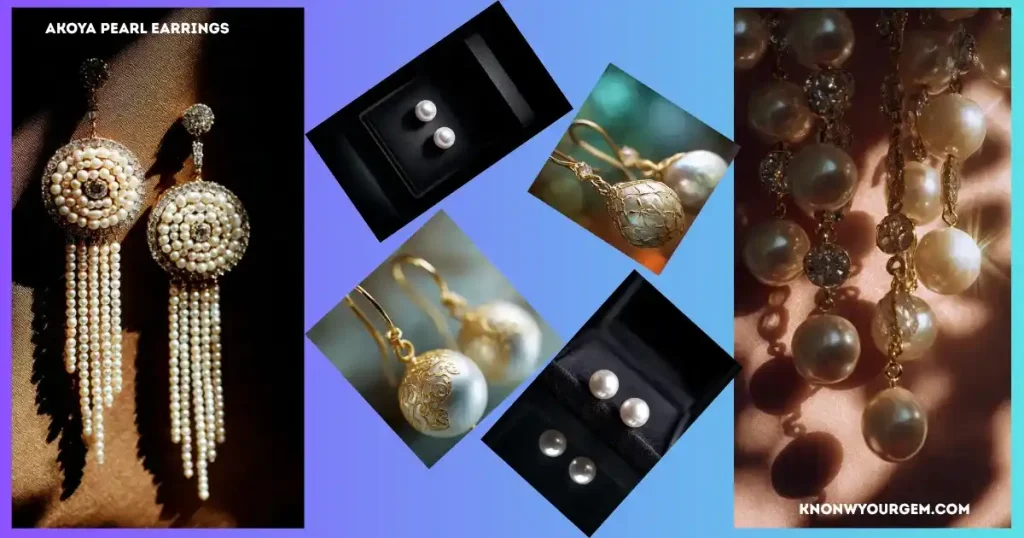
Akoya earrings are your everyday upgrade minimalist studs for work, drops for date night. Whether recent trends showcase influencers loving them for that “quite luxury” polish.
- Studs: Single pearl in a white gold or platinum; super versatile, from jeans to black the tie.
- Drops: It add a diamond link or three graduated pearls for movement perfect for evenings.
- Hot tip: Pair it with cool toned metals to amp up the crisp Akoya shine.
Ring real talk:
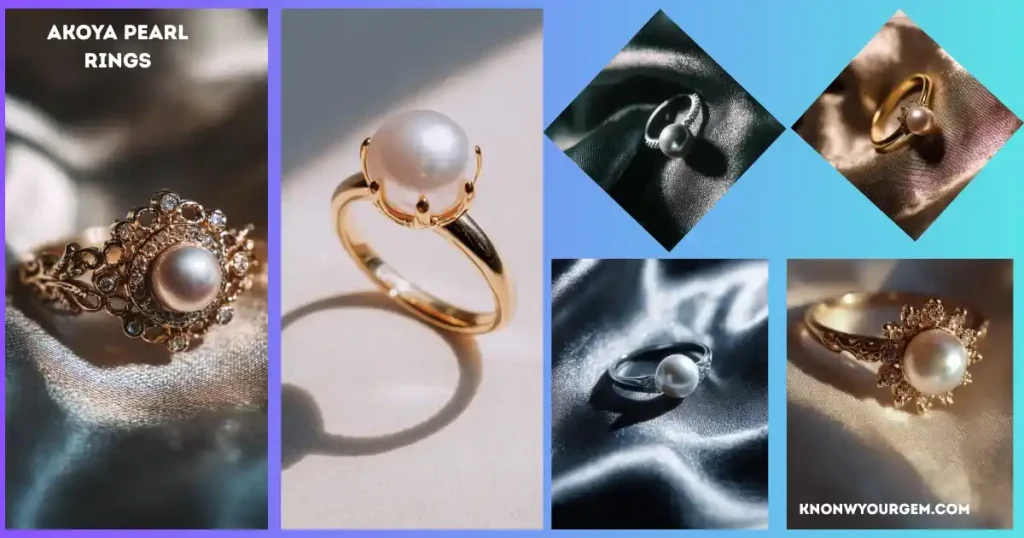
A 7-9mm Akoya pearl ring is romantic without holding diamond drama, great for engagements if you want something personal, just protect that delicate pearl.
- Best Settings: Bezel wraps its snug; since, low prongs or diamond sides keep it safe from knocks.
- Buyer Note: 8mm hits the sweet spot not too big for small hands, but noticeable.
Bracelets that last:
Wrist jewelry sees more action, so thick nacre (aim for 0.4mm + in AAA Hanadama) is the key Akoyas can handle it better than you think.
- Simple: 6.5-7mm single strand on silk.
- Fancier: Multi-strands or pearl accents in metal for stackable fun.
Easy Pendants:
Start here if you are new a lone Akoya on a thin chain screams effortless cool. Single diamond accents make it bridal ready without fuss.
Bridal sets done right:
For weddings, match necklace/earrings/bracelet from the same batch having 7-8mm AAA Akoyas in a white/rose are brides’ faves for that flawless glow. Mikimoto or custom from a pro nails it.
8. Akoya pearl price & value guide:
| Category | Size Range | Quality Grade | Description | Price Range (USD) |
| Entry-Level Loose Pearls | Owns 6 – 6.5 mm | A | Basic quality, individual pearls | Command prices from $30 to $80 per pearl |
| Mid-Range Retail Jewelry | 7 – 8 mm | AA | Set in gold, decent luster and surface quality | Command prices from $200 to $1,500 per piece |
| Premium Japanese Akoya Strands | Owns 7.5 – 8.5 mm | AAA | High luster, well-matched strands | Command prices from $1,000 to $8,000 |
| Luxury Designer Necklaces | Owns 7 – 9 mm | AAA+ | Designer brands like Mikimoto | Command prices form $3,000 to $30,000plus |
| Top-Tier Matched Strands | Owns 9 mm+ | Flawless/AAA+ | Rare, perfectly matched, premium Japanese pearls | Command $10,000 to $50,000 plus |
8.2 What affects Akoya Pearl value genuinely:
- Luster quality is the dominant price driver because of top luster Akoya pearls can command multiplies of the price of dull specimens at the same size.
- Size adds value exponentially. Since, Each millimeter increase in diameter more than 7mm significantly increases price.
- Surface perfection it directly multiplies or reduces price. Since, a clean surface 8 pearl can be three to five times more expensive than the same size pearl with have moderate blemishing.
- Overtone rarity is particularly vivid rose overtones add premium value for white Akoya pearls.
- Origin matters big time for top-shelf Akoyas pearl. Stone from Japanese ones from mie’s fram charge more than Chinese even same size and grade thanks to their striker quality checks before export.
8.3 Are Akoya Pearls expensive?
Akoya pearl sit on higher priced than freshwater pearls, however they are a steal as compared to pricey South Sea or Tahitian ones especially in a smaller size. For their pinpoint roundness, razor sharp luster, and timeless class, they punch way above their weight other luxury gems at the same price.
8.4 Luxury vs entry level Akoya Pearls:
Entry level Akoya jewelry think Chinese AA grade in small sizes and basic settinigs get you that saltwater pearl look without breaking the bank. Since, Luxury Japanese AAA ones (8mm+, designer flair) are next level; deeper, 3D luster that feels alive, not pretty.
9. Authenticity & identification:
Real Akoya pearls stand out with their glow from within luster and tiny natural bumps the key sings you are holding the real, not cheap knockoffs.
Spotting genuine Akoyas:
Always look for a deep, 3D shimmer where it dances inside the pearl, not just bonus off. Under a loupe, expect subtle ridges or marks; glassy perfection screams fake.
Real vs. Faux Pearls:
Fakes are plastic or glass dipped in shiny paint no depth, no life. Since cultured Akkoyas, Oysters built realistic nacre layers around tiny nucleus, so they are 100% genuine (GIA agrees).
Quick home checks:
- Tooth Test: Rub on your teeth realistic ones grit like fine sand; fakes slide smooth.
- Weight: Akoyas feel hefty for their size (thicker nacre).
- Temp: Cool to touch, warms gradually on skin plastics that heat right up.
Why certs matter:
For buyer with having more than $500 of range can demand GIA or GTA certs which confirm saltwater origin, nacre thickness (0.15mm+ ideal), color, and treatments like dyeing. Japanese Akoyas often ace these reports.
Red flags to dodge:
Uniform perfection in no real pearls vary slightly in shade and shine. Sketchy sellers dodging origin or grades walk away.
| Check | Real Akoya | Fake/Imitation |
| Luster | Deep, from within | Flat surface shine |
| Surface | Light texture | Too smooth |
| Price (8mm) | $200+ per pearl | Under $50/strand |
| Match | Subtle variations | Identical clones |
10. Meaning, symbolism & cultural value:
Pearls hold deep meanings across cultures, and Akoyas that especially shine as symbol of timeless grace which is perfect for someone that like you who appreciates their layers beyond the luster.
Timeless symbolism:
White Akoya pearls scream purity and wisdom, like a blank canvas of light. Since, they dressed queens and brides for ages, that stands for health and luck in Asia, elegance in the west.
Today’s vibe:
Modern wearers pick Akoyas to say “ they choose quality that lasts,” not flashy trends. Just think Coco Chanel layering them casually or Audrey Hepburn’s poised glow they are the ultimate quite luxury.
Wedding & gift magic:
Brides worldwide love Akoya sets for that flawless, heirloom feel. In Japan , they are the go to for anniversaries or graduation that gift one that feels like passing on prosperity.
Sustainable farming facts:
Japan’s Akoya farms like Mie, Nagasaki run tight ships with eco rules, small scale and oyster focused. China’s bigger operations vary, but both enhance local jobs.
Eco wins:
These oysters act as like nature’s water filters that clean the Sea as they grow, that makes mini ocean safe havens. Farmers protect their waters like gold since clean seas equals to notch pearls.
Ethical side:
Harvest at the oyster’s end, reuse shells for inaly minimal waste. Since Japanese spots hire family pros with fair pay; it is craftsmanship not factory grind.
Smart buying:
Demand origin papers and treatment info Japanese direct sellers offer the straightest story check docs for peace of mind.

12. care, maintenance & durability:
Akoya pearls need TLC to keep a glow for decades, they are softer than diamond but last forever with smart habits.
How tough are they?
At 2.5-4.5 Mohs, Akoyas hate chemicals than pumps. Since, thick-nacre ones like AAA Japanese resist scratches best; thin ones show wear faster. If you treat them rightly they become heirlooms.
Everyday cleaning:
Wipe after wear with a damp soft cloth, no under-sounds or harsh cleaners, they eat nacre. Mild soap +water for dirt, then dry fully. Skip soaking strands; silk rots.
Big no:
Perfume, hairspray, sunscreen, chlorine, acids (even fruit juice) all nacre killers. Dry air cracks them; rough gems nearby scratch.
Smart storage:
Use soft pouch for storage, and away these gems from diamonds or metals. A bit of humidity helps airtight safes or long bank box stays.
Wear them often:
Skin oils condition nacre naturally. Since, restring silk strands every 1-2 years. Rings/bracelets off for chores.
Buying smart:
Luster first: Sharp reflections= winner. Must check blemishes, origin like Japan> China for quality), treatment. Over $500 Get GIA cert. Strands need even glow/color/size.
Traps to skip:
- Size obsession: Dull 9mm < shiny 7.5mm.
- “Japanese” labels on Chinese pearls.
- Photos lie luster doesn’t photograph well.
- Bargain “perfect” giants? Fakes.
Value picks:
| Budget | Go-For | Why Great |
| Value | AA 7-7.5mm Japanese, rose overtone, 14k clasp | Everyday wow, fair price |
| Luxury | AAA 8mm+ , thick nacre, 18k/platinum | Investment stunner |
In store is best for luster you can check and go with pros who offer return policies, multi photos, and nacre details.
14. Your Quick Answers:
1. What is an Akoya pearl?
A cultured slatwater pearl from Japan’s Pinctada fucata oyster also from China farms. Akoya pearl famous for near perfect rounds, mirror sharp shine, and white /cream with having silver glows.
2. Are Akoya pearls real pearls?
100% realistic oysters build the nacre naturally after a tiny nucleus kickstarts iT Since, SIA calls them genuine pearls, just farmed smarter than wild ones.
3. Why are Akoya pearls expensive?
Tough farming (1-2 good pearls per oyster), picky that matches for strands, plus premium for top luster/nacre. Rarity +craft =value.
4. How can you tell if Akoya pearls are real?
Tooth rub: Gritty feel from nacre crystals like (fake silp). Since, deep 3D glow, with having no flat paint. Loupe showcases tiny bumps. GIA cert seals it.
5. Are Akoya pearls better than freshwater pearls?
Akoyas crush on roundness and crisp luster for formal looks. Since freshwater win cheap variety/shapes for fun wear. Pick Akoya for heirlooms.
6. Do Akoya pearls fade over time?
Natural whites don’t fade color. Since, dyed ones might shift with sun/chemicals. Always ask treatment status.
7. What is the most valuable Akoya pearl color?
White body plus vivid pink overtone rules flattering on all skin, timeless demand. Since, rare natural blues fetch collector bucks.
8. Can Akoya pearls be worn daily?
Totally skin oils keep them conditioned. Just perfume/cosmetics last, wipe after, restring silk yearly. Skip rings for rough days.
9. Where are Akoya pearls found?
Japan leads like Mie, Nagasaki coats for best, whether China scales up volume. Pre Ausssie spots too.
This Guide is written by Gemstone enthusiast KamilHussian!

Welcome to KnowYourGem.com! your ultimate destination for uncovering the fascinating world of gems and their secrets! I'm Kamil Hussain, a passionate blogger with a Master’s degree in Economics, dedicated to bringing you insightful, well researched content that blends the beauty of gemstones with the art of storytelling. With a keen analytical mind and a love for discovering hidden treasures, I created this platform to help you explore the brilliance, history, and value of every gem.


[…] Pearl: It can be easily scratched without acid (even perfume and vinegar). […]