
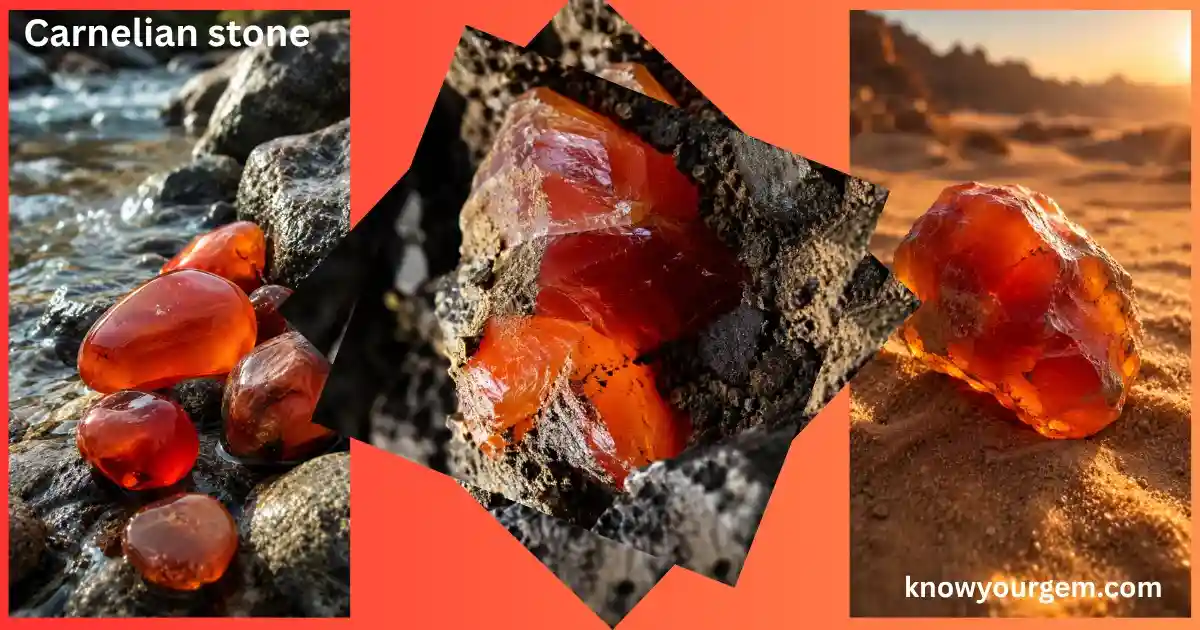

Overview:
What Is Carnelian? Carnelian is a semi-translucent, fiery orange–red chalcedony which is a micocystalline form of Quartz. With a Mohs hardness of 6.5 – 7, Carnelian is inexpensive and is one of the oldest stones used by man in the form of carved works and jewelry.
Many also treat it as a stone of energy, creativity and confidence, though those are traditions, not medical facts.
Most carnelian on the market has been heated to deepen its color, and a lot of what’s sold under the name is dyed agate. That’s the part buyers need to get right, so it gets plenty of space below.
What Is Carnelian?
Quartz is a transparent, pointed crystal or a hidden type consisting of grain-lets, too tiny to be seen. The second is chalcedony. The color of the iron oxide makes carnelian a peach, orange, or brick red. Every high-quality stone will radiate when held up to the light, and that radiance gives you a clue as to what the stone is worth.
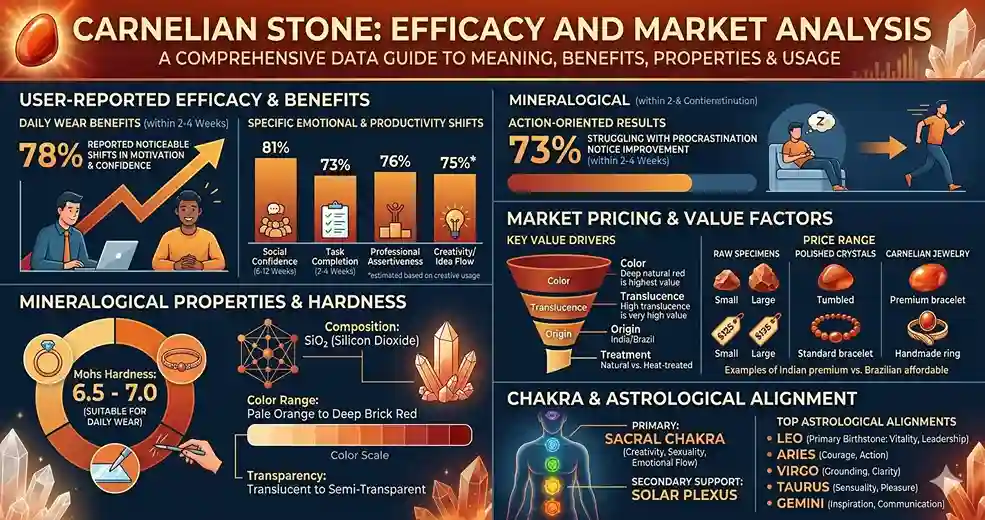
| Mineral group | Chalcedony (microcrystalline quartz) |
| Chemical compsition | Its chemical composition is silicon dioxide (SiO₂) with iron oxide as the coloring agent |
| Mohs scale | About 6.5 to 7 |
| Color | The stone displays pale orange through red-orange to deep brick red |
| Transparency | This stone is translucent to semi-translucent |
| Specific gravity | 2.58 to 2.64 |
| Majorly found | Brazil, India, Madagascar, Uruguay |
The connection Between Carnelian & Agate, Jasper, Onyx & Bloodstone? They’re all Quartz. The only difference is in the colour, pattern and translucency.
The best stones are a good, even, deep orange or red colour with a soft glow and a smooth polish. Paler, peachy material is common and perfectly nice. It just costs less.
Where Does Carnelian stone Come From?
Brazil makes up a big proportion of the market, as does India; the material also comes from Madagascar and Uruguay. India has a long history here: making carnelian beads around Gujarat dates back millennia and is still practiced today. Brazilian rough is relatively inexpensive and often heated to intensify the reds.
The appearance of a stone is more important than its origin. A brightly colored, well-polished stone from any location is preferable to a lackluster one from a renowned source.
What Has Carnelian Meant Through History?
Carnelian has been worn since the age of time. It was transformed into scarab beads and amulets by the Egyptians, and was also used to create vivid jewellery in vibrant red that represented blood, life, and energy.
Romans entered into the art of Intaglios, engraved gems used as signet rings and seals. Carnelian doesn’t cling to hot wax, which was a useful characteristic for sealing, and had a smooth grain that held good detail.
The ancient near East and South Asia also carried the use of carnelian beads to burial grounds and trade routes. Even societies with limited contact continued to choose the same stone for similar purposes.
What you’ll read about its “healing” past is mostly later tradition, not documented medicine. That’s worth knowing even if you still find the symbolism pleasing.
What Does Carnelian Mean Spiritually?
Everything in this section is belief and tradition. This is not proven medicine and it doesn’t substitute a doctor or a therapist.
As a crystal practitioner, carnelian signifies drive, inspiration, and artistic expression. Depending on your source, it’s known as the stone of “becoming,” as in a little extra push to go from thinking about doing something to actually doing it.
Its hot orange-red hue is associated with action, bravery, and self-assurance, and the stone is associated with the second energy center (or chakra), located a couple of inches below your navel and associated with emotion, intimacy, and the things we enjoy.
Traditional lists of “signs of imbalance” in that chakra include creative blocks, emotional numbness, trouble setting boundaries, and a vague sense of dissatisfaction. Believers use carnelian in meditation to work on those areas.
A very basic sacral chakra meditation can be as simple as this. Place a piece of carnelian in one hand and rest the other hand on your lower belly, close your eyes and breathe deeply and slowly, picturing a warm orange around that part of your body.
Rest for about 10-15 minutes and then note down any thoughts or emotions which have arisen during this time. You can use a particular hand if you like but nothing is set in stone.
Is there anything real in it? Possibly the ritual itself. A set time to sit still, hold something warm and tactile, and write down your thoughts can help some people feel steadier and more creative. That’s the practice working. Nobody has shown it’s the stone.
What Are the Reported Benefits of Carnelian?
These are claims from crystal-healing traditions, and there’s no scientific evidence behind them. Here’s what people say:
- Confidence and self-worth: Are the most frequently mentioned benefits. People have said that carnelian helps them to express themselves and diminishes self-doubt.
- Motivation: For that procrastinator in all of us (students, entrepreneurs – you know who you are).
- Creativity: A writer, a painter, a musician – they all leave a piece on the desk to get unstuck.
- Emotional balance: Supporters describe it as a steadying, warming presence during stressful times.
- Manifestation: Some practitioners treat it as an “action” stone for goals, working best when paired with real effort.
The honest version is that a stone can work as a reminder. Keep a piece of carnelian on your desk, and each time you see it, you’re reminded of the thing you said you’d do. That’s a habit tool, and some people find it useful.
For anxiety, this stone is not a cure. If you have been experiencing anxiety, depression or trauma then you need to speak to experts, not a lone stone.
How Do You Wear Carnelian?
You don’t have to believe in any of the traditions to enjoy the jewelry. If you do, people tend to match the piece to the purpose.
Bracelets are the most popular. They sit on the wrist all day, which is why people who want “constant contact” prefer them. Styles may be beaded elastic strands (cheaper, traditional), a solitaire polished stone with accents of metal, mixed-gemstone bracelets, and raw chunks on a cord for an organic appearance.
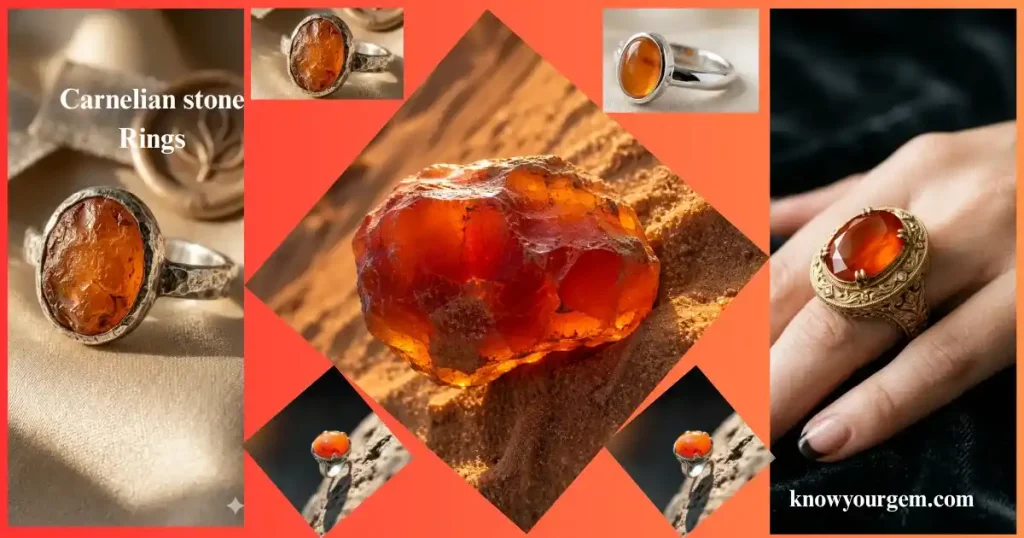
Rings get linked with personal power. Some traditions say to wear carnelian on the dominant hand’s ring finger for leadership or creative work. That’s folklore, so treat it as tradition.
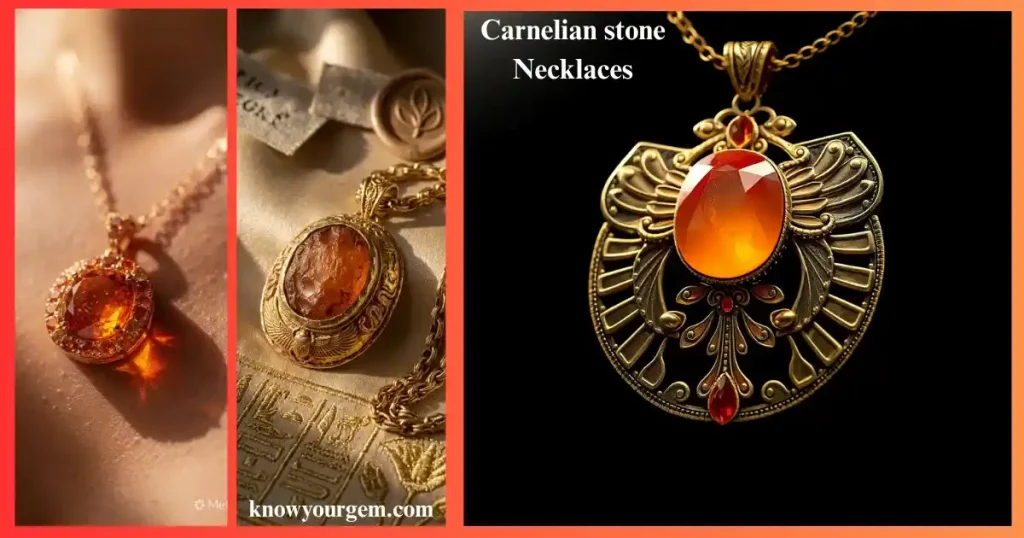
Necklaces and pendants go close to your heart, so you might be drawn to these styles to wear a meaningful theme or personal expression.
For daily wear, then yes, the carnelian is about 6.5-7 and can stand up to frequent wear. While you don’t play with a pendant or earrings, they can be beat up a little. Rings and bracelets will scratch so you’ll need a halo setting to protect them.
Which Crystals Pair Well with Carnelian?
Sources are crystal traditions. Typically, citrine for abundance, rose quartz for confidence with softness, clear quartz as the “amplifier”, amethyst to bring calm to action, black tourmaline for protection, hematite for grounding, and red jasper for vitality and groundedness.
What About Affirmations and Manifestation?
Others combine carnelian with brief daily affirmations, which they recite while holding the stone. Typical ones are things like “I take steady action toward my goals” or “I speak clearly and with confidence”. People often repeat them daily for several weeks.
Whether that “rewires” anything is unproven. Repeating a sentence you believe in, every day, may help you stay focused, and that’s all most people need from it. The stone is optional.
Is Carnelian a Birthstone? What About Zodiac Signs?
It depends on the list. The traditional lists of zodiac and birthstones include carnelian in different places. Some ascribe it to Leo, some to Virgo and others to Aries or Taurus. It isn’t a standard modern birthstone for any month, and sardonyx and peridot usually get August.
Ask where it says carnelian is the right one for one particular sign. When you get the answer, be prepared to say, “No, I meant in real life, did you just choose it for the sign because it’s a good fit?” Fire and confidence for Aries and Leo, grounding and clarity for Virgo.
How Can You Tell Real Carnelian from Fake?
Most of the “fake carnelian” isn’t plastic. It’s real stone dyed (generally agate since it’s readily available and takes colour easily). Glass and plastic versions can be found as well.
Look at the color. Natural carnelian will have soft variation, sometimes more cloudiness and more subtle shifts from light to dark. If you see consistent bright red-orange throughout a whole batch, that’s a red flag. Dyed stones often have color pooled in tiny cracks or at the edges.
Test the light. Since genuine carnelian is semi-transparent, hold it to a light to see it glow. Glass can look too clear. Opaque red stone is more likely jasper, which is a perfectly good stone but a different one.
Check the feel. Carnelian feels cool and a bit heavy. Plastic warms fast and feels light.
None of these checks is proof. A water test, for example, can’t be trusted on its own, because some dyed stones don’t bleed. For an expensive piece, a gemological lab is the only reliable way to confirm what you’ve got. A good report names the stone and any treatment.
Is heat-treated carnelian still real?
Yes. Many carnelians, especially Brazilian material, are heated to deepen or even out the color. It’s a long-established practice and the stone is still natural carnelian. It’s permanent and hard to detect without lab equipment.
What matters is disclosure. If the stone has been heat-treated, it should be offered as such. It should not be offered as natural, unless the seller can explain the origin of the color. A good seller answers without a fuss.
Carnelian vs Red Jasper vs Agate:
| Family | Chalcedony | Quartz (jasper) | Chalcedony (banded) |
| Transparency | Translucent | Opaque | Translucent to semi-translucent |
| Look | Glows orange or red under light | Flat, deep brick red | Banded, many colors |
| Hardness | About 6.5–7 | About 6.5–7 | About 6.5–7 |
| Usual price | Low to moderate | Low | Low |
| Chakra tradition | Sacral | Root | Varies |
The easiest way to separate carnelian from red jasper is light. Hold a thin edge up to a lamp. Carnelian glows, and jasper stays dark. Agate is another chalcedony, but it’s usually banded, and many “carnelian” beads are dyed agate.
How Much Does Carnelian Cost?
Carnelian is not expensive, and its price is subject to a few considerations. For example, deep and even tones, as well as a natural hue, are pricier than pale and dull. Good translucence adds value. Size matters, because larger pieces of fine color are scarcer.
Treatment matters too: stones sold as natural color should cost more than heated ones. Finished jewelry costs far more than the same stone loose or tumbled, and handmade pieces in precious metal cost more again. As for investment, carnelian isn’t one. Buy it simply because it is to your taste or because it is the type of things you want to wear and use all the time.
How Do You Clean and Care for Carnelian?
Use a little warm water, a mild soap, and a brush – then rinse and polish with a dry cloth! That’s all you need for the physical.
No to Steam or ultrasonic cleaning, no to Products with aggressive chemicals, no to soaking, no to excessive heating; caution with sunlight: even a few hours of direct sunlight can bleach some stones especially the dyed ones.
Jewelry should be worn after applying perfume and cosmetics and stored in a soft pouch when not in use. Never store your jewelry with diamonds, sapphires or topaz that are hard enough to scratch these stones. Take off rings when doing serious physical work.
Energetic cleansing (A Traditional Practice):
Many also “cleanse” and “charge” the stones. Traditional cleansing techniques include using moonlight, selenite, sound, or sage or incense smoke. Sun is also employed in a few lineages, so just make it quick, and don’t leave a heated or dyed stone lying around for an extended period of time.
In order to try to trigger the activation, usually it goes like this: Take your stone in your hands, clear a spot and feel your intention. See the stone bathed in warm orange colour and say your intention. Carry it or wear it. The stone doesn’t need it, so omit any step that could harm it.
Where Should You Buy Carnelian?
Your safest bet are those rare establishments that deal solely with stones and crystals. Mineral shows give you a chance to view and even hold the rocks.
Shopping for the best deals when it comes to stores, online marketplaces have a lot of choices at the cheapest prices but buy from genuine stores and check for genuine reviews and refund policy.
Wholesale jewelry must be bought in wholesale quantities. Ask for treatments and photos under natural light.
Mistakes Buyers Make:
The biggest is assuming every red-orange stone labeled “carnelian” is natural and untreated. Others include paying a “natural color” price for dyed agate, trusting a single home test, leaving a stone in hot sun for days, cleaning it in an ultrasonic machine, and treating spiritual claims as medical facts.
Key Takeaways:
- Carnelian is a semi translucent red-orange to red variety of the mineral chalcedony (microcrystalline quartz), which owes its colour to the presence of iron oxide.
- Is it hard? It’s approximately 6.5 to 7 on the Mohs scale and can be worn everyday as long as you’re sensible.
- Heat treatment is normal and accepted. The biggest head fake is from dyed agates.
- Hold it to the light: The carnelian “gives fire”; the dark red jasper does not.
All of the spiritual, chakra and zodiac meanings are cultural beliefs and not a scientific fact.
Sources:
Properties and classification as per GIA, International Gem Society (IGS) and the Mineralogical Society of America. Historical data from museums and archaeological sites.
FAQ:
1. What is carnelian stone?
Semi-translucent, red to orange, chalcedony (cryptocrystalline quartz) with colouring from iron oxide.
2. What is carnelian stone used for?
Things in Jewelry, carving & decorative objects and in crystal for confidence, motivation and creativity. Those purposes are traditional, not medical.
3. What does carnelian mean spiritually?
It is linked to enthusiasm, vitality and creative urge and the sacral chakra. These are presumption values and are not scientifically supported.
5. Which chakra is carnelian associated with?
Mostly sacral chakra, also solar plexus in crystal traditions.
6. Is carnelian a birthstone?
It isn’t a common modern birthstone. Some common traditional lists match the zodiac to Leo, Virgo or Aries. There are, however, disagreements among the sources.
7. How can I tell if carnelian is real?
Always go for natural colour and glow, a cool, just a little weighted feel. The most widely used fake: Dyed agate. Question the treatment and request a lab report with your high priced items.
8. Is heat-treated carnelian real?
Yes. It is a widely accepted method to improve the color and the stone remains natural. It should be disclosed.
9. Is carnelian expensive?
Generally No. The price of this stone should be in the range of $1-$30 per carat as it depends on various aspects like colour, size, translucency, and treatment.
10. Can carnelian be worn every day?
Yes, but only if you’re gentle to it. Not going to lie – it’s tough enough for daily wear at 6.5 to 7 (on the Mohs scale), but rings and bracelets can scratch and chip it.
11. How do you cleanse carnelian?
Spiritually for washing use warm water, gentle soap and a soft cloth. Some traditionally also use moon light, selenite, sound or smoke. Avoid sunbathing for a long time and also the usage of chemicals.
12. What’s the difference between carnelian and red jasper?
A) A) Carnelian can be translucent and is orange- red when light is shone upon it. B) Red Jasper: it is opaque and has a more intense, matte brick red color.
13. What is the natural color of carnelian?
Anything from a pale peachy orange through to dark brick red, with the most valuable being a uniform translucent orange-red.
Content is published by Gemstone Expert and Enthusiast KamilHussain!

Welcome to KnowYourGem.com! your ultimate destination for uncovering the fascinating world of gems and their secrets! I'm Kamil Hussain, a passionate blogger with a Master’s degree in Economics, dedicated to bringing you insightful, well researched content that blends the beauty of gemstones with the art of storytelling. With a keen analytical mind and a love for discovering hidden treasures, I created this platform to help you explore the brilliance, history, and value of every gem.

