

Quick view:
Red jasper is a brick-red opaque quartz which derives its colour from an iron oxide content. It sits around 6.5 to 7 on the Mohs scale, it’s mined on several continents, and it costs next to nothing compared with most gemstones.
Because it’s so common and so cheap, a lot of things get sold under its name that aren’t it. Carnelian, bloodstone, dyed agate, even red glass. One quick rule helps: red jasper never lets light through. If it lights up when you press it to a lamp, it’s another object.
What Is Red Jasper?
Jasper is quartz that’s opaque, and red jasper is the kind colored mostly by hematite, an iron oxide (Fe₂O₃). Under a microscope you’d see a mass of tiny quartz grains, far too small to pick out by eye, packed so tightly that no light gets through. That’s where the smooth feel and the soft, waxy shine come from.
Don’t expect a crystal with points and faces. Amethyst and rock crystal grow like that. Jasper doesn’t. It’s a dense, heavy-feeling stone, and I’d say that’s most of its charm.
The shade depends on what else is in the mix. A bit of goethite, another iron mineral, and the red slides toward brown or yellow. Reference books often describe jasper as quartz with a good deal of other material in it, commonly put at 20 percent or more, and that’s partly what separates it from clear chalcedony.
In classification terms it’s a silicate, in the quartz group, in the chalcedony family, alongside carnelian, agate, bloodstone and onyx. Same basic structure, different color, pattern and see-through-ness.
What Does Red Jasper Look Like?
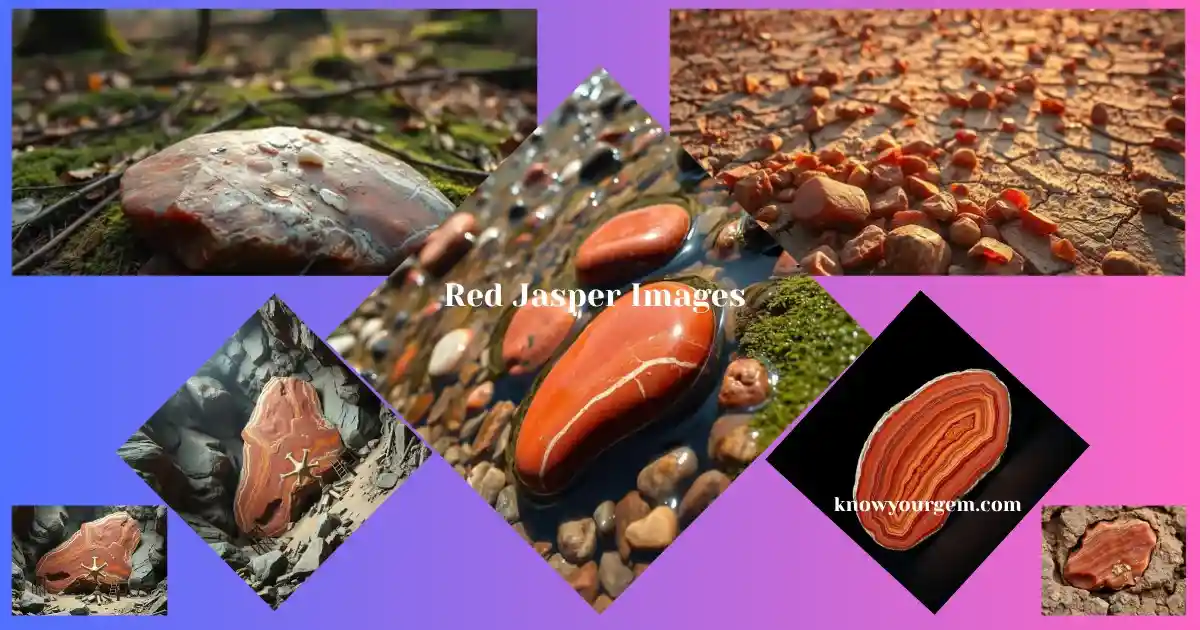
Most people picture a deep, even brick red, and that’s the one buyers pay the most for. But you’ll also find brownish stones, red banded with yellow, red with black veins (sold as red vein jasper), and pieces with green or gray patches.
Brecciated jasper is the odd one out, and my favorite. The rock cracked under pressure, then silica or other minerals seeped in and healed the breaks. What’s left is a mosaic of red fragments with veins running between them. Orbicular jasper has round patterns, though you rarely see that in red.
Want something safe? Even color, good polish. Collectors lean toward the patterned stones, and fair enough.
How Hard Is Red Jasper?
Between 6.5 and 7. A steel knife or a piece of glass won’t scratch it easily, but quartz and topaz will. The tight grain gives it decent toughness too, so bracelets and pendants cope well.
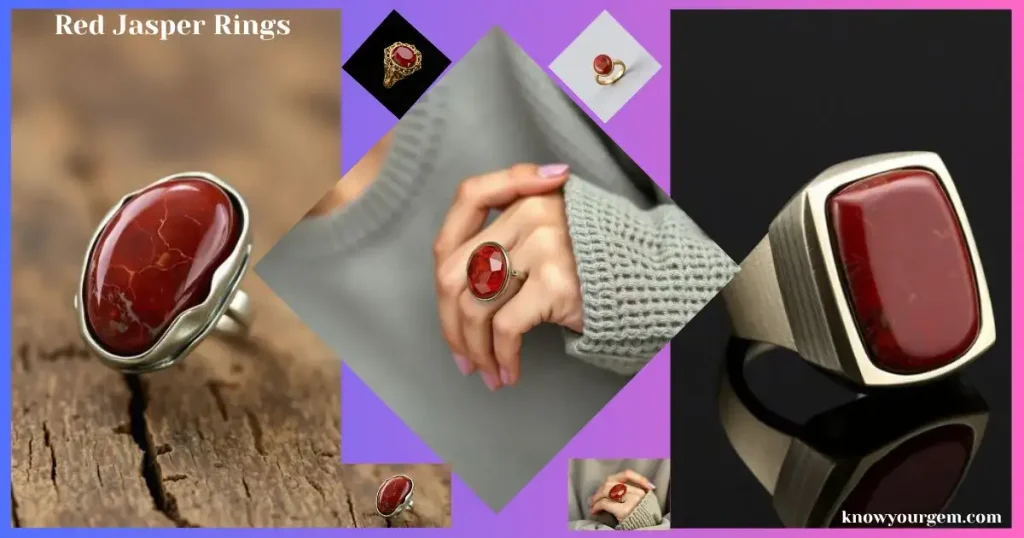
Rings need a little thought. Fine for daily wear with a setting that covers the edges, though any cabochon can chip if it takes a hard knock against a counter or a door frame.
Polishing matters more than you’d expect. Left natural, the surface is dull to waxy. Polished, it goes smooth and glassy and the red looks deeper. Even in a thin sliver it still blocks light, which is the quickest way to tell it from carnelian.
Red Jasper vs Carnelian, Bloodstone and Red Coral:
People search for red jasper vs carnelian more than any other comparison, and the confusion is fair. Both are red, both belong to the chalcedony family. Light is what separates them.
| Family | Quartz (jasper) | Quartz (chalcedony) | Quartz (chalcedony and jasper) |
| Color | Deep brick red | Orange-red to red | Dark green with red spots |
| Mohs scale | 6.5–7 | 6.5–7 | 6.5–7 |
| Transparency | It is opaque | It is translucent | It is also opaque |
| Red is made of | It is made by Iron oxide (hematite) | It is made by Iron oxide | It is made by Iron oxide spots |
| Usually used in | It is used in Jewelry, decor, carving | This stone is used in Jewelry, carving, seals | This stone is used in Jewelry, collectibles |
Hold up a wafer of carnelian to a strong light and it will be orange; red jasper, on the other hand, will seem dark, flat, and dull, even deeper in hue. Bloodstone is easy once you’ve seen it, since the base is dark green and the red flecks are iron oxide.
There’s no way red coral is supposed to be in here. It’s an organic (plant/animal) creation and is a softer material (probably a 3-4 on the mohs scale), and can be fairly delicate, with more definite more exact branching, and sometimes a little porousness to it. You can tell the difference when you hold it in your hand next to a piece of jasper.
How Is Red Jasper Formed?
The silica-heavy liquids filter down through the host rocks and are deposited in small quartz crystals. In the sedimentary environment, the silica-bearing water enters cracks and fissures in the rocks.
The silica cools and solidifies and is deposited as quartz. In the volcanic environment, the silica bearing liquids move through crack veins and gas pockets within the rhyolite and basalt rocks, the silica cools and solidifies as quartz. The iron comes from the host rock.
The reds are all rust. Iron rusts to hematite, and that’s red. Splash some goethite in and you go toward yellow and brown. It’s the same chemistry as a rusty nail, just more gradual and larger.
Where Is Red Jasper Found?
Nearly everywhere, which is why it’s cheap. Brazil is a top producer, exporting rough, faceted, cabbed, and finished jewelry. There is abundant banded material in India, and Indian beads and cabs are some of the most traded. Australia (Western Australia and Queensland) gives strong color and sometimes wild banding.
In the United States, Arizona is the name you’ll hear, plus a few other states, mostly from volcanic ground. Madagascar and South Africa both produce jasper, brecciated types included, and Russia’s Ural Mountains have long been a source of decorative stone.
Where a stone is mined is far less important than many believe. A shiny, uniformly colored piece from an obscure mine is far more desirable than a dull piece from a well-known one.
What Has Red Jasper Meant Through History?
People have been carving Jasper for thousands of years. Egyptians carved red jasper and carnelian to produce amulets and figurines for protection associated with blood, life and strength, and to carve out of red jasper. Some of these amulets were placed with the dead to protect them.
Romans carved it. Intaglios, small carved stones for seals and signet rings, needed a fine grain, and jasper has one. You’ll often read that Roman soldiers wore red stones for courage, tied to Mars, though that’s hard to pin down with evidence.
Stone with jasper in Mesopotamia is available in stone of cylinders, small carved cylinders are rolled over soft clay to make impression on a document. Native peoples throughout the Americas used stone with jasper to produce tools, ceremonial objects and spear points because of its physical and symbolic qualities.
Strength, courage, protection, staying grounded. Cultures that never met kept landing on the same set of ideas. Maybe it’s the blood-red color.
How Is Red Jasper Used Today?
Mostly jewelry. It’s durable and attractive, and nobody has to save up for it.
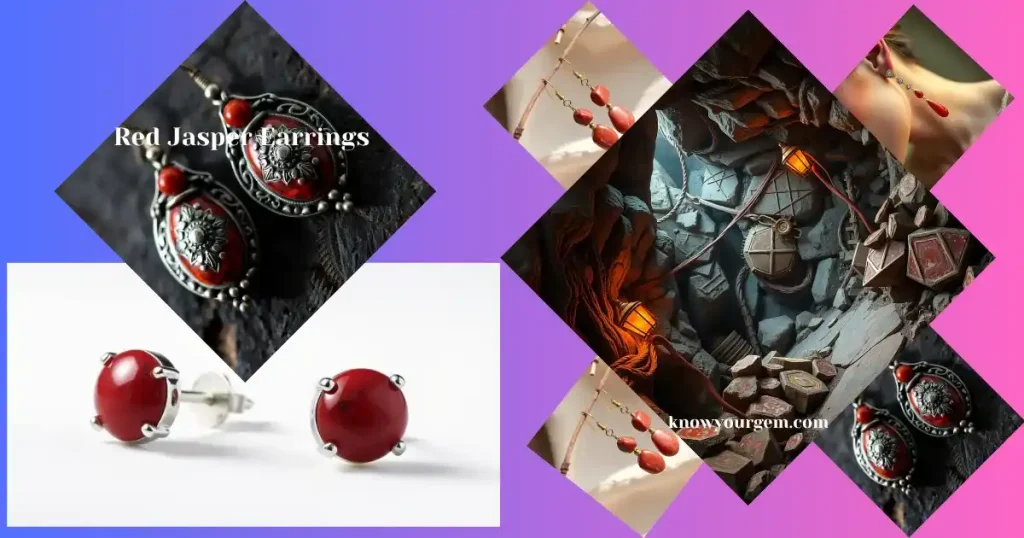
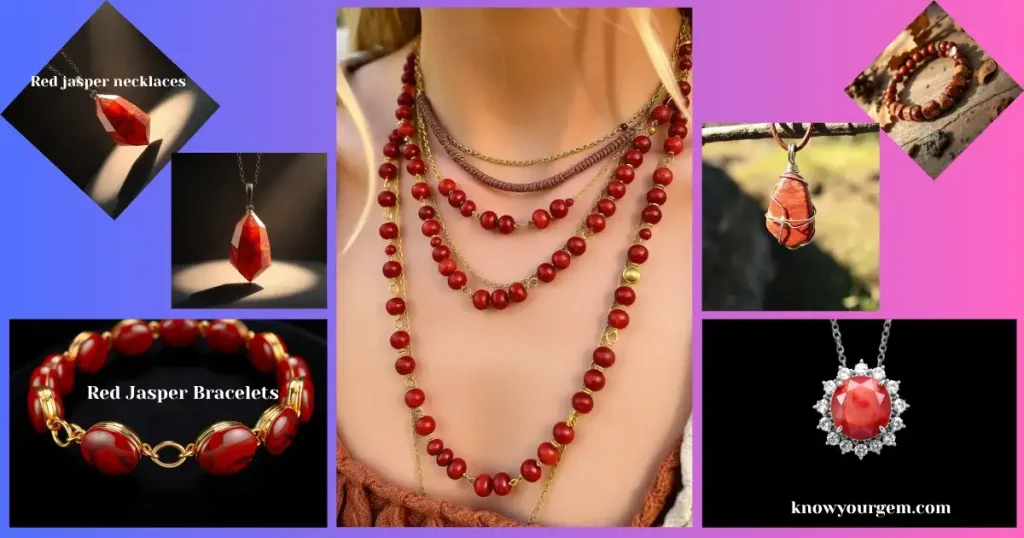
Necklaces may be just one polished pendant (heart, teardrop, freeform cabochon) or a string of beads. The red shows in both silver and gold and looks just as beautiful on a leather or wood cord.
Bracelets may be stretch strands of 6 to 10 mm beads with or without hematite, tiger eye or green aventurine beads. Rings are generally oval or round cabochons, sterling silver, large, chunky and natural looking. Earrings may be small studs or larger drops.
Carved hearts are a popular item. Measuring 30-50mm, a hand-carved, highly polished heart is a great gift. Not just for jewelry-makers, these can be transformed into bookends, bowls, vases, spheres, palm stones.
Makers also love these for they can be cut and polished on standard lapidary equipment, break in a predictable fashion so a jasper cab is a classic “first project”.
What Do People Believe About Red Jasper?
It has a big following in crystal healing and spiritual practice. All this is essentially faith and custom, not science.
Root Chakra located here and bringing a feeling of groundedness and stability, some practitioners even use this stone in their meditation practice to feel more grounded. Known as the stone of strength or warrior’s stone.
You’ll see it called the stone of endurance or the warrior’s stone. Courage, motivation and calm under stress come up a lot. In elemental systems, it belongs to earth, thanks to that soil-red color.
It’s often paired with other stones. Hematite and black tourmaline for grounding and protection, carnelian for vitality, amethyst for balance in meditation, turquoise for the red-against-blue-green contrast.
Some traditions connect it with Aries, Scorpio, Leo or Capricorn, though sources don’t agree. It isn’t a traditional birthstone for any month. It occasionally appears on alternative March lists beside bloodstone.
There’s no reliable clinical evidence to suggest that carrying or wearing red jasper will heal you. All a piece of jewelry can do is give you something to hold and a reminder to pause, and that’s a benefit no matter what the stone.
Is Red Jasper Rare or Valuable?
Not rare. It’s one of the most abundant gemstones around, and that’s exactly why it’s inexpensive. Nobody’s bidding it up against ruby or sapphire.
Still, prices are not flat. Deep, consistent brick red sells for more than dull or mottled material, and the more desirable figure adds more.
Mirror-polished stone brings more than a rough surface, large, uniformly colored pieces bring more than smaller ones, and jewelry takes a hefty price increase over the same material in the rough.
A few localities, some Arizona and Australian material for instance, carry a modest premium. Exceptional stones with unusually rich color or distinctive patterns can be scarce in the collector market, but standard commercial grade is everywhere.
As an investment? Don’t. Buy it because you like it, or because you make things with it. Expecting it to appreciate is a mistake.
How Can You Tell Real Red Jasper from Fake?
The usual imitations are dyed agate, dyed howlite and red glass.
Use your eyes first. Real red jasper is fully opaque, so any glow means carnelian or something else. The color should vary slightly, with flow lines, small inclusions, subtle shifts.
A perfectly uniform, very bright red across a whole tray can mean dye. Under bright light, real stone has some depth, while glass and dyed pieces often look flat or too vivid. Then your hands.
Real red jasper feels cool and solid, and plastic warms up quickly and feels light. A loupe reveals: polished jasper is glossy and waxy to glassy; dyed varieties can be found out by pinprick pools of dye in microscopically tiny fissures.
Steel knives scratch glass, soft false stones and surface-hardened glass, but not red jasper – however, it’s possible to mark the real thing with a careless scrape, so make a test on an obscured area or a knowledgable friend.
None of this is proof. It’s a way to spot trouble. For an expensive piece, only a gemological lab can confirm what you’ve got, and a good report names the stone and any treatment.
Warning signs when buying: prices far below market for “high-quality polished” pieces, listings that say “translucent red jasper” (it’s opaque), “imperial jasper” or “fancy jasper” sold as red jasper (different varieties), and sellers who can’t tell you what the stone is or where it came from.
Where Should You Buy Red Jasper?
It’s everywhere, so the question should be who to buy from. Specialist gem and crystal dealers are likely to have the most options and experts who can identify your purchase. Mineral and lapidary trade shows are a good place to examine stones in person and even speak directly with sellers.
Marketplace sites have a huge selection for good prices, but shop around and deal with a seller with a positive selling history. Buying in bulk for jewelry? Consider wholesalers. A local crystal shop is an easy choice with inconsistent-quality.
Choose a stone with a rich even color, good polish, no pits or grinding marks and a cab that has a domed, polished surface and a flat, polished bottom.
How Do You Care for Red Jasper?
Use lukewarm water and a soft cloth, dry it well. That covers most of it.
Is red jasper waterproof? Short, yes. Light rinse. Anything more than a quick soak, use of a steam or ultrasonic cleaner will delicately take away your shine, so stay away from those.
Wear your jewelry after your perfume and/or make-up and don’t put any peroxide or other harsh chemicals on them. Keep your jewelry in a separate bag because sapphire, topaz and diamond can scratch it.
Some people “charge” their stones in traditional practice, on soil, in a few hours of sun, or beside selenite. That’s your business and tradition, not something the stone must have. If you can do it, respect the rules of the body, and keep all your colored stone out of the bright sun.
Mistakes Buyers Make:
The big one is buying something labeled “red jasper” without checking that it’s opaque. Others: paying extra for dyed stones, assuming “red chalcedony” or “sard” means red jasper, running it through an ultrasonic cleaner, expecting investment returns from a common stone, and taking health claims as medical fact.
Key Takeaways:
- Red jasper is an opaque microcrystalline quartz and is mainly Hematite red.
- 6.5 – 7 (Mohs) Suitable for everyday jewellery with normal care.
- Cheap and readily available in the country but the value is estimated on grade and finish and not on the exclusiveness.
- Look for transparency, variation of natural colour and a good polish, as well as dye and fake stones.
- Healing, Chakra & Zodiac associations. These are cultural beliefs, not proven medical effects.
Sources:
GIA, the International Gem Society, and the Mineralogical Society of America for properties and classification and museum and archaeological sources for history.
1. Is red jasper a real gemstone?
Yes. It’s a natural, opaque form of microcrystalline quartz, a type of crystal that’s been used in carving and jewelry-making for thousands of years.
2. Is red jasper rare?
No. It’s one of the most abundant gemstones. Exceptional patterned or richly colored pieces can interest collectors.
3. How much is red jasper worth?
However, generally very little. Price depends on size, color, polish, form. And depending on the quality and color the work is worth more as finished jewellery than as rough pieces.
4. How can I tell if red jasper is real?
Verify the item is totally opaque, with a natural color variation, stays nice and cool to the touch and is a dense, stone-like material and won’t scratch when you drag a steel knife across it. Demand a lab report if it is expensive.
5. What is the difference between red jasper and carnelian?
Carnelian is translucent and typically orange-red. Red jasper is an opaque material, and is a much darker brick red.
6. What is the difference between red jasper and red coral?
Red coral is organic and also is much softer (3 to 4 Mohs) and also for this reason the stone feels very porous. Red jasper is a mineral.
7. Can red jasper get wet?
Yes, if it’s a quick rinse. Not in soaks, steam, and ultrasonic cleaners.
8. Where is red jasper found?
E.g. Brazil, India, Australia, United States, Madagascar, South Africa and Russia.
9. What chakra is red jasper linked to?
Original crystal healing theory. The root chakra. It is a belief – not a proven effect.
10. Is red jasper good for jewelry?
Yes. Accessible, inexpensive and available in all shapes from beads to cabs to carved pendants.
11. What is brecciated jasper?
A pressure from within the earth fractured the jasper, which was bonded to silica or other minerals, and was shattered into many pieces.
This content is written by gemstone enthusiast KamilHussain!

Welcome to KnowYourGem.com! your ultimate destination for uncovering the fascinating world of gems and their secrets! I'm Kamil Hussain, a passionate blogger with a Master’s degree in Economics, dedicated to bringing you insightful, well researched content that blends the beauty of gemstones with the art of storytelling. With a keen analytical mind and a love for discovering hidden treasures, I created this platform to help you explore the brilliance, history, and value of every gem.


[…] connection Between Carnelian & Agate, Jasper, Onyx & Bloodstone? They’re all Quartz. The only difference is in the colour, pattern and […]