

Quick Answer:
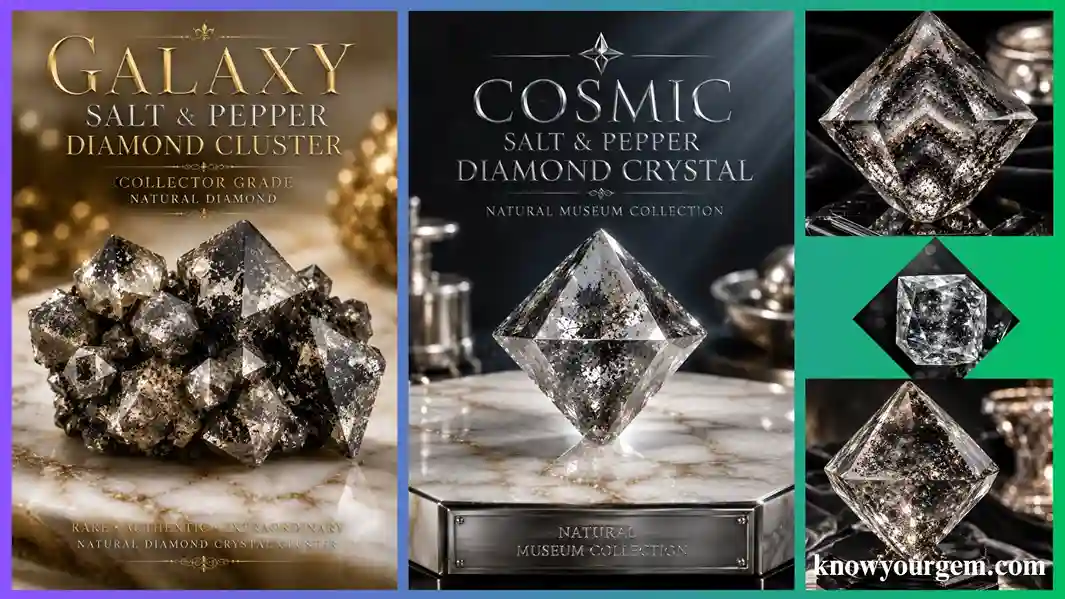
A salt and pepper diamond is a natural variety of diamond, displays striking black and white inclusions that give it a speckled , galaxy-like look. Since, carbon, graphite, and other minerals produce these natural inclusions. They are formed deep within the surface of earth as diamond grew because they are heavily included. This stone is much affordable than white diamond.
Key Takeaways:
- Authentic Diamond: Salt and pepper diamonds are naturally forming stones with having 10 Mohs hardness.
- Unique inclusions: These are black and white speckles come from trapped graphite, carbon, and minerals.
- Hardness: They are tough as link any diamond that ranks 10 on the Mohs scale.
- Affordable price: They are usually sold for $300-$1,500 per carat, much affordable than flawless white diamonds.
- Popular cuts: Cuts like Hexagon, marquise, kite, rose cuts showcase their patterns best.
- Reports: GIA and and IGI can identify the, as clarity isn’t graded traditionally.
- One of a variety: Every stone is found in unique shape that makes this variety more valuable for collectors and indie jewelers.
Introduction:
Salt and pepper diamonds are going to be most popular choices in bridal jewelry. Their beauty comes from visible inclusions, that give each stone a raw, earthy, character that feels authentic.
Salt and pepper diamonds form with natural inclusions that give them speckled look. This guide covers their origins, pricing, best cuts, and tips for buying a genuine stone with confidence.
What Is a Salt and Pepper Diamond?
Salt and pepper diamonds are natural stones filled with black and white inclusions which create a smoky, speckled, galaxy like look.
The “salt” comes from white mineral crystals, whether the pepper comes from black carbon and graphite, that makes each diamond completely unique.
Not same as clear white diamonds, that are valued for invisible inclusions, these gems are valued for visible, well balanced speckling.
Their formation starts through the same process as any diamond carbon crystallizing under extreme heat and pressure however with an extra minerals trapped inside, giving them their distinct character.
Dealer’s Insight: First time buyers often make the mistake of choosing by carat weight noticing the patter. Since a smaller stone with balanced speckle looks better and feels more special than a bigger one with uneven inclusions.
Major Mining Locations:
Salt and pepper diamonds are not mined from special deposits of their own. They appear naturally during regular diamond mining, sorted out as lower clarity rough alongside gem quality stones.
It means their sources follow the same major diamond producing regions as any other diamond, make them a byproduct of traditional mining rather than a separate supply chain.
- India: It is home to some of the oldest diamond trading and cutting traditions, including Gujarat’s cutting houses, that handle a large share of the world’s included and fancy cut rough.
- Botswana: It is one of the largest producers of diamond that owns rough value, supply material across the clarity spectrum.
- South Africa: It is the region of the modern diamond industry, still producing significant volumes from established kimberlite mines.
- Canada: It is recognized for strong chain of custody tracking, that appeals to buyers who focused on traceability.
- Russia: It is one the largest producers by volume globally, as buyers should current sourcing guidance given ongoing sanctions that affect Russian diamond exports.
- Australia: It is historically significant for colored and included diamonds, as major production has showed in recent years.
- Brazil: It is a smaller but historically essential source, particularly for alluvial diamond deposits.
Nor and neither single mine specializes in producing only salt and pepper diamond material. Instead, cutters and dealers sort included rough out of general production batches, then select and cut the most visually interesting pieces specifically for the salt pepper market.
Crystal Habit:
Crystal habit is authentic shape a mineral takes before it is cut or polished. In diamonds, the rough usually up in three main habits, that gem cutters use as the starting point for shaping the stone.
- Octahedral: It is most common diamond habit, resembles two pyramids joined at the base; most brilliant style cuts are planned around this shape.
- Dodecahedral: It is a twelve sided form that often results from the natural resorption during the diamond’s journey to the surface.
- Cubic: It is a less common, cubic like habit that frequently correlates with the higher inclusion content, that is one reason cubic rough often ends up in the salt and pepper diamond category.
Rough salt and pepper diamonds often look cloudy or opaque before cutting as their inclusions scatter light. To bring out the best look, a cutter studies the stone under magnification and plans a cut that showcases the most balanced speckled pattern.
History and Rising Popularity:
Sal and pepper diamonds were once dismissed as industrial grade material. They were too included for fine jewelry and were often sold for use in cutting tools of abrasives.
That perception shifted when independent jewelers began cutting them to highlight their inclusions of hiding them, turning flaws into features.
With the increase of handmade and vintage-inspired engagement rings, these stones found their place in the mainstream. Those buyers who are looking for one of a kind, ec-conscious, and budget friendly alternatives to flawless white diamonds embraced them, and today salt and pepper diamonds appear in designer collections as well as artisan shops a true modern jewelry trend.
How Salt and Pepper Diamonds Form?
Diamonds form when carbon bonds under extreme heat and pressure deep within the earth’s mantle for billions of years, then volcanic eruptions bring them up to the surface where they should mine.
It sometimes traps bit of minerals, fluids, or carbon. In salt and pepper diamonds, this usually happens, during creating the speckled black and white look. A clear diamond, on the other hand grows with far fewer inclusions, that give it a pure, transparent appearance.
Why They Have Black and White Inclusions?
Salt and pepper diamonds gain their unique look from darker and light inclusions that are existing inside the crystal. Black specks are usually graphite or minerals like iron oxide and sulfides, whether white flecks are often quartz or feldspar.
Such inclusions don’t weaken the stone, however they work as durable as flawless diamond. Instead of sharp brilliance, the scattered light creates a soft, smoky glow that makes it stand out from a colorless diamond.
Inclusion Gallery: What You’re Actually Seeing
Salt and pepper diamonds usually contain several distinct inclusion types, and learning to recognize them help buyers understand what they are looking at.
- Graphite: It is a soft, dark, plate like carbon crystal, that creates the “pepper” speckling.
- Pinpoints: These are tiny dots like mineral crystals, often appear as fine white specks.
- Feathers: These are small internal fractures that can look like wisps or cracks; large feathers reach the surface can worth extra scrutiny before setting.
- Clouds: Such are the clusters of very tiny pinpoint inclusions grouped closely enough to create a hazy, milky patch.
- Crystal inclusions: These natural inclusions are primarily found in larger trapped mineral crystals, like feldspar or olivine, visible as distinct white or colored stones.
- Needles: These are long thin, rod like inclusions that can catch light in an interesting linear pattern.
- Cavities: These are so called small surface reaches hollows, less common but worth checking for inspection since they can collect dirt over times.
Jewelers use 10x magnification to spot the tiny inclusions in a diamond, and by nothing whether dark specks like graphite or lighter crystals such as quartz are more common, they can judge the stone’s character.
Colors, Patterns & Visual Appeal:
Don’t assume that two salt and pepper diamonds carry the same look, it is impossible because a mix of black and white inclusions on each gem create patterns that range from speckles to bold smoky streaks. Each stone carries its own personality.
Its body color also shifts from icy white with darker flecks to grayish, brownish or champagne tones, that totally hinges on trace elements. Since, buyers often choose stones based on color balance that most appeals to their eye.
There is no any official grading scale for this diamond, but dealers usually use informal shorthand to describe patterns. It is not standardized Like GIA color grade, yet it helps when it is compared side by side.
| Informal Grade | Typical Appearance |
| Top tier | The stone carries balanced, even distribution of black and white natural inclusions across the entire stone, sometimes, it is described as a “galaxy” pattern |
| Mid tier | This means that moderate inclusions with having visible speckle but some uneven clustering |
| Lower tier | It refers dense, heavy black areas that are concentrated in one section of the stone |
| Commercial grade | Means that the stone has uneven, patchy pattern with little visual balance, usually the most affordable option |
Dealer’s Insight: From a dealer’s perspective, evenly spread “galaxy” patterns tend to sell the quickest as they look balanced and appeal the most buyers.
They said many collectors have fallen in love with darker stone once they see them in person, those bold inclusions photograph dramatically and a strong impression.
Since, lighter, airy patterns often suit daily wear better, and blend softly against skin tones, while darker stones stand out more as statement pieces.
Salt and pepper Diamond Gemological Properties:
Following geological properties showcases the, clarity, hardness, crystal structure and durability in depth:
Hardness:
Salt and pepper diamonds owns 10 Mohs hardness, as like regular diamond, that makes them the hardest natural minerals used in daily wear jewelry.
Clarity:
These diamonds fall into the “included” rage, however jewelers usually describe them through speckle patterns, light, medium, or heavy, as traditional clarity don’t suit inclusion forward stones.
Crystal Structure:
It means the stones built from carbon atoms in a cubic lattice, their structure gives them an exceptional hardness regardless of inclusions.
Durability:
These diamonds hold up well to everyday wear. Since, only large feather inclusions reaching the surface can create weak points, so jewelers inspect is crucial before setting these stones.
Optical Properties:
Salt and pepper diamonds are shining like regular ones, however their inclusions scatter light, give a smoky glow. They can look semi clear opaque hinging on how many inclusions they contain.
How Salt and Pepper Diamonds Are Graded:
Official labs like GIA or IGI didn’t set any grade for salt and pepper diamonds. Since the standard diamond clarity scale was designed to measure how invisible inclusions are, no how attractive their pattern looks. Instead, jewelers and dealers, evaluate these stones use more qualitative set of criteria.
- Pattern distribution: As inclusions are spread evenly or clustered unevenly across the stone.
- Light versus heavy inclusion density: Means how much of the natural inclusions cover the stone’ body.
- Transparency: It means that how much light still passes through the stone how opaque it appears.
- Cut precision: It refers that how accurately the facets are proportioned and aligned.
- Symmetry: It means that how evenly the facets and outline match on every side of the stone.
- Polish: It means that the quality of the surface finish, free of scratches or drag lines from cutting.
- Color tone: It means that the entire warmth or coolness of the body beneath the inclusions.
- Overall visual appeal: It means more subjective factor that integrates all the above into a stone’s desirability.
There is no any universal grading system for salt and pepper diamonds, so descriptions can be different from one jeweler to another.
Smart buyers always don’t forget to ask, what a seller means, when they use terms like high quality or premium, such labels are personal to the dealer, not industry standards.
How the 4Cs Apply to Salt and Pepper Diamonds:
The 4Cs color, clarity, cut, and carat still matter for salt and pepper diamonds, however they have essential shifting as compared to colorless stones.
Below is, the clarity about inclusions’ pattern, color, blends, with those inclusions, and buyers who focus more on the entire look than perfection.
| Factor | White Diamond | Salt & Pepper Diamond |
| Color | It is extremely essetial colorless is most valuable | Whether less importance of body color as it is considered as secondary to pattern |
| Clarity | While having highest priority and fewer inclusions mean higher value | Inclusions are desired because pattern and balance matter more than absence |
| Cut | It is very important for brilliance and proportion | While it is important for showcasing the natural inclusions pattern |
| Carat | It is essential for the entire value e | Whether it is essential, but often secondary to patter quality |
Shapes & Cuts of Salt And Pepper Diamond:
Certain cuts usually highlight the inclusions in salt and pepper diamonds, that turning the stones into part of the designs:
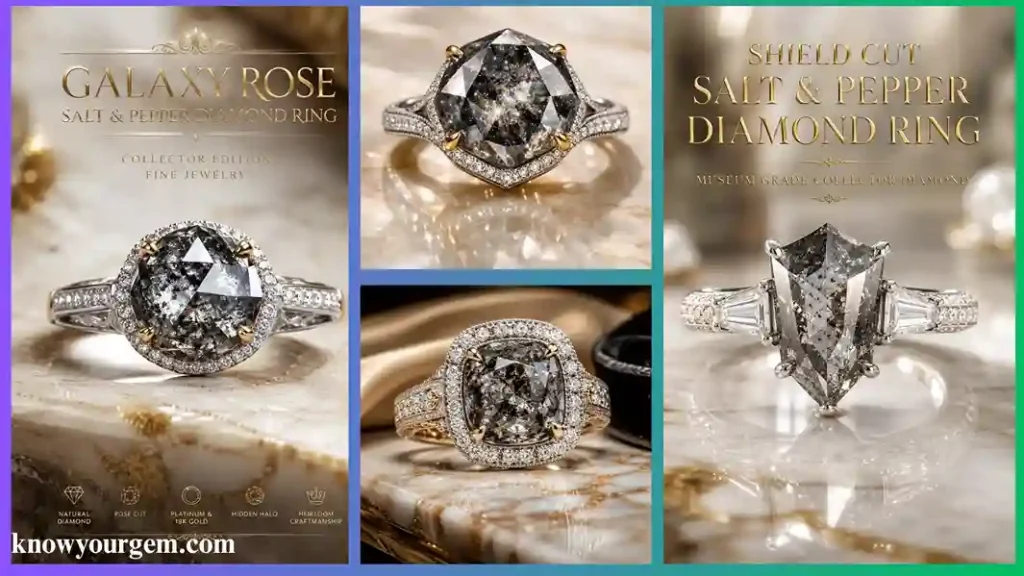
- Hexagon cut: It is flat and geometric cut, showcases the full pattern like a window.
- Marquise cut: It is elongated shaped cut, usually draws the eye along the stone’s length.
- Rose cut: It is domed cut top with having antique glow, soft and romantic.
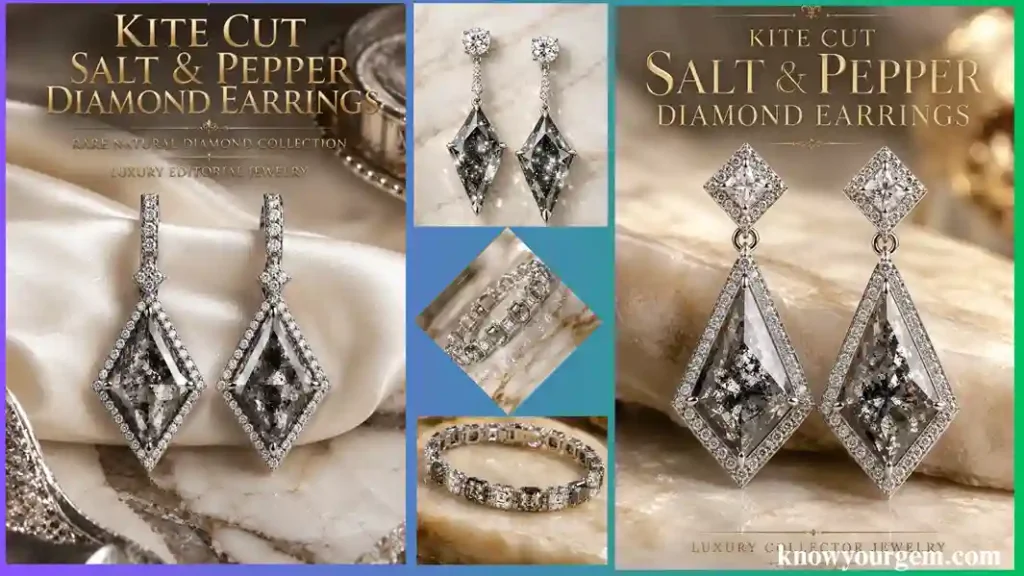
- Kite cut: It is pointed four sided shaped cut and it is often used as accents.
- Cushion cut: It is rounded corners and big facet cut that adds movement.
- Oval and pear cuts: elongated It is generally considered as elongated silhouette perfect for stacking rings or drop earrings
As faceted cuts like cushion and oval add sparkle while breaking up the light across more surfaces, whether rose cuts and slices emphasize the raw, natural look of the inclusions themselves.
Below is the general comparison of the popular shapes, balance sparkle pattern visibility, based on typical faceting styles for each cut:
| Shape | Sparkle | Pattern Visibility |
| Hexagon | Moderate | Very high |
| Oval | High | High |
| Rose Cut | Low | Very high |
| Marquise | High | High |
| Cushion | High | High |
| Kite | Moderate | High |
Dealer’s Insight: Hexagon and oval cuts are usually considered as the most requested, hexagons for their bold, modern geometry, and ovals for their flattering, easy to wear shape.
Salt and Pepper Diamond Rings:
Salt and pepper diamond rings range from simple bezel set ting solitaires to elaborate halo designs. Since, Bezel settings are especially popular as they contain protective ability, that matters more here since inclusions can reach near the surface.
Vintage Styles:
Settings with having scalloped bands, milgrain detailing, and hexagon bezels beautifully with the antique character of such stones, that give them a timeless feel.
Custom Designs:
Various buyers choose bespoke designs, to build a ring around one specific stone rather than picking from a catalog, that make each piece truly personal.
Engagement Rings:
Salt and pepper diamonds have become a favorite for non traditional engagement rings, as they offer couples a stone that make them feel like personal and one of a kind since no two contain same shapes.
They are also budget friendly, as one carat usually costs far less than a colorless diamond and for everyday wear, jewelers recommend protective setting like bezel or low prong instead, of exposed mounts.
Earrings, Necklaces & Bracelets:
- Earrings: Salt and pepper diamond shines beautifully in stud or drop earring, where light hits the inclusions from different angles, the stone showcases its natural glowing look.
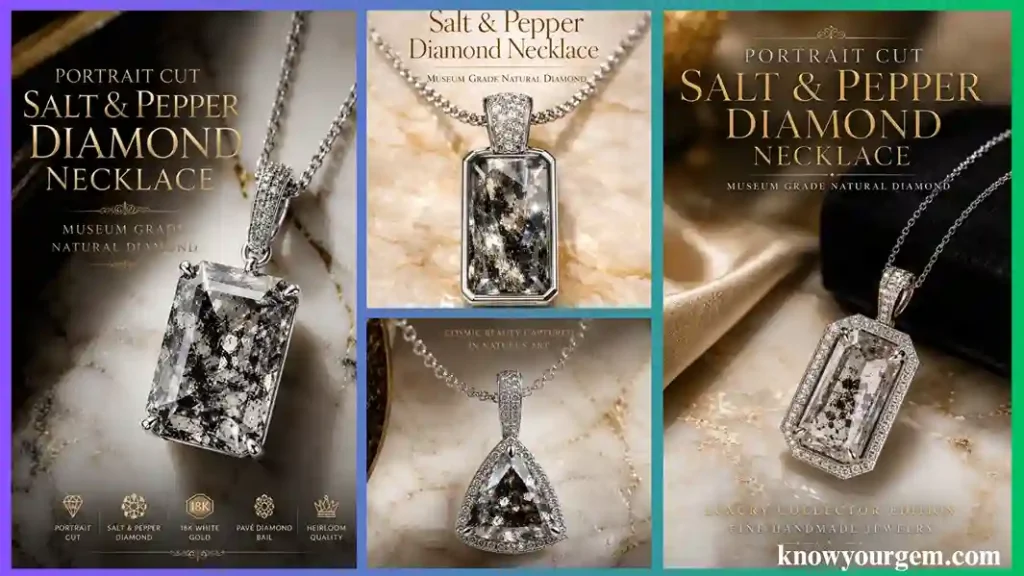
- Necklaces: Necklace and pendant usually highlights a single larger stone as the centerpiece, lets its unique pattern stand out as a focal design.
- Bracelets: Bracelets often use smaller accent stones that are paired with metal detailing. As matching stones are difficult, buyers should expect a premium for well paired setts or work with a jeweler who sources them specifically.
Jewelry Suitability at a Glance:
| Jewelry Type | Suitability |
| Engagement Ring | Excellent, with a protective setting |
| Pendant | Excellent |
| Earrings | Excellent |
| Bracelet | Good, best for smaller accent stones |
| Daily Wear | Very good, given diamond’s hardness |
Lab-Grown vs Natural Salt and Pepper Diamonds:
Lab grown salt and pepper diamonds are made using HPHT or CVD methods that intentionally introduce inclusions. Chemically and physically, they are identical to the natural diamond, to share the same carbon lattice and hardness.
The main difference is origin and price, as lab grown stone usually cost less while natural one carry the “found in nature” appeal that several buyers. Since visual inspection alone can’t distinguish them, it is best to ask the seller directly whether a stone is natural or synthetic.
Salt and Pepper Diamond vs White Diamond:
White diamond are valued for their clarity and colorless factor and with the highest value that goes to the stone that showcases no inclusions to the naked eye. Whereas Salt and pepper diamonds flip that idea, their visible inclusions are the major attraction, that give them unique character.
In practice, the biggest difference is price, as white diamond of the same size cut can command price like 5-20 times more because clarity drives its value.
Since light performance also varies white diamonds sparkle with the brilliance and fire, whether salt and pepper diamonds glow in a softer, more muted way.
Salt and Pepper Diamond vs Black Diamond:
A black diamond is dense with having inclusions or heat treated, that makes it look solid and opaque. Whether a salt and pepper diamond, on the other hand, stays translucent, with the light through its mixture of black and white inclusions.
Visually, black diamonds feel bold and uniform, whether salt and pepper diamonds showcases unique textures and patterns. Buyers who want a sleek monochrome that looks lean toward black diamonds, while enthusiast who love individuality often choose salt and pepper stones.
Price Guide & Cost Per Carat:
Slat and pepper diamonds generally command price like $300-$1,500 per carat, with having rare patterns or larger stones going higher. Since the price of this stone hinges on its key factors like, weight, cut, and shape, as rose cuts fancy shapes like hexagons often cost more than simple rounds.
However finished ring usually commands $500 for simple silver whether gold verneil designed ring is sold for $3,000 plus for solid gold or platinum with larger, well matched stone.
Are Salt and Pepper Diamonds Valuable?
Salt and pepper diamonds are realistic natural diamonds with having value, but the value comes from their unique patterns, inclusions, and cut rather than the traditional “four Cs.” Their appeal is mostly aesthetic, not investment driven, as resale markets for included stones are smaller and less standardized.
Most buyers choose them for persona style and individuality rather than financial gain, that makes them valuable in a different, more expressive way.
Are They a Good Investment?
Salt and pepper diamonds are the best seen as personal or sentimental purchases, not financial investments. Their value hinges on the unique patterns and inclusions, so resale prices vary and are hard to predict.
For investment purposes, buyers generally choose high clarity white diamonds with having standardized grading and resale markets. However for individuality and meaning, salt and pepper diamonds often bring more satisfaction than treating them like assets.
Looking at the practical realities of this market can help to set expectations:
- Liquidity is lower than with white diamonds, as fewer buyers and dealers focus on the reselling included stones.
- Auction demand is niche, with salt and pepper diamonds, that showcase more in designer or estate jewelry lots than as standalone pieces.
- Collector interest is rising, especially among the collectors who appreciate one of a kind natural patterns, as the market is still developing.
- Resale expectations should stay modest, as sellers usually recover part of what they paid rather than seeing appreciation.
Ethical Sourcing and Sustainability:
Salt and pepper diamonds usually follow the same source frameworks as the wider diamond industry, since the come from the same mines and supply chains.
The Kimberely process helps to resist conflict diamonds through tracking stones from mine to export, as it doesn’t cover every labor or environmental issue.
Buyers who care about origin can look for suppliers documenting conflict free sourcing and responsible mining practices, that include fair labor and environmental remediation. Recycled diamonds are another low impact option, as they avoid mining altogether.
Lab grown salt and pepper diamonds are often marketed as the most straightforward ethical choice, eliminate mining but requires significant energy to produce.
Market Trends:
- Rising demand: Couples who want unique, personal engagement rings salt and pepper diamonds work well.
- Expanded offerings: Now widely available as future niche artisan markets.
- Lab-grown trend: It commands lower price point, same with same look.
- Natural appeal: It is valued for one of a kind origin story.
- Fancy cuts: Cuts like hexagon and kite shapes gain popularity over traditional rounds and princess cuts.
Designers Who Popularized Salt and Pepper Diamonds:
- Independent designers: They usually bring salt pepper diamonds into mainstream bridal fashion, not big legacy houses.
- Small-batch studios: They built full collections around these stones long before larger retailer joined in.
- Experimental cuts: Buyers stilllook for independents for bold shapes and unique settings.
- Research tips: choose Choose designers who share clear sourcing info and showcase detailed photos or videos of an actual stone, not stock images.
How to Identify Genuine Stones?
Authentic salt and pepper diamond passes standard diamond tests like thermal conductivity, as its carbon structure is identical to other diamond, reputable jewelers routinely use these check to confirm authenticity.
How Gemologists Identify Salt and Pepper Diamonds?
Gemologists depends on the integration of instruments to confirm a stone is authentic and to document its properties.
- Thermal tester: It measures heat conductivity, whether diamond conducts far faster than simulants like glass or CZ.
- Refractometer: It checks light reflection, as inclusions can make readings harder.
- Polariscope: It confirms single refractive isotropic structure, which is not like doubly refractive simulants.
- Spectroscope: It implement absorption patterns to detect treatments or confirms natural origin.
- UV fluorescence: Some diamonds glow under UV, that supports identification.
- Microscope: It discloses inclusion type, placement, and surface features that affect durability.
- DiamondView imaging: It is a lab technique to distinguish natural growth patterns from lab grown structure.
What to Look for in a Certificate?
A diamond with having report or identification certificate for a salt and pepper stone should clearly state several key details.
- Whether the stone is natural or lab grown
- If any treatments are applied, like fracture filling or irradiation
- Precise measurements and proportions
- Carat weight
- Shape and cutting style
- Gemologist comments describing the inclusion pattern and overall character
Since salt and pepper diamonds don’t receive a standard clarity grade, but the comments section of a report holds more useful information than the grading boxes themselves.
Fake vs. Real: What You Might Be Shown Instead
| Sold As | Actually Is |
| “Salt and pepper diamond” | Glass with having printed or painted inclusions |
| “Salt and pepper diamond” | Cubic zirconia (CZ) with having inclusions like flaws |
| “Salt and pepper diamond” | Moissanite treated to mimic dark inclusions |
| “Salt and pepper diamond” | Composite or doublet stone sold as a thin diamond layer glued over another material |
An authentic salt and pepper diamond can be ruled in with a thermal tester and loupe or microscope, as inclusions make quick visual checks that are less reliable, and buying from a seller who tests in front of you or provides lab documentation is key.
Buying Guide & Best Places to Buy:
When you buy a salt and pepper diamond, you should choose sellers who provide high resolution photos or videos of the actual stone, each diamond’s pattern is unique. Independent jewelers have stronger ethical sourcing knowledge and more creative settings than chain retailers.
Before buying a salt and pepper diamond, collectors should ask about origin, certification and return polices from jewelers.
Care, Cleaning & Maintenance:
- Clean this stone gently with lukewarm water and mild soap, while using soft brush to remove dust, then wash it thoroughly under warm water.
- Store jewelry separately to resist scratches, and schedule routine jeweler inspections to catch loose settings or inclusion issues early.
Care Mistakes to Avoid:
- Don’t use a home steam cleaner, as the heat and pressure can stress the surface reaching inclusions.
- Do not soak the stone in strong acids industrial cleaning solutions.
- Don’t expose this stone to bleach or chlorine, including in hot tubs and swimming pools, as chlorine can damage certain metal alloys used in the setting.
- Don’t hammer, tap or strike the stone against hard surfaces, even briefly.
- Don’t ignore loose prongs or shifting bezel, as having any looseness repaired promptly, since a loose setting is the most common cause of a lost stone.
Expert Buying Tips:
- Pattern over size: A smaller stone with having a striking look is better than a larger with no striking look.
- Balanced inclusions: Avoid heavy clustering in one area.
- Surface feathers: Skip larger surface that reaches flaws, especially for daily wear rings.
- Real videos: Always ask online sellers for actual stone footage, not stock images.
- Certification: Verify your gem with trusted lab reports or request written origin details.
- Protective settings: Always choose bezel settings or low profile prongs for everyday wear jewelry.
Salt and Pepper Diamonds Compared to Similar Stones:
- Gray diamond: This is naturally colored with a uniform gray body and fewer inclusions, that give a smoother monochrome look.
- Black diamond: Either heavily included to opacity or heat treated, as it offers a bold solid black appearance instead of mixed patterns.
- Moissanite: It is a lab generated silicon carbide gem, sometimes it is cut with artificial inclusions to mimic salt and pepper diamonds at the lower cost, however with different optical and durability traits.
- Rose cut diamond: It is usually clean or lightly included white diamonds cut with a domed top and flat bottom, that shares antique aesthetics but lacks heavy inclusions patterns.
Pros and Cons:
| Pros | Cons |
| It owns unique patterns, every stone is one of a kind | But doesn’t carry clarity grading means that its lacked standardized system |
| It is affordable per carat, means cheaper than white diamonds | It is usually found in smaller resale market and its demand is less than traditional diamond |
| It is durability is same as white diamond contains. | But its surface inclusions can need protective settings |
| It is ethical appeal, popular in sustainable jewelry | But the stone is hard to match that makes it difficult for earrings |
| It has creative cuts and wide range of unconventional styles are available | It has less brilliance lower fire than colorless diamonds |
Conclusion:
A salt and pepper diamond usually offers something which flawless diamond simply can’t a pattern that exists in exactly one stone and nowhere else. For collectors who want a meaningful, budget friendly, and genuinely unique pieces of jewelry , and who understand that these stones are chosen for character rather than grading for perfection.
Frequently Asked Questions:
1. What is a salt and pepper diamond?
It is a natural diamond with having visible black and white inclusions that create speckled look.
2. Is a salt and pepper diamond a real diamond?
Yes salt and pepper diamond is natural with having the same carbon crystal structure that white diamond carries.
3. Why do salt and pepper diamonds have inclusions?
Because this diamond forms when graphite, carbon or minerals are trapped during the growth.
4. Are salt and pepper diamonds valuable?
Yes these stones are valuable but less than white diamond and their prices hinges on pattern and cut, not clarity grades.
5. Are salt and pepper diamonds rare?
Yes they are rare as they contain unique patterns but more abundant than flawless rough.
6. Are salt and pepper diamonds natural?
Yes most of them are most are natural, but some can be lab grown.
7. Why are salt and pepper diamonds black and white?
They get black inclusion from graphite/carbon, white from lighter minerals.
8. Are salt and pepper diamonds durable?
Yes they are durable enough as they contain 10 Mohs hardness but their surface inclusions need protective settings.
9. Do salt and pepper diamonds sparkle?
Yes they produces softer glow due to light scattering.
10. How much does a salt and pepper diamond cost?
A single salt diamond can command price like $300-1,500,however in rings setting price can depend of design.
11. Can salt and pepper diamonds be certified?
Yes they are certified by labs like GIA/IGI.
12. How do you identify a genuine salt and pepper diamond?
Natural diamond lets pass light when it is tested through thermal conductivity.
13. Which cut looks best for a salt and pepper diamond?
Cuts like hexagon, marquise, rose cut, and cushion highlight patterns of the diamond.
14. Are salt and pepper diamonds ethical?
It totally hinges on suppliers, whether offer lab grown of ethically sourced natural diamond.
15. Can salt and pepper diamonds be lab grown?
Yes it is because it created through HPHT or CVD with intentional inclusions.
16. Do salt and pepper diamonds increase in value over time?
It is best for enjoyment not an investment material.
17. What are good alternatives to salt and pepper diamonds?
Its alternative stones like Moissanite, gray diamonds, rose cut white and sapphires.
18. What is the best shape for a salt and pepper diamond engagement ring?
The best shapes of diamond is hexagon oval shape, which is especially popular in engagement rings.
19. Can you find matched salt and pepper diamonds for earrings?
Yes, but it can take more search than white diamond, as no two stone share an identical pattern.
Collectors are advised to check their Gem with GIA or IGI for authenticity, ethical sourcing clearance and refractive index before buying it! Gem Enthusiast KamilHussian

Welcome to KnowYourGem.com! your ultimate destination for uncovering the fascinating world of gems and their secrets! I'm Kamil Hussain, a passionate blogger with a Master’s degree in Economics, dedicated to bringing you insightful, well researched content that blends the beauty of gemstones with the art of storytelling. With a keen analytical mind and a love for discovering hidden treasures, I created this platform to help you explore the brilliance, history, and value of every gem.

