

Overview:
Blue diamonds can look absolutely unworldly. Some are light and otherworldly, icy-lookng, while others are a dense, saturated blue that’s almost inky. The hue generally originates below the surface of the stone (not from surface treatments or coatings) and from the atomic structure of the mineral itself.
Natural blue diamonds happen to be the most uncommon shade of diamonds you can buy, so that’s precisely why you want to be somewhat cautious. Rarity is a reason to look closer at a stone, not a reason to trust the price tag.
Here’s the problem most buyers run into. A natural blue diamond, a lab-grown one and a color-treated one can look almost identical in a photo. These should be very different purchases, and they are priced differently
The short version:
- Natural blue diamonds are rare. Color origin matters as much as color.
- Color grade alone doesn’t tell you how a stone will look or what it’s worth.
- Natural, lab-grown and treated stones are different products. Make the seller say which one you’re getting.
- Always get a report from a reputable lab for every costly stone and verify it.
What Gives a Blue Diamond Its Color?
Blue hues in a lot of natural blue diamonds are caused by small particles of boron inside the crystal. They are generally the type IIb diamond, which has relatively little nitrogen in comparison to most other diamonds.
How does it change the interaction of the light with the stone? Boron will make the stone seem as if its original color tone changed. With some of the stones, you can see a very light, gentle cool blue, a very saturated blue, a grayish blue or you can even see the ink.
Not all the stones formed in the same place. According to research by the Gemological Institute of America (GIA), many Type IIb diamonds formed at depths beneath the Earth’s surface that are considered unlikely.
One possibility is that the boron was carried into the mantle along with an extinct oceanic crust that was subducted, and then incorporated into diamonds in formation. For more, see GIA’s research on blue diamonds.
Boron isn’t the only route to a blue look, though. Other structural defects, hydrogen-related features, radiation effects and inclusions can produce blue, gray or violet colors in some diamonds.
That’s why you can’t judge a blue diamond by eye. A photo won’t tell you how the color got there. For an expensive stone, documentation beats appearance every time.
Natural, Lab-Grown and Color-Treated: Three Different Stones
This is where online shopping goes wrong, so let’s separate them.
- Natural blue diamond: Formed naturally within the Earth. The bluish color could be from boron in the water, or other natural factors.
- Lab-grown blue diamond: A blue diamond that has been produced in a lab, generally by either HPHT or CVD processes.The colour of the diamond can be created in-growth or can be introduced or altered through various treatments.
- Colour-treated blue diamond: A diamond whose color was changed or enhanced after it was formed.
These three stones can be well fitted in lovely jewelry. The difference is origin, color history, rarity and price. It isn’t how blue the stone looks.
Before you buy, ask two separate questions. Where was this diamond formed? And how did it get its color? If the seller can’t answer both clearly, you can’t compare prices fairly.
Why Natural Blue Diamonds Are So Rare?
A natural blue diamond needs an unusual set of conditions. In the common Type IIb variety, boron has to get into the crystal while nitrogen stays extremely low. The crystal then has to grow, and survive, well enough to become a gem.
Those conditions explain why natural blue diamonds are far harder to find than colorless diamonds or most other colored gems.
The Cullinan mine in South Africa has been an important source of modern Type IIb blue diamonds. Australia’s Argyle mine also produced blue, gray and violet diamonds, though it was best known for pink. Mining at Argyle ended in November 2020.
Scarcity is part of what makes it attractive to buyers. But a lack of availability doesn’t mean they will be desirable. Two blue diamonds are going to be vastly different prices if one has better colour or a better face-up appearance and more attractive inclusions than the other.
So rarity generally explains why such stones get more attention. The individual diamond decides whether the asking price makes sense.
Understanding Blue Diamonds Color Grades:
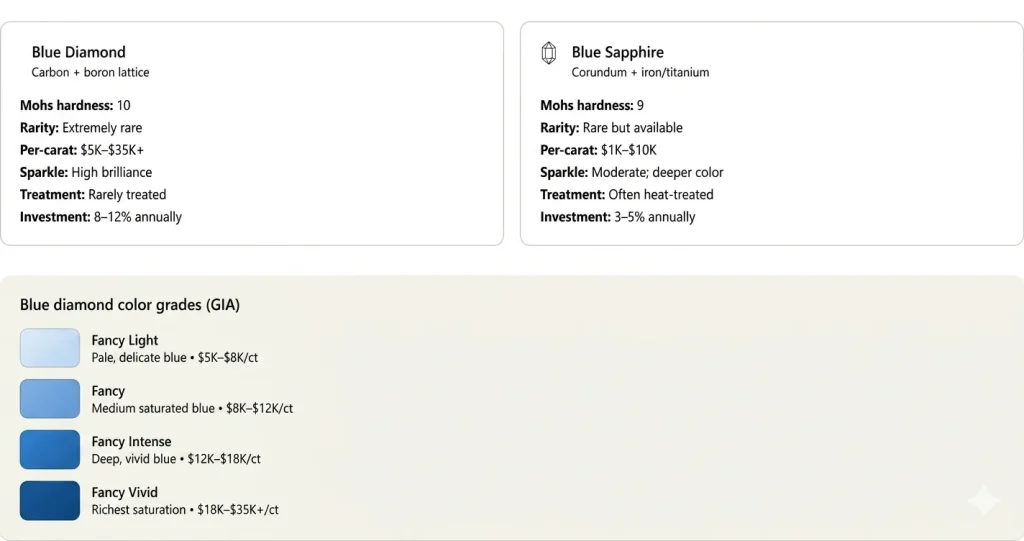
Blue diamonds are not generally graded on the D-to-Z scale, but it is used for colorless stones only. They’re graded with the fancy-color system. GIA’s terms are:
- Faint
- Very Light
- Light
- Fancy Light
- Fancy
- Fancy Intense
- Fancy Vivid
- Fancy Deep
- Fancy Dark
Don’t see this as a basic ladder that each step gets more attractive and more expensive. The descriptions give the color quality.
Intensity, tone, saturation, secondary colours and your own flavour all matter – along with that very thing that you bring to the bottle. Someone who loves a dark, intense blue might choose a stone that another customer might find plain.
What the grades look like in practice?
- Dim: The blue is very subtle, and sometimes you can’t see it at all unless the light is good.
- Very Light and Light: A gentle hint of blue. Subtle, it can get easily lost in some groups.
- Fancy Light: The blue is generally more noticeable but still soft.
- Fancy: Color starts to lead. You see the blue at a glance.
- Fancy Intense: Rich and pronounced. The stone has real presence.
- Vivid Colors – intense saturation: In demand among the collector and as a jewelry stone.
- Fancy Deep: Intense and dark in color, creating a dramatic impression.
- Fancy Dark: Overall dark, blue also can be dimmer.
Fancy Intense and Fancy Vivid stones can attract a lot of attention. But the grade is only part of the story. A deep blue is exactly right for one buyer, while another wants something brighter with more visible color.
Our advice: look at the stone under more than one light. Jewelry-store spotlights flatter almost everything. Check it in neutral light too, and in the light you’ll actually wear it in.
Natural vs. Lab-Grown Blue Diamonds:
Yes, both are real diamond material. The distinction is in the origin, and that will determine availability, price and collectability.
| Feature | Natural blue diamond | Lab-grown blue diamond |
|---|---|---|
| Origin | Forms naturally in the Earth | Grown in a laboratory |
| Color | May come from boron or other natural features | May develop during growth or through treatment |
| Availability | Desirable natural blue stones are very scarce | Generally easier to find |
| Price | Often much higher | Generally lower |
| Main appeal | Natural rarity and collecting | Color, size and budget flexibility |
| Mohs hardness | 10 | 10 |
| Documentation | Should confirm natural origin and color information | Should disclose lab origin and any treatment |
If it’s mainly for appearance, a lab-grown blue diamond can get you a larger carat weight in the center stone for less than the cost of a natural.
If the point is natural condition, origin and collecting value, a natural stone makes more sense.
How Much Does a Blue Diamond Cost?
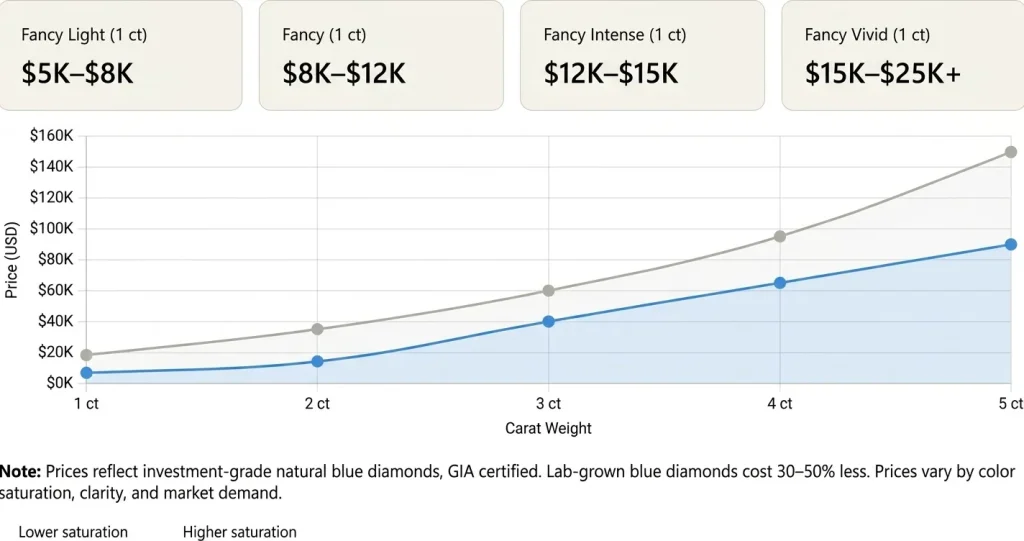
There’s no price/carat for blue diamonds. Two stones of the same weight may have very different values if they have colour, clarity, country of origin, indication of treatment or appearance.
Before you compare listings, check these:
- Color grade, intensity and secondary hues
- Carat weight
- Clarity and how visible the inclusions are
- Cut quality and face-up appearance
- Whether it’s natural, lab-grown or color-treated
- Grading reports and supporting documents
- Market demand and the seller’s pricing
GIA notes that strongly colored fancy diamonds can be extremely rare and valuable, and that small differences in color appearance can change what buyers will pay. See GIA’s overview of fancy color diamonds.
What moves the price most?
1. Color intensity: Color is one of the biggest factors. A comparable Fancy Intense or Fancy Vivid stone can sell at a large premium over a lighter one. Secondary hues matter too. Some desire the pure blue. Some like a hint of gray or green. Color removal or enhancement may add or take away value depending on the stone and the market.
2. Carat weight: Larger natural blue diamonds get expensive quickly, especially when the color is strong and evenly spread. But bigger isn’t always better. Don’t settle for a big stone with bad color – if the smaller one has great color. Go by what the stone shows in the jewelers rather than what the report says.
3. Clarity: Some natural inclusions are nearly invisible without magnification. Others, especially dark ones, pull attention away from the color or affect transparency. An inclusion doesn’t automatically rule a stone out. Where it sits and how visible it is decide that.
4. Origin and treatment: Natural, lab-grown and treated stones can look the same online and sell for very different prices. If the listing is vague, don’t assume the stone is natural just because it says “blue diamond.”
5. Paperwork: An independent report from a reputable laboratory provides independent evidence. For a significant piece, the paperwork should verify the natural or created origin, and the source of the color. Consider what the lab report actually confirms, since not every report provides information for every characteristic.
Where buyers overpay?
- Paying natural prices for a stone with no proof it’s natural.
- Paying for a grade name without looking at the stone in real light.
- Chasing carat weight on a stone with uneven color.
- Skipping the report because the photo looked great.
A photo gets your attention. Documentation tells you what you’re paying for.
Blue Diamonds vs. Blue Sapphires:
They can look similar in photos. They’re different minerals with different properties, availability and prices.
| Property | Blue diamond | Blue sapphire |
|---|---|---|
| Mineral | Carbon | Corundum |
| Common cause of blue | Boron in many natural blue diamonds | Mainly iron and titanium |
| Mohs hardness | 10 | 9 |
| Visual appeal | Often valued for brilliance and fire | Often valued for rich blue color |
| Availability | Natural blue stones are very rare | Wide range of qualities and prices |
| Treatment | Color origin and possible color treatment | Heat treatment is common |
| Typical appeal | Rare luxury jewelry and collecting | Blue gemstone jewelry across many budgets |
Here’s how we’d frame the choice. If you’re looking for a colored diamond, for their uniqueness and brilliance, then choose a blue diamond. If you prefer a very deep blue color and a more affordable price, then a blue sapphire should be for you. There is no need to compare them, these stones satisfy different needs.
Blue Diamond Engagement Rings:
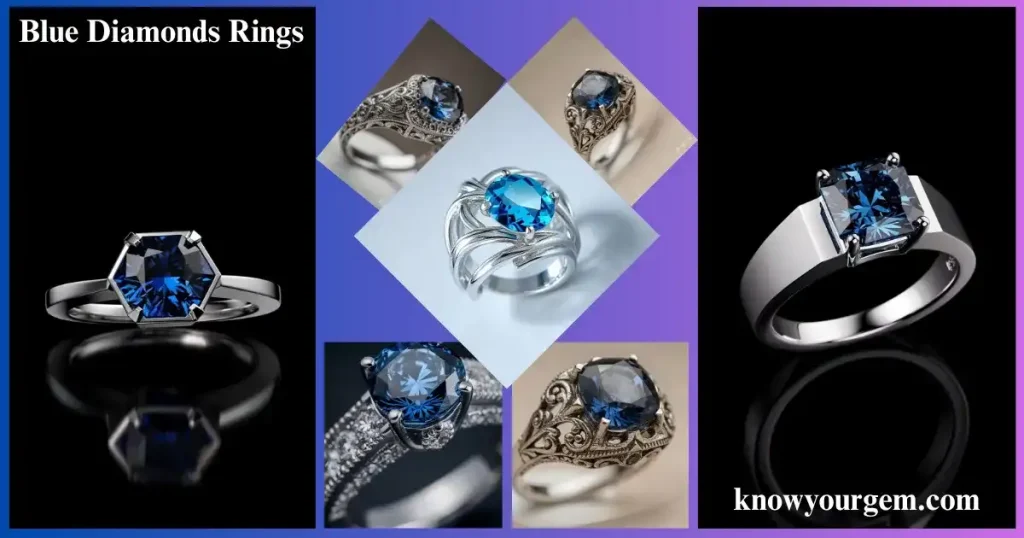
A blue diamond ring is an alternative to the white diamond, and you keep the hardness of diamond. The best design depends on the center stone’s shape, color, size and proportions, and on your own style.
Popular ring designs:
- Solitaire: one stone, nothing else. It keeps the blue as the main feature.
- Halo: Small accent diamonds around the center add sparkle. This difference can generally make the blue stone stand out.
- Cushion cut: It is a rounded cut that, with its corners and larger facets, gives a softer, classic look. How the blue appears depends on that stone’s cut and color. The elegant shape, when done right, can appear larger face-up than a round stone of the same weight.
- Vintage-style: Milgrain, intricately worked metal and chosen accent stones. Suitable for both elegant and intricate styling.
- Tailored: You select the stone, metal, setting, and proportions – tailoring it yourself. You have more control – although overenthusiastic design input can escalate the price.
Which metal works with a blue diamond?
- Platinum: Naturally white, with a clean modern look.
- White gold: A similar effect to platinum. Cost depends on the alloy and design.
- Yellow gold: A warm contrast that makes the blue pop.
- Rose gold: A bit softer and warmer, a more unique pair.
No metal is best for every stone. Look at your diamond’s particular shade, the contrast you want and the jewelry you already wear.
A diamond can still chip:
Hardness isn’t the same as toughness. Diamond resists scratching better than anything else, but a hard knock on the wrong edge can still damage it. That’s why the setting matters. Check the prongs, the security of the stone and the finish, especially on a ring you’ll wear every day.
Blue Diamond Earrings, Pendants and Other Jewelry:
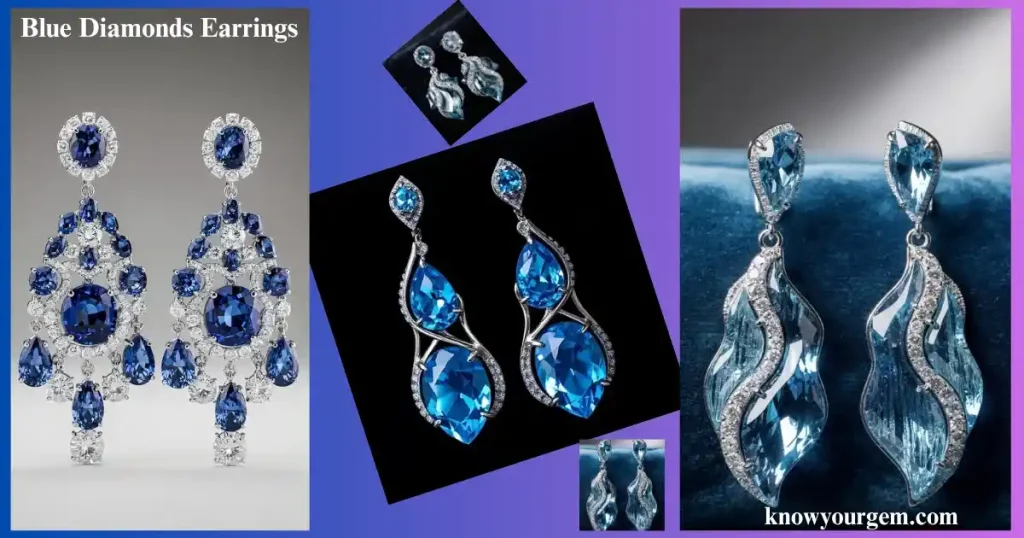
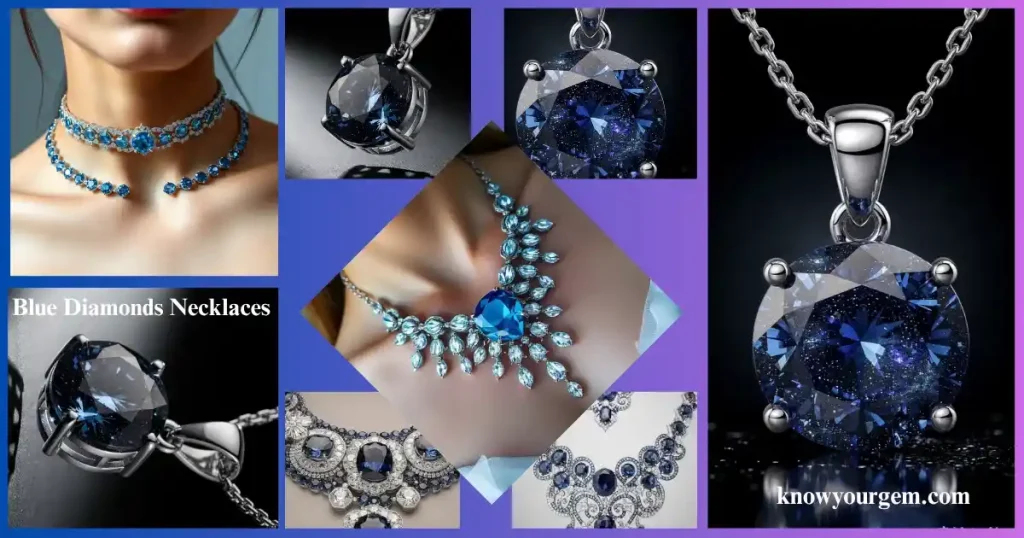
You don’t have to be getting engaged to wear blue diamonds. This hue makes for a perfect pair of earrings, pendant, or bangles, and necklace and bracelet pieces to be worn in a range of fine jewelry creations, from modest to more elaborate.
Stud earrings: These are perfect for people who like a more subtle look. You can wear them more or less all the time, and they suit almost every outfit. If you’re after something simple, stud earrings are a great choice. They are versatile and suitable for daily wear.
Drop earrings sway and reflect light at various angles. They work well for special occasions and during the evening.
Pendants brought the blue in closer to the face, where the color really became the star. A solitaire pendant kept the look simple, while a halo delivered on the glitter.
Tennis necklaces and bracelets have an array of stones in a row for a little more of a statement. The bad? Matching a few blue diamonds together all at once can really eat a chunk of your budget.
How often will you wear the item? Studs and pendants are more flexible, while elaborately detailed earrings and tennis necklaces and chunky bracelets are best worn on special occasions. For a pricey item, the setting and documentation that goes along with the stones can be just as important as the design.
How to Verify a Blue Diamond Before You Buy?
A natural stone, a lab-grown one and a treated one can look identical to the unaided eye. So don’t rely on your eyes alone. Work through these steps.
- Request for a grading report: Obtain the original report or an authentic copy of a grading report from a reputable gemological laboratory. Do not depend solely on the seller’s assessment.
- Verify the report number: Confirm that the report appears on the laboratory’s published records on their website and matches the document you received.
- Determine the stone’s origin: Verify whether it is natural or lab-created. The term “diamond” does not automatically indicate it is natural.
- Query color source: Determine if the blueness occurs naturally or if it has been added or altered by measure.
- See report attached to stone: Take measurements, carat, identification features and any images or plotted inclusions.
- Match the report to the stone. Compare measurements, carat weight, identifying characteristics and any images or plotted inclusions.
- Get a second opinion: For the more expensive purchase you may want to have an independent gemologist give you another opinion.
- Keep the paperwork. Save the report, invoice, appraisal and treatment disclosures. You’ll want them for insurance, resale and future checks.
Depending on the type of report, a GIA colored diamond report may comprise color grade, color origin, carat weight, clarity features and color picture.
Red flags
- The seller won’t answer questions about treatment.
- Key claims can’t be backed up with paperwork.
- You’re pressured to pay before you can verify anything.
- The report doesn’t match the stone, or the number doesn’t check out.
- The price looks far too low for a natural blue diamond.
With an expensive stone, spending extra time on documents is part of the purchase, not a delay.
Are Blue Diamonds Ethically Sourced?
Miners aren’t the only standard of ethical sourcing. It’s not just about whether the diamond passes the conflict-diamond test. Conditions while mining, the treatment of workers, the impact on the planet and traceability through the supply chain are also important concerns.
The Kimberley Process is an international certification scheme to prevent conflict diamonds from entering the legitimate rough-diamond trade. Participating countries impose controls and documentation requirements on shipments of rough diamonds that are subject to the scheme.
But Kimberley Process compliance doesn’t cover every part of a diamond’s environmental or ethical history. It isn’t complete proof of responsible sourcing.
Questions worth asking a seller:
- Is the mine or country of origin known?
- What documents support that origin?
- Can the supplier explain its sourcing/supply chain policies?
- Is chain-of-custody or traceability information available?
- Would a lab-created diamond be more suitable for you?
Replicating the stone itself frees you from a major downside of mined stones: The destruction of the environment caused by that mining.
However, growing a stone does require energy and resources. How much energy and resources will depend on the manufacture and energy sources.
Not every buyer will have the same one answer. Probe, look for evidence and take any far-reaching ethical assertions with a pinch of salt.
How to Care for Blue Diamonds Jewelry?
In truth, a diamond is a 10 in on the moh’s scale of mineral hardness so very scratch resistant. But, a blow with sufficient force on the ideal face will chip a diamond and the setting may become loose or worn over time.
Everyday cleaning:
Cleaning Fresh Water Only soap and warm water, a soft cloth or a soft bristled toothbrush Gently clean the stone and setting. Rinse thoroughly and pat dry with a lint-free cloth. Do not use harsh scrubbing or cleaners that can scratch metal and potentially damage sensitive parts of a setting.
Take your jewelry off before:
- Gardening or heavy manual work
- Exercise or anything that could knock the stone against something hard
- Handling cleaning products or chemicals that could affect the setting
- Any activity where the piece could catch, bend or get damaged
Check the setting:
Check the prongs and setting periodically. Take your piece off if the diamond moves or a prong looks flattened or damaged, or if there is any other kind of damage, until you have had it looked at by a jeweler.
Store the grading report along with your receipt. If you’re insured, be sure your documentation and coverage are up-to-date.
Common Mistakes We See:
- Buying a “natural” blue diamond with no report.
- Trusting a photo for color.
- Treating the color grade as a quality ranking.
- Overpaying for a stone that’s lab-grown or has a colour enhancement treatment.
- Choosing the largest stone rather than selecting the most attractive one.
- Never inspecting the prongs on a ring that is expensive to ensure it’s secure.
- Throwing away the paperwork after purchase.
Final Thoughts: Is a Blue Diamond Right for You?
Blue diamonds are desirable because they are a rare colour, as well as the hardness of a diamond. It’s a lot more complex than just the bluest stone or the one of the highest grades.
Start with a ranking: natural scarcity, certain colour, carat, ring style or budget that allows you to keep the rest.
Next look at the actual stones. Examine the color under different light, test the weight, determine clarity and cut, and check the origin and color history with accurate documentation.
For those of you who might appreciate natural scarcity and collectability, a natural blue diamond should be something you take time to research. For you who simply would love a blue diamond piece at a more affordable level, lab-grown stones provide you a wider range of options.
The best buy isn’t necessarily the largest or most costly stone, it’s the one that fits your requirements in appearance, documented attributes, price and provenance.
FAQs:
1. What makes a diamond blue?
In many natural blue diamonds, tiny amounts of boron in the crystal cause the color. These are usually Type IIb diamonds. Other features can also produce blue or grayish-blue tones.
2. Are natural blue diamonds rare?
Yes. They require rare conditions of formation, so very few natural blue stones exist in comparison to colourless diamonds.
3. How can I tell if a blue diamond is natural?
Not identifiable by sight show a report from a well-established gem lab confirming if it is natural or lab-grown, the origin of the color, and check the report number with the gem lab’s website.
4. What is the difference between a natural and a lab-grown blue diamond?
Same or Different? This is a diamond. Natural stones are found naturally in the ground; lab-grown stones are created in a lab. Natural stones are typically a lot more costly.
5. What does Fancy Vivid blue mean?
It’s a GIA fancy-color description for strong color saturation. It describes how the color appears. It isn’t a simple quality ranking.
6. How much does a blue diamond cost?
It really varies. It depends on the color, carat, clarity, cut, origin, whether it has been treated or not, if there’s any documentation.
7. Is a blue diamond better than a blue sapphire?
Neither is better. A diamond is harder, at 10 to 9, and a natural blue diamond is far more rare. A blue sapphire is rich colour at a broader spectrum of price points.
8. Is a blue diamond good for an engagement ring?
Yes. Diamonds make excellent everyday stones and will, like any gemstone, be damaged if hit. Make sure they are well set and checked.
9. Are blue diamonds ethically sourced?
Depending on the stone. The Kimberley Process addresses the conflict diamond issue but not all other concerns. Discover more about the stone’s origin and whether it’s sustainable, or opt for a lab-grown stone.
10. How do I clean a blue diamond?
Khadi warm water, gentle soap & soft cloth use warm water, gentle soap and a soft cloth, then dry with a lint-free towel. Remove jewelry prior to exercise and exposure to chemicals.
Comment below with your feedback and enhance our confidence to bring more fruitful content! Gemstone Expert And Enthusiast KamilHussian!

Welcome to KnowYourGem.com! your ultimate destination for uncovering the fascinating world of gems and their secrets! I'm Kamil Hussain, a passionate blogger with a Master’s degree in Economics, dedicated to bringing you insightful, well researched content that blends the beauty of gemstones with the art of storytelling. With a keen analytical mind and a love for discovering hidden treasures, I created this platform to help you explore the brilliance, history, and value of every gem.


[…] blue hue of these amazing gemstones is just what the scientists say: “tiny boron atoms” embedded in […]
[…] Blue diamonds without enhancements are very rare. Their blue color is caused by the boron found within the crystal structure. A large number of blue diamonds have been mined from the Cullinan mine in South Africa. […]
[…] falls mid-point on the Mohs scale, well below diamond and sapphire. Check out the guide to the hardest gemstones to see how it […]