
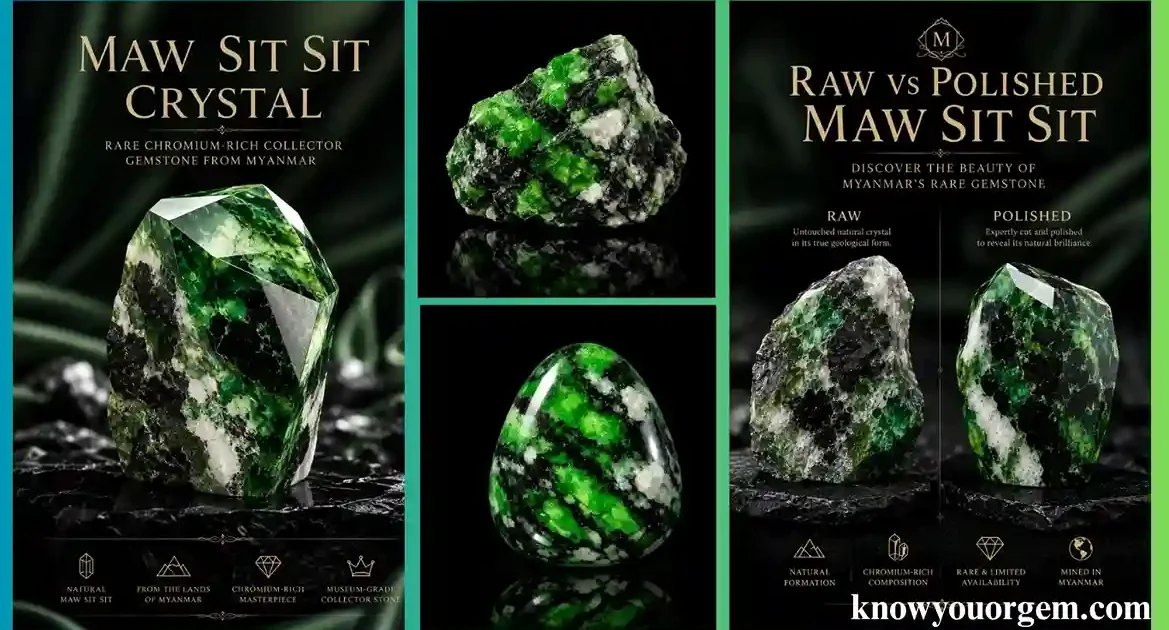

Maw sit sit is rarer, opaque green gem primarily comes from northern Myanmar and valued for its intense chrome green color and black veining. It is not true jade, as it is sold and mistaken as one, it is distinct metamorphic rock built kosmochlor, chromium rich jadeite, and albite feldspar.
Check green Emerald ultimate Guide from its origin to the market journey.
What Is Maw Sit Sit?
Maw Sit Sit is best thought of as a “gem rock” rather than a single mineral. It is polymineralic, meaning it is built from several minerals fused, not a uniform crystal lattice like sapphire or emerald. That is the key difference: it is a rock with a mixture of components, not a pure mineral species.
Its major ingredients are kosmochlor, chromium-rich jadeite, and albite felspar. Smaller amounts of chromite, exkermannite, and natrolite sometimes join the mixture. Because the proportions are different from piece to piece, every slab of Maw Sit showcases a unique look, as no two patterns are ever the same.
Where Does the Name Come From?
The name is taken from northern Myanmar where it was first discovered. It is not the same as stones that have their own symbolic names; this is purely a geographic reference, similar to other minerals that are called after their discovery site.
Swiss gemologist Eduard Gübelin formally identified the stone in 1963. His 1963. His 1965 paper in the Journal of Gemology confirmed it as a jade albite rock distinct from jadeite, finally resolving decades of confusion about its classification.
Where Is Maw Sit Sit Found?
Maw Sit Sit is formed only in Tawmaw, a jade-mining area of Kachin State, Myanmar, in the Himalayan foothills. This region supplies limited Maw Sit Sit, which makes the stone rare, alongside its famous jade deposits.
This single-source origin is what makes it so rare. Unlike stones like sapphire or garnet that occur worldwide, every genuine piece of Maw Sit Sit traces back to that one district in Myanmar.
Maw Sit Sit Composition and Formation:
Maw Sit Sit forms under the same high-pressure metamorphic conditions that create jadeite. Extremely deep in the Earth’s crust, heat and pressure recrystallize the rock into a dense, interlocking structure which gives it durability.
Its vivid green color comes from unusually high chromium content among the strongest of any gem rock. That’s why its color often looks more electric and saturated than jadeite. The black veins and patches are kosmochlor concentrations. This mineral not only intensifies the green but also explains why some dealers call it “kosmochlor jade.
Maw Sit Sit vs. Jade: Are They the Same Thing?
Maw Sit Sit is often mistaken for jade; however, it is not the same thing. True jade refers only to jadeite or nephrite; both are single minerals with fixed chemical formulas, whereas Maw Sit Sit is a rock made of several minerals.
The confusion makes sense, as this green stone contains jadeite and is mined right next to a fine Burmese jadeite deposit. Gemologists call it “jade related” rather than jade itself, and reputable dealers should always disclose it by its proper name.
Maw Sit Sit Gemological Properties:
| Property | Value |
| Mineral type | Rock (polymineralic aggregate) |
| Primary minerals | It is type of Kosmochlor, chromian jadeite, albite feldspar |
| Mohs hardness | A stone owns 6 to 7 |
| Specific gravity | It has 2.45 to 3.15 specific gravity |
| Refractive index | It owns refractive index like 1.52 to 1.68 |
| Transparency | A stone is Translucent to opaque |
| Luster | Waxy to vitreous |
| Color | Chrome green to emerald green, with black veining |
| Source | Kachin State, Myanmar (single known locality) |
Maw Sit Sit stone owns essential details for wearers. It ranks 6 to 6.5 on Mohs hardness; gemologists mark it just below the ideal 7+ as it is exposed to daily impact.
Even so, the number suggests. Hardness only measures scratch resistance to chipping, and Sit’s dense, interlocking mineral structure gives it impressive durability when it is cared for properly.
Is Maw Sit Sit Valuable?
Maw Sit Sit carries value due to its rarity, yet it says more affordable than fine jadeite. Its affordability is part of its appeal; collectors can hold a rare Burmese gem rock without jadeite’s sky-high price tag.
A well-cut cabochon with good color can cost under $50 if it is small or lower grade. But larger stones with vivid, even green and minimal inclusions can reach several hundred dollars, still far below jadeite’s market levels.
Maw Sit Sit Price Per Carat:
| Quality Grade | Approximate Price Per Carat (USD) |
| Commercial grade stone with pale, heavily mottled can command | $2-$8 |
| Mid grade stone with good color, moderate veining can command | $8-$20 |
| Fine grade stone with vivid, saturated green, minimal black usually command | $20-$50plus |
| Rare collector specimens stone with exceptional color/pattern is sold for | $50-$100plus |
Curved Maw Sit Pieces and larger decorative object are usually valued by the piece, not by carat weight. Museum quality carvings from recognized lapidary artists can reach into the thousands, that reflect artistry as much material.
Pricing can’t standardized the way is for diamonds. Two dealers can list visually similar stones at very different prices hinging on how they source and grade their material.
Why Is Maw Sit Sit Rare?
It comes from a single locality; mining there is limited and increasingly restricted, and the rock needs a rare mineral pressure integration that doesn’t reliably recur even in Myanmar’s jade regions.
Supply has been further limited due to potential instability in Kachin State, which has disrupted mining and exports. That’s why older inventory and pieces already in the trade are often sold for a premium price as compared to newly mined material.
How to Identify Real Maw Sit Sit?
Authentic Maw Sit showcases a mottled texture, bright chrome green broken up by darker green to black veins. A stone that looks perfectly uniform in color is suspicious, as it is more typical of dyed imitations or unrelated green rocks.
Visual inspection alone is not enough to confirm identity. Only a gemological lab can verify Maw Sit by testing its mineral composition and refractive index; that is worth the cost for higher value purchases.
Fake vs. Real Maw Sit Sit:
Dyed serpentine and dyed green quartzite are the most common substitutes sold as Maw St. Both can be treated to mimic the chrome green color cheaply, but under magnification the dye pools in cracks and pores instead of showing even saturation.
That is why documentation matters when buyers buy stones for more than casual prices. Look for dealers who disclose Naw Sit by name, not vague “jade” labels, and who can explain the mineral composition of their stock a good sign they are sourcing correctly.
Does GIA Certify Maw Sit Sit?
GIA and other main labs can issue reports to confirm a stone’s authenticity and identify where it comes from. For Maw Sit Sit, verifying its mineral composition and refractive index is not assigning a standardized grade.
Unlike diamonds, there is no cut grading or color scale for Maw Sit. What you are paying for is certainty that the stone is genuine, not a quality score on a universal chart.
Maw Sit Sit in Jewelry:
Cabochons are the most common for Maw Sit stone because its opaque, mottled texture doesn’t suit facet. The rounded dome lets the green and black swirls flow together as single scene not broken up by facets.
With its moderate hardness, bezel settings are the safest choice for everyday wear. They protect the stone better than prongs but also frame the cabochon like a picture frame, drawing the eye into its vivid color.
Maw Sit Sit Rings:
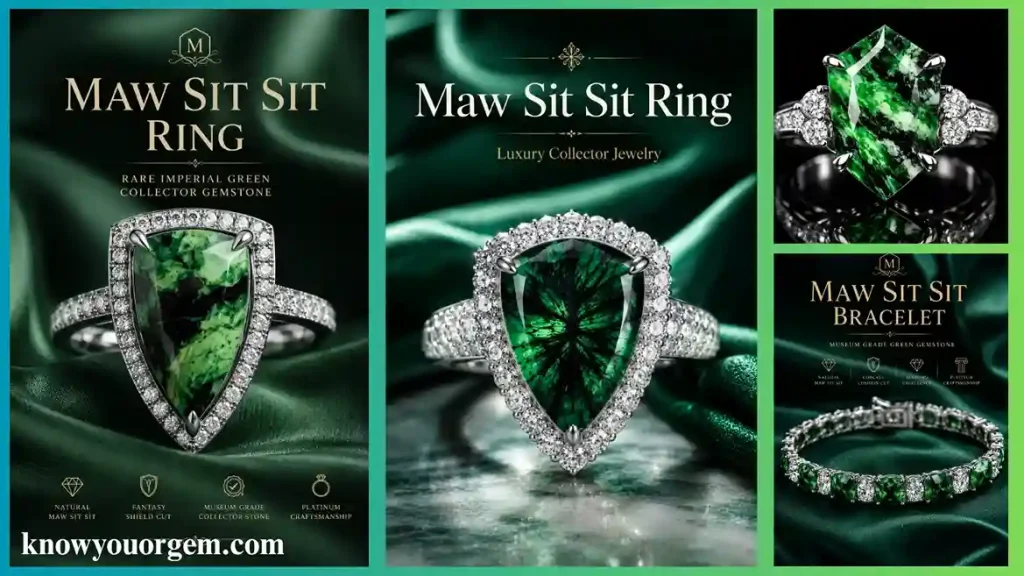
Maw Sit Sit ring is the most famous setting usually built around a single oval or cushion cabochon in bezel. Sterling silver emphasizes its cool green tone, whether yellow or rose gold warms deeper, darker veined stones more effectively than pale ones.
Designers often pair this stone with black onyx inlay or contrasting metal bands to echo its natural veining. Since, fine pieces can add diamonds or garnets for sparkle against its matte to vitreous, luster and men’s signet style rings are especially common.
Maw Sit Sit Pendants and Necklaces:
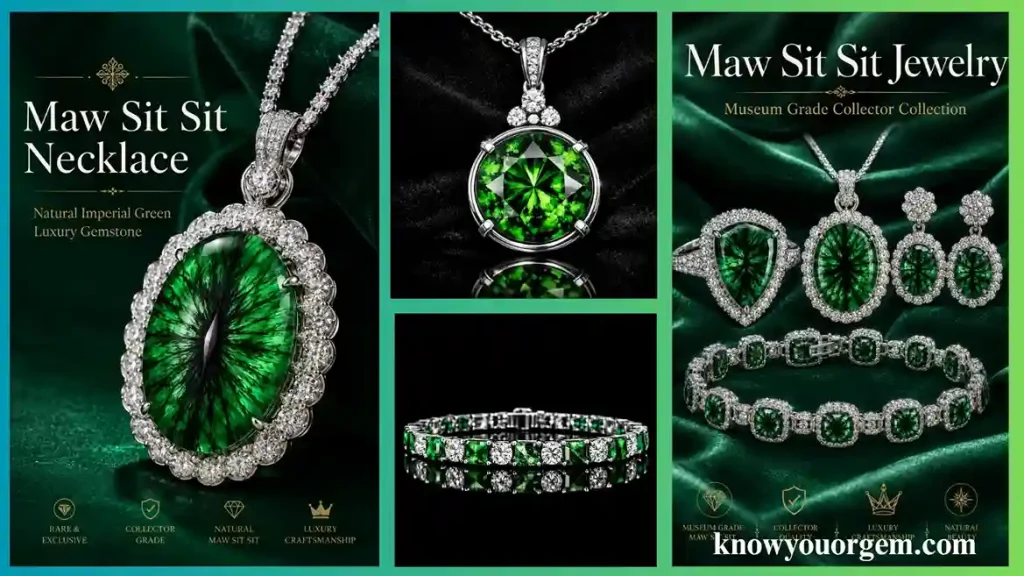
Pendants let cutters showcase larger cabochons or carvings without the wear and tear risks for rings. Most are simple wire wrapped or bezel set so the stone’s pattern stays the focus.
Beaded necklaces are the other main style. Check for even bead size and consistent color across the strand, not just one standout bead.
Maw Sit Sit Earrings and Bracelets:
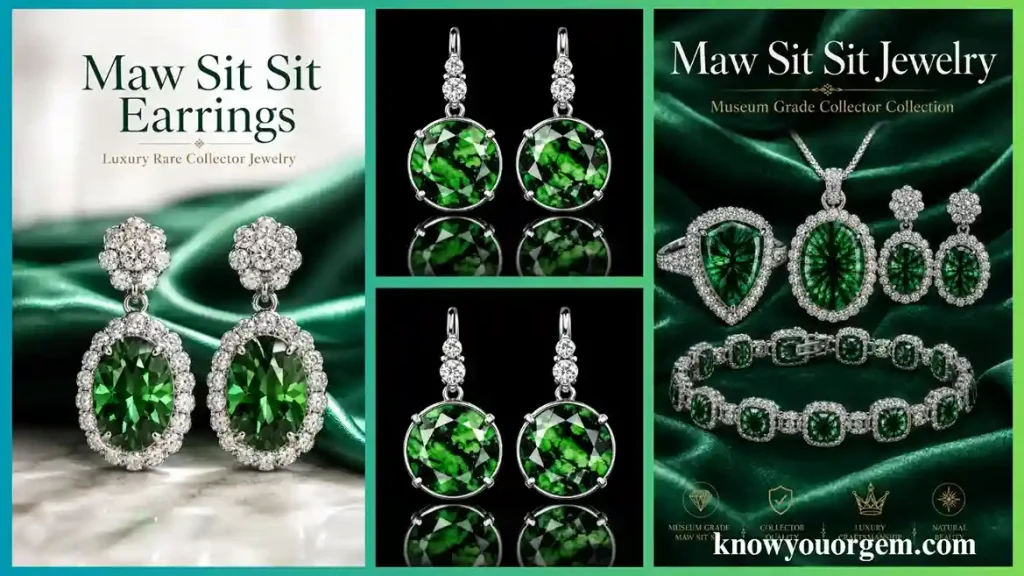
Earrings feature matched pairs of smaller cabochons, that cost more than single stone because matching color and pattern is tricky with Maw Sit . Stud and drop both are common, with drop showcase more of the stone’s swirling movement.
Bracelets are mostly bead strands in the 6-8 mm range, whether bangles sit at the high end commands much higher prices for the larger amount of material they need.
Maw Sit Sit Jewelry Price Guide:
| Jewelry Type | Typical Price In USD | What Drives the Price |
| Sterling silver pendant (single cabochon) can command | $50-$200 | And stone size, color saturation, setting complexity |
| Sterling silver ring (bezel-set cabochon) usually command | $80-$300 | And has stone quality, band design, metal weight |
| Beaded bracelet (strand) can command | $150-$350 | Its stone size matches bead, consistent, with clasp metal |
| Stud or drop earrings (matched pair) | $100-$350 | Its it very difficult to match two stones |
| Fine gold ring with accent stones (diamonds, onyx) | $1,500-$4,000plus | It has Gold content, accent stone quality, maker design |
| Carved bangle or large statement piece | $1,000-$5,000+ | It has rough material like curving skill, rarity of pattern |
Retail market only reflect to finished jewelry, not loose stones, and designer or vintage Burmese pieces that often exceed the high end. with no standardized prices body for Maw Sit, it is best to compare multiple reputable listings before treating any single as a benchmark.
How to Clean and Care for Maw Sit Sit:
Maw Sit needs a gentle care like warm water, mild soap, and a soft cloth are enough for cleaning. It is also better to avoid using ultrasonic steam cleaners, as vibration and heat can scratch its internal boundaries.
Store pieces separately from harder gems like sapphire, ruby and diamond for scratches resistant. Wrapping them individually is worth the effort for this rare stone.
Maw Sit Sit Meaning and Spiritual Beliefs:
Maw Sit Sit is often introduced in crystal healing as a gem of Joy, abundance, and emotional balance. Its vivid green color is sometimes associated to the heart chakra, but such associations come from belief traditions not from science.
Practitioners call it a grounding and full of positive energy, often recommending it for meditation. Still none of these claims are backed by research, and it can’t replace medical or psychological care, it works better as a personal or symbolic practice, much like birthstones.
Maw Sit Sit vs. Other Green Gemstones:
| Gemstone | Mohs Hardness | Transparency | Typical Price Point |
| Maw sit sit | 6-7 | A stone is translucent to opaque | And it has low to moderate price |
| Jadeite (fine/imperial) | 6.5-7 | A gem is translucent | And it has high to very high price |
| Nephrite jade | 6-6.5 | A gem is translucent to opaque | And it has low to moderate price |
| Emerald | 7.5-8 | A gemstone is Transparent | And this stone has high to very high price |
| Chrysoprase | 6.5-7 | Translucent | A stone has Low price |
| Green aventurine | 6.5-7 | A stone is Translucent to opaque | Has very low price |
Emerald and fine Jadeite are priced far higher than maw sit sit due to having transparency, demand, and mineral origin. Chrysoprase and aventurine are closer in value, but lack maw sit’s rarity and bold black veined look.
Conclusion:
Maw Sit Sit is a rare, chromium rich gem rock originated in northern Myanmar, composed mainly of kosmochlor, chromain jadeite, and albite rather than a single mineral species.
It is not actually jade, but a jade related metamorphic rock made up of several minerals. So, enthusiasts value it for its vivid chrome green color streaked with bold blak veins.
Frequently Asked Questions:
1. Is maw sit sit a real jade?
No, Maw sit is a jade relevant rock that contains jadeite as one of several minerals, but it is not classified as itself. True refers specifically to jadeite or nephrite.
2. Is maw sit sit rare?
Yes Maw Sit is a rare stone only found in Kachin State, Myanmar, with having new supply increasingly limited by mining and export restrictions.
3. Can maw sit sit be worn every day?
Maw Sit, is durable enough for daily wear jewelry, as it owns 6-7 Mohs which is usually considered durable but still requires protective settings like bezel that can safe the stone from scratching.
4. How much is maw sit sit worth per carat?
A stone can command prices from $2 to $8 per carat whether commercial grade stones are sold for up to $50 or more per carat fine, vividly colored specimens.
5. Does maw sit sit scratch easily?
It can be scratched by harder materials, including quartz based dust and grit, since its hardness of 6 to 7 falls below that of many common household surfaces. Store it away from harder gems and avoid wearing it during rough manual work.
6. What’s the difference between maw sit sit and chrome jade?
“Chrome jade” is a trade term sometimes used loosely for Maw Sit because of its high chromium content and vivid green color, but it is not a formal gemological classification and the correct mineralogical name is Maw sit.
7. Where can I buy genuine maw sit sit?
Always buy this stone from dealers who clearly label the stone as Maw Sit, not generic “jade,” and who provide lab reports or sourcing details for higher value.
Always confirm your gem with trusted labs like GIA, IGI, SSEF for authenticity, refractive index, specific grading and ethical sourcing.

Welcome to KnowYourGem.com! your ultimate destination for uncovering the fascinating world of gems and their secrets! I'm Kamil Hussain, a passionate blogger with a Master’s degree in Economics, dedicated to bringing you insightful, well researched content that blends the beauty of gemstones with the art of storytelling. With a keen analytical mind and a love for discovering hidden treasures, I created this platform to help you explore the brilliance, history, and value of every gem.

