

Quick Answer:
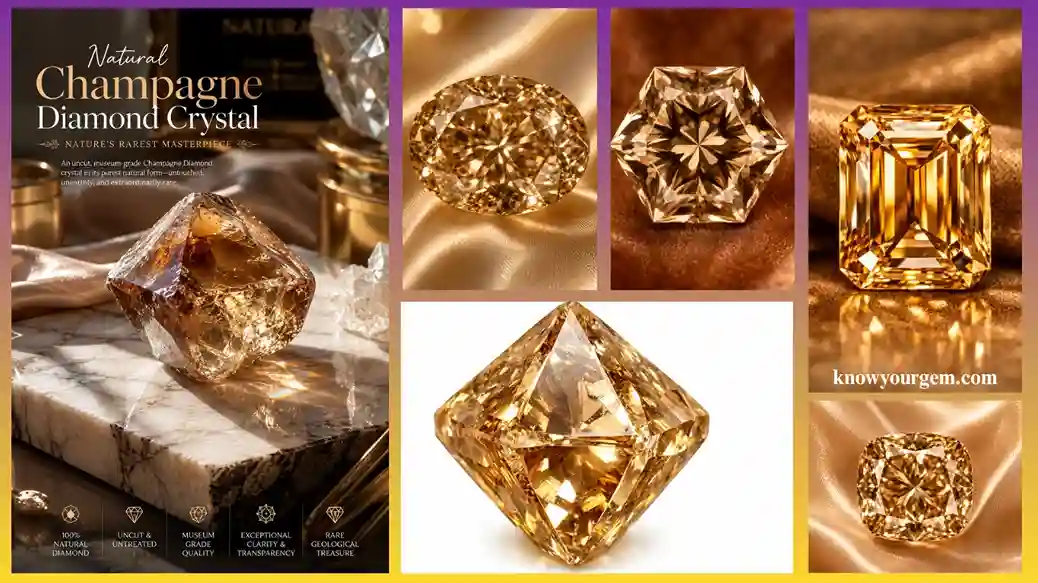
Champagne diamond refers to a natural precious brown gem that has a warm golden hue, made by trace nitrogen and structural distortions under intense heat and pressure.
Although it is a stone naturally mined, not created in labs or just a marketing term, and graded on the C1 to C9 scale instead of the usual D-to-Z colorless range. This stone is valuable, but distinct from white diamond.
On average, it is worth 30-60% cheaper per carat, which makes it suitable for engagement rings, anniversary jewelry, or anyone who wants size and warmth instead of the huge tag. Buyers who love to own a stone that contains attractive color, character, and value rather than resale speculation, this stone better suits their preferences.
This seldom-seen stone is generally sold for $800-$3,000 per carat; While, lighter stones can also command $4,000-$10,000 more per carat because of their rarity, as well as dark champagne or cognac stones with strong clarity and cut can command premium prices.
Expert takeaway: Choose a champagne diamond for its beauty, warmth, and relative value compared to a white diamond, which is not considered for short-term investment.
Complete Guide to Cognac Diamond.
Before You Buy a Champagne Diamond:
Is it a real diamond?
Yes, a champagne diamond is a real precious stone; It is also mined with the same hardness, durability, and refractive index. Everything is the same but color.
Why is it brown?
Is “champagne” just marketing?
Partly, the term was popularized in the 1980s by the Argyle mine to make brown diamonds more appealing. Labs like GIA simply grade them as fancy brown or yellow brown.
Are all brown diamonds champagne?
Not at all; champagne usually refers to lighter, golden brown stones. Since darker ones are marketed as cognac diamonds, while deep chocolate tones are branded as chocolate diamonds, it’s a retailer’s trademark rather than a gemological grade.
Should Enthusiast Buy Champagne Diamond?
Buy a champagne diamond if:
- Enthusiasts who want larger stones or better cut quality for their budget than a white diamond allows.
- If you are looking for warm, golden brown tones, rather than colorless brilliance
- If you want a distinctive engagement ring that stands apart from standard solitaires
- You value natural over resale liquidity.
Avoid a champagne diamond if:
- Your major goal is short-term resale value or investment-grade appreciation; you should avoid champagne
- You want maximum fire and sparkle in a completely colorless stone; you should avoid champagne.
- If your aim is to have a diamond that grades the D-Z scale, a champagne diamond doesn’t fulfill your requirements.
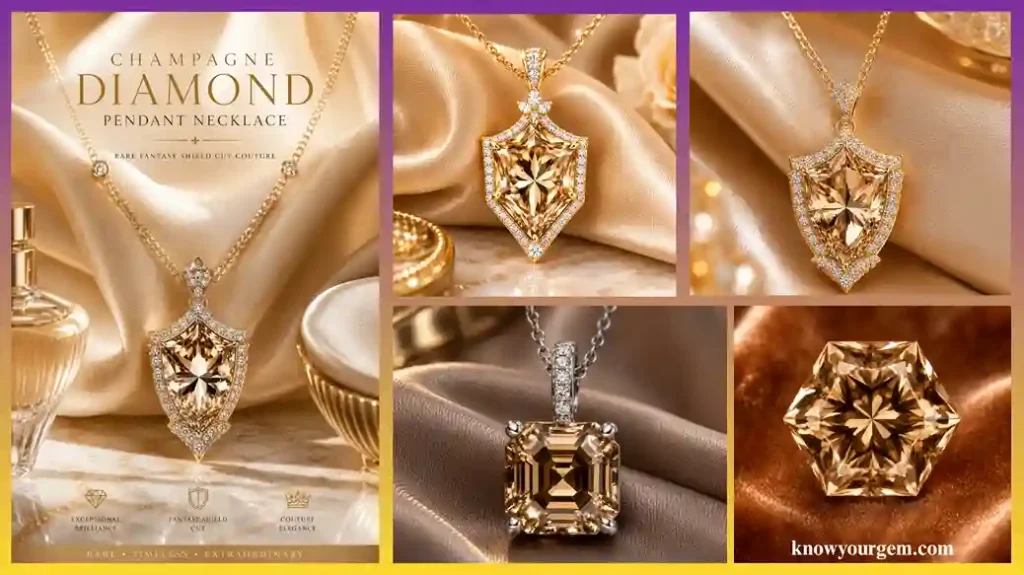
Best for engagement rings: This precious dark brown, most loving stone fits best for engagement rings. Such settings flatter warm color tones of this stone and are popular in vintage and bridal styles.
Best for investment: It is best if it is found in the rare and dark tiers like deep, saturated, Argyle-origin stones with strong cut and clarity hold and gain value more reliably than light or medium champagne diamonds, which are relatively abundant.
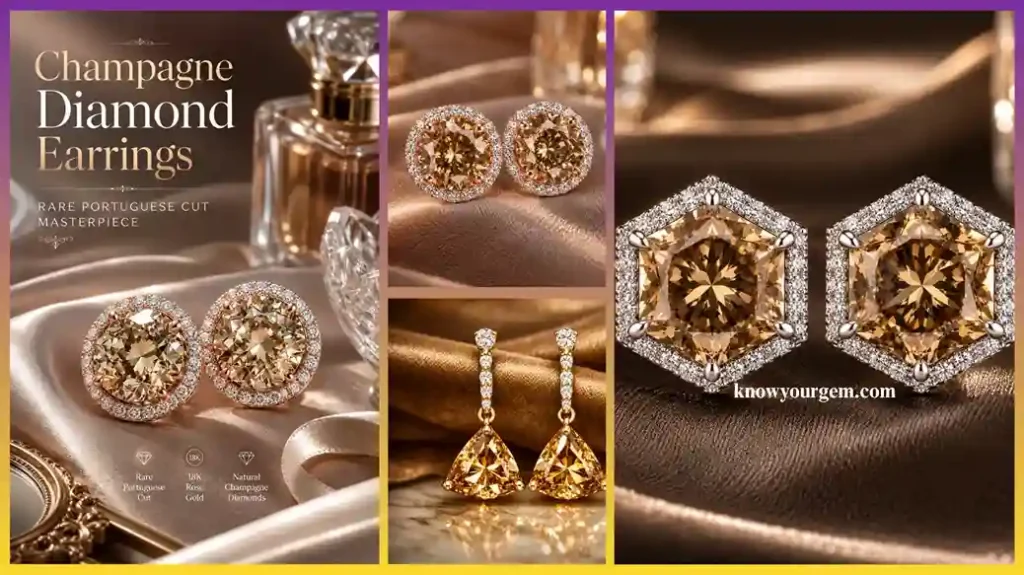
Best for daily jewelry: A stone is best for everyday jewelry like rings, to its 10 Mohs hardness like colorless diamond; that’s why it shows up frequently in tennis bracelets and stackable rings meant for everyday wear.
How Much Does a Champagne Diamond Cost?
This brown diamond’s price can increase with carat weight, color depth, cut quality, and certification. Below is the price by carat table you can explore:
Price by carat:
| Carat Weight | Price Range |
| 0.50 ct | $500 -$1,500 |
| 1.00 ct | $800 – $3,000 |
| 1.50 ct | $1,200 – $4,000 |
| 2.00 ct | $1,800 – $6,000 |
| 3.00 ct plus | $3,000 – $10,000 plus |
Price by color depth:
| Grade | Description | Relative Price |
| C1- C2 | Light champagne | Lowest |
| C3 – C4 | Medium light champagne | Low-mid |
| C5 – C6 | Medium champagne | Mid |
| C7 – C8 | Dark champagne | Mid-high |
| C9 | Cognac / darkest champagne | Highest |
Price by cut:
A well-executed cut usually maximizes brilliance; such as cushion, oval, radiant, and round cuts command premium prices compared to poorly proportioned cuts, sometimes by 15% to 25%, because strong cuts generally hide inclusions and intensify color evenness.
Price by certification:
A reputable lab GIA verified diamond primarily commands 10-20% more price as compared to uncertified or lab-graded stones.
2-carat examples:
A 2 carat light champagne diamond with having good cut and VS clarity generally commands $3.500-$6,000.
A, 2 carat saturated champagne or cognac diamond having excellent cut and strong clarity usually command $12,000-$20,000, that depends on origin and certification.
Value comparison:
1 carat colorless diamond with clarity can be sold for $4,500 to $6,500 per carat. Whereas 1 carat champagne brown diamond with similar cut and clarity is sold for $1,500-$3,000, roughly half the price for the same size and durability.
Why Some Champagne Diamonds Cost 10× More?
Most guides say “darker means pricier,” however the real story is more complex. A light champagne diamond commands $600, but a dark, well-saturated can hit $10,000 plus, and that spread comes from several factors:
- Argyle origin: When the Argyle mine closed in 2020, it produced provenance stones scarce and added a premium value for this stone.
- Saturation: Price jumps are not linear; moving from C6 to C8 can double per-carat value.
- Rare undertones: Pink or rose hues are rare and can command strong markups.
- Cut quality: A precise cut makes color look rich and even, directly affecting price.
- GIA grading: Fancy color grading is stricter, and a GIA origin report includes resale confidence.
- Market demand: Warm-toned engagement rings are trending, and rising market demand pulls buyers toward darker champagne stones.
Champagne Diamond Color Explained:
Rather than just listing shades, below is how each tier actually affects your purchasing decision.
Light Champagne:(C1–C2)
It looks nearly colorless in small sizes and under indoor lighting; a stone that is the most budget-friendly and versatile option. It is ideal for you if you want a diamond that reads “warm white” rather than distinctly brown.
Medium Champagne:(C3–C6)
This stone showcases a clear, honey-to-golden tone that is easy to identify at arm’s length, striking a balance between visible color and affordability that makes it the most popular tier for engagement rings.
Dark Champagne:(C7–C8)
It delivers a bold, rich brown gold color that reads as a statement stone rather than a diamond substitute; this tier pictures beautifully and holds value better than lighter grades.
Cognac:
It sits at the deep end of the champagne spectrum and is often used interchangeably with C9, and describes an intense reddish-brown reminiscent of the drink it is named after the rarest and most collector-driven tier.
Pink Champagne:
It refers to champagne-toned diamonds with a secondary pink or rose modifier, a genuinely rare integration that commands a significant premium over standard champagne stones of the same depth.
Which color hides inclusions?
Darker champagne diamonds (C6 and higher) naturally hide small inclusions. This means buyers can pick a slightly lower clarity grade without seeing flaws and save money without losing beauty.
Which sparkles most?
Light champagne shows off the most classic white diamond style brilliance, but less body color means less interference with light return; while darker stones trade some sparkle for richer, warmer color saturation.
Which resells better?
Dark champagne and cognac diamonds specifically with Argyle provenance and GIA certification hold resale value more reliably than light champagne stones, which are common enough that buyers have many alternatives.
Which Champagne Diamond Ring Should You Choose?
Below is the complete guide that showcases which champagne diamond ring should be worn:
Engagement Ring:
Cuts like cushion and in solitaire or halo setting are known as the most popular choice, because they balance vintage warmth with everyday wearability.
Wedding Band:
A row of small, matched light to medium champagne diamonds in a pavé or channel setting complements a colorless or champagne center stone without competing with it.
Anniversary Band:
Eternity bands with graduated champagne tones, light to dark across the band, create a subtle ombré effect that became a popular way to mark milestone years.
Halo Ring:
A halo design with a white diamond around a champagne center stone intensifies the perceived color contrast, which generally makes even a light brown diamond look more saturated.
Solitaire:
A solitaire simple prong setting displays the diamond’s color and cut front and center; that works best with medium-dark champagne stones.
Vintage Ring:
In vintage and Art Deco settings, champagne diamond pairs well because a stone carries the warm tone of the antique-inspired yellow-gold and rose gold jewelry aesthetic.
Cluster Ring:
Grouping small champagne diamonds can mimic the look of one big stone at much lower cost, like a smart budget-friendly trick that still gives plenty of sparkle.
Three Stone Ring:
A champagne center stone flanked by two white diamonds is a popular way to symbolize past, present, and future, whether keeping most of the ring’s cost in the more affordable champagne center.
Best Diamond Cut for Champagne Color:
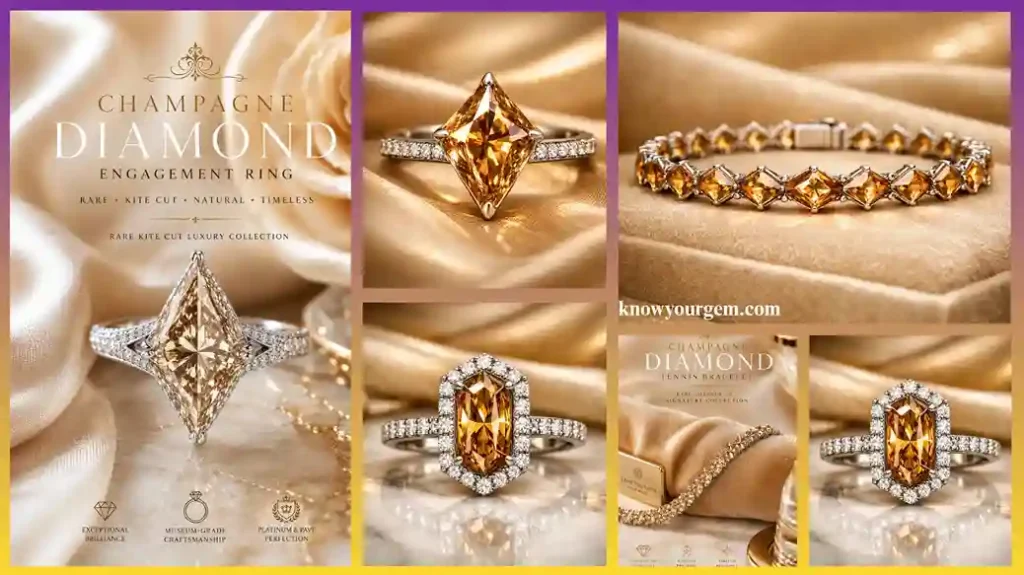
Cushion makes a gem’s corners and creates more open facets that pool and intensify color, which makes cushion one of the most flattering cuts for champagne diamonds.
Oval cuts make a diamond look bigger for its weight and spread the color nicely. So an oval champagne diamond should be a smart choice if you want more size and even color without spending extra.
Pear combines the oval’s elongating look with a tapered point, and also focuses color at the tip for a distinctive style.
Round showcases the most brilliance & sparkle of every cut, which makes lighter champagne diamonds ideal for maximum light return instead of deep color saturation.
Marquise stretches the stone’s face-up appearance beyond almost any other shape, which makes it a popular choice for buyers who want a light or medium champagne diamond to look larger than its carat weight suggests.
Radiant integrates the brilliance of a round cut with a rectangular outline, which generally offers strong color saturation and sparkle simultaneously, a favorite medium to dark champagne stones.
Princess showcases colorless evenly over cushion or radiant cuts due to having a pavilion structure that makes it a better fit for lighter champagne tones than for darker, more saturated stones.
Champagne Diamond vs Everything Else:
Champagne vs White Diamond:
White diamonds are graded D-Z because they lack color, while champagne brown diamonds are graded C1- C9 for visible color; champagne browns usually cost 30–60% less per carat than whites.
Champagne vs Yellow Diamond:
Yellow diamond gets its color from isolated nitrogen atoms. Vivid yellow is rarer and more widely recognized as a true fancy color diamond. It usually commands higher prices at the same saturation as compared to brown champagne tones.
Champagne vs Cognac Diamond:
Cognac diamond is basically the darkest end of the champagne spectrum; it is usually around C7-C9. The term “cognac” is not a strict gemological grade; it is more of a marketing label that signals deeper, reddish brown saturation as compared to higher champagnes.
Champagne vs Chocolate Diamond:
“Chocolate Diamond” is a trademarked branding name of this brown stone; a single retailer uses this name in a market to sell it; gemologically, it overlaps with darker champagne and cognac stones, but the difference is revealed through the color category, which is only recognized through trusted labs like GIA, IGI, IGS, and SSEF.
Champagne vs Lab Diamond:
A champagne brown diamond formed more than a billion years underground; a lab-grown champagne diamond is created in weeks while using HPHT or CVD technology. Synthetic versions cost significantly less but carry little to no resale value as compared to natural stones.
Champagne vs Moissanite:
Moissanite is a different mineral, except silicon carbide, with higher dispersion than diamond, meaning that a stone carries more rainbow flash and less characteristic than a white diamond. It is also far cheaper but not diamond at all, natural or lab-grown.
Champagne vs Salt & Pepper Diamond:
Salt and pepper diamonds get their appearance from visible black and white natural inclusions rather than body color, which gives them a speckled, galaxy-like look that is cosmetically and structurally different from champagne diamonds’ smooth, even color.
Natural or Lab Grown?
Here is a deep guide about which is better: natural vs. lab-grown diamond:
Which has higher resale?
Natural champagne diamonds primarily keep resale value more than lab-grown pieces, but they are genuinely rare, especially if we talk about Argyle stones.
Which looks better?
Visually, natural and lab-grown champagne diamonds are nearly indistinguishable to the naked eye and even under standard jeweler’s loupes; specialized lab equipment is generally required to tell them apart.
Which costs less?
Synthetic champagne typically costs 30%-50% less than natural stones for equivalent size, color, and clarity.
Which should you buy?
Choose natural if provenance, rarity, and long-term matters to you; choose lab-grown if you want the same look at a lower price and aren’t concerned with resale or investment potential.
Is Champagne Diamond Rare?
Yes, actually, because its supply is abundant worldwide as compared to other fancy colors. This brown diamond accounts for a significant share of all diamonds, but well-cut, well-saturated stones with strong clarity remain a small fraction in supply.
Demand for this stone has increased over the past decade as bridal fashion has moved toward warmer, then more distinctive stones, bringing more buyers into a market which was historically overlooked in favor of colorless diamonds.
Argyle closure in 2020 removed the single largest source of champagne and cognac diamonds from the market permanently, which is already tightening supply of dark, saturated, well-documented stones.
Future rarity is likely to increase for the darker, Argyle provenance tier specifically, whether lighter champagne brown diamonds are sourced from mines in Russia, Canada, and Africa that should be relatively accessible.
Investment outlook favors patience; rare, dark, certified stones with documented origin are positioned to appreciate gradually as post-Argyle supply tightens, but common champagnes are not expected to assume significant price movement.
Can Champagne Diamonds Increase in Value?
Price Trends:
- Argyle closure impact: Since the 2020 shutdown, documented Argyle origin champagne and cognac gems have seen steady appreciation. The rise is slower than pink or blue scarcity that is now locked.
- Market positioning: Champagne diamond remains more accessible than various vivid fancy colored stones, which makes it suitable for anybody who desires rarity without astronomical prices.
Demand Drivers:
- Warm-toned rings: Such traditional engagement rings are rapidly popular, with champagne hues and durability.
- Narrative value: Buyers who are looking for stones with provenance and personality find Argyle champagne diamonds are ideal choices for them.
Collector Appeal:
- Argyle provenance: Collectors specifically search for stones with Argyle documentation, while recognizing that supply is permanently finite.
- Mid-tier risk: It is different from fancy colors, champagne brown diamonds require careful selection to ensure appreciation potential.
Investment Considerations:
- Upside: They are rare, trendy, and cheaper than top fancy colors.
- Risks: Value increment for this stone is a bit gradual; that depends on quality and certification.
How to Tell If a Champagne Diamond Is Real:
- Visual checks: Lab grown and treated stones can look identical but they are not naturally formed minerals.
- Certification: Trusted labs like, GIA or IGI reports always confirm whether a stone is natural, untreated or synthetic.
- Fakes: They generally look like glass or cubic zirconia; you can easily spot with them with a diamond tester.
- Lab-grown: These are real diamonds, but must be revealed and labeled in certification.
- Scams: Common tricks, including sell treated brown diamonds without disclosure or using “Champagne” language to mask lower grades.
Expert Buying Checklist:
Before buying, confirm:
- Certification: GIA or IGI Trusted labs report always confirms the authenticity, grade, RI, and specific gravity of a stone.
- Cut: Proportions can maximize color evenness and brilliance for chosen shape.
- Color: Grade also matches what is described in the listing
- Fluorescence: It is written on the certificate, as strong fluorescence is more effective under UV light.
- Seller reputation: It is established with verifiable reviews and clear sourcing information
- Return policy: It is a reasonable window that (typically 14-30 days) to have the stone independently verified
- Warranty: It is coverage for setting damage, prong wear, and stone loss over time
Champagne Diamond Care:
- Cleaning: Clean this stone with water plus mild soap, a soft brush, and wash well.
- Storage: Keep it separate in a pouch or box for scratch resistance.
- Insurance: Get it appraised and add to a jewelry policy rider.
- Maintenance: Have prongs/settings checked yearly to resist stone loss.
Complete Specification Table:
| Property | Value |
| Refractive Index | A stone owns RI like, 2.417- 2.419 |
| Specific Gravity | Its specific gravity is 3.50 -3.53 |
| Mohs Hardness | A stone owns10 Mohs hardness |
| Crystal System | It crystalizes in Cubic crystal system |
| Chemical Formula | A stone owns chemical formula like C (carbon) |
| Dispersion | Its dispersion 0.044 |
| Cleavage | Perfect, in four directions |
| Luster | Adamantine |
| Density | Its density is 3.5-3.53 g/cm³ |
| Origin | It is found in Argyle, Russia, Canada, various African sources |
Frequently Asked Questions:
1. Is champagne diamond expensive?
This stone is usually 30-60% cheaper than white diamond with the same size. But rare dark stones from the Argyle mine can be as pricey as mid tier white diamond.
2. Is champagne diamond a real diamond?
Yes, it is a real diamond owns same hardness, same durability. But the only difference is its warm brown gold color.
3. Is it a brown diamond?
Yes it brown diamond but Champagne’ is just a trade name for lighter shades of brown diamond.
4. Is champagne diamond rare?
Yes, it is rare because it contains light and medium tones commonly. Dark, rich colors, especially Argyle origin, rarely produce this stone since the mine closed in 2020.
5. Why are champagne diamonds cheaper?
Brown diamond is more abundant, and historically people preferred colorless stones.
6. Can champagne diamonds be lab grown?
Yes, lab grown stones can be made in labs. Same chemistry, but lower resale value.
7. Do champagne diamonds sparkle?
Yes they sparkle like any diamond. Lighter tones that showcase more brilliance; darker ones emphasize color.
8. Which cut is best?
Cushion, oval, and radiant cuts usually highlight the warm tones beautifully.
9. Are they good for engagement rings?
Yes, its hardness makes it fully suitable for daily wear, and its warm tone has become a popular alternative to traditional colorless engagement ring stones.
10. Are they an investment?
They are moderately suitable for investment, and majorly in the rare, dark, certified, Argyle-origin tier; light and medium champagne diamonds are unlikely to see significant price appreciation.
11. How long do they last?
Indefinitely under normal wear, given diamond’s 10 Mohs hardness, there is no practical durability concern with everyday use.
12. Are they certified by GIA?
Yes, GIA certifies champagne while using its fancy color diamond grading system, because the certificate will use technical terms like “fancy brown” rather than the trade term “champagne.”
Quick Recap:
- Budget buyers: Real diamonds’ sparkle and durability at 30-60% less than a white diamond. A bigger cut stone for the same spend.
- Collectors: Dark, saturated, Argyle-provenance stones with GIA documents are the true rarity play, especially post-2020 mine closure.
- Luxury buyers: Cognac and deep champagne tones deliver warmth and individuality that colorless diamonds can’t match.
- First-time engagement ring buyers: More stone and more character for the same budget, with having no compromise on durability.
- Investment buyers: Treat this stone as a patient, moderate holding. Only the rare, certified, dark Argyle stones contain real long-term investment.
Enthusiasts should verify their stones with reputable sources like GIA, IGI, IGS, and SSEF for authenticity, grading, refractive index, and also for ethical sourcing. Gems Enthusiast KamilHussian

Welcome to KnowYourGem.com! your ultimate destination for uncovering the fascinating world of gems and their secrets! I'm Kamil Hussain, a passionate blogger with a Master’s degree in Economics, dedicated to bringing you insightful, well researched content that blends the beauty of gemstones with the art of storytelling. With a keen analytical mind and a love for discovering hidden treasures, I created this platform to help you explore the brilliance, history, and value of every gem.

