
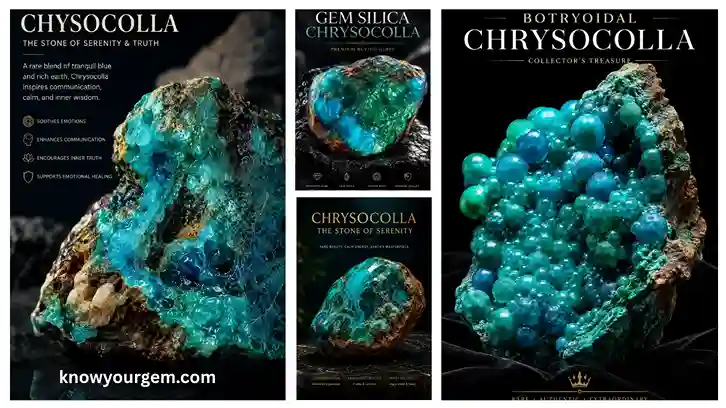

Chrysocolla is naturally a copper stone with having a soft blue-green glow, like clear seawater. It generally forms in copper’s oxidized zones, so its colors perform the same as echo weathered copper greens and blues. It is a different mineral as compared to diamond and sapphire by nature.
People value Chrysocolla gem for its vivid color display, as like a mixture of turquoise, teal, and sky blue. It is fact that two pieces of the same variety can’t be the same by look, as each piece has the ability to display its own look. Most pieces are opaque, sometimes semi-translucent, and the finest pieces showcase patterns that look hand-painted.
Quick Facts:
Chrysocolla stone’s character generally comes down to some initial perspectives: Such as what it is made of, how this stone forms, and the way it behaves as like a mineral is crucial to know. Those fundamentals cover up almost everything else for its rich blue-green color to the fact that it requires gentle care.
Mineral Classification:
Gemologists classify chrysocolla as a secondary mineral that generally forms when copper decomposes through weathering and oxidation.
Chemical Composition:
A hydrated copper silicate with providing a blue-green color that comes from copper. Shifts in aluminum and water content make each specimen slightly different.
Crystal System:
Chrysocolla doesn’t form neat and clean, visible crystals. Instead of usually appearing as masses, grape-like crusts, or thin coatings on other minerals. Because of this crystal system a stone’s shapes and habits rather than fitting it into a single crystal system.
Physical Properties at a Glance:
| Property | Value |
| Mohs | A stone contains 2.5–3.5 Mohs scale but its premium variety can show up to 7 |
| Color | It displays colors like Blue, blue-green, green, turquoise, occasionally white or brown-streaked |
| It s Luster is | Vitreous to dull, sometimes waxy |
| Transparency | Opaque to semi-translucent |
| Specific Gravity | 2.0–2.4 |
| Refractive Index | 1.50–1.68 (variable) |
| Fracture | Conchoidal to uneven |
| Cleavage | None |
Pure chrysocolla is fragile; that’s why it requires careful handling. When it is mixed into quartz, it can be cut and worn nearly as agate.
What Is Chrysocolla?
Chrysocolla stone makes a place between geology and gemology and a copper mineral born from chance reactions in the earth. It is beautiful enough for jewelry, and its unique formation makes every piece look like a little different.
Definition:
A copper silicate mineral that basically forms near to the surface of copper in different deposits. However, gemologists do not classify it as a true gem material due to its vivid colors that are different than normal stones and its ability to take a good polish, which makes this copper-valued ornamental gemstone.
How Chrysocolla Forms?
Chrysocolla stone starts growing when copper-rich water reacts with silica rock, that is mostly near to the surface of copper deposits. As the solution cools and evaporates, the stone leaves behind chrysocolla in cracks and crusts, which is a process that can take weeks or thousands of years.
Why Every Stone Is Unique?
Chrysocolla forms from flowing mineral solutions, so there can’t be two deposits the same. Shifts in copper, silica, and host rock create the swirling blue-green zones that make every polished piece unique.
History of Chrysocolla:
Chrysocolla’s name and use have been popular throughout history. People linked Chrysocolla stone to ancient trade, metalworking, and now it cuts are showing how people have valued it across time.
Ancient Civilizations:
Chrysocolla got its name from ancient Greek, which was linked to its role in early gold work. Various centuries ago, miners in copper-rich lands uncovered this stone, and often side by side with malachite and turquoise, weaving it into the story of old civilizations.
Historical Uses:
History showcases the picture that was used in metalwork, carved into beads, amulets, and ornaments in ancient Egypt and the Near East. Moreover, some of the old “turquoise” pieces could actually be chrysocolla by color and shape, not by nature.
Modern Popularity:
Chrysocolla stone stayed famous in the 20th century when artists were cutting it into cabochons. But in the current market, it is common in Southwestern jewelry, and it is loved due to having a turquoise-like look at a lower price.
Origin and Mining Locations:
Chrysocolla stone forms where copper deposits are usually exposed to weathering. Since most commercial sources come from dry, copper-rich mining regions that are around the world.
Major Producing Countries:
Chrysocolla is mainly found in Arizona, where qualitative gems are mined and supplied, including the valued gem silica. Other notable producers including Peru, Chile, the Democratic Republic of the Congo, Mexico, Russia, and Israel.
Important Deposits:
Arizona’s copper belt is near to Morenci, and the historic Inspiration Mine has yielded some of the finest gem silica. Other popular ethical sources include Peru’s Ansean copper districts and Israel’s Timma Valley, home of the Eilat Stone.
How Chrysocolla Is Mined?
Chrysocolla is generally taken as a byproduct of copper mining, which is found in the oxidized layer which is above the main sulfide ore. Because of this, gem-grade material hinges on the economics of copper mines, not dedicated gemstone mining.
Physical and Optical Properties:
Chrysocolla stone’s look and feel come from its optical and physical traits. These physical and optical traits are believed to set limitations for buyers that are essential to know.
Color:
Color is the most impactful factor in every gem that quickly reveals the sparkle of the stone. Colors like sky blue, turquoise, teal, or apple green are genuinely related to this stone.
Luster and Transparency:
Most chrysocolla stones are found in dull to glassy and opaque; however, gem silica can be nearly translucent with a bright shine.
Specific Gravity:
It contains specific gravity of 2.0-2.4, which makes it lighter than quartz or turquoise, a quick gemologist clue.
Refractive Index:
Chrysocolla stone has a refractive index of 1.50–1.68, whereas gem silica measures closer to quartz.
Crystal Habit:
It rarely forms in crystals, which shows as like crusts, stalactites, veins, or massive fillings.
Types and Varieties:
Whenever chrysocolla stone mixes with quartz, then copper minerals form different varieties with different strength and value.
Chrysocolla in Quartz:
Quartz usually attaches strength, but chrysocolla stone adds vivid color, indicating this mixture is highly valued in jewelry.
Chrysocolla Chalcedony:
The crystal habit gives chrysocolla a smooth blue-green and waxy shininess, which makes it more durable for beads and cabochons.
Azurite Chrysocolla
Its deep blue color with chrysocolla’s teal usually creates more striking banded or mottled patterns.
Fibrous Chrysocolla:
These are thin, hair-like crystals that can form velvety crusts while providing a soft, plush look to a stone.
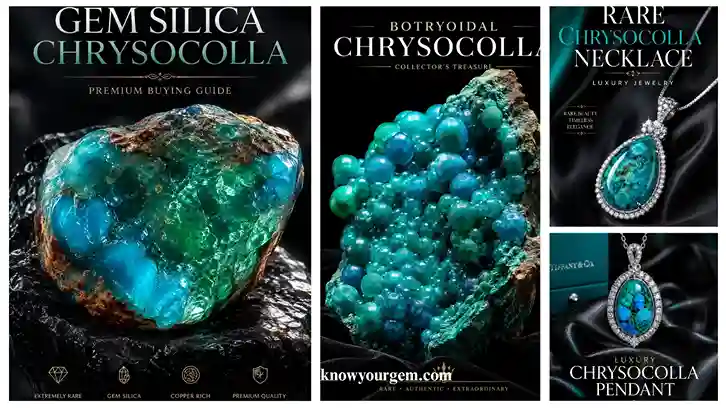
Gem Silica:
This is the rarest chrysocolla because of having vivid blue-green-glassy, and its prices can touch emerald or tanzanite.
Colors of Chrysocolla:
Buyers always focus on color, which almost look like turquoise.
Blue:
Pure saturated blue color is rare, but copper-rich is highly valued, especially in gem silica.
Blue- Green:
The classic teal or robin’s-egg-like shade is widely available, and it is usually considered as it signature color.
Green:
Iron or aluminum shift chrysocolla toward green, but is less valued and popular in earthy jewelry.
White and Mixed Colors:
Some chrysocolla showcases white, cream, or brown coloration from quartz, chalcedony, or iron stains. They mostly look stunning, but stones with having uniform blue-green colors are usually more valued.
What Causes the Color?:
Chrysocolla’s blue-green color is caused by copper but shifts in copper, water, or other minerals can change the shade naturally.
How to Identify Genuine Chrysocolla?
Chrysocolla stone is perfectly shares colors with other stones, so recognizing the key signs can help to avoid fakes like dyed howlite.
Visual Characteristics:
Realistic chrysocolla showcases soft, cloud-like color and waxy to glassy luster, while fakes are flat or overly even.
Common Inclusions:
Natural chrysocolla stone contains Quartz veins, malachite streaks, or azurite patches, which are considered as the natural companions and signs of authenticity.
Simple Identification Methods:
A steel pin can scratch pure chrysocolla but not quartz-rich varieties; genuine stones also feel lighter than imitations.
Professional Testing:
Gemologists generally confirm chrysocolla stone’s authenticity with its refractive index and specific gravity testing on a refractometer and copper spectroscopy, vital for gem silica.
Quality and Grading:
There is no formal system existing, but dealers commonly judge stones by consistent visual and structural traits.
Color Quality:
High-quality stones showcase vivid blue or blue-green with even color and few brown or gray tones.
Pattern and Texture:
Balanced swirls, bands, or cloud-like patterns usually add depth and are more valued than chaotic looks.
Transparency:
A gem’s transparency, like silica is rare; however, opaque transparency is commonly found in nearly every gem.
Stability:
If the stone is thick, it can generally be considered as strong, meaning it is scratch-resistant. But here we discuss about chrysocolla stone, which can easily chip and absorb oil more easily due to its thin stability.
Overall Grade:
Dealers sort this stone into commercial, fine, and gem silica tiers, with gem silica at the top.
Price and Value:
Chrysocolla stone usually commands a different pricing structure, like from a few dollars for tumbled stones to hundreds per carat for top-quality silica.
What Determines Value?
Chrysocolla stone’s value basically comes from its rich colors and its transparency; quality patterns matter more. Although silica is the premium choice, as it contains quartz’s hardness and clarity with chrysocolla’s vivid color.
Price Per Carat:
Commercial-grade chrysocolla stones generally command prices under $1 per carat; however, fine cabochons are sold for $ 2- $ 15, and top gem silica can be sold for $100-$300 plus per carat.
| Chrysocolla Type | Typical Price Per Carat |
| Commercial-grade massive chrysocolla stones are sold for | Under $1-$2 |
| Fine cabochons can be sold for | $2-$15 |
| Chrysocolla-in-quartz with mid-quality can command | $10-$40 |
| Gem silica with having fine translucent can be sold for | $100–$300+ |
| Rare/exceptional gem silica can command prices like | $300–$500+ |
Jewelry Pricing:
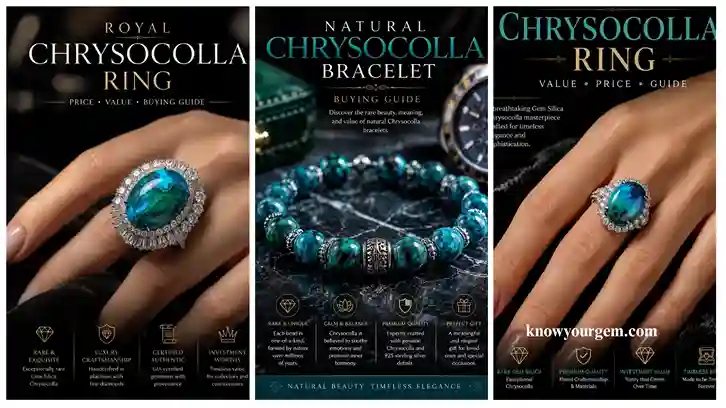
Silver rings and pendants of chrysocolla stone can command prices like $ 30- $ 150, but gem silica in gold metal can be sold for thousands of dollars per carat.
| Jewelry Type | Typical Price Range |
| Silver chrysocolla beads/ bracelets can be sold for | $15–$60 |
| Silver chrysocolla pandent or earrings command | $25–$100 |
| Silver chrysocolla ring with gem silica or quartz can command | $40–$150 |
| Gold-set gem silica ring or pendant | $500–$3,000+ |
Collector Value:
Collectors generally value fine azurite-chrysocolla combos or colorful botryoidal crusts that can be highly valued, especially if they originate from Arizona.
Chrysocolla Jewelry:
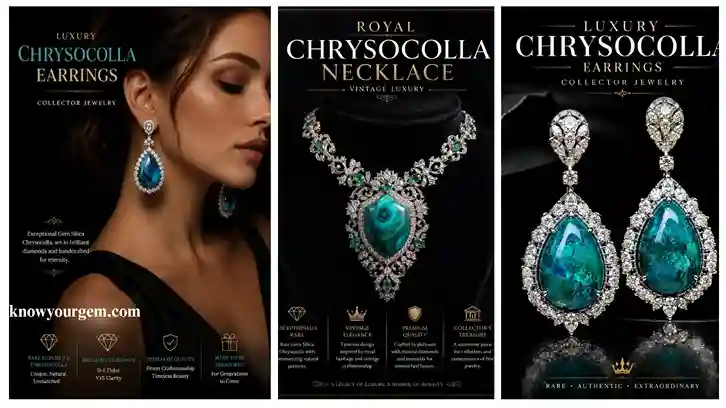
The color of Chrysocolla stone generally suits every jewelry, but hardness differences can require jewelry with protective settings.
Rings:
Chrysocolla stone rings can work with quartz or gem silica, which often contains protective settings like bezel or prong.
Necklaces:
Pendants generally enable the use of softer chrysocolla stone with having larger cabochons that could showcase natural patterns.
Earrings:
Earrings generally use light cabochons and softer chrysocolla that is fine, but they face little wear.
Beads:
Chrysocolla stone beads are popular in fine and casual designs; however, they showcase different durability, so buyers should ask whether they are natural or stabilized.
Pendants and Cabochons:
Loose cabochons let buyers select patterns, with freeform cuts while highlighting zoning.
Buying Guide:
Confident buying means recognizing what to ask and spotting red flags.
What to Look For?
When you are about to buy this stone, you will need to look for factors like color, saturation, minimal cracks, and the right variety.
Questions to Ask Before Buying:
Before buying this stone, you should ask sellers if the stone is natural and stabilized, as well as where this variety comes from.
Common Mistakes to Avoid:
Do not purchase chrysocolla for rings or pay gem silica prices for ordinary material.
Choosing the Right Piece:
You should match the variety to use quartz or gem silica for rings, chalcedony for beads, and massive for pendants.
Treatments and Enhancements:
Various chrysocolla stones are heat treated to enhance durability, so recognizing if it has been done can be more helpful to make the right decision.
Stabilization:
Increments fill pores to make soft chrysocolla stronger, which is common and accepted practice.
Resin Impregnation:
Increased seals porous chrysocolla to stop oil or moisture absorption, and sellers should disclose it.
Dyeing and Composites:
Some stones are dyed or reconstituted with increasing frequency, which must be clearly revealed.
Effect on Value:
Stabilized stones usually hold value; dyed or composite stones are usually considered as worth less.
Certification and Authenticity:
Certification is rare among these stones, but it is essential for high-quality chrysocolla, especially for gem silica.
- When Certification Matters: Reports are so worthwhile for gem silica or costly specimens, since they are less needed for everyday cabochons or beads.
- Information Included in a Report: Reports can confirm identity, note that listings like quartz or chalcedony mixture, revealed treatments, and give weight, size, and color is reliable.
- Trusted Gemological Laboratories: You can verify this gem with most trusted labs like GIA, IGI, because they can reveal the authenticity of the gem.
Care and Maintenance:
Chrysocolla stone is a softer which needs careful daily maintenance.
- Cleaning: Wash this stone with lukewarm mild soap water, remove dust with a toothbrush, and pat dry it with a soft cloth.
- Storage: Store Chrysocolla stone away from harder gemstones; a wrapped or lined box is recommended.
- Daily Wear: Daily wear rings require quartz or gem silica; and don’t forget to remove these rings before engaging in any heavy activities.
- Water & Heat: Keep this stone away from prolonged soaking or sudden temperature changes, as they can dull the stone.
- Tumbling: It requires very gentle cycles, fine grit, and can pit instead of polish.
Uses of Chrysocolla:
Chrysocolla stone can be used in many jewelry, decoration, collecting, and carving.
Jewelry:
Chrysocolla stone’s color generally shines in silver beads and gem silica rings.
Decorative:
Larger specimens can become bookends, spheres, bowls, or sculptures, which show off natural patterns.
Mineral Collecting:
Collectors generally value fine crusts and azurite-chrysocolla combos that are tied to locality and habit.
Lapidary and Carving:
Both stones, quartz and chalceony, are carved into cabochons, figurines, and inlay work.
Healing and Spiritual Beliefs:
These ideas generally come from tradition and modern spiritual practice; they can’t compete with science.
Traditional Benefits:
Chrysocolla stone is linked to calm communication, balance, and strength in cultural belief systems.
Energy Associations:
It is said to own soothing, feminine energy that is tied to emotional release.
Chakra Associations:
A stone is generally connected to the throat chakra for communication and sometimes the heart chakra for openness.
Meditation Practices:
Some use chrysocolla in meditation for calm focus, though this is spiritual belief, not science.
Considerations and Limitations:
Spiritual usage of this stone should complement, shouldn’t replace, medical care; softness limitations heavy handling.
Advantages and Limitations:
Chrysocolla stone generally offers a unique and affordable beauty, but softness and porosity can be harmful for the holder.
Advantages:
It has striking one-of-a-kind color, and quartz-rich varieties give it good wearability at accessible prices.
Limitations:
Pure chrysocolla stone can get scratches and chips easily, and imitations can mislead buyers mostly.
Who Should Choose Chrysocolla?
It is best for people who love painterly blue-green tones and also want to match the variety to its use.
Short Summary:
The value of chrysocolla stone occurs in its colors and patterns; its value doesn’t relate to its sparkle and Mohs. Prices of this stone can range from very low to higher, since it is affordable for everyone in normal condition, displaying a blue-green color. However, high-quality specimens like gem silica and chrysocolla quartz can be worthy due to having high hardness and rarity.
FAQs:
1. Is Eilat Stone the same as Chrysocolla?
Nor and neither; Eilat can be chrysocolla stone, but it contains a combo where chrysocolla also sits.
2. What is Chrysocolla?
It is a copper-rich secondary silicate mineral that displays most striking bluish-greenish colors.
3. Is Chrysocolla rare?
Chrysocolla stone is completely common, but gem-quality and gem silica are rare.
4. Is Chrysocolla valuable?
Its top quality is valuable due to having higher hardness and rarity.
5. What color is Chrysocolla?
Chrysocolla stone usually showcases colors from blue and teal to green, but sometimes it showcases white or brown.
6. What is Chrysocolla good for?
It is good for occasional wear jewelry, carving styles, and has also earned its popularity in spiritual healing.
7. Where is Chrysocolla from?
Its is mainly found in ethical sources like, Arizona, Peru, Chile, Congo, Mexico, Russia, and Israel.
8. What kind of stone is Chrysocolla?
It is considered as a secondary copper silicate mineral in gemological point of view.
9. What does Chrysocolla look like?
It displays blue-green color patterns, and its gem silica variety usually contains transparency like opaque to glassy.
10. Is Eilat Stone Chrysocolla?
No, both stones are not the same, but they partially relate to each other.
11. What stones pair with Chrysocolla?
Chrysocolla stone’s good pairs are Turquoise, malachite, azurite, and sterling silver.
12. What is fibrous Chrysocolla?
It means that the stone forms as thin fibrous aggregates that are often velvety crusts.
13. What are some interesting facts about Chrysocolla?
The name Chrysocolla means ‘gold glue” in Greek, and its high-quality pieces can command higher prices that can touch emerald.
Always verify your Gem with trusted labs like GIA, IGI, IGS, and SSEF for its authenticity.
Gem Enthusiats KamilHussian!

Welcome to KnowYourGem.com! your ultimate destination for uncovering the fascinating world of gems and their secrets! I'm Kamil Hussain, a passionate blogger with a Master’s degree in Economics, dedicated to bringing you insightful, well researched content that blends the beauty of gemstones with the art of storytelling. With a keen analytical mind and a love for discovering hidden treasures, I created this platform to help you explore the brilliance, history, and value of every gem.

