
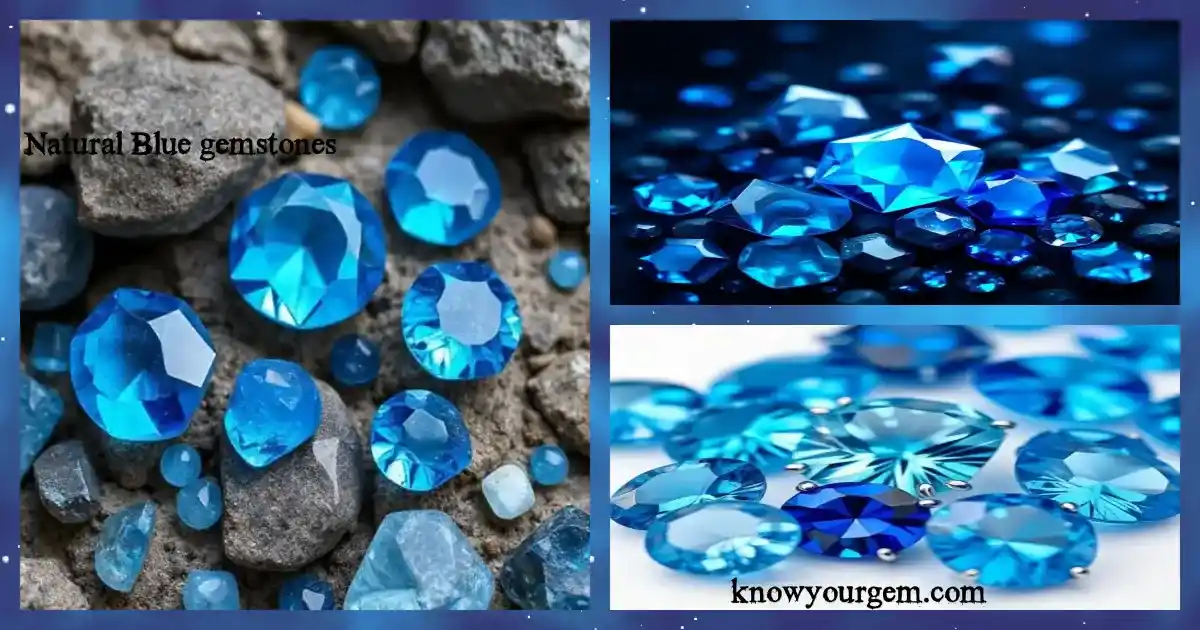

A blue gemstone is a mineral that is or can be naturally or artificially blue in color. Blue gemstones of high value include natural blue sapphire, aquamarine, tanzanite, topaz, turquoise, and lapis lazuli.
This buying guide explains what is responsible for blue color in these gems, how the most popular blue gems acquire their color, what makes them valuable and how to identify natural blue gems.
Quick Answer:
Blue Sapphire is the bes-known blue gem. Other well-known blue stones are aquamarine, blue topaz, tanzanite, and iolite. The more rare blue stones are natural blue diamond, Paraiba tourmaline, and benitoite.
Price is based on the stone, carat, color, size, clarity, treatment, and where it is from. Be sure to get a lab report if you buy an expensive stone.
| Blue sapphire | Cornflower to royal blue | 9 | Often heat-treated |
| Blue diamond | Steel to vivid blue | 10 | Color comes from boron |
| Aquamarine | Sky to medium blue | 7.5 to 8 | Often heated to remove green |
| Blue topaz | Sky, Swiss and London blue | 8 | Almost always treated |
| Tanzanite | Violet-blue | 6 to 7 | Only known source is Tanzania |
| Iolite | Violet-blue | 7 to 7.5 | Strong color change by direction |
| Turquoise | Sky to blue-green | 5 to 6 | Porous and often stabilized |
| Lapis lazuli | Deep blue stone with attractive gold pyrite inclusions. | 5–6 Mohs hardness. | A type of rock made up of calcite and pyrite. |
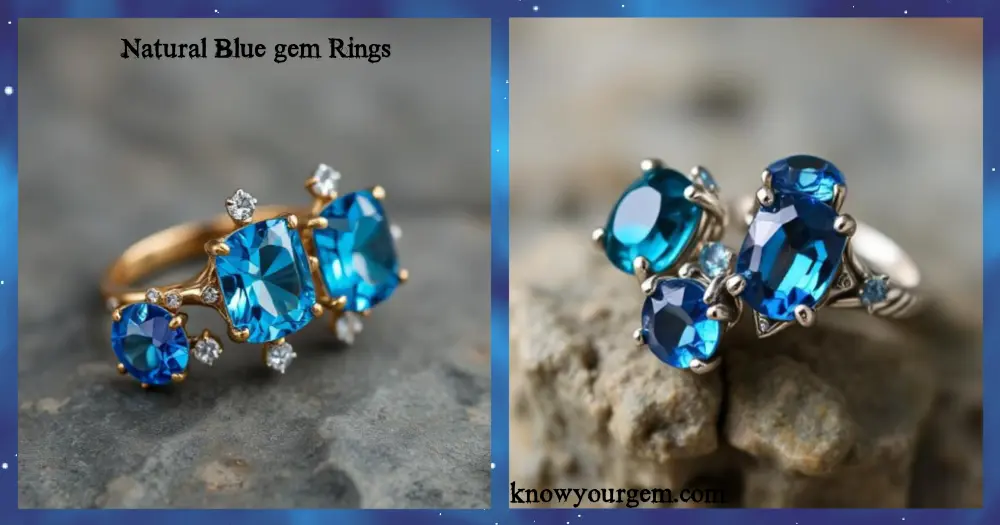
What Makes a Gemstone Blue?
The majority of blue stone get its blue colour due to traces of other elements. These elements absorb some of the light’s colours and reflect back the blue colour you see.
Different stones use different elements:
- Sapphire: It is produced by iron and titanium
- Turquoise: It is made by copper
- Blue diamond: It is produced by boron
- Paraíba tourmaline: It is made by copper
Some blues aren’t created by chemistry. This adularescence, or blue sheen of moonstone, is a reflection effect that occurs because of the layers in the feldspar. The sheen shifts as you move the stone.
Types of Blue Gemstones:
Blue Sapphire:
What kind of blue sapphire is the best? Blue sapphire is a variety of corundum. It ranks 9 on the Mohs scale of mineral hardness and is one of the hardest natural gemstones after diamonds.
Colour ranges from very pale to medium dark, to a bright, deep, intense blue with a hint of violet. The most valuable colour is medium-dark, dark blue with a fair violet hue. The most famous deposits are from Kashmir, Myanmar (Burma) and Sri Lanka.
Most commercial sapphires are heated for color. This is standard for commercial industry. A substantial premium can be paid for unheated stones with lab report.
Blue Diamond:
Blue diamonds without enhancements are very rare. Their blue color is caused by the boron found within the crystal structure. A large number of blue diamonds have been mined from the Cullinan mine in South Africa.
Blue diamonds also can be cultivated in a laboratory. Same chemistry, lower price. And the Blue Moon of Josephine fetched about $4 million a carat when it was sold in 2015. Don’t use that as an example for the average jewelry.
Tanzanite:
Tanzanite is a blue or purple and blue gem which is only found in the area of Mount Kilimanjaro in Tanzania. It exhibits strong pleochroism.
Hardness 6 to 7, softer than sapphire. Requires a protective setting. In 2002, tanzanite was added to the list of December birthstones, a change that hadn’t occurred in nearly 50 years.
Aquamarine:
Aquamarine is the blue to blue-green variety of beryl. Its name means “sea water.” The best stones are a pure blue without green.
It rates 7.5 to 8 and suits everyday wear. Many stones are heated to remove green tones. Brazil is a major source.
Blue Topaz:
Natural topaz is generally found as colorless or in pale condition. Almost all blue topaz is treated with irradiation and heat to create its color.
The stone rates at 8 on the Mohs scale and is widely available in cheap price. Swiss blue is bright and light. London blue is darker.
Turquoise:
What Is The mineral turquoise? A hydrated copper aluminum phosphate with a waxy luster. The color varies from sky blue to greenish blue. Good stones are an even robin’s-egg blue with few brown veins.
Soft (5 to 6) and porous. Several stones are stabilized and/or impregnated, inquire to the seller.
Lapis Lazuli:
Lapis lazuli is a stone. It gets its blue colour from the mineral lazurite, and contains white calcite and gold pyrite. These look like stars.
Hardness 5 – 6 – preferable to rings for daily wear, but makes an excellent pendant or earrings. Lapis has been the source of the traditional blue powder ultramarine for centuries.
Moonstone:
Moonstone glows a bluish hue that appears to float over nearly colorless background. The finest stones have a strong blue sheen. It has a hardness of 6 – 6.5 and is sometimes fragile.
Iolite:
You can view Iolite as transparent blue in one direction and yellow or colorless in the other. It is sometimes called water sapphire. It rates 7 to 7.5 and costs far less than sapphire.
Blue Kyanite and Blue Zircon:
Kyanite crystals are long and blade shaped. Its hardness will vary from about 4.5 to 5 along the crystal to 6.5 to 7 across the crystal, making it a challenge to cut and wear.
Blue zircon is very brilliant. Typically its color is created using heat. Use a protective setting to prevent chipping.
Rare Blue Gemstones:
You won’t find these stones on the local jeweler.
- Paraiba tourmaline: Glows with an electric blue to blue-green. Copper causes the color. It comes from Brazil, Nigeria, and Mozambique. Fine stones are among the most expensive tourmalines.
- Benitoite: California’s state gem, located mostly in San Benito County. This is a bright blue with very high fire. It fluoresces a vivid blue under short-wave UV light. There are very few faceted stones over one carat.
- Blue grandidierite: A blue-green gem from Madagascar. It is strongly pleochroic. Clean transparent stones are very hard to find.
- Jeremejevite and hauyne: Both are collector minerals. Jeremejevite is usually pale blue or colorless. Hauyne is a deep blue mineral from volcanic rocks, such as Germany’s Eifel region. Gem-quality material is rare.
Blue spinel. This cobalt-blue spinel is a very elegant, delicate gemstone with a wonderful brilliance. Flawless to the naked eye! It would be excellent to combine with any collection.
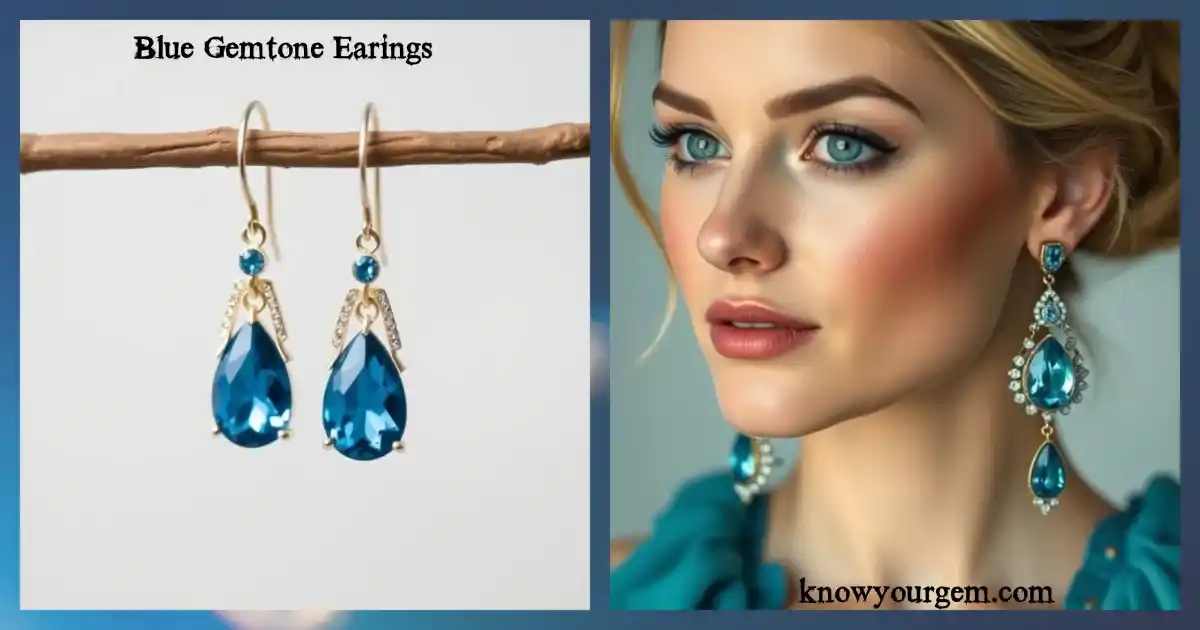
Blue Gemstone Colors:
Many Shades of blue has a whole bunch of shades. Express what you want when you use clear color words.
- Light and pale blue: Soft aquamarine, light topaz and moonstone
- Sky blue: A pure medium blue, as in Swiss blue topaz
- Royal blue: The rich, saturated sapphire look
- Navy blue: Extremely dark, as seen in London blue topaz and darker sapphires
- Blue-green: Paraíba tourmaline, grandidierite, turquoise.
Typically this causes the stones to look a little brighter than pure blues. Green-blue stones also tend to look a little brighter.
What Decides the Value of a Blue Gemstone?
The price of blue gemstones can be rock bottom to some of the most costly substances on our planet. Here are 5 things that influence price.
Color:
Color is the single most important. For the best stone, it is an intense, clean, well saturated blue, which has no gray or brown shades. Too pale and too dark will both detract.
Clarity:
Clarity is more important in some stones. Fine inclusions depress sapphire and aquamarine values. Opaque stones, such as turquoise and lapis, are assessed by their color consistency and pattern.
Carat Weight:
Price per carat increases significantly with size. A clean 3 carat sapphire is way more than three times the price of a 1 carat stone of the same quality as a result of the availability of large clean stones.
Treatment:
Unheated, untreated stones tend to command a higher premium. A sapphire that is untreated is more valuable than one that has been heated but appears identical. Even simply stating in the report ‘no heat’ can give the value of a stone a boost.
Origin:
Some sources include a premium. Kashmir sapphire and Paraíba tourmaline are examples. The premium is only valid if accompanied by an origin report from a recognized lab.
I don’t provide a price-per-carat table. Prices change quickly and from seller to seller. Request written estimates specifying the precise stone and report.
Affordable Blue Gemstones:
For lower budgets, blue topaz, iolite, commercial aquamarine and blue chalcedony offer a lot of color for the money. Blue topaz is the easiest to find.
Best Blue Gemstones for Jewelry:
Hardness and toughness can generally decide where each stone works best.
| Engagement rings | Sapphire, aquamarine | Hard and durable |
| Protection Rings | Tanzanite, moonstone | Soft so use a bezel or halo |
| Necklaces and Earrings | Turquoise, lapis, moonstone, tanzanite, iolite | Slightly less impact from these. |
| Beads | Blue topaz, aquamarine, lapis, turquoise, blue agate | Even the lower grades are acceptable |
| Collection items | Paraiba tourmaline, benitoite, grandidierite | Unique and rare |
Sapphire is tough enough to wear every day – the most renowned example being Princess Diana’s engagement ring, which set the style for Catherine, Princess of Wales to wear today.
By type of stone Soft stones should be set with bezel settings that fit around and protect the stone’s edges. Harder stones can be set with prong settings.
How to Identify Real Blue Gemstones?
No single home test proves identity. Use several clues together.
Look Under Magnification:
Inclusions in the stone include crystals or healed fractures which are typical of natural stones. Synthetic stones may be too clean-looking or have curved lines of growth. Glass may have round bubbles.
Check for Pleochroism:
Some stones show different colors from different directions. Aquamarine shows blue and near-colorless. A dichroscope reveals this quickly. Glass shows none.
Watch for Lightness and Weight?
Different minerals have different typical weight/density for their size. A piece of stone that appears lighter than expected for its size to you by comparison might be some type of cheap plastic or glass. The specific gravity of a sapphire is about 4.0.
Avoid Scratch Tests:
Don’t scratch the stones to check their hardness. You can inflict damage on the stones and get a false read. Hardness matters, but test it only on a lab’s instruments.
Do Not Trust Temperature or UV Alone:
Real stones may feel cool to the touch, but so do glass. Fluorescence can vary from stone to stone also. Both should be weak clues.
Beware of Blue Goldstone:
Blue goldstone is glass created by man, with crystals of copper in it. It looks very sparkly and deep blue. It is not a natural gemstone, and some sellers fail to say so.
Dyed or Mislabeled Stones:
Blue tiger’s eye or hawk’s eye is a naturally occurring quartz and thus is not rare. There are artificially coloured and synthetic examples of the same.
Get a Laboratory Report:
Request a lab report for any big buy (GIA, Gübelin, SSEF, GRS or AGL). Labs determine, examine and test: refraction, specific gravity, spectra and inclusions. They confirm identity, source and any treatment.
Meaning and Symbolism of Blue Gemstones:
Across cultures, there is a long-standing tradition and belief that blue, for example, is associated with trust and relaxation, and gives a sense of clarity – however, these effects have not been scientifically demonstrated.
- Sapphire: Wisdom, loyalty. Legend has it that the earth was once supported on the back of a gigantic sapphire. During the Middle Ages, the clergy adopted sapphires as a symbol of heaven.
- Aquamarine: The sea – It would be worn by sailors on their persons for a safe voyage.
- Turquoise: Native American, Persian, Tibetan protective and lucky power.
- Lapis Lazuli: Truth and divinity; amulets of the Ancient Egyptians. Lapis lazuli was used for amulets and also on the funeral mask of Tutankhamun.
- Tanzanite: Change & new beginnings.
Astrology and Crystal Beliefs:
The Blue Sapphire- Neelam in Vedic Astrology. Blue Sapphire or Neelam is associated with planet Saturn. The customs and traditions of wearing it are different. Chat with your trusted astrologer and receive a lab report and natural blue sapphire.
“Western” birthstone lists have sapphire for the month of September and aquamarine for the month of March. The list of the birthstones for the month of December includes turquoise, tanzanite, zircon, and blue topaz.
Blue stones are linked to the throat chakra, which is connected to clear, calm, and focused communication. It’s spiritual practice, not medicine. It cannot and does not replace medical advice.
How to Choose and Care for Blue Gemstones?
Need stone style? Select the appropriate stone for the way you will wear it.
- Pick hard stones for the ring and soft stones for the earrings and pendants.
- Use bezel settings for softer stones
- Clean with lukewarm water, mild detergent and a soft bristle toothbrush.
- Shun heavy duty chemicals, and do not bring porous stones like turquoise in contact with oil or cleaning supplies.
- Store each piece apart so harder stones don’t scratch softer ones
- Have prongs checked once a year
Blue Gemstone Buyer Checklist
1. Please tell us what type of stone you require and which colour you would prefer.
2. Ask whether the stone is natural, laboratory-grown, or treated.
3. High-cost stones: Get a report from a recognised laboratory on expensive stones.
4. Check the hardness as per the application.
5. See the stone in natural light.
6. Itemized written quotes with identical grade and size.
7. Check out the return policy.
8. Stay away from sellers who say you can be assured your profit.
FAQS:
1. What Are Blue Gemstones Called?
There is no single name. Blue gemstone is a general term for sapphire, aquamarine, blue topaz, tanzanite, lapis lazuli, and other blue stones.
2. What Stones Are Naturally Blue?
Gemstones with blue colour like, blue sapphires, aquamarine, tanzanite, lapis lazuli, turquoise, kyanite, iolite, azurite etc. Are naturally blue and blue topaz is a colourless stone where the treatment makes it blue.
3. What Is the Rarest Blue Gemstone?
Natural blue diamonds are very difficult to find. Paraiba tourmaline, benitoite, and blue grandidierite are also very difficult to find.
4. What Is the Most Popular Blue Gemstone?
Blue sapphire. It is hard, tough, and has a number of colours.
5. Are Blue Gemstones Expensive?
It depends on the stone. Blue topaz is inexpensive. Big, high-quality sapphire and Paraíba tourmaline can be expensive. quality, size, treatment, source and color all factor into the price.
6. What Is the Most Expensive Blue Gemstone?
Natural Blue Diamond. Large vivid stones have realized millions of dollars.
7. Is Blue Topaz Natural?
Treatment – Most topaz is natural but most blue topaz has been artificially created in the stone by irradiation and heat. This is accepted and common practice.
8. How Can I Tell If a Blue Gemstone Is Real?
Magnify, check pleochroism and order a lab report. There is no at home test you can perform that is both safe and accurate.
Our responsibility is to bring insight about every gem however users must read and comment feedback on the comment section: Gemstone Expert and Enthusiast KamilHussain!

Welcome to KnowYourGem.com! your ultimate destination for uncovering the fascinating world of gems and their secrets! I'm Kamil Hussain, a passionate blogger with a Master’s degree in Economics, dedicated to bringing you insightful, well researched content that blends the beauty of gemstones with the art of storytelling. With a keen analytical mind and a love for discovering hidden treasures, I created this platform to help you explore the brilliance, history, and value of every gem.

