

What Is a Ceylon Sapphire?
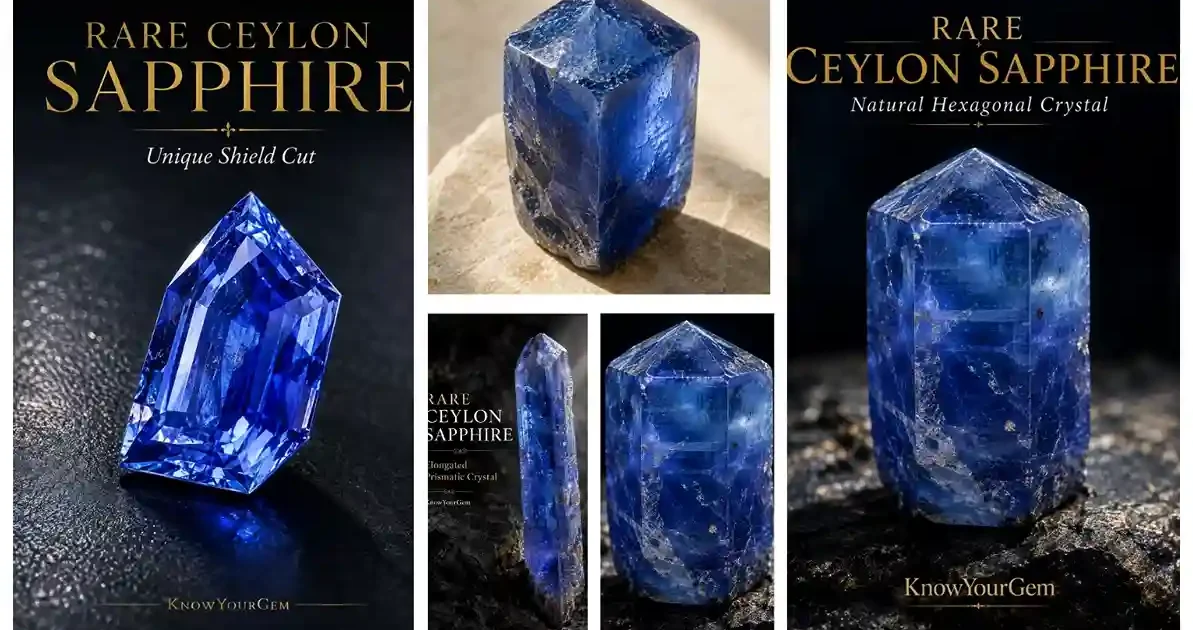
Ceylon sapphire is natural precious stone comes from Sri Lanka. This mineral is made of corundum, its color varieties are blue, pink, yellow, orange, purple, green, and rare color-change or star sapphires but among them blue is more popular.
Its specificity is that its gemstones are the most valuable when their richness, good transparency, and size are all preserved, with no enhancement. Gems command higher prices when they are appropriate and are obtained with Sri Lankan-certified sources.
These gemstones are usually loved by collectors and jewelers rather than similar species that are found in other areas.
Ceylon Sapphire: Definition and Terminology
“Ceylon sapphire” is a geographical origin claim, not a distinct gem species. Any sapphire sourced from Sri Lanka is called a Ceylon, regardless of color.
“Ceylon” and “Sri Lankan” relate to the same thing “Ceylon” was the name of the country when under colonial rule by Britain until 1972, and the term stuck, as Sri Lankan stones put the country’s gem history on the map for hundreds of years.
The key thing to get here is that blue sapphire refers to a colour. Ceylon refers to an origin. Blue sapphire usually comes from locations like Sri Lanka, Madagascar, Myanmar, Kashmir, or it can also relate to lab-created stones. But a lab-created as well as foreign material from any other source, can’t be called a “Ceylon sapphire,” as there is no chemical similarity to the Sri Lankan material.
Ceylon Sapphire at a Glance: Gemological Properties:
| Property | Ceylon Sapphire |
| Relates to | Corundum family |
| Composition | Al₂O₃ (aluminum oxide) |
| Crystal structure | Trigonal |
| Mohs Scale | 9 |
| Refractive index is | 1.762–1.770 |
| Birefringence is | 0.008–0.010 |
| Specific gravity is | 3.95–4.03 |
| Luster is | Vitreous |
| Transparency | The stone is transparent to opaque |
| Pleochroism | It typically displays two distinct color |
| Geographic origin | Sri Lanka |
Why Are Ceylon Sapphires Famous?
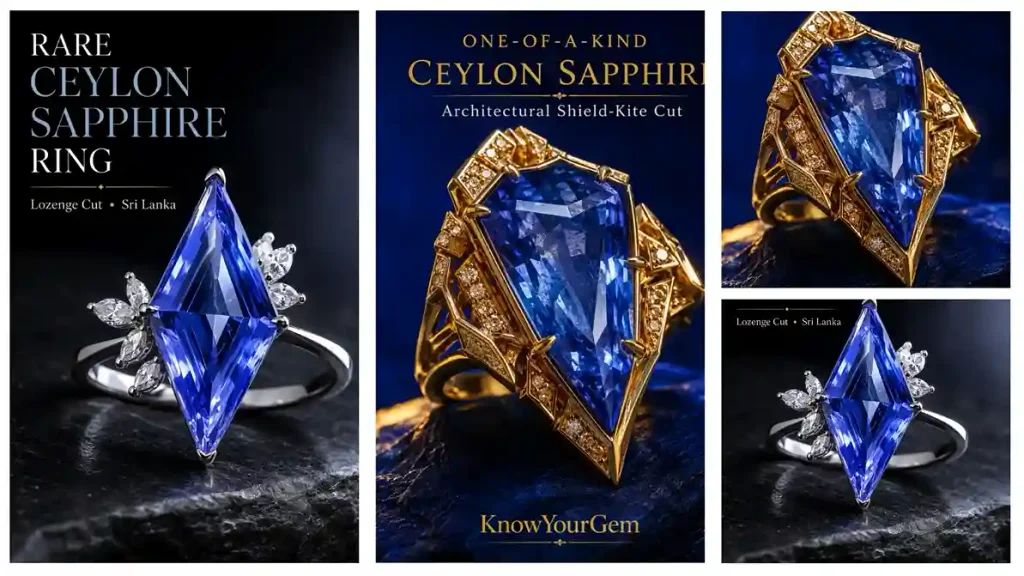
Corundum in gem quality has been mined in Sri Lanka for more than 2,500 years, and the alluvial gravels on the island near Ratnapura (“city of gemstones”) have supplied the courts of the various kings, antique traders, and collectors of Sapphire and Ruby forever. Marco Polo wrote of Ceylon sapphires in the 13th century, and continued trading has never really ceased:
What distinguishes Sri Lankan material is really the geology, not the marketing. The island‘s gem gravels were created by the weathering of Precambrian metamorphic rock. Concentrating corundum crystals in a secondary deposit which are comparatively simple to extract in labor-intensive fashion and which frequently produce larger.
More “clean” rough than many other sources, and the result of this combination of size, clarity potential and a well-documented pathway to market, is why collectors and jewelers continue to regard “Ceylon” as a badge of pedigree in the world gem market.
Where Are Ceylon Sapphires Found?
In Sri Lanka below are the main areas where Ceylon sapphire is found:
- Ratnapura: It is the traditional center of Sri Lankan gem mining for blue and fancy-color sapphire
- Elahera: It is one of the most important new finds, right?
- Balangoda: It is other than the blue and fancy blue sapphires supplies other gemstone varieties of species.
- Kataragama: It is a refractory area of multiple color varieties of corundum
- Okkampitiya: It is noted for cool blue and padparadscha quality.
The bulk of Sri Lankan sapphire derives from secondary (alluvial) deposits known as illam pockets of gravel made up of abraded corundum crystals in ancient, eroded, and transported host rock.
This is in contrast to the primary deposits, where each corundum remains embedded in its parent massif, which explains why conventional workers’ methods of collecting sapphires from pits and pans have persisted in Sri Lanka over thousands of years.
Ceylon Sapphire Colors:
Blue Ceylon Sapphire:
Based on trade history, blue became the “signature” color of Sri Lankan blue sapphires. Ceylon Sapphires can have a spectrum of shades, counted as the palest, nearly “cornflower” and “royal blue” medium tones to darker and more saturated stones.
Cornflower blue is among the most popular tones in the trade; soft, relatively pale medium blue with a tinge of violet is closely associated with fine Sri Lankan material, although stones of this tone come from other sources as well.
Royal blue is a more saturated, slightly darker blue, many buyers’ “perfect” tone and saturation.
Pink, Yellow, and Orange Ceylon Sapphire:
Four other varieties of sapphires are also produced here, in addition to the blue, all the expensive high-end collectors’ stones, who will be able to enjoy the rich hues.
They include a range of pale to intense pinks, lemon to deep gold yellow, much valued for their transparency, and orange, between pink and yellow on the color wheel, and seeming to be the purest in saturation, unmodified.
Purple, Green, and Colorless Sapphire:
Purple and violet Ceylon sapphires are also observed to go back and forth from dusky reds to bluish hues of purple in different lighting conditions.
Minor green coloration is less common commercially but does exist. Due to inconsistent trace elements, there is also “leucosapphire,” a colorless form of corundum, mostly of technical/collector interest.
Color-Change and Star Ceylon Sapphire:
Color changing sapphire generally changes its color in different lighting reflection. Such as in daylight the stone glows light bluish-violet in daylight and purplish indoors.
A star sapphire shows a glowing star, called asterism. This comes from fine rutile inclusions, and the gem is cut as a smooth cabochon to reveal the star.
Ceylon Padparadscha Sapphire:
Padparadscha sapphire is considered as the rarest and most valuable Ceylon sapphire. It is a mixture of pink and orange, and is named after the lotus flower.
Sri Lanka is known as the traditional source, and it provides the finest natural, unheated padparascha from there is among the most valuable corundum gems on the market.
| Color | Typical appearance | Key value considerations |
| Blue | This color generally appears in blue-violet-blue. | Its hue, tone, saturation and clarity are its value boosting factors |
| Pink | This color displays as pale to vivid pink | Its color color intensity, and clarity can enhance its value |
| Yellow | The color appears in Yellow to golden | Its saturation and tone improves its value |
| Orange | It appears in orange to pinkish-orange | Its purity makes it more valuable |
| Padparadscha | It often shows pink-orange color | Its color balance, origin, and treatment status make it valuable. |
| Purple | This usually appears in violet to purple | Its saturation and clarity make it valuable |
| Green | It looks green-blue-green | Its color quality, and rarity makes it more valuable |
| Color-change | Shifts under lighting | Strength of the shift |
| Star | Body color plus asterism | Star sharpness, body color |
Why Are Ceylon Sapphires Blue?
Sapphires mostly found in blue color because tiny amounts of iron and titanium replace aluminum in the mineral corundum.
The stone forms when light passes through, electrons jump between the iron and titanium (called intervalence charge transfer). This can generally absorb certain colors of light and leaves the rich blue that we can see.
The strength of that blue will then depend on the quantity of Fe & Ti and their uniformity of distribution.
Strong, uniform Fe-Ti pairing will result in an intense, uniform blue, while uneven distribution of that Fe-Ti pairing during the crystal growth will cause the banded/patchy color zoning seen under magnification by the gem cutter.
This color zoning is a natural result of the growth rate of the sapphire and is not a flaw, as would be a crack or inclusion.
Where the violet tint is seen in some Ceylon material is simply from a small additional pipe of chromium, or some other trace element(s), overlying the core Fe-Ti mechanism.
Ceylon Sapphire Inclusions:
Inclusions’ internal features are studied by gemologists to support the origin determination, processing, and sometimes geographical provenance of a stone. Neither inclusions are found in Sri Lankan stones, based on 76 the report that considered the whole inclusions in conjunction with chemistry.
| Inclusion | What it looks like | Why it matters |
| Rutile silk | It has fine, needle-like reflective inclusions | Because it is common in natural corundum; pattern that can support natural origin |
| Fingerprints | It has wispy, feathery healed-fracture patterns | Because it is a sign of natural growth history |
| Negative crystals | It has empty or fluid-filled crystal-shaped cavities | Because it is consistent with natural formation |
| Zircon crystals | It has small rounded crystals, sometimes with stress halos | Because it is common accessory mineral in Sri Lankan corundum |
| Mica and pyrite | It has platy or metallic mineral inclusions | Because it contributes to origin assessment alongside other clues |
| Color zoning | It has banded or angular color distribution | Because it reflects natural growth conditions |
How to Identify a Ceylon Sapphire?
Gemological experts generally test hardness, reflectiveness, and the optical effects, while comparing key factors like:
- Check color hue, tone, saturation, and presence of color zoning.
- Test transparency and detail under magnification, in normal and transmitted light.
- Examine inclusions in a loupe or microscope for any characteristic growth features.
- Measure the refractive index while using a refractometer.
- Check the specific gravity with the hydrostatic balance.
- Examine the feature spectra for all absorption features characteristic of corundum.
- Assess the indicators of practices, with emphasis on heat-treatment proof.
- Weigh geographic-origin evidence from inclusions and trace-element chemistry.
- Achieve lab testing for a documentable, defensible opinion that any major purchase can depend on it.
What You Can (and Can’t) Do at Home?
At home, you can do some quick visual and loupe examinations, compare the color and cut to reference materials, and look at anything provided by the seller.
You can’t normally determine geographic origin, subtle heat treatment, fine differentiation between natural and synthetic material, etc. (Those are lab-grade tests.) When you’re talking about anything other than a cheap, casual purchase, having a professional do some testing is generally worth it.
Ceylon Sapphire Origin Determination:
Laboratories for gem identification make origin judgments by using a variety of tools such as microscopy to examine inclusions and growth features, spectroscopy to compare absorption spectra.
And trace element chemistry (commonly measured using LA-ICP-MS) to compare the chemical fingerprint of a specimen to a database of reference spectra of known origin.
There is no test that can genuinely and definitively determine origin. Sri Lankan, Madagascar, and certain East African deposits are able to result in similar.
Chemically and visually indistinguishable products, so laboratories should conclude the origin statement on the basis of the cumulative results of the tests performed rather than by absolute proof; consequently, high-quality reports state the origin status as determined “to a reasonable degree of certainty”.
Ceylon vs Other Sapphire Origins:
| Feature | Ceylon (Sri Lanka) | Burmese (Myanmar) | Kashmir | Madagascar |
| Typical blue | Cornflower to royal blue | Deep, velvety blue | Soft, “sleepy” cornflower blue | Wide range, often similar to Ceylon |
| Inclusion character | Rutile silk, zircon, fingerprints | Dense silk, marble-related minerals | Fine, dust-like silk | Varies by deposit |
| Treatment | Commonly heated | Often less heated at the top end | Rarely heated (deposit largely depleted) | Commonly heated |
| Origin ID difficulty | Moderate | Moderate | High confidence when tested | Can overlap with Ceylon material |
| Market reputation | Historic, well established | Considered top-tier for deep blue | Extremely rare, historic peak prices | Major modern supply source |
Kashmir, from a historic but now largely exhausted deposit, fetches the highest prices in the trade.
It is famous for its unusually soft, velvety blue. Burmese sapphire is mined for saturated, deep color. Ceylon’s sapphire usually contains both a longer and more thoroughly recorded lead time and a wider color range.
Are Ceylon Sapphires Heat Treated?
Yes, this has been done to Sri Lankan sapphire for decades and is an accepted practice on a substantial number of high-quality stones to darken or lighten the color and to rid of silk inclusions.
This is very much listed on a CZ and does not make the stone “fake,” as a heated natural sapphire is just that – a heated natural sapphire.
Unheated, no heat) Ceylon sapphires are less common and command a true premium as both colour and clarity are natural.
In addition to heat treatment, there are now more aggressive methods of enhancing the sapphire’s appearance, such as diffusion, where elements responsible for the blue color are diffused into the surface layer.
In the case of beryllium diffusion, the effect is more dramatic, and even the production of orange and yellow colors is possible. Both of these are required to be disclosed and have various worth.
Natural vs Synthetic Ceylon Sapphire:
A natural Ceylon sapphire is a sapphire that has naturally formed in the earth in Sri Lanka over geological time.
A synthetic sapphire is fabricated in the lab, and regardless of how chemically similar it is to material from Sri Lanka, it is not possible to call it a Ceylon sapphire – a phrase used to denote its geographic source and therefore not chemically representative.
Under magnification, laboratories identify the natural or otherwise source through display of growth-pattern evidence (curved striation on synthetics and angular zoning on natural stones) and inclusion type and trace-element chemistry.
Ceylon Sapphire Certification:
| Certificate field | What it means |
| Species | Corundum |
| Variety | Sapphire |
| Weight | Carat weight |
| Color | Laboratory’s color description |
| Treatment | Disclosed treatment status |
| Origin | Geographic-origin opinion, where offered |
| Measurements | Stone dimensions |
| Comments | Additional observations |
A document stating Origin: Sri Lanka is an expert (i.e., lab) opinion relying on the evidence; it is a very good and convincing reference but not a definitive legal statement, as origin science is probabilistic.
It doesn’t get its value itself, but its origin, treatment status, color, and clarity all determine the price jointly.
Ceylon Sapphire Price and Value:
The price of Ceylon sapphire varies a lot. Their value actually depends on things like color quality, clarity, cut, carat weight, treatments, origin reports, and overall market demand at the time of sale.
| Quality tier | Treatment | Origin documentation | General market positioning |
| Commercial | Heated | None | Entry-level |
| Good | Heated | Documentation varies | Moderate |
| Fine | Heated | Certified | Higher |
| Fine | Unheated | Certified | Premium |
| Exceptional | Unheated | Documented Sri Lankan origin | Very high |
| Collector-grade | Unheated | Strong documentation | Potentially exceptional |
Please remember that the final retail asking, auction, wholesale, and insurance appraisal values are four different figures and have been developed based on four very different assumptions.
Do not treat them as peers of a single piece of data or rely on them interchangeably when attempting research.
What Determines Ceylon Sapphire Value?
In rough order of importance: color(hue, tone, saturation) appears to be the most significant, with clarity and transparency coming next.
Then cut quality, carat weight, treatment, origin and associated paperwork, certification, then rarity of color (postparadscha and top quality unheated blue form the top).
Therefore, two Ceylon sapphires with the same weight can cost very different amounts. Since, a well-saturated, unheated, certified stone with a perfect cut can generally be worth much more than a paler, heavily treated, uncertified stone.
How to Buy a Ceylon Sapphire?
A practical buying checklist:
- Confirm natural status
- Check treatment disclosure
- Verify any origin claims against documentation
- Request a laboratory report for meaningful purchases
- Evaluate color under different lighting
- Check clarity and transparency
- Inspect cut quality and proportions
- Compare carat weight against overall quality, not in isolation
- Evaluate how much the seller discloses upfront
- Compare against similar stones before deciding
Red Flags to Watch For:
Seller claimWhat to ask
- “100% Ceylon” Is origin laboratory-documented?
- “Unheated” Is that supported by a lab report?
- “Royal blue” What does the actual report state?
- “Rare” Rare compared to what, specifically?
- “Investment grade” What objective evidence supports that?
- “This inclusion proves Ceylon” Has origin actually been lab-tested?
Buying by Budget:
- Under approximately $500, you will find smaller-sized stones; typically, heating is involved, and there will be less reporting.
- As the price range moves from $500–$5,000, you start to see increasingly better color and clarity, again usually heated.
- When you get into the range of $5,000–$10,000, you will find certified stones and better cut quality as well.
- Over $10,000, you are now seeing unheated stones, good origin reports, and larger size fine color material, with padparadscha and somewhat exceptional unheated blue well over that range.
Ceylon Sapphire Jewelry, Cuts, and Engagement Rings:
A Ceylon sapphire is geologically considered as tough and very strong because of its 9 Mohs hardness. The stone is well suited for engagement rings which you can wear regularly.
This stone basically comes in striking colors that pair beautifully with diamonds in rings, watches, necklaces, earrings, and bracelets. Popular settings include halo, bezel, and solitaire styles.
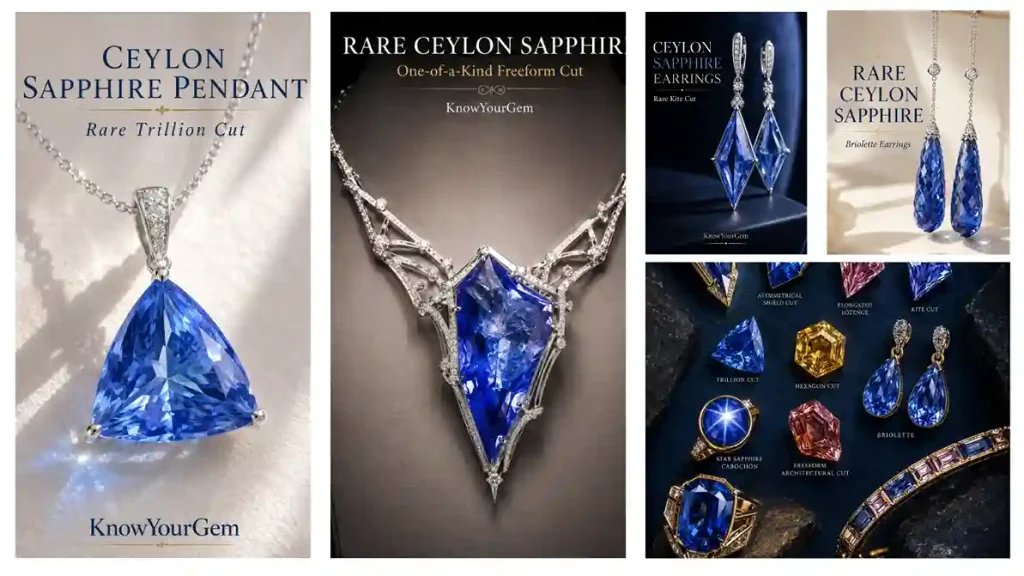
It is typically found in cuts like oval, cushion, round, emerald, pear, marquise, and cabochons, but each cut has its own value.
Cut quality greatly influences color response: poorly cut stones may exhibit windowing (where light is lost out the table, leading to a faded pale area) or too much extinction (leading to dead dark areas).
Light should be evenly dispersed in the face of a properly cut stone, and this is dependent on the orientation of the shape in relationship to the crystal’s color zoning.
Ceylon Star Sapphire:
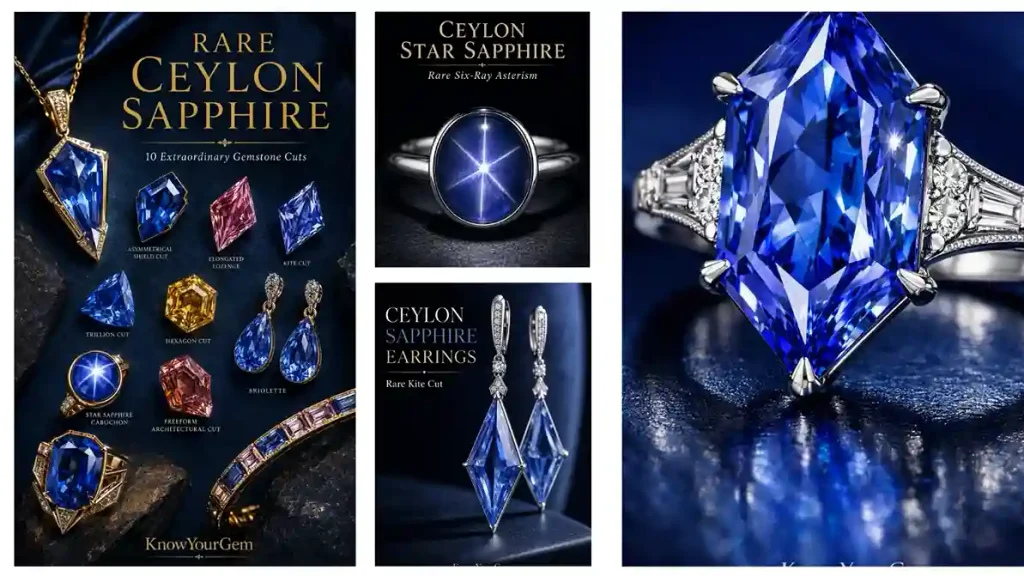
A Ceylon star sapphire’s glow on its surface is called asterism. This usually happens when light reflects off tiny, needle-like rutile inclusions that line up inside the corundum crystal.
While a six-ray star is standard, twelve rays occur where each set of inclusions overlaps. Price is influenced by the sharpness and focus of the star, the body’s coloration beneath, and is usually cut as a cabochon.
Ceylon Color-Change Sapphire:
Color-change sapphire – variable color by light source on scales from pale bluish-violet to purple in daylight and from purple to bluish-violet in incandescent light is caused by a combination of trace elements, such as vanadium, chromium, and titanium.
Absorbing specific wavelengths under the different spectral distribution of daylight versus incandescent light. Authentic, strong, distinctive change is relatively rare, so admired by collectors looking for unusual optical effects over standard appearance.
Famous Ceylon Sapphires:
- Blue Giant of the Orient: This is one of the largest cut blue sapphires known (BB, roughly 466ct), Sri Lankan.
- Blue Belle of Asia: A 392-carat Sri Lankan sapphire with a provenance recorded, sold at auction at a record price in 2014.
- Star of India: 563-carat Sri Lankan star sapphire, in the permanent collection at the American Museum of Natural History.
- Logan Sapphire: Sri Lankan 423-carat sapphire mounted on a diamond brooch that is displayed in the Smithsonian Institution.
From Sri Lankan Mine to Finished Sapphire:
The process chain ranges from the mineral deposit to the jewelry by way of artisanal and small-scale mining, separating the rough by size and value, cutting and polishing as well as heat treatment (if applicable).
laboratory grading and testing, certification, and setting into jewelry. An added cost throughout this process chain, if recorded appropriately, is the value added by this chain.
Are Ceylon Sapphires Ethically Sourced?
Most sapphires are mined in Sri Lanka using small-scale and traditional pit-and-pan methods that generally cause less environmental impact than big machines.
So when you buy these stones, you should ask dealers about origin, the mining process, and where it entered the supply chain. This will help you choose the right seller.
Ceylon Sapphire Benefits and Symbolism:
Historically and in various cultures, sapphire has been used as a sign of good communication, wisdom, loyalty, and trust, as a protector against evil and harm, and in some cases for specific chakras or planets.
These are traditional, historic, spiritual, or belief-related properties and are not medically or physically proven or known.
Ceylon Sapphire Birthstone:
Sapphire is the traditional stone of September. “Ceylon” just indicates that the geographic origin of the sapphire is Sri Lanka; the birthstone designation denotes any sapphire, not just material from Sri Lanka.
Ceylon Sapphire Care:
No doubt, a Ceylon sapphire is very hard with 9 Mohs hardness, so it is good for rings and daily wear jewelry. But it still needs gentle cleaning with warm water, mild soap, and a soft brush to maintain its genuine color glow.
If your stones are filled with fractures, you will need to store them separately from other stones. A jewelry box or soft pouch is recommended for safe storage. However, it is best to check stones with jewelry annually for re-polishing and maintenance.
Common Ceylon Sapphire Myths:
Not all Ceylon sapphires are blue; the island also offers all the original fancy colors. Not all Ceylon sapphires are unheated; heating is the industry norm, not the exception.
A deep cornflower blue alone is no guarantee that the stone is from Sri Lanka, and no one specific inclusion on its own is proof; the industry believes that when their credentials are combined, the origin has been proven.
Just because it is a darker blue isn’t necessarily better; a dull picture-blue can actually detract from the brilliance that buyers are seeking. And a heat-treated sapphire is not a failure; it is a norm that is acceptable when indicated by jewelry industry standards.
Ceylon Sapphire FAQ:
1. What is a Ceylon sapphire?
Ceylon sapphire generally belongs to the corundum family. It is a natural sapphire with a different name.
2. Is Ceylon sapphire the same as Sri Lankan sapphire?
Yes. Ceylon sapphire and Sri Lankan sapphire are the same stones, but “Ceylon” is the old name of Sri Lanka.
3. What color is Ceylon sapphire?
Ceylon sapphire generally showcases blue, but is also found in other colors like pink, yellow, orange, purple, green, clear, and padparadscha.
4. How much is a Ceylon sapphire worth?
It does not actually involve one form of pricing; the cost and the price of these precious gemstones will rely entirely on such features as the stone’s hue, clarity, cut, carat weight, whether it has been treated, and which location this gemstone is extracted from.
5. Are Ceylon sapphires heat treated?
These natural stones are treated to enhance their color saturation, but their pieces with treatment are considered more valuable.
6. Can a laboratory prove Sri Lankan origin?
This question is only about laboratory proof: The synthetic stone offers expert evaluation of its structure and chemicals but cannot always determine this with over 99% certainty.
7. What’s the difference between Ceylon and Burmese sapphire?
Burmese sapphire is generally found in a darker blue color, but mostly in the cornflower to royal range. However, Ceylon sapphires display lighter blue and are found in many other colors too.
8. Are Ceylon sapphires good for engagement rings?
Ceylon sapphires are generally considered as good choice for engagement rings due to having 9 Mohs hardness.
9. What is Ceylon padparadscha?
The definition is a rare pink-orange hue gemstone that derives from Sri Lanka, and the hue it offers can certainly account for some of the finest values within the fancy colors gamut.
Ceylon Sapphire in 10 Facts
- Ceylon means Sri Lanka.
- There is no difference between Ceylon sapphire and regular sapphire.
- It is a corundum family member.
- Its blue color is best known, but a single color can’t define the stone properly.
- Sri Lankan deposits supply sapphires worldwide in nearly every color.
- Heat treatment is common and industry-accepted.
- Unheated stones can command real premiums.
- Color alone cannot prove geographic origin.
- Laboratory testing provides a professional origin opinion, not absolute proof.
- Value always depends on multiple quality and market factors together.
Always verify these type of precious stone with trust labs like GIA, IGI, SSEF Authenticity, RI, SG, and authentic information.
Gems Enthusiast {KamilHussain}

Welcome to KnowYourGem.com! your ultimate destination for uncovering the fascinating world of gems and their secrets! I'm Kamil Hussain, a passionate blogger with a Master’s degree in Economics, dedicated to bringing you insightful, well researched content that blends the beauty of gemstones with the art of storytelling. With a keen analytical mind and a love for discovering hidden treasures, I created this platform to help you explore the brilliance, history, and value of every gem.

