
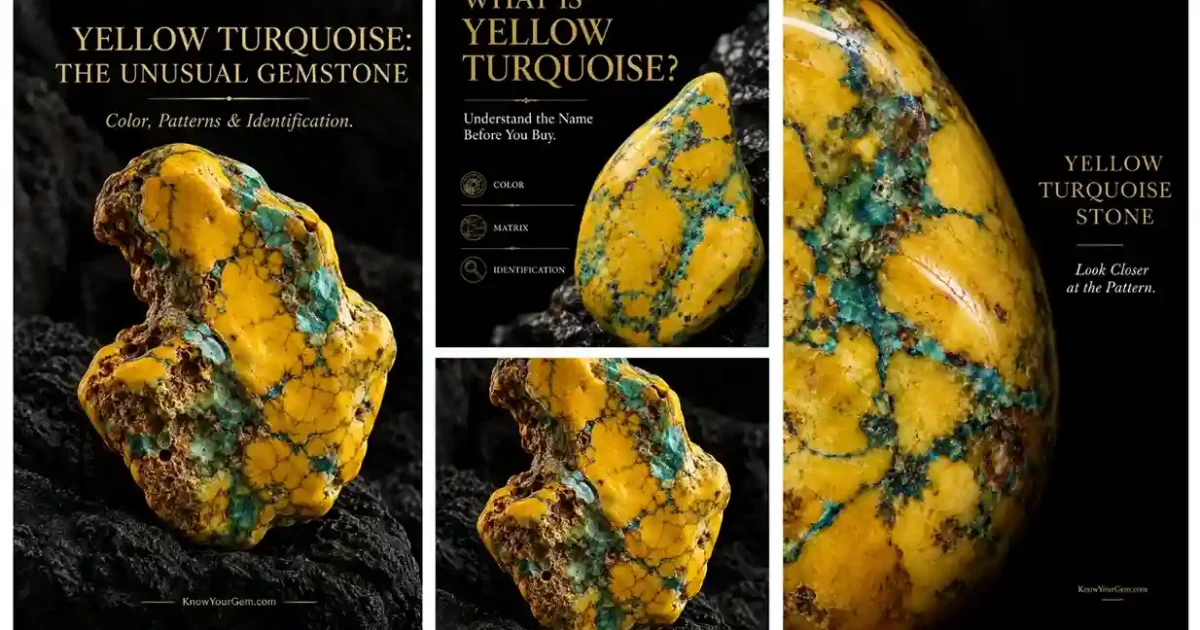

“Yellow turquoise” is a trade name, not a mineral. Real turquoise can lean yellowish-green, but the bright yellow stones with dark spiderweb veining sold under this label are usually jasper, serpentine or something else, and some are dyed or stabilized.
If you’re looking at a bead strand, cabochon or ring with that label right now, read on. By the end you’ll know what it probably is, how to tell the options apart, and what to ask before you hand over money.
Quick answer:
- Is yellow turquoise real? The name exists in the market. The mineral doesn’t.
- What is it usually? Mostly jasper. Occasionally serpentine, dyed howlite or magnesite, or a composite.
- Can turquoise be yellow? It can be yellowish-green. That’s not the same as the strong yellow in most listings.
- What should I do? Since all turquoises aren’t the same, you shouldn’t be paying those “next” prices. Find out what the material is, if it’s been treated and who identified it.
A name isn’t an identity:
Two things are getting confused in here, and you will find most lists will either effortlessly or intentionally blur the lines.
A mineral name will tell you what the composition of the stone is. Turquoise: A hydrated copper aluminum phosphate with a triclinic crystal system. A trade name only tells you how a stone looks or how it’s sold. Nobody approves it and no lab checks it.
“Yellow Turquoise ” is a trade name. It gives you color and pattern, and nothing about the material underneath. People see “turquoise” and assume they’re getting yellow turquoise. Sellers know that. It shows up in the price.
Is yellow turquoise real?
Does it exist in nature?
Yellow stones with dark veins exist, and they’re sold by the thousands. Most came out of the ground, so “natural” is often a fair word. But natural only says where something came from. It doesn’t say what it is.
Can real turquoise be yellow?
Sort of. The color of turquoise comes down to chemistry. The blue of copper – mix it with iron or zinc, and the stone trends toward green – then yellowish-green. So yes, an authentic turquoise can be greenish-yellow That color is usually muted and green-leaning. It’s not the lemon or mustard yellow on most “yellow stone” strands.
Why is jasper sold as turquoise?
It just seems “right,” and the word sells. Jasper is the opaque variety of microcrystalline quartz. It polishes well and often has dark lines that look like turquoise matrix. Put a yellow jasper cabochon next to a green turquoise one, and plenty of people can’t tell them apart at a glance.
Is every one fake?
No, and I wouldn’t say so. Some sellers are honest: “yellow jasper, sold as yellow turquoise.” Some stones may be real yellowish-green turquoise. You just can’t know from the name. Every stone needs its own evidence.
What actually settles it?
Testing. Not a photo, not a seller’s say-so. A lab measures properties that separate materials. More on that below.
What it’s usually made of:
Never think of these as a definition, always as a possibility.
Jasper:
The most likely answer. Jasper is hard, being mostly microcrystalline quartz, about 6.5 – 7 on the Mohs scale, so it will remain tough and take a good polish. Dark irregular lines are common, which is why it passes for Yellow turquoise matrix.
Serpentine:
A group of minerals consisting of magnesium silicate. The hardness ranges from a very soft mineral to about 5.5. Yellow-green and olive are normal colors, and some pieces have veining. It’s often mistaken for jade, and now and then for turquoise.
Dyed howlite or magnesite:
Howlite is white with gray veins and soaks up dye. That’s why it’s been a yellow turquoise imitation for a long time. Magnesite acts much the same. Either is soft, about 3.5 to 4.5, and both can be dyed any colour (including yellow).
Stabilized, composite and reconstituted material:
Most is porous or soft, so all commercially-sold yellow turquoise has been treated. Treatment: Filling – Material injected into the stone to change it. Stabilizing – Material injected into the stone to make it more stable.
Dyeing – (colouring or deepening) Reconstructed/ Reconstituted – Turquoise powder / chips joined together with glue. A stone can have real yellow turquoise and be a different type. Treatment and construction have to be disclosed.
One Rule That Helps:
If a listing gives you color and pattern, it’s a trade name. If it names a mineral (jasper, serpentine, turquoise), that’s an identity. Good sellers give both.
Yellow turquoise vs. jasper vs. serpentine:
The above ranges are standard in many magazines, however, they do not provide a guarantee on the properties of any stone. Impurities, treatment, and how the test is made can change the figures.
| Material | Hydrated copper aluminum phosphate | Microcrystalline quartz | Magnesium silicate group |
| Mohs hardness | About 5–6 | About 6.5–7 | Roughly 2.5–5.5 |
| Specific gravity | About 2.4–2.8 | About 2.5–2.9 | About 2.2–2.6 |
| Refractive index | About 1.61–1.65 | About 1.54 | About 1.55–1.57 |
If tests don’t agree, take the range, not one reading. Small cabochons and strung beads may provide only an approximate reading, so most labs will run multiple tests.
Color, pattern and matrix:
Matrix is the host rock that shows through. In real yellow turquoise, it’s often brown, black or gray webbing. Jasper can show nearly the same thing. That’s the whole problem with judging by eye. Pattern is a clue. It isn’t proof.
What a photo can and can’t show?
It shows color, polish and pattern. It can’t show hardness, density, refractive index, dye or resin. Colors may be greatly changed by lighting and editing. Use photographs to determine what to inquire about, not to determine the identification of a stone.
When testing is worth paying for?
Get a report when the price is high, when the seller says “natural yellow turquoise,” or when the seller can’t say what the stone is. Basic tests cover refractive index, specific gravity and magnified inspection.
Infrared spectroscopy or X-ray diffraction can help when those don’t settle it. Results still depend on the lab and on whether the piece can be tested. Mounted stones and strung beads are harder.
The biggest buyer misconception
What people think: “The listing says turquoise, so it’s turquoise.”
What’s true: Often the word is just part of the trade name. A yellow cabochon with black veins sold as “natural yellow turquoise” can be jasper. The listing may not be technically false. It still misleads.
Why it matters: Money. You may end up paying several times what the material is worth. Treatment matters too. Dyed, stabilized, and reconstituted stones are priced differently from untreated ones, and new buyers rarely ask.
So ask plainly. Dyed? Impregnated? Stabilized? Assembled? A seller who knows will tell you. A seller who dodges has just told you something too.
Meaning and metaphysical claims:
Yellow stones go hand-in-hand with joy and trust. Yellow Turquoise is considered to be a stone of protection and good fortune. Those are beliefs. And they are the property of the people who possess them.
There’s no scientific evidence that a stone heals illness or changes your health. If the symbolism appeals to you, fine. Just don’t pay extra for claimed powers, and don’t let them stand in for facts about the stone.
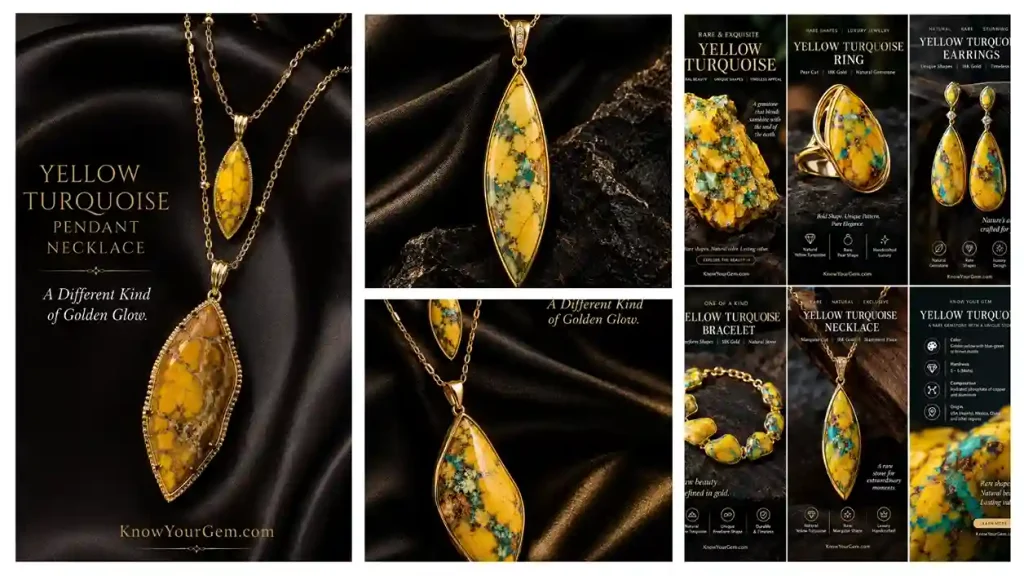
Yellow turquoise jewelry:
Styling and identification are separate questions. You can like how a stone looks whatever it turns out to be.
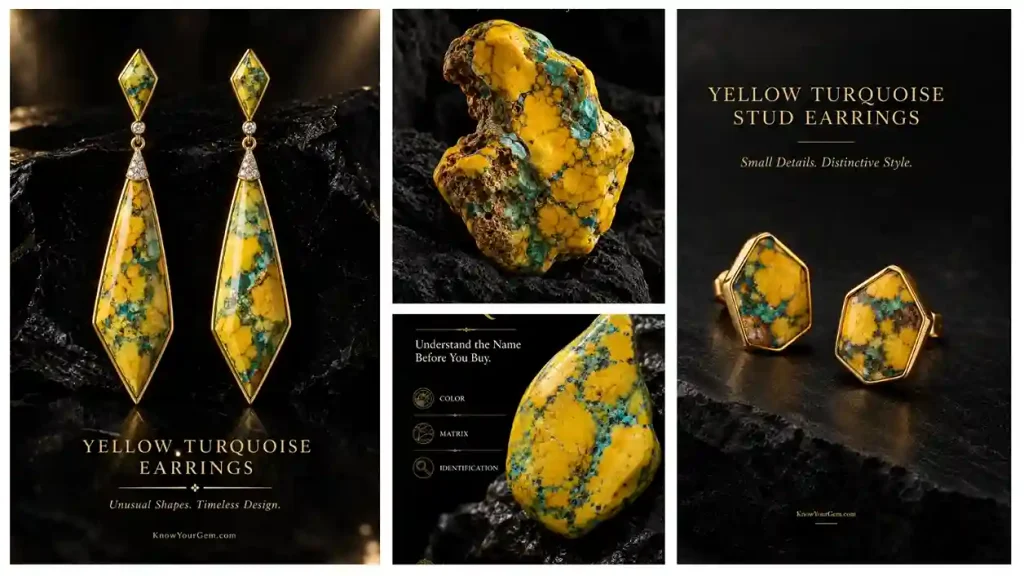
Beads and jewelry. This is where mislabeling can be tricky – nobody tests every bead. Discover if the strand is dyed or natural.
Bracelets and earrings. Bracelets take knocks. Earrings are easier on a stone. Match the material to how the piece will be worn.
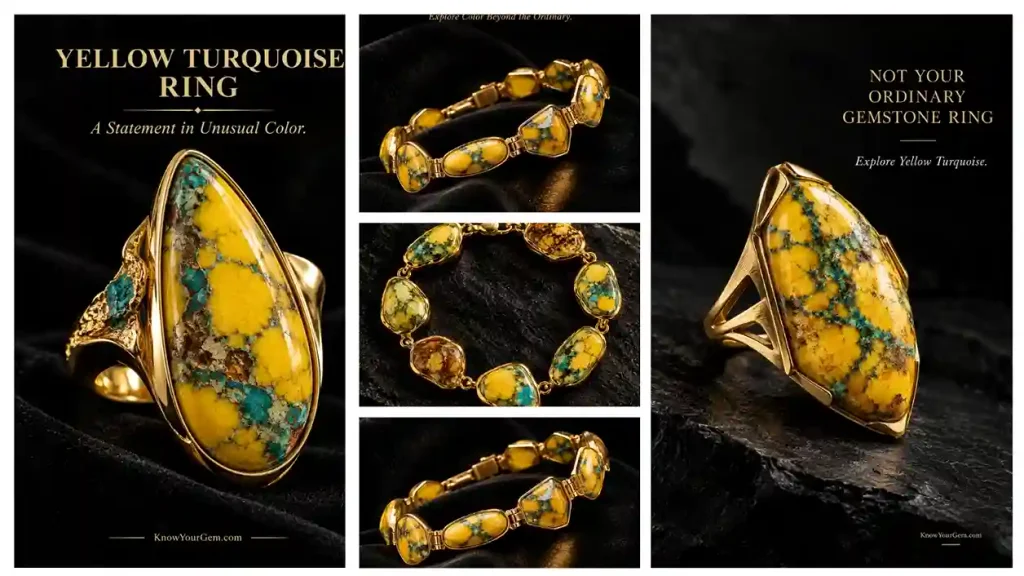
Rings. Rings get the worst of it. Real yellow turquoise, at about 5 to 6, scratches more easily than jasper. Take it off for washing, gardening and heavy work.
Yellow gold. It is perfect for yellow turquoise. The yellow hues can be contrasted and softened by this warm metal combined with the blue-green. For the yellow gem, it will appear softer.
Turquoise with yellow sapphire. Works as a style pairing. Sapphire is about 9, much harder, so in a single piece the turquoise takes most of the wear. Don’t stack them where they rub.
Care. Keep yellow turquoise away from perfume, oils, cleaners and heat. Porous or treated material can change color. Just use a soft dry cloth to shine.
Color: what does it look like?
Natural turquoise has a sky blue to green color, although a few stones are slightly yellow-green. Trade “turquoise” is usually plainly yellow, from pale butter to mustard, with dark veins.
As people look for: blue and yellow pigments, you get green. The color turquoise is between blue and green, so if you add yellow, you end up more in the lime part of the spectrum.
Yellow and turquoise also make a dynamic couple in clothing and interior decorating because they are opposite each other on the color wheel. That’s interior design, not gemology.
Price, quality and rarity:
Is it rare?
Don’t call it rare without proof. The name is common, and the materials behind it, jasper especially, are common. A rarity claim needs evidence about that specific stone.
What good turquoise looks like?
Most buyers will look at color, color consistency, hardness and polish, matrix, and if the turquoise was stabilized or reconstituted. The cleaner, harder, good color turquoise stones are the most popular.
What moves the price?
Material, treatment, color, size, cutting, and workmanship. And the format; single stone, strand or finished jewelry. Compare them on those, not on the name.
Why the name can’t set the value?
It says nothing about the material. Two stones sold as “turquoise” can be worth wildly different amounts.
I haven’t given a price per carat or per strand. I don’t have reliable, comparable market data for this trade name, and a made-up range would do you harm.
What to ask for before paying more?
The identified material listed above, full treatment disclosure, clear photos taken under natural light, and a return policy. For higher-value pieces, an independent report by a third party.
Where does it come from?
Buying Guide True turquoise is found in the southwestern United States, Iran, and China. Materials sold as turquoise can come from entirely different places, because jasper and serpentine form in many regions.
“A lot of the Chinese turquoise says Chinese turquoise” as a place or style, not a proven geological origin. Laboratories can sometimes identify a stone as a type of material, but tying it to a mine is difficult and likely not definitive. Don’t accept an origin label as fact.
How to buy without getting burned?
Five questions for the seller:
- What is this exactly? Is it Jasper, serpentine, turquoise, or something else?
- Is this dyed, stabilized, impregnated, or reconstituted?
- How was it identified: seller’s description, visual check, or lab testing?
- Is there an independent gemological report?
- What’s the return policy if it turns out to be something else?
What a report can and can’t do?
A reputable report can name the material and note signs of treatment. It can’t tell you what a stone is “worth,” and it covers only the piece tested. Check that it matches the exact item you’re buying.
Reading product photos:
Look for the same lighting, get close and personal with the surface of the picture and click from more than one angle. Watch out for fake or artificially enhanced pictures. An image alone cannot tell who a person is.
When to walk away?
If the seller refuses to name the material, refuses to answer questions about treatment, says something is rare or simply states where the piece comes from with no proof, or encourages you to buy it quickly, walk away.
How to label evidence in a gallery?
If you add specimen photos, mark each one by how strong the evidence is:
- Seller-described: The identity is merely the seller’s representation.
- Visually examined: Evaluated using the eye and/or a magnifying glass, but not subjected to an instrument test.
- Confirmed by lab: Tested, you can quote our report.
Nothing in this page has been lab-tested by KnowYourGem. Label any specimen you add honestly. It’s the clearest way to show readers the gap between a claim and evidence.
FAQ:
1. What is yellow turquoise made of?
Generally jasper, but sometimes serpentine, dyed howlite or magnesite, or a composite. It is not one mineral.
2. What is yellow turquoise made of?
Generally jasper, but sometimes serpentine, dyed howlite or magnesite, or a composite. It is not one mineral.
3. Is yellow turquoise natural?
The base material often is. That doesn’t make it turquoise. Ask about dye and stabilization.
4. Is yellow turquoise serpentine?
Other times a jasper piece has been misnamed, though it does not look like a typical jasper. It may be serpentine. Serpentine is a softer stone than jasper.
5. Is it valuable?
Not because of the name. Real material, workmanship, treatment, quality.
6. Can I wear it every day?
Depends on the material. Jasper is harder. Really turquoise, dyed howlite and serpentine are softer and need to be treated more carefully (rings).
7. Do I need a lab report?
For a cheap bead strand, probably not. For a high price, or any “natural turquoise” claim, yes.
Most trust labs for identification or certification of all stones are GIA, ISG and SSEF.
Gemstone expert and Enthusiast KamilHussain!

Welcome to KnowYourGem.com! your ultimate destination for uncovering the fascinating world of gems and their secrets! I'm Kamil Hussain, a passionate blogger with a Master’s degree in Economics, dedicated to bringing you insightful, well researched content that blends the beauty of gemstones with the art of storytelling. With a keen analytical mind and a love for discovering hidden treasures, I created this platform to help you explore the brilliance, history, and value of every gem.

