


Overview:
Blue zircon is a natural gemstone that is not related to cubic zirconia. These two are commonly confused. Blue Zircon is a real mineral (zirconium silicate, ZrSiO₄) that is extracted from the earth. In contrast, cubic zirconia is a man-made material designed to resemble diamonds.
We love it because it sparkles like a diamond but costs much less than sapphire. However, we handle it cautiously since it can chip. Most of what comes next focuses on accurately addressing both of these points.
[Knowyourgem] has handled gemstones for [two years]. [We displayed blue zircon, blue sapphire, and blue diamond together when our new client came to buy blue zircon.
But he was confused about sapphire and diamond with zircon and was asking which one was zircon. That was not just a question, but it was a reality; we showed proper certification of zircon and its pieces correctly. He happily bought it, and he is still our customer.
What Is Blue Zircon?
Blue zircon is a tetragonal mineral that occurs in igneous rock. Crystalline zircons from Western Australia have been dated as approximately 4.4 billion years old – the oldest shards of Earth’s crust. That’s true of the mineral as a whole, not of blue stones specifically. We mention it because some sellers blur the two.
The blue is usually man-made, in a sense. Natural zircon comes in brown, red, yellow, green and colourless. Most blue stones start as brownish rough that’s been heated.
Blue zircon also contains traces of uranium and thorium. Some old stones are very mildly radioactive. The faceted gems sold in jewellery aren’t considered a health risk. If a customer asks, we say so plainly and move on.
Zircon vs cubic zirconia
This is the confusion we hear most. The names look similar, so people assume the stones are related. They aren’t.
| Properties | Zircon | Cubic Zirconia |
|---|---|---|
| Origin | Natural mineral | Lab-made |
| Composition | Zirconium silicate | Zirconium dioxide |
| Mohs scale | 6.5–7.5 | 8–8.5 |
| Double refraction | Strong | None |
CZ is harder. It’s also the stone you’ll see in every cheap ring. Blue zircon looks deeper and livelier in person, and it has a history, a geology and a range of colours that CZ never will.
So if someone tells you “zircon is fake,” they’re thinking of zirconia. Blue zircon is genuine. If a seller uses the two words as if they mean the same thing, walk away.
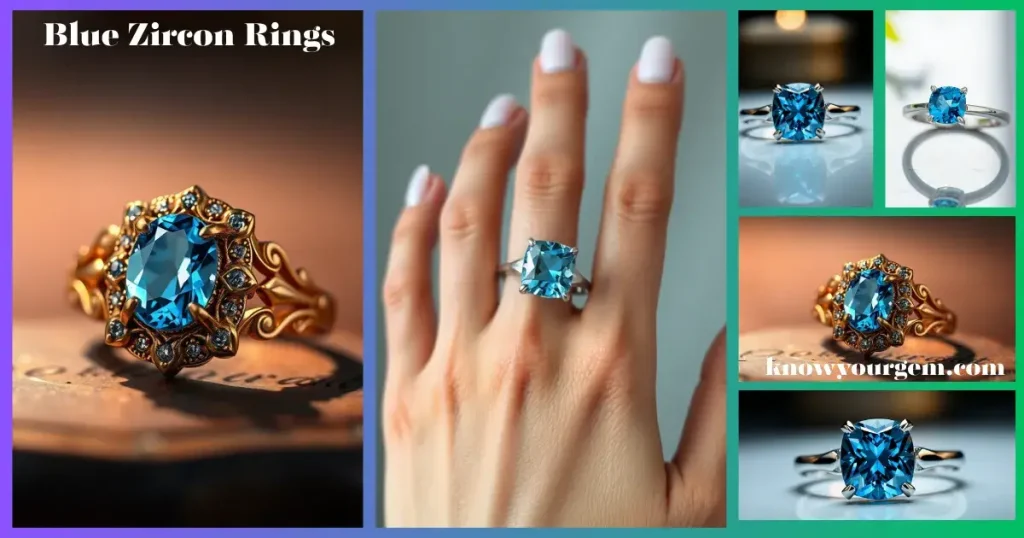
Why Blue Zircon Sparkles?
Two numbers explain it. The first is its refractive index: 1.810 to 2.024. second one dispersion: 0.039, against 0.044 for diamond. The first makes the stone bright. The second splits white light into little flashes of colour.
Most coloured gems give you one or the other. Blue zircon gives you both. That’s why a well-cut blue zircon looks lively across a room, while a blue topaz of the same size looks calmer.
| Property | Blue Zircon | Blue Topaz | Aquamarine |
|---|---|---|---|
| Mohs scales are | 6.5–7.5 | 8 | 7.5–8 |
| Refractive indexes are | 1.810–2.024 | 1.609–1.643 | 1.577–1.583 |
| Specific gravities are | 4.6–4.7 | 3.49–3.57 | 2.68–2.74 |
| Dispersions are | 0.039 | 0.014 | 0.014 |
| Typical treatments are | Heat | Irradiation + heat | Usually none |
Here’s a quick test you can do. Look through the top of the stone with a loupe. If the back edges look doubled, it’s blue zircon, because the stone splits light into two rays. Topaz and CZ won’t do that.
One more thing. Blue zircon feels heavier than it looks. Put a zircon and a topaz of the same size in your palm and you can often feel the difference. That’s specific gravity at work, and it’s a handy second check.
Which Shade of Blue Should You Choose?
Blue zircon isn’t just one colour, it ranges from pale sky blue to turquoise, and up to deeper shades of midnight blue, and the one you choose depends on what you want to wear.
- Sky blue: The gentle and delicate colour. Ideal for vintage styles and those looking to build up a soft feel.
- Turquoise blue- a greenish tint, similar to that seen in tropical waters. Attention-demanding, may be popular with some, but others find it too bright and harsh.
- Color deep blue: Similar to the saturation of sapphire. A gemologist can still tell them apart with magnification and testing, but most people wearing it won’t be asked.
- Aqua blue: lighter tones, often from Sri Lanka. It looks good in white gold or platinum.
Cambodia has historically produced the most sought-after electric blues, and those stones are often sold as blue Cambodian zircon, usually at a premium.
Our advice: Choose by eye, not by name. Look at the stone in daylight, then under shop lighting, then under LED. Blue zircon changes more than you’d expect, and the shade you fall for under a spotlight may look flatter in an office.
Is Blue Zircon Treated? (Almost Always, and That’s Fine)
Almost always. Brown rough gets heated to about 900–1000°C with little oxygen, and the blue appears. The heat changes the crystal structure and redistributes trace elements, which locks the colour in.
Jewellers have done this for a long time, and it’s fine as long as the seller says so. The problem was never the heat. The problem is a seller who stays quiet about it, because treatment affects price.
Untreated blue zircon exists, but it’s rare, and you should want paper before you pay extra for it. Telling the difference by eye isn’t reliable.
Labs use magnification and spectroscopy, and some untreated stones show uneven colour banding under magnification. If a seller says “untreated” and can’t show a lab report, treat that as a sales line, not a fact.
What to ask:
- Has this stone been heat-treated?
- Can you put that in writing?
- If you say it’s untreated, which lab says so?
A good seller answers all three without hesitation. A bad one changes the subject.
Does Blue Zircon Fades It Color?
Most treated stones hold up in normal wear. Hours of strong UV or serious heat can fade some of them. That means a few practical habits:
- Don’t leave zircon on a sunny windowsill for weeks.
- Don’t wear it in a sauna or leave it in a hot car.
- Ask the seller whether they’ve seen fading in stones like this one.
Where Blue Zircon Comes From?
Cambodia (Ratanakiri) built the reputation. Sri Lanka, Myanmar, Tanzania and Madagascar also produce it.
- Cambodia: The benchmark for electric blues. Decades of mining have used up the easy deposits, which adds to scarcity.
- Sri Lanka: Significant quantities, generally paler than those from India, alluvial deposits. Most stones are colourless or pale blue and have to be heated to achieve full brilliance.
- Burma: The occasional valuable stone, in addition to the more famous ruby and sapphire.
- Tanzania: A relatively new producer with deposits around the Umba River. The rough usually requires treatment and responds very well.
- Madagascar: growing supply, with quality that varies by mine.
Cambodian stones often sell at a premium. In many cases that premium reflects reputation more than a measurable quality difference. We’d rather have a lively Sri Lankan stone than a dull Cambodian one. Colour and cut decide it.
What about ethical sourcing?
Mostly mining centers are based on small scales and artisanal, so they can trace a stone back to its mine can be hard. That’s true across much of the coloured-gem trade, not just zircon.
Here’s what you can realistically do:
- Ask what origin documentation exists. Don’t assume it does.
- Ask whether the seller knows the supplier.
- Buy this stone from sellers who can openly disclose what they can and can’t trace.
Guidelines are provided by groups like the Responsible Jewellery Council, but areas and dealers differ in how well they adhere.
A seller who explains what can’t be done is more honest than one who guarantees a complete chain of custody. [ We generally source this stone from Gilgit-Baltistan deposits like Chilas and Diamar district, Astor Valley, Shigar valley and Sikardu/Haramosh mountains.]
What Does Blue Zircon Cost?
Its price is roughly counted from $50 to $600 per carat for most gemstones, more for documented untreated ones. [Eye-clean, well-cut stones we sell for premium prices.]
| Grade | Description | Approx. per carat |
|---|---|---|
| Commercial | 1–3 ct, moderate clarity | $50–150 |
| Fine | 3–5 ct, eye-clean, good colour | $150–300 |
| Exceptional | 5 ct+, vivid colour, excellent cut | $300–600 |
| Untreated premium | Documented untreated | $400–1,000+ |
The price increases rapidly over 5 carats, because good stones with intense colour are relatively scarce. Expect to pay around $200 per carat for good material that is suitable for fine jewellery.
How Blue Zircon Is Compared With Others?
- We buy cheap blue topaz at a cost of $20 to $100 per carat, because there is an abundance of supply. However, it is harder, but it doesn’t sparkle as much.
- Sapphire begins at around $400 a carat and goes up quickly. It’s much more durable, and it has the price to match.
- Zircon – it’s right in the middle, and it just looks better than what you pay.
Where people overpay?
- Paying “untreated” prices without a lab report.
- Paying for a famous origin when the colour is average.
- Buying a larger stone with a weak cut. A small, best-cut stone can look brighter than cheap-cut ones.
Buyers must need set their budget first then they should look for the best color and cut inside it. They shouldn’t chase carat weight.
How to Buy Blue Zircon Without Getting Burned?
Request in writing to be shown the treatment you are being given. For stones over a specified value, request GIA or IGI report. It should say that the stone is blue zircon, have all treatments listed and information on its quality.
Then look at the stone itself.
Quality checklist:
- The blue should be clean, not grey or brown.
- Look for small “windows” in the middle, and if you see a little light bleed, then you have some laser light escaping.
- Observe it by daylight and in LED.
- Examine edges and facet joints for chips. Zircon will chip along its edges more than other stones.
- Check to make sure the make is eye-clean, or inclusions are NOT visible to the naked eye.
- Measure the size based on what you can afford, not by comparing it to the size of the stone next to it.
Authenticity checklist:
- Treatment disclosure in writing.
- Doubled back facets under magnification.
- Specific gravity of 4.6–4.7 for high-type zircon, if the seller can measure it.
- Origin documentation on premium stones.
Buying online:
Get a jeweller’s loupe. Naturals have inclusions at 10x – tiny crystals or colour zoning. Angle the stone and see how the brightness and fire play when you move it in the light. If the store doesn’t let you look at it closely – be suspicious.
Then ask:
- What are the exact measurements and carat weight?
- Is it treated, and is that written on the invoice?
- What’s your return policy if it looks different in person?
Buying in a store:
Try a jeweller’s loupe. Natural stones often have inclusions visible at 10x, like small crystals or colour zoning. When you tilt the stone slightly, with a direct light, see how it reflects fire and light back. If the shop won’t let you look closely, that tells you something.
Which Setting Protects Blue Zircon Best?
This is the section that saves people money. Most damaged zircon isn’t damaged by bad luck. It’s damaged by a setting that didn’t fit the stone.
Blue zircon is brittle. A hard knock along a facet edge can chip it, and a chip can’t be undone. It can only be recut, which loses weight.
What to choose?
- Bezel: the metal wraps the stone and covers the edges. This is the safest option.
- Halo: a ring of small stones around the centre adds a buffer.
- Low profile: the stone sits close to the finger, so it catches on fewer things.
- Marked prongs: When the prongs are pointy, they can snag on the edges and load force to the edge.
- Preserve: As metals, platinum and 18k gold can retain the stone securely year after year.
What to avoid?
- Tall, thin solitaire prongs on a ring you’ll wear daily.
- Thin settings with nothing guarding the corners.
Open-backed mountings let light in from every angle, which boosts sparkle. If you choose one, make sure the edges are still protected.
Ask about resizing before you buy:
One thing people don’t ask about until it’s too late is resizing. The stone is brittle, so the jeweller often has to take it out first. That adds cost and risk. Get the size right before you buy, and ask the jeweller how they’d handle it.
Which Jewellery Suits Blue Zircon?
It depends on how hard you are on your hands.
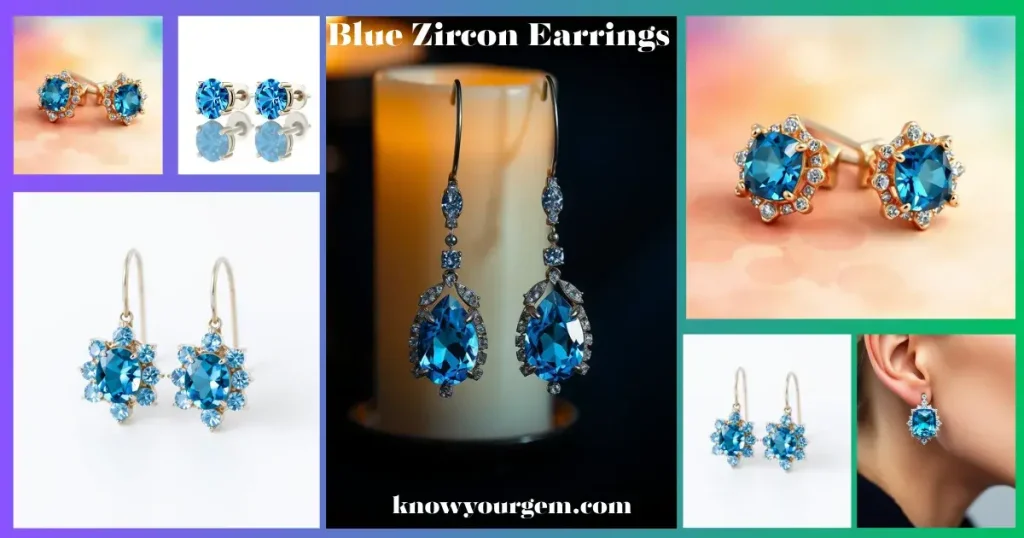
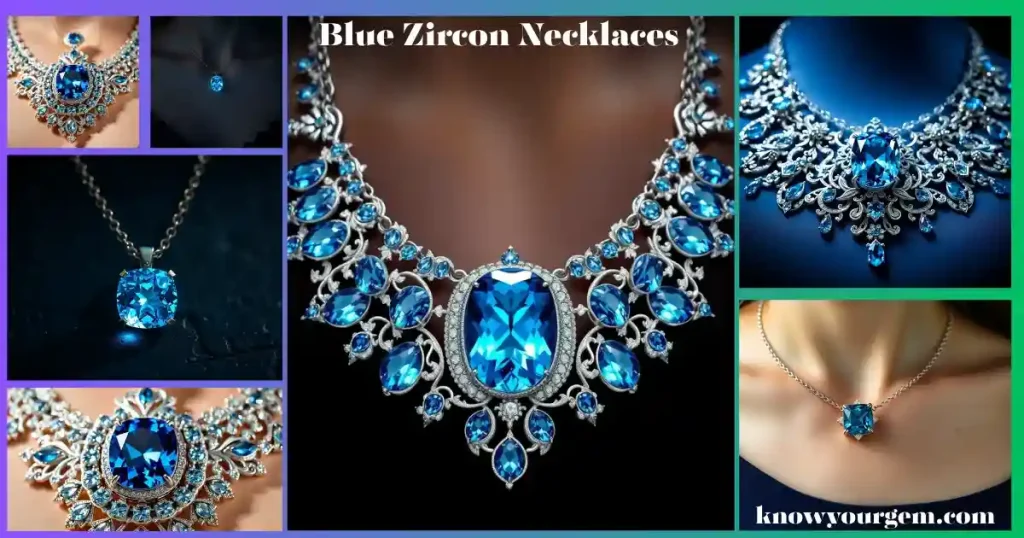
Earrings and pendants are the safest choices, because they rarely get knocked. White gold studs are understated and work in an office. Drops with several stones make more of a statement. If you want zircon and want it to last, start here.
Engagement rings are an option: Increasingly, we see blue zircon instead of the diamond solitaire. The more you can do with cuts: oval and cushion cuts show inclusions better; round brilliants have the most fire but use the most rough, which drives the cost up.
The brutal trade-off: it will be much cheaper than a sapphire ring, and it will be more delicate – if you’re rough on your hands, think carefully.
Bracelets are risky. Wrists knock against desks, doors and keyboards. Use bezel settings, or keep the piece for occasional wear.
Cabochons and beads show colour instead of sparkle. Domed, unfaceted stones suit vintage designs. Beads are common in time-honoured jewellery, although their softness can limit the extent to which jewellery can be manufactured. Some beads are set with sapphire or spinel.
Metals:
- Yellow gold: Warm vintage look with some accent diamonds.
- Rose gold: A romantic softness to offset the blue that goes with many complexions.
- White gold/platinum: Throws back more light into the stone and enhances colour.
Blue Zircon as a December Birthstone Gift:
Blue zircon is one of the new December birthstones (like tanzanite, turquoise and blue topaz). So, lots of choices, and zircon definitely knows how to sparkle.
If you’re buying a gift:
- Choose earrings or a pendant over a ring, so you don’t need a size.
- Pick a shade you’ve seen her wear, not one you like.
- Include the care card. A gift that gets cleaned in an ultrasonic machine won’t last.
If you’re unsure, a pendant in a bezel setting is the safest choice. [ It usually seems that we have customers who generally choose vintage-inspired rings for gift becuase they love to see their lovers classic styled jewelry on the fingers of their lovers.]
How to Clean and Care for Blue Zircon?
Rinse with warm water and wash with mild soap and a soft brush (dust removal) using a soft cloth for drying.
- Soak the item in warm water with a small amount of gentle, nonabrasive soap for 10–15 minutes
- Use a soft brush to clean.
- Simple wipe using a soft cloth.
What to skip:
- Ultrasonic cleaners: May loosen or break stones.
- Steam cleaner: Danger of heat shock.
- Chemicals in the wash: Bleach, acids, and chemicals from household cleaners.
- Abrasives: Bicarb and whitening toothpastes. Temperature fluctuations.
Storage: Keep it in its own pouch or a divided box, so diamond and sapphire can’t scratch it. Once the polish wears down, the stone loses its life, and that’s hard to ignore on a stone sold for its sparkle.
Daily wear: Take rings off before using lotion, perfume or cleaning products. Take them off for gardening, lifting weights, and washing up.
Maintenance. Take your jewelry to a jeweller annually to have it checked out. He/she can have worn-down stones repolished, a service that usually runs in the $50-$150 range for each stone, depending on their size and setting. [Weekly repolishing service is better for each stone]
A Short History of Zircon:
In trade, pale zircon was called “jargoon” back in the day. In medieval times, Europeans associated it with a good night’s rest and a shield against harm. A favorite of Victorian jewelers, Art Deco designers shaped it into dramatic geometric forms.
It was even believed to be an astrological stone in some Eastern beliefs, and the gem was once used as a cheaper substitute for sapphire. European traders regarded it as a base stone in earlier days, which is also the reason behind its nickname “affordable luxury”.
Healing and Metaphysical Claims:
Research–free: There isn’t any research to support them. The crystal communities have long associated blue zircon with clear, calm communication and the throat chakra. They sometimes combine it with aquamarine, with aquamarine for emotional healing and zircon for clarity of thought.
Those are traditional beliefs, offered here for interest. They aren’t medical advice. Seek support from a qualified professional if you are anxious or having sleep or health problems. A stone can be significant to you without necessarily being treatment.
Common Mistakes We See:
- Buying “untreated” stones with no lab report.
- Choosing a ring setting for looks, not for protection.
- Cleaning at home with an ultrasonic machine.
- Paying extra for origin when the colour is average.
- Avoid leaving this stone loose in a jewelry box with harder stones.
- Don’t forget to ask about resizing the stone.
- Don’t judge the color under one light only.
[We have seen these mistakes commonly among buyers, mostly among beginners. So they should avoid all these things and enjoy their jewelry or stones.]
FAQS:
2. Is zircon a fake stone?
No. People think it’s cubic zirconia, which isn’t the same thing.
3. Is blue zircon treated?
Almost always, by heat. It should be disclosed.
4. Does it fade?
“Not in everyday wear. Bright sunlight or high heat can fade certain stones.”
5. Is blue zircon good for an engagement ring?
Yes, with a protective setting. It’s softer than sapphire, so it needs care.
6. Is blue zircon the same as blue topaz?
No. Zircon has doubled back facets, feels heavier and sparkles more. Topaz is harder and generally less costly.
7. How can I tell if a blue zircon is real?
Spot doubled back facets with a loop, ask for treatment disclosure, and obtain a lab report for high-end stones..
8. Is blue zircon valuable?
It has good colour, clarity, is well cut, and holds good value. Cambodian stones tend to fetch a higher price.
9. How much does blue zircon cost?
Most stones are priced in the range of $50-600 per carat, depending on size, colour and cut.
10. Is it a birthstone?
Yes, for December.
11. Can I clean it at home?
Yes, it is safe to use a mild, lukewarm soap and a damp cloth. Avoid using ultrasonic and steam cleaners.
12. Does blue zircon have healing properties?
There’s no scientific evidence. Those are traditional beliefs.
Sources:
American Gem Trade Association, GIA , International Gem Society (IGS) the Mineralogical Society of America, and the journals Gems & Gemology and Journal of Gemology.
This content is published by Gemstone Expert and Enthusiast KamilHussain.

Welcome to KnowYourGem.com! your ultimate destination for uncovering the fascinating world of gems and their secrets! I'm Kamil Hussain, a passionate blogger with a Master’s degree in Economics, dedicated to bringing you insightful, well researched content that blends the beauty of gemstones with the art of storytelling. With a keen analytical mind and a love for discovering hidden treasures, I created this platform to help you explore the brilliance, history, and value of every gem.

[…] Blue zircon is very brilliant. Typically its color is created using heat. Use a protective setting to prevent chipping. […]