
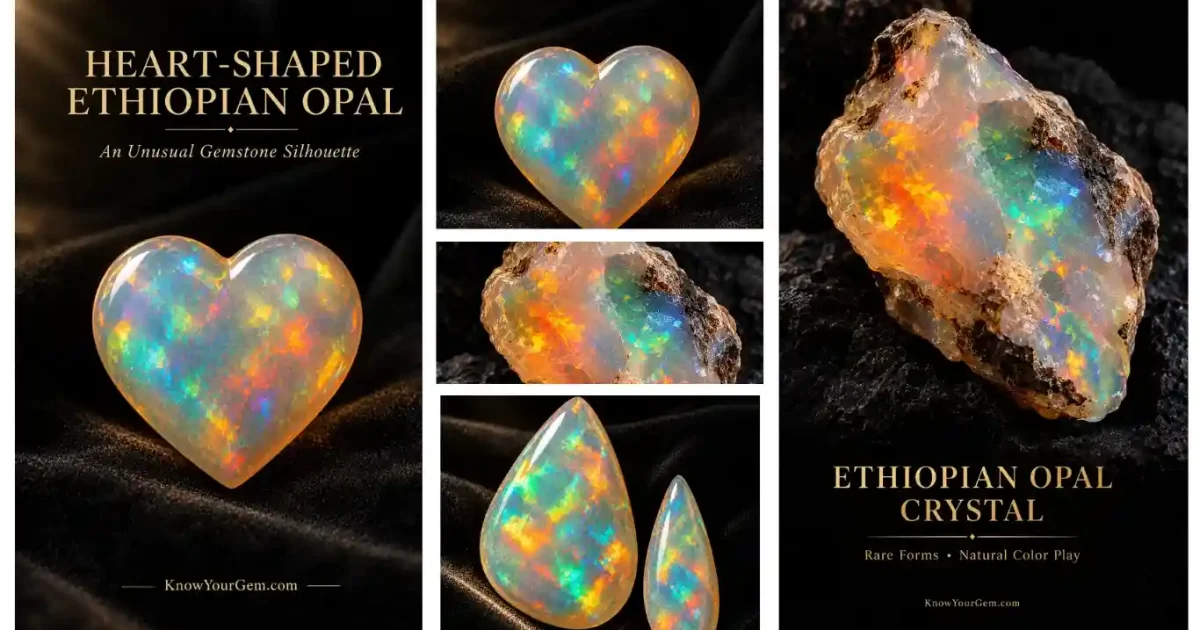

What Is Ethiopian Opal? Ethiopian opal is a natural opal that’s found in the country of Ethiopia. Like most other opals, it exhibits play-of-color, which are rainbow flashes that sparkle and dance across the surface of the stone.
A lot of it, especially from the Welo (Wollo) area, is hydrophane. In plain words, it soaks up water. That one trait shapes how you buy it, wear it, and clean it.
Quick Answer:
Ethiopian Opal is a natural stone. So an Ethiopian Opal is not necessarily the highest quality of stone and no two stones are exactly the same just because they come from Ethiopia.
Most Welo opal is hydrophane which can turn translucent in water, and can also crack when wet. Also find out if the stone is solid, assembled or treated, and always keep your valuables away from water.
What Is Ethiopian Opal?
Opal is hydrated silica, and it isn’t a true crystal. Under a strong microscope you’d see tiny silica spheres packed together. When those spheres stack in an even pattern, they split light into colors. That’s play-of-color.
What Makes It Different From Other Opals?
Mostly the water. A big share of Ethiopian opal is hydrophane, while Australian opal usually isn’t. Ethiopian stones also tend to be bright, and many have a light body tone.
The Welo finds changed the opal trade. Opal from Wollo Province came onto the market in large amounts from about 2008, and GIA researchers described it in 2010.
Where Is It Found?
Silica-saturated water enters cracks or cavities in a volcanic rock. In time, silica slowly drops out of solution to form small spheres. The perfectly aligned spheres produce color, but not perfectly aligned spheres produce plain opal, which doesn’t sparkle.
How Does It Form?
Silica-rich water seeps into cracks and cavities in volcanic rock. Slowly, the silica settles out as tiny spheres. If they line up neatly, you get color. If they don’t, you get plain opal with no flash.
Is It Rare?
Less than people claim. Plenty of Ethiopian opal reached the market after 2008. What’s harder to find is a bright, stable, well-cut stone in a good size. I’d never call it the world’s rarest opal, because nobody can support that.
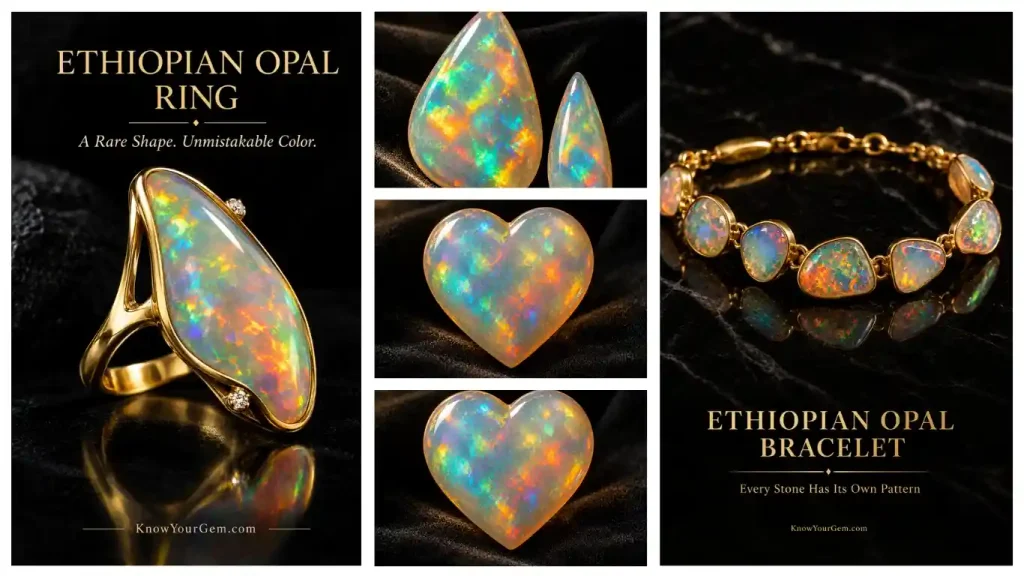
Ethiopian Opal Types, Colors and Patterns:
Keep two things apart. Body color is the base tone of the stone. Play-of-color is the flash that sits on top of it.
Names like “crystal” or “black” are trade labels. They don’t prove a formal variety, a natural color or a treatment status.
| White | Light, milky body | Translucent | Cabochon | Water absorption, cracks |
| Crystal | Clear body, bright flash | Transparent to translucent | Cabochon, sometimes faceted | Crazing, cleanliness |
| Honey or brown | Warm yellow to brown | Translucent | Cabochon, faceted | Natural color or dye |
| Dark | Gray to dark body | Translucent to opaque | Cabochon | Smoke or sugar treatment |
| “Black” | Very dark body | Opaque to translucent | Cabochon | Natural or treated, needs a lab |
A photo can’t confirm any of these labels.
Black Ethiopian Opal: Natural Color or Treatment?
Here’s the trap most buyers fall into. Hydrophane opal takes smoke well, and a smoked stone turns dark. GIA has written about this. Sugar treatment can darken it too.
Natural dark Ethiopian opal does exist. But you can’t tell it from a treated one by eye, so a dark body proves nothing. Ask for a lab report.
Faceted vs Cabochon:
Cabochons are the normal choice. The smooth dome protects the stone and shows the flash well. Faceted Ethiopian opal is out there, mostly in clear material, and its sharp edges chip more easily.
Which Patterns Do Buyers Prefer?
Color through the stone, visible in all directions, with a distinct pattern and quality of fire. A stone that only has fire in one direction will be disappointing to all but an expert after a short while. Always see in two or three lights.
Are All Ethiopian Opals Hydrophane?
No. Hydrophane just means the opal is porous and absorbs water. It’s similar to how a sponge absorbs water. But according to GIA most of the opal from Wollo is hydrophane. Most doesn’t mean all, though.
Why Do Some Absorb Water?
They’re full of tiny gaps. Water fills those gaps and changes how light moves through the stone. That’s why the look can shift.
Are All Welo Opals Hydrophane?
Not necessarily. Test the stone in front of you, not the region.
Does Hydrophane Behavior Prove Ethiopian Origin?
No. Other opals are also hydrophane and some Mexican fire opals do have a weak hydrophane effect. Use it as a lead, but nothing more.
Can You Identify Hydrophane Opal Without Soaking It?
Yes. A gemologist can check it under a microscope with light shining through. GIA describes this method, and it’s safer than putting the stone in water.
What Happens When Ethiopian Opal Gets Wet?
A splash or a quick rinse usually does no harm. Soaking is another story. Please don’t soak a valuable stone, and never use water as an authenticity test.
Why Does It Turn Transparent?
Water enters the pores which allows more of the light to pass directly through. The stone appears clearer and sometimes darker and the play-of-colour is sometimes different.
Does It Go Back to Normal?
Often it does, as it dries. I can’t promise it, because it varies from stone to stone. Some stones change for good.
Can Water Damage It for Good?
It can. GIA notes there’s a real risk of cracking whenever a hydrophane opal is immersed in liquid. And nobody can predict which stone will crack.
If Your Opal Gets Wet:
Remove from the water. Place it to dry naturally in the open air at room temperature, off any sources of heat. Avoid using any heavy friction. If it clouds up or develops a crack, take the item to a jeweler or gemologist to be evaluated.
Does It Need to Live in Water?
No. Store in a soft pouch in a dry area, don’t bring it near heat or anywhere its humidity could change.
Ethiopian Opal Durability, Hardness and Everyday Wear:
A more delicate material than many other well-known gemstones, many types of opal fall between 5.5 and 6.5 on the Mohs hardness scale. I won’t give a single fixed number, because it varies.
Hardness isn’t everything. Toughness and stability are important as well. Any opal will chip if it gets a knock, crack if you strike it, or craze from systematic wetting and drying.
Can You Wear It Every Day?
Yes, but cautiously. Pendants and earrings are easier to keep safe as opposed to rings, which are subjected to knocks, soap, water and chemicals throughout the day.
What About Engagement Rings?
Potential, but not quite ideal in my book. If you’re going to do it, bezel-set it, remove it for any rough work, and let the customer know the potential dangers beforehand.
What Causes Cracks and Crazing?
Impact, drying, temperature fluctuations, rapid cycling between wet and dry conditions in hydrophane opal, and aggressive chemicals. Not all Ethiopian opals will develop crazing. Nevertheless, the danger is there, so shield your stone.
How to Identify Genuine Ethiopian Opal?
Looks alone prove very little. Plenty of materials pass for opal at a glance.
A Simple Buying Routine:
1. Pay attention to the description. Uses words like solid, treated, doublet or triplet.
2. (SA) Check for stratification, warping, dye pooling or any other oddness on the stone.
3. Look for photos taken in comparable lighting.
4. Request the documents and review the Return Policy.
This routine raises questions. It doesn’t certify anything.
Glass, Synthetic Opal and Imitations:
Glass and plastic can imitate opal. Synthetic opal, like Gilson opal, is grown in a lab. A gemologist can separate them with a microscope and the right instruments.
Doublets and Triplets:
A doublet is a thin slice of opal glued onto a backing. A triplet adds a clear cap on top. Neither is solid opal. Check the side of your stone for a flat line or a layered edge.
Can a Photo Confirm Identity or Origin?
No. It will not tell you whether a stone has been treated, or what it is or where it is from.
Ethiopian Opal Treatments: Natural, Treated, Synthetic or Imitation?
A treated natural opal is still natural opal material. The treatment just has to be disclosed. Synthetic opal, imitation material and assembled opal are different things altogether.
Smoke Treatment:
Smoke can darken hydrophane opal. A pale stone can end up looking dark, and some pass as black opal.
Dye:
Hydrophane opal drinks up dyes just like water. In 2011, GIA documented a dyed purple Ethiopian opal, and more recently, they documented blue and pink dyed stones. Dyes tend to collect in tiny pits and scratches.
A brown Ethiopian opal was also dyed, according to GIA. So non-white hydrophane opal deserves extra suspicion.
Resin and Other Treatments:
Resin can fill the pores of porous opal. That’s a treatment, and sellers should disclose it. Sugar treatment darkens the body.
What Should Sellers Disclose?
Ask if the stone is solid, treated, dyed, resin-filled, or assembled. Get this in writing.
Does Treatment Make an Opal Worthless?
No. A treated stone should cost less than an untreated one with the same look, though. The real problem is hiding the treatment.
Ethiopian Opal Price and Value Guide:
I won’t publish a fixed price per carat. Without dated, verified sales of comparable stones, any number would mislead you. The same goes for “black Ethiopian opal price,” since a dark body alone doesn’t make a stone valuable.
What Affects Value?
| Play-of-color | Brightness, spread, pattern, colors |
| Body tone | Light, crystal, brown or dark |
| Transparency | Transparent, translucent or opaque |
| Condition | Cracks, chips, crazing, damage |
| Cutting | Proportions, polish, symmetry |
| Treatment | Known treatments and how well they’re disclosed |
| Construction | Solid, doublet, triplet or other |
| Market context | Comparable stones of similar quality |
Is Ethiopian Opal Expensive?
It depends. Some stones are affordable. Others, with strong color and good condition, cost far more. Price follows quality and condition, not the country name.
Does Brightness Matter More Than Body Color?
For many buyers, yes. Strong play-of-color usually matters most. Body tone still shapes the look and the price, though.
Does a Certificate Raise the Price?
Not by itself. A report tells you what the stone is. The confidence that comes with it can support a better price
How to Compare Two Stones Fairly?
Match body tone, size, brightness and treatment status first. Then compare prices, and label each one as an asking price or a sold price.
Not an Investment:
I don’t treat opal as an investment. Prices move, and nobody can promise a return.
Ethiopian Opal vs Australian Opal:
Both sources offer nice stones and a wide range of material.
| Hydrophane | Often, especially Welo | Usually not |
| Body tone | Often light to medium | Light to black |
| Play-of-color | Often bright | Often bright |
| Stability concern | Water absorption, crazing in some stones | Varies by stone |
| Treatment concern | Smoke, dye, resin | Less common |
| Natural black opal | Can’t be reliably told by eye | Known source of natural black opal |
I won’t rank one above the other. Ethiopian opal isn’t always unstable, and Australian opal isn’t always stable. Judge the stone you’re holding.
Ethiopian Opal Jewelry, Beads and Cutting:
Rings, Earrings and Pendants:
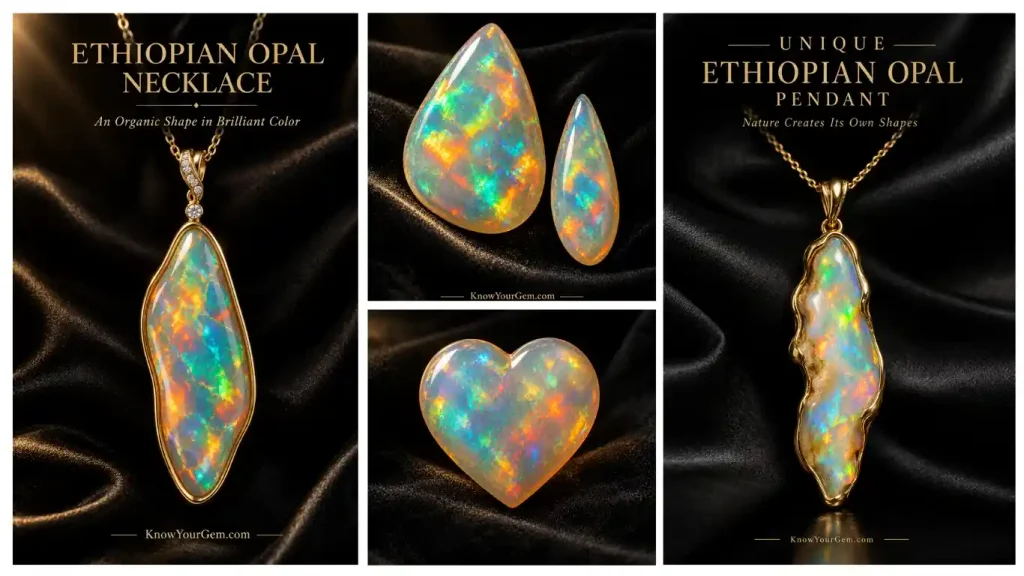
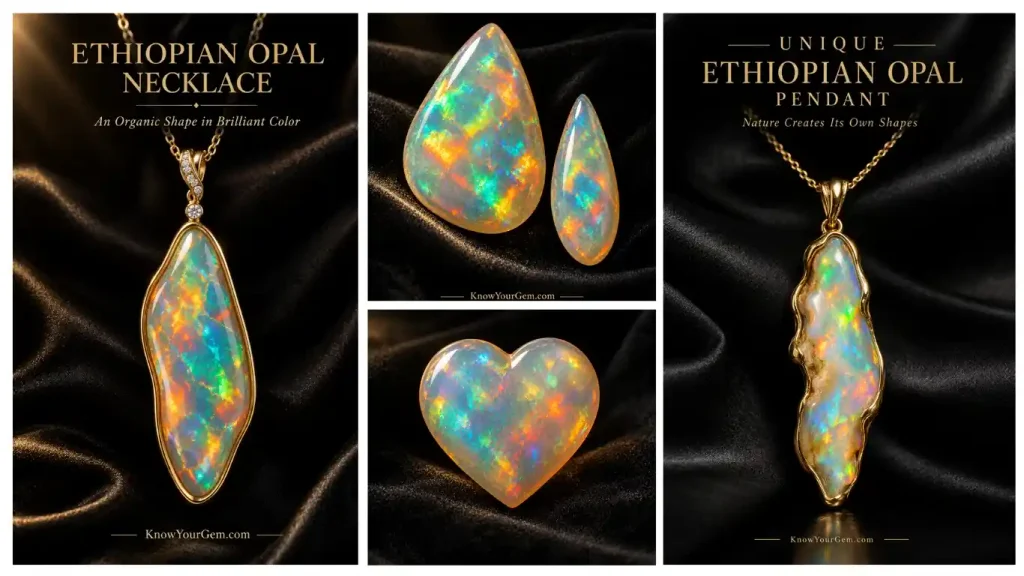
It is a beautiful ring, but remember diamond is a lot harder than opal so keep the opal protected. Drop earrings and pendants are good choices.
Beads:
How tough are opal beads? Because drilling puts stress on them, they are quite delicate. They are suitable for delicate wear, not rough use.
Cutting and Polishing:
Opal can be difficult to cut. But moisture, heat and stress can crack rough. Don’t tumble valuable stones; remember drilling and polishing can cause problems as well. If the rough is valuable, have an experienced opal cutter cut it. I am not going to give a do-it-yourself procedure.
How to Clean and Care for Ethiopian Opal?
Wipe with a soft, damp cloth and dry thoroughly. That’s all it takes.
- Avoid prolonged soaking.
- Don’t fool around with ultrasonic cleaners, because water with just a splash of mild soap will do the trick.
- And, this stone should be isolated from other chemicals, soap, and any other cosmetics.
- Before hand washing, bathing or swimming, take off jewelry.
- Store it dry in a soft bag in a cool place.
- Have a jeweler check the setting on occasion.
Stop cleaning when the stone starts to become cloudy and bring it to a professional.
Is Ethiopian Opal Ethical?
Country of origin doesn’t prove ethical sourcing. It says nothing about working conditions, environmental practices or the chain of custody behind one stone.
So ask real questions. Who mined or supplied the rough? Can the seller show documents? How did the stone travel to the cutter? How are labor and safety handled? A promise isn’t proof, and documents are.
My Experience With Ethiopian Opal:
KnowYourGem is an online gemological source. We help genuine buyers and verified sellers find each other.
Once, a jewelry owner contacted us looking for verified sellers of gem-quality rough. They planned to cut the stones to suit their own clients. We connected them with the owner of the Yita Ridge deposit. They bought gem-quality rough and were happy with it.
What I took from that is simple. Buyers do better when they deal with a verified source and ask about the stone first. If you’d like to reach us, use our contact page.
The Biggest Buyer Mistake:
Many buyers assume a bright, dark or colorful opal must be real, natural and stable. That’s the mistake I see most.
Actually, appearance doesn’t matter that much. Smoke, dye, resin and glued-up stones can all look really good. Additionally, a stone can be a hydrophane, which will make a difference to your wearing and caring for it.
A first time buyer might soak the opal in water to see if it is real or just use the black opal to assess its value or think all Ethopian opal is a fragile and soft stone. They also overlook impact, moisture changes and unprotected ring settings. Avoid those four, and you’re ahead of most buyers.
Ethiopian Opal Buyer Checklist:
1. Check the play-of-color in more than one light.
2. Confirm whether the stone is solid or assembled.
3. Ask if there has been smoke, dye, resin, or other treatment.
4. Enquire if it’s hydrophane, and how the seller knows.
5. Observe for fractures, chips and also crazing.
6. Look at the location.
7. Look over the return policies.
8. Request lab report if price is very high.
Do not wet the stone to test it.
Walk away from anyone who promises investment returns. You can browse our other gemstone guides in the GemHub.
Ethiopian Opal Benefits, Astrology and Healing Claims
These are beliefs, not scientific facts.
Several modern lists identify opal as the birthstone for October. Traditions associate it with creativity, hope, and change. Certain astrological traditions also connect it with Venus, and
There’s no established clinical evidence that opal treats menopause symptoms or any medical condition. Don’t pay extra for a health claim. If the significance is essential to you, cherish it as tradition, and choose the stone for quality.
Frequently Asked Questions:
1. What Is Ethiopian Opal?
Natural Ethiopian Opal (play-of-color). Much of it is Hydrophane.
2. Are All Ethiopian Opals Hydrophane?
No. Most Welo opals are, but this varies from stone to stone, so you’ll need to ask individually.
3. Can Ethiopian Opal Get Wet?
A splash is usually fine. Don’t soak it, because soaking can cause cracks.
4. Is Black Ethiopian Opal Natural?
Sometimes, but many dark stones are smoke or sugar-treated. A lab can confirm.
5. Can I Wear Ethiopian Opal Every Day?
Maybe, with caution. But Pendants and earrings are more secure than rings.
6. How Can I Tell If Ethiopian Opal Is Real?
Read the description for layers or dye and ask for literature. Use a lab when the cost is high.
7. How Much Is Ethiopian Opal Worth?
There’s no fixed price. Play-of-color, body tone, condition, treatment and construction decide it.
8. Does Ethiopian Opal Help With Menopause?
There is no clinical evidence of that.
Sources:

Welcome to KnowYourGem.com! your ultimate destination for uncovering the fascinating world of gems and their secrets! I'm Kamil Hussain, a passionate blogger with a Master’s degree in Economics, dedicated to bringing you insightful, well researched content that blends the beauty of gemstones with the art of storytelling. With a keen analytical mind and a love for discovering hidden treasures, I created this platform to help you explore the brilliance, history, and value of every gem.

