
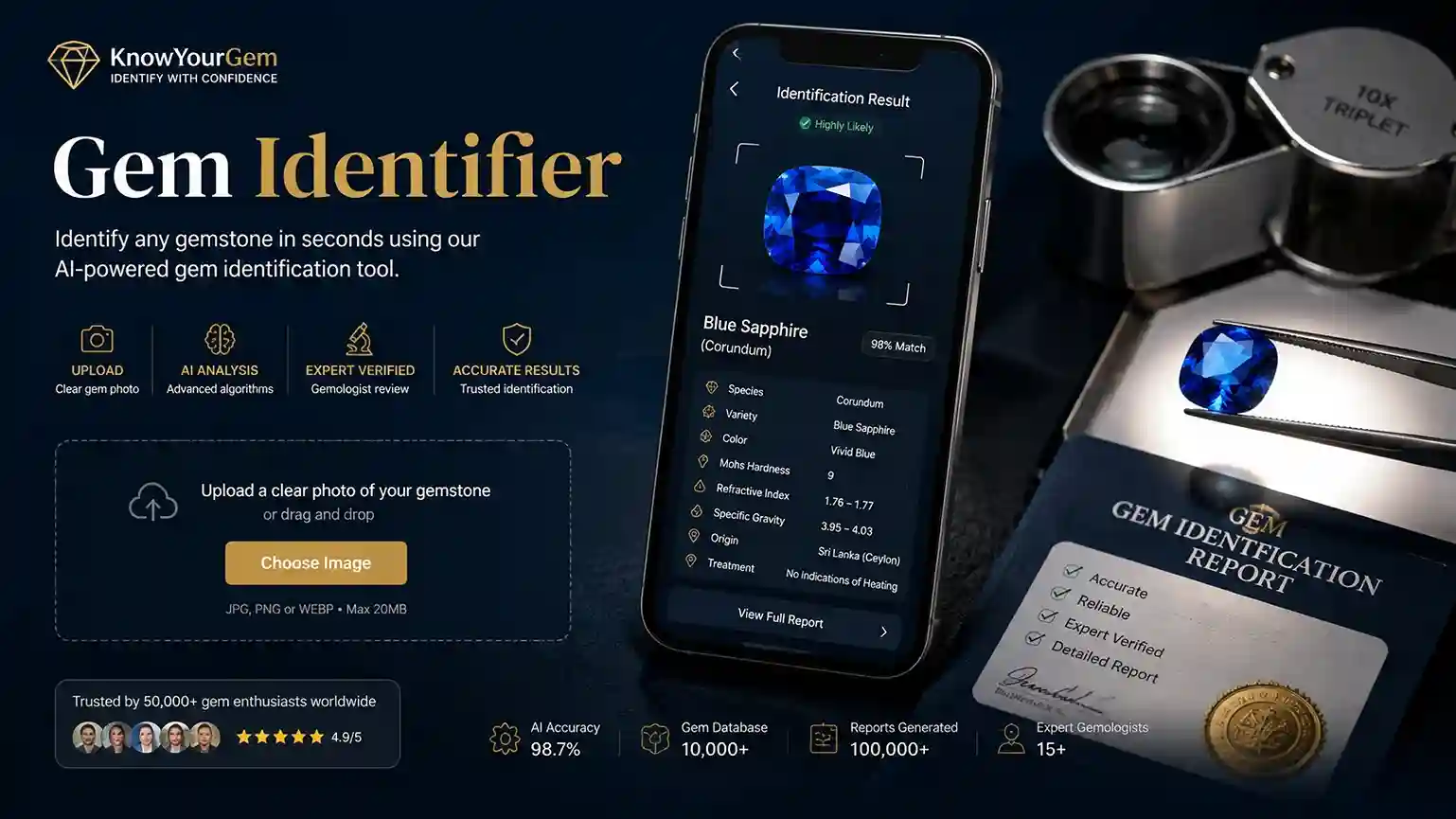
Gem Identifier: Identify Gemstones by Photo
While uploading a gem’s photo or entering, you can observe that this gem identifier tool matches it against a structured gemological reference that returns likely identification, the evidence behind it, close lookalikes, and the test that will mostly helpful to resolve any remaining uncertainty.
It is a free gemstone identifier and stone identifier and gem identifier by picture, built to be honest about what a photo can and can’t prove.
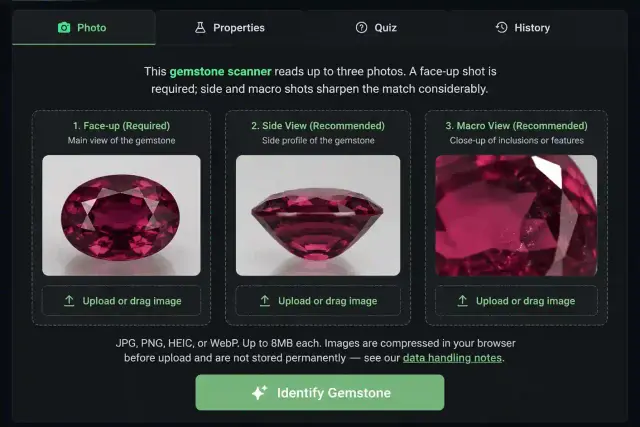
This gem identifier reads up to three photos. A face-up shot is required; side and macro shots sharpen the match considerably.
JPG, PNG, HEIC, or WebP. Up to 8MB each. Images are compressed in your browser before upload and are not stored permanently — see our data handling notes.
Answer what you can — skip anything you’re unsure of. Each answer narrows the field; you don’t need all of them for a useful result.
A quick, playful what gem am I quiz for when you don’t have a stone in hand yet — three questions, one lighthearted starting point.
How Our Gem Identifier Works?
Most of the other tools that usually introduce themselves as gem identifier are actually a single classifier, like a photo in and name out. That approach still overstates what a photo can prove.
However, this built-in gem identifier approach integrates several independent signals such as the photographs you provide, gemological properties you can observe or measure, and a structured reference database and scores every plausible candidate against all of them at once. .
Each result in this tool separates a likely identification, which is supported by the evidence that you provided, from a confirmed identification, which requires instruments a browser can’t replicate: for example, a refractometer, a polariscope, and a microscope, or a gemological laboratory.
When the evidence is thin, the built-in says so directly rather than forcing a confident-sounding guess.
Identify a Gemstone by Picture:
Photo quality can change what you can actually see, just like a gemologist’s loupe does. A face-up shot showcases the stone’s color, cut, and overall clarity. A side or profile shot uncovers color zoning and in-depth hue that front lighting can generally hide. And when users move in close with a macro shot, that’s when inclusions and the stone’s internal “fingerprint ” start to appear. internal “fingerprint” of a stone — actually become visible.
A few simple habits make a big difference:
- For authentic photography, use soft daylight instead of a harsh flashlight.
- Remove fingerprints and dust before shooting.
- Keep the background plain and neutral.
- Hold the camera close to the facets or crystal faces to keep them sharp rather than making them look like a colored blur.
How AI-Assisted Gem Identification Works?
The built-in gem identifier AI vision model looks at a gemstone photo the same way that a trained eye does on first glance: it notes the color, how important the stone seems, the luster, the cut style, and any inclusions or growth structures that show up.
Those are first impressions, and they are compared against a reference database of gemstone traits things like hardness, refractive index, birefringence, specific gravity, and typical inclusion patterns to inspect which species and varieties line up with what’s visible.
It is basically pattern-matching against recognized optical behavior, not a chemical test. The logic is the same as when a gem enthusiast says, “That could be spinel, not ruby, ” but here it is applied systematically and with full disclosure. And essentially, the modal can also admit when a photo simply isn’t enough to make the call.
Can You Identify a Gemstone From a Photo In Gem Identifier?
A photo can generally narrow the stone down to its species or variety. Users can generally tell corundum from spinel, or a garnet from a tourmaline, because color, luster, and visible inclusions carry real diagnostic weight.
What a photo can not do is measure refractive index, specific gravity, or hardness directly. And it can’t reliably separate natural from lab-grown material when both are clean and well cut.
You can treat photo-based results as a strong start hypothesis, not like a final verdict, especially before insuring, selling, or paying for something based on species.
How to Tell If a Gemstone Is Real?
“”Real” reflects two different questions: one is whether the mineral claimed to be (not glass or a simulant), and whether it is natural rather than lab-grown. Both have visual clues, though neither is settled by eye only.
- Glass Clues If you see bubbles or swirl marks on the stone under magnification, that is glass, not a crystalline gem.
- Facet Doubling When back facets show bubbles through the front with a loupe, it means strong birefringence. You easily spot this in peridot or tourmaline, but not in diamond, garnet, or spinel.
- Touch Test Diamonds can feel cool longer than glass or plastic because they conduct heat so well. But this is only a rough field check a thermal probe is the realistic tool for the job.
- Inclusions Tiny crystals, fractures, or growth zoning usually point to a natural stone. However, a flawless, bubble-free interior, on the other hand, can often mean glass or synthetic.
How to Tell If a Ruby Is Genuine:
An authentic ruby often gives itself away under testing. Mostly untreated or heat-treated gemstones display strong red-to-orange fluorescence under long-wave UV. They also show pleochroism that shifts between purplish red and orange red, but hinges on the directional view.
For authentic gem identification under magnification, you can see silk (fine rutile needles) or “fingerprint” healed fractures, both classic signs of natural corundum. In contrast, red glass and synthetic ruby can disclose rounded gas bubbles or curved striae, instead of the angular growth patterns that authentic stones form.
How to Identify a Raw Diamond:
Natural raw diamonds primarily show an octahedral shape like two pyramids joined base-to-base or a rounded dodecahedral habit. Their surface looks greasy rather than shiny, but if they are wiped, even the rough faces give off that unmistakable adamantine luster.
Since a rough diamond is also hard enough because it has 10 Mohs hardness can scratch quartz and topaz easily, while quartz can not scratch it back. Its 3.52 specific gravity feels noticeably stronger in the hand compared to quartz or glass-like stones in the same sizes.
Natural vs Laboratory-Grown Gemstones:
Lab-grown gems can be chemically and structurally identical to natural stone because they share the same formula, crystal lattice, and optical behavior; that’s why they can be so hard to tell apart just by looking.
The realistic differences come from their formation. Those conditions leave different types of inclusions, not different colors or brilliance. So what you are spotting under magnification can’t change in the gem’s sparkle, but subtle clues in its internal “fingerprint.
Natural
Grows over geological time in rock. Often carries mineral inclusions, healed fractures (“fingerprints”), and irregular color zoning tied to its specific geological environment.
Laboratory-grown
It grows in a few weeks to months under controlled conditions. It can show growth lines (flame-fusion), metallic flux inclusions (flux-grown), or unusually few inclusions overall.
Reliable separation is a laboratory task, but it typically uses microscopy for inclusion type, and sometimes spectroscopy or trace-element analysis for material where inclusions alone aren’t conclusive. This tool will flag when a candidate has well-established synthetic counterparts, but it does not claim to make that determination from a photo.
How Professional Gemologists Identify Gemstones:
Gemological experts usually work through a sequence of non-destructive testing, from fastest to the most specialized, through adding each if the previous results leave more than one candidate standing:
No single testing method is decisive on its own, but the identification comes from the pattern across several of them, which is exactly the multi-signal approach this tool tries to approximate with the information you can provide from home.
Gemstone Identification Tests:
If you want to know what a photo of the stone can tell, a small starter kit generally makes a big difference. A 10× loupe, a UV flashlight, and a simple specific-gravity setup with a scale and a container of water can clear up a surprising number of common mix-ups without needing specialized gear.
Skip destructive tests altogether. Scratch testing against reference minerals should only ever be done on an inconspicuous facet or the girdle and never on a stone whose value you don’t yet recognize. When you are unsure, a gemological laboratory can run the same tests safely, with no risk to the stone.
Gemstone Lookalikes

Natural gems like ruby, red spinel, and rhodolite almost look like garnet by color when you view them at different angles. Their traits, such as specific gravity and the types of inclusions, can separate each variety.
That’s why color isn’t a reliable gem identifier in gemology; too many unrelated minerals share the same hue. Classic mixtures include ruby vs. red spinel, emerald vs. tsavorite garnet, aquamarine vs. blue topaz, and sapphire vs. blue spinel or tanzanite. No one can be resolved through color alone.
A good identification tool like gem identifier always lists the lookalikes worth ruling out, and highlights the properties that actually separate them.
Identify Minerals by Picture:
The same matching approach extends to rough mineral specimens, not only faceted gems. Crystal habits the characteristic shape a mineral grows into- are often more diagnostic in a rough material than in cut stones since faceting deliberately erases the original crystal form.
Use the Identity by photo or Identity by properties mode and note the crystal habit field if you have an uncut specimen and you want to know its identity through a gem identifier. Inclusion microscopy example: fine rutile “silk” like inside corundum is a diagnostic clue no color photo alone can capture.

Gemstone Grades:
Grading and identification both are separate steps. Identification answers “how good an example of that stone is it?” it is typically scored across color (hue, tone, saturation), clarity (inclusions visibility), cut quality, and carat weight.
The tool gem identifier only addresses identification, but grading for value purposes should come from a certified appraiser or lab report, since it depends on physical inspection under controlled lighting.
Gemstone Identification FAQs
Not a photograph can support identification of species and varieties, but confirming natural vs synthetic origin or undisclosed treatment generally requires microscopy, spectroscopy, or other lab testing that examines inclusions and trace elements that a camera can’t resolve.
Yes. Gem identifier is 100% free; there is no need for account creation, no paywall, and no artificial daily limit.
Yes gem identifier works. Because raw specimens often preserve crystal habit cleavage evidence that cutting can remove, which can also be identified more easily in some respects than with a faceted stone.
No. Identification and valuation are different tasks. So, value depends on grading factors: exact color, clarity, cut, carat weight, and current market demand, which requires a qualified appraiser’s physical inspection not gem identifier tool.
The photo or properties that are provided can’t point clearly enough to a single candidate. Users can see the top possible candidates, why each remains plausible, which additional observation can help, and which professional test would resolve the uncertainty./p>
Methodology, Limitations & About:
Methodology:
Photo observations and user-entered properties that are scored against a structured reference database that covers hardness, refractive index, birefringence, specific gravity, luster, and recognized patterns for each Photo observations and user-entered properties are scored against a structured reference database.
Results are shown by how much the provided evidence is consistent with it, not by a black-box confidence percentage.
Limitations:
Photo-based color and clarity can be affected by lighting, camera, and screen calibration. The built-in can’t measure RI, SG, or hardness directly, and can not reliably separate natural stone from lab-grown material.
But users can explore guides about hardness, RI, and SG on the existing site for almost every gem. The tool’s results are a starting hypothesis, not a certification.
About KnowYourGem:
KnowyourGem is an independent gemstone education and informational guideline for collectors, jewelers, and enthusiasts. We are not affiliated with GIA, GemRock, IGS, or any other gemological laboratory, and we do not issue certification.
Sources & references:
Property data is drawn from standard gemological references on mineral hardness, optical properties, and diagnostic inclusions. Where value can vary by locality or treatment, we show a range rather than a single figure.