

Value, price & investment:
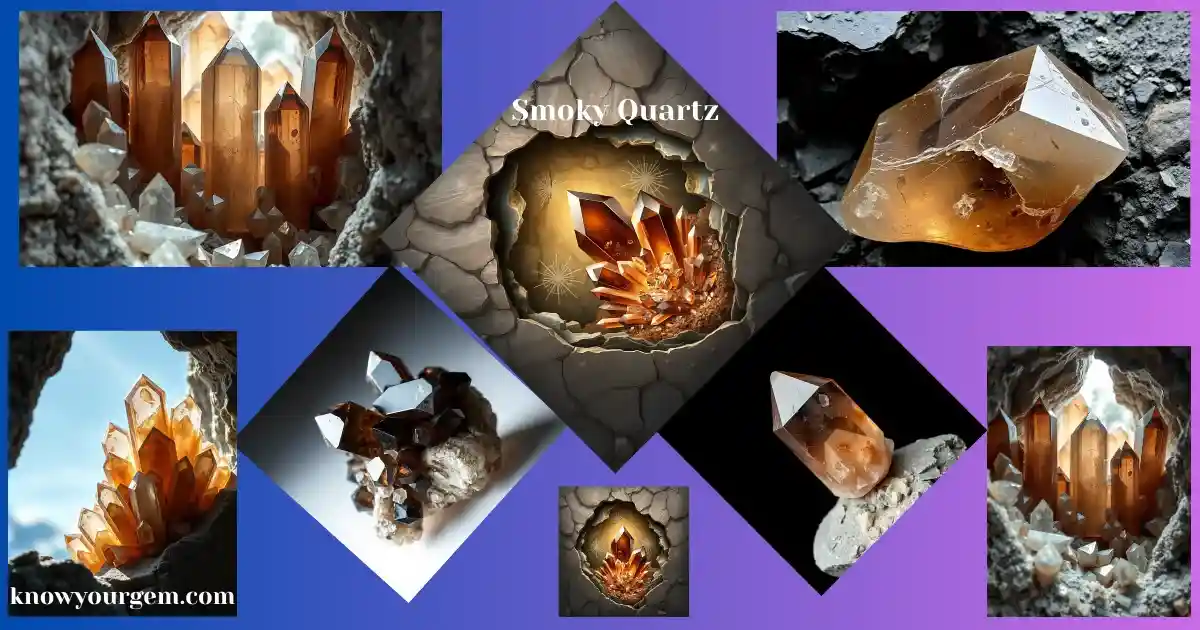
Smoky Quartz is a stunning variety of the mineral usually called quartz (silicon dioxide, SiO). the stone is distinguished by its characteristic brown-to-black translucent color. Although, this smoky coloration develops naturally when aluminum impurities within the crystal lattice are generally exposed to the natural radiation for more than millions years, a gemological process that transforms colorless quartz into the most visually striking gemstones available. Smoky Quartz is durable enough with having 7 mohs scale and also carrying a warm, earthy look. It is popular in both jewelry and mineral collections. Major sources including Brazil, Madagascar, Scotland, and Swiss Alps, make it widely available, because top quality pieces can still be quite valuable.
Get more details about Hessonite garnet:
Quick answers about smoky quartz:
Get quick solution of your problems through given below questions and answers:
1. What is smoky quartz?
Smoky Quartz is brown to black colored transparent gemstone belongs to the quartz family. Jewelry seekers desire to see its transparency on daily wear jewelry like ring, while having chemical formula of (SiO) it displays its smoky color saturation, which results from the natural irradiation of aluminum-bearing crystals. This gem belongs to the trigonal crystal system and owns 7 mohs scale of hardness which make it durable enough for daily wear jewelry.
2. Why is smoky quartz smoky?
The smoky color grows from a radiation-induced color center mechanism. When natural gamma radiation from surrounding rocks strikes quartz crystals contain trace aluminum impurities, free electrons become trapped at aluminum substitution sties within the silicon dioxide lattice. Since, these trapped electrons absorb specific wavelengths of visible light, that produces the brown and gray tones characteristic of Smoky Quartz. Higher radiation does and greater aluminum concentrations produce darker stones.
3. Is smoky quartz rare?
Smoky Quartz isn’t considered rare as like other previous gemstones including Ruby or sapphire but it is widely distributed across all major continents and is commercially available accessible price points. However, large, deeply colored, inclusion free crystals, especially those which exceed 10 carats or display the near black Morion coloration, are significantly less common and command collector level premiums.
4. Where is smoky quartz found?
Smoky Quartz generally forms in Granite, pegmatite veins, and Alpine fissures. Its major commercial sources like, Brazil, Madagascar, Scotland, and Switzerland, each location is recognized for different specimens. Additional deposits are found in Colorado, Russia, and several African countries that make this gemstone both widespread and diverse in origin.
5. How much is smoky quartz worth?
Commercial grading Smoky Quartz is generally sold around $5 to $20 per carat.However fine jewelry-quality stones command price from $20-$100 per carat. An exceptional collector pieces or large crystals can go well beyond $100 per carat, sometimes they are sold for hundreds of dollars. Prices majorly hinge on color depth, clarity, cut precision, and crystal size.
6. Is smoky quartz natural or treated?
Mostly Smoky Quartz gems are naturally get their color through radiation more than millions of years. Some pale or clear quartz stones are treated in labs with artificial irradiation to create or deepen the smoky color. These treated stones look almost the same as natural ones and can only be identified through advanced tests by expert labs like the GIA.
7. What is a smoky quartz good for?
Smoky Quartz is a best for making grounded your energy, also good for protecting you against negativity, and stress or emotional blocks. This gemstone is basically used detoxify, enhance immunity, and to promote calm focus.
8. Is smoky quartz worth any money?
Smoky quartz is an affordable, it is typically sold for $1-$10 per carat for quality pieces that totally hinges on size, clarity, and cut nothing super pricey unless rare and large.
9. Can Capricorn wear smoky quartz?
Capricorns can wear this stone on daily basis as jewelry, which can boost their confidence and ease fears. It also helps soften self doubt, balancing their natural stubbornness with steady strength.
10. Is smoky quartz good for Scorpio?
Absolutely, it is good for Scorpios as well, its can be helpful to break bad vibes at home or at work , it shields from hostility or gossip, and supports intense emotions.
Smoky quartz quick facts:
| Property | Details |
| Mineral family | It belongs to Quartz (Silicon Dioxide) |
| Chemical formula | Its chemical formula is SiO₂ |
| Hardness | The stone owns 7 Mohs scale of hardness |
| Crystal system | It forms in Trigonal crystal system |
| Color range | It has color like Light brown to near-black (Morion) |
| Transparency | It is Transparent to translucent |
| Refractive index | Quartz is calculated by 1.544 – 1.553 refractive index |
| Specific gravity | It owns 2.65 Specific gravity |
| Major sources | Brazil, Madagascar, Scotland, Switzerland |
| Common uses | This gem can be used in Jewelry, mineral specimens, metaphysical |
What is smoky quartz basically known for?
Basically Smoky Quartz is recognized for its stunning Smoky color saturation and also for its durability. Modern jewelry seekers love to see this gem on their daily wear jewelry like ring, bracelet and earring. It crystallizes in the trigonal crystal system, and gets its color from tiny impurities and radiation. Smoky quartz is most recognized variety among all quartz family members like, Amethyst, Citrine, and Rose quartz.
Its definitive characteristic and its warm color spectrum which ranges from light champagne-brown through rich chocolate tones to the near opaque black of Morion Quartz make it desirable crystal. Since, this coloration is not caused by separate mineral inclusion but through structural defect within the quartz crystal lattice itself, that makes Smoky Quartz a true color variety rather than a coated or composite stone.
Geologically, Smoky Quartz forms under a specific set of conditions: the presence of trace aluminum within growing quartz crystal, that is combined with sustained exposure to the natural ionizing radiation from nearby radioactive minerals like uranium or potassium-40. This combination creates what gemologists call a “color characteristic smoky hue.
While having 7 mohs scale, Quartz is well suited for jewelry use, that offer good resistance to everyday scratch while remaining workable for lapidaries. Its good transparency, vitreous luster, and conchoidal fracture make it an excellent cutting materiel, and its availability in large crystal sizes allows for bold, striking gemstone cuts rarely achievable with rare gems.
How smoky quartz forms in nature:
Smoky Quartz forms in surprisingly stunning way. As quartz gradually crystallizes from hot, silica-rich fluids deep underground or forming of cooling granite and pegmatite rocks, infinitesimal amounts of aluminum slip into the crystal structure, and takes the place of silicon. These subtle “swap” create little imperfections, balanced out by nearby alkali ions, and its delicate changes give it unique character and dusky beauty.
The coloration process itself a radiation induced phenomenon. Since, natural gamma radiation and alpha particles emitted by radioactive minerals in the surrounding rock, particularly uranium and thorium-bearing minerals, penetrate the growing quartz crystal and dislodge electrons from oxygen atoms that are associated with the aluminum substitution sites. These liberated “electrons hole color center” or specifically an Al-O⁻color center in quartz science literature.
These trapped electrons absorb light in the visible spectrum, particularly in the blue-violet range, that causes the crystal to appear brown, gray, or black by subtraction. Although, the greater the aluminum content and the higher the cumulative radiation dose. The darker the resulting Smoky Quartz coloration.
Smoky Quartz tends to grow up in three major natural settings:
- Granitic pegmatites, can be found where slow cooling of silica-rich magma enables huge crystals to form.
- Alpine fissure veins, They are usually high in the mountains, especially in the Swiss and Austrian Alps, where hot fluids fill cracks in metamorphic rock.
- Granite cavities and miarolite pockets, open spaces inside granite where mineral-rich fluids leave behind beautifully shaped quartz.
Its ultimate shade is that while a soft gray or the deep black of Morion Quartz comes from the delicate balance between the crystal’s structure, the amount of aluminum inside, and how long and intensely it is exposed to the natural radiation. In other words, nature’s chemistry and time collaborate to the paint Smoky Quartz with its signature smoky tones.
Smoky quartz color and varieties:
The color spectrum of Smoky Quartz a broad range, and gemologists and collectors who recognize several informal grades and named varieties based on depth of color.
Light smoky quartz:
The palest variety showcases very light gray-brown tones, sometimes called “champagne quartz” informally in the trade. Light Smoky Quartz transforms considerable light and showcases good brilliance when it is faceted. These stones are popular in large-format jewelry designs where dramatic size is desired at moderate cost.
Medium smoky quartz:
The most commercially resistant category, medium Smoky Quartz displays warm chocolate-brown to gray-brown coloration with good transparency. This grade can balance an attractive color depth with transmission, that makes it an ideal for faceted gemstones in jewelry like ring, pendant, and earring, Medium smoky tones offer the best combination of visual impact and affordability.
Dark smoky quartz:
Deep brown to nearly black stones with having limited light transmission. The dark dark smoky quartz is highly treasured by collectors and jewelry designers dramatically, and bold aesthetics. These stones demand precise cutting to resist an overly dark appearance under low light conditions, and skilled lapidaries often choose cut profile to maximize light return
Morion quartz:
The darkest of the spectrum, Morion (from the Latin “morion” for type of dark helmet) that describes opaque to near-opaque black Smoky Quartz. True Morion is relatively uncommon and highly collectible. Since, large Morion crystal specimens from Brazil and Madagascar are particularly sought after by mineral collectors and can command significant premiums.
Cairngorm:
Cairngorm is the smoky quartz comes from Scotland’s Cairngorm Mountains. Cairngorm is basically recognized for its warm amber-brown color. It is a key part of Scottish cultural, used in highland dress like kilt pins, brooches, and knife handles.
Like other quartz types, it shares the similar base but gets its unique hue from chemistry and nature:
- Amethyst: violet from iron and heat.
- Citrine: yellow from heated iron.
- Rose Quartz: pink from rutile or titanium.
Each has its own “color story.”
Where smoky quartz is found:
Given below the major ethical sources where Smoky stone is found:
Brazil:
Brazil produces the world’s top smoky quartz, majorly in Minas Gerais state’s huge pegmatite fields. Since, these yield massive, gem quality, clear crystals ideal for jewelry. It is cherished for producing warm brown shades and large flawless pieces that appeal to jewelers and collectors.
Madagascar:
Madagascar produces some of the finest larger Smoky stone specimens in the world. Malagasy crystals frequently showcase an exceptional size, well-developed prism faces, and rich uniform coloration. The island’s granitic geology provides an ideal pegmatte environments for quartz development, and madagascan Smoky stone commands high prices in the mineral specimen market.
Scotland:
The Carigorm Mountains of the Scottish Highlands have produced Smoky stone for centuries. Since, Caringorm stones hold a deep cultural significance in Scotland and remain among the most iconic regional gem varieties in the world. Cairngorm pieces carry heritage value in addition to their gemological merits.
Switzerland:
The Swiss Alps are renowned for spectacular Alpine quartz specimens, which includes larger and highly lustrous Smoky crystals recovered from fissure veins in metamorphic basement rocks. Swiss Smoky quartz, sometimes associates with chlorite inclusions that give crystals a green phantom effect, is among the most cherished material for high-end mineral collectors and museum specimens.
Other Notable Deposits:
Significant Smoky crystal also lies in Colorado state (USA), where crystals from the Pike’s peak grante are popular among American collectors; Russia (Ural Mountains and Siberia); Namibia; Zambia; and India. Each geographic ethical origin can impart subtle differences in crystal habit, color tone, and inclusion characteristics that experienced collectors recognize.
Physical & optical properties of smoky stone:
| Property | Value | Notes |
| Chemical formula | ISmoky stone owns chemical formula like, SiO₂ | Silicon dioxide |
| Crystal system | It has Trigonal crystal system | Means that the stone own hexagonal prisms with rhombohedral terminations |
| Mohs scale | It is 7 on the mohs scale of hardness | Means that the stone resist scratches |
| Specific gravity | It owns specific gravity like, 2.65 | Consistent across quartz varieties |
| Refractive index | The tone is calculated by 1.544 – 1.553 refractive index | Uniaxial positive |
| Birefringence | It owns 0.009 birefringence | Low, not visible to naked eye in faceted stones |
| Luster | It has Vitreous (glassy) | High polish achievable |
| Transparency | The stone is transparent to translucent | Varies by color depth |
| Cleavage | It carries no cleavage (poor in some directions) | Conchoidal fracture instead |
| Pleochroism | Weak to none | Color consistent from all directions |
| UV fluorescence | Inert | Means it doesn’t has fluoresce under UV |
Refractive index of smoky quartz:
Smoky stone is measured by 1.544-1.553 refractive index which means that it is typical for quartz varieties. This is measured while using a gemological refractometer to identify it from fakes like smoky glass, dark topaz, or treated synthetic quartz.
Fracture and Durability:
It lack cleavage and showcases a conchoidal, shell like fracture instead. This can make it chip-resistant and durable for daily wear jewelry, with a glassy luster that polishes to the high brilliance in lighter shades.
Smoky quartz value and price guide:
The smoky stone market divides broadly into the two segments: The faceted gemstone market that servers jewelry manufactures and designers, and the mineral specimen market that serves collectors and intuitions. Since, prices can dynamically different significantly between these two channels.
| Quality Category | Price Range (Per Carat) | Key Characteristics |
| Commercial grade stones can command | $5 – $20 | Light to medium color, minor inclusions, standard cuts |
| Fine jewelry grade stones can be sold for | $20 – $100 | Rich uniform color, eye-clean, precision faceting |
| Premium / collector grade demands high prices like | $100+ | Exceptional color, large size, rare varieties (Morion, Cairngorm) |
| Large crystal specimens can also command | $50 – $500+ per piece | Museum-quality crystals from Madagascar or Switzerland |
The primary value factors for faceted Smoky quartz gemstones are as follows:
- Color saturation and uniformity: While having a rich, evenly distributed brown coloration believed to command higher prices than pale or uneven stones.
- Clarity: An eye clean gemstones with having no visible inclusions are preferable for jewelry applications.
- Cut quality: Precision faceting can maximize the brilliance and light return, significantly grow value.
- Carat weight: Larger clean gemstone are proportionally more valuable; since, fine material with having more than 20 carats can genuinely uncommon.
For mineral specimens, aesthetic factors dominate: crystal size, face development, matrix presentation, luster quality, and geographic provenance like Swiss and Madagascar specimens typically command the hugest prices. An exceptional specimens from renowned localities have sold at the major auction houses for thousands of dollars.
How to identify real smoky quartz:
Give below the complete guide to spot out a realistic stone you can follow:
Refractive index testing:
Gemologists use refractometer to understand how much light bends inside a gemstone. For smoky quartz, the reading of gem generally falls in between 1.544 and 1.553, with only a tiny difference of 0.009. Although, this small range can help to separate it from other materials and glass is lower around 1.48-1.52 and dark topaz is higher like, 1.609-1.643.
Hardness Testing:
While having 7 mohs scale Smoky stone scratches glass easily but can’t be scratched by steel blade. Hardness testing must be performed cautiously and only on inconspicuous areas of the specimen to resist damage.
Natural Inclusions:
Genuine Smoky stone often contains characteristic natural inclusions: Needle like rutile, negative crystals (fluid inclusions), two phase inclusions, and growth zone patterns visible under magnification. The complete absence of inclusions in dark brown stone can suggest glass or synthetic material.
Lab Certification:
For high value purchases, laboratory certification from well recognized gemological institution endows the most authoritative authentication.Since, the gemological institute of America (GIA) and the International Gem Society (IGS) embodies the leading standards bodies in gemstone verification. A GIA report confirms species identity, ,color origin that is naturally treated, and detectable enhancement.
Smoky Quartz Jewelry Guide:
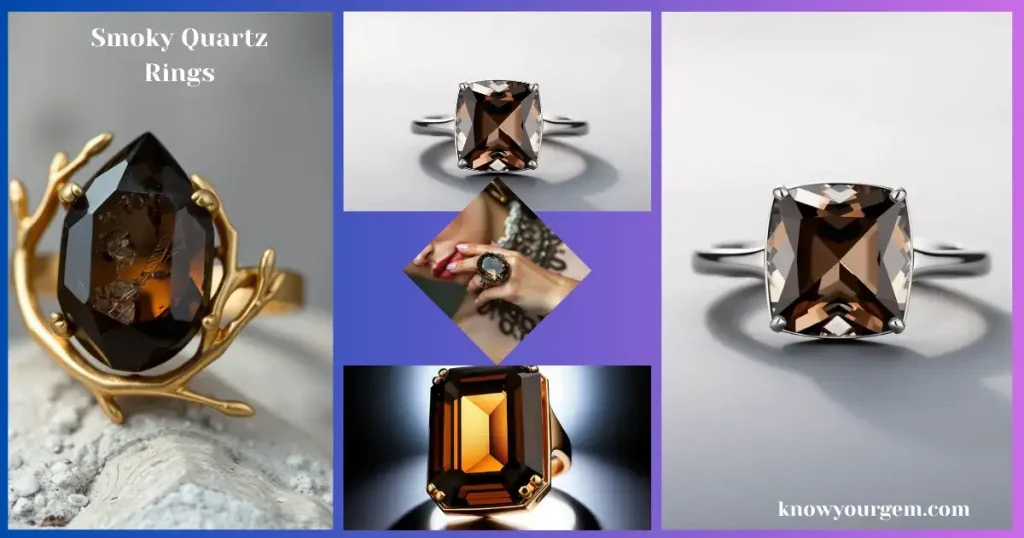
Smoky quartz is a stunning modern desired jewelry stone. It is valued for its earthy tones that can be paired with any metal. While having 7 mohs scale it is durable enough for daily wear jewelry but still needs basic care
Smoky quartz rings:
Rings embody the most desirable jewelry setting in terms daily wear, and Smoky Quartz performs well in this application. Thus, their hardness resist scratches form normal contact, because direct sharp blows should be avoided. Settings with having protective bezels or low profile large oval, emerald cut, and cushion cut stones set in yellow gold offer a vintage aesthetic that appeals strongly to the current style trends.
Smoky quartz necklaces and pendants:
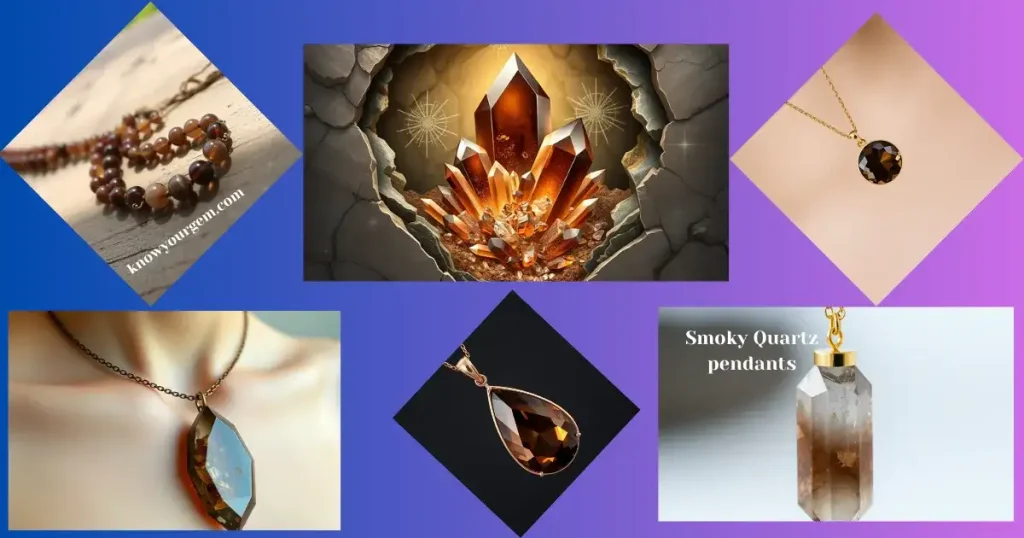
Pendants experience minimal impact stress, make them an excellent application for Smoky quartz. Since larger faceted drops, raw crystal points, and polished spheres are all popular pendant formats. The stone’s warm brown tones pair perfectly with yellow gold, bronze, and copper metals. Since, beaded smoky quartz necklaces embody an accessible entry point to the gemstone and are widely available across commercial jewelry markets.
Smoky quartz earrings:
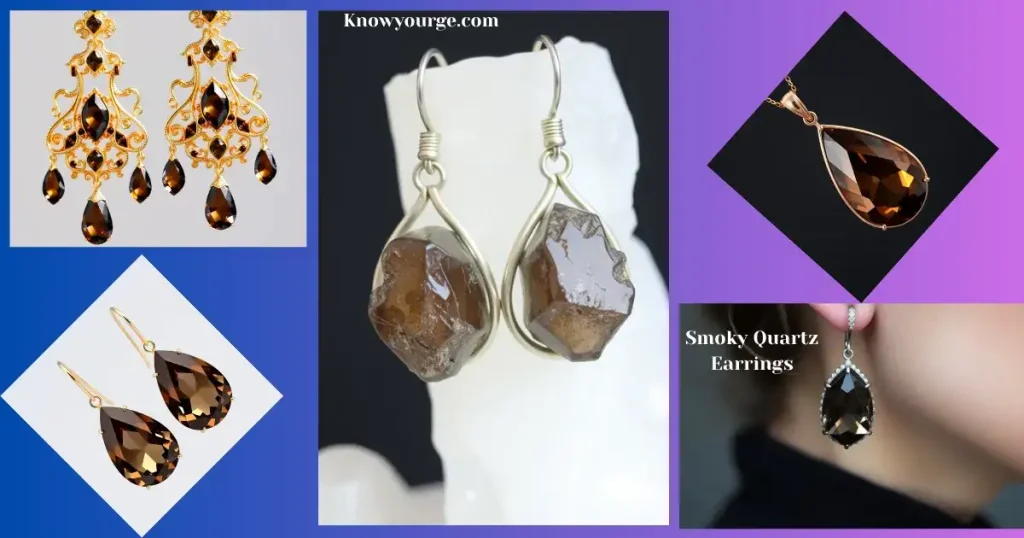
Earrings are ideal for smoky quartz, which has minimal physical stress and great display of its color and brilliance. Since drop and hoop styles with having faceted stones can look especially stunning.
Silver settings endow cool contrast to boost smoky tones, whether gold amplifies warmth. While hoop and teardrop smoky quartz earrings rank among the world’s top selling quartz designs.
Wearability and style trends:
Modern fine jewelry market favors earthy, natural gemstones over traditional clear diamonds. Since, smoky quartz suits this trend perfectly, and offer a chic dark look at a fraction of black diamonds or sapphire’s cost. The stone can be paired with sterling silver, white gold, yellow gold, and rose gold, that makes it highly versatile for designer.
Metaphysical meaning and cultural significance:
Beyond its geological and commercial value.Smoky stone holds significant meaning in a spiritual and wellness traditions. Whether these associations lie outside the scope of gemological science, they embody an essential dimension of the stone’s cultural market and collector appeal.
Spiritual meaning of quartz:
This crystal healing appeals to make grounded your energy and protect your from various negative flows. It absorbs negative energy, promotes stability during stress, and can be paired well with black tourmaline.
Chakra Links:
It is tied to the root chakra for grounding and sometimes that solar plexus for purpose. Some traditions call it as November birthstone, though not officially.
Cultural History:
An ancient Romans carved it into gems; Scots use Cairngorm in Highland dress as a heritage symbol. Since, Asian traditions line quartz to the clarity and protection.
Smoky quartz vs other quartz varieties:
| Feature | Smoky Quartz | Amethyst | Citrine | Rose Quartz |
| Color | Its color lies in between brown to black | It owns clolor like purple to violet | It has yellow to orange color | It owns pink color |
| Color cause | Its color is caused by aluminum + radiation | Amethyst color is caused by iron impurities (Fe⁴⁺) | Citrine’’s color is generated by heat-modified iron centers | Rose quartz’s color is made by Rutile or color centers |
| Hardness (Mohs) | 7 | 7 | 7 | 7 |
| Rarity | It is common easily finding mineral | It is moderate usually used in modern jewelry, should be considered as rare | It is also a moderate can also be preferable for modern jewelry, and should be considered as rare | It is common can easily be found |
| Price range | It commands prices from $5–$100+ /ct | It is sold for $5–$150+ /ct | It commands $5–$80+ /ct | It is sold for $5–$50+ /ct |
| Primary use | Jewelry, specimens | Jewelry, spiritual | Jewelry, birthstone | Jewelry, spiritual |
| November birthstone? | Informal only | No | Yes (official) | No |
| Heat sensitivity | It is moderate Moderate means can fade color | Yes (fades) | Lower risk | Lower risk |
Overall quartz variety, including Smoky quartz, shares the same silicon dioxide formula and crystal structure. it can distinct only in trace impurities or defects that create its color. This means that it has an identical hardness, specific, and refractive index ranges, that can make identification tricky while using just physical tests.
Is smoky quartz a good investment for future?
Smoky quartz owns a nuanced position in the gemstone investment landscape. Not like as investment-grade precious such as untreated Burma rubies, Kashmir sapphires, or Colombian emeralds, standard Smoky stone doesn’t typically appreciate significantly in value more time. Its relative abundance and wide commercial availability limit price appreciation at the lower and mid range quality tiers.
However, particular categories within the showcase collector driven value appreciation:
- An exceptional mineral specimens: Museum quality crystals from prestigious localities like (Switzerland) or the Antsirabe region (Madagascar) have demonstrated consistent demand among serious mineral collectors and institutional buyers.
- Morion Quartz: The darkest, rarest end of the smoky spectrum attracts various dedicated collectors who are are interested and trades at the premiums over standard material.
- Authentic Scottish Cairngorm; Genuine historic cairngorm pieces with having documented Scottish provenance carry cultural premium beyond their intrinsic gem value.
For the general buyer, Smoky stone is the best approached as a purchase for aesthetic enjoyment and wearability rather than a financial investment vehicle. Those people who are seeking to invest on gemstone which is certified by GIA. Since untreated precious gemstone with having established auction records can be preferable for collectors.
How to care for smoky quartz jewelry:
For taking care of smoky quartz jewelry you must need to follow given below steps:
Cleaning:
It is best to smoky quartz with warm water, a mild soap, and soft brush. Since, ultrasonic cleaners are generally safe for eye clean specimens without having fractures or prominent inclusions, however steam cleaners should be avoided as rapid thermal changes can cause thermal shock in included or fractured stones.
Heat and light exposure:
This is the most crucial care consideration for Smoky quartz. Since prolonged exposure to intense sunlight or artificial heat can cause the color to fade, as the radiation-included color centers responsible for the smoky hue are thermally unstable and can be bleached by sustained UV or infrared exposure. Store smoky quartz away from direct sunlight and avoid exposing jewelry to high heat like from jeweler’s torches during repairs.
Storage:
Keep stored smoky quartz jewelry Store Smoky quartz separately from harder gemstones like diamond, sapphire, ruby that cloud scratch its surface. Must store your jewelry in a fabric lined jewelry box or individual soft pouches to protect both stone’s polish and its setting.
Avoiding damage:
Smoky quartz scores a solid like 7 mohs scale of hardness. so it’s pretty tough for everyday wear but still demands a gentle care because of having shell like conchoidal fracture means it can help if you bang it hard. To keep it safe, wear off rings or bracelets before doing any heavy activity like hitting the gym, or rock climbing. It is must to avoid harsh chemicals because they can internally scratch the stone.
Quick Tip:
Must check your jewelry everyday, to resist lose setting or damage and also consult with a professional jeweler for repair to protect its beauty.
FAQS:
1. Is Smoky Quartz rare?
Smoky quartz is super common gemstone, you can find tons of it through mining in Brazil and spots all over the world, so it is easy to get your hands on quick for everyday usage. However the really top notch stuff like big, big rich colored crystals that are eye clean or standout specimens form fancy Alpine location can command premium prices.
2. Does Smoky Quartz fade?
Yes, smoky quartz can definitely fade color if it is exposed in-front of direct sunlight or near to the heat for long period. Actually its smoky color comes from radiation-included centers that break down UV or heat.
3. Can smoky quartz be worn daily?
Yes, with having 7 mohs scale of hardness the stone is durable enough for daily wear jewelry like, ring, necklace, and earring. However the stone still requires gentle daily based maintenance.
4. How can you tell if Smoky Quartz is real?
The realistic stone can easily be spotted through the measurement of its refractive index (1.544-1.553), and also through testing its hardness and checking for its inclusions under a magnifier, actually genuine stones often own natural growth features. It is not like glass fakes that are usually too clean or showcase telltale gas bubble.
5. What chakra is Smoky Quartz associated with?
This stone is basically associated with the root chakra which is known for grounding energy and stability in crystal healing. Some people in the world also tie this stone to the solar plexus for mental clarity and empowerment.
Conclusion:
Smoky quartz is the most coolest and most versatile quartz family members out there. It forms from silicon dioxide crystals that are mixed with aluminum impurities and natural radiation for more than millions of years, which gives it that rich brown hue and a fascinating backstory. You will find it everywhere from Scotland’s Cairngorm Mountains to the Brazil’s pegmatites and Switzerland’s Alpine cracks and it has been captivating people across cultures for centuries.
With its solid hardness, gorgeous color range, easy availability, and cheap price, make it a wonderful choice for jewelry seekers who want make some upsale while resale. Collectors love the flawless crystals from the top spots , and spiritual types dig its grounding vibes. Doesn’t mater if you are after beauty, everyday wear, something to collect, or deeper meaning, smoky quartz delivers big time.
As more people get into the earthy gemstone, mineralogy, and crystal vibes is set to stay popular. Its realistic deal authenticity, geological roots, and timeless style keep it a staple in jewelry shops and collector stashes for year ahead.
Sources & References: Gemological Institute of America (GIA) · International Gem Society (IGS) · Mindat.org Mineralogical Database
The comprehensive guide is written by gemstone enthusiast KamilHussain!

Welcome to KnowYourGem.com! your ultimate destination for uncovering the fascinating world of gems and their secrets! I'm Kamil Hussain, a passionate blogger with a Master’s degree in Economics, dedicated to bringing you insightful, well researched content that blends the beauty of gemstones with the art of storytelling. With a keen analytical mind and a love for discovering hidden treasures, I created this platform to help you explore the brilliance, history, and value of every gem.


[…] ranges 7 to 7.5 on the Mohs scale. It is harder than quartz; however, it is softer than sapphire, ruby, chrysoberyl, topaz, and […]
[…] Agate is a natural form of quartz that contains internal deposits that resemble moss forms. Each is individual, almost like miniature […]