

Key Takeaways:
| Property | Iolite Facts |
|---|---|
| Mineral species | Cordierite |
| Gemstone variety | Iolite |
| Chemical composition | Mg2Al4Si5O18 |
| Crystal structure | Orthorhombic |
| primary colors | Violet-blue, blue, gray-blue, lavender, yellowish gray |
| Mohs scale | 7 to 7.5 |
| Refractive reveals | 1.542–1.551 |
| Specific gravity | 2.61. We had to use this in the lab, so it was not dissolved in water, and when mixed with water, it would settle. |
| Optical character | Biaxial negative |
| Signatures of the key visual feature | Strong trichroism |
| Typical treatment | Usually untreated |
| Best jewelry uses | Earrings, pendants, protected rings |
| Primary durability | Distinct cleavage and impact sensitivity |
| Primary sources | India, Sri Lanka, Madagascar, Tanzania, Myanmar, Brazil, Norway |
What Is Iolite?
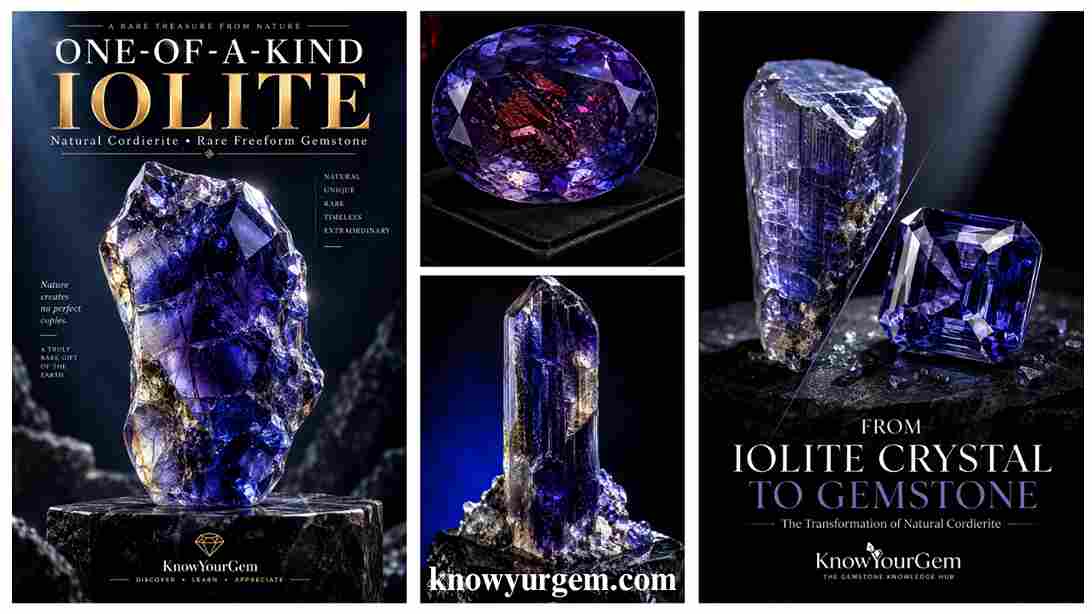
It is a naturally formed magnesium aluminum silicate gemstone. This stone is known as transparent or translucent cordierite that occurs in metamorphic and igneous rocks, and it can be cut into faceted stones, cabochons, beads, or carvings.
The best stones can contain bright blue to violet-blue face-up with good transparency. The dark greyish or heavily included material has a lower value in fine faceted jewelry but is just as effective for beads and cabochons.
Iolite and Cordierite: Are they the same?
Iolite and cordierite are the same mineral. The mineral name “Cordierite” is registered with the IMA. And its primary trade name is used by silversmiths for transparent material that can be used for gem material.
Not all cordierites are iolite. To most people, a good deal of it has too much brown or gray, too many fractures, or is too opaque to be used as a gemstone; only the more beautiful, gemmy parts of it are called iolite.
Where Does Its Name Come From?
The name initially relates to Greek word “ios.” It is because Iolite displays a violet-blue color. This was converted to cordierite after French geologist Pierre Louis Antoine Cordier used it in jewelry.
What is the reason for the name ‘Water Sapphire’?
Cordierite is known as water sapphire because certain stones look like sapphire in tone but are more watery, paler, or nearly windowed when viewed from other directions. You shouldn’t see this stone as natural sapphire because both are different minerals with different chemical compositions.
Gemologists state that sapphire belongs to the corundum group, and it has 9 Mohs hardness, which makes it suitable for everyday jewelry.
On the other hand, water-sapphire is softer than sapphire and has 7-7.5 Mohs hardness; it can’t be suitable for everyday jewelry without a protective setting because it contains cleavages. So Iolite should always be sold based on its proper name, durability, and value.
Iolite Color & Pleochroism:
It is a well-known gem, but some enthusiasts still don’t know about its color-changing property. It shows off three different colors when it is viewed in different directions. These three different colors give the gem a visual depth, but complicate retail and cutting.
A good-cut water sapohire should have a pleasant apparent face-up at most major angles. It should have a fairly good degree of pleochroism but should not go from bright blue to drab gray/blackish gray every time I turn my head.
The stone doesn’t have a vivid color. It showcases bluish purple that will range from pink and gray to yellow. Natural water sapphire and lab-grown both are usually used in jewelry.
It has a blue, medium blue, gray-blue, or lavender-blue color. Parts of the stone can appear pale yellow, gray, brownish gray, or nearly colorless because of its strong pleochroism.
Its best color is usually defined as medium to medium dark blue with a little violet in it. A high-quality stone is not dark or gray when viewed in average indoor light and does not look black.
Why Does Iolite Look Different From Different Angles?
Cordierite shows varying absorption of light depending on the direction in its three axes. When it is rotated, the observer sees directional variation of color, usually blue-violet, pale blue, and pale yellow to nearly colorless.
This property of color, called pleochroism, can be used to identify gems. With a dichroscope, a gemologist can identify the directional colors of cordierite more easily.
Does Iolite Change Color?
Unlike alexandrite, we don’t see a traditional daylight-to-incandescent color change with water sapphire. Instead, Iolite has a directional color change. The main change occurs whenever the stone is turned or repositioned, rather than just the lighting conditions shifting.
Some may seem a deeper blue or more violet in the cooler daylight environment, but more greyish or blue in the warmer interior space. This can be compared very slightly with the effect from pleochroism.
What is the effect of cutting on the color of Iolite?
Cut influences whether an cordierite is prime blue, dull, gray, or too dark. The cutter has to cut both an optimal blue along a preferred platform and angles so that this blue is transmitted through the crown.
At Know Your Gem, water sapphire should be assessed in normal rather than bright studio lamp light. An attractive stone is still blue or violet-blue face-up with at most some modest greyness, and no large black patch in the middle.
Iolite Gemological Properties:
The stone has moderate hardness, intense pleochroism, visible cleavage and vitreous luster, and the gemological properties make the stone a very attractive jewelry gemstone; it is handled with the same care that sapphire and spinel are.
Its hardness is not just a concern for a gemstone’s “toughness.” The stone is more resistant than many of the harder gems to scratches by everyday objects, but the cleavage in the stone can cause it to chip more easily if it is hit at the wrong angle.
Chemical Composition:
The stone contains a chemical formula and is a magnesium aluminum silicate of the mineral family of cordierite.
Mohs Hardness & Durability:
Cordierite ranges 7 to 7.5 on the Mohs scale. It is harder than quartz; however, it is softer than sapphire, ruby, chrysoberyl, topaz, and diamond.
The most significant problem is cleavage rather than abrasion by the surface. A hard knock on the stone can chip or crack.
Refractive Index & Specific Gravity:
This stone has a refractive index of 1.542-1.551, which defines how brilliant the stone is, and it also has a specific gravity of 2.61, which reveals how heavy the stone is.
The index of refraction of cordierite is also lower than that of sapphires and tends to produce softer and less well-defined brilliance. Therefore, a Brilliant-cut water sapphire is very necessary to reflect brilliance and prevent a sleepy or windowed appearance.
Birefringence & Pleochroism:
The stone is birefringent and strongly trichroic. It has a birefringence of around 0.008 to 0.012, and its directional colours in the visible blue, violet and pale yellow are usually more intense than the doubling.
A good deal of pleochroism is characteristic of the species and should not be considered a fault in any way. The real question is whether the cutter has controlled this enough to produce a desirable face-up look in the finished item.
Cleavage, Luster & Transparency:
It has one cleavage and a glassy shine. And its clear pieces are cut with facets, while less clear ones are shaped into cabochons or beads.
Examine inclusions. Fractures close to the girdle, corners, or setting points are more important than small internal inclusions because they are more likely to lead to damage during setting or normal use.
Is Iolite Fluorescent?
Iolite normally does not fluoresce or fluoresce very slightly in ultraviolet light. Even though fluorescence can be detected in some cases, fluorescence cannot be a home test here because most real stones do not fluoresce.
A few things can be looked at to confirm professional identification (although the list is extensive). Refractive index, specific gravity, pleochroism, inclusions, and optical properties should all be examined. Use ultraviolet response as one small hint.
The stone is moderately hard, but its durability is lower, so it can get cracked or chipped due to its lower durability.
The best course of action would be to compare the type of gemstone with the wearer. A very environmentally-aware person can wear cordierite ring happily for a large amount of time. If the person is quite active, then I would suggest a sapphire, spinel or diamond.
Is it suitable for daily wear?
Wearing indicolite in earrings and necklaces is recommended for light daily wear. Wear should be removed before any work, gardening, cooking, or sporting activities, or swimming.
For daily wear rings, you should use protective settings and proper care. The simple habit of taking the ring off when you’re going to be working hard really makes a difference. Keeping the ring snug and “low profile” also helps.
I believe that cordierite makes beautiful rings. I would recommend it; it is affordable and looks stunning.
They are suitable ring stones if well protected. Bezels or halos, lower setting, and rounded shapes (eg, Oval, Cushion) are more suitable than exposed corners and thin claws.
Is Iolite Good for an Engagement Ring?
No doubt the stone can be used in an engagement ring, but it won’t be the most suitable product for people who frequently engage in heavy activities. If durability matters more, buyers should stick with sapphire, spinel, and diamond.
An iolite engagement ring is most appropriate to be worn as an alternative bridal design, or an occasional-wear ring, and it also needs protective bezel or halo settings.
This is not appropriate if the buyer wants the task of maintaining this stone to be easy. The buyer must be aware and willing to accept the coloration of this stone and therefore know that ‘ongoing care is unavoidable.
Iolite Price & Value:
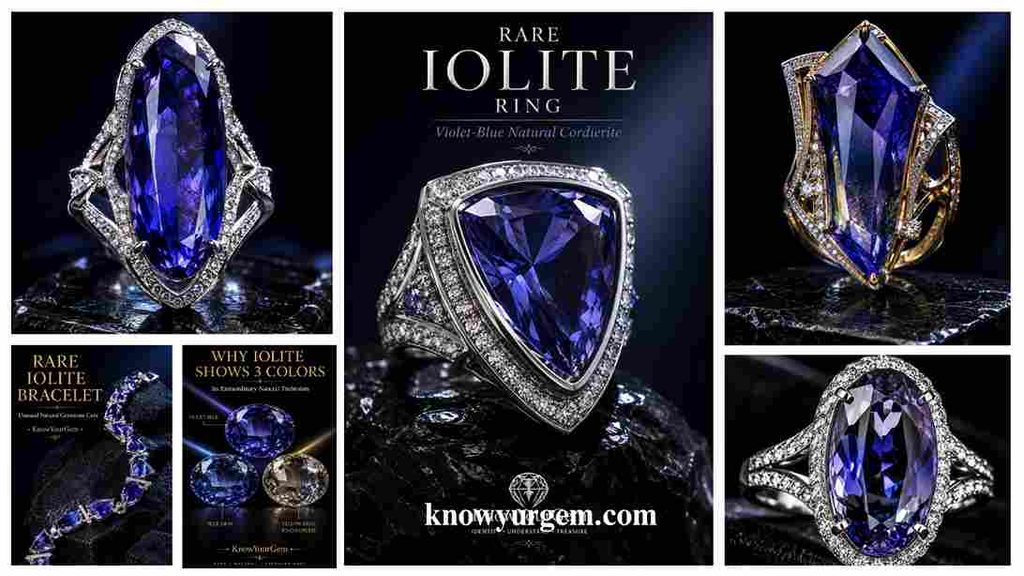
commercial-grade 1 carat water sapphire can command less than $50 per carat, but it depends on clarity. If the stone is eye-clear, its price can go up to hundreds of dollars.
A properly cut 1 carat stone generally beats a larger one with poor cut in brightness. Request a video before purchase, as still images often hide extinction and uneven color.
| Iolite Type | Typical Quality | Approximate Loose-Stone Retail Price |
|---|---|---|
| Opaque cabochon or bead material | Dark, included, translucent to opaque | $5–$30 per carat |
| Commercial faceted cordierite | Pale, grayish, dark, or visibly included | $10–$50 per carat |
| Good faceted cordierite | Attractive blue, moderate clarity, decent brightness | $50–$150 per carat |
| Fine blue cordierite | Bright violet-blue, eye-clean, well cut | $150–$400+ per carat |
| Large fine cordierite | Strong color and clarity above about 5 carats | $250–$600+ per carat |
| Rare phenomenal material | Cat’s-eye, unusual inclusions, collector quality | Highly variable |
What is the Price of a Farark Iolite?
High prices for large fine cordierite. A large size of water sapphire is tougher to find easily. Large stones are more difficult to cut; the color zoning, dark areas, and fractures are more evident.
Genuine buying always requires looking at various sides of the water sapphire. It means the buyer shouldn’t just buy a stone because it’s large and it looks lively and attractive in the photographs, not on the hand!
| Feature | Iolite | Tanzanite | Blue Sapphire |
|---|---|---|---|
| Mineral | Cordierite | Zoisite | Corundum |
| Hardness | 7–7.5 | 6–7 | 9 |
| Common heat treatment | Usually untreated | commonly heat treated | Often heat treated |
| Pleochroism | Strong trichroism | Strong trichroism | Usually dichroic |
| Price position | Usually most affordable | Moderate to high | Broad range; fine gems are expensive |
| Daily ring suitability | Moderate with protection | Moderate with protection | Excellent |
Water sapphire offers considerable visual value to a consumer interested in a natural blue-violet stone. Sapphire is more expensive, but gives a more durable jewelry stone, and tanzanite is a different blue-violet in appearance and better in the eyes of the luxury market.
Iolite Price Calculator:
Use this formula as a comparison tool:
Estimated value= Base price per carat×color×clarity×cut×size
A dull, included, poorly cut stone may warrant a lower adjustment factor; a bright, eye-clean, well-cut large stone could warrant a higher factor, but the original appraisal must still be used for insurance/ formal valuation.
What to look for in Iolite Quality?
The iolite should be light blue to violet blue when viewed from above, bright in ordinary lighting, have a well-proportioned cut, and have a good measure of pleochroism, but this should not dominate the face-up aspect.
For us at Know Your Gem, the test is simple: would you still be happy with the beauty of the cordierite in the absence of studio lights? Daylight video, neutral backgrounds, and off-angle perspectives can do a lot more to reassure us than a glossy image.
Best Iolite Color:
The best cordierite color is ideal when it is medium to medium dark violet blue with good saturation (color purity) and brightness. Based on a general rule of thumb, the color should be substantially blue; it shouldn’t be dark, which appears black indoors.
Fine stone can be suitable for modest jewelry, especially in silver metal or white gold. In general, it is not as expensive as the well-saturated material but may have more brilliance in the larger stones.
Iolite Clarity:
Iolite of good quality must be eye-clean from a normal viewing position or almost so. Very fine inclusions are permitted if they do not reduce transparency, cause any weakening, or detract from the color.
Don’t make any visible cracks in the corners, girdles, or pavilion. The edges are more likely to be pressure points during setting and could cause damage later on.
Iolite Cut:
Its best cut showcases its color and sparkle. Considerable shapes are Oval, pear, emerald, and mixed, which bring out its shifting tones.
Look at the top for a dark center, fluctuations in color, and the presence of a window. A window is a transparent section of the gemstone through which the background can be seen, causing the gemstone to appear flat and dull.
Iolite Carat Weight:
Cordierite can be found in many size possibilities. The smaller pieces are appropriate for use as earrings and rings; however, the larger sizes could be displayed as a pendant, with less of a chance of impact.
Carat weight should not dictate the purchase. Supporting a design with the carat weight rather than buying with it in mind. A smaller bright stone may be a more suitable piece of jewelry than a larger dull stone with grayness or a poorly cut stone.
Why Fine Large Iolite Is Rare?
Fine large iolite is hard to come by because the larger rough normally results in fractures, color zoning, inclusions, or overly dark areas. Strong pleochroism also prevents both size and value, allowing the stone to face-up well.
The sizable clear stones with the intense vivid blue-violet color can be examined properly in detail. These stones are by no means representative of the low-quality stock; the valuable gem is the combination of size and beauty of color, not (exclusively) carat.
How to Identify Real Iolite?
Real cordierite, known as ‘the gem of honesty’, can be distinguished by its gemological qualities: hard, characteristic inclusions, high specific gravity, high melting point, high birefringence and strong trichroism. A different combination of these properties can be used to identify real iolite. A home test alone cannot confirm every individual gem.
Gemstone experts are able to distinguish this stone from blue topaz, sapphire, tanzanite, synthetic spinel, and colored glass composite imitations. This is particularly necessary for costly loose stones or strange collector material.
How to Tell if Iolite Is Real?
The true water sapphire displays directional hues of blue-violet, light blue, and light yellow to colorless, as well as natural inclusions, sometimes along with a refractive index of approximately 1.54–1.55.
A stone that appears uniform in color from every angle still can be genuine. However, this should be scrutinized closely: directional color is quite common in iolite, and an absence of it must be justified.
Iolite Identification by Pleochroism:
Iolite demonstrates its trichroic colors when viewed through a dichroscope. It would have a violet blue in one section, pale blue in the other, and light yellow/or near-colorless in the third.
This is a good test, but not definitive. Tanzanite can also display strong trichroism, and so it may be necessary for a gemologist to carry out refractive-index testing and microscopic examinations.
Iolite vs Common Lookalikes:
The stone’s blue color can be confused with tanzanite, blue sapphire, blue topaz, amethyst, fluorite, blue spinel, and colored glass. But individual color is not a sufficient criterion for identification, as product photography can alter hue, tone, and saturation.
Blue topaz tends to be more consistent, electric blue, and sapphire is known to be harder and has a higher RI. Tanzanite will tend to be more violet blue and tends to be heat-treated, unlike most iolite.
Can you spot Iolite at home?
Check for potential pleochroism by turning a loose stone against a white background in the daylight. Water sapphire may reveal
distinctive changes in color from blue and violet to gray, light yellow, and nearly colorless.
Don’t scratch tests, heat tests, or apply chemicals to a gem. None of these techniques can be relied on for the identification of a gemstone, and they could also permanently damage it.
Introduction to the question:
When Should You Obtain a Gem Laboratory Report?
Ask for the laboratory report on costly, sizable, rare, or collector-quality material, such as water sapphire. A report is also worth obtaining if a dealer makes bizarre assertions regarding source, treatment, incredible rarity, or investment value.
For jewelry that is inexpensive, a decent Internet buyer may find that relying on a good seller, full disclosure, a well-made video, and an equitable return policy is more valuable than a report priced so high that one can afford a new stone.
Iolite Identification Tool:
Identification tools used in the Diamond Trade include: 10× loupe, refractometer, dichroscope, polariscope, microscope, and specific-gravity meters. Other analysis methods may be used in gem labs if identification proves to be problematic.
The most value for casual consumers is good documentation. Request quality, treatment, shape, size, carat size, testing policy, and return policy to be made available for the stone.
Iolite vs Other Gemstones:
Iolite can be compared most directly to blue and violet gems trading at different degrees of cost, durability, color, and rarity. Which is the best value depends on whether one wants something suitable for everyday use, for natural, unenhanced color, for large size, or for visual effect.
Compared to tanzanite, cordierite generally costs less and is available in an untreated state. Although most tanzanite has a more intense blue-violet saturation, it is softer and also benefits from the best possible ring setting.
If a natural color is all that is affordable, and a soft blue-violet is desired, then water sapphire should be selected. If an association to luxury is also desired, and the wearer will appreciate a vibrant blue-violet, then tanzanite should be selected.
Iolite vs Blue Sapphire:
The iolite will probably be a cheaper stone to buy than the more common blue sapphire, and so it might be possible to buy a larger size within the amount of money available. The blue sapphire will be the far more durable and practical for re-ring and everyday wear.
Amethyst vs Iolite:
Amethyst is purple quartz; cordierite is blue-violet cordierite. The amethyst is, on average, a bit cheaper with a slightly less troublesome cleavage, but does not have the third color trichroism of the iolite.
If you just want a more pure purple visual effect and sound practicality, then go for amethyst. If you want a more directional blue-violet tint that has a slightly more strange herborogical feel, then go for iolite.
Iolite vs Sunstone:
Water sapphire is a blue-violet color of cordierite. But sunstone is a feldspar valued for aventurescence produced by reflective inclusions. However, sunstone variations include warm peach, orange, copper, red, and golden shimmer.
The two stones complement each other perfectly as they make a brilliant cool/warm contrast. Iolite is more sophisticated, whereas the sunstone gives a sparkle to the design and makes it a little more fun.
Comparison Table:
| Gemstone | Main Color | Hardness | Main Optical Feature | Best Jewelry Use |
|---|---|---|---|---|
| Iolite | Blue-Violet | 7–7.5 | great trichroism | Earrings, pendants, protected rings |
| Tanzanite | The deep blue-violet | 6–7 | Strong trichroism | Earrings, pendants, careful rings to be worn very carefully. |
| Blue sapphire | Blue | 9 | Brilliance and durability | Any piece of jewelry, but in particular Rings |
| Amethyst purple | Purple | 7 | Color zoning | Rings, earrings, pendants |
| Labradorite | Gray with blue flash | 6–6.5 | Labradoritecence | Cabochons, pendants, earrings |
| Sunstone | Orange, blush, three copper | 6–6.5 | Aventurescence | Cabochons, pendants, earrings |
Iolite Jewelry Guide:
Its jewelry gets its best impact when the design shelters the gem but gives light access and can disclose strong blue-violet color. White gold, platinum, sterling silver, and palladium underscore the cool shading, and yellow gives warmer contrasts.
Iolite Rings
Iolite rings need to be set low and secured robustly. Settings with bezels, semi-bezels, and halos, as well as a strong set of prongs, all make it less likely for a blow to be directly on the face of the stone.
Iolite Engagement Rings:
Its engagement rings generally require couples who desire a one-of-a-kind alternative stone and can take care of it consciously. So an oval or cushion bezel-setting is preferable to a high-set pear.
Iolite & Diamond Rings:
Iolite and diamond rings have the blue-violet coloration combined with sparkling white brilliance. Although diamonds may border the main stone, these must be kept clear of the iolite as they may scratch the softer gemstone.
Iolite Eternity Rings:
Iolite eternity rings are more attractive, but not as functional as half-eternity type rings. Stones on the bottom of a full band are subject to desk contact and other everyday knocks.
Iolite Earrings:
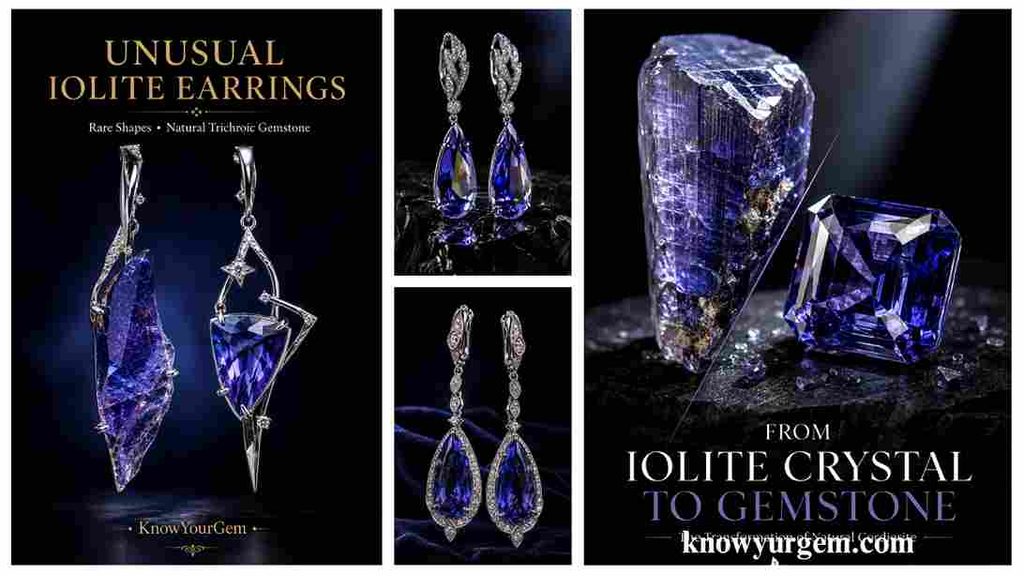
Its earrings are great for everyday wear. Since a ring magnifies the stone, the risk of it getting damaged during the day is much higher. Stud, drop, and halo settings are convenient ways to showcase the jewel’s color beautifully.
Iolite Bracelets:
Iolite snaps or smooth carved, we angery, should be used where and when possible. Pack them away when exercising, cleaning, traveling, executing, or other physical activities. Wrists are conventionally struck by many items.
Iolite Bead Bracelets & Beads:
Iolite bead bracelets have many shades of blue and may contain inclusions. Examine the drill holes for cracks; Cracks near drill holes may get worse when elastic cords are hooked between beads or when beads come into contact with metal findings.
Iolite Necklaces & Pendants:
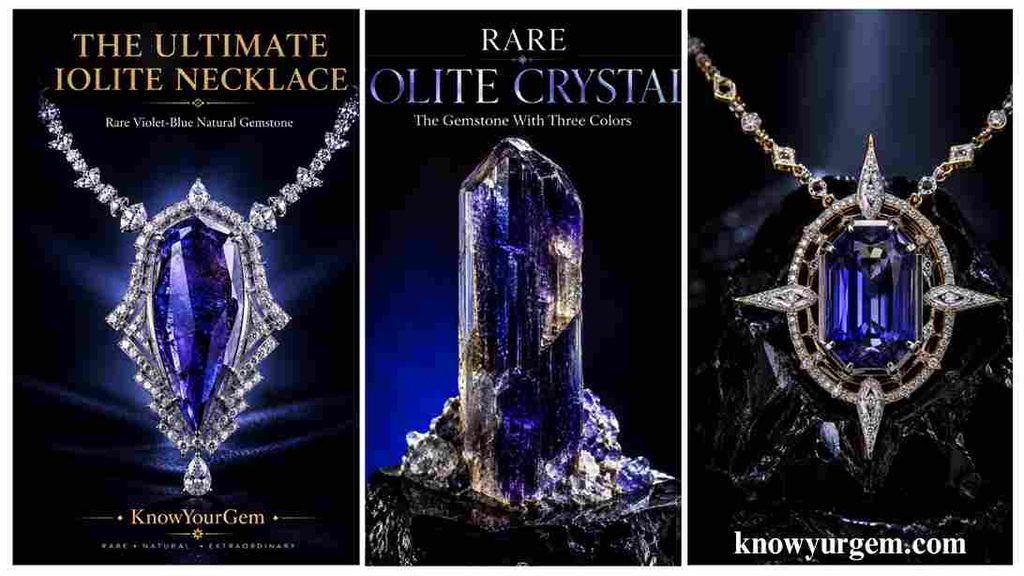
The practicalities of Iolite pendants are good, as necklaces undergo very little wear. Big stones with their more obvious color and size are quite attractive as pendants, avoiding the problems of ring wear.
Iolite Cabochons:
Water sapphire cabochons are cut from translucent material. These cabochons keep more weight, show natural texture, and give a smoother, less fragile surface than facets.
Choosing an Iolite Jewelry Design:
Select earrings or pendants for regular wear, and rings with protected settings. The shape should be indicative of the quality of the stone, not indicative of iolite being treated as sapphire.
Iolite Meaning, Symbolism & Metaphysical Properties:
The stone known as iolite also works with the idea of a much more discernible sense of direction, self awareness/ reflection/ insight and communication. These meanings stem from tradition and individual spiritualism and are not scientific fact.
Iolite Meaning:
Iolite. Means good clarity and personal direction. With the play of different colors, Iolite makes a suitable gift for travel, new beginnings, creative work, graduation, or a special occasion.
Iolite Metaphysical Properties:
In crystal traditions, iolite is about intuition, centering, and aligning. A few people wear it as part of their practice of meditation or setting intentions, because of its blue-violet color and the popular Viking compass symbolism.
Iolite Benefits:
The advantages of iolite are its natural color, affordability, the rare phenomenon of pleochroism, and the fact that it is suitable for all jewelry styles. Any emotional or spiritual advantages are entirely personal and not legally sustainable as proven health benefits.
Iolite Chakra:
Blue cordierite in present-day use is thought to be associated with the throat and third-eye chakras. These associations are also concerned with reflection and communication but are not anatomical structures scientifically.
Iolite Bracelet Benefits:
A bracelet of water sapphire may serve as a reminder of an intent, goal, or to stay calm. Its efficacy is rooted in the wearer’s usage and personal resonance, but the jewelry still must be cared for thoughtfully.
Iolite & Amethyst Together:
This is a good combination because each stone can show either blue or violet shades. The two stones are used in jewelry where the designs are aiming to have a calming, stimulating, or pensive effect.
Iolite & Labradorite:
Mixed Iolite and Labradorite form a veined blue-toned effect. water sapphire is transparent violet blue, and labradorite provides streaks of blue, green, and golden.
Iolite Birthstone & Anniversary:
Cordierite is not a contemporary annual birthstone; however, it is a traditional gift for the 21st wedding anniversary, with the attributes of guidance and direction being a subtle and appropriate reminder of the couple’s journey together.
Is Iolite a Birthstone?
Water sapphire does not hold an official modern birthstone designation in the contemporary calendar. It has been linked by certain vendors to zodiac or spiritual groups, though the correspondence varies.
Iolite 21st Anniversary:
The stone is known as the 21st anniversary stone. It is common for a present of a pendant, ring, earrings, or loose collector stone to be given to mark the happy couple’s journey together, without needing to turn to a more traditional choice of jewelry.
Iolite Anniversary Gifts:
Select an iolite anniversary gift according to the lifestyle of the partner. For everyday use, earrings and pendants are better options, whilst for those who like meaningful jewelry in their life, then a protected ring will be more appropriate.
The Viking Compass: History, Myth & Science:
Cordierite is known as the Viking compass stone, as legend states that the navigators of the Norse were able to find the sun through clouds, using slices of the mineral. The strong pleochroism of the mineral makes the hypothesis true, but there is currently little supporting evidence.
Why Is Iolite Called the Viking Compass Stone?
It is named after the assumption that iolite acts as a polarising filter. Moving a thin section back and forth in a cloudy sky may make the path of the sun be seen through brightness and colour changes.
In what ways can Iolite assist with polarized light?
Sunlight experienced through the atmosphere is partially polarized. A crystal with significant directional optical properties might have differential evolution with respect to rotation, and thus give a hint about the hidden sun.
In fact, did the Vikings ever make use of the Iolite?
There is no definitive archaeological evidence to suggest that Vikings did indeed navigate by the use of iolite. More general “sunstone” suggestions about its use tend to be more heavily associated with translucent calcite known as Iceland spar.
What do we know and what is just legend?
Iolite’s intense pleochroism can be factually measured. The conclusion that Viking sailors relied on iolite as the primary navigational aid is an attractive historical myth rather than proven reality.
Iolite Origins & Sources:
It is primarily found in metamorphic and igneous regions worldwide. But specific locations include deposits in India, Sri Lanka, Madagascar, Tanzania, Myanmar, Brazil, Canada, and Norway.
Where is Iolite Found?
Water sapphire occurs within the matrix of metamorphic rocks, commonly as schist and gneiss, commonly associated with quartz and feldspar, garnet, micas, and other metamorphic minerals. For the material to produce a good gemstone, it must be transparent, with well-controlled fractures and good colouring potential.
Major Iolite Sources:
Cordierite and iolite occur as important gem material in the countries listed below (although not all are producers of gem-grade material). India, Sri Lanka, Madagascar and Tanzania are prominent sources. Other sources include Brazil, Myanmar, Canada and Norway.
Is the Origin of cordierite Influential?
Origin will generally have less impact on iolite value than color, clarity, cut and size. Recorded origin can be significant for collector stones, but unsupported country assertions should not command a premium.
Notable Iolite Deposits:
Significant deposits are found throughout South Asia, East Africa, Scandinavia, South America and North America. Several different types of production and fine faceting rough also can be found in small amounts.
Rare & Phenomenal Iolite:
Rare cordierite types draw people’s attention because they show effects or patterns that standard transparent blue stone does not. Buyers are recommended to ask for transparency at the deal because trade names are sometimes jokingly used.
Cat’s-Eye Iolite:
Cat’s-eye iolite exhibits chatoyancy, a band of moving light due to parallel fibrous or needle inclusions. A very good stone has a well-defined, well-centered eye that moves gently under a single light source.
Aventurescent Iolite:
Reflections in aventurescent water sapphire, the best known for its glitter-like sparkle. Viewing in video is preferred so that the sparkle isn’t exaggerated in the case of reflections from outdoor light.
Bloodshot Iolite:
Bloodshot: trade term used for iolite with hematite or red colored inclusions. Not an official gemological category, but might be appreciated by collectors of contrast!
Large Fine Iolite:
Large fine iolite balances clean transparency, bright color, good brightness, and commission-cutting, an order-of-magnitude rarer package that includes large, dark, included, or uneven-colored material.
Collector-Grade Iolite:
Collector-grade iolite could exhibit outstanding color, large size, rare phenomena, unusual crystal form, documented locality, or prominent mineral association. Provenance and lab documentation become increasingly important at this level.
Iolite Treatments, Imitations & Laboratory-Grown Material:
Water sapphire is usually untreated and unenhanced. It is important for consumers to always ask about enhancement. Treatments, coatings, dyes, and fillings must be disclosed, as well as assembled jewelry construction. Promotional statements of rarity or “stoneness” are non-issue unless the customer is provided with proper acknowledgment.
Is Iolite Reacted?
Cordierite is not well known for routine treatment. The majority of blue-purple iolite is marketed in the original color, whereas sapphire and tanzanite are more normally heat-treated to enhance the color.
Is water sapphire Heat Treated? The most common question I get about this stone. To tell you the truth, I haven’t seen any evidence of Iolite Heat treating, and I doubt it is heat treated at all. I believe that this is indeed the natural state of the stone.
Heat treatment is not a common commercial procedure for water sapphire. However, the buyer should still request written disclosure of treatment, instead of assuming each specimen has not been treated.
Natural vs Treated Iolite:
Color for natural untreated cordierite is created solely by its own chemistry and structure. A treated stone, while still attractive, should be identified and valued accordingly.
Iolite Imitations:
Watter sapphire imitations are blue glass, synthetic spinel, blue topaz, dyed quartz, and falsely tagged blue stones. Indeterminate terms like “Viking crystal” may not be accepted for the correct species name.
Does Laboratory-Grown Iolite Exist?
There is not a lot of room for cultivated iolite in the general jewelry market. Almost 100 percent of what is available commercially is natural cordierite. Customers, however, should inquire about a visit if terms like “created” or “synthetic” are used by the seller.
How Treatment Affects Value?
Treatment affects value when it causes a change in color, stability, availability, or selling confidence. Undisclosed treatment damages value more than disclosed treatment because a buying decision cannot then be made with knowledge.
How to Care for Water Sapphire?
Water sapphire should be cleaned normally and protected from impacts. Its hardness is appropriate, but because of the cleavage, one must be wary of a sharp blow more so than a little abrasion on the surface.
| Care Area | Best Practice |
|---|---|
| Shower | To prevent soap and shampoo residue as well as hard water deposits, take jewelry off before showering. |
| Swimming | Take off before entering pools or beaches. Swimming water that is chlorinated or salty, sand |
| Storage | Use your own pouch/computer for each lens. Store with diamond/sapphire lenses |
| Ring protection | Choose low-profile or bezel settings for exposed corners and higher settings. |
| Inspection | Use a 10x hand-held magnifying glass to inspect prongs every 6–12 months for loose setting or damage. |
Can Iolite be cleaned in an ultrasonic cleaner?
It shouldn’t be consistently cleaned with ultrasonic. The vibration can make fractures worse or stress stones with cleavage planes, inclusions, or weak settings.
How to Store Iolite Jewelry
Store it separately from harder stones because harder stones can chip or dull it. A soft pouch or jewelry box is recommended for storage.
How to Protect an Iolite Ring?
Settings like bezel, halo, or partial bezel are suitable for an Iolite ring. But during engagement in heavy activity, the jewelry should be taken off.
How to Buy Iolite?
Buy cordierite from a seller who can identify the gem as a yellow OR blue Iolite (or the combinations where relevant), explains if it has been treated or not, provides photographs or a video image in natural lighting conditions, and operates a reasonable returns policy. Your choice should be based on good information and honest disclosure, not loud sales talk.
How do we determine if an Iolite is a good quality?
A good iolite will have a pleasing blue-violet coloration that is bright enough to be lively indoors. Water sapphire has a suitable clarity and a brilliant cut which maximizes its dark extinction, and it will be sound enough to be used in jewelry pieces.
Natural vs Treated:
Most of the water sapphire is untreated, but buyers need to be direct rather than presumptuous in this regard. If treatment is present, the seller needs to disclose what it is and if it has any consequent effect on care or stability in the long term.
What Information Would a Seller Expect to Provide?
The seller must give gemstone identification, measurements, carat weight, color statement, clarity statement, disclosure of treatment, details about the setting, return policy, and origin if it is on record.
One Tip about Requesting a Laboratory Report:
Please ask for a report on any valuable loose stones, large fine iolite, rare phenomenal pieces, or gems sold with major origin or rarity claim. A report provides an independent confirmation of identity, but may not substitute for an appraisal.
How to Avoid Misleading Iolite Listings:
Don’t list the stone alongside murky, heavily re-colored images, unclear descriptions, unsubstantiated origin claims, healing or financial prosperity sales pitches. Request a daylight video of the stone tilted at different angles.
Iolite For sale :What to Check Before Buying
- Check that the gem is disclosed as natural iolite or cordierite.
- Check color face-up in daylight and regular indoor lighting.
- Inquire about processing treatments, coatings, filling, or assembly.
- Search for dark centers, windows, uneven coloring
- Discrepancies in fractures around corners, girdles, and prong points.
- Match the environment to your mode of living.
- Rely on the Expertise Report, but request a report for very high-end or collector-grade stones.
- Check the seller’s policy on returns before you buy
Quick Questions and Answers:
1. Is iolite a genuine gemstone?
Yes, cordierite is a natural gemstone variety of cordierite. Fine transparent material is faceted, while included or translucent material is cut as cabochons and beads.
2. Is iolite an uncommon stone?
Cordierite is not overly rare as a mineral. Fine, large, eye-clean, bright blue-violet material is significantly rarer than average opaque or included rough.
3. Can iolite all be scratched easily?
Relatively soft and can get scratched if it is in contact with harder gems. Keep separately from Diamond, sapphire, ruby, topaz, and other durable jewelry stones.
4. Is it possible for iolite to break?
Yes, water sapphire may crack or chip when subjected to a force.
5. Can Iolite be worn every day?
For a1, iolite may be worn frequently in earrings and pendants. Daily rings can be worn with care, but sapphire or spinel is preferable for an active lifestyle.
6. Can iolite go in water?
Contact with clean water is generally safe. Prevent long immersion in water, water containing salt or chlorine, and contact of glued or broken jewelry with water.
7. Does iolite need cleansing?
This deep blue healing crystal absorbs and transmits high vibrational frequencies and that of other stones; it can be tricky to fully clear.”
8. In what ways can iolite be used for Anxiety?
There is no proven medical ability for Iolite to help with Anxiety. While a gemstone can be personally comforting, prolonged Anxiety should be discussed with a formal healthcare professional.
9. Which chakra does using iolite affect?
The stone is associated with the throat and third-eye chakras in the realm of crystal tradition. Please note, this is a belief-based association and is not considered a fact.
10. Is iolite a birthstone?
Iolite is not a standard modern birthstone. It is occasionally used as an alternative zodiac or spiritual stone, with inconsistent associations.
11. Which wedding anniversary is iolite?
The stone is associated with the 21st wedding anniversary.
12. Is iolite worth investing in?
Iolite is best purchased for appeal, adornment, or collecting. It is not a wise investment! Resale value is heavily based on the quality, certification, appeal, and obtaining a buyer.
13. What is the most favorable color of iolite?
Perhaps the best for color is a bright to medium dark medium to medium dark violet blue with medium to strong saturation. The stone should remain visually blue without appearing gray or black indoors.
14. Is iolite ethical?
Even though the in-house expert is critical of treatment, the use of iolite remains ethical. While there are questions surrounding the quality of treatment, it is still pure in outcome.
GIA, IGS, SSEF, and IGI are most trusted labs for gemstone verification

Welcome to KnowYourGem.com! your ultimate destination for uncovering the fascinating world of gems and their secrets! I'm Kamil Hussain, a passionate blogger with a Master’s degree in Economics, dedicated to bringing you insightful, well researched content that blends the beauty of gemstones with the art of storytelling. With a keen analytical mind and a love for discovering hidden treasures, I created this platform to help you explore the brilliance, history, and value of every gem.


[…] Gem variety called iolite […]