
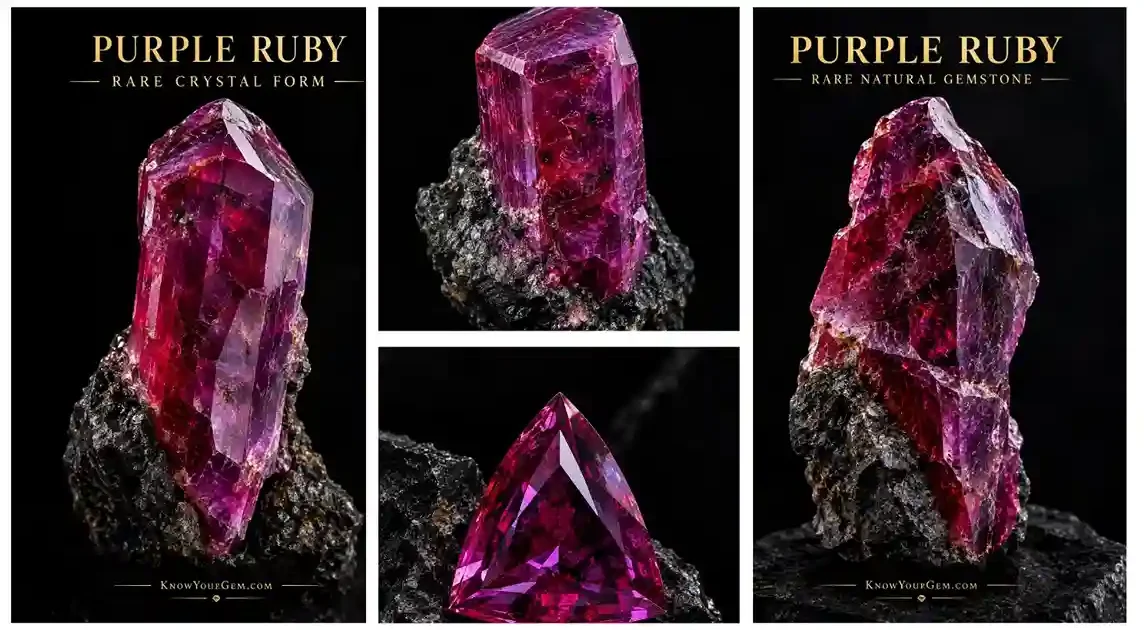

A ruby can lean purple, but only so far. Ruby is red corundum, and the best stones run from pure red to slightly purplish red. Once purple takes over, a laboratory will call the stone a sapphire.
Quick Answer:
“Purple ruby” is generally a purplish-red corundum where the predominant color is still red. However, it‘s a trade term and definitely not a species or official trade name for a gem.
GIA‘s standard on the identification of corundum is that if the color reads red, then corundum can be identified as a ruby.
Any stone having a purple or violet reading can only be a purple sapphire. But with amethyst, purple spinel, and purple garnet being other mineral species, the line between their trade names can sometimes be confused overlapping.
What Is a Purple Ruby?
As such, ruby and sapphire are not two separate minerals they are one mineral: corundum, aluminum oxide (Al 2O 3). Red corundum is a ruby. Corundum in a different color is a sapphire.
Chromium makes the red. The purple comes from somewhere else, a bluish edge on that red caused by other trace elements and by how the crystal handles light.
So the phrase describes a colour, not a quality. It will be written out as purplish red ruby, purple red ruby, violet ruby, deep purple ruby, or purple colour ruby stone. And each of those is asking the same question: is this stone red enough to be ruby?
The answer isn’t perfectly settled. GIA wants a dominant red hue. The International Colored Gemstone Association, by contrast, considers any red corundum a ruby, regardless of depth or intensity.
A borderline stone can get different names from different labs, and from different countries. That’s the main reason to want a report on anything unusual.
Does Purple Ruby Really Exist?
Purplish-red ruby exists, and it’s ordinary. A truly purple ruby, by GIA’s standard, doesn’t.
Picture a slider. At one end, pure red. Move toward purplish red, and red still leads, so it’s ruby. Move further into violetish red, and you reach the gray zone where opinions split. According to past reviews, purple won, and the stone is a purple sapphire.
Is there a purple ruby, and does it exist?
Yes if you mean purplish red. No if you mean clearly purple.
Can ruby be purple?
It can lean that way. Past a certain point it stops being ruby.
Can ruby look purple?
Sometimes. In rubies, which are very pleochroic, the color will be very distinctly different if you look at it parallel to the c axis than if you look perpendicular to it.
More commonly, the color is orangey red if viewed perpendicular and a red to purplish red if viewed perpendicular to the c axis. Which one you see face-up depends on the orientation of the cutter and the light.
What is a purple ruby called?
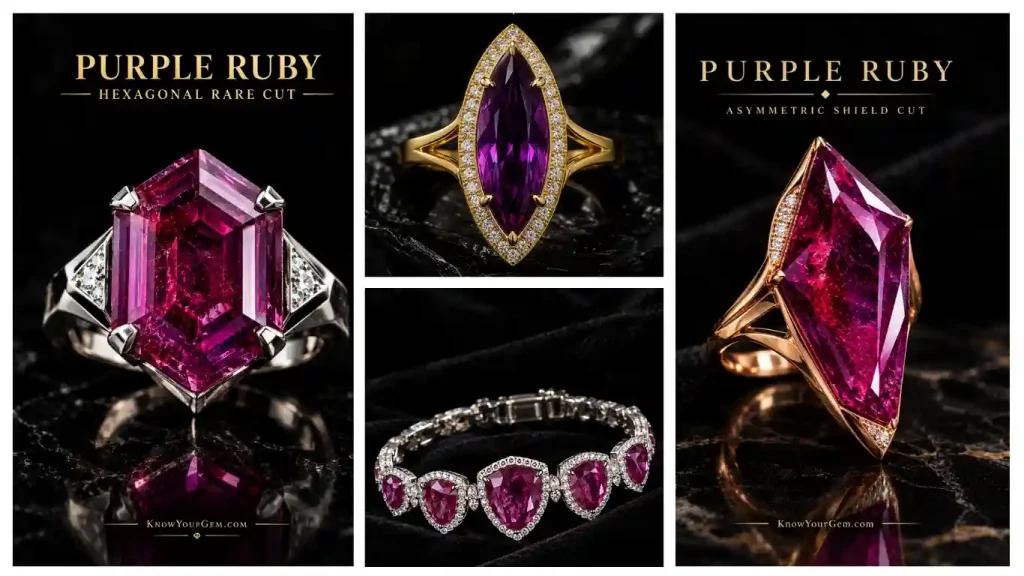
Purplish-red ruby. Red-violet corundum. Purple sapphire, or purple, yellowish-green, or blue. Go with what the lab report says.
Purple Ruby vs Purple Sapphire:
Same mineral, different color call:
| Mineral | Corundum | Corundum |
| Hardness | Mohs 9 | Mohs 9 |
| Composition | Al₂O₃, chromium-led color | Al₂O₃, other trace elements |
| Color call | Red dominant | Purple or violet dominant |
All we need to know is that because the physical properties overlap, the characteristics of hardness and the basic gem-lab readings will not distinguish between the two. It is the color grading, which is a matter of opinion, that draws the line and where the differences begin.
If offered a ring with a mixture of red and purple stones, or a “ruby and purple sapphire ring,” then ask the seller to individually identify each stone, and to give reasons.
Purple Ruby vs Amethyst:
Amethyst is purple quartz. Different mineral, different physics, and a fraction of the price. People confuse the two constantly.
| Mineral | Corundum | Quartz |
| Chemistry | Al₂O₃ | SiO₂ |
| Hardness | 9 | 7 |
| Refrective is | About 1.76–1.77 | About 1.54–1.55 |
| Specific gravity is | About 4.00 | About 2.65 |
The numbers are miles away, an minute’s worth of work by a gemologist. Ruby feels noticeably heavy for its size. Amethyst doesn’t.
Amethyst is fine if all you are after is a purple stone. It‘s hard 7 will scratch more easily and is more suitable in earrings and pendants than a worn ring. Ruby wears more hard 9, but is priced much higher.
Purple Ruby Color: What You’ll Actually See
Hue, tone, saturation, and light all shape the color:
Hue is the blue content behind the red.Tone is the lightness or darkness of the stone. Deep dark stones look purple-black. Saturation refers to how vivid the stone is. As it decreases, it is leaning toward pink. Then there’s light: daylight, LED, and warm incandescent bulbs can each push the same stone to a different place.
Cutting adds another layer. The cutter picks which of the crystal’s two directional colors dominates the table, and transparency affects how deep the color looks.
What causes ruby to look purple?
There’s no single answer. Chromium gives the red. A bluish component can come from other trace elements such as iron and titanium, and from how the two directional colors blend after cutting. Different stones can get there by different routes. A seller who gives you one neat explanation for all of them is simplifying.
Deep purple ruby vs purplish red ruby
Neither is a grade; they’re descriptions. The first “Purplish red” indicates the red is still the dominant color, so the stone should be a proper ruby. The second “Deep purple” indicates the red may not be dominant; ask whether the stone is sapphire.
Purple Ruby Price Per Carat:
Purple rubies, no, there is no price for the category yet. If it is ruby, it is priced as such; and if it is purple sapphire, it is priced as such.
Factors that affect the weight of the jewel: color, saturation, tone, clarity, transparency, carat weight, cut, treatment, origin, certification, and whether the stone is natural or laboratory grown.
No reliable published price series for “purple ruby” as a distinct item was available. The data below is from retail or auction-house guides, not finalized transactions, and the figures don‘t agree. Use as a projection, then check against real classified advertisements with the same lab-reported information.
| Purple sapphire, faceted | Cost $1,000–$2,300 on average (with poor quality ranging from $100–$400 and the best stones up to $5,200). |
| Purple sapphire, fine 1 ct | Price is $400–$2,000 |
| Purple sapphire, broad range | $200–$750 |
| Ruby, heated Mozambique, under 1 ct | Are sold for $200–$2,000 but commercial stone can charge, $1,500–$6,000 fine |
| Ruby, unheated fine Mozambique, under 1 ct | $3,000–$12,000 |
| Ruby, 1 ct, July 2026 | Roughly $ 1,000 $ 4,000 for good color with visible inclusions; roughly $20,000 for unheated Burmese |
The distance is great because each source has an alternative definition of “fine” and a different assumption of treatment and origin. When comparing stones, compare price per carat, never total price
Does purple ruby cost more than red ruby?
Not automatically. A well-saturated, untreated purplish-red stone can outprice a pale or dark red one. A dark, murky purplish stone may sell for much less. Saturation and treatment decide it, not the direction the hue leans.
One opinion, flagged as mine: I’d treat faceted purple ruby as a collector’s alternative, not an investment. Resale needs documentation and a buyer who wants that exact color.
Is Purple Ruby Rare?
Fine ruby is scarce in any color. “Purple ruby” adds confusion, because the phrase covers very different things.
Ordinary purple corundum is mostly sapphire, and it isn’t especially rare. Natural purplish-red ruby is available, priced by ruby standards. What’s genuinely hard to find is the combination: strong saturated color, good transparency, a decent size, and little or no treatment. Staying on the red side of the line narrows it further.
A deep purple stone being unusual doesn’t make it valuable. Value follows demand, and demand for deep purple corundum is smaller than for fine red.
Natural vs synthetic:
Synthetic ruby is real corundum grown in a lab. It matches natural ruby in chemistry and hardness. What differs is origin, and origin affects value. A flawless, bargain-priced stone should make you ask why.
Purple Ruby Origins:
Origin can raise the price, but only when it’s documented.
“Burmese” means Myanmar, mainly Mogok and Mong Hsu. The word has also been used as shorthand for a color quality, and GIA points out that terms like pigeon’s blood can be misinterpreted when used to describe a ruby’s actual color.
A stone can be Burmese in origin without matching the legend, and a stone can be sold as “Burmese color” without being from Myanmar.
Mozambique is a major current source. Its finest stones can show a rich, slightly purplish-red color, which makes it relevant for this search.
Thailand, Madagascar, Tanzania, Sri Lanka and other localities also produce ruby, and Thai material often runs darker and more brownish or purplish red. That’s a tendency, not a guarantee.
You can’t tell origin by eye. It takes inclusion study and trace-element analysis at a recognized lab, and even then it’s an opinion with limits.
Natural vs Synthetic: Can You Tell by Eye?
No. Color alone doesn’t settle natural origin, or even species.
Most natural stones normally have mineral crystals, fine rutile silk, and healed fractures. Lab-grown ones mainly have curved growth lines, gas bubbles, and flux residue.
1 Many of these patterns resemble those of treated natural stones, thus requiring training and equipment such as microscopes and spectrometers for identification.
To check a stone: get a report from an accepted lab; ensure it identifies species, color & treatment; and ensure weight and size are consistent with your stone. Then make sure the seller will accept it back if a second lab differs.
Purple Ruby Treatments:
Most rubies are treated, and heat is the usual method. Heating is widely accepted when it’s disclosed.
The treatments that hurt value more:
- Flux healing partly closes fractures.
- Lead-glass filling fills fractures to improve clarity. The glass is chosen to match ruby’s refractive index closely, but it shows up under magnification as orange and blue flash effects and trapped gas bubbles.
- Diffusion and dye are rarer and can leave color pooled in cracks.
Treatment matters for price and for durability. GIA’s care advice for fracture-filled, cavity-filled or dyed stones is a damp cloth only. A purple color isn’t evidence of treatment, and testing is what reveals it.
Purple Ruby Cabochon:
Cabochons are smooth, domed cuts. They’re used for stars and for translucent or heavily included material that wouldn’t facet well.
The modified behavior of light at the dome alters the appearance of colors and often gives subdued hues. Translucent materials appear more tonal and delicate. Look at any cabochon in more than one light. Dyed cabochons exist, so ask about disclosure and check for color gathering in surface cracks.
Purple Star Ruby:
A star ruby shows asterism, a star-shaped pattern of light that glides across the dome. It appears when fine needle-like inclusions, usually rutile, line up in the crystal and the stone is cut to show them.
“Purple star ruby” stacks two unrelated ideas: a color and an optical effect. The star doesn’t prove rarity or value. A sharp, centered star on good color is desirable. A faint star on gray, opaque material isn’t. A purple star stone may also be a purple star sapphire, so the color rules above still apply.
Purple Ruby Jewelry:
- Rings: Corundum’s hardness of 9 handles daily wear. Hardness isn’t toughness, though. Corundum can part along certain planes if struck hard, so a bezel or halo is sensible for a valuable stone on the hand.
- Bracelets: These take knocks. Setting security and height matter more than hardness.
- Beads: Often cabochon or tumbled, and low-grade strands are common. Ask about dye and filling.
- Purple ruby and purple sapphire rings: Fine, but get each stone identified separately.
- Amethyst alternatives: Amethyst costs far less and is fine for occasional wear. Ruby wears harder and costs far more.
Purple Ruby Benefits & Meaning:
This part is tradition and belief. It isn’t science.
Red has always been associated with passion, life, and safety. Purple is associated with spiritual enlightenment and royalty, so a bit of purple in your ruby combines the meaning of the stone with the meaning of the color.
Vedic astrology associates a ruby (manik) with the sun. Your astrologer is probably more concerned with what the actual stone is than whether it has any treatment, which is yet another good reason to know exactly what you‘re buying.
What’s supported by evidence: nothing. No scientific evidence shows that ruby heals, protects or changes health, luck or money. Wearing it for symbolism is a personal choice. A seller promising measurable effects is promising something nobody can show.
How to Identify Purple Ruby?
Color narrows the field and confirms nothing. Plenty of stones look purplish red:
The refractive index for ruby is given as 1.762–1.770, and specific gravity as about 4.00. Published ranges vary a little by source and specimen. Amethyst, near 1.54 and 2.65, is nowhere close.
Hardness is Mohs 9, but don’t scratch-test a stone you plan to keep. You can damage it.
Use a microscope to observe silk, crystals, and healed fractures. Expect a reliable method of differentiation is wet lab testing such as spectroscopy and more sophisticated analysis.
For a stone near the ruby–sapphire line, a lab report is the only dependable record of species, color, and treatment.
Purple Ruby vs Other Purple Gemstones:
| Purplish-red ruby | Corundum | 9 | It usually displays Purplish red to red-purple color |
| Purple sapphire | Corundum | 9 | It displays purple to violet color |
| Amethyst | Quartz | 7 | It has purple to violet colore |
| Purple spinel | Spinel | 8 | It has purple color |
| Purple garnet | Garnet group | About 6.5–7.5 | It has purple to purplish red |
The Biggest Buyer Misconception:
Buyers assume a rich purple color means a rare, valuable “purple ruby.” It doesn’t. The phrase is a color description, strong purple usually lands in sapphire territory, and color alone never proves what a stone is or what it’s worth.
The cost is real. Pay ruby prices for what a lab would call purple sapphire and you overpay. Pay for “ruby” and receive another mineral and you overpay more.
Here’s a field test. Corundum has no cleavage. A stone sold as ruby that chips along flat planes, or scratches much more easily than it should, isn’t corundum, whatever the listing says. Ask for the species in writing.
Buyer Checklist:
- Get a report from a recognized lab naming species and color.
- Check that treatment is stated.
- Ask why the seller calls it ruby rather than sapphire.
- Compare price per carat.
- View the stone in daylight, LED and warm light.
- Ask about origin only if documents support it.
- Pick a protective setting for a ring.
- Confirm return terms before paying.
FAQ:
1. Is purple ruby natural?
Only testing can say. Color and price can’t.
2. Is purple ruby the same as purple sapphire?
Same mineral. The color call differs.
3. Is purple ruby the same as amethyst?
No. Amethyst is quartz, softer and far cheaper.
4. What color is purple ruby?
Red with a purplish or bluish edge.
5. What is deep purple ruby?
A sales description, not a grade. Check whether it’s ruby or sapphire.
6. What is the price of purple ruby and valuation per carat?
No fixed price exists. See the ranges above and compare against stones with the same lab details.
7. Is purple ruby rare?
Fine, saturated, untreated, larger stones are scarce. Ordinary purple corundum isn’t.
8. Is Burmese purple ruby rare?
Myanmar rubies are valued, but “Burmese” is an origin claim that needs a report behind it.
9. Can purple ruby be a cabochon?
Yes. Cabochon cutting is common for translucent and star material.
Sources:
- GIA (Ruby Quality Factors, Pink Gemstone Buying Guide, Gems & Gemology lead-glass study);
- Gem Society; National Jeweler; GemDat; Wikipedia (Ruby, Sapphire); retailer and auction price guides retrieved October 2026.
- Confirm amethyst, spinel and garnet values against GIA or Gem-A before publishing.
This article is written and published by gemstone expert and enthusiast: KamilHussian!

Welcome to KnowYourGem.com! your ultimate destination for uncovering the fascinating world of gems and their secrets! I'm Kamil Hussain, a passionate blogger with a Master’s degree in Economics, dedicated to bringing you insightful, well researched content that blends the beauty of gemstones with the art of storytelling. With a keen analytical mind and a love for discovering hidden treasures, I created this platform to help you explore the brilliance, history, and value of every gem.

