
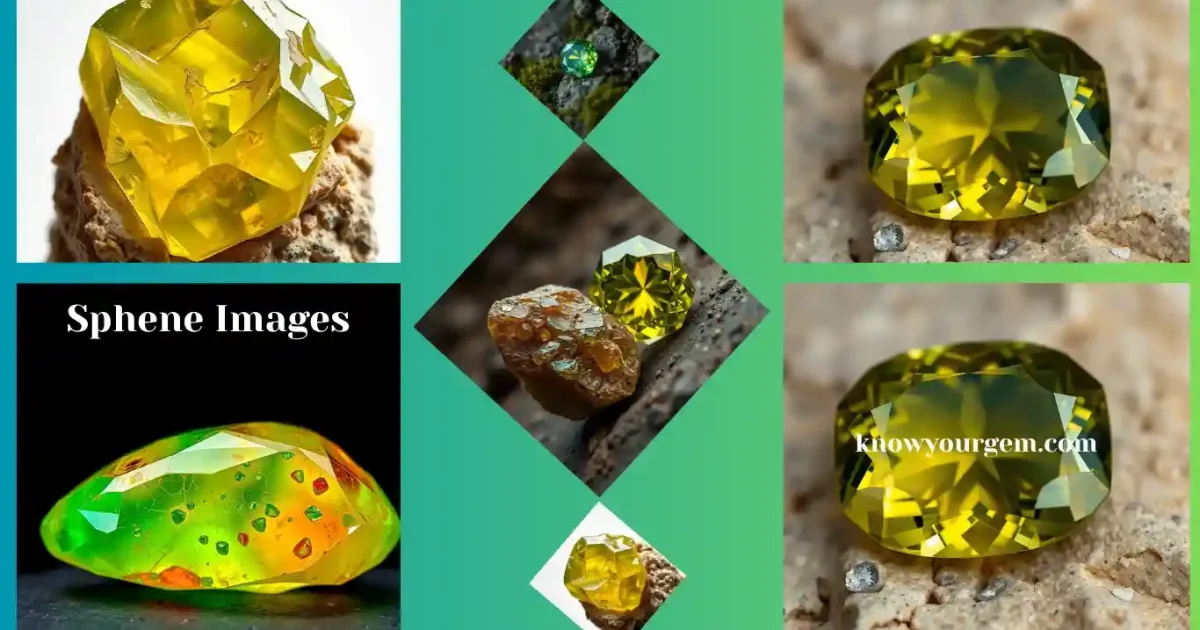

Sphene is an uncommon, collector grade gemstone generally cherished for its extraordinary fire, a dispersion rating that surpasses even diamond. It is also recognized by its mineralogical name titanite, it ranges in color from yellow and green to the deep chrome green, that make it one of the most visually dramatic stones in the world of colored gemstones. Its lower hardness makes it best suited for protected jewelry settings or collector display than daily wear.
Get detailed guide about green emeralds and how they relates to the same minerals:
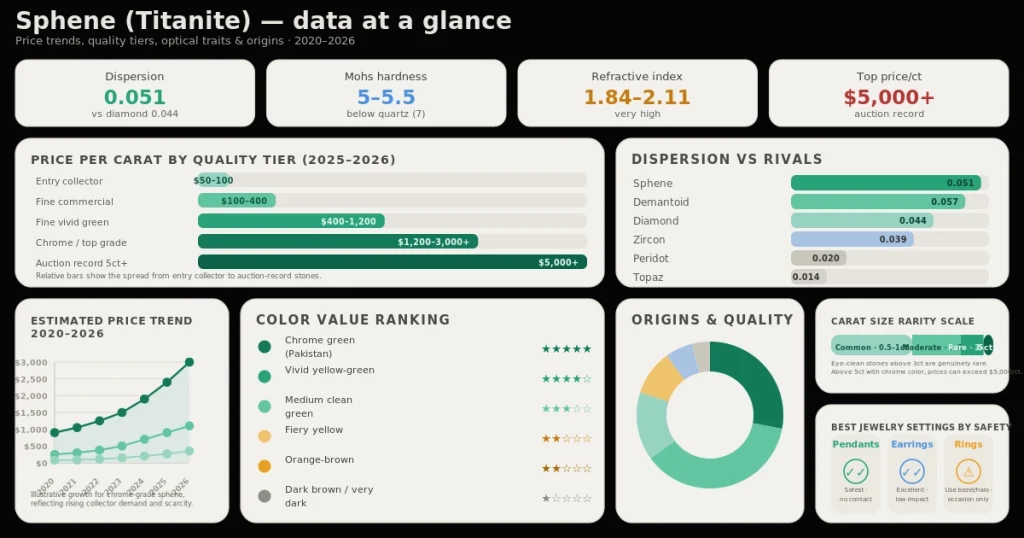
4 key stat cards At the top dispersion, hardness, refractive index, and top auction price gives an instant fingerprint of Sphene’s nature.
Price tier bars Visualize the jump from entry level like ($30/ct) all the way to auction records ($5,000+/ct), that makes the quality gap very easy to read.
Dispersion comparison Showcases exactly how sphene stacks up against diamond, demantiod, zircon, peridot and topaz, its biggest selling point has made visual.
Price trend line (2020–2026) Tracks estimated growth for all three quality grades: chrome, five vivid green, and commercial reflects the article’s note that collector demadn has grown and supply has tightened time.
Color value ranks, an origin donut chart, a carat rarity scale, and a jewelry safety guide round out the full picture in a clean, easy to scan layout. You can also click the buttons below to dive deeper into any topic that interest you.
What is sphene?
Sphene is a calcium titanium nesoslicate mineral which forms in metamorphic and igneous rocks. In gem trade, it is recognized for its vivid fire, the splitting of white light into spectral colors which exceed that of diamond, white topaz, and most other faceted gemstones. Despite this exceptional optical quality, sphene remains relatively unknown outside collector and connoisseur circles, partly because clean, large specimens are rare and partly because its moderate hardness limits mainstream jewelry usage.
Collectors and gem dealers value it for its dispersion, unusual color range, and the fact is that fine material is genuinely scarce. When you encounter a well cut sphene in a dark room under a spotlight, the flashes of orange, red and green fire are difficult to forget.
Sphene vs Titanite: Are they the same Gem?
Yes, they are exactly the mineral! Titanium is the official name recognized by the international association, whether sphene is the old school trade name that has called by gem dealers, jewelers, and collectors. It comes from greek word “shpen.” meaning wedge perfect for describing the mineral’s classic wedge crystals.
Both names appear on the certificates, dealer listings and gemological reports. When you search fro “Sphene gem for sale: or “titanite gemstone.” you are searching for the same material. Since, modern gemological labs tend to use “titanite” in formal reports, whether the trade continues to use the actual name “Sphene” in commercial contexts.
Why Sphene is known for exceptional fire:
Fire in gemology is that stunning effect where white light splits into a rainbow of spectral colors think orange, red, yellow, and green as it refracts through a faceted gem. Since, Sphene’s dispersion value of 0.51 beats diamond’s 0.044 hands down and leaves sapphire, emerald, or peridot in the dust. In everyday lighting, a well cut sphene just explodes with the different fire flashes that catch your eye every time.
The stone’s high refractive index (1.843-2.110) further amplifies its brilliance. The combination of the strong dispersion and high RI makes this one of the most optically dramatic gemstones available, particularly in yellow and green tones where body color doesn’t suppress the fire display.
Common colors, origins, and typical stone sizes:
Sphene occurs in a wide range of colors including yellow, yellow-green, orange-brown, and the treasured chrome green is found in material colored by chromium. The most commercially valued colors are vivid green (especially chrome sphene), clean yellow-green, and transparent yellow with having strong dispersion. Brown and very dark green specimens are less desirable because body color suppresses fire visibility.
Primary origins include:
- Pakistan (Gilgit-Baltistan): It produces fine yellow-green chrome material
- Madagascar: It is a major source of commercial and fine-grade sphene
- India (Rajasthan and Maharashtra): It produces brown-yellow and green stones
- Brazil: It Yields some orange-brown material
- Austria and Switzerland: The are historic alpine sources of collector specimens
- Russia and Myanmar: The are smaller production of gem-quality stones
Most faceted sphene in the market weighs between 0.5 and 3 carats. Since, eye-clean stones more than 3 carats are uncommon. Stones with having more than 5 carats of fine quality are genuinely rare and command significant premium prices.
Sphene quick facts:
This stone offers stunning optical fire that surpasses diamond, but its relative softness requires careful consideration for jewelry usage:
Mineral family, hardness, dispersion, and optical traits:
While recognizing sphen’s physical and optical properties is essential before making any purchasing decision. Or setting in jewelry. Its beauty is extraordinary; its physical limitations are realistic.
| Property | Detail |
| Gemological name | Titanite |
| Trade name | Sphene |
| Crystal system | The stone has Monoclinic crystal system |
| Mineral family | It belongs to Nesosilicate means calcium titanium silicate. |
| Hardness (Mohs) | Sphen is 5-5.5 on the mohs scale means can get scratched quickly if it is gathered with hard stones |
| Cleavage | It cleavage distinction in two directions |
| Dispersion | 0.051 (higher than diamond at 0.044) |
| Refractive index | It is calculated by refractive index of 1.843 to 2.110 |
| Color range | Yellow, green, orange-brown, chrome green |
| Typical faceted size | 0.5–3 ct; 3–5 ct is uncommon; 5+ ct is rare |
| Best settings | The stone can best fit in settings like, bezel, halo, protective prong for pendants and earrings |
| Daily-wear suitability | It is not typically recommended for daily wear jewelry like rings; acceptable for earrings and pendants |
| Treatment status | Typically untreated; occasional fracture filling reported |
| Collector appeal | High one of the top dispersion gems in the collector market |
Best Jewelry uses at a glance:
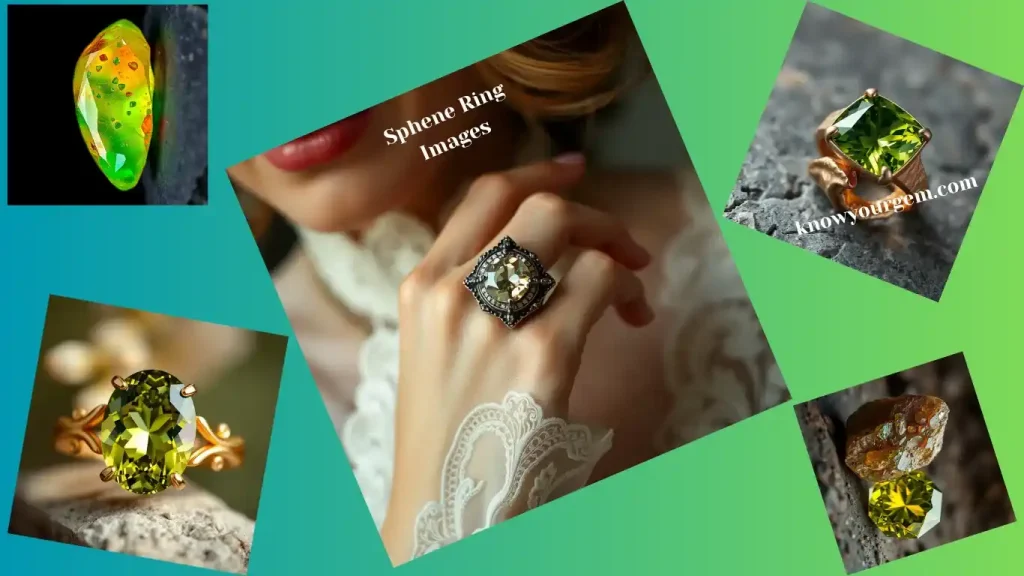
Sphen’s optical performance is best displayed in faceted cuts under direct light. Since, Oval and round brilliant cuts tend to maximize fire. It performs stunningly in pendants, drop earrings, and bezel-set rings where stone to surface contact is minimized, protective settings, bezel or halo designs are strongly preferred for any ring application.
Who sphene is best for:
Sphene suits collectors, color stone enthusiasts, and buyers who prioritize visual drama over everyday durability. It is a natural choice for anyone who are building a collection of rare green gemstones or are also seeking for a gemstone that owns fire exceeding that of diamond. It is not the right choice for buyers who want a daily wear engagement ring stone without special care.
Why is sphene valuable?
Sphene is valuable because of the interaction of four primary factors like color, clarity, cut quality, and carat weight. Since, origin plays a secondary but growing role, particularly for chrome sphene from Pakistan. Buyers must need to understand these factors for making a perfect purchasing decision.
Color: Why green and Chrome sphene command premiums
Color is an individual most powerful value driver in Sphene. The most desirable colors are vivid, saturated greens particularly chrome sphen, which owes its intense green color to chromium content rather than iron. Since, Chrome sphene’s color is stronger, more even, and more stable under different lighting conditions than standard green stone.
Vivid yellow-green and clean medium-toned green stones also hold strong premium prices and values because they enable maximum fire visibility. Very dark green stones absorb too much light to showcase strong dispersion. Yellow and orange-yellow sphene ranks below green in value but still commands prices well above most commercial stones when they are eye clean and well cut.
The light green stone and yellow green stone varieties are popular precisely because their pale body color lets spectral fire flash through with maximum impact one of sphen’s defining characteristics.
Clarity and inclusions: What buyers should sccept:
Eye cleann sphen is genuinely uncommen. Most this green stone contains visible inclusions in the market: needle like crystals, growth planes, or fingerprint inclusions. Not same as diamonds, where the clarity grading scale is strict, colored gemstone buyers apply more practical standard: is the stone eye-clean from a normal viewing distance of about 10 inches.
Fine sphen that is eye-clean under naked eye commands significantly premium prices and value over included material. Collectors and connoisseurs will accept minor inclusions in exceptionally fine chrome Sphen when color and size are outstanding, but eye-clean material at any quality tier is worth paying more for.
Avoid stones with having large fractures near the surface or table, as sphene’s distinct cleavage makes it susceptible to chip along those planes.
Cut and dispersion: Why faceting quality matters more than usual
In most colored stones, cut affects brilliance modestly. In this light green stone, cut quality has an outsized impact because fire is the stone’s primary selling point. A poorly proportioned sphen with having windows can lose most of its dispersion display. A well cut sphen, even in a modest, can look dramatically more impressive than a better quality stone with lazy faceting.
When you are evaluating sphen, you should ask for video under a spotlight or point light source. This is where its fire showcases best, and it is the clearest way to judge whether the cut is working.
Carat size and the premium for clean larger stones:
The light green stone displays strong carat premium prices. Since a 2 carat eye clean stone doesn’t cost twice the price of a comparable 1 carat stone it costs substantially more, because the combination of fine clarity and larger size genuinely rare. More than 3 carats of eye-clean material with having good color, the price can jump per carat becomes steep.
Buyers with collectors intent should understand that the scarcity of the larger, clean material is realistic structural features of the sphen market, not a sales technique.
Origin and rarity: When locality changes buyer interest:
Origin matters in for this gemstone specifically for chrome material. Pakistani chrome sphene from Gilgit Baltistan region commands premium prices from an advanced collectors and institutional buyers. Whether Madagascar material is the most commercially common and covers a wider range of quality tiers. Austrian and Swiss alpine specimens are valued as mineralogical curiosities.
For most commercial buyers, origin matters less than color, clarity, and cut. For an advanced collectors purchasing investment tier chrome sphene, locality documentation adds credibility and can support higher resale valuations.
Sphene price guide:
The prices of this substantially hinges on quality tier. The following ranges reflect market direction as of 2025-2026 and should be verified against current pricing structure before purchase, as the rare gemstone market adjusts quarterly.
Sphene price per carat by quality tier:
| Quality Tier | Description | Approximate Price Per Carat |
| Entry collector grade | Included, lighter color, standard green/yellow | $30 to $100/ct |
| Fine commercial grade | Eye-clean or slightly included, good color, 1–2 ct | $100 to $400/ct |
| Fine vivid green grade | Eye-clean, vivid green, well-cut, 1–3 ct | $400 to $1,200/ct |
| Chrome sphene / top collector grade | Chrome-colored, eye-clean, strong dispersion, 2+ ct | $1,200 to $3,000+/ct |
Auction results for an exceptional chrome sphene more than 5 carats have exceeded $5,000 per carat. Since, retail pricing from established jewelry store add 30-100 % margin over dealer cost. Whether, online auction platforms and dealer to collector prices can fall below retail but require greater buyer diligence.
What increases price fastest:
The quickest way to move up the price curve in Sphen is a combination of vivid chrome green color and eye-clean clarity in stones more than 2 carats. Each of these factors individually raises price; together, they create exceptional premium territory. Strong cut quality that maximizes fire adds additional value. Locality documentation for Pakistan chrome material adds a further increment for advanced buyers.
Why cheap sphene is usually cheap:
Sphen is listed below $30 per carat typically indicates heavily included, very pale or unattractive color, poor cut, or small fragments not suitable for jewelry. Occasional bargains exist from estate sales or less-experienced sellers, but deeply discounted fine quality green stone is rare. If a price looks dramatically below market for the described quality, verify the stone’s identity with an independent lab report.
Retail vs auction vs dealer pricing:
Retail jewelry stores price green with having a big markup to cover overhead, design, and setting costs.Since auction house results for essential prices come from competitive bidding, so they can beat or undercut private dealer prices, which really hinge on buyer interest. Direct sales from established gem dealers specializing in rare stones often give best value to savvy collectors who know exactly what they are after.
Is sphene a good Investment?
Sphene is better described as a niche collector gemstone than a conventional investment asset. That distinction matters if you are approaching the purchase with financial return as a primary motive.
Collector Stone vs mainstream investment gem:
Mainstream investment gemstones like, rubies, sapphires, emeralds, alexandrite have broad global buyer bases, established auction house track records, active institutional interest, and decades of price documentation. The light green stone has no scale. Its buyer base is knowledgeable but narrow. Auction appearances are infrequent. Price history is thin as compared to the primary colored gemstone categories.
And it is said that, this green stone has appreciated meaningfully over the past two decades as collector interest in rare dispersion gems have grown, and as fine chrome stone has become harder to find in larger sizes.
What “investment-grade” actually means for sphene:
For a sphen specimen to have any realistic resale potential, it should meet all of the following criteria: chrome or vivid green color, eye-clean clarity, weight more than 2 carats, and having an excellent cut quality, no undisclosed treatments, locality documentation preferred, and ideally accompanied by a reputable lab report. Material that falls short of multiple criteria is collector’s financial asset.
Liquidity, certification, and exit risk:
Liquidity is the primary risk in this green stone as an investment. When you want to sell, your buyer pool is small. Not as same as diamonds, which have established resale channels, Sphene requires finding a specialist dealer. This can take time and can require prices below your purchase cost if you need a quick sale.
Certification from following reputable laboratories (GIA, Gübelin, SSEF, GRS) can improve liquidity by reducing buyer skepticism. Unfortified stones, regardless of quality, face significant resale friction.
When sphene makes sense as a portfolio addition:
This light green stone makes sense as a minor allocation within a broader collector gemstone portfolio not as a standalone investment. If you already own rubies, sapphires, and alexandrite, that add a fine chrome sphene piece adds diversification into a rarity category with genuine supply constrains and growing collector interest. Buying this green stone purely as a financial play, without collector motivation, is not recommended.
How to buy sphene safely:
This green stone is also recognized as titanite, which is collector’s gem with having an exceptional fire and neon-green vibrancy, but its rarity invites scams. This guide equips you with important steps to buy confidently.
What to check before you buy:
Buying this light green stone demands verifying a set of non-negotiable quality and authenticity factor before committing. Since, this mineral is distinctive enough that substitution with other gemstones that are deductible, but listing descriptions can be vague or misleading.
Buyer checklist before purchase:
- [ ] Is the stone confirmed natural (not synthetic or simulant)?
- [ ] Is it untreated, or are any treatments fully disclosed?
- [ ] Is the locality disclosed and plausible for the color and quality described?
- [ ] Is the stone eye-clean, or are inclusions described and documented in photos?
- [ ] Is video available under multiple light sources, including a spotlight?
- [ ] Does the seller offer a return policy of at least 7–14 days?
- [ ] Is a lab certificate available or can one be obtained?
- [ ] Is the listed price consistent with market range for the described quality?
Lab reports, certificates, and seller proof:
A report from GIA, Gübelin, SSEF, GRS, or AGL confirms, natural origin, and treatment status. For chrome sphene more than 2 carats, a lab report is strongly available. For smaller or entry-grade stones, a reputable seller’s written guarantee of the natural, untreated origin can be acceptable for buyers with having established dealer relationships.
Always request the full report, not just a summary card . Since, full reports include gemological testing data that allows independent verification.
Questions to ask a dealer:
Ask following questions before purchasing this stone: what is the stone’s origin and can you provide documentation? Has the stone been treated in any way? What is your return policy if the stone fails independent testing? Can you provide video under both diffuse and direct light? Is the stone owns certification from a reputable laboratory?
A reputable dealer will answer these questions easily without any hesitation. Vague or evasive responses are a warming sign.
Red flags in listings and marketplaces:
Keep away listing which describe this green stone as “ investment grade” without locality disclosure. Watch for photos that are taken only under diffuse lighting, which can hide inclusions and exaggerate color. Very low prices for large, vivid apparently eye clean stones are worth treating with skepticism. Sellers who refuse returns or independent testing should be avoided entirely.
Best jewelry settings for sphene:
Sphene’s fiery sparkle shines brightest in settings which protect its moderate hardness like 5-5.5 mohs scale and perfect cleavage from daily wear.
Rings vs earrings vs pendants:
Sphen’s Mohs hardness of 5 to 5.5 places it below quartz which is 7 on the mohs scale means that everyday dust and contact can scratch its surface. For this reason, the stone performs best in jewelry pieces where stone to surface contact is minimized.
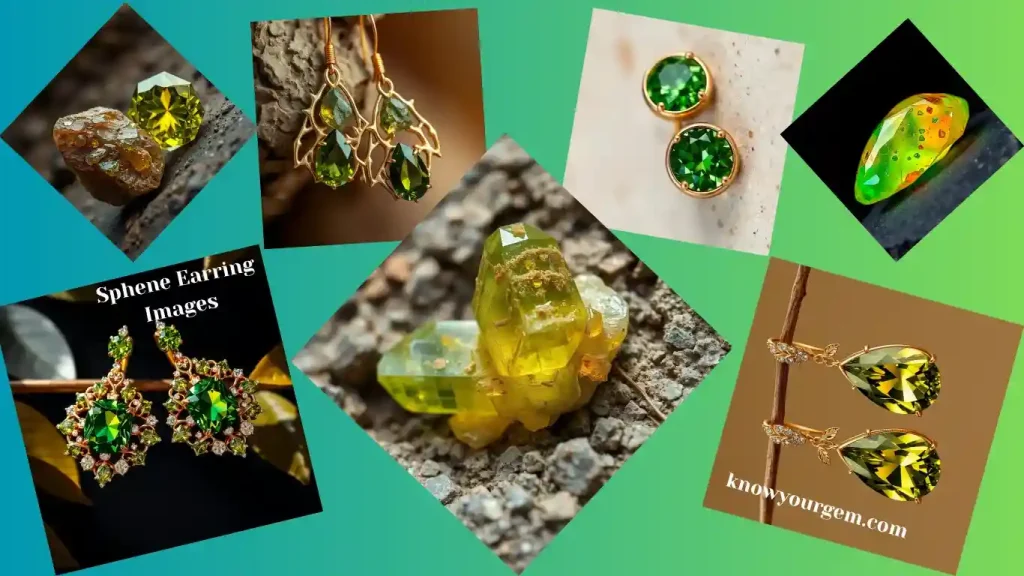
Pendants are the safest setting for this light green stone in fine jewelry. The stone hangs freely and rarely contacts hard surfaces. A well cut sphene pendant in yellow gold or rose gold will display its fire beautifully in both natural and artificial light.
Drop earrings and stud earrings are also excellent choices. The stone is protected from the most contact damages and can be enjoyed without the wear risk associated with the hand jewelry.
Rings are the trickiest setting for this white-green gemstone. Since, everyday hand stuff like cooking, typing, workouts, or grabbing tools meaning constant bangs and scraps. For a sphen ring, you should select a protective bezel or halo design to guard the edges and save it for special occasions instead of daily wear.
Why protective settings matter:
Protective settings compensate for this stone’s cleavage and hardness limitations. Since, bezel setting surrounds the girdle of the stone with having a metal rim, prevent direct edge contact. Whether halo setting surrounds the center stone with having small diamonds or gemstones, that create a physical buffer against impact. Both approaches reduce the risk of chipping along sphene’s cleavage planes, one of the more common failure modes for this gem in ring applications.
Who should avoid sphene for daily wear:
The stone can be avoided by anyone who works with their hands, doing outdoor activity, or consistently wears their jewelry during exercise, cooking, or manual tasks should avoid this stone because a daily wear green jewelry with fire are demantiod garnet which owns hardness like 7-7.5, both offer strong dispersion and better durability for ring use.
How to care for sphene:
Given below caring and maintenance guide will help you out to protect your gem or jewelry from damages:
Cleaning do’s and don’t:
Clean your stone gently with a warm water, a mild soap, and a soft brush, a good use for cleaning delicate items or baby items. Wash your stone thoroughly and pat dry it with a lint free cloth. This is sufficient for removing everyday oils, lotions, and dust.
Don’t use ultrasonic cleaners on this gem because the vibrations can exploit cleavage planes and cause internal fracture. Skip steam cleaner because can they shock the stone with sudden heat changes. Keep away your jewelry or stones from harsh chemicals like chlorine bleach, acetone, ammonia, cleaners, or acids, plus any jewelry solutions for tougher gems.
Storage and scratch prevention:
Store your gem or jewelry separately from other gemstones, particularly quartz-based stones and harder materials that can scratch its surface during contact. Since, a soft pouch or a padded individual compartment in a jewelry box can work very well. If you store multiple pieces of sphen or sphen jewelry together, wrap each other, and it can certainly be scratched by harder neighboring stones.
Travel and insurance advice for valuable stones:
For fine sphen worth $500 or more, travel with the stone in your carry-on luggage, never checked baggage. Use a hard-sided travel case with an individual padded compartments. Take multiple photos of the gem and it certificate before heading out. Get a standalone jewelry insurance policy or add a rider to your homeowner’s insurance for loss, damage, or theft coverage.
How to tell if sphene is real:
Spotting realistic sphen starts with unbeatable fire and unique traits given below the check list you can explore and also given key comperisions.
Visual signs of authentic sphene:
This authentic green stone delivers a fire display not same as most imitations. Under a spotlight or direct light, genuine stones flash strong spectral colors, red, orange, and yellow that shift as you tilt it. It’s high birefringence also showcases up under magnification: facet edges look doubled from strong double refraction, a telltale sign you can spot with a loupe.
Realistic Sphene often owns natural inclusions like needle, growth planes, or fingerprint-style liquid patterns. If it’s flawless under magnification and has insane fire, get it gem tested to be sure.
Sphene vs. Peridot:
Both come in yellow-green shades, fooling newbie buyers. Peridot owns 6.5-7 mohs scale of hardness and less fiery like, dispersion 0.020. Always look for its lily pad inclusions (liquid/gas) and lower Refractive index like (1.654–1.690) vs. sphene’s (1.843–2.110). A refractometer nails it.
Sphene vs. Topaz:
Yellow or yellow-green topaz mimics sphene at a glance. Since, topaz is tougher ranks 8 on the mohs scale of hardness and owns less dispersion (0.014), and has a lower refractive index like (1.619–1.627). Sphene’s fire pops in direct light, whether topaz just sparkles refractometer confirms.
Sphene vs. Zircon or Demantoid:
These match sphene’s fire best zircon’s dispersion (0.039) is lower with variable high Refractive index. Demantioed garnet edges it slightly (0.057) but it harder (6.5-7.5), with horestail inclusions and refractive index like (1.888–1.889) lacking sphene’s birefringence. testing sorts them out.
Quick Pro Tip: Always check visuals with gemologist’s tools like refractometer or spectroscope for 100% surety about real and fake gems.
Chrome sphene: The premium variety
Chrome sphen stands out as the elite version of this gem, we are grateful to its knockout color and rarity.
What makes chrome sphene different:
Chrome sphen gets its vibe from chromium swapping in some iron in the crystal, that crank out an intense, vivid green that’s worlds away from standard sphen’s yellow-green or brownish or brownish tones. It echoes top demantoid or Tsavorite but layers on its signature fire, blends deep green saturation with stunning spectral flashes a combo you won’t find anywhere else in gems.
Why chrome sphene is rare:
Chromium rarity showcases in its natural haunts. The gem quality stuff hails from Pakistan’s Gilit-Baltistan region, but deposits are tiny and tough to broad mine. Eye clean pieces more than 3 carats are supper rare, even for specialty dealers that’s why it tops the sphen price charts.
What buyers should pay attention to:
For chrome green stone, demands a lab report that confirms not just iron but also confirms for the color, it’s what justifies the premium price. Get locality docs for pakistani origin if that is enhancing value. Check for even (zoning kills the look), and always hunt eye clean clarity inclusions tank desirability, even that killer hue.
Who should buy sphene?
This green stone is not for everyone, but it is a gem for those people who are chasing rarity, fire, and standout green vibes you can explore the list:
Best for Collectors:
It is perfect for those people who are building rare mineral collections, dispersion suites (think demantoid, sphene, diamond, zircon), or and A-Z gem lineup with optical wow-factor. It slots in with tourmaline, alexandrite, and spinel as a true rarity that screams “serious collector.”
Best for color-stone enthusiasts:
Green stone lovers, if gems like peridot, green tourmaline, or tsavorite are in your jewelry box, sphen’s unattached fire will blow them away. Rock it in green earrings, necklaces, or pendants for head turing impact every time.
Best for buyers seeking “fire” over hardness:
Crave max spectral flash that stops people in their tracks, since, crushes it among colored stones. Ideal for drama in green crystal, ring, or collector piece, if you are cool with the some TLC, it is a winner.
Who should choose another gem instead:
Skip it for daily wear rings without babying; go tsavorite or demantiod garnet for tough green fire. Investment hunters, stick to ruby , sapphire, or alexandrite. Constant-wear light green engagement ring , green sapphire’s hardness like 9 loughs at everyday abuse.
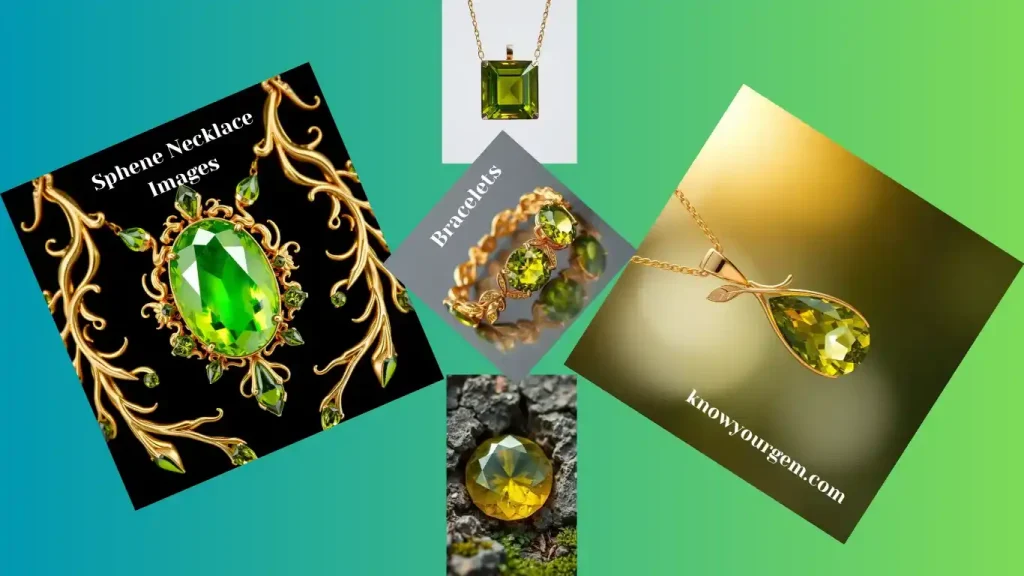
Final verdict: Is sphene worth buying?
Sphen’s gem with have massive appeal for the right buyer, given below the botton line by audience.
Best choice for collectors:
Absolutely yes, especially chrome sphen or vivid green in bigger sizes. It is one of the optically unique stones out these: truly rare, tough to find eye clean and large, and a thrill for both eyes and brain. It deserves a spot next to demantiod, alexandrite, and tsavorite in any elite collection.
Best choice for jewelry wearers:
Great pick with caveats: shine in pendants, drop earrings, or occasion rings with protective settings. A killer-cut sphen dangles with having a jaw dropping flair and personal rarity. But for wear daily rings be realistic about your habits most people won’t pamper it enough.
Best choice for investment-minded buyers:
Only as a small, speculative side bet in a diverse gem portfolio, not your main play. Low liquidity, niche buyers, and spotty price history can’t match ruby or sapphire’s resale reliability. Since top chrome sphene with having docs might climb, but expect uncertainty on timing and exists.
Always verify stone for certification from a reputable source like GIA or IGS:
Quick Q and A:
1. Is sphene the same as titanite?
Yes, they are identical both are calcium titanium silicate. Since, Titanium is the official mineral name (per the International Mineralogical Association), While Sphen is the catchy trade name jewelers love. You will see both on reports and lists; same gem no difference.
2. Why does sphene sparkle more than diamond?
Because of its dispersion (0.051) which beats the dispersion of diamond like (0.044), so it splits light into bolder rainbow flashes like red, orange, green, and yellow that explode under spotlights. Yellow and green colors make it especially dramatic.
3. What color sphene is most valuable?
Chrome sphene gets the crown with its intense chromium green. And also gets vivid yellow-green or clean medium green follows, then fiery yellow, dark brownish least pricey on the market.
4. Is chrome sphene rare?
It is super rare. Chromium doesn’t play nice in green stone’s geology, and gem quality stuff mostly comes from Pakistan’s Gilgit Baltistan. Eye-clean pieces more than 2-3 carats are hard to find, even pros.
5. How much is sphene worth per carat?
Rough ranges like $30-$300 for enter-level collector grade, whether prices from $100-$400 for fine commercial stones, while for vivid green prices start from $12,00-$3000 plus for premium chrome. Auctions have hit $5,000/ct for standouts. Check live dealers for current vibes.
6. Is sphene good for engagement rings?
Not for everyday wear because the gem owns 5-5.5 mohs scale of hardness means it can be scratched quickly if it is used on daily bases. Opt for bezel/halo protection, remove for chores, and plan extra upkeep. Better than diamond or sapphire, not but stunning for occasional dazzle.
7. Can sphene be worn every day?
Only with TLC. Household dust (hello, quartz, scratches) is its enemy. Pendants or earrings work best; rings need protective settings and off during workouts. Manage it right, and it will last.
8. Is sphene treated or enhanced?
Mostly untreated with no heat treated like sapphires. Rare fracture-filling in junky stones. Get it in writing from sellers, and lab reports for big buys.
9. Does sphene need certification?
For anything more than $500 (especially chrome or big clean ones), yes GIA, Gübelin, SSEF, GRS, or AGL confirms it’s real, natural, and untreated, plus boosts resale. Smaller stuff trusted guarantee often suffics.
10. Is sphene a good investment gemstone?
Niche collector play with upside in a fine chrome tiers, but skip if returns are your goal. Since low liquidity and thin history vs. ruby/sapphire. Buy it because you love it, note to flip.
This comprehensive content is written by Gemstone Enthusiast KamilHussain!

Welcome to KnowYourGem.com! your ultimate destination for uncovering the fascinating world of gems and their secrets! I'm Kamil Hussain, a passionate blogger with a Master’s degree in Economics, dedicated to bringing you insightful, well researched content that blends the beauty of gemstones with the art of storytelling. With a keen analytical mind and a love for discovering hidden treasures, I created this platform to help you explore the brilliance, history, and value of every gem.

