
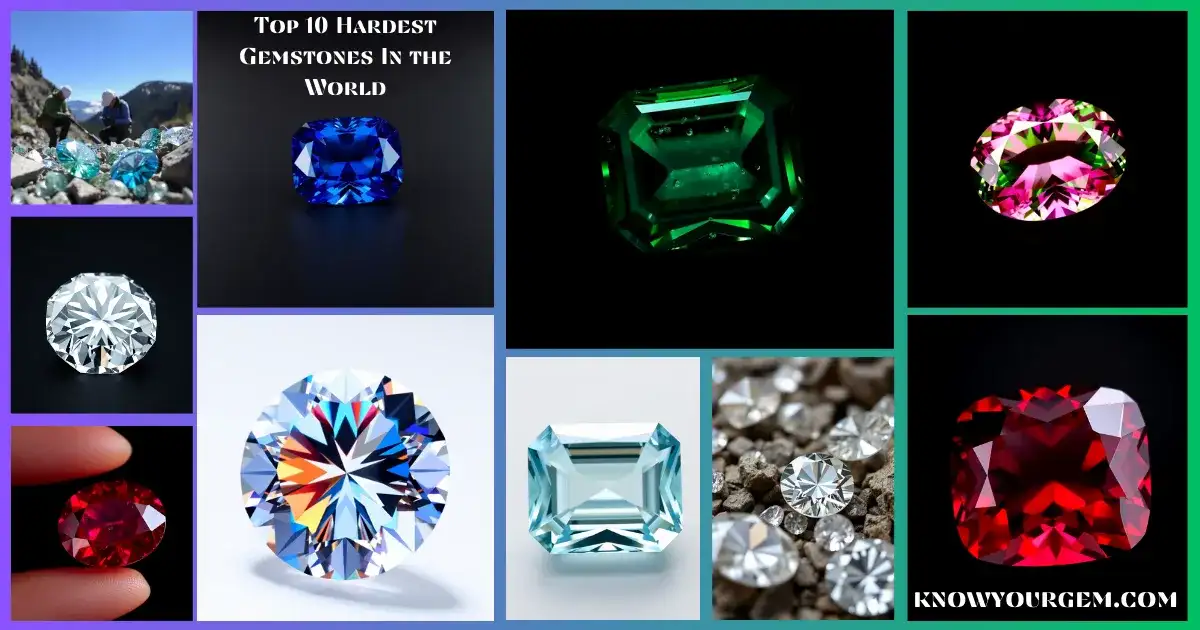

What is Gemstone Hardness?
Hardness is a measurement that how a gem can prevent itself from getting scratches and damages. The hardness of a gemstone generally has been developed in 1812.
The Mohs assigned hardness to a gemstone on a scale of one to ten, this is a competition between soft and hard stones. On the bases of Mohs hardest gemstones can survive genuinely in every jewelry and even tools, as they don’t scratch.
Top 10 Hardest Gemstones: (Mohs Scale)
A perfect evidence is given below in shape of a table, which proves how much the harness important in a gem for daily use, even in tools.
| Gemstone | Hardness | Simple Description |
| Diamond | 10 | Diamond is the top-rated natural gemstone and it is produced by carbon. In fact the stone is strong but it still can break or damage. |
| Moissanite | 9.25 | It is usually considered a step below diamond on hardness. Generally, it is lab-made. Bright and cheap. |
| Corundum | 9 | Sapphires and rubies are both thought to be very tough and very good for everyday wear. |
| Chrysoberyl | 8.5 | All of the semiprecious stones, such as alexandrite and cat’s eye, are highly durable and scratch-resistant. |
| Topaz | 8 | It has different colors, is hard, but chips are possible on impact. |
| Spinel | 7.5–8 | Spinel appears similar to ruby or sapphire; the two properties are as follows. |
| Aquamarine | 7.5–8 | An aquamarine is a pale blue gem; very strong, but requires attention for scratching. |
| Emerald | 7.5–8 | Emerald is a dark green colored gem, which is relatively soft and can be scratched easily. |
| Tourmaline | 7–7.5 | Tourmaline is made in many different colors, which are suitable for jewelry. It is made in many different colors, which are suitable for jewelry. |
| Zircon | 6.5–7.5 | Zircon is a natural gemstone; people usually relate it to zirconia, but it is a mistake because zirconia is a lab-grown material, not organic. it is quite sparkling and moderately hard. |
Ethical sourcing of the top 10 hardest gemstones:
Below are the ethical sources of the hardest gemstones you can study:
Ethical sourcing options for each Hardest Gemstone:
Below are the ethical sources of the hardest gemstones you can study:
1. Diamond: Ethical options
- Lab-Grown Diamonds: Lab-Grown Diamonds: These are synthetic diamonds which can copy Mohs, look color, and brilliance of natural ones. But these stones are cheaper than natural diamond and suitable daily wear jewelry.
- Canadian Diamonds: Canadian diamonds are extracted in compliance with the highest standards of working conditions & environmental protection. So, it is crucial to check for Canada Mark™or Polar Bear™ certification.
- Recycled/Antique Diamonds: No new demand for mining. This supports the value of the circular economy.
- Certifications: Have GIA or IGI certificates with origin disclosure, Kimberley Process for conflict credibility.
2. Moissanite : Ethical Options:
- 100% Lab-Created: As you know, all commercial Moissanite gemstones are lab-grown alternatives to diamond, but they are not real diamonds. They are grown within a few weeks or months.
- Eco-Friendly: It is a label for so-called ‘Silicon carbide production’, which is less adverse to the environment than traditional diamond mining procedures.
- Certifications: It owns Charles & Colvard or other recognized lab certifications.
3. Corundum – Ruby & Sapphire (Mohs 9) – Ethical Options:
- Fair Trade Rubies: Their Gemfields exist in Mozambique, and is named as practicing ethical ruby mining with community development programs. So, buyers are advised to look for fair trade Gems certification, especially when they buy corundum varieties.
- Ethical Sapphires: Sapphires originating in Madagascar can be considered ethically fair trade sapphires. The Australian sapphires are produced under strict Asian sapphires, and as such could also be considered ethically sourced. The aforementioned Sapphires from Montana are established in their country’s labor laws.
- Lab-Grown Corundum: It is more easily available and provides identical properties that do not raise mining issues.
- Certifications: Fair Trade Gems possess Gemfields provenance reports, GIA and/ or Gübelin origin certificates.
4. Chrysoberyl (Mohs 8.5) – Ethical Options:
- Brazilian Sources: It tends to have better labor standards than some sources in Asia.
- Small-Scale Mining: It is artisanal, with lower impact on the environment.
- Verification: You will need to ask for origin certificates and dealer transparency on where they are sourcing from.
5. Topaz (Mohs 8) – Ethical Options:
- Brazilian Topaz: It is the biggest producer, and there are regulations for mines.
- Untreated Stones: Always insist on naturally colo/u red topaz, as other treatment issues 1 also be guaranteed.
- Artisanal Mining: Most of the topaz sources are from small-scale operations where it is more accessible.
6. Spinel (Mohs 7.5-8) – Ethical Options:
- Myanmar (Burma) Spinel: Reputable ethical dealers who purchase their stone post-2021 reforms.
- Sri Lankan Spinel: Historically, a low-impact method of mining has usually been used.
- Tanzania Spinel: An ethically responsible producer is increasing its output.
- Fair Trade: Fair trade indicates how spinels are becoming offered by more expert merchants.
7. Aquamarine (Mohs 7.5-8) – Ethical Options:
- Brazilian Aquamarine: It adheres to the country’s labor law and maintains regular mining procedures.
- Nigerian Sources: It does offer some options with fair trade certification.
- Madagascar Sources: Available in Madagascar Sources: artisanal with traditional ethics.
- Natural Color: These stones are most often found in untreated condition, but their processing issues are not often a concern.
8. Emerald (Mohs 7.5-8) – Ethical Options:
- Colombian Emeralds: They always have a number of mines that can be part of fair trade schemes.
- Zambian Emeralds: Gemfields’ Kagem mine is thought to be adhering to up-to-date and transparent mining practices.
- Lab-Grown Emeralds: They are suitable for those people who want an alternative, naturally looking emerald, but lab-grown emeralds lack the natural forming process.
- Certifications: They generally possess Gemfields certification, with fair trade, and also provide Gübelin provenance reports.
9. Tourmaline: Ethical Options:
- Brazilian Tourmaline. It is ethically mined (regulated).
- Afghan Tourmaline: They further enhance the Afghan economy through
- African Sources: Fair trade is available from Madagascar and Nigeria.
- Variety: They are available in a wide range of colors, which means diverse ethical source options.
10. Zircon (Mohs 6.5-7.5) – Ethical Options:
- Cambodian Zircon: It appears to be the so-called small-scale artisanal mining with minimized impacts to the environment.
- Sri Lankan Zircon: It is traditional mining with cultural tradition.
- Not Cubic Zirconia: True zircon is natural, as confirmed by a gemological certificate.
- Heat Treatment: Most of the zircon gemstones are heat treated to ensure the facilities are treated ethically.
How to verify Ethical Sourcing:
When you are purchasing the top hardest gemstones, it is essential to check:
- Ask for certification: Always demand an origin certificate, Fair Trade certificate, or a lab creation certificate if you want the stone to be verified.
- Verify dealer credibility: You should verify who is dealing with you and what is his credibility.
- Confirm online: Dig through the certificate number with the organization: GIA, IGI, Fair Trade Gems.
- Ask questions: Reputable sellers retain answers to questions regarding ethical sourcing.
Hardness Ranges:
One of the factors that need to be described for the properties of the gemstones is the hardness. The hardness describes how durable or usable the gemstones are. This method was established by German mineralogist Friedrich as Mohs in 1812. The Mohs scale was set to rank stones from 1 to 10; 1 being the softest (talc) through to 10 being the hardest gemstone, like Diamond.
In this way, the Mohs scale is heavily dependent on the fact that one mineral will scratch the other; therefore, if a gemstone is being visibly scratched by another gemstone due to storing both together.
And this is a clear indication that the gemstone which is being scratched more is a softer gemstone than the scratcher. So, a German mineralogist is providing a simple yet effective comparison of the relative hardness of different gemstones.
Additionally, when we go into a softer gemstone world, then Opal is the softer gemstone rather than the hardest gemstones such as diamond and sapphire. Opal rate at 5.5 to 6.5 on the Mohs scale that clearly indicates that is not made for daily wear jewelry; It can only be worn as occasional jewelry.
Meanwhile, the hardest gemstones(such as sapphire, diamond) are also so hard that they would not be scratched and are tougher; these are more popular for jewelry that will be used all the time. For instance, diamond is the hardest substance in the world; plenty of it is used for rings.
Tenacity:
The most durable gemstones should be used as the basis of classification since this measurement rates their resistance to scratching, abrasion, and indentation. It can be a significant factor in the geology, material science, and engineering industries.
Every buyer or gemstone enthusiast should have perfect knowledge about Mohs scale because if they are able to know hardness of the stone, they can pick a genuine and ethically sourced piece rather than picking fakes.
The method “Mohs scale” also rates opal as the softest gemstone because it has 5.5-6.5 Mohs hardness, which is dangerous for daily-wear jewelry. And this softness also requires gentle care for maintaining its natural glow.
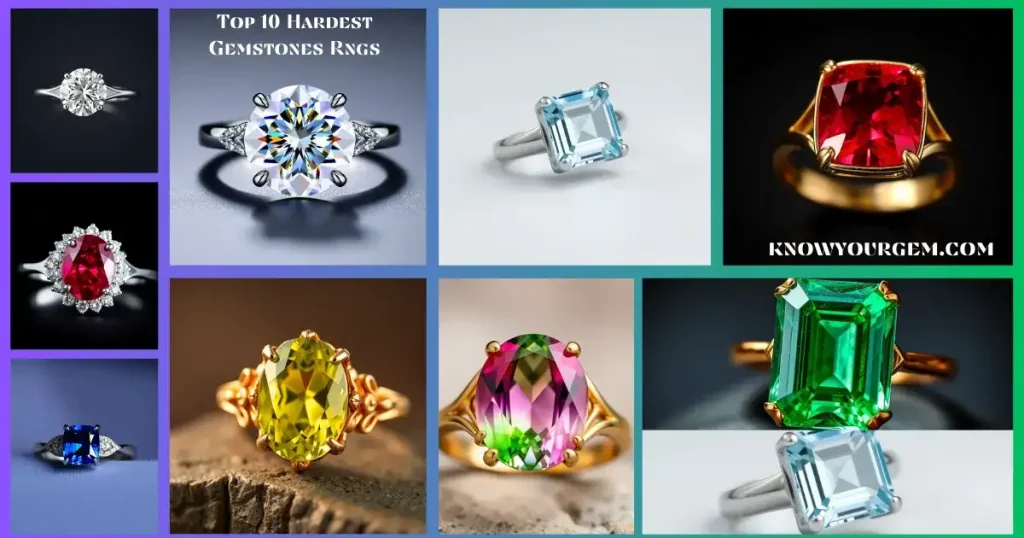
Gemstone Hardness and Wearability:
The wearability grade generally offers a convenient method called comparing gemstones that can be better choices for everyday use without sustaining scratches or losing visual appeal.
Most commonly, even the toughest gemstones such as diamonds, sapphires, and rubies tend to be given the highest wearability grade (A) because they are very durable and unreactive, which renders them suitable for everyday wear in the form of rings and Bracelets.
Alternatively, delicate, softer stones such as opals and emeralds are thought to be given a lower rating because they demand more preservation and are more attractive as jewelry than from a wearability standpoint. Thus, wearability grading is ideal for jewelers and buyers to determine which stone is best suited to a particular piece of jewelry.
Gemstone Cleavage:
The Cleavage in both the hardest gemstones and the softest gemstones is a natural basic feature of the way in which gemstones fracture along certain parallel internal plane surfaces within their crystal structure.
These are the nature’s creativites in the stones, and they are dependent on the arrangement of the atoms and the strength and nature of bond between the atoms. Stones that contain cleavages can be damaged if you hit them in the wrong direction. The stones with perfect cleavage; they can be cut easily to set in jewelry.
For instance, the most difficult stones, such as diamonds and topaz, will require super economy care, as they can be smashed into smithereens through the cutting and setting process due to the fact that they possess straightforward cleavage.
Crack or break along this line if it can’t be done properly, which will detract from the beauty of gems. But if jewelers know about cleavage, they can exploit its meaning to make an accurate cut so that the gems will increase sparkle or eliminate flaws, as well as enhance beauty.
Hardest gemstones are an ideal choice for Jewelry Settings:
But hardness really counts when you are choosing a stone for rings, bangles or other jewellery that will be worn every day, as the hardest stones can be kept to a high shine over many years and not become scratched up and dull as softer stones will. This is why they are so good for everyday use: any type of engagement ring, family jewellery, etc.
- Diamonds are considered as the top scores on hardness among other gemstones. They have 10 Mohs hardness which makes them very reliable and most suitable for every jewelry.
- Sapphires and rubies are believed to be the corundum collection and again are close to the hardness of diamonds. They have been a long-used gem of royal jewels but are extremely durable even for someone with an energetic and positive lifestyle.
- Moissanites are are another hard gem and are a good choice because they too are almost as hard as a diamond and have a superb brilliance, but are cheaper than a diamond, which could be a wise decision to buy.
- Alexandrite and cat’s eye chrysoberyl are indeed the hardest gemstones and also are tough. With a hardness of 8.5 on the Mohs scale, they are stronger than most other gemstones and, quite uniquely, their special optical effects make them fascinating to look at.
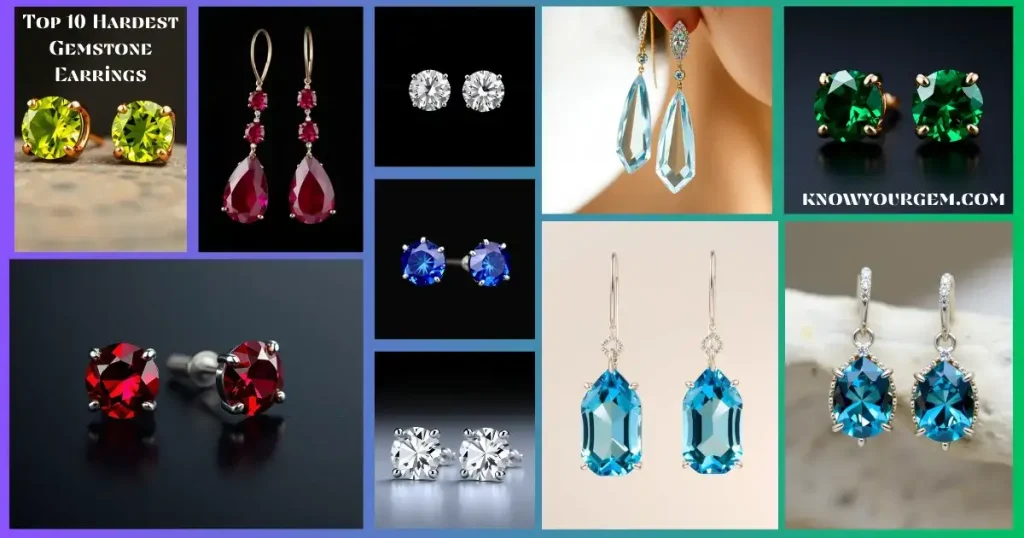
Pricing guide for the top 10 hardest gemstons:
Price recognition is a helpful tool in making purchases from these top 10 hardest gemstones for your jewelry. In some cases, prices can vary slightly based on size, quality, color, source, and place of origin, and whether or not ethically obtained.
Complete Price per carat hardest gemstones:
| Gemstone | What Makes It Special | Typical Price Range | Best Value Size |
| Pure diamond | A sign of high living and promise. | Most expensive in the 2K-20K range, average at 5K-10K range. | Best value per diamond in 0.5–1. |
| Lab-Grown Diamond | It has as much brilliance as a natural, but is 20% less expensive and more sustainable. | Its prices are between $800 and $3,500 according to carat–quality. | Its optimal value is at 1–2 carats. |
| Canadian Diamond | It is ethically sourced and has transparency of supply. | Price is between $3K–$12K. | The best value and value for money is at 0.5–1 carat. |
| Moissanite | It has a brilliant fire and sparkle, a diamond alternative. | Cost is 400–$800. | Best value at 1–2carats. |
| Natural Ruby | It is vibrant red, extremely scarce, and well-respected. | Its value ranges from $1K–$25K+ and varies by source and clearness. | Typically occurs in measurements less than 2 carats. |
| Synthetic Ruby | Looks identical, far more affordable. | Price is $200–$800. | Best value at 1 to 3. |
| Blue Sapphire | The regal colour of royalty, the class you’ll be met with forever. | The price from $ 400- $ 15 K plus. | Best value 13ct. |
| Fancy-Colored Sapphire | These are also natural sapphires but with different colors like pink, yellow, and green. | They can charge from $300 to more than $800 per carat. | They are ideally found in 1 to 2 carat size. |
| Synthetic Sapphire | It is an economical sparkle for daily use. | Price range is $150–$600. | It gives the most value between 1–3 carats. |
| Chrysoberyl | It has a beautiful golden-green glow (an underappreciated stone). | Its price is $200–$1.5K. | When defining value, the 1–2 carat weight is by far the best. |
| Alexandrite | It has an exotic color-changing stone. | It’s highly valued. Its value is $3K-$35K+. | Best value below 1-carat |
| Blue Topaz | Bright, lively, extremely inexpensive. | Price $20–$200. | value 3-10 carats. |
| Imperial Topaz | It contains deep golden-orange hue. | Sellers usually sell it for $150-$3500. | Ideal size is 2- 5 carats. |
| Spinel | Bright, may be confused for expensive ruby. | Price: $200–$5,000. | Best value: 1–3 carats. |
| Aquamarine | It carries calm ocean-blue glow and the stone is popular for its large size. | So it is sold for $100-$1.2k. | Best value is 2–5 carats. |
| Natural Emerald | Natural Emerald displays deep green luxury; may have inclusions. | $500–$20 K plus. | Best value at 0.5–2 carats. |
| Synthetic Emerald | It has affordable green sparkle. | Price is $150–$800. | Its best value is at 1–3 carats. |
| Tourmaline | The rainbow gem, and it is also in many different colors. | The price of this gem is $100– $3.5K. | It is the best value at 2 – 5 carats. |
| Zircon | It has sparkle and is very economical (not cubic zirconia). | Its price is 50$–800$. |
Price Factors That Affect Top 10 Hardest Gemstones:
Size (Carat Weight):
- The cost of the larger stones is described by an exponential, not linear, function.
- For instance, a 2 carat sapphire isn’t twice the price of a 1 carat; it probably is 3-4x the price.
- The value sweet spot is 0.5-2 for precious stones and 2-5 for semi-precious.
Color Quality:
- Diamonds: They are colorless to the high end and their cheapest colorless.
- Sapphires/Rubies: They have intense well-saturated color with good tone control and they command higher prices.
- Emeralds: Their color is very deep green but isn’t too dark-thick green, they are mainly sourced in Colombia.
- Fancy Colors: These colors start from Padparadscha sapphire to bright pink spinel and mostly such colors enhance their value.
Clarity:
- Diamonds: They are considered as pricier as the are flawless (FL to IF); best value for VS1 to VS2.
- Colored Stones: standards are variable; emeralds normally have inclusions; sapphires are cleaner.
- Eye-Clean: the most practical factor; if you don’t see inclusions, you are OK.
Cut Quality:
- Perfect cut=plus 20 to 40% value.
- Average- cuts shave 30-50 % off the attractiveness/ value.
- The most rare shapes are cushion, and marquise. They can be market shifters.
Origin:
- Premium: Origins like Kashmir, Burmese, Colombia produces premium stones that command (20 to 50%) more price.
- Standard: Megawe, Madagascar, Thailand, Zambia-owned high quality, higher value.
The origin affects the “color” and the perception, not the durability.
Treatment:
- Untreated equals 50 to 200%.
- Standard heat as ruby/sapphire = fine
- Intensive treatments: (fracture filling, diffusion are similar to big value drop.)
Budget Guide:
- Under $2K: Can buy a synthetic Diamond quite affordably from the 0.5-0.75 carat range, can get a brilliant Moissanite loose from 1-2 carat, and quality small sapphires or aquamarine/spinel to good prices.
- $2K–$5K: A lab diamond in this budget can be between 1 and 1.55 carats, but the increased price of natural sapphires and rubies is still affordable compared to a Canadian diamond, and smaller alexandrite.
4 best Hardest Gemstones for engagement Rings:
Engagement rings are not just jewelry but also are reputed to show symbols of love and commitment that refer to the last or lifetime. Engagement rings are worn each day, so they need the hardest gemstones that are not scratched and damaged by use. Though beauty is critical, durability is vital to preserve the sparkle of rings.
Given below are the top 4 hardest gemstones that can be well suited for engagement rings:
1. Diamonds (Hardness: 10).These are the most extraordinary hardest gemstones because they have the power to scratches other easily. They are durable enough and best fit for engagement rings, birthday gifts, anniversary gifts as well as they also deserve to be daily as daily use.
2. Moissanites (Hardness: 9.25). Moissanites are another excellent hard gemstone to use as an alternative to a diamond because they are very close to being just as hard and sparkle more with a rainbow brilliance that many are captivated by. Their availability of lab counterparts makes it even cheaper and greener to choose moissanite stones.
3. Sapphire & Ruby (Hardness: 9) Both stones belong to the same corundum family. The stones are popular for the toughness and strength. Although they are also found in different color shades and they also had been an important part of royal jewelry.
4. Alexandrite & Chrysoberyl (Hardness: 8.5). If you want color changing gemstone, then alexandrite should be your best choice because it avails this property. It changes colors depending on light reflection; it glow green in daylight and darker green in moonlight.
What is the Second hardest gemstone after diamond?
The level of hardness out of ten that one ranks on the Mohs scale is the level of hardness that minerals can be ranked on. The corundum mineral family, which contains sapphire and ruby-producing elements. They are ranked as 9 out of a 10 level on the Mohs scale of hardness, the latter of which usually ranks as 10.
Despite being the hardest, Diamond is regarded as the second hardest precious stone. Moissanite is mostly lab-grown in origin to be used for jewelry. Corundum is regarded as a natural mineral that has been used for adornment for centuries.
Sapphires and rubies have been prestigious objects worn by royalty and developed into fine jewelry. They are not only prized for their aesthetic qualities but also their toughness and permanence.
Some humans have grown a little confused as to how some believe moissanite to be harder than Corundum if scored at roughly 9.25; the Mohs scale is not equally spread, meaning a 9 to 10 leap is a much larger leap than it appears, and moissanite isn’t part of it! It is entirely a natural mineral scale and does not include artificial stones.
What is Corundum?
Corundum is a natural mineral which is composed by Aluminum oxide (Al 2 O 3). It is considered as one of the most hardest minerals in the world which produces two different gemstones called sapphire and ruby. Pure corundum is colorless, it contains small impurities and it produces the most valuable gemstones like sapphire and ruby.
Easy-to-understand overview:
Overview:
- Hardness: Stones which belong to corundum have 9 Mohs hardness, and they are suitable for everyday jewelry. You can set corundum varieties into your regular wear rings, and bracelets.
Gemstone Types:
Sapphire: Each Corundum without red glow is called sapphire. But people keep little bit of knowledge about this mineral that it only produces sapphire in blue color, but in fact the mineral also produces a variety of colors from pink, green, yellow, to purple and rare orange sapphire.
Ruby: The red corundum is called ruby rather than sapphire because red comes from chromium only.
The second hardest gemstones on earth Corundum’s Popularity in Jewelry:
Technically, Moissanite is the second hardest gemstone, but in geological perspective natural sapphire and ruby both ae rate at the second position on Mohs hardness because they are natural mineral not synthetic.
A Gem with a Powerful Past:
The other treasures were Corundum, believed to have been treasured since antiquity. The intense red Ruby, the distillation of Corundum, appeared to signify power and courge.
Previously, kings and rulers used to wear rubies in their crowns as they thought that they had a magic flame that could protect them; that’s why rubies were titled as “King of gems”.
However, sapphires were very hard stones, and the traditional blue sapphires, associated with the sky and heavens, were considered to be the hardest stones. These hardest stones were thought to have bestowed wisdom, truth and divine blessings.
Over the centuries, they gained popularity with the royal family and spiritual leaders. If we look in the past, we find a contemporary example of the eternal attraction of sapphires such as Princess Diana’s famous sapphire engagement ring, which is currently owned by Princess Catherine.
More than just Red and Blue:
Corundum is not only rubies and blue sapphires. It is found in many other gorgeous shades and is called a fancy sapphire, being suitable for all types of jewelry.
- Pink Sapphires: Pink is a gentle, sweet, romantic color. It is softer than blue and brighter than lavender. Tones vary from light blue to very hot pink Magenta.
- Yellow Sapphires: They are cheerful and warm, the hardest stones with variation from pale yellow to golden.
- Padparadscha Sapphires: They are rare and unique gems which contain pink and orange color combo. They are rarely mined and traded.
Strong And Reliable:
Corundum is attractive not only because of its hardiness. With a measure of 9, it is also scratch-resistant and durable for everyday use.
It is not one of the hardest stones that cannot be chipped; this makes it a perfect stone for rings and other jewelry which you wish to wear regularly and hand down to future generations.
What is the weakest gemstone?
Of the gemstones that are used in jewelry, the one least resistant is said to be amber with a hardness of 2- 2.5 on the Mohs scale. But “weakness” can be defined in various terms, so this will be considered:
By Hardness:(Scratch Resistance)
Weakest gemstones on the Mohs scale:
- Amber (2–2.5): Not a mineral but fossilized tree resin. So soft that it is very easily scratched with a fingernail.
- Pearl (2.5–4.5): This is a natural gemstone and is produced within molluscs. It is quite soft and is easily scratched.
- Jet (2.5–4): It is a woody fossilized gem, soft and light, with a feel like that of a.
- Corals (3- 4): calcium carbonate generated from marine creatures.
- Malachite (3.5–4): can be identified as a green variety of stone, given that it is relatively soft and easily scratched.
- Fluorite (4): It is a true mineral, but is too soft, so it’s not very useful for jewelry.
- Apatite (5): It is harder than any of the above gems.
Gemstone toughness:
Hardness and toughness are different things; some stones are brittle:
- Opal (5.5-6.5 hardness): Contains water and is susceptible to craze and cracking
- Emerald (7.5-8 hardness): It is just hard enough, but is very brittle due to internal fractures.
- Moldavite (5.5 hardness): It is a natural glass which is fragile 20despite a moderate degree of hardness.
By Stability: (Chemical and Environmental Resistance)
- Amber: It can be melted easily in a mild environment. It can also be dissolved in some kinds of solvents.
- Pearl: It can be easily scratched without acid (even perfume and vinegar).
- Turquoise: It is porous and can absorb oils, lotions, or water.
- Opal: Can dry out and crack if not looked after properly.
The Overall Weakest:
Amber is basically considered the weakest gemstone in overall durability because it:
- Has the lowest hardness. Which means that it is very scratchable by almost anything.
- Has a relatively low (150- 180 C) burn or melt point.
- Is easy to scratch by chemicals and solvents.
- Lightweight and crushable.
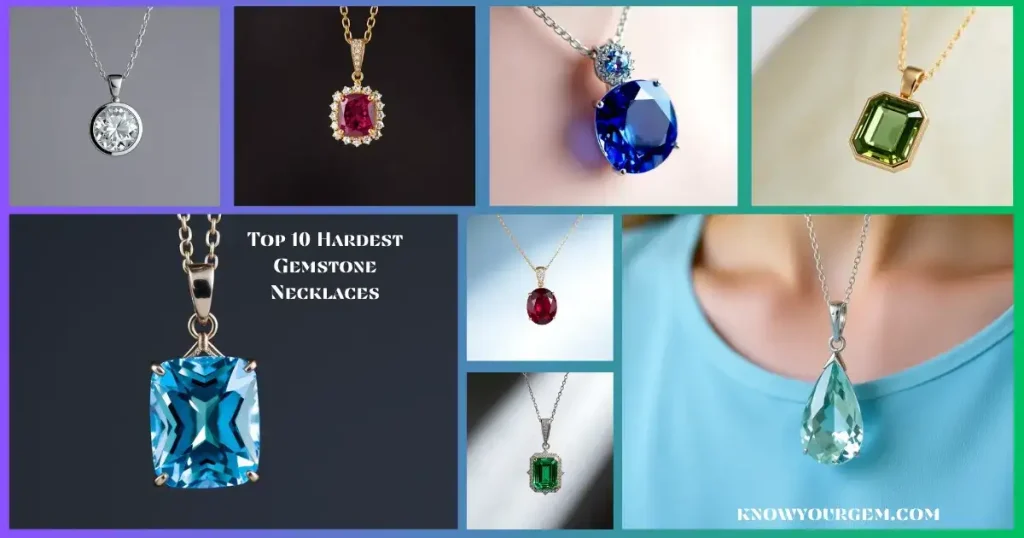
Natural hardest gemstones Vs Synthetic hardest gemstones:
Similarly, in the field of gemology, there is widely accepted, at least amongst experts, a division of what are considered two fundamental properties in gemstone quality, e.g., hardness and toughness.
Though in daily conversation people often confuse these two terms, and they are similar, each is unique and very important in determining the true:
Hardness:
It is a measurement of a mineral’s ability to prevent scratches. Hardness is actually rated using the Mohs scale; if stone rates at 1 Mohs scale it is called softer whether a gemstones scores 10 on Mohs scale it is considered as the most hardest gemstone.
Toughness:
It is not just a word but it proves itself as if a gem ables to withstand breaking, cracking, or chipping when it is struck or dropped and it defines the stone toughness. Toughness is more concerned with the strength of the stone’s internal structure and its ability to withstand forces on the surface.
Natural Hardest Gemstones:
Natural hardest gemstones: Diamonds, Corundum (Rubies and Sapphires also), formed deep within the earth for huge long periods of time under tremendous temperature and pressure through billions of years, which provides the atomic structures with sound stability. While their hardness would enable a sense of durability in jewelry worn,
Hard Gemstones cleaning and maintenance:
Hard gemstones are usually the term for gemstones such as Diamond, sapphire, and ruby. Hard gemstones are generally appreciated for their beauty as well as being hard. Their hardness and low susceptibility to scratches make them suitable for wearing during daily use when appropriate.
Why Hard Gemstones need regular cleaning:
The best way is to state that hard gems also need a uniform treatment as they come in contact with body oils, powder, pollution, and dust every day while wearing.
These chemicals form an ultramicro film which reduces the reflection of light. Although this makes your stones and jewels look dull rather than maintaining the strength of your stones. By washing your hard gemstones, this film within your stones will be removed, reducing the risk of long-term scratching of settings and the stones.
Daily maintenance for Hard Gemstones:
Maximizes your everyday habits that can keep your investment pristine: Remove your rings or bracelets when you are engaging in any heavy activity or involving in playing football, swimming, or gardening. Keep your each jewelry piece in a separate pouch because when hardest gemstones can damage softer ones.
Ruby/Sapphire: Protect from prolonged heat. Run these under a microscope to check for inclusions that may have reached the surface.
Alexandrite soil of nature of oil only safe to be cleaned too much; protect it from sudden temperature.
Topaz: Should avoid steam (risk of cleavage). Keep away from abrasive stones.
Professional vs. At-Home cleaning methods:
The following are the crucial methods that can help you keep your hardest gemstones cleaned and maintain their sparkle:
Safe at-home cleaning:
- Use warm water and drop a mild dish soap on it.
- Use a soft-bristled toothbrush for scrubbing.
- Use a lint-free cloth for drying.
- Always prefer commercial jewelry cleaning solutions that are formulated for hard gemstones.
Professional services:
- Ultrasonic cleaning for diamonds and untreated sapphires.
- Steam cleaning for heavily soiled pieces.
- Annual inspection and tightening of settings.
Don’t use ultrasonic cleaners for emeralds, opals, or fracture-filled stones because these ultrasonic cleaners despite their moderate hardness. The vibrations can worsen internal flaws.
Special care considerations by stone type:
| Hard Gemstone | Cleaning Caution | Maintenance Priority |
| Diamond | Don’t use harsh chemicals | Always check prongs quarterly |
| Moissanite | The standard methods can safe the stone | Clean your stone weekly for maximum brilliance |
| Ruby/Sapphire | Keep away from prolonged heat exposure | Inspect for surface-reaching inclusions |
| Alexandrite | Gentle cleaning only | Protect from thermal shock |
| Topaz | Avoid steam (cleavage risk) | Store away from harder stones |
Long-Term Preservation Strategies:
Hardest gems can be positioned for the long-term care of the gemstones, which is not limited to cleaning. It is required to have a professional appraisal scheduled once every one to three years, because a professional examination annually may preserve the sparkle and brilliance of one’s gemstone.
Think of the setting material. Both platinum and gold show off hard gems well, yet each requires specific maintenance. While platinum develops a metal patina, which only Jewelers can clean, gold needs a rhodium wash for white gold.
Climate is also an issue.
Sudden temperature changes can be stressful on some of the hardest stones. There is a need to take off when entering saunas or working with dry ice. Some hard and durable stones are sensitive to thermal shock, so be aware that a change of temperature can cause problems.
Recognizing When Hard Gemstones Need Professional Help:
Maintained cloudiness indicates internal defects. Chips or scratches on supposedly hardest gems are a sign of misidentification or serious trauma. Get to a gemologist ASAP. Alexandrite and treatment-related color-shifting stones should be reviewed by a professional for authenticity.
Hard gemstones buying guide:
Getting knowledge about quality factors, ethical vendors, and value proportions isn’t only require to buy hard gemstones but perfect buying requires complete knowledge about the hardest gemstones. You should also add following factors in your daily knowledge:
Understanding hardness ratings before purchase:
The Mohs scale is your starting point for selecting hard gemstones. Anything rated and above will be very resistant to scratching and suitable for everyday use. “Moissanite is 9.25 Mohs” Mohs, rubies/sapphires (9), and Diamond (10) are at the top of the chart.
You should remember that hardest gemstones can survive many years of abrasion without surface damage. But the softest stones are not because they can easily get damaged or chipped by harder ones.
Stones such as these have been used for years without surface scratches. However, stones of 7.5-8 (emerald, aquamarine, spinel, etc.) are considered hard, but require more prudent jewelry applications.
They will not scratch from household dust (hardness 7 quart) but will reflect scratches after many years of use. For rings that are to be used every day, choose 9 plus.
Evaluating quality in hard gemstones:
Before purchasing the hardest gemstone, collectors should consider these factors first:
The four Cs adapted for durability:
- Color: Bright saturation is common with the most expensive gemstones. Cornflower blue or royal blue colors are desirable for sapphires. Pigeon blood red should be present in rubies. High prices are also encountered with rare fancy colors of diamonds and color change Alexandrite.
- Clarity: Hardest gemstones generally contain significantly fewer natural inclusions compared to softest gems. Diamonds, moissanite, and sapphire/ruby are called premium qualities and opal and some other stones are low grade due their softness and they might contain inclusions.
- Cut: The best cutting is achieved in the hardest jewels. The best fire is obtained in diamond and moissanite when they are cut to the best proportions. In colored hard stones such as ruby and sapphire, the cut should maximize the depth of color but also should be durable.
- Carat: The majority of the most intense gemstones, the cost rises just as quickly with size. Because it is so rare, a two carat sword-value piece of sapphires would be anything over twice the cost of a one carat gem. One should always make sure to go just under standard weights, thinking of
Ethical sourcing in modern Hard Gemstone purchases:
Modern consumers want provenance. Hardest stones from a conflict area are tainted with legal problems. Request provenanced diamonds at all times and check for any fair trade certification when buying colored stones.
- Lab-Grown Alternatives: Lab-grown moissanite, diamond, and sapphire have the same hardness and appearance with assuredly fewer labor issues. These hardest gems are cheaper than natural gem prices by 30-70% with no worries about labor.
- Already in the sight: Canadian diamonds, Australian sapphires, and Montana sapphires are typically accompanied by fairly transparent supply chains. Gemfields’ operations in Zambia provide ethically sourced gemstones with community-benefits schemes.
Setting selection for maximum protection:
Hardest gemstones deserve secure settings that complement their durability:
- Prong Settings: The most conventional and safest setting for diamonds and moissanite. Six prongs are more secure than four to avoid corner damage. Too thin a prong can bend and undermine security.
- Bezel Settings: The metal holds hard gemstones in place entirely, offering maximum protection, and bezel settings are perfect for active lives because the surface area is minimized.
- Channel settings: These settings safeguard hard gemstones in wedding bands by placing stones in a niche between metal walls. Eliminates the possibility of edge-breaking in square stones.
- Tension settings: contemporary and dramatic, the setting itself must be checked to see how strongly the metal springs. The hardest of stones will bear the strain, but poor fitting can result in total failure.
Budget allocation strategies:
- Below $1000: Expect to see either synthetic diamonds in the 0.3-0.5 carat size range, or moissanite in the larger sizes around 1-2 carats. There is a chance of a small natural sapphire or spinel. Don’t forget that at this price point it is more important to look for the best cut rather than the largest size.
- 1000 5000: This range presents the availability of natural sapphire and ruby around 1-2 carats, relatively larger moissanite stones, and Canadian mined diamonds around 0.5 carats.
- $5,000–$15,000: In this range, seek out finest natural diamonds, 0.7- 1.2 ct, unheated sapphires, such as Kashmir or Burma, premier rubies, and larger alexandrites.
- Above $15,000: Investment-grade gem diamonds over 1.5 carats, with D-F color and IF-VVS clarity, unheated Burmese rubies, Kashmir sapphires, and the finest natural fancy colored diamonds.
Certification and documentation essentials
Never buy large, hard material without an independent grading report from labs:
- GIA (Gemological Institute of America): It has in its possession the world-class equivalent; the benchmark for diamonds that are known and recognized universally.
- AGS (American Gem Society): Excellent cut grade for diamonds
- Gübelin: First seller of scholarly report on colored gemstones & origin reports.
- SSEF: Swiss laboratory specializing in fine colored hard gemstones.
Check report numbers online before purchasing. Certifications should state a treatment, country of origin, and all the quality factors.
Red flags in hard Gemstones purchasing:
Avoid these warning signs:
- Market values are substantially underpriced for claimed quality.
- Sellers vary of offering independent certification.
- “New” vintage garments from anyone. Without any kind of paperwork or authentication e.g 1950s cocktail dress purchased from whoever).
- Exposing or minimizing heavy treatments.
- Attempts to create a sense of urgency through pressure tactics or limited-time products; References to stay-on-time delivery or guaranteed 12-month rental agreements; and.
- There are no return policies or use of escrow services on some online shopping.
Long-term value considerations:
The harder the gemstone, the more value is likely to be held in it in the long run. The conventional “precious” stones, diamonds, rubies, sapphires, and emeralds, are not only understandably “precious” but also very hard.
Think about future costs of maintenance. For re-polishing, hard stones need not be done as often as softer stones; easy ones, as hard as they may be, tend to lose their carat weight after several decades.
The resale value of certified higher-end hardest gem stones is quite healthy regardless; treated or synthetic stones will always have a faster depreciation.
Conclusion:
In the field of gemology, to be able to identify a gemstone for suitable jewelry, the ability to identify physical characteristics of the stones, mainly their hardness. Has been the number 1 priority; many people believe hardness is only rubbed off by other objects, but it certainly incorporates more. Mohs Scale, which is a measure of hardness, was devised in 1812.
Useful as it scores minerals 1 to 10, the hardest natural material is impervious to scratching by anything used regularly.
Toughness is a measure of how easily a gem will break or chip. Hard gemstones can be brittle and break even though they are hard; the best example of the hardest gemstone top rating is the diamond. It can still chip because of lines existing inside, known as cleavage planes.
Recommendation:
For everyday ring, you should choose the hardest gemstones like diamond, sapphire, ruby, or moissanite for their high durability. Because their high Mohs hardness ensures long-lasting brilliance and scratch resistance.
FAQS:
1. What gemstone is harder than a diamond?
In current market, there is no any natural competitor of diamond in hardness as diamond rates at the top on 10 Mohs hardness. However, scientists have created nanorods which are much harder than nature’s own diamonds. These super hard materials aren’t classed as true hardest gemstones, because they are only used in industry.
2. What is the strongest gem?
Diamond is initially considered as the most strongest precious gemstone in the world with its with its glittering look. Its transparent quality and its brilliance of reflected light make it shine a lot.
3. What is the king of gem?
Ruby is generally considered as the king of gemstones because it red pigeon blood glow can beat every gem in any type of jewelry.
4. What is the deadliest gemstone?
Cinnabar is considered as the most beautiful and vibrant, deadliest red gemstone, which can be found safely but requires gentle handling.
5. What is rarest gemstone?
No one can compromise for the wrong direction, especially hard stones when they contain natural inclusions and cleavages. Even diamonds are the hardest gemstones, but they can still break you if hit in the wrong direction.
6. What gemstone is unbreakable?
No one can compromise for the wrong direction, especially hard stones when they contain natural inclusions and cleavages. Even diamonds are the hardest gemstones, but they can still break you if hit in the wrong direction.
7. What gem is cursed?
The Hope Diamond is a gorgeous but so-called creepy gem. Most people say that the stone is haunted because of its history of hoodoo, where it was suffering from stalkers, including death and bankruptcy.
8. What is the weakest gem on earth?
Talc is the softest gem before opal because it rates at 1 on the Mohs scale, and it is not suitable for nearly any jewelry without a protective setting.
9. Why is gemstone hardness important for jewelry?
Hardness means how durable the stone is and how scratch-resistant it is. The hardness of a stone makes it everyday wearable without any protective setting.
Short Summary:
In conclusion, the hardness of any gemstone contributes a great deal to the longevity and overall quality of long-term wearability. In fact, the hardest gemstones are not just suitable for long-term investment, but they are the kind of gems that are capable of maintaining their brightness and brilliance for many years to come. And they are most likely to be suitable for all manner of jewelry.
Must read:
I've provided comprehensive information about the most hardest gemstones. If you have any questions, please don't hesitate to ask in the comments section. I'll ensure that all your queries related to the blog are addressed. Thank you!

Welcome to KnowYourGem.com! your ultimate destination for uncovering the fascinating world of gems and their secrets! I'm Kamil Hussain, a passionate blogger with a Master’s degree in Economics, dedicated to bringing you insightful, well researched content that blends the beauty of gemstones with the art of storytelling. With a keen analytical mind and a love for discovering hidden treasures, I created this platform to help you explore the brilliance, history, and value of every gem.

