
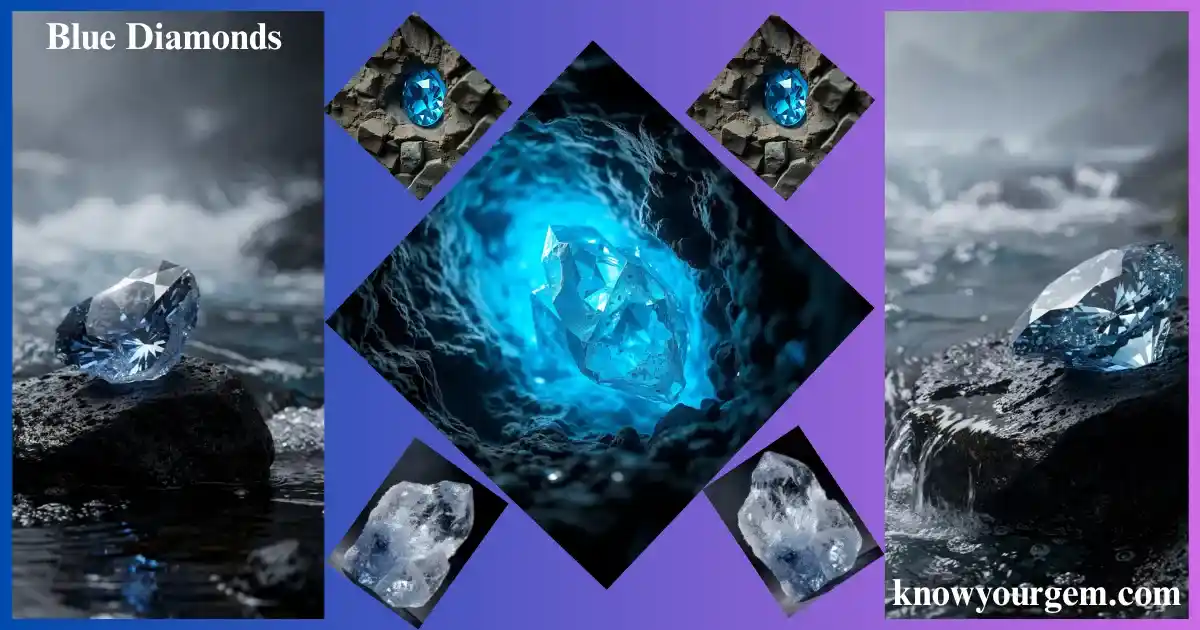

Blue diamonds are rare, naturally colored gemstones, they are valued for their vivid azure hues and exceptional rarity. They are mostly considering for modern jewelry, investment. Although, these genuine diamonds command premium prices because of mineral boron that creates their distinctive color. Natural blue diamonds are far uncommon than white diamonds and lab grown alternatives.
What is a blue Diamond?
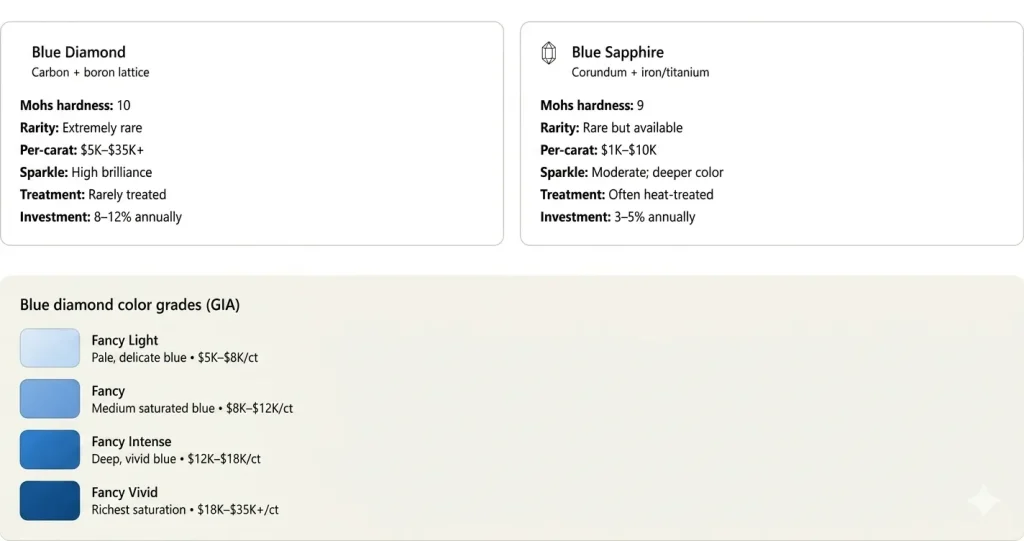
Blue Diamonds and precious gemstones, they get their color naturally from trace amounts of boron, which absorbs red wavelengths of light reflects blue. This natural coloration process makes diamond vary from white diamonds and other colored gemstones. Although, the Gemological Institute of America (GIA) classifies blue diamonds into specific color grades such as, Fancy Light, Fancy Intense, and Fancy Vivid.
Blue diamonds preeminently belong to fancy colored family of diamonds, alongside pink, yellow, and orange varieties. Not same as white diamonds, where lack of color inclined value, blue diamonds are valued precisely for their saturation, tone, and purity of color. Since, a single carat of blue diamond can range from light pastel blue to deep, saturated fancy vivid blue, each with dramatically distinction different market values.
Why are blue diamonds so rare?
Natural diamonds are extraordinary rare, because they 1.0% available in market. Their scarcity comes from the unique geological conditions needed to weave boron into a diamond’s carbon lattice as it forms deep in Earth’s mantle.
Mostly natural blue diamonds come from a limited number of sources. The Argyle mine in Australia, historically the world’s largest diamond producer, has closed, further restricting supply. Other sources including mines in South Africa, Russia, and Botswana, but yields remain minimal.
The rarity inclined dramatically with color intensity. Since, fancy vivid blue diamonds are considered as the most saturated and desirable grade, they are found in only a handful of stones per year globally. This limited supply directly influences pricing and makes authentication critical for buyers who are seeking investment grade stones.
These naturally occurred blue stones are also rarer than many precious gemstones, including fine rubies and sapphires. This rarity, is combined with their use in high end jewelry and fine art collections, them as luxury assets with stable appreciation potential over decades.
Blue diamond meaning and symbolism:
Blue sapphire own symbolism that spans cultures and eras. Since, Kings and queens used to worn them as badges of royalty and divine favor, and you will spot them in historic jewelry collections everywhere.
In this era, these blue precious stones embody honesty, loyalty, and that inner emotional peace. Plenty of people swear by their calming energy, sharper thinking, and spiritual boost, science aside, it is what keeps alive among collectors.
The blue precious diamonds are increasingly chosen of engagement rings and milestone jewelry because their rarity and meaning convey exclusively and emotional significance. The color itself cool, serene, and sophisticated appeals to buyers who are seeking something beyond conventional white diamond engagement rings.
The most famous blue precious diamond, like the Hope diamond (45.52 carats) holds centuries of legend and has become synonymous with both beauty and mystique. Its history elevates the cultural status of all blue colored diamonds in the luxury market.
Natural vs Lab grown Blue Diamonds:
Natural occurred blue colored diamonds form more than millions of years under the extreme pressure and temperature, with boron naturally present in the geological environment. Their rarity, geological pedigree, and investment credentials make natural diamonds the premium option for serious collectors and investors.
Whether Lab grown blue precious diamonds, so called synthetic or man made blue treated diamonds, are created in controlled laboratory settings which using high presence, high temperature (HPHT) or chemical vapor deposition (CVD) methods. These methods can produce visually identical blue synthetic diamonds in weeks rather than billions of years.
| Factor | Natural Blue Diamond | Lab-Grown Blue Diamond |
| Formation process | Billions of years | Weeks to months |
| Rarity | Extremely rare (<0.1% of diamonds) | Abundant; supply increases yearly |
| Cost (1 ct) | Commands $5,000–$25,000plus | Commands $2,500–$12,000 |
| Investment potential | Strong; 8 to 12% annual appreciation | Weak; depreciation as supply grows |
| Resale value | It purchase price is about 70-85% | It purchase price is about 40-50% |
| Durability (Mohs) | It owns 10 on the Mohs scale | It is 10 on the Mohs scale |
| Light refraction | Identical optical properties | Identical optical properties |
| GIA certification | Clearly marked “natural” | Clearly marked “lab-grown” |
| Legal status | No restrictions | Must be disclosed; legally required |
| Collector demand | Very high | Moderate; growing but secondary |
For engagement rings and jewelry, lab grown blue diamonds offer an excellent visual quality at lower cost. Whether for investment and heirloom pieces, natural blue diamonds are the saturated choice among serious collectors.
Blue diamond price guide:
Blue colored diamond prices are determined by four primary factors such as, the ( 4Cs, cut clarity, carat weight, and color) certification status, market demand, and rarity of the specific stone.
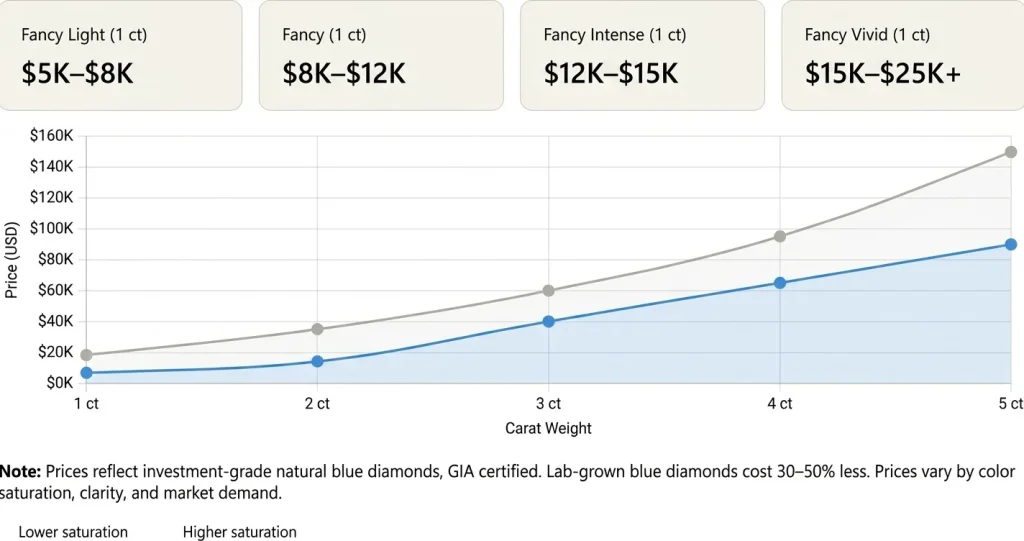
- Color intensity is the dominant price driver. Since, a fancy vivid blue diamond commands 5-10 times more than the Fancy light blue diamond of identical carat weight and clarity. The saturation and tone of blue dramatically shift market value. The interactive chart above showcases how prices escalate with carat weight more than different doubles price, that reflect the rarity and larger natural stones.
- Carat weight rises price exponentially. Since, a 1 carat blue colored diamond can command prices from $5,000 -$15,000 which hinges on color grade. Whether a 3 carat stone of the same color grade can cost more like $40,000-$60,000 or more, that reflects the rarity of larger natural stones.
- Clarity changes the price a lot. VS1 and VS2 are great value any flaws are invisible to the naked eye but cost less than flawless stones. Various collectors care more about color intensity than perfect clarity.
| Color Grade | Per-Carat Range | Market Saturation | Annual Appreciation |
| Fancy Light | Can command $5,000–$8,000 | Moderate | 5 to 7% |
| Fancy | Can command $8,000–$12,000 | Moderate | 7 to 9% |
| Fancy Intense | Can command $12,000–$18,000 | Low | 9 to 11% |
| Fancy Vivid | Can command $18,000–$35,000+ | Extremely low | 10 to 15% |
- GIA certification includes 10-20% resale value as compared to uncertified stones. Since, certification from respected labs provide authentication, grading documentation, and market credibility essential for investment grade purchases.
- Current market trends showcase steady appreciation of natural blue colored diamonds. Whether investment grade stones typically 2+ carats, Fancy Intense or vivid color, VS1 clarity or better have appreciated 8-12% annually over the past five years.
Price hinges on the seller who sell it. Auction houses often get the the highest prices for rare or historic stones. Although, retail jewelers usually add 100-150% to wholesale cost. Since certified dealers and online platforms usually showcase clearer prices, but you still need to carefully check the GIA certificate.
Blue diamond engagement rings:
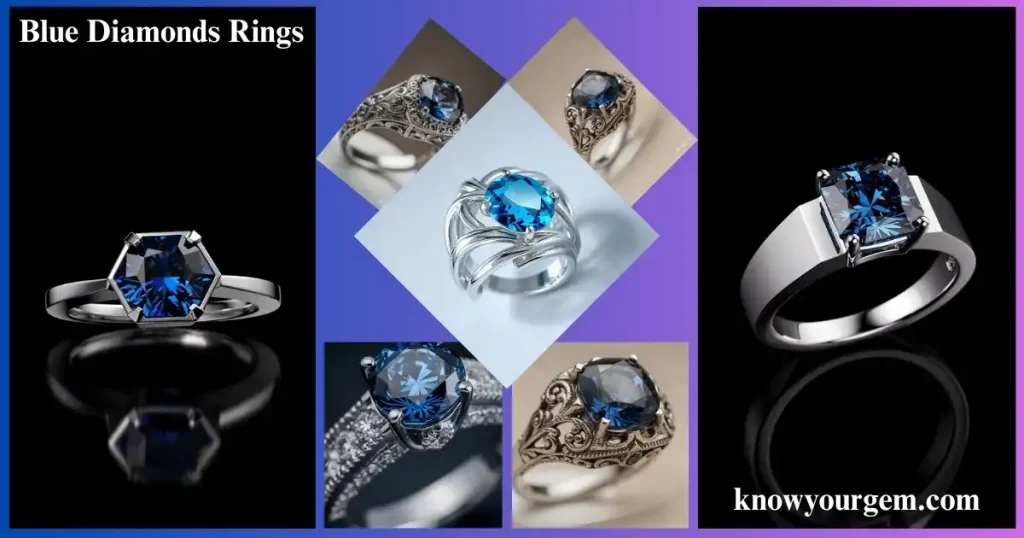
Blue diamond engagement rings provide a refined alternative to classic white solitaires. Their rarity and unique color give blue colored diamond rings a distinctive, personal, and memorable feel.
Popular blue diamond ring styles:
- Halo settings surround blue diamonds with white diamonds or platinum, amplify light and making the center stone appear larger. This design maximizes visual impact and is popular among luxury buyers.
- Cushion cut blue diamonds are preferred for engagement rings because the larger facets showcase color saturation. A cushion cut blue colored diamond displays color more vividly that smaller brilliant cuts.
- Oval cut blue diamonds offers excellent color display with an elongated silhouette that flatters hand and appears larger than round stones of equivalent carat weight.
- Vintage-inspired settings pair blue colored diamonds with having intricate metalwork that appeal to buyers who are seeking historical or romantic aesthetics. Since, these designs often include accent diamonds or complementary gemstones.
- Custom blue diamond rings enable buyers to choose an exact color, metal like, as platinum, white gold, yellow gold, or rose gold and design details. Custom designs usually command 15-30% more than ready made rings, but they offer exclusively and a more personal, one of a kind look.
| Ring Style | Best for Color Display | Typical Center (ct) | Price Range | Popularity |
| Solitaire | Showcase good and clean | 1.0 to 3.0 | $8K to $60K | Very high |
| Halo | Excellent; amplifies size | 0.8 to 2.5 | $12K to $75K | High |
| Cushion cut | Excellent; saturated hue | 1.2 to 3.0 | $10K to $65K | High |
| Oval cut | Very good; elongated | 1.0 to 2.8 | $9K to $55K | Moderate-high |
| Vintage | Good; romantic detail | 0.9 to 2.0 | $15K to $70K | Moderate |
| Custom design | Optimized per spec | 1.0 to 5.0 plus | $20K to $100Kplus | Growing |
When you choose blue diamond engagement ring, focus on a certified stone from trusted jeweler. Must check the GIA certificate, that examine the diamond under different lighting, and review the return and warranty terms. Since, investment grade engagement rings can hold their value and can even appreciate over several decades.
Blue diamond earrings and jewelry:
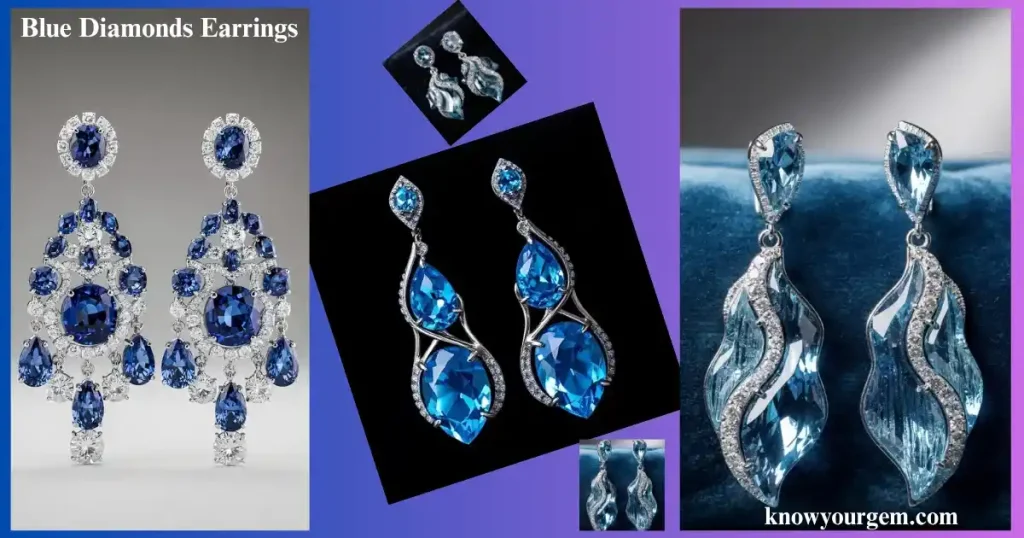
Blue diamond earrings can range from subtle studs to drop designs, that serves both daily wear and special occasion jewelry.
- Blue diamond stud earrings hold smaller blue diamonds typically about 0.5 to 2 carats total set in white gold, platinum, or yellow gold. These versatile pieces complement professional and casual wardrobes and serve as entry level blue diamond purchases for new collectors.
- Blue diamond drop earrings suspend blue diamonds from ear wires or posts, that creates movement and visual interest. Since, drop designs work well for blue diamonds because they enable light to enter the stone from multiple angles, enhance color display.
- Blue diamond hoop earrings set blue colored diamonds into hoop designs, that blend timeless elegance with having a modern, luxurious feel. Since, these pieces are ideal for those buyers who want stylish, wearable luxury that can be worn every day.
- Blue diamond tennis earrings feature a line of matched blue colored diamonds that set closely together, create a continuous sparkle. Since, Tennis earrings work particularly well with blue diamonds because the repeating color creates strong visual impact.
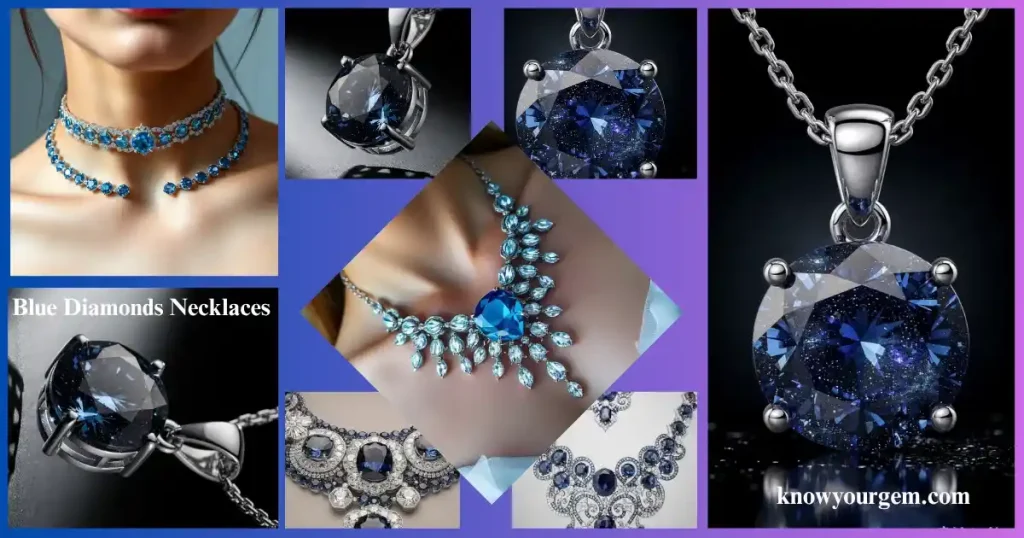
- Blue diamond necklaces and pendants showcase blue colored diamonds as focal points. Although pendant designs can range from solitaire drops to elaborate designs that incorporate white diamonds, other colored gemstones or vintage metal work.
- Blue diamond tennis necklaces hold a continuous line of matched blue diamond that offers maximum color impact and sophisticated luxury aesthetics.
- Blue diamond bracelets incorporate blue colored diamonds alongside white diamonds or other gemstones. Tennis bracelets and bangle both accommodate blue diamonds effectively.
| Jewelry Type | Typical Stone Size | Metal | Price Range | Daily Wearability |
| Stud earrings | 0.25 to 1.0 ct each | Gold/platinum | $3K–$20K | Excellent |
| Drop earrings | 0.5 to 2.0 ct each | Gold/platinum | $5K–$40K | Excellent |
| Hoop earrings | 0.1 to 0.5 ct total | Gold/platinum | $2K–$15K | Good |
| Pendant | 0.5 to 3.0 ct | Gold/platinum | $4K–$60K | Good |
| Tennis necklace | 2 to 8 ct total | Platinum/gold | $15K–$120K | Fair (formal) |
| Tennis bracelets | 3 to 10 ct total | Platinum/gold | $20K to $150K | Fair (formal) |
Blue diamonds are harder as like diamonds and own 10 Mohs scale which means their toughness resist scratches and keep their brilliance for decades.
Blue diamond vs sapphire:
Both stones can confuse buyers but they are geologically different gemstones with having different properties, pricing and investment potential.
- Blue colored diamonds usually contain boron impurities within a carbon lattice.Whether sapphire belongs to Corundum family, it colored by iron titanium. This basic difference affects how they bend durable they are, and how rare they are.
- Both diamonds and sapphires are on the top in hardness, diamond ranks 10 on the mohs scale whether sapphire is 9 on the mohs scale respectively. Diamonds are slightly harder and more scratch resistant.
- Diamonds typically showcase more “fire,” whether sapphires display deeper color saturation with less sparkle.
- Natural blue diamonds are much rarer than sapphires. Although, 1 carat of blue diamond commands $5,000-$15,000, as compared to sapphire which is sold for $1,000-$5,000. This price tells that how rare is blue diamond.
| Property | Blue Diamond | Blue Sapphire |
| Chemical formula for both gems | Carbon (C) plus boron | Corundum (Al₂O₃) + iron/titanium |
| Mohs scale | Diamond owns 10 mohs | Sapphire owns 9 mohs |
| Rarity (natural) | It is extremely rare (<0.1%) | It is rare but available |
| Color range | One primary blue | Wide blue variations |
| Sparkle/fire | High brilliance | Lower sparkle, deeper color |
| Cost per carat | Blue diamond commands $5K to $35Kplus | Blue sapphire commands$1K to $10K |
| Investment appreciation | It is about 8 to 12% annually | It is about 3 to 5% annually |
| Treatment frequency | Rarely treated | Often heat-treated |
| Resale value | 70 to 85% | 50 to 70% |
| Engagement ring suitability | Excellent; investment-grade | Good; lower cost |
- Color options: Sapphire usually offer a wider range of blue tones and intensities. While diamond mainly showcases one color range, but both stones saturation varies form light to vivid.
- Treatment considerations: Various sapphire stones are heat treated to enhance their color, but diamonds rarely require treatment.
Diamond and sapphire both can perfectly shine in engagement rings. Since Sapphire brings accessible luxury with having a wide range of colors, whether blue diamond is stand out for it rarity, prestige, and long term value.
Most expensive blue diamonds in History:
The rarest an most historically significant blue diamonds can command extraordinary prices at auction and in private collections.
- 45.52 carats of Hope Diamond is world’s most popular blue diamond, worth an estimated $200-$300 million. It is on display at the Smithsonian Institution and has a documented history that spans centuries, and earns it legendary status in gemstone history.
- 105.5 carats Koh-I-Noor Diamond is a historic blue diamond, it a part of British Crown Jewels. Even though it is not pure blue, its blue undertones and rich history make it the world’s valuable colored diamonds.
- The Regent Diamond (140.64 carats) is popular white diamond with having blue undertones, it is valued at more than $200 million. While, technically white, its color characteristics and historical rank it among the most valuable diamonds globally.
- The Pink Star (59, 60 carats) holds the auction record for any diamond, that can be sold for $71.2 million in 2017. Since white pink rather than blue, this sale benchmark establishes pricing exceptions for ultra rare fancy colored diamonds.
- 14.64 carats oppenheimer Blue is sod for $57.5 million in 2016, whether setting the auction record for a blue diamond specially. Its Fancy vivid blue color and exceptional clarity exceptional clarity exemplify investment grade blue diamond characteristics.
| Diamond | Carat Weight | Color | Estimated Value | Current Location |
| Hope Diamond | 45.52 | Fancy Deep Grayish-Blue | $200 plus $300M | Smithsonian Institution |
| Oppenheimer Blue | 14.64 | Fancy Vivid | $57.5M (sold 2016) | Private collector |
| Koh-i-Noor | 105.6 | Blue to white | $200M plus | British Crown Jewels |
| Regent Diamond | Is about 140.64 | White/blue undertone | $200Mplus | Louvre Museum |
| Pink Star | Is about 59.60 | Fancy Vivid Pink | $71.2M (sold 2017) | Private collector |
Historic blue diamonds rarely appear at auction. Most exceptional reside in museum collections or private vaults, where they function as permanent heirlooms rather than traded assets. When major blue diamonds do sell, prices exceed $1 million per carat for investment grade stones.
Blue diamond investment value:
Blue colored diamonds function as alternative investments, they offer portfolio diversification, tangible asset ownership, and appreciation potential as compared to fine art and rare collectibles.
- Investment criteria: Investment grade blue diamonds typically meet these specifications:
- 2 plus carats (larger stones appreciate more predictably)
- Fancy Intense or Fancy Vivid color grade
- VS1 clarity or better (visible inclusions reduce value)
- GIA certified (third-party authentication essential)
- No treatments or enhancements
Stones that meet to this criteria can go up 8-12% each year over the past five years, beating inflation and many traditional investment. Since this growth comes from rising demand from collectors, jewelry designers and international buyers.
- Market dynamics: The blue diamond market is relatively illiquied as compared to the stocks or bonds. While selling investment grade blue diamonds require time, expert appraisal, and connection to qualified buyers. Auction houses, have specialized dealers, and private collectors embody typical exit channels.
- Risk factors: Blue diamond values hinge on market sentiment, wealth levels among the collectors, and fashion. Since economic downturns can reduce demand and prices. Authentication, provenance, and certification are critical fraudulent or undocumented stones face severe value penalties.
Comparison with alternative investments:
| Investment type | Annual Appreciation | Liquidity | Volatility | Storage cost | Tax treatment |
| Natural blue diamonds | 8 to 12% | Low (requires expert) | Moderate | 0.1 to 0.2% of value | Collectible (28% rate) |
| Fine art | 6 to 10% | Low | Moderate–high | 1 to 2% | Collectible (28% rate) |
| Stocks/ETFs | 7 to10% (average) | Very high | High | Minimal | Capital gains (15–20%) |
| Real estate | 3 to5% | Low | Low | 1 to 2% | Capital gains plus depreciation |
| Precious metals | 2 to 5% | High | High | 0.1 ti 0.3% | Collectible (28% rate) |
- Tax considerations: Blue diamond investments can lead to capital gains when is sold, and tax treatment varies by country. They can be seen as collectibles or alternatives, so working with a tax key to smart planning.
- Storage and insurance: Physical blue diamonds require storage, insurance, and professional appraisal. Annual insurance updates and documented certification protect investment value. Storage costs typically run 0.1-0.2% of stone value annually.
Blue diamonds are great for serious collectors. They preserve wealth, diversify portfolios, and look stunning which is not like stocks or bonds. For casual buyers, they add investment value on the top of personal enjoyment.
Ethical and conflict-free blue diamonds:
More and more buyers both individuals and institutions want ethical, conflict free blue diamonds. Since conflict diamonds are used to fund wars, but blue diamonds usually don’t have this problem they come from places with having clear, transparent supply chains.
- Conflict-free certification: The Kimberley Process was established in 2003 to resist conflict diamonds form entering the mainstream market. While imperfect, it has significantly reduced conflict financing from diamond mining.
Mostly natural blue diamonds come from established mining operations in Australia, South Africa, Botswana, and Russia countries with having regulated mining practices and documented supply chains. These sources endow reasonable assurance of ethical sourcing as compared to high risk regions.
- Ethical sourcing practices: Reputable blue diamond dealers verify the mine origin, that keep chain of custody documentation, and support responsible mining practices. Ask sellers about their sourcing practices and requires certification documents ensures you make an ethical purchase.
- Lab-grown blue diamonds: Synthetic blue diamonds eliminate mining concerns entirely, that offer ethical advantages for environmentally conscious buyers. Lab growth can use less water and land than traditional mining, energy requirements vary by production method.
- Sustainable jewelry practices: Ethical jewelry is not just about the diamond, but it also considers the metal work labor practices, and environmental impact. While choosing certified jewelers who follow sustainable practices that ensure your purchase truly reflects your values from start to finish.
| Sourcing Category | Conflict Risk | Environmental Impact | Documentation | Certification |
| Australian natural (Argyle closed) | Very low | Low | Excellent | Kimberley compliant |
| South African natural | Very low | Low | Excellent | Kimberley compliant |
| Russian natural | Low | Moderate | Good | Kimberley compliant |
| Botswana natural | Very low | Low–moderate | Excellent | Kimberley compliant |
| Lab-grown (HPHT) | Zero | Moderate (energy use) | Excellent | Requires disclosure |
| Synthetic (CVD) | Zero | Moderate (energy use) | Excellent | Requires disclosure |
For those buyers who have focused on ethics, while asking for mine origin, Kimberley process certification, and chain of custody records ensure transparency. Since, trusted dealers usually welcome these request and provide clear sourcing information to back up their practices.
How to care for blue diamond jewelry:
Blue diamonds are more durable gemstones that require standard care to maintain brilliance and value. Proper maintenance ensures generations of enjoyment and preserved investment potential.
- Regular cleaning: Use warm, soapy water and a soft brush to remove dust and oil. Ultrasonic cleaner will work well, but it would be better to avoid steam cleaners if your jewelry has delicate accent stones.
- Professional cleaning: It is beneficial to clean these stones with professional jewelers and inspect with them yearly basis. This will help to remove buildup and catch issues like loose stones or stressed metal before they turn it into costly repairs.
- Storage: Store blue diamond jewelry separately from other pieces to resist scratching. Use soft cloth pouches or jewelry boxes with individual separately from other pieces for scratch resistance. Soft cloth pouches or jewelry boxes with having an individual compartment will work better.
- Setting inspection: Check regularly that the prongs hold your stones are secure. Loose prongs can cause you to lose a stone during daily wear.
- Avoid harsh chemicals: Wear off diamond jewelry when you apply lotions, perfumes, or cleaning chemicals. These substances can dull brilliance and damage metalwork over time.
- Protective practices: Remove jewelry during exercise, gardening, or manual labor. Whether diamonds are hard, impacts can cause damage to delicate settings to adjacent accent stones.
- Insurance and appraisal: Maintain updated appraisals and insurance coverage. Since, Appraisals should be renewed every 3-5 years to reflect current market values. Professional documentation protects against loss and ensures proper claim settlement.
With having basic care, blue diamond jewelry maintains beauty and value indefinitely. The investment in proper maintenance is modest as compared to the stone’s value and longevity potential.
Give below is the visual comparison of blue diamonds vs sapphire and GIA color grading chart:
FAQs:
1. What causes the blue color in blue diamonds?
Boron impurities in the carbon structure of diamond believe to absorb red light and reflect blue. More boron means deeper color, from Fancy Light to Fancy vivid.
2. Are blue diamonds real diamonds?
Yes , blue diamonds are authentic gemstones. This only difference is blue diamonds carry boron which creates the blue color.
3. What is the cost of 1 carat diamond?
1 carat blue diamond can command prices like $5,000 to $5,000 per carat that totally depends on different factors like, color, clarity, and certification. Although, with having fancy light blue color usually commands $5,000-$8,000.
4. Can blue diamonds be more expensive than white diamonds?
Yes, blue colored diamond of the same weight and quality can command price much more because it is extremely rare less than 0.1% of all mined diamonds.
5. What is the rarest blue diamond color grade?
Fancy vivid blue is the rarest and most value color, and only few carats of it is found worldwide each year. Fancy Intense is more available but still very rare.
6. Can you tell if a blue diamond is real without a certificate?
No, you will need a gemologist and special equipment (UV light, density and heat tests). While buying from a reputable dealer with having GIA certification can remove all speciousness.
7. What is the difference between blue diamond and sapphire?
Carbon and trace elements make blue color of diamond. Whether corundum makes sapphire and colored by iron and titanium.
8. Do blue diamonds appreciate in value?
Investment grade natural blue diamond have grown 8-12% yearly over the past 5 years. Since, larger stones (2+carats) with having great color and clarity can hold value better. Whether lab grown blue diamonds lose value as production increases.
9. Can I wear a blue diamond engagement ring daily?
Yes blue Diamonds own 10 mohs scale of hardness, so they are perfect for daily wear. Use secure settings, store them safely, and get regular professional maintenance.
10. What should I pay for a certified blue diamond?
Price of certified diamonds depends key factors like carat, color, and clarity. So, must check with GIA pricing guide and recent results.
11. Can lab grown diamonds be realistic?
Yes synthetic blue diamonds are chemically and physically identical to natural diamonds. A big difference of origin vs lab makes natural diamond more expensive.
12. What is a good investment blue diamond?
Must ask for 2 plus carats, Fancy intense or vivid color, VS1 clarity or better, GIA certified. These have grown steadily and resell well at the auctions and to collectors. Approximately 8-12% annual growth and 70-85% resale value of blue diamond.
13. How do I verify a blue diamond’s authenticity?
Always get GIA certificate and verify the number on GIA’s website. Must ask for mine origin and chain of custody papers.
Comment below with your feedback and enhance our confidence to bring more fruitful content! Gemstone Enthusiast KamilHussian!

Welcome to KnowYourGem.com! your ultimate destination for uncovering the fascinating world of gems and their secrets! I'm Kamil Hussain, a passionate blogger with a Master’s degree in Economics, dedicated to bringing you insightful, well researched content that blends the beauty of gemstones with the art of storytelling. With a keen analytical mind and a love for discovering hidden treasures, I created this platform to help you explore the brilliance, history, and value of every gem.


[…] blue hue of these amazing gemstones is just what the scientists say: “tiny boron atoms” embedded in […]
[…] Blue diamonds without enhancements are very rare. Their blue color is caused by the boron found within the crystal structure. A large number of blue diamonds have been mined from the Cullinan mine in South Africa. […]