


Enter any gem show, and you may notice the same shop pattern as you see continually repeating slabs and cabochons reflecting light in a way faceted stones simply cannot. Not a brilliant sparkle but a subtle, all-over glow, as if the surface appears frozen. That‘s druzy (also drifting around as drusy), whatever the correct spelling.
Druzy isn’t a single mineral. It’s a growth habit a way crystals form and that distinction is often obscured in most jewelry descriptions.
What the Term “Druzy” Actually Means?
In its earliest use, the term came from the German Druse, meaning a clump of rock with a membrane-like interior crust of crystal.
The spelling of the term eventually divided into “drusy” and “druzy,” and both are seen in retail listings today; “drusy” more closely resembles the original mineralogical name of the underground formation, while “druzy” is the variant that has made its way into commercial jewelry.
And here’s what most guides to druzy stone leave out: druzy is not based on the mineral present; it is based on the presence of a surface coating of tight crystal points, formed as the mineral-rich water evaporates away, depositing crystals on a host rock.
Quartz is the most prevalent mineral that produces druzy, so this is why the two are often mixed up. But quartz is the typical answer to “What kind of druzy is that?
How Druzy Forms?
The water bearing minerals penetrates into a fissure or hollow in a rock. Over time, or at times far, this water evaporates at a slow speed, leaving the mineral content behind with increasing depth.
Finally the silica molecules (or, in fewer cases, calcite) begin to precipitate and bund to form minute seed crystals all over the exposed surface.
Each seed then grows outward, and if thousands of seeds grow in parallel to one another (like many of a druzy’s crystals) a crystallized mat is formed making the source of all that sparkle!
Whether you prefer the former or you could care less between the dense, sugar-like druzy and the larger, more visibly faceted kind comes down to how it was grown: the temperature, the mineral, and the time it was allowed to grow uninterrupted.
The Non-Quartz Druzy Varieties Almost Nobody Mentions:
This is resonating with me to the degree that I find myself wanting to research it, since it’s unfortunately just not something commonly received in most consumer sources. Quartz-based druzy stone is by far the most common on the commercial front it’s what you find in almost every mass-market cabochon, but it is not the only druzy available.
- Uvarovite garnet druzy produces a startling bright green crust found almost exclusively in Russia’s Ural Mountains. No other significant locality is known, making this druzy variety a genuine rarity rather than a marketing claim.
- Cobaltoan calcite druzy (occasionally known as cobalto Dolomite druzy) offers an uncommon hot-pink coloration to a brownish matrix. Occurrence first identified on Elba Island of Italy in 1910.
- Chrysocolla druzy and hematite druzy also occur, each with a distinct color signature.
What this means in context: The hardness of the host mineral might also vary considerably within a druzy. Quartz druzies, for example, are quite hard, 6.5-7.
Calcite-based druzies are soft as well, rating around 3-4, and will be etched by a gentle soap even, or worse, a little vinegar or CLR quite easily, without marking a quartz drusy. So, don’t jump to any conclusions about using classic druzy care instructions until you’re certain what your drusy has been grown on.
| Druzy Host Mineral | Hardness (Mohs) | Typical Availability |
| Quartz druzy | 6.5–7 | Common, most jewelry-grade druzy |
| Chalcedony/agate druzy | 6.5–7 | Common |
| Chrysocolla druzy | 2.5–3.5 | Uncommon, mostly collector market |
| Calcite druzy (cobaltoan) | 3 | Rare, fragile, display pieces |
| Uvarovite garnet druzy | 6–7.5 (on matrix) | Very rare, single-locality |
Where Commercial Druzy Comes From?
Brazil leads global druzy stone output, primarily from Rio Grande do Sul and Minas Gerais, with much of the quartz and agate druzy destined for jewelry. India, which is primarily responsible for the Deccan Plateau sources, dominates the wholesale druzy earrings market.
United States’ domestic druzy deposits are present in Oregon, Michigan and some Southwest states. Deep-purple amethyst druzy geodes are found in Uruguay while Mexico and Morocco are the latest sources for collector-grade druzy material.
The Common Druzy Types You’ll Actually Encounter:
Quartz Druzy stone is what most jewelry will consist of white to clear, star bright, and the typical background for all druzy earrings, pendants and bracelets in the marketplace.
Agate druzy stone again covers the banded surface of the agate with a mineral overlay. so that the finished piece has the pattern and the sparkle in one stone, a combination most in demand in stones in the metaphysical market.
Chalcedony druzy leans toward a bluish or lavender hue underneath the crystal layer, with chalcedony’s lovable smooth nature shining through, a standby in simple and bohemian druzy styling. Amethyst druzy blends violet tones with the glinting of a whole crystal face over the top.
Any city also has a fair number of shops selling coated druzy (often billed as “aura druzy”) and this is where the technical machinery involved becomes more complicated than most articles bother to go into.
Starting from the base natural quartz druzy stone, they are put through a vacuum-coat process in which titanium is fused directly to the crystal surface, giving a rainbow, oil-slick-like iridescence.
There are two different processes being utilised in this sect of the druzy industry, Physical Vapor Deposition (PVD) and Chemical Vapor Deposition (CVD) with the listings in the shops often confusing these two things considerably.
PVD tends to be more long-lasting aura druzy, CVD is the chemist‘s “cheaper, higher-volume process, which makes most of the budget druzy cabochons, and this kind of coating each has its period of Diminishing
Druzy Stone Color and What Drives Price:
| Druzy Color | Typical Source | Market Position |
| White/clear druzy | Natural quartz | Broadly popular, most affordable |
| Pink druzy | Natural or dyed | Strong bridal demand |
| Purple/amethyst druzy | Natural amethyst | Collector and spiritual-market appeal |
| Rainbow/titanium druzy | PVD or CVD coating | Premium fashion segment |
| Black druzy | Hematite/manganese, often dyed | Growing, edgier aesthetic |
| Blue druzy | Titanium coating or natural chalcedony | Strong coastal styling appeal |
Untreated druzy in the unusual natural colours, real pink druzy, and genuine amethyst druzy stone all attract a true premium when compared to the dyed varieties. The titanium-coated druzy group falls into its own price range due both to appearance and the fact that the coating process is a serious cost of running the equipment.
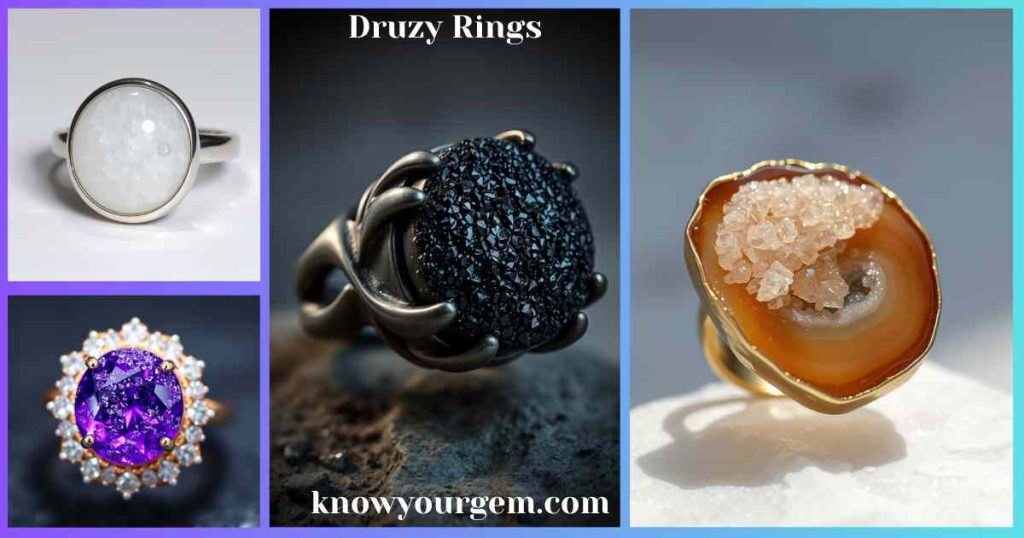
Druzy Jewelry Formats Worth Knowing
Most druzy base is flat and slab cut, so a bezel setting can be easily made without much additional shaping, this is part of the absolute appeal of the stone, all of the surface texture does the work.
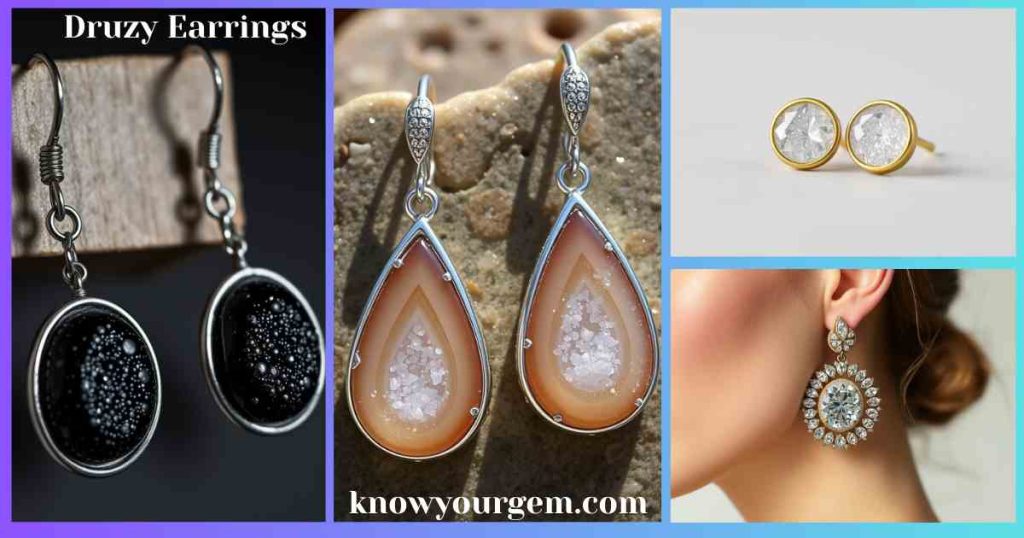
Druzy rings often inset the crystal-topped slab into Sterling, gold-filled or vermeil bezels. Druzy earrings are possibly the most common drusy style, topping understated posts and chandelier designs with shimmering crystals (often in oxidized silver to add the bohemian touch).
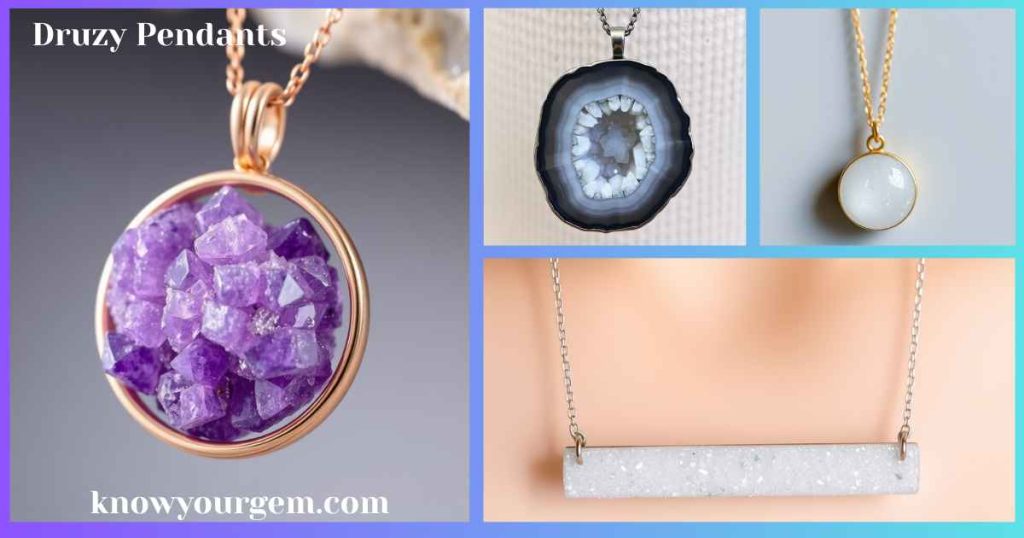
With pendant designs, the larger top gives more room to use the whole face of the crystal as a miniature sculpture. Examples of typical druzy bracelets range from tiny beads with silver-plating on just some of the surface, to centered designs that focus on one larger point.
On wholesale sourcing: the wholesale druzy earrings and parts market is dominated by India, China, and Brazil, and buyers and sellers will generally deal in packaging by stone type, appearance, species, value, and treatment status.
Any individual wholesale druzy stone buyer would be foolhardy not to have the documentation on value and treatment steady to go.
Buying Wholesale Druzy Stone: What Experienced Buyers Check
This is a different skill than spotting one fake druzy stone in a retail listing. Sample lots before committing to volume listing photos don’t tell you whether crystal density is consistent across a full batch of druzy, but physical samples do. Watch for lots mixing coated druzy stone into a batch marketed as “natural,” which happens more at scale than most buyers expect.
Pay attention to how price-per-piece drops as druzy lot size increases; a steep drop past a certain threshold sometimes signals lower-grade sourcing. Push for treatment documentation written into the purchase agreement itself. And treat vague language around druzy treatment “naturally enhanced,” “specially finished” as a prompt for a direct follow-up question.
Telling Natural Druzy Stone From Enhanced Druzy:
Genuinely natural druzy stone formed through geological processes shows irregular crystal sizing and slightly uneven, organic color. Under 10x magnification, natural druzy reveals individual growth points with real variation rather than machine-like consistency.
Lab-grown druzy, by contrast, is produced by growing crystals on a substrate under controlled conditions, and it tends to look almost too tidy remarkably uniform crystal size, perfectly even color. It’s not fake exactly, but lab-grown druzy lacks the geological history tied to naturally formed material.
Then there’s the enhancement layer: dye, applied to porous natural druzy stone to produce saturated, sometimes unnatural color, at a discount to naturally colored druzy not fraudulent when disclosed, frequently not disclosed.
Electroplating bonds a thin metallic layer onto drusy’s surface, giving a metallic sheen distinct from natural druzy sparkle. And the titanium coatings covered above, legitimately disclosed as treated across most of the market.
Quick tests worth trying on your own druzy stone:
- A 10x loupe: Irregular crystals read as natural druzy, suspiciously uniform ones suggest lab-grown druzy.
- Shortwave UV light: Natural druzy often fluoresces in ways dyed druzy doesn’t match.
- A gentle scratch test: Genuine quartz druzy resists both fingernail and copper coin.
- Basic color inspection: Perfectly even, highly saturated color is a flag for dyed druzy.
- Weight in hand: Natural druzy carries appropriate density; unusually light druzy deserves a second look.
Myth vs. Reality in the Druzy Stone Market:
“Aura druzy is a naturally occurring rainbow stone.” It isn’t aura drusy is natural quartz drusy that’s been through a disclosed titanium coating process. Beautiful and legitimate, just not a naturally occurring rainbow mineral.
“Druzy is always durable because it’s basically quartz.” Only true when the druzy stone host actually is quartz or a close relative like chalcedony. Calcite-based and chrysocolla-based druzy are meaningfully softer.
“Rare druzy colors like black are always natural.” Natural black druzy stone exists but is genuinely uncommon. Most black druzy on the market is manganese or hematite coated, or simply dyed.
“Bigger druzy slabs are automatically more valuable.” A large druzy piece with inconsistent crystal density or patchy coverage can be worth less than a smaller, cleaner druzy specimen.
“All druzy sparkles the same way.” Crystal size and density vary significantly, fine, sugar-textured druzy produces a softer shimmer, while coarser druzy throws sharper, more individual glints of light.
Druzy Stone Value and What Collectors Are Watching:
| Druzy Stone Type | Approx. Price Per Carat |
| Standard white quartz druzy | $5–$20 |
| Pink/lavender druzy | $15–$50 |
| Natural amethyst druzy | $20–$80 |
| Titanium/aura druzy | $30–$100 |
| Rare collector druzy colors | $50–$200+ |
| Clifton droplet druzy | $80–$300+ |
Titanium-coated druzy Stone has appreciated fairly consistently in the wholesale market since around 2020, riding the broader fashion trend toward color-shifting statement druzy jewelry.
Looking forward, three things seem to be gaining traction among serious druzy collectors: locality-documented druzy specimens, large-format display druzy pieces aimed at interior designers, and rarer natural druzy colors as the standard white-and-pink druzy market becomes increasingly saturated.
For anyone buying druzy stone with resale in mind, the pieces most likely to hold value are large, natural, and locality-documented, everyday commercial druzy jewelry functions as a fashion purchase, regardless of what a listing implies about investment potential.
Ultural and Metaphysical Associations With Druzy
Different crystal-healing traditions attribute druzy’s glittering texture to magnified energy and vibrancy. Druzy agate, for example, follows agate’s traditional link to steadiness, the crystal layer seen by healers as an energetic show of that stability.
Popular druzy associations are emotional harmony, eg sharp intuition, protection, grounding. By chakras: clear druzy to crown chakra; amethyst druzy to ajna; pink druzy to Anahata; black druzy to Muladhara.
To be clear: these are associations according to Tradititional and Personal belief not medical claim.
Buying Druzy Safely: A Practical Checklist
Before purchasing druzy stone online, confirm the seller states clearly whether the piece is natural, dyed, coated, or lab-created. Ask for druzy photos under more than one lighting condition.
Check for actual seller credentials. Confirm a reasonable return window. For any druzy piece over roughly $100, ask for a certificate of authenticity. Treat druzy pricing well below comparable listings as a signal to ask more questions.
FAQS:
1. What is druzy actually used for?
Druzy stone is actually used in jewelry like pendants, rings, drop earrings, and bracelets plus decorative display specimens. Some communities use this stone for meditation.
2. What does the term druzy mean technically?
The stone-coated surface texture is formed on a host rock. A description of this growth pattern is not a specific mineral.
3. How can I tell if druzy is genuinely natural?
You should check this stone under magnification for irregular crystal sizing and look for slightly uneven natural color. Try UV light, and for an expensive stone, get a gemologist’s opinion.
4. Is druzy worth buying as an investment?
You should select its larger pieces, natural, locality-documented specimens, and rare druzy colors. Standard commercial druzy jewelry is a style purchase, not a financial one.
5. Can druzy be dyed or otherwise enhanced?
The stone is routinely dyeing, titanium coating and electroplating are common in the stone’s market.
6. How do I clean druzy without damaging it?
Cleaning this stone. When cleaning this stone, the best method is to rinse it in warm water with a small amount of gentle soap. A soft toothbrush, a complete rinse and air drying are also effective ways of cleaning this stone.
7. What is aura druzy, specifically?
Natural quartz that has been treated with the titanium vapor-deposition treatment process which yields an iridescent rainbow surface.
8. Is druzy agate the same as druzy quartz?
Not exactly, because agate features a druzy crystal coating on agate host, Whether druzy quartz refers more broad to any druzy formation on a quartz base. Both share the same micro-crystalline quartz crystal surface, but their host stones are different in banding pattern and formation history.
9. Where does druzy come from?
The primary sources of this stone are Brazil, India, and the United States. Since, Brazil supplies the highest volume of druzy qurtz and agate druzy globally. India is a major producer of agate druzy used in the druzy earrings wholesale market .
10. Is agate druzy the same as quartz druzy?
Related but different agate is definitely a crystal coating on an agate host, whereas quartz is a general term for any crystal growth on a quartz surface.
Always verify these gemstones with reputable labs like GIA, SSEF, and IGS for authenticity. Gemstone Enthusiast KamilHussain.

Welcome to KnowYourGem.com! your ultimate destination for uncovering the fascinating world of gems and their secrets! I'm Kamil Hussain, a passionate blogger with a Master’s degree in Economics, dedicated to bringing you insightful, well researched content that blends the beauty of gemstones with the art of storytelling. With a keen analytical mind and a love for discovering hidden treasures, I created this platform to help you explore the brilliance, history, and value of every gem.

