

QuickCheck:
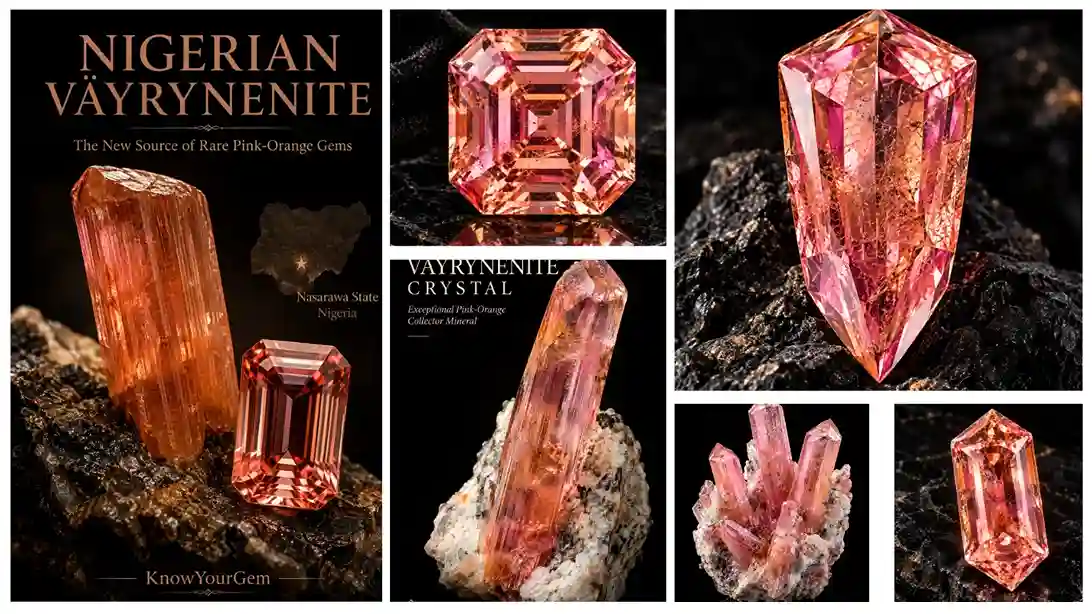
Vayrynenite is a manganese-beryllium phosphate. If you don’t know what that is, don’t blame yourself this is actually quite a rare stone, even for dealers who work in the trade and specialize in rare stones.
The composition of it is BeMn 2+ (PO 4) (OH), sometimes F instead of the OH (not in this specimen).
It happens in the identical complex granite pegmatites- the identical busy, mineral-laden pockets that produce tourmaline and spodumene. It can be a pinkish, salmon color, orangey pink, to an orangy-orange. Or on the deep reddish side.
This is so uncommon that until recently the faceted gems you could buy were tiny with obvious inclusions, just the type a collector searches for, not the type that will sparkle.
That changed in 2024. Nigerian production started turning up larger, noticeably cleaner crystals, and the vayrynenite market looks different than it did five years ago.
What is vayrynenite?
A rarely encountered phosphate mineral used in gem form for color, ranging from pink to orange, and though transparent, cuttable material is still one of the more difficult to find in colored stones.
How Rare Is Vayrynenite?
Ask three mineral vendors how “rare” vayrynenite is and you will get three different answers, primarily because “rare“has different connotations depending on what precisely you are talking about.
The species itself only occurs at a handful of pegmatite localities around the world. That’s rarity number one. Transparent crystals within those occurrences are rarer still. Facetable rough, the stuff a cutter can actually work with, is rarer again.
And clean facetable rough at a size worth cutting sits at the very top of that pile. Most vayrynenite that changes hands never makes it past step two. It stays a mineral specimen because there’s simply nothing to facet.
Older gem-quality material was typically under a carat, and even the good examples had visible inclusions you’d notice without a loupe.
GIA’s recent reports on Nigerian material describe something different: stones exceeding 10 carats showing up in trade, a size class that basically didn’t exist for this for this stone before.
Is vayrynenite one of the rarest gemstones?
I’d say it is definitely “among the most rare”. However, is it fair to claim that it is “the rarest in the world,” without clarifying what you mean? In the world of gem marketing, this is a phrase that is used loosely, and vayrynenite should not be pigeonholed with it! That’s a bold claim, and one that pulls the rug out from under this stone.
How rare is rare? It depends on what we classify the statement “rare” on. Is that mineral available as a transparent gem material? Is the finished cut material? Is the thundering huge clean stones? This high in the chart in all 4 (to be fair, not5) of those categories would be putting it above many.
Why large vayrynenite is especially rare?
It can be thought of as a funnel. The broadest part is the incredibly rare mineral, then thinning as clarifying material, further contrasted as rough facetability, less contrasted as good color, down further as good clarity, and finally as a good size.
If any one of these parameters is not accounted for, the stone in question is disqualified. This is the reason a 3 carat clean väyrynenite is not simply 3 times more rare than a 1 carat, but rather far more rare.
Vayrynenite Price Per Carat:
How much does väyrynenite cost per carat? No one is quoting a single number here, and for someone to do so is to state too reduced a version of the truth. Too much is not getting to the market, and the stones that do suffer from too much variance in quality to be averaged into one number.
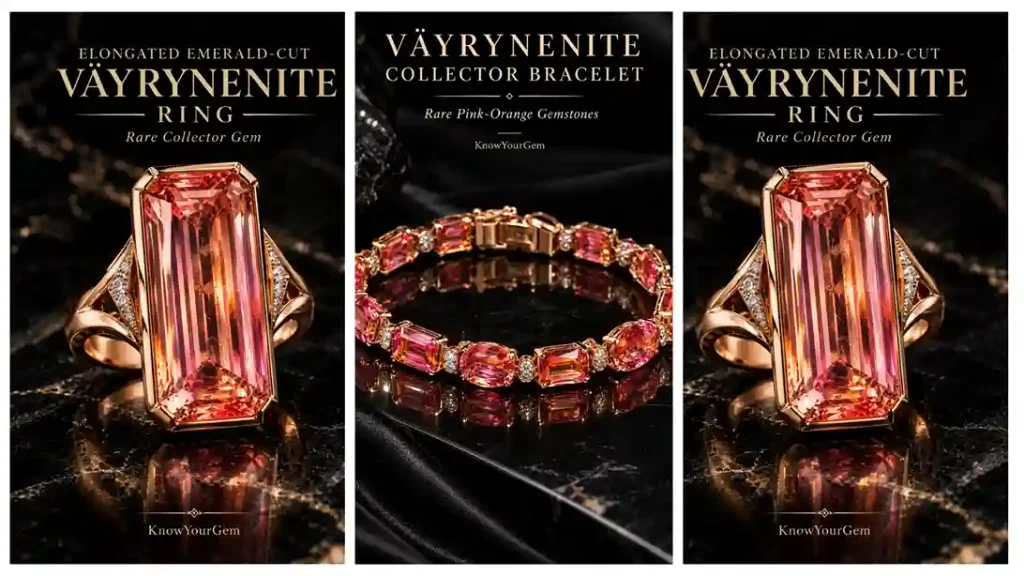
That said, the market today is putting faceted material in the ($500-$4000+) per carat range, with truly superb stones commanding even more.
As to where a given stone falls today, it comes down to size, color, clarity, documentation, and lab paperwork (if any). A light, dull, undocumented stone and a bright, eye-clean Nigerian with a GIA report are not really the same market, they merely have the same mineral name.
Vayrynenite Price Factors:
| Factor | Effect on Value |
|---|---|
| Color | Strong pink or orangy-pink saturation pushes desirability up |
| Clarity | Eye-clean material is unusual enough to command a real premium |
| Carat weight | Large clean stones are scarce enough that value climbs faster than weight alone would suggest |
| Cut | Proportions and symmetry affect both beauty and how much rough survives the process |
| Origin | Documented Nigerian provenance is currently generating extra collector interest |
| Transparency | Facetable, transparent rough is far rarer than opaque specimen material |
| Condition | Increasingly expected once a stone crosses into serious money |
| Lab documentation | Increasingly expected once a stone crosses into serious mone |
Price per carat vs. total price -don’t conflate them. This 0.30-carat stone could carry an alarmingly high per-carat figure due to the fact that a scarce and facetable vayrynenite may be of such small total weight.
It may be inexpensive because of the small weight, but it may have a higher total value than an expensive 3-carat stone with a lower per-carat value. Check both numbers before deciding which listing is the better deal-people get this wrong constantly with rare stones generally, not just this one.
Does Nigerian Väyrynen cost more? Not automatically. What Nigeria changed is availability-bigger, cleaner rough exists now where it didn’t before. Price still comes down to the individual stone’s quality and paperwork, not a blanket origin premium.
Vayrynenite Properties:
| Property | Vayrynenite |
|---|---|
| Family | Phosphate |
| Composition | BeMn²⁺(PO₄)(OH) |
| Crystal system | Monoclinic |
| Mohs | 5 |
| Refractive index is | ~1.638–1.676, varies by specimen |
| Birefringence is | ~0.025–0.027 |
| Specific gravity is | ~3.22–3.25 |
| Luster is | Vitreous |
| Transparency | The stone is transparent to translucent |
| Cleavage | It has distinct to perfect in certain directions |
| Pleochroism | It is strong, often trichroic |
| Typical colors | Pink, orangy pink, orange, reddish pink |
The GIA analysis of the Nigerian material measured a refractive index of 1.639–1.676, birefringence (1.222–135) with a specific gravity of 3.22–3.25 and trichroism from pinkish orange to pure pink to yellowish orange.
One thing worth flagging: published numbers for vayrynenite shift a bit depending on which specimen and locality a researcher was testing. Remember, if you see a reading just a little out of the ballpark, it’s not necessarily a bad thing. One mineral can be all over the place!
Vayrynenite Hardness: Is It Durable Enough for Jewelry?
Väyrynen, with a Mohs hardness of 5, is about on the same durability level as apatite, softer than window glass in certain makeup combinations, and well below the 9 and up range that sapphires and rubies are in. In practical terms, this means the dust that accumulates on every countertop and is wiped across a ring with a dishtowel over time can produce micro-scratches.
Cleavage makes it worse. Väyrynen has distinct to perfect cleavage in certain directions, so a sharp knock at the wrong angle doesn’t just scratch. It can split the stone outright. GIA is blunt about this: a hardness of 5 makes vayrynenite better suited to collectors than to jewelry.
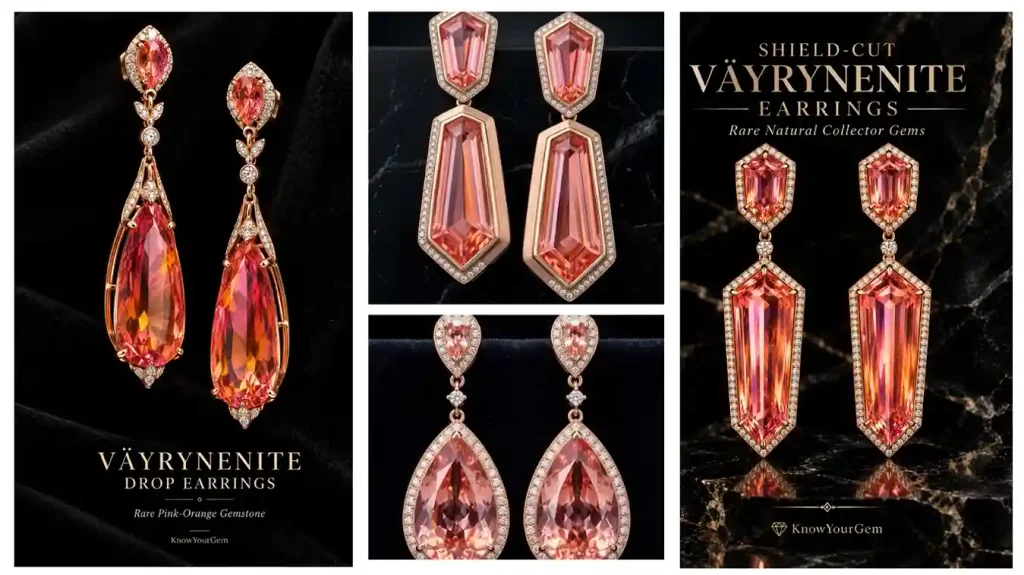
Can you wear a vayrynenite ring? Yes, with real caveats:
- Use a protective setting: Bezel or half-bezel, not exposed prongs
- Keep it away from impact: Sports, yard work, anything physical
- Never run it through an ultrasonic or steam cleaner; hand-wash only, and gently
- Take it off before anything rough on the hands, gardening included
- Check the setting periodically: A loose prong turns a minor bump into a chip
Earrings and pendants dodge most of this risk simply because they don’t take the same daily contact a ring does.
Vayrynenite Color: Pink, Orangy Pink and Orange
The colors go from light pink through salmon and rose pink to pinkish orange, straight orange and red-brown, and just to call it “pink” does not do it justice. Much of yungirnenite’s character is due to pleochroism, the fact that a visible change occurs as the angle of observation changes.
GIA’s dichroscope examination of Nigerian material found trichroic behavior: pinkish orange, pure pink, and yellowish orange, each along a different crystallographic axis.
That means a single rough crystal can look like two or three different stones depending on how it’s oriented-which is exactly why cutters spend real time studying vayrynenite rough before committing to an orientation. Cut it the wrong way, and you lose the color that made the rough worth buying in the first place.
Is pink vayrynenite rare? Color by itself doesn’t answer that. A pale, muddy pink stone with heavy inclusions is common enough. A smaller stone with vivid saturation and genuine eye-clean clarity is the rare one. Size, transparency, and cutting potential carry as much weight as hue.
Vayrynenite From Nigeria:
Where in Nigeria is vayrynenite found? Nasarawa State, near Angwan Doka, roughly 20 kilometers southeast of Keffi. The deposit sits in pegmatitic geology-and in a bit of an ironic twist, it’s ground that had previously been mined for tourmaline, not vayrynenite.
GIA reports that artisanal miners turned up orange to orangy-pink rough there in mid-2024, material that was initially expected to be something more familiar before it was correctly identified as Väyrynen.
That identification is the whole story here. A parcel that could easily have been overlooked or mislabeled turned into one of the more significant developments in the mineral’s history.
Why is Nigerian vayrynenite important?
| Feature | Older Reported Material | Nigerian Material |
|---|---|---|
| Typical size | Often under 1 carat | Larger examples reported |
| Clarity | Frequently included | High clarity reported in several stones |
| Color | Pink, orangy pink | Orange to orangy pink |
| Collector interest | Consistently high | Growing quickly |
| Faceting | Rare, small stones | New larger faceted gems |
GIA examined Nigerian stones ranging from 0.72 to 2.45 carats directly, and separately reported larger faceted gems over 10 carats appearing in trade. For a mineral where any facetable material used to make the mineralogical newsletters, that’s a real shift.
Vayrynenite Origin and History:
Vayrynenite was first identified in the 1950s, having been named after Finnish mineralogist Heikki Allan väyrynen whose fieldwork on the Finnish pegmatites contributed to the discovery of the species. The Finnish material, if reports are correct, was more of a mineralogist’s interest than that of the user’s.
Gem-quality material later came out of Pakistan, then Afghanistan-both regions with a long track record of producing colored gem rough from pegmatite terrain. That’s where most of the faceted vayrynenite in circulation through the late 20th and early 21st centuries actually came from: small, usually included, but genuinely cuttable.
Nigeria is the newest chapter, and arguably the most consequential one, since it’s the first time in decades that supply has shifted meaningfully in both size and clarity rather than staying roughly static.
Vayrynenite Mineral vs. Vayrynenite Gemstone:
Both are used in place of each other, and that is where many baffled customers originate from. Vayrynenite mineral covers the species in any form-crystal clusters, matrix pieces, opaque fragments, gem rough, all of it. Vayrynenite gemstone means specifically transparent material that’s been cut and polished.
Most vayrynenite you’ll actually encounter is the mineral, not the gemstone. That’s worth saying plainly, because it’s an easy mistake to assume any listing for “vayrynenite” is gem-quality by default. It usually isn’t. And that’s not a defect, just a different category of collectible with a different kind of value.
Vayrynenite Meaning and Metaphysical Properties:
Vayrynenite meaning:
Amongst the crystal-collecting community, vayrynenite has also acquired connotations of the scarce, the idiosyncratic, the creative, the abovementioned expressiveness themes that seem only natural to follow a stone that is actually rare, and that changes hue with perceived angle.
Vayrynenite metaphysical properties:
Some practitioners connect vayrynenite to emotional balance, self-expression, or creative clarity. Worth being direct about this: these are traditional or contemporary metaphysical interpretations, not scientifically demonstrated properties.
No clinical evidence supports healing claims attached to vayrynenite or any gemstone. That doesn’t make the associations meaningless to the people who hold them.
It just means they belong in the category of personal belief, not medical fact, and that distinction matters regardless of how deeply felt the belief is.
Vayrynenite Jewelry:
Why is vayrynenite rarely used in jewelry?
Stack up the reasons and it adds up fast: hardness of only 5, cleavage that raises chip risk, extreme scarcity of facetable rough, high cost on the little suitable material that exists, and mineral collectors who’d often rather keep a fine crystal whole than see it cut down for a ring.
Best applications-anything with limited contact:
- Earrings, which rarely take a hard knock in normal wear
- Pendants, ideally bezel-set for extra protection
- Brooches, which stay put once pinned on
Riskier applications worth thinking twice about:
- Daily-wear rings, especially with exposed prongs
- Bracelets, which absorb constant incidental bumps
- Any open setting without a protective bezel or halo
IGS points in the same direction, recommending protective settings and favoring earrings, brooches, and other low-impact pieces over anything worn every day.
Vayrynenite for Sale: What Should Buyers Check?
Before buying, especially online, run through this:
- Is it actually confirmed as vayrynenite by a qualified gemologist or lab-not just labeled that way in the listing?
- Is it natural, with no undisclosed treatment?
- What locality is claimed, and is there documentation behind that claim?
- Rough, mineral specimen, or finished faceted gem?
- What’s the exact carat weight?
- How’s the clarity-eye-clean, lightly included, heavily included?
- Any visible chipping, fracturing, or old damage?
- Is there a lab report for anything priced meaningfully high?
- Are the photos and video clear enough to actually judge the stone, or just a single flattering angle?
- Is it following realistic comparable sales, or capitalizing solely on the word “rare”?
Rare doesn’t mean every specimen is expensive. A small, included, undocumented stone is still Vayrynenite. It’s simply not worth the same as a big, clean, clearly identified one, and a decent seller will never claim otherwise.
Vayrynenite Specimen vs. Faceted Gem:
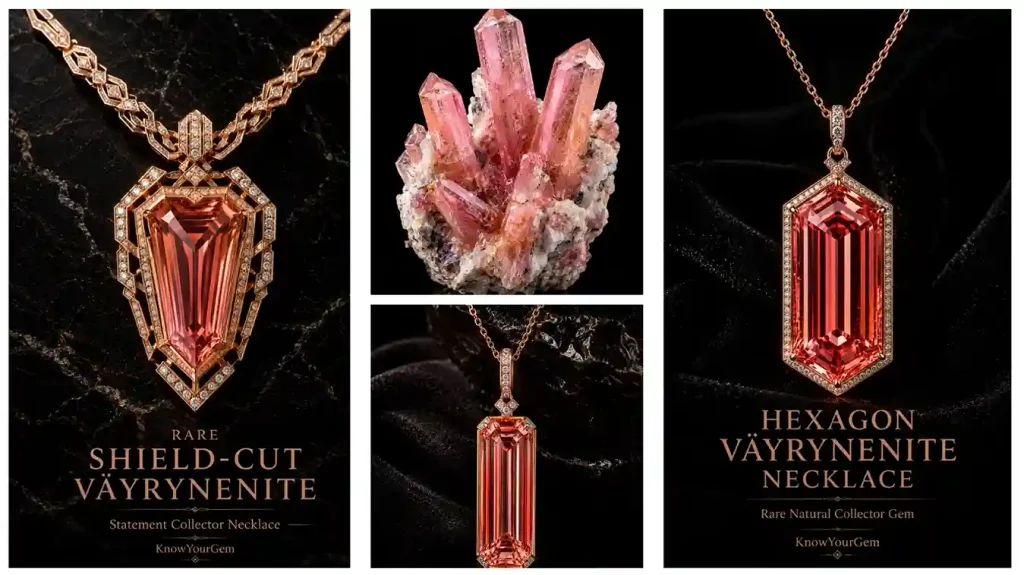
Mineral specimen or crystal specimen means vayrynenite left in its natural form, valued for geological and visual interest rather than cutting potential. Gem rough: material that is not cut yet. Faceted gemstone: the final cut.
This division is more significant here than it would be on most gems, since vayrynenite has been considered more of a mineral collector’s item than a standard jewelry gem for the majority of its existence. Plenty of serious mineral collections hold vayrynenite crystals that would never be considered for the cutting wheel. Their value is entirely in staying exactly as they formed.
How to Pronounce Vayrynenite?
The accepted pronunciations on the IGS website are vuh-REN-i-nite or var-e-YEN-i-nite. Either of these is acceptable as a pronunciation in English for the mineral in question and the context of gemology.
The original spelling, as I think is, recognizing the Finnish mineralogist whom it is named after, has the diacritical, and mark as the stone Vayrynenite.
Frequently Asked Questions:
1. What is vayrynenite?
A pink-orange gem-quality manganese-beryllium phosphate, chemical formula BeMn 2+ (PO 4) (OH), a very rare mineral found in pegmatite, which is.
2. How rare is vayrynenite?
Rarity is a critical element in the appeal of an individual gem; the rarer a type of gemstone is in the natural world, the more exotic it is perceived as being.
The rarity of an individual gem is most definitively determined by the mineral’s relative frequency, with each step along the process of difference from raw crystal to finished gem being measured largely in terms of the rarity factors involved.
3. How much is vayrynenite worth per carat?
Between $ 500-4,000, and even more per carat for faceted material, for exceptional stones based on color, clarity, size, and documentation.
4. Is vayrynenite a gemstone?
Only transparent, cut material qualifies. Most vayrynenite is mineralogical, not gem-quality.
5. What is vayrynenite hardness?
About 5 on the Mohs hardness scale- another gemstone, softer and more scratcher than sapphire, ruby and diamond.
6. What is vayrynenite’s Mohs hardness?
Around 5, but comparable to apatite.
7. Where does vayrynenite come from?
Historically, this stone came from Finland, Pakistan, and Afghanistan; more recently, Nasarawa State, Nigeria.
8. Is vayrynenite from Nigeria?
Yes. Nigerian production since mid-2024 has produced larger, cleaner material than previously documented sources.
9. Is Nigerian vayrynenite valuable?
It can be, though value still rests on individual clarity and color, not origin alone.
10. What color is vayrynenite?
Golden yellow to light orange brown, pale pink through salmon, orangy pink, orange and reddish; often strongly pleochroic.
11. Is pink vayrynenite rare?
Color cannot be the sole criterion-that-clarity, transparency, and size are controlled for as well.
12. Is vayrynenite good for a ring?
Workable in a protective setting, but risky for daily wear given its softness and cleavage.
13. Can vayrynenite be worn as jewelry?
Yes. Earrings/pendants/brooches are involved much less risk than rings or bracelets.
14. Where can I buy vayrynenite?
Specialty colored-stone and mineral dealers occasionally carry it; documented, lab-verified stones are worth prioritizing given the price spread.
15. What does vayrynenite mean?
Associated in metaphysical traditions with rarity, individuality, and creative or emotional expression.
16. Does vayrynenite have metaphysical properties?
Some practitioners attribute some emotional and spiritual qualities to it. Belief-based traditions, not scientific fact.
17. How do you pronounce vayrynenite?
Either “vuh-REN-i-nite” or “var-e-YEN-i-nite” is correct.
Final Buyer Takeaway:
Vayrynenite is an exceptionally rare collector mineral and gemstone, and most of its appeal comes down to two things: colors that shift depending on how you look at the stone, and a scarcity of facetable material that’s kept it out of mainstream jewelry for decades.
Nigerian production has genuinely expanded what’s available bigger. Cleaner stones than the market has seen before but a Mohs hardness of 5 and real cleavage risk still mean this is a stone for careful, occasional wear, not an everyday ring.
This article is written and published by GEMS expert AND enthusiast KAMILHUSSAIN!

Welcome to KnowYourGem.com! your ultimate destination for uncovering the fascinating world of gems and their secrets! I'm Kamil Hussain, a passionate blogger with a Master’s degree in Economics, dedicated to bringing you insightful, well researched content that blends the beauty of gemstones with the art of storytelling. With a keen analytical mind and a love for discovering hidden treasures, I created this platform to help you explore the brilliance, history, and value of every gem.

