


Insights:
Orange gemstones can be sold for lower and higher prices. Citrine and carnelian are the most common gems which command low prices. However, Padparadscha sapphire and vivid orange diamond gemstones are rare, command higher prices. So users are advised to focus on treatment, disclosure, and lab certification for higher quality-value stones during buying them.
Key takeaways:
- Orange sapphire color cause oversimplified: stated as “iron and chromium” but GIA research shows orange corundum is primarily caused by trapped hole–chromium (h- -Cr³⁺) color centers, sometimes with iron involvement.gia+2
- “Padparadscha is the rarest orange gemstone which can easily be found at market” is contradictory and misleading; padparadscha is rare but not “easily found.”
- Orange diamond price claim of “$1,000,000+ per carat” needs qualification; fancy vivid orange diamonds have sold for high prices but this is auction-specific and quality-dependent.gia+1
- “Orange River Quartz is the rarest orange crystal” lacks authoritative support and appears to be an unsupported claim.
- Fire opal hardness listed as 5.5–6.5; authoritative sources cite 5.5–6.0.
Why Gemstones Turn Orange?
The orange color doesn’t happen accidentally. It is actually the result of specific chemistry that is working inside a crystal lattice.
Manganese is basically the star behind spessartine garnet’s tangerine glow. Iron (Fe³⁺) gives citrine and carnelian a golden warmth. However, in sapphire, the orange hue comes from a more complicated interaction including trapped hole chromium color centers (h- -Cr³⁺), sometimes with iron playing a supporting role to generate orange color. Although this is more nuanced than the oversimplified “iron plus chromium” explanation you will often see.
Orange color in diamond gemstones comes from nitrogen. But don’t get us wrong, because not only nitrogen can specifically generate the stone; The arrangement matters. Two diamonds with an identical nitrogen content can generally look different, which depends on how those atoms are distributed.
Some other gems borrow their orange color from optical tricks rather than chemistry. For example, fire opal glows with light interaction; Moonstone’s orange variety showcases adularescence, a soft, floating glow caused by light scattering between feldspar layers.
The Orange Gemstones You’ll Actually Find:
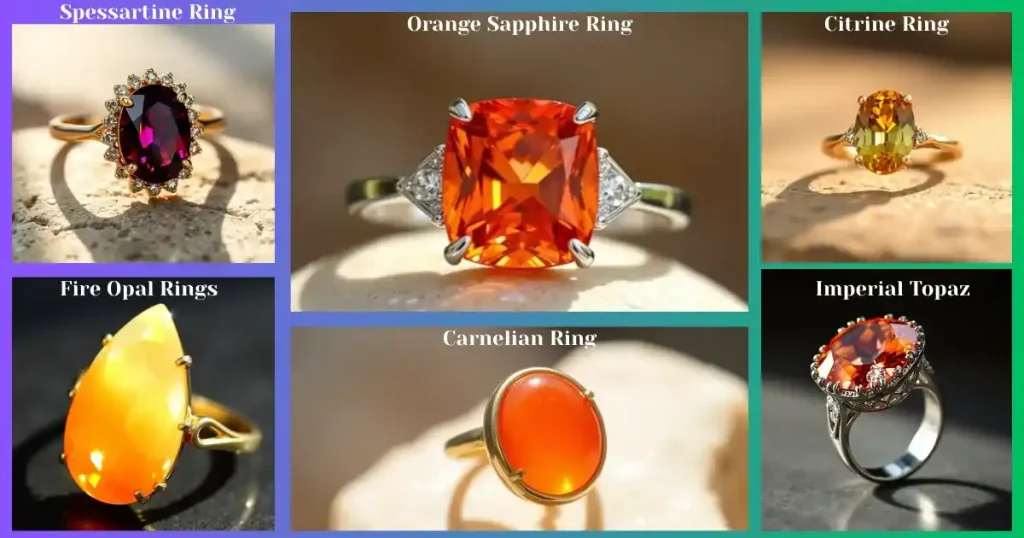
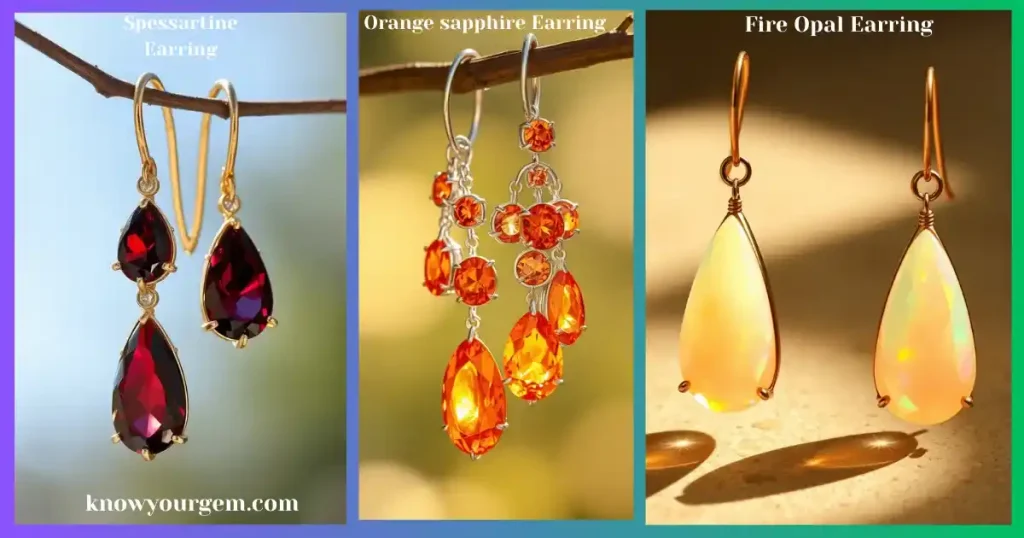
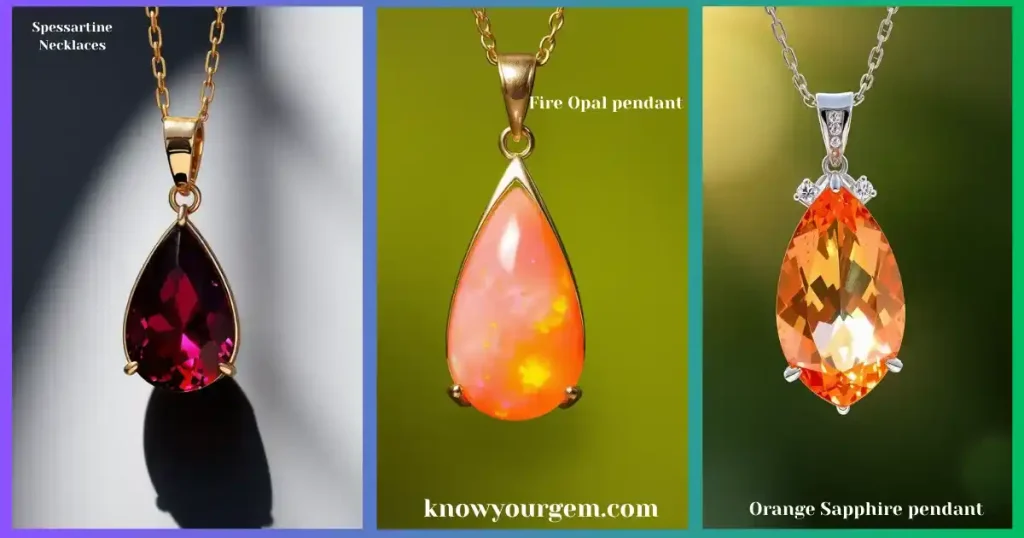
Spessartine Garnet:
A garnet group member known for its bright orange color. The stone gets its color from the manganese chemical element; for that reason, the stone is called a manganese-rich garnet.
What matters:
- Hardness: Due to having 7-7.5 Mohs hardness, it is durable and suitable enough for everyday jewelry.
- Origin: Its ethical sources are Namibia, which produces vivid, saturated stones, and Nigeria and Madagascar also supply commercial-grade stones.
- Treatment: Spessartine garnet is commonly found without treatment; So, buyers should still ask the seller to disclose any treatment.
- Price: Namibian Mandarin garnet commanded $600–$2,500 per carat for 1 to 5 carat stones in 2025–2026. But larger, cleaner pieces can be sold in higher prices, like $3,000–$6,000 per carat.
Spessartine is generally considered a collector’s gem when it hits that pure tangerine note without brown masking. So anything muddy or overly dark can quickly lose appeal.
Orange Sapphire:
A corundum member alongside ruby and regular sapphire. Its 9 Mohs hardness allows all types of jewelry to set this stone, even everyday rings without bezel settings.
Color cause: Its color is caused by trapped hole-chromium (h- -Cr³⁺) color centers, but sometimes it shines with iron involvement.
What matters:
- Hardness: Due to its durability, it is tough and durable enough for engagement rings.
- Origin: Its major resources are Sri Lanka, Madagascar, and Tanzania.
- Treatment: Orange sapphire is usually sold as heat-treated, but sellers should disclose it properly.
- Price: Orange sapphire in commercial pieces can command $3,00-$8,00 per carat, and fine quality can get higher, from $3000 to $10000 plus per carat.
Padparadscha sapphire is the rarest stone and also a member of corundum. Its color glow is pink-orange, and the rarest stone is named after sinhalese used for “lotus blossom.” But pure Padparadscha generally displays a color like a delicate balance, a mixture of pink and orange.
Padparadscha pricing (2026):
- Commercial heated stone is sold for $600–$3,500 per carat
- Fine unheated stones can command $8,000–$25,000 per carat
- Exceptional 5+ carat stones are sold for $30,000–$100,000+ per carat at auctiongia+1
Fire Opal:
Fire opal is a type of opal and orange gemstone. Its transparency is translucent to transparent, often without play-of-color, and the variety is valued for its body tone, like yellow-orange ot deep red-orange.
What matters:
- Hardness: The stone is softer because it has 5.5- 6.0 on Mohs hardness, which doesn’t permit you to wear it on a daily basis.
- Water content: This stone is more sensitive to dryness, heat, and harsh chemicals, so avoid them for its safety.
- Origin: Mostly, it is mined in Mexico but rarely comes from Australia.
- Price: Commercial-grade stones command $50-$500 per carat, but the commitment must be that they should come from Mexico and their transparency should be rich tangerine with no play-of-color; anything can exceed this.
Fire opal needs gentle care. Only bezel protective settings can be helpful for daily-wear rings.
Citrine:
Quartz variety citrine is tough enough with 7 Mohs hardness and suitable for everyday use. It has refractive brilliance of 1.544-1.553. So, the stone shows soft yellow to deep orange-brown coloration.
The uncomfortable truth: It is a big truth that untreated citrine stones are rarely mined. But most commercial-grade pieces like amethyst or smoky quartz are found as heat-treated.
What matters:
- Hardness: 7 Mohs hardness
- Treatment: Citrine is mostly found in heat-treated condition; natural untreated pieces in the variety are rare.
- Price: Commercialized stones charge $10-$500 per carat, but fine natural pieces with deep reddish color are sold for $100-$300 per carat.
Citrine is set as an entry-level orange gemstone. It is accessible, durable, and looks good in gold metal.
Imperial Topaz:
It is the finest piece that glows orange to red with pink or golden flashes. Almost all true imperial topaz comes from Brazil’s Ouro Preto region.
What matters:
- Hardness: Its 8 Mohs hardness can make it suitable for everyday wear but it also contains perfect cleavage, which makes stone weaker becuase if you it by wrong direction, the stone will break.
- Treatment: Imperial topaz is generally found as untreated, but its some specimens can be coated or heat-treated; then they will display pink-orange color.
- Price: Specimens from Brazil can command $500–$3,000 per carat. Coated or treated stones sell for less.
A collector’s gem imperial topaz is rarer than blue topaz and also holds a long history.
Orange Spinel:
This orange stone is overlooked because it displays a clean, bright brilliance that can define its single gem refraction rather than sapphire and tanzanite, which have double the brilliance.
What matters:
- Hardness: Its 8 Mohs hardness makes it durable and suitable enough for everyday wear.
- Treatment: Its untreated popularity increases its value and uses.
- Origin: Its primary ethical sources are Tanzania, Myanmar, and Sri Lanka.
- Price: It is named as Mahenge orange spinel, and in fine quality, it is certified by GIA, IGI, IGS, and SSEF can charge $2000-$15,000 per carat
Spinel’s investment trajectory generally is rising. Since fine Mahenge material in particular has gained collector attention.
Carnelian:
Chalcedony variety carnelian gets its color from iron oxide. It is translucent to opaque and has a soft, waxy glow.
What matters:
- Hardness: Its moderate Mohs 6.5–7 lets it be used in pendants and bracelets, but rings need protective settings.
- Treatment: Its treatment status is often dyed or heat-treated.
- Price: It is affordable, sold for $5–$30 per carat.
Historically, people set it into amulets and scarabs. But now it is popular in bohemian and artisan jewelry.
Other Orange Gemstones Worth Knowing
Orange Tourmaline:
It is a rare types of tourmaline with 7-7.5 Mohs hardness. It gets its color from iron and manganese. This stone is sold for 4100-$800 plus per carat for its fine pieces.
Orange Moonstone:
It has 6-6.5 Mohs hardness, and the stone displays adularescence in warm peachy-orange tones. The stone contains perfect cleavage into two directions, which makes the gem vulnerable to impact. It is suitable for pendants or earrings and command price of $ 30- $ 300 per carat.
Orange Zoisite:
Orange zoisite is an orange variety of the mineral zoisite. But it should be described simply as a type of tanzanite, because tanzanite a specific blue-to-violet gem variety of zoisite.
Orange Coral:
It is organically formed by marine polyps. The stone is culturally used in Tibetan, Italian, and Native American jewelry. Its critical CITES compliance is mandatory. So users should verify provenance and legal harvest documentation. So, prices of this stone vary widely based on quality and species.
Orange Diamond:
This a variety of pure diamond but only its color makes it different. It has the same 10 Mohs hardness that regular diamond carries, but it is rare and tough to find easily. It gets its orange-shaded color from nitrogen-related defects and the 480nm band. Its pumpkin glow with 5.5 carats in vivid fancy orange can command $1.3 million in 1997.
However, current auction prices are flexible; they don’t only focus on the stone’s vivid color, but they also check for clarity, size, treatment, and origin. So the stone meets all these, it can be sold for $100,000–$1,000,000+ per carat depending on quality.
Bi-color and combination stones: Some tourmaline and garnet crystals show green and orange zoning. Agate and jasper can display orange and white banding. These are popular in cabochon cuts.
Orange Gemstones at a Glance:
| Gemstone | Mohs | Transparency | Color Cause | Treatments | Jewelry Use | Rarity |
|---|---|---|---|---|---|---|
| Orange Sapphire | 9 | Transparent | h- -Cr³⁺ color centers | Heat common | Excellent for daily rings | Rare |
| Padparadscha Sapphire | 9 | Transparent | h- -Cr³⁺ with balanced pink-orange | Heat common; unheated premium | Excellent for daily rings | Very rare |
| Orange Diamond | 10 | Transparent | Nitrogen defects | None (natural) | Excellent for daily rings | Exceptionally rare |
| Imperial Topaz | 8 | Transparent | Iron (natural) | Coating, heat possible | Good with protective settings; has cleavage | Rare |
| Orange Spinel | 8 | Transparent | Chromium, iron | Generally none | Excellent for daily rings | Uncommon to rare |
| Spessartine Garnet | 7–7.5 | Transparent | Manganese | Generally none | Good for daily wear | Uncommon |
| Orange Tourmaline | 7–7.5 | Transparent | Iron, manganese | Generally none | Good with care; brittle | Uncommon |
| Citrine | 7 | Transparent | Iron | Heat treatment very common | Good for daily wear | Common (mostly treated) |
| Carnelian | 6.5–7 | Translucent-opaque | Iron oxide | Heat, dye common | Pendants, bracelets | Common |
| Fire Opal | 5.5–6.0 | Translucent-transparent | Silica structure, body tone | Generally none | Protective settings only | Uncommon |
| Orange Moonstone | 6–6.5 | Translucent | Adularescence | Generally none | Pendants, earrings; avoid daily rings | Common |
| Orange Coral | 3–4 | Opaque | Organic pigment | None (organic) | Decorative; avoid rings | Culturally significant |
Orange Gemstones Prices:
The pricing table only reflects the current market structure based on color, clarity, cut, carat weight, treatment, origin, and certification.
| Category | Examples | Price Per Carat | Notes |
| Entry Level | Citrine, Carnelian | Citrine commands $10-$50 and Carnelian is sold for $5-$30 | Citrine is most found as heat-treated like amethyst |
| Mid-Grade | Fire Opal, Orange Tourmaline, Orange Moonstone, Spessartine | Fire Opal commands $50-$500, Tourmaline is sold for $100-$800, Moonstone can command $30-$300 and Spessartine charges $100-$2,500 | Prices of these depend on their color saturation and clarity |
| Investment-Grade | Imperial Topaz, Orange Spinel, Orange Sapphire | Topaz is sold for $500-$3,000, Spinel commands $500-$5,000 plus and Sapphire charges $300-$10,000 plus | Fine unheated material generally commands premium prices |
| Auction-Grade | Padparadscha, Fancy Vivid Orange Diamond | Padparadscha is sold for $8,000-$100,000 plus and Diamond commands $100,000-$1,000,000+ | These are considered as higher valuable gemstones their results can vary based on auction. |
Which Orange Gemstone Is Rarest?
Pure padparadscha sapphire is top listed in rarity, with its perfect pink-orange balance, which matches less than 1% to natural sapphires. Secondly fancy vivid orange diamonds also sit in this list.
They appear as tiny numbers at auctions. However, unheated vivid orange spinel from Mahenge, Tanzania, is also rare with its strong color. Moreover, other orange gemstones also rarely exist, but they do not command standard prices.
Meaning, Symbolism, and Tradition:
Orange gemstones generally hold cultural weight across centuries based on tradition only:
Sacral chakra:
Carnelian, citrine, and spessartine are primarily connected with the sacral chakra. The sacral chakra provides the body’s energy.
Historical uses:
- Ancient practitioners carved carnelian into amulets and scarabs because they were believeing that the stone offered them courage and protection.
- Orange sapphire and hessonite garnet are both stones connected to the moon’s nodes in astrological facts.
Symbolism:
Orange gemstones represent symbols of enthusiasm, warmth, confidence, and energy to face all adventurous situations. Throughout history, imperial topaz was called as the “gem of the sun” in Brazilian indigenous traditions.
Best Orange Gemstones For Jewelry:
Engagement rings:
Sapphire and spinel are tough enough, and they also have brilliance, which generally suits engagement rings.
Everyday jewelry:
Mostly rings are used regularly because they always hold harder stones like orange spinel, orange sapphire, and sometimes imperial topaz with bezel settings. But spessartine garnet and citrine are also suitable because they are harder, with 7 Mohs.
Budget buyers:
Budget-conscious buyers can set their jewelry with citrine and carnelian because these stones are more affordable than other premium pieces.
Collectors:
Collector-grade gemstones are more valuable for their exceptional durability and refractive brilliance. In the above list, Padparadscha sapphire, fine unheated Mahenge spinel, and Namibian garnet meet these requirements.
Rarity seekers:
Some buyers only accept rare and most vivid gemstones like orange diamond, Padparadscha sapphire, and gem-quality orange zoisite.
Brilliance:
Stones with exceptional brilliance and durability are Orange spinel. But their isometric structure and single refraction produce generally a clean, bright appearance.
Durability:
Durability in any stone can prevent it from scratches and damage.
How to Buy Orange Gemstones Without Getting Burned?
1. Verify origin. Buyers should verify the origin of the stone; if they want a genuine piece, because each stone comes from different shapes with different origins.
2. Ask about treatment. Buyers are advised to ask for the treatment status of the stone from sellers. They should have knowledge about whether the stone is heat-treated, irradiated, diffusion-treated, or fracture-filled.
- Citrine: It is rare as untreated but commonly available in heat-treated condition.
- Sapphire: It is commonly treated by heat to enhance its sparkle. So you can accept its treatment status if it is disclosed by sellers.
- Topaz: Some imperial topaz stones are coated; ask for treatment status.
- Spinel, garnet: Generally untreated.
3. Get lab certification for stones over $500 per carat.
Trusted labs like GIA, AGL, Gübelin, and SSEF certification, treatment status, and origin are required.
4. Evaluate color saturation.
You should look for vivid, evenly distributed orange color without brown or gray masking. So, the finest material displays a “pure” orange or reddish-orange color.
5. Consider transparency and cut.
Clarity in every gemstone is a first priority, so stones with excellent clarity can command premium prices.
6. Match hardness to use.
Daily wear jewelry requires hard gemstones with up to 7 Mohs. But Fire opal and moonstone are softer; they need protective settings for daily wear, and they are better suited for occasional display.
7. Source ethically.
Coral always needs verification of CITES compliance and legal harvest documentation. But buyers should always ask about mining status from sellers.
Care and Maintenance For Orange Gemstones:
Gem Care Basics
- Hard stones: You can clean orange sapphire, spinel, topaz, citrine, and tourmaline with warm soapy water and a soft brush for removing dust.
- Fire opal: Pat dry it with a damp cloth, not ultrasonic or steam cleaners.
- Orange coral: Use a soft dry cloth for pat drying and don’t allow acids, perfumes, heat, or long water exposure.
- Orange moonstone: Mild soapy water + soft cloth is well suited.
Storage
- Store each orange gemstone separately in fabric-lined boxes or pouches.
- Softer stones like opal, moonstone, and coral should be stored separately from harder stones like sapphire, diamond, and spinel.
- Opal and coral need stable humidity; sealed containers or silica packets can work very well.
Settings & Wear
- Check prong settings once a year to maintain brilliance.
- Bezel or tension settings need less frequent checks.
- It is best to remove jewelry when you are engaging in any heavy activities, including swimming, working out, playing football, etc.
Natural vs. Treated: What You Need to Know
Heat treatment:
Heat treatment generally enhances a stone’s color sparkle but can affect the price. while unheated stones are exceptionally more valuable and can command more prices.
Irradiation:
It is used for some topaz and quartz but should be disclosed. Certain irradiated colors can generally fade under prolonged light exposure.
Diffusion treatment:
It generally forces trace elements like beryllium or titanium into the surface under heat to enhance color. And it also creates a shallow color layer. So lab detect it easily; you can request for certification for high-value stones.
Fracture filling:
Resin or oil filling fractures generally improves the clarity. Most fine orange gemstones are eye-clean, and they don’t require filling, but disclosure matters more.
Certification:
Investment-grade stones must have reports from GIA, AGL, Gübelin, or SSEF which can confirm identity, treatment status, and origin these gemstones.
FAQS:
1. Which gemstones are orange?
Orange gems fall into two groups: rare and common. Rare stones include padparadscha sapphire, orange diamond, and citrine. And common stones are spessartine garnet, orange moonstone, orange coral and carnelian.
2. What is an orange birthstone?
Fire opal is sometimes considered as October’s birthstone.
3. What rock is orange?
The specific rocks that contain iron oxide minerals like sandstone, carnelian, and orange calcite.
4. What is orange tourmaline?
It is a rare boron silicate mineral which gets its orange color from iron and manganese.
5. Is orange coral ethically available?
Yes, it is, but only with CITES compliance and verified legal harvest documentation.
6. What’s the difference between orange garnet and hessonite?
Orange garnet” typically refers to spessartine with vivid orange color. However, hessonite is a grossular garnet with a warmer, more brownish-orange tone.
7. Is natural citrine common?
Natural citrine is relatively uncommon compared with commercial heat-treated citrine. So, you can find a wide range of commercial citrine, like amethyst or smoky quartz, at a low price.
Sources:
- GIA (Gemological Institute of America): Corundum chromophores ; citrine treatment ; diamond color defects ; moonstone ; fire opal ; topaz treatments .
- The Sapphire Bank: Padparadscha pricing ; Mahenge spinel pricing .
- Farmonaut: Spessartine garnet pricing.farmonaut
- GemRockAuctions: Orange sapphire properties .
- GGTL Laboratories: Zoisite properties .
- LiveAuctioneers and auction house records: Padparadscha auction results.explorehiddensrilanka+2

Welcome to KnowYourGem.com! your ultimate destination for uncovering the fascinating world of gems and their secrets! I'm Kamil Hussain, a passionate blogger with a Master’s degree in Economics, dedicated to bringing you insightful, well researched content that blends the beauty of gemstones with the art of storytelling. With a keen analytical mind and a love for discovering hidden treasures, I created this platform to help you explore the brilliance, history, and value of every gem.


