
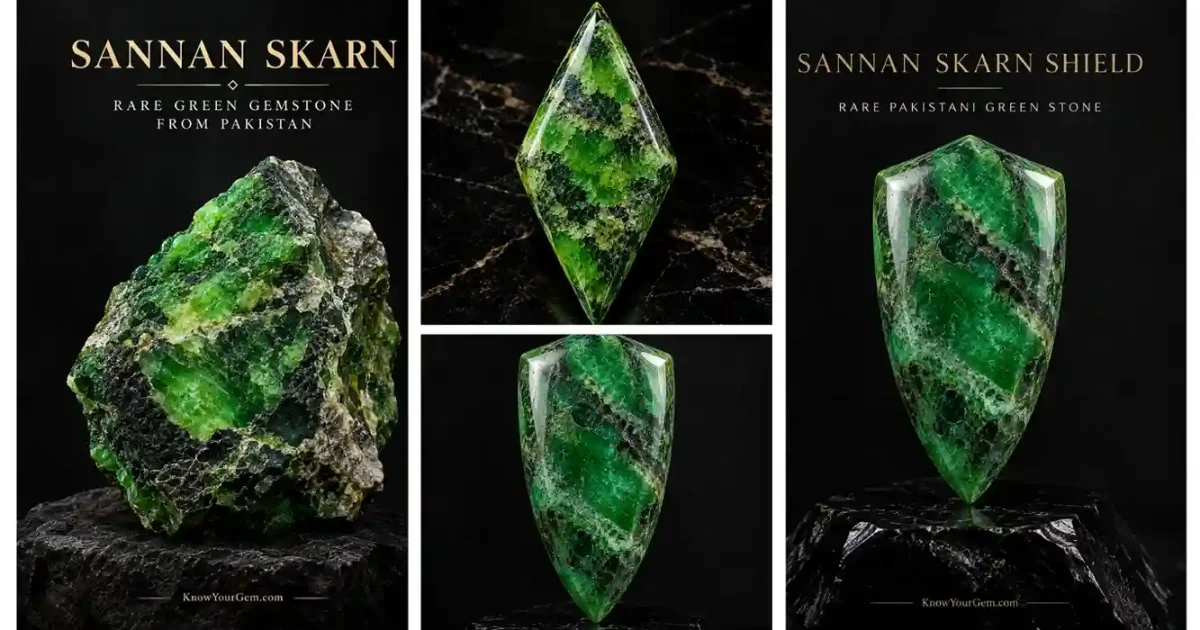

Sannan Skarn is a green ornamental gemstone material from Balochistan, Pakistan. It looks like jade, but it is not jade. It is a fine-grained skarn rock made of several minerals, and it was first sold under the wrong name, Maw Sit Sit.
Quick Answer:
What is Sannan Skarn? A complex, fine-grained green rock from western Pakistan, formed by metasomatism. Researchers recommended “Sannan-Skarn” as its trade name.
Is it jade? No. Jade can be jadeite or nephrite. Sannan Skarn is a combination of hydrogrossular, diopside, aegirine, winchite, pectolite, chlorite, natrolite, and sodalite.
Why is it green? Mainly chromium, according to the published research.
Is the price fixed? No. There is no standard price-per-carat for this material. Value is determined by color, pattern, polish, size, condition, documentation, and finished form.
What Is Sannan Skarn?
Sannan Skarn is a rock, not a single mineral. That one fact explains most of what buyers see in the market.
A mineral has one defined chemistry and crystal structure. A rock is a mixture of minerals. Sannan Skarn is a mixture, so it has no single chemical formula.
The published research from the University of Basel describes it as a complex, fine-grained green rock from western Pakistan. The minerals identified include:
- Hydrogrossular
- Diopside
- Aegirine
- Winchite
- Pectolite
- Chlorite
- Natrolite
- Sodalite
The mix changes strongly over short distances. Two pieces from the same area can have different minerals, different color and different density.
Why the Name Has Two Words:
“Skarn” is the rock type. “Sannan” is a locality modifier. Researchers used it to describe the skarn from this specific new occurrence. So Sannan Skarn means “the skarn from this particular source,” not “any skarn.”
Is Sannan Skarn a Gemstone?:
In a strict sense, it is an ornamental stone ( ornamental rock). It is not a mineral species, such as ruby, emerald, etc.
The trade still treats many rocks as gem materials. Lapis lazuli is a rock. Many jade pieces are rock too. Sannan Skarn belongs in that group.
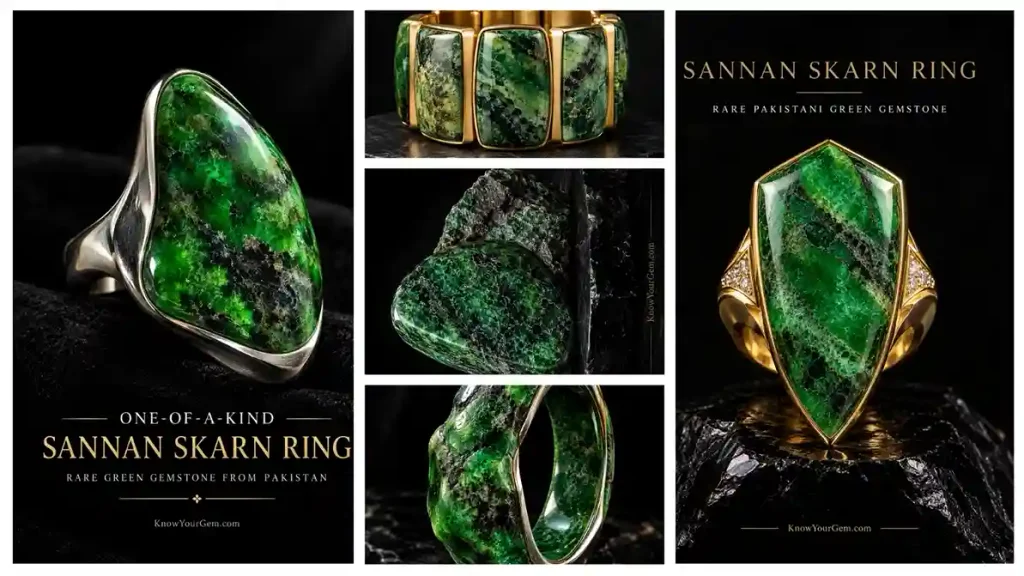
The material is opaque. It takes a polish. The research notes it is suitable for cabochons, spheres, carvings and other jewellery items. Bangles and beads are also made from it.
The 2015 Discovery: How a Wrong Name Led to a New One
This is the best story in the Sannan Skarn history, and it is a useful warning for buyers.
At the Hong Kong Jewellery and Gem Fair in September 2015, a large volume of green rock from western Pakistan was sold to dealers. The sellers called it Maw Sit Sit.
They proved it. The very first tests revealed immediately that it bore no relationship to Maw Sit Sit. Its SG and RI overlapped, and even standard gem testing instruments could easily fool the tester. However, the minerals revealed something else entirely.
Two clues stood out:
- Calcium is a main constituent of the Pakistani material. This is a main difference from Maw Sit Sit.
- Chromium was present in all samples.
The researchers then proposed “Sannan-Skarn” as the correct trade name. They said the material should be identified properly and sold under that name.
The lesson is simple. Similar SG and RI do not prove identity. Overlapping numbers on a basic test can hide a completely different material.
Is Sannan Skarn Jade?
No. Jade is a trade name for two substances: (1) Jadeite is a sodium aluminium pyroxene. (2) Nephrite is an amphibole, chiefly in the tremolite-actinolite series.
Sannan Skarn is not. It is a skarn composed of many minerals, some of which are pyroxenes (such as diopside and aegirine), some of which are amphiboles (such as winchite). But just because a rock contains pyroxene or amphibole doesn‘t mean that it is jade. The mixture, the texture, the geology all matter.
A related Basel study on another Muslim Bagh ornamental rock made the same point for that material. It said such a rock cannot be sold as “a kind of jade.”
So why does it look like jade? Because green, opaque, fine-grained, and polishable is a look many rocks share. Visual resemblance is not mineral identity.
Sannan Skarn vs Maw Sit Sit vs Jadeite vs Nephrite:
| Material type | Skarn rock, many minerals | Complex rock, Myanmar | Mostly jadeite mineral | Mostly tremolite-actinolite |
| Main chemistry clue | Calcium is a main constituent; chromium present | Differs in calcium content from Sannan Skarn | Sodium aluminium silicate | Calcium magnesium iron silicate |
| Locality | Balochistan, Pakistan | Myanmar (Burma) | Myanmar and other sources | Several countries |
| Typical color | Green, gray-green, patchy green, white and gray | Strong green with dark and light patches | Green to many other colors | Green to gray, brown, white |
| Texture | It is usually found fine-grained, often patchy | It is found fine-grained, often patchy | It generally looks Interlocking grains | It has felted, fibrous grains |
| Transparency | Opaque | Opaque | Translucent to opaque | Translucent to opaque |
| SG | Varies, about 2.7 to 3.3 | Overlaps with Sannan Skarn | About 3.3 | About 2.9 to 3.0 |
| Hardness | No single published value | Not one value | About 6.5 to 7 | About 6 to 6.5 |
| How to identify | Thin section, EDXRF, micro-Raman | Same lab methods | Standard gem tests plus spectroscopy | Standard gem tests |
| Typical use | It is used in cabochons, bangles, beads, spheres, carvings | It is used in cabochons, carvings | It is used in Jewelry, carvings, bangles | It is used in carvings, bangles, beads |
| True jade? | No | No | Yes | Yes |
Note on the Maw Sit Sit column: Often called a kosmochlorbearing jade-like rock, the trade is usually very loose with the term. Handle the label carefully.
Where Is Sannan Skarn Found?
Sannan Skarn comes from western Pakistan, in Balochistan.
The Basel research describes the source as a remote area of Balochistan, about 60 km from the Muslim Bagh chromite mine. That is the published reference point. I use it as a general guide only.
Chromium fits that setting. The region is known for chromite and oceanic rock sequences, which are rich in chromium. That helps explain why chromium shows up in the minerals of this rock.
A Note on “Sannan Sharif”:
You may see “Sannan Sharif” in search results. This article does not connect the gemstone to that name. In the published terminology, “Sannan” is a locality modifier chosen by researchers for the skarn.
No authoritative geological reference has led me to link the gemstone to a location called Sannan Sharif. Be wary of any dealer who asserts a specific village or mine connection without documentation.
How Does Sannan Skarn Form?
Skarn is a result of a chemically active fluid interacting with a precursor rock. It has a special name: metasomatism.
Followed in its simple form:
1. A carbonate rock, such as limestone or dolomite, is available.
2. Destroyed and deformed under the action of a tectonic movement.
3. Hot, chemically active fluids flow through the fractured rock.
4. These fluids add certain elements and remove others.
5. Calcium containing silicate minerals recrystallise where carbonate used to be.
6. This forms a skarn.
This is a strong brecciation, mylonitization, and fluid-driven replacement of carbonate by calc-silicates according to the study. The detected minerals are characteristic of metasomatic enrichment that causes skarn mineralisation.
What Is Metasomatism?
Metasomatism is a change in a rock’s chemistry while the rock stays solid. Fluids carry elements in and out. The rock does not melt. It changes slowly, mineral by mineral.
That also explains the patchy look. The fluids did not reach every part equally. Some zones changed fully. Some changed little. The result is a rock with green, gray, and white zones side by side.
What Is Skarn?
Skarn Geology Skarn is a metasomatic replacement product of a parent rock – often a carbonate. The product is typically a group of calc-silicates.
A few terms help here:
* Protolith: Rock as it was before being altered
* Metasomatism: Change through fluids
* Calc silicates: Minerals rich in calcium and silica such as garnet, pyroxene and amphibole
Skarn is not a mineral family. People sometimes write “the skarn group” as if it were like the garnet group. It is not. The minerals in a skarn depend on the original rock, the fluids and the conditions. Two skarns can have very different mineral content.
What Is a Skarn Deposit?
Not all skarns are ore deposits. When a skarn contains a good amount of economic minerals, it becomes a skarn deposit. That usually involves hot fluids from an intrusive rock meeting carbonate host rock. Metals then collect in the altered zone.
Sannan Skarn is valued as an ornamental material. It is a skarn, not a metal ore deposit. I am not aware of any source that classes it as an economic skarn deposit.
Types of Skarn Deposits:
Geoscience Canada discusses seven major economic skarn classes:
- Iron skarns
- Tungsten skarns
- Gold skarns
- Copper skarns
- Zinc skarns
- Molybdenum skarns
- Tin skarns
Skarns are also described as calcic or magnesian, depending on the type of carbonate host rock. Calcic skarns form in limestone. Magnesian skarns form in dolomite-rich rock. This is background geology. It does not decide the quality of a Sannan Skarn bangle.
What Minerals Are in Sannan Skarn?
The published work identifies these minerals. Their roles in the rock differ from sample to sample.
| Hydrogrossular | Garnet-group component |
| Diopside | Pyroxene |
| Aegirine | Sodium-iron pyroxene |
| Winchite | Amphibole |
| Pectolite | Calc-silicate |
| Chlorite | Sheet silicate, often an alteration product |
| Natrolite | Zeolite |
| Sodalite | Feldspathoid |
| Calcite | Carbonate |
The researchers described three sample types:
- A calcite-chlorite-hydrogrossular-diopside skarn
- A chlorite-pectolite-aegirine skarn
- An aegirine-natrolite-winchite skarn with sodalitic parts
Two examples from the research show how much it changes. One sample was medium green with a light green margin. Another had a patchy texture with green, dark grayish-green and whitish areas.
That is why I tell buyers not to expect two identical pieces.
Why Is Sannan Skarn Green?
The main cause is chromium. The Basel researchers state that the green color is due to chromium present in most of the constituent minerals.
Other minerals also contain iron. Aegirine – A mineral that contains iron, and the study states, “It shows very strong pleochroism from bright green to yellow-green under the microscope.”
The colour will also vary as the mineral mix does, which means you may experience:
- Dark green
- Medium green
- Gray-green
- Light green
- Patchy green, white and gray
Color is not one uniform thing here. A piece can be bright in one zone and dull in the next.
Sannan Skarn Gemological Properties:
| Material type | Skarn rock, many minerals |
| Chemistry | No single formula |
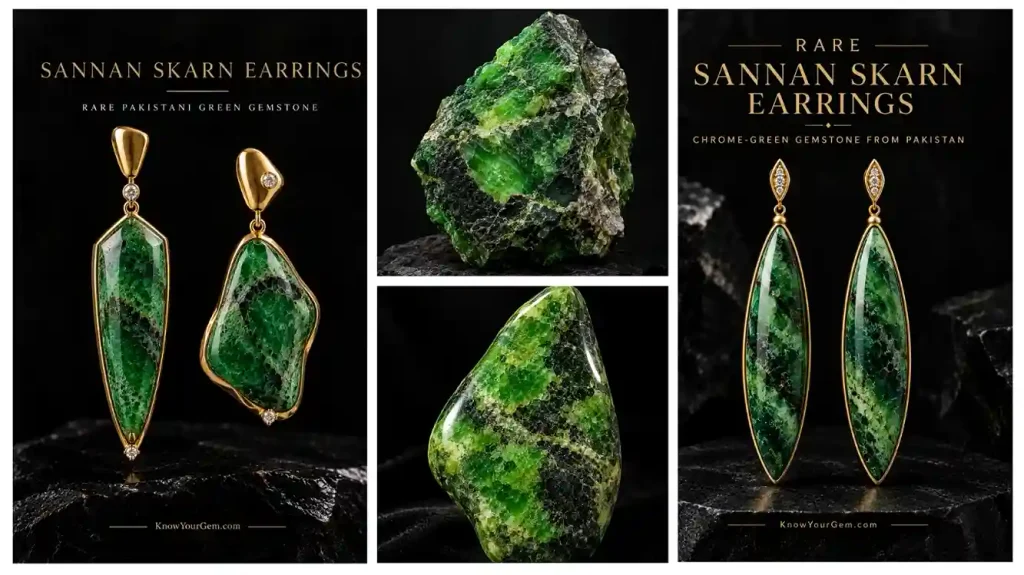
| Color | Green, gray-green, patchy green, white and gray |
| Transparency | Opaque |
| Luster | Depends on the polish and the mineral mix |
| Texture | Fine-grained, often patchy |
| SG | Varies with the sample |
| Refractive index | Overlaps with other green materials; not a reliable identifier |
| Hardness | No single published Mohs value; depends on the constituent minerals |
| Typical cuts | Cabochons, beads, spheres, carvings, bangles |
Why There Is No Single SG?
Published samples gave SG values of about 2.67 and 2.98. A third sample was reported near 3.26. SSEF reports a broader range of about 2.7 to 3.3 g/cm³. The spread comes from the changing mineral mix.
If a seller gives you one exact SG as proof of identity, ask what sample it came from. One number cannot describe the whole rock.
What About Hardness?
No reliable Mohs figure for Sannan Skarn, and I will not make one up. Each mineral in the piece has its own hardness. The final piece acts according to the mix, grain bonding, and any fractures. If hardness matters to you, ask for lab data on that piece.
How to Identify Sannan Skarn?
Identification works on three levels. Each level gives you less certainty than the next.
1. Visual Examination
You can see color, pattern, opacity and polish. This tells you the piece is a green opaque ornamental material. It does not tell you which one.
2. Classical Gemological Testing:
SG and RI help narrow the field. But as the 2015 story shows, they can overlap with other green materials. The Basel researchers specifically said SG and RI may show overlapping data with Maw Sit Sit.
3. Advanced Laboratory Methods
This is where identification becomes reliable. The researchers named three routes:
* Polarized-light microscopy of thin sections: Reveals the minerals and their textures
* EDXRF: Tests for calcium, which is a key difference from Maw Sit Sit.
* Micro-Raman spectroscopy: The detection of aegirine, winchite, hydrogrossular and other minerals
A thin section needs a small slice of the material. That is a destructive step, so it is better suited to rough or sacrificial samples than to a finished bangle. Micro-Raman and EDXRF are better for finished pieces.
Can You Identify It at Home?
Not with certainty. For you are in at home, you are able to gaze at color, texture, polish, and pattern. Can you look for chips and cracks ? It helps with quality, but it doesn’t support the identity.
You cannot reliably prove these at home:
- The exact mineral mix
- The origin
- Whether it is Sannan Skarn or a similar green rock
- Whether it has been dyed or treated
If the purchase matters, use a laboratory.
My Experience With Sannan Skarn:
I have bought and sold this material myself.
A mining company in Balochistan told me they had more than 100 grams of Sannan Skarn available at a suitable price. I went there in person and inspected the stone with my own eyes. I bought 90 grams. I then had the specimens cut and polished, and sold them. I had a good experience.
Looking at the material at its source showed me just what a lot a buyer receives when they lay eyes on it. A photo can’t reveal a thin crack or the hue variations of a piece.
I also saw that demand for this stone is growing in the market. Prices vary, and they depend on the factors I describe below. I am not publishing a price list because I do not think one honest number exists.
The Biggest Buyer Misconception:
What people believe?
“If it is green and looks like jade, it must be jade or a kind of Maw Sit Sit.”
What is actually true?
Sannan Skarn is a skarn rock with its own mineralogy. It is not jadeite. It is not nephrite. It is not Maw Sit Sit.
Why it matters when buying?
By labeling it “jade” or “Maw Sit Sit,” untrusted sellers suggest these names sound exotic and expensive. A buyer may then pay a price based on the wrong material. The 2015 case shows how large volumes were sold under the wrong name.
Sannan Skarn is a fine ornamental material in its own right. It does not need a borrowed name. A seller who sells it honestly under its own name is a better sign than one who promises “Pakistani jade.”
Sannan Skarn Value and Price:
What Affects Value?
There is no fixed price list. These factors matter:
Color
Vibrant, eye-catching greens are usually more popular. Not-so-bright or dull gray-green products will not get much attention.
Pattern
Natural patterns can add collector appeal. Some buyers like even color. Others like patchy contrast.
Quality:
Observe polish, condition of surface and condition of structure. Cracks take away from beauty and strength.
Size:
Large, clean pieces for a bangle or carving are more difficult to obtain than small cab material.
Craftsmanship:
A finished, well-cut bangle is priced differently from rough rock.
Documentation:
A piece with clear origin papers and lab identification gives the buyer more confidence. Confidence has market value.
How Much Does Sannan Skarn Cost?
I cannot give you a fair price-per-carat figure. There is no widely accepted benchmark for this material like the ones that exist for ruby or sapphire.
The price changes at each stage:
- Rough material: priced by weight and visible quality
- Cut cabochon or bead: priced by color, polish and yield
- Bangle or carving: priced by size, finish and labor
- Designer jewelry: priced by design, metal, setting and brand
Compare like with like. A rough price and a finished bangle price are two different things.
Is Sannan Skarn Rare?
It has a limited known source, and the published occurrence is a single remote area of Balochistan. That supports calling it geographically limited.
But “limited source” is not the same as “rare as jade.” I would avoid that comparison, and I would avoid “investment” language too. Market awareness is still growing, and I have seen demand increase. That is a market observation from my own experience, not a guarantee of future value.
Sannan Skarn Bangles and Jewelry:
How Is It Cut and Used?
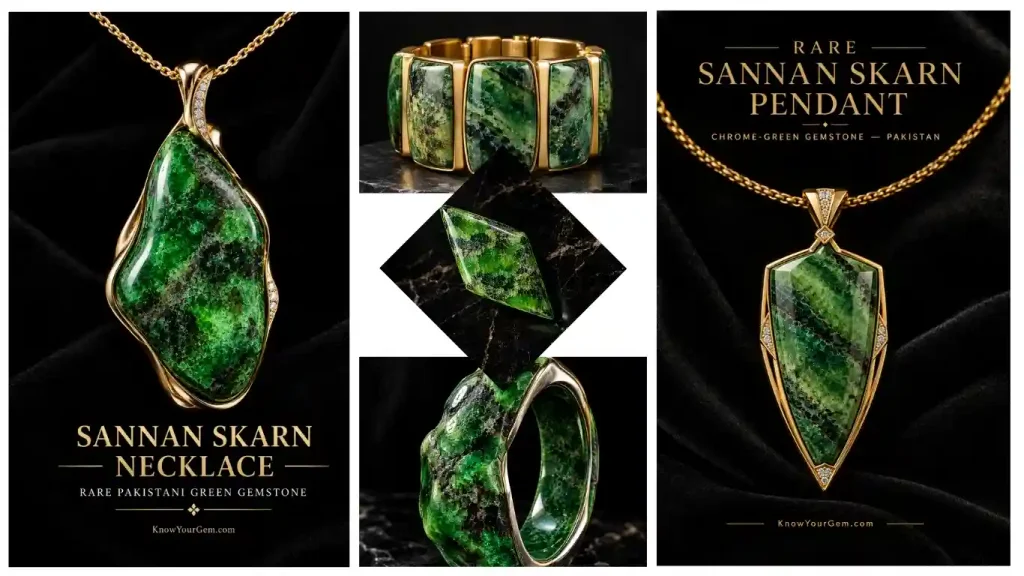
The article explains the opaque material is suitable for cabochons, spheres, carvings, and other jewellery pieces. In real life, you will also see:
- Cabochons
- Beads
- Spheres
- Pendants
- Rings
- Bangles
- Decorative objects
What Makes a Sannan Skarn Bangle Special?
An opaque green material works well in a bangle. The color can run through the whole circle. Natural patches can give each bangle a personal look.
A Sannan Skarn bangle is not a jade bangle. They can look similar from far away. How they are mineralized, how they are marked, and how you should buy them are different.
Check these points before you buy:
Fractures:
Run your eye to and fro on the entire circle, inside and outside. Tiny cracks frequently begin at thin places.
Pattern continuity:
Must check that the patches do not conceal a repair or a joint.
Polish:
Must ensure that the surface is smooth, without ridges or lumps.
Provenance:
Always ask where the material came from and who can confirm it.
Identification:
Must inquire whether the material has been verified by the lab.
Is It Good for Everyday Jewelry?
It depends on what the piece is and how you wear it.
The mixture of minerals is different, so I will not claim the strength level of the jade. I also will not claim a numeric durability rating that no source offers.
Some practical points:
* Bangles bang against tables and doors.
* Rings are more subject to impact and abrasion than any other form of jewelry.
* Protective settings are safer for cabochons than exposed edges.
* Pendants and earrings can generally withstand less stress.
If you intend to wear an item daily, opt for a good, well-made, and finely finished piece and treat it with respect.
Sannan Skarn Care and Cleaning:
Be conservative, because the material is compositionally variable:
* Use warm water, a small amount of soap and a soft cloth.
* Skip the chemicals.
* Consult with a professional before using ultrasonic and steam cleaners. They may not be safe for that item.
* Hard hits are to be avoided.
* Keep it in a separate place away from other pieces which might scratch it or be scratched by it.
Sannan Skarn vs Other Green Gemstones:
| Jadeite | Mineral-based rock | Green to many colors, translucent to opaque | True jade; different chemistry |
| Nephrite | It is a mineral-based rock | Its displays Green, gray, brown; fibrous texture | It is a true jade; amphibole |
| Maw Sit Sit | Complex rock | Strong green with dark patches | Different mineralogy and calcium content |
| Aventurine quartz | Quartz | Green with sparkle from mica | Quartz, usually with visible flakes |
| Serpentine | Mineral group | Soft green, often waxy | Softer and chemically different |
| Malachite | Copper carbonate | Banded vivid green | Distinct banding; softer |
| Chrysoprase | Chalcedony | Apple green, translucent | Quartz family |
| Green grossular | Garnet | Green, can be translucent | Single mineral species |
Note that hydrogrossular a garnet-group mineral is present at Sannan Skarn. But the entire rock is not “green grossular”. It has a lot more.
Is Sannan Skarn a Type of Jade?
No. It looks like jade, but it is not actually jadeite or nephrite mineralogically.
Metaphysical and Zodiac Beliefs:
Some people think the green stones refer to zodiac signs or have healing properties. They are cultural beliefs. There is no science to support this, and I will not tell you they do. Have fun with tradition if it’s important to you. Don’t pay extra.
Sannan Skarn Buyer Checklist:
Ask the seller these questions before you pay:
- Is this really Sannan Skarn?
- What is the source, and can you show documents?
- Do you have a license?
- Has a laboratory identified the material?
- Is it treated or dyed?
- Are there any cracks or repairs?
- Is the polish even?
- Is there the use of “rare as jade” or “investment value”? if yes, beware!
- Is the price for rough, cut or finished jewelry?
First-time buyers are selecting by color and making quick decisions. Old hands ask these questions first. Do the same.
Frequently Asked Questions:
1. What is Sannan Skarn?
A green, fine-grained, ornamental rock from western Pakistan. It is a type of rock called a skarn composed of various minerals, not a single mineral.
2. Is Sannan Skarn jade?
No. It isn’t jadeite or nephrite. It just looks like jade.
3. Is Sannan Skarn a gemstone?
It is a gemstone material made of many different mineral species.
4. Where is Sannan Skarn found?
In Balochistan, western Pakistan. The published research describes a remote area.
5. What is the difference between Sannan Skarn and Maw Sit Sit?
Mineralogy. They are mineralogically different. Sannan Skarn has calcium among the main constituents. They may have similar SG and RI.
6. How is Sannan Skarn identified?
By thin-section microscopy, EDXRF for calcium, or micro-Raman spectroscopy for the minerals.
7. What is Sannan Skarn worth?
There is no set price. The value varies depending on color, pattern, polish, size, craftsmanship, and accompanying documentation.
8. Is Sannan Skarn durable?
It depends on the piece. I cannot give one durability rating. Check for cracks and wear it with care.
This content is well researched and published by gemstone expert and enthusiast,[kamilHussain]

Welcome to KnowYourGem.com! your ultimate destination for uncovering the fascinating world of gems and their secrets! I'm Kamil Hussain, a passionate blogger with a Master’s degree in Economics, dedicated to bringing you insightful, well researched content that blends the beauty of gemstones with the art of storytelling. With a keen analytical mind and a love for discovering hidden treasures, I created this platform to help you explore the brilliance, history, and value of every gem.


[…] the material is metamict (amberised) due to alteration of the crystal structure by radiation. Colour is not an indication of the safety of the material – it’s the actual radiation, not what […]