
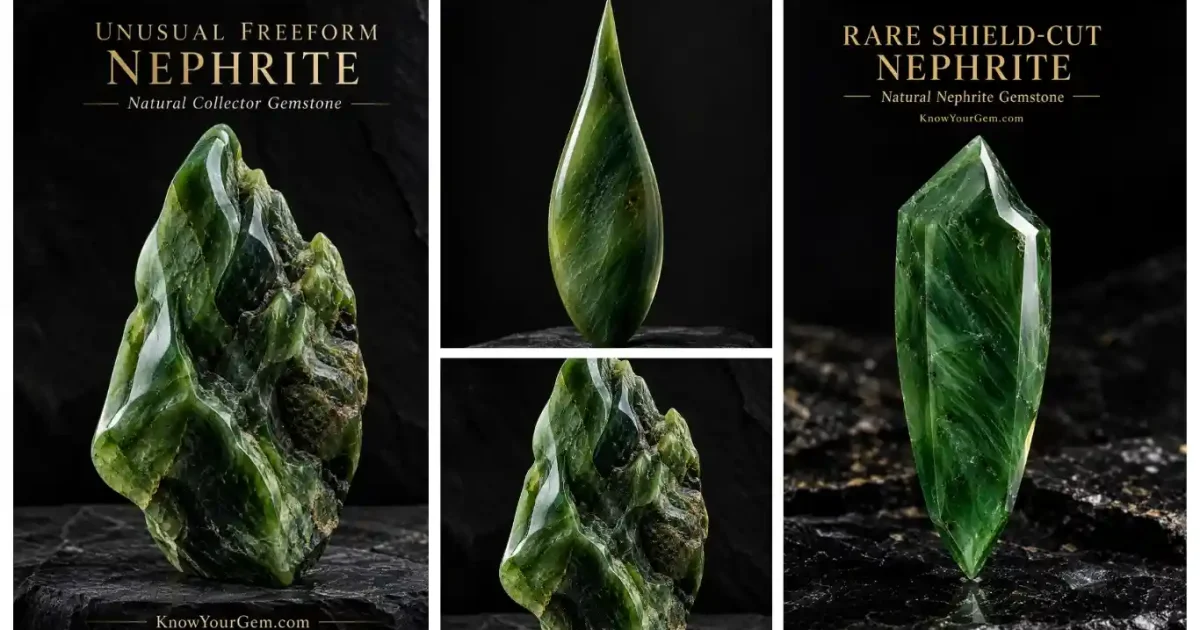

Nephrite Gemstone: What It Actually Is, Why It Matters, and How It Differs from Jadeite
The other half of the specimens sold as jade is nephrite. The structure of nephrite is a translucent, almost greasy, organic look, fine-grained, profusely interlocking fiber of tremolite, or actinolite.
Usually the specimens are some shade of green, white, cream, grey, brown, or black. It weighs about a 6-6.5 on the Mohs scale for hardness, but that was about expected; rather, the toughness of nephrite is perfectly extraordinary.
Carvers have used it for thousands of years because it polishes well and doesn’t break if you drop it. This continues to be the reason it shows up in bangles, beads, and carvings all over the globe and why it has become so popular to imitate and produce high numbers of fakes over the years.
The Short Version About Nephrite gemstone:
Nephrite gemstone is a calcium-magnesium-iron silicate built from a dense mat of amphibole fibers. It’s one of the two true jades (jadeite is the other). It can be translucent or opaque, rates about 6–6.5 on Mohs, and resists breakage better than almost anything else in the gem world.
What Nephrite Gemstone Really Is?
It’s a rock, not a single crystal. Slice a thin piece and put it under a microscope and you’ll see a felted tangle of tiny tremolite and actinolite fibers like wool, only stone. That structure is exactly why a solid chunk is so hard to break.
People ceased calling “nephrite” a species name in 1975. In fact, the two minerals are simply tremolite and actinolite. The trade didn‘t mind, and continued to use nephrite, which is however still the valid name for the rock.
Color follows chemistry. Pure tremolite is white. Add iron and you get actinolite, which is green. More iron means darker color, until the stuff turns black.
Here’s the part that throws most people off. “Jade” refers to two completely different stones.’ Nephrite is an amphibole. Jadeite is a member of the pyroxene group.
While visually similar at first glance, they are similar in chemistry, density, texture, and Pricing. If a seller simply says “jade” without giving you a specific type, that hasn’t fully addressed the matter.
Nephrite gemstone is metamorphic. Studies of the Xinjiang deposits put the classic Hetian material at around 400 million years old. Other types in the same region formed later. Is it a gemstone? Yes. It isn’t a crystal in the everyday sense. It’s a mass of microscopic fibers, and the trade has treated it as one for a very long time.
Properties Of Nephrite Gemstone:
Most people compare it straight to jadeite, so here’s the practical difference:
| Mineral group | Amphibole (tremolite-actinolite) | Pyroxene |
| Scales are | About 6–6.5 | About 6.5–7 |
| Specific gravities are | About 2.90–3.10 | About 3.24–3.43 |
| Refractive indexes are | About 1.606–1.632 | About 1.654–1.693 |
| Structures are | Fine, felted fibers | Granular, interlocking grains |
| Lusters are | Oily to waxy | Often glassier |
| Toughnesses are | Exceptional | Very high, but lower than nephrite |
| Typical colors are | Green, white, gray, yellow, brown, black | Green plus lavender, red, pink, black |
Models vary to a slight degree depending on where you look for data, and iron content can artificially increase these. Black nephrite from Guangxi has recorded refractive indices to ca.
1.65 and specific gravity to just under 3.4- this is well outside the normal range there is so much iron present! Use the table as a reference-guide then have the lab report to hand for the stone in your hand.
Most websites never bother mentioning refractive index or specific gravity. That’s a shame. Those two numbers are among the fastest ways to separate real nephrite from the junk sold in its place.
Hardness vs Toughness About Nephrite Gemstone:
They are confused all the time, and it costs them money. Hardness is how well a mineral resists scratching. Nephrite’s 6-6.5 is only very good.
Toughness is how well a mineral resists breaking, and nephrite has it in spades: the abraded, matted fibers absorb the blows and prevent a crack from propagating. Jadeite is a little harder but not anywhere near as tough.
Next in hardness after sapphire (Mohs 9) is nephrite gemstone, which scratches quite easily. With everyday quartz dust (7) finished surface can be dulled by long, slow wearing.
They are good for opposite things – sapphire on scratch resistance, nephrite for not breaking. Sapphires chip and fracture for no reason, nephrites nourish blows and knocks which will break all but the strongest stones.
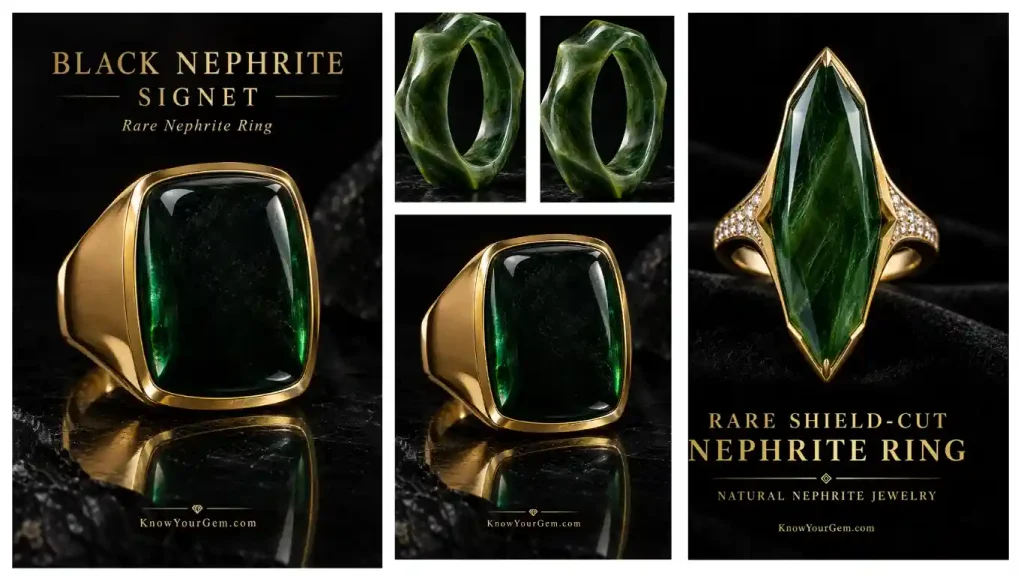
That makes bangles, beads, pendants and carvings just right. Daily wear rings are less suitable, so keep away the polish through rubbing. So think about them as occasion-only jewellery and, if possible, go for a bezel setting.
Nephrite Gemstone Response In Light, Luster and Feel:
Nephrite gemstone is translucent to opaque. The fine white “mutton fat” material glows at the edges. The dark green and black may appear to be opaque, but a thin slice viewed against strong light reveals green.
The texture is a lot more important than many think. Fine, even grained packings reflect light evenly and give the fact that soft oily looking sheen. Coarser or patchy grain appears to be flat and streaky. Two stones of the same color can actually feel totally different in your hand.
Luster is another clue. Polished nephrite tends toward oily or waxy. Jadeite often looks glassier. It’s a hint, not a final test.
Colors:
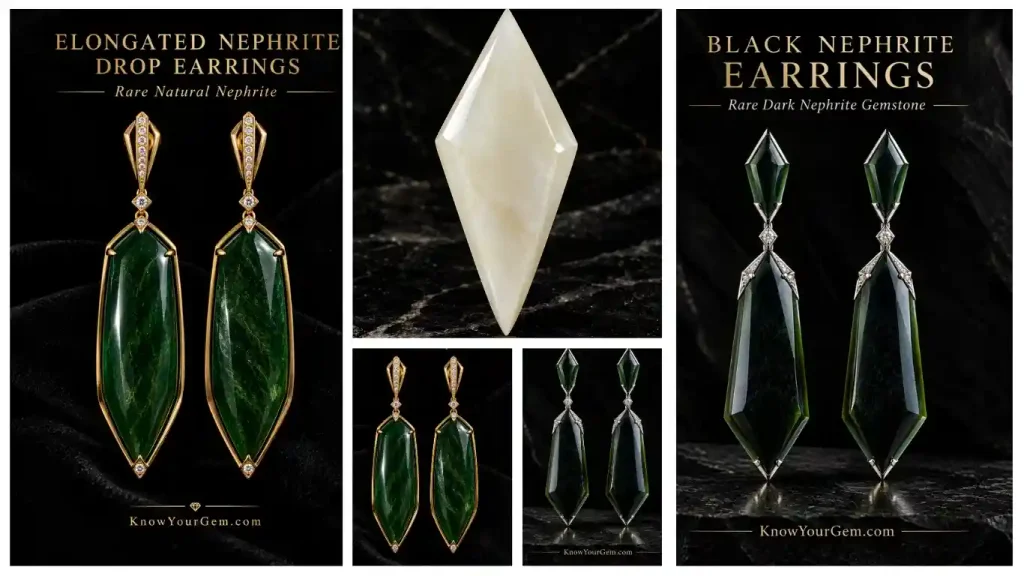
Green color of Nephrite gemstone is the classic range-pale to very dark-mostly from iron. Some British Columbia material gets an intense emerald green from chromium. White nephrite gemstone, especially the translucent white to pale yellow “mutton fat,” is the traditional Hetian ideal.
The opaque version, “chicken bone,” runs white to pale brown or gray. Black colored Nephrite gemstone is really just very dark green from high iron. Yellow, brown, and gray turn up less often. Dealers also call dark grayish green “spinach jade.”
Brown is often iron staining. Some dealers bleach it out, which leads straight into treatments. Ancient burial pieces show something different: the bony white-to-ochre skin on “tomb jade” comes from burial conditions, not the original color. Color is the easiest thing to judge and the easiest to fake. Remember that.
Sources:
| China (Xinjiang, Qinghai) | Historic source. Hetian and nearby areas produce the prized white “mutton fat.” |
| Russia (Siberia) | Major supplier of green nephrite in volume. |
| Canada (British Columbia) | Stone from this origin have display color like dark to bright green, often with black inclusions (Polar Jade is one well-known type). |
| New Zealand | Stones from this origin display colors like pounamu / greenstone from the South Island. Ownership is regulated. |
| Taiwan | Historic source; mining has largely stopped. |
| Others | Australia, USA, Poland, South Korea. Some reports of material from Pakistan’s Karakoram, though documentation is thinner. |
Dealers talk about tendencies: Hetian linked to warm cream and butter tones with “mutton fat” at the top; British Columbia deep green with black specks; Siberian dark green to black, sometimes veined white.
These are tendencies only. One deposit produces many looks, and a skilled seller can find a Siberian piece that passes for Canadian. Origin is one clue among several. If it’s important to you, put it in writing. Nephrite gemstone won’t be able to tell you where it was picked up.
A lot of the green nephrite moving through China actually comes from British Columbia and Siberia. Naming can get blurry. If something is labeled “Hetian,” ask what that claim rests on.
How Rare Nephrite gemstone Is?
Depends what you mean. Nephrite gemstone is far more common than jadeite. Gem-quality material is different. Only a few places produce it, and fine, even, translucent stone with clean color is much scarcer than ordinary rough. The rock itself isn’t rare. The best of it is. “Rare” alone never justifies a price.
Treatments Status about Nephrite gemstone:
Some of the treatments applied to nephrite gemstone are waxing, bleaching, impregnation of polymer, heating, and dyeing. Also, the letter grades applied to jadeite are reserved in most of the trades:
- Type A: untreated (or just a light wax)
- Type B: bleached and polymer-filled
- Type C: dyed
- Type B+C: Avoid bleached, polymer, and dye
Bleach can bleach out brown iron stain, but it can also weaken the stone and so it is often followed by the insertion of polymer. A Type B piece can end up more fragile than it looks.
Opinions differ on how common these treatments are. Some say nephrite is rarely dyed because of its dense structure and that the work is mostly done on jadeite.
There are, however, other reports, such as dyed nephrite gemstone, particularly green and black (Palmer et al, 1994). In this instance, the solution to that problem is also simple: Ask every time and ensure you get the answer in writing.
Nephrite gemstone Look-Alikes:
Serpentine is by far the most find-flake/miss-flake softer, with a specific gravity of about 2.5 2.6, thus feeling lighter. Vesuvianite can be tricky due to its greasy luster! Dyed marble gets sold as “mountain jade” near 2.7 specific gravity.
Chrysoprase and amazonite are green but different materials. Glass gives itself away by weight and wear. Jadeite is real jade, it isn’t only nephrite, and it is priced differently.
The one way to estimate whether an object is too light for its size is to determine its specific gravity before purchasing.Jadeite usually appears granular and exhibits brighter zoning and glassier translucency.
Nephrite appears more felted and shows slablike even body color and a waxier depth. Those are field clues only. Lab is what settles it. Color alone proves nothing-dye and imitations can, too.
Checking a Piece:
- Even body color and a silky, felted texture.
- Oily or waxy luster; thin edges may glow.
- Feels dense but lighter than jadeite.
- The stone has a specific gravity of 2.90–3.10 (jadeite is higher, serpentine lower).
- Its refractive index is usually near 1.61.
- Magnification for fibrous texture and any signs of filling or dye.
- Lab report (Raman or infrared) when the money matters.
A photo can’t identify nephrite. It can only suggest possibilities. It won’t prove identity, treatment, or origin.
Nephrite gemstone Working With:
Nephrite gemstone doesn’t chip the way brittle gems do. The felted structure holds together while it’s shaped, which is why carvers have liked it for so long. It also takes that oily-to-waxy polish people expect.
The same toughness makes it slow work. Trouble can conceal stress cracks that only appear once cutting begins. Thus, check pieces thoroughly up front.
Yes, dust is a problem. Any of the tremolite-actinolite series contain asbestosis formes, so always cut wet and use the correct protection.
Nephrite gemstone Jewelry and Uses:
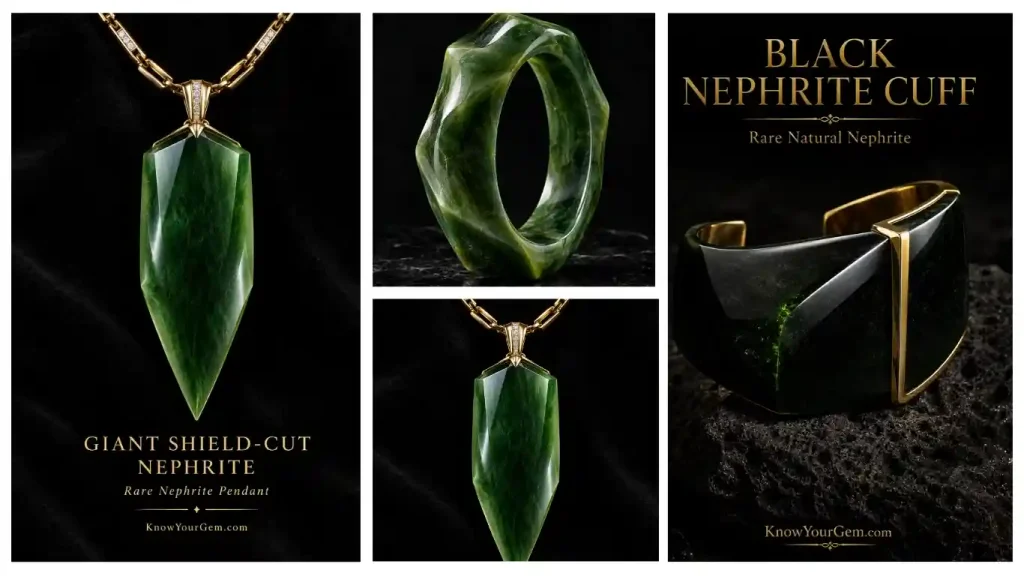
Bangles, bracelets, beads, necklaces, pendants, cabochons, sometimes rings, carvings and Carvings and ornaments. Most of the green nephrite bangles in the Chinese market derived from British Columbia and Siberia.
They will exploit the hardness, but monitor for fine cracks in the thinnest regions. Search for uniform pigmentation and consistency – try to hold a strand up to the light for translucency.
Beads- best all around, best general use; uniform color and way to compare translucency (hold to light). Cabochons- texture, luster over 100% cut stone, off-shape stone. Carving- look inside the grooves no flat lines. Ring- piece to have- use a bezel if you want to wear it a lot.
Care For Nephrite Gemstone:
Use warm water, gentle soap, soft cloth, and avoid Acidic and bleaching agents that are not recommended. Avoid high temperature and solvents for polymer-treated product ultrasonic cleaning machines are not suitable for products that have undergone polymer processing.
What Actually Drives Nephrite Gemstone’s Value?
There is no market figure for price per carat. Anyone quoting one is losing too much accuracy. Material sells by weight, piece, or finished. The quality is too variable.
There is no market figure for price per carat. Anyone quoting one is losing too much accuracy. Material sells by weight, piece, or finished. The quality is too variable.
Don’t judge by color alone. Texture, treatment, luster, specific gravity, and paperwork all matter. Experienced buyers check the whole list. Beginners often stop at color and overpay.
In the Chinese market, origin carries weight, but a lot of the green material is still from British Columbia and Siberia. Xinjiang origin has its own premium. Quality and marketing both play a role.
Rough Nephrite Gemstone, Wholesale, Finished:
Rough is rated according to color, texture, cracks, size, and anticipated yield. Check the skin and any cut windows to see if the interior reflects the surface.
Wholesale lots are combinations of several stones; the average quality is more significant than the top quality presented. Importance is given to the quality of the carving along with the stone in finished work.
A strong carving in ordinary material can outprice a plain piece of better stone. Always ask for lab checks and origin documents before talking serious money.
The Most Common Mistake:
Thinking a “nice” green is truly enough. It is not. Color is the most noticeable thing, and the one that you should find to be the most misleading. Two stones the same shade can differ completely in texture, treatment and identity. Paying for color alone means paying for the one thing dye can copy.
Myths Worth Dropping:
- “All jade is jadeite.” No. Nephrite gemstone is jade too, and the older material in Chinese tradition.
- “Nephrite is cheap jade.” Common stone is modest. Fine material isn’t.
- “The greenest is best.” Strong green can be dye or a look-alike. Texture and evenness matter more.
- “Heavier means real.” Weight is a clue only. Jadeite is denser. Measure specific gravity properly.
- “Only Hetian is real.” False. Documented deposits exist in several countries.
Questions Worth Asking:
- What is this stone exactly called?
- Is it natural, or dyed serpentine, glass? Any lab-grown claim needs paperwork.
- Is this stone Nephrite or jadeite?
- What is its ethical Origin, and will it be in writing?
- How about its treatment status? (wax, bleach, polymer, dye)?
- Is this stone contain perfect clarity, inclusions or cracks?
- What is its specific gravity and refractive index?
- What documentation, and from which lab?
- Does the seller have any return policy?
Check the answers for the stone in front of you. If a seller refuses to answer any of the above, he is certainly trying to tell you something.
Meaning:
In Chinese tradition, the meaning of jade is morality, nobility, and long life. Among different colors of nephrite, scholars were more interested in white nephrite. Pounamu was treasured in the viewpoint of Maori.
This is a kind of cultural meaning. No quantifiable property is measured by these meanings. The scientific reports suggest that nephrite would not have an effect on curing the illness or alter health. Therefore, purchase is for appearance and wears.
1. Is nephrite a gemstone?
Yes. One of the two jades.
2. Is nephrite the same as jade?
It is one kind of jade. Jadeite is the other.
3. Is nephrite jade rare?
Common material isn’t. Fine gem-quality is.
4. Is nephrite expensive?
Depends on quality. Common is modest; fine is not.
5. How hard is nephrite?
About 6–6.5, exceptional toughness.
6. Is nephrite translucent?
Ranges from translucent to opaque. Fine white can glow at edges.
7. What colors does nephrite come in?
Green, white, gray, yellow, brown, black.
8. Where is nephrite found?
China, Russia, Canada, New Zealand, Taiwan, Australia, USA, Poland, South Korea and a few others.
9. How can you tell if nephrite is real?
Specific gravity, luster, texture, then a lab report. Photos aren’t proof.
10. Is black nephrite real?
Yes. High-iron material. Dyed versions exist too.
11. What is the difference between nephrite and jadeite?
Nephrite is the tough amphibole with felted texture and lower density. Jadeite is the denser pyroxene with granular texture.
12. Can nephrite be used in jewelry?
Yes. Especially bangles, beads and pendants. Rings for occasional wear.
Sources:
- Wikipedia, “Nephrite” (property ranges drawn from GIA): https://en.wikipedia.org/wiki/Nephrite
- Penn Museum Expedition, “Jade”: https://www.penn.museum/sites/expedition/jade/
The content is written and published by gemstone expert and enthusiast KamilHussain!

Welcome to KnowYourGem.com! your ultimate destination for uncovering the fascinating world of gems and their secrets! I'm Kamil Hussain, a passionate blogger with a Master’s degree in Economics, dedicated to bringing you insightful, well researched content that blends the beauty of gemstones with the art of storytelling. With a keen analytical mind and a love for discovering hidden treasures, I created this platform to help you explore the brilliance, history, and value of every gem.


[…] colourless, white, and occasionally pale yellow or brown. Transparent ones appear watery. Opaque ones appear milky or silky. Tints usually result from inclusions of clay or minerals with the […]
[…] Sannan Skarn is a combination of hydrogrossular, diopside, aegirine, winchite, pectolite, chlorite, natrolite, and […]