
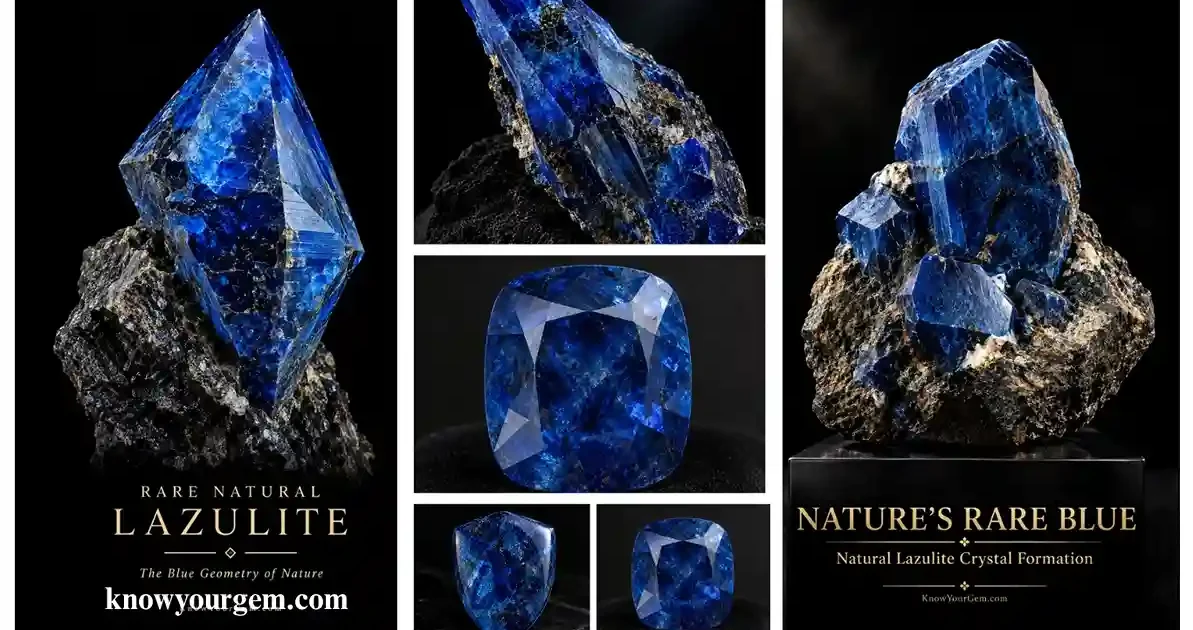

Lazulite gemstone is a blue phosphate mineral with the chemical formula (Mg, Fe²⁺)Al₂(PO₄)₂(OH)₂. Although its name is similar, it is different from lazurite and lapis lazuli.
Quick Answer:
Lazulite gemstone is a Blue Magnesium, iron, and aluminium phosphate mineral. Usually Azure and sky blue to bluish white and occasionally a blue-green.
Cut lazulite is quite a rare stone as material suitable for faceting is impossible to find. Pricing of lazulite is also dependent on whether it is found as a crystal on matrix, rough, cabochon, or faceted stone.
| Mineral class | Phosphate |
| Composition | (Mg,Fe²⁺)Al₂(PO₄)₂(OH)₂ |
| Crystal structure | Monoclinic |
| Color | Azure, sky blue, bluish white, blue-green, rarely green |
| Mohs scale | 5.5 to 6 |
| Specific gravity is | About 3.1 to 3.2 (sources differ) |
| Refractive index is | 1.604 to 1.663 (depends on direction) |
| The stone | transparent to semi-opaque |
What Is Lazulite Gemstone? Mineral Identity and Origin
Lazulite Gemstone Classification and Chemical Composition:
Lazulite is a phosphate mineral with magnesium, iron, aluminium, phosphate, and hydroxyl in its composition.
Lazulite exhibits a solid solution series with scorzalite. Scorzalite, the iron-rich endmember, is often a darker color. If you are purchasing, color and properties can vary from specimen to specimen, because one blue stone is not always exactly the same as another blue stone.
Lazulite Is Not Lazurite:
Here’s where many buyers go wrong, so I want to get this straight off the bat.
1. Lazulite is a phosphate mineral. It is monoclinic. The hardness is 5.5-6.
2. Lazurite is a tectosilicate mineral, a member of the sodalite group. It is isometric. The mineral’s hardness on Mohs’ scale is 5 to 5.5, whereas its specific gravity (density) is only about 2.4.
3. Lapis lazuli is a rock. Its main blue mineral is lazurite.
So they are different minerals with different chemistry and different density. They only share blue color and a similar name. Both names come from old words for “blue stone” or “azure.” That is why the confusion started.
How Lazulite Gemstone Forms?
Lazulite gemstone forms in high-grade metamorphic rocks that are rich in silica. It also forms in pegmatites. It is usually a small and local mineral. That is why most fine lazulite goes to collectors as crystals and specimens, and not into jewelry.
Where Lazulite Gemstone Is Found?
The type locality is Freßnitzgraben in Krieglach, Austria. Lazulite is also found in Salzburg (Austria), Zermatt (Switzerland), Minas Gerais (Brazil), Lincoln County in Georgia (USA), Inyo County in California (USA), the Yukon in Canada and other places.
Lazulite Gemstone in Canada: The Yukon
The best-known Canadian source is the Rapid Creek area in northern Yukon, in the Dawson mining district. Mindat gives the history, citing Grice (1989).
In 1959 a geologist working for Triad Oil Company collected blue, water-worn mineral chips in the Blow River area of northeastern Yukon. They were identified as lazulite. About fifteen years later, a prospector looking for iron found the lazulite source along Rapid Creek.
Rapid Creek lazulite is mainly known as mineral specimens. It is not a common source of faceted stones.
Is Lazulite a Gemstone or a Collector’s Mineral?
It is both, but it is more a collector’s mineral. Lazulite gemstone can be cut and polished. But clean, transparent material in a cuttable size is hard to find. Most lazulite in the market is crystal on matrix or rough pieces for collectors. Faceted lazulite exists, but it is rare.
Lazulite Gemstone Properties:
Lazulite Gemstone Color: Blue, Blue-Green and Greenish Specimens:
The normal color is azure or sky blue. Some specimens are bluish white or blue-green. Green is rare. The more iron, the darker the color. Therefore, the presence of more iron makes the material darker.
That is where scorzalite is used. So be cautious if a seller states “green lazulite”. If it’s slightly greenish, it may actually be another member of the series or otherwise a different mineral.
Mohs Hardness and Durability:
Lazulite has a hardness of 5.5 to 6 on the Mohs scale. This is considered moderate hardness. It is less hard than quartz, which rates at 7.
Hardness is just one aspect of durability. Lazulite has cleavage ranging from poor to good, and it fractures unevenly and splintery. If struck forcefully, it may chip or break. It should not be considered a tough stone.
Crystal System and Crystal Habit:
Lazulite crystallizes in the monoclinic system. It forms steep, wedge-shaped or bipyramidal crystals. It can also be granular or massive. Twinning is common.
Refractive Index and Specific Gravity:
The refractive index is a published value of about 1.604 to 1.663 (by direction). Such data suggest that lazulite is a double-refractive mineral.
Different sources give different values. Some give around 3.0 to 3.1. Others give about 3.12 to 3.24. I’ll not make an arbitrary choice. The variation stems from changes in the composition of the natural material: If you buy from a seller who give you one very precise number as proof, regard it only as a rough measure.
Transparency, Luster and Cleavage:
Lazulite can be transparent to semi-opaque, the transparent gem-quality material is quite rare. Luster is vitreous, even on the better pieces. Cleavage is good to fair, cutters need to be cautious.
Lazulite vs Scorzalite:
They are the two ends of a single series. Scorzalite, a generally darker, much higher-iron one. Again you cannot tell them apart by eye at the middle of the series. You will have to look it up in a lab for composition.
How to Identify Lazulite and Distinguish It From Similar Minerals?
What Natural Lazulite gemstone Looks Like?
With a mineral specimen, the blue is generally in crystal form, which will be wedge-shaped, on or within the host rock. With a cut stone, you’ll see a deep blue with the color shifting slightly as you move the stone.
Lazulite vs Lazurite vs Lapis Lazuli:
| Type | Phosphate mineral | Lazurite is a mineral, lapis is a rock |
| Crystal system | Monoclinic | Isometric |
| Mohs Hardnesses are | 5.5 to 6 | 5 to 5.5 |
| Specific gravities are | About 3.1 to 3.2 | About 2.4 |
| Refractive indexes are | 1.604 to 1.663 | About 1.50 |
| Look like | Crystals, glassy blue | Deep blue, often with pyrite and white calcite |
| Commonly used in | Specimens, rare faceted stones | Beads, cabochons, carvings |
The most apparent indicator is the difference in density. Lazulite gemstone feels significantly heavier than lazurite. Lapis lazuli often contains flecks of gold pyrite, while lazulite does not.
Lazulite vs Azurite and Sodalite:
Azurite is a copper carbonate. It is usually a deeper blue and it is softer. Sodalite is in the same group as lazurite and it is lighter in density. Both can look like lazulite in photos. Color alone cannot separate them.
How to Assess a Rough Lazulite Specimen?
Inspect the entire specimen. Look for any cracks or loose crystals. Check if it has been repaired. Observe the matrix. Determine where it was discovered. A specimen with a clearly documented locality is generally more trustworthy than one with an uncertain origin.
Can You Tell Whether Lazulite Is Real From a Photograph?
No. Pictures can only reflect color and not identity. There are many blues that appear the same on the internet. The angle of the shot, the lighting, and camera setting can all affect the color of a blue stone.
Avoid also tests done at home (itching or acid). They may damage the sample, and still they won´t provide a definitive answer.
When Laboratory Identification Is Necessary?
Get a laboratory report when:
- the stone is faceted and the price is high
- the seller says it is a rare green or unusual color
- you will set it in expensive jewelry
- you buy online without seeing it first
A gem lab can distinguish lazulite gemstone from similar stones with ordinary equipment and can determine its refractive index and density.
Lazulite Price Per Carat and Market Value:
Is Lazulite Expensive?
It depends on the form. Small mineral specimens can be low in price. Large crystals on matrix and good faceted stones cost more.
I will not give one universal price per carat, because there is none. Faceted lazulite gemstone is traded in very small quantity and the price information is scattered.
Market Examples From Public Listings:
These examples come from my research of public market information. They are not my personal sales. Asking prices do not guarantee sale value.
- Lazulite on matrix, 7.5 x 4.9 cm, $440.
- A specimen from Rapid Creek fetched $38 in August 2026.
See the gap. Size, crystal quality, matrix and presentation change the price a lot. Two pieces can both be called “lazulite specimen” and have very different prices.
What Determines Lazulite Gemstone Price?
Color:
A strong, clean blue is usually more desirable. Pale or grayish pieces usually cost less.
Transparency:
And clear materials are rarer than opaque or semi-opaque materials. For faceted stones, clarity is everything.
Size and Form:
A large faceted stone is likely to be significantly harder to locate than a big crystal specimen. Also, crystal specimens are rated and graded based on the form and clarity of the crystal and the contrast of the crystal with the matrix.
Condition:
Cracks, chips, and damage decrease the value. Use close inspection.
Locality and Documentation:
It’s more convincing if we are familiar with the locality, for instance, the Austrian type locality or the Yukon. Or if records are unambiguous.
Rough Lazulite vs Faceted Lazulite:
Rough is priced by quality and by how much clean, cuttable material it has. Faceted stones carry extra value for cutting. But the clean yield is small. That is why finished stones are rare.
How to Estimate the Value of a Lazulite Specimen?
- Look for items like yours.
- Use actual selling prices.
- Remember the market changes.
- And adjust for how well your item is kept.
Do not use one listing as proof of value.
Why Advertised Prices May Differ From Sale Prices?
Sellers are free to ask any price. Only a sale measures the actual price a buyer paid. Some listings remain for months at high prices.
My Personal Experience With Faceted Lazulite:
I personally bought and sold faceted lazulite Gemstone. I bought from the Krieglach deposit in Austria. The mining company owner was friendly. He talked with me at length on the rarity and hardness of it. He mentioned he only had a few faceted stones and they each weighed about 5g. I also needed at least one piece of that size. So I bought around 50 grams of what was available, at a suitable price.
The company was reputable and had all the necessary documentation. I went back to my own business and made some expensive jewelry from the stones. I sold it and kept my margin. It was a good experience.
What I learned is simple. A Seller who can admit the weak points of the stone is a seller I trust. Faceted lazulite of this size is uncommon, so the paperwork as well as the color are quite important.
Lazulite Jewelry: Rings, Earrings, Beads and Cabochons
Is Lazulite Gemstone Suitable for Everyday Jewelry?
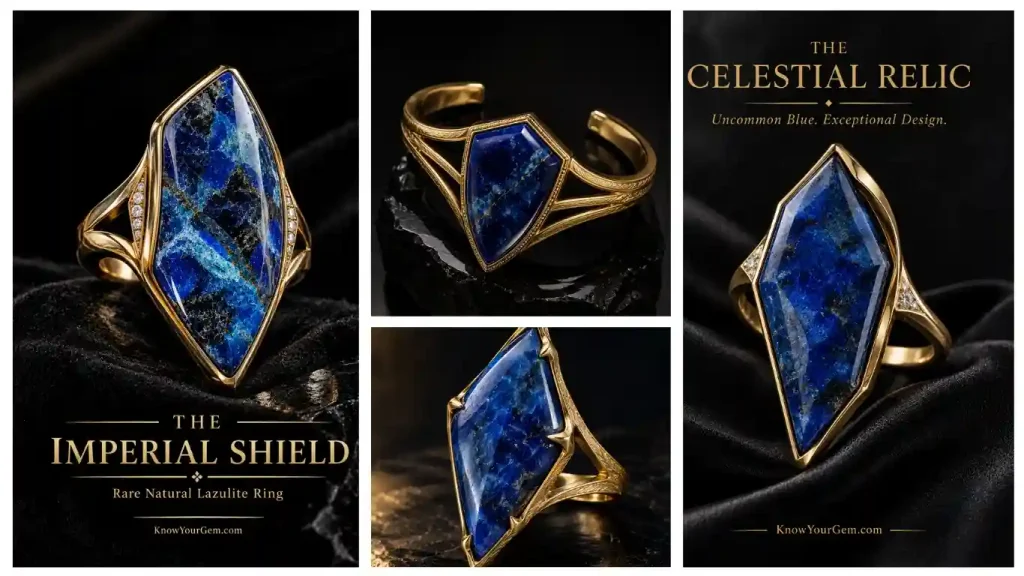
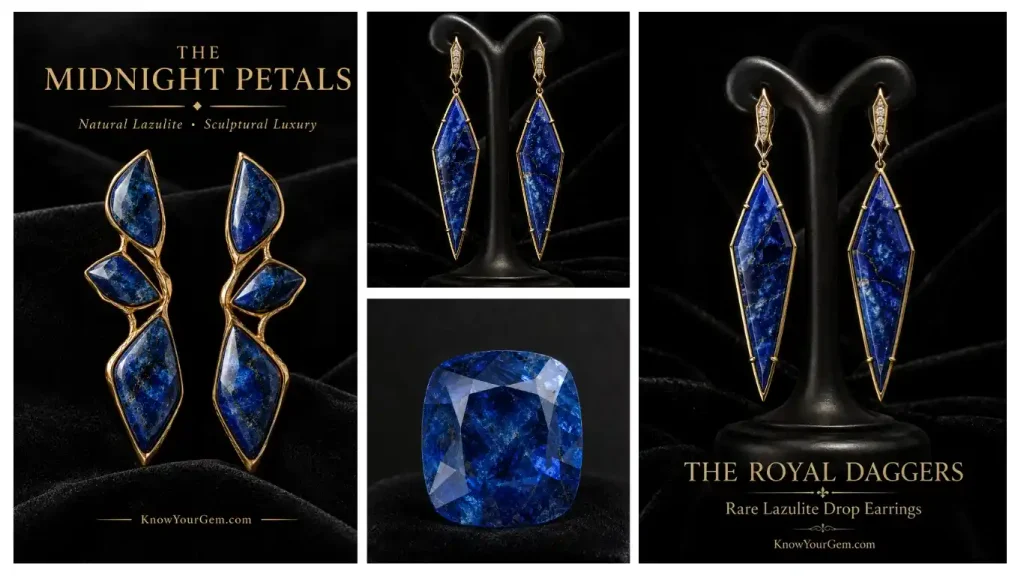
With care, yes. Without care, not always. Lazulite gemstone has a hardness of 5.5 to 6 on the Mohs Scale of Hardness and can be brittle. So it fares better in items that are occasionally used rather than the ones that take daily abuse.
Lazulite Rings and Protective Settings:
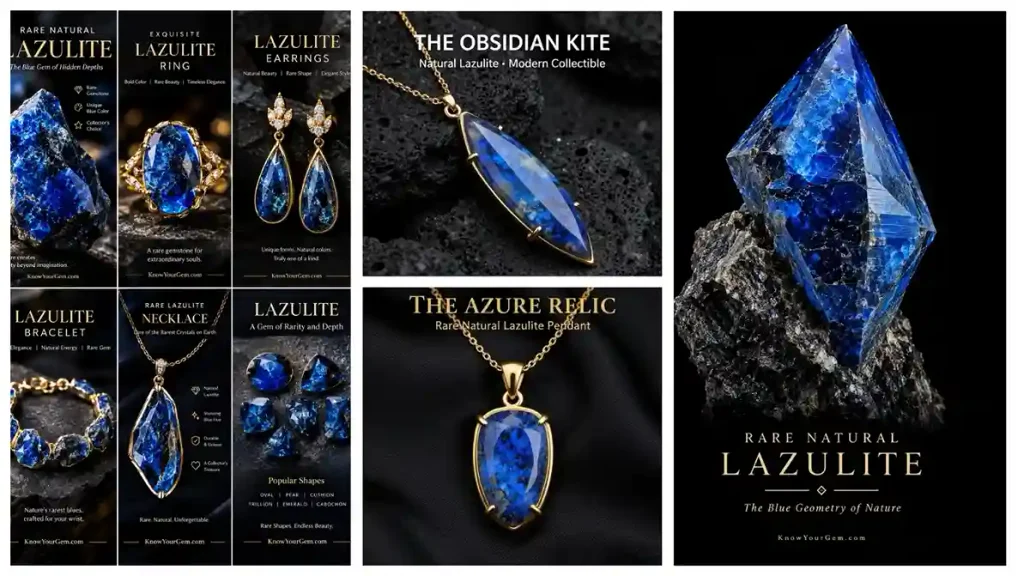
Rings suffer the most. If you desire a lazulite ring, secure it in a bezel setting. Don’t wear it during strenuous labor. A prong setting with an exposed border leaves the stone vulnerable.
Lazulite Gemstone Earrings and Pendants:
Earrings and pendants are safer. They rarely hit hard surfaces. For many buyers, these are the best way to wear lazulite.
Lazulite Gemstone Beads and Bracelets:
You can make beads and bracelets. But bracelets may hit desks and doors. Check the bead material carefully. Ask if it is natural lazulite or another blue stone. Blue beads are often sold under loose names.
Faceted Lazulite Gemstone vs Lazulite Cabochons:
Facets shine more but have delicate edges and corners. A cabochon’s smooth surface is less exposed. For a cleavage stone, a cab probably poses less risk. Not all rough specimens can be faceted. Don’t expect all rough material to turn into jewelry.
How to Choose a Quality Lazulite Gemstone Jewelry Piece?
- Must check for chips, cracks, and wear
- Look at the evenness of color
- Ask if it is natural and untreated
- Ask how the setting protects the stone
- Ask for identification papers on expensive pieces
How to Clean and Care for Lazulite Safely?
How to Clean Lazulite Gemstone at Home?
For cleaning purposes, you can use lukewarm water, a little bit of mild soap, and a soft brush or cloth. Rinse and dry.
What to Avoid?
- Harsh chemicals and acids
- Ultrasonic and steam cleaners, unless a professional confirms they are safe for that piece
- Sudden temperature change
- Hard knocks
This is a word of caution because specimens often have hidden fissures and variable constituents. A technique suitable for one specimen may be destructive to another.
How to Store Lazulite?
Store it in a soft bag or padded box in a safe place, and beware of scratches from harder stones like quartz, sapphire, and diamond.
The Biggest Buyer Misconception:
What People Believe?
“Lazulite and lazurite are the same stone, and blue means lapis.”
What Is Actually True?
They’re different minerals. Their chemistry, hardness, density, and crystal structure are different. Lazulite gemstone is a phosphate. Lazurite is a feldspathoid that comprises most of the lapis lazuli.
Why It Matters When Buying?
A wrong name could lead to wrong price, wrong durability expectations, and wrong care. Discussions on Mindat in the past have noted confusion between lazulite gemstone and lazurite in specimen descriptions. I can’t say how prevalent that is today among sellers. However, buyers should always check.
Faceted blue stones are particularly risky when purchased based on photographs alone. Photos do not provide information about density or refractive index.
Where to Buy Lazulite?
Buying Rough Lazulite Crystals:
The best are those offered by good mineral dealers, documented specimen shows, and well-documented mining companies. Require the locality.
Buying Faceted Lazulite and Cabochons:
Lazulite gemstone is a rare stone. Purchase from sellers who are able to identify the origin and who accept returns. For expensive stones, request a report from a laboratory.
Questions to Ask a Gemstone Seller:
Mostly experienced buyers ask these questions before they pay:
- Is this really natural lazulite?
- How was it identified?
- Where was it collected or mined?
- Do you have documentation?
- Do you have a license?
- What is its treatment status?
- Are there any cracks or repairs?
- Can I return it?
New buyers often look only at color and make a quick decision. I think this is a wrong decision. They should ask the same questions.
How to Evaluate Photographs, Provenance and Identification Claims?
Ask for photos in different lights. Ask for the locality and who identified the stone. A claim without a document is only a claim.
Red Flags When Buying Lazulite Online:
- Short descriptions like “blue crystal”
- Claims that lazulite is the same as lapis
- Exaggerated rarity or investment claims
- Healing claims used to raise the price
- No clear return policy
Lazulite Buyer Checklist:
- Ensure that it is lazulite (no ‘r’), not azurite, lazurite, or sodalite.
- Request the area and the documents.
- Check for cracks, chips, and previous repairs.
- Compare with already finalized sales rather than listing prices.
- Inquire about the treatment status.
- Protect your rings.
- Order a lab report for high-priced faceted stones.
- Avoid any sellers that promote via rarity, investment or healing.
Lazulite Meaning, Benefits and Metaphysical Beliefs:
Lazulite Crystal Meaning:
In crystal traditions, some individuals connect lazulite gemstone to stillness, intuition, and spiritual knowledge. That is the old (or traditional) way. This is not scientific research.
What Science Says About Healing Claims:
Lazulite gemstone has not been proven to treat anxiety or any medical condition. Do not pay extra because of a healing claim. If the meaning is important to you, enjoy it as a cultural belief. Judge the stone by its quality.
FAQs:
1. Is Lazulite a Rare Gemstone?
Faceted lazulite gemstone is quite rare, as clean, cuttable material is limited. The mineral is known from several localities, mostly as collector specimens.
2. Is Lazulite Expensive?
By type, it varies. Small specimens can be inexpensive. Large crystals on matrix and nicely faceted stones are more.
3. What Is Lazulite Worth Per Carat?
There isn‘t always a fixed price per carat. Compare similar pieces and completed sales.
4. What Is the Chemical Formula of Lazulite?
(Mg,Fe²⁺)Al₂(PO₄)₂(OH)₂.
5. What Color Is Natural Lazulite?
Azure to sky blue. Sometimes bluish white or blue-green. Green is rare.
6. Is Green Lazulite Real?
Greenish lazulite is known, but this is at the extreme end of the scale. You should get ID before shelling out the extra.
7. Is Lazulite the Same as Lazurite?
No. Lazulite is a phosphate. Lazurite is the main mineral component of lapis lazuli.
9. Is Lazulite Suitable for Rings?
Possible, but not ideal for daily wear. Use a protective setting.
10. How Can You Tell Whether Lazulite Is Genuine?
Not by color or photos alone. Use a laboratory test, or buy from a documented source.
11. How Should Lazulite Be Cleaned?
Warm water. Gentle soap. Soft cloth. Do not use ultrasonic or steam unless safe to do so.
12. Where Is Lazulite Found?
It is distributed in Austria and Switzerland, in the United States, in the Yukon of Canada, in Brazil, and in other localities.
13. What Does Lazulite Symbolize in Crystal Traditions?
Calm and intuition, according to belief systems. This is not science.
If you want to buy faceted stones or other cut stone you must need to ask for whether seller has certification from trusted laboratories like GIA, IGS and SSEF.
[Gemstone expert and enthusiast KamilHussain]

Welcome to KnowYourGem.com! your ultimate destination for uncovering the fascinating world of gems and their secrets! I'm Kamil Hussain, a passionate blogger with a Master’s degree in Economics, dedicated to bringing you insightful, well researched content that blends the beauty of gemstones with the art of storytelling. With a keen analytical mind and a love for discovering hidden treasures, I created this platform to help you explore the brilliance, history, and value of every gem.

