


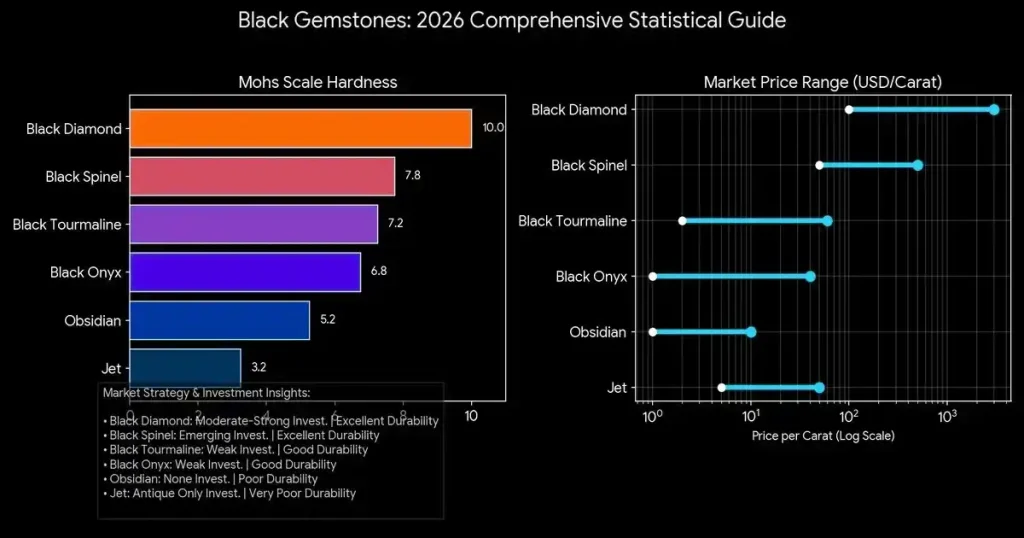
Black stones are a diverse lot. On one end is the hardest of all, black diamond. On the other is jet, a hardwood fossil you can scratch with your fingernail.
The prices vary from very cheap at a few dollars per carat onyx to very expensive natural black diamond at thousands of dollars per carat. The value of any of them depends on color, hardness, documentation, and rarity. All the stones are listed here, along with the prices, so that you aren’t paying natural prices for something treated.
Quick Answer: What Are the Main Black Gemstones?
Most black stones are black diamond, black spinel, black onyx, black tourmaline, obsidian and jet. Of these, the natural black diamond is the priciest by the carat. Black spinel is the most affordable natural, untreated black gemstone to wear as daily rings.3
| Black diamond | 10 | Excellent | Natural, treated and lab-grown versions exist |
| Black spinel | 7.5 to 8 | Excellent | Usually natural color |
| Black onyx | 6.5 to 7 | Good, with a bezel | Almost always dyed |
| Black tourmaline | 7 to 7.5 | Fair | Brittle, so protect the edges |
| Obsidian | 5 to 5.5 | Poor for rings | Volcanic glass |
| Jet | 2.5 to 4 | Very poor | Fossilized wood |
Black Gemstones: Meaning, Classification and Value
Black gemstones are significant and flexible. They are revered and they go with nearly every trend, and the range in price is very broad. No other color family can offer so many varieties in one appearance.
A Quick Scoop on Black Gemstones:
These stones absorb light. A dark, opaque colour of the material usually means there is a mineral content of manganese, iron, graphite or carbon in the crystal. Sometimes the colour is caused by nature, while other times heat, radiation or dyeing will deepen it.
So natural stones with proper documentation command the highest prices. Documentation is what separates them from treated lookalikes.
Why Black Gemstones Are So Popular in Jewelry?
Black gemstones moved from niche to mainstream over the past two decades. Three things drove it.
They Look Good on Every Metal:
It is the opposite of the warmth of yellow gold, the blush of rose gold, the coolness of white gold and the raw edge of blackened metal. Set a black diamond in yellow gold for a bold, electrifying effect. A black diamond mounted in platinum pavement is sleek and muted.
Couples Wanted Something Different:
Today many couples wish to buck tradition with a ring that stands out from the norm. Black diamonds have become a more daring alternative to the classic white solitaire.
They Carry Cultural Meaning:
The black stones are in European heraldry, charms made in West Africa, and Native American spirituality. The use of black tourmaline and obsidian and the practice of crystal healing share the quality of protection. That’s been true through the ages, no matter the trend.
Every Budget Works
You can buy a $50 black onyx cabochon in silver for daily wear. You can also pay thousands for a certified natural black diamond. No other color family has that range.
Complete List of Black Gemstones and Their Properties:
You gain confidence in your purchase once you know each stone’s chemistry, hardness, treatment info and value.
Black Diamond:
Black diamond is the hardest black gem and hardest natural substance on Earth (10 rating Mohs). It’s crystallised pure carbon with the same cubic crystal structure as a white diamond but many dense graphite inclusions throughout the crystal make it a deep opaque black.
There is a clear divide in the trade between natural, treated and lab-grown stones.
| Natural fancy black | Color formed in the earth | About $1,500 to $5,000+ per carat |
| Black or treated | With included rough, heated or irradiated | Approximately $300 to $1,000 per carat |
| Lab-grown black | Real black diamond Grown in a lab | Approximately $200 to $600+ per carat |
Those ranges are from published dealer guides, which don’t agree among themselves. Take them as very rough guides, not gospel market figures.
How GIA grades black diamonds black diamonds are opaque, so the scales aren’t the same as those used for white diamonds. The report will state whether it is natural or treated color. Black diamonds can chip along an inclusion plane, so consider a protective setting such as a ring.
What About Carbonado?
Note that this is not a black diamond, it is carbonado. It’s a porous, polycrystalline diamond-aggregate encountered in Brazil and the Central African Republic. The name is derived from the Portuguese for charcoal. Some vendors have been known to use the name in a generic sense when referring to a black diamond so verify the stone.
| Mohs hardness | 10 |
| Price per carat | About $300 treated, about $1,500 or more natural |
| Jewelry durability | Excellent |
| Investment rank | Moderate, natural stones with a report only |
Black Onyx:
Black onyx is a type of chalcedony, which is a crystalline form of quartz. Like all chalcedony, its fine structure gives it a waxy to glassy appearance. It is easily carved and polished into cabochons, beads and carvings.
Almost all black onyx you see is dyed. Gray or white chalcedony is soaked in a sugar solution and then treated with acid. That leaves carbon inside the stone and locks in a stable black. The trade has used this method for centuries. It’s accepted when disclosed, and it doesn’t hurt durability.
Onyx rates 6.5 to 7. It resists most daily scratches but loses to sand and quartz dust. For rings, use a bezel setting to protect the edges.
Onyx has no real investment value. Suitable chalcedony exists on every continent, and suppliers process it at large scale. Prices run from a few dollars to about $40 per carat. It’s a jewelry and decorative stone, and it does that job well.
| Mohs hardness | 6.5 to 7 |
| Price per carat | About $1 to $40 |
| Jewelry durability | Good, with a bezel |
| Investment rank | Weak |
Black Spinel:
Black spinel – this gemstone is one of the most underrated gemstones in fine jewelry. Its chemical composition is magnesium aluminum oxide (MgAl₂O₄), and it has a cubic structure. The black color comes from the iron that’s present in the crystal, and most gem-quality stones are sold untreated.
How hard is spinel? Spinel has a hardness of 7.5 to 8 and no cleavage planes so it’s a solid choice for rings and bracelets. How much does a carat of spinel cost? Rocks under a carat go for about $200 to $500 per carat according to one dealer guide with bigger gem-quality stones going for more.
Designers increasingly use it in place of treated black diamond and black sapphire. That’s a real trend, but it hasn’t built the auction record or collector base of an investment stone yet.
| Mohs hardness | 7.5 to 8 |
| Price per carat | About $200 to $500 for small stones |
| Jewelry durability | Excellent |
| Investment rank | Emerging, no track record yet |
Black Tourmaline:
Black tourmaline is called schorl in mineralogy. It’s the most common member of the tourmaline family. Iron in its boron-aluminum silicate crystal gives it the black color. It’s almost always natural. Dye, irradiation and heat aren’t needed.
The market splits in two. Raw and tumbled stones sell cheaply as crystal-healing stock, often by weight at a few dollars. Faceted stones cost more, usually from about $20 to $60 per carat.
Tourmaline has a hardness of 7 to 7.5. It doesn’t exhibit real cleavage, yet it can be broken by a sharp knock. Use a bezel for rings. Pendants and earrings are safer.
It has no meaningful investment value, because the material is plentiful. As a natural, untreated, affordable black stone, it’s an honest everyday choice.
| Mohs hardness | 7 to 7.5 |
| Price per carat | About $2 to $60 |
| Jewelry durability | Good, with protection |
| Investment rank | Weak |
Obsidian:
Obsidian is not a mineral. Obsidian is a volcanic glass: silica-rich lava that cools extremely quickly so that crystal formation cannot occur. This lack of a crystal structure means that Obsidian has no defined chemistry. Obsidian contains tiny crystals of magnetite that give it its black color.
It rates 5 to 5.5. Household dust contains quartz at 7, so obsidian scratches during normal wear. It also breaks with sharp, curved edges, the same property prehistoric toolmakers used. A dropped ring or a side knock can chip a polished cabochon.
It works for pendants, earrings and as a display piece. Rainbow obsidian, with bubbles or parallel patterns, is a little more expensive. None of them have any ‘investment’ value. Typical stones are a couple of dollars a carat.
Black Onyx vs. Obsidian:
Buyers confuse them all the time. Onyx – a mineral. Obsidian – a glass. Onyx- harder, more durable for jewelry, is often dyed. Obsidian – softer, less durable, in its natural state, is typically more delicate and cheaper in high wear environments.
| Mohs hardness | 5 to 5.5 |
| Price per carat | About $1 to $10 |
| Jewelry durability | Poor, pendants and earrings only |
| Investment rank | None |
Jet:
Jet is fossilized wood, a lignite coal. True Whitby jet, from the cliffs of North Yorkshire in England, sets the standard. It’s dense, deeply black, light in weight and takes a high polish. Spanish jet from Asturias is more brittle and generally ranks below it.
Jet rates 2.5 to 4, so moderate fingernail pressure can mark it. That rules it out for modern rings and bracelets. It suits pendants and brooches in protective settings.
Jet became fashionable after the death of Prince Albert, 1861. That history remains important. Antique Victorian jet, including carved cameos and mourning brooch, from known workshops can bring strong prices based on history and craftmanship. Modern beads and carvings are purchased for almost nothing.
| Mohs hardness | 2.5 to 4 |
| Price per carat | Low for modern pieces, much higher for antique Victorian |
| Jewelry durability | Very poor |
| Investment rank | Antique pieces only |
Other Black Gemstones:
A few more stones come in black:
- Black sapphire: corundum at 9, colored by iron; common variety heated.
- Black opal: A dark-bodied opal with bright play-of-color. It measures 5.5 to 6.5 on the Mohs scale of hardness.
- Tahitian pearl: A pearl with dark body color. It’s very soft and reacts to chemicals.
- Black garnet (melanite): A dark garnet of intermediate hardness.
Which Black Gemstone Has the Highest Value?
Natural fancy black diamond is the most valuable black gemstone per carat. Fine black spinel sits in the middle. Black onyx is the most available and the cheapest.
Here’s the order from highest to lowest value:
- Natural black diamond with a report showing natural color
- Fine black spinel and black sapphire
- Treated and lab-grown black diamond
- Black tourmaline (faceted)
- Black onyx, jet and obsidian
Keep context in mind. Black stones sit inside a much larger colored gemstone market. Fine rubies, sapphires and emeralds, for example, can cost far more per carat than any black stone.
Black Gemstones vs. Imperial Topaz:
Some buyers compare black stones with Imperial topaz as a reality check. It’s a fair comparison, because it shows why source, collectors and auctions matter.
Imperial topaz is the warm orange to pinkish golden topaz from Brazil. It’s mined mostly around Ouro Preto in Minas Gerais.
What Makes It Different?
- Source: Imperial topaz comes from essentially one region. Black stones come from many places. Onyx comes from Turkey and India, tourmaline from Africa and obsidian from the US and Mexico.
- Collectors: Museums, estates and serious collectors chase fine Imperial topaz. Black stones lean more on jewelry trends.
- Auctions: Top Imperial topaz appears regularly at major auction houses. Natural black diamonds sell well at times, but their record is less consistent.
I don’t publish a price table or an appreciation percentage for either stone. Sorry I didn’t have reliable sourced figures, and we would lead you astray with fictitious figures.
The Takeaway:
Black stones should be about style, not the scarcity of supply. That is how black stones help you build your collection. Get a single-source stone with a good track record if you want a collector stone; if you want a good, wearable black stone, here are your picks.
Are Black Gemstones a Good Investment?
Mostly no. A few types hold their value better than the rest, but I can’t promise a return on any of them.
What Affects Value?
- Documentation: Report from GIA or another accepted laboratory verifying species, treatment and natural color.
- Natural Color: Irradiated Diamonds and dyed Onyx are Design Wear, not invest wear.
- Origin: A proven, documented source can add value for some stones.
- Fashion: Demand for black stones rises with trends. It can fall when trends fade.
Where The Value Is?
Natural black diamond with a GIA report is the strongest black stone for value. Fine black spinel is an emerging option for patient collectors, with no long track record. Treated black stones, onyx, obsidian and jet are for wear.
The resale market for black gemstones is small, and selling can take time. Buy for beauty and meaning. Treat any resale value as a bonus.
How to Spot Genuine Black Gemstones?
The market has plenty of fakes. Synthetic stones are sold as natural. Treatments go undisclosed. Glass is sold as mineral. Knowing what to look for protects your money.
Common Treatments:
- Black diamond: Irradiation and heat turn colorless or low-grade rough black. The stone is hard and durable, but cheaper than a natural stone. A GIA report flags it.
- Black onyx: Sugar-acid dyeing is standard. It’s fine when disclosed.
- Fracture-filled stones: Cracks are concealed under glass or resin and are weak. Do not use ultrasonic cleaners with these.
Lab Reports Matter:
Order a GIA report (or other proper gemstone lab) for any top quality gemstones. The report should show the species, include whether colour is natural or treated, and show weight. Verify the report number corresponds to the report laboratory.
Price Red Flags:
- A “natural black diamond” priced far below dealer guides is probably treated.
- Sellers who dodge questions about natural or treated status.
- Phrases like “AAA” or “investment grade” with no documents.
- A perfectly uniform black with no variation, which can mean dye or glass.
Don’t Damage the Stone:
Never conduct scratch tests or acid tests as they can harm the stone and might not even give you a clear answer.
Best Black Gemstones for Rings and Everyday Wear:
Choose how hard, how tough and how readily the stone will take knocking and cleaning.
Most Durable Options:
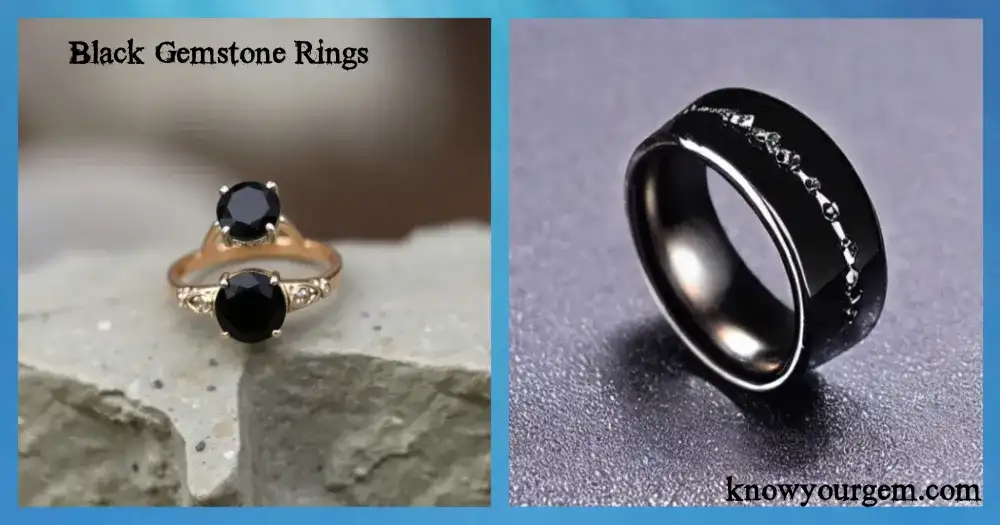
- Black diamond: Rates 10, resists scratches and is a top pick for daily rings, including engagement rings.
- Black spinel: Rates 7.5 to 8, has no cleavage and is naturally black.
- Black tourmaline: Rates 7 to 7.5. It works in a bezel setting. Avoid exposed prongs, because a sharp knock can crack it.
Luxury Choices:
- Natural black diamond with a report: The real luxury choice. It looks best in platinum or white gold.
- Fine black spinel: Quiet luxury, with a bright luster and natural color.
- Black diamond, treated: The coolkid on the block for less. Buy as look, not as investment.
Budget Choices:
- Black onyx: The best cheap black rock. It polishes to a glossy or matte black and is available in any shape. It’s good in bezel-set cabochons.
- Black tourmaline beads & raw stones: Our best budget choice for wellness jewelry.
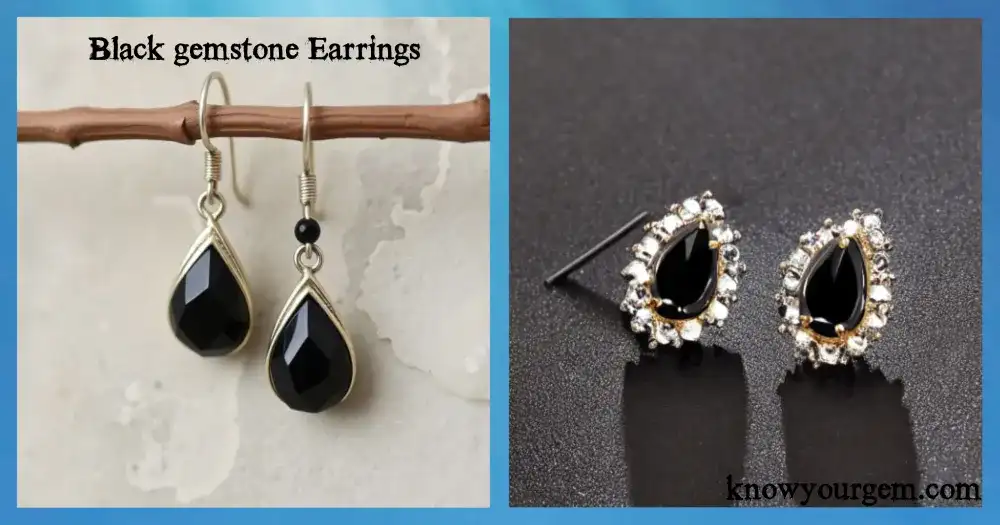
- Obsidian: Okay for pendants and earrings, but off limits for rings and bracelets.
Men’s Jewelry:
A large, smooth oval or round black onyx cabochon is a traditional choice. For a step up, black spinel in a polished round shape offers more shine and greater hardness.
Meaning and Symbolism of Black Gemstones:
The following are traditional and cultural beliefs don’t compare with scientific facts.
Protection Across Cultures:
Black Stones and Defence For centuries black stones have been known as protectors. They have been used to protect in European heraldic traditions, in West African charms, and in a number of practices among Native Americans. Some traditions believe black absorbs negativity, some that it offers protection or is mother earth.
Grounding and Calm:
Contemporary crystal work recommends black tourmaline, obsidian and jet to ground a scattered mind. This loosely ties to the root chakra idea from South Asian traditions. There’s no scientific proof, but strong belief keeps this market steady.
Symbolism in Major Traditions:
- Feng shui: The black color is water and is associated with the north, career, and wisdom.
- Japanese features: These matte black stones lend themselves to the concept of wabi-sabi, a humble, flawed appearance.
- The Victorians: Jet was the sole mourning gem and established an entire industry at Whitby.
Why Meaning Matters to Buyers?
Many people buy black tourmaline or obsidian for protection and don’t care about clarity grades. Meaning is part of why people buy, especially for gifts and spiritual jewelry. Just don’t pay extra for a health claim.
Final Thoughts: Should You Buy Black Gemstones?
Jewelry – yes. Black stones look great in any metal, work for all budgets and have a cultural significance which makes them a thoughtful gift.
Best Picks:
- Rings and everyday wear: black diamond or black spinel.
- Pendants, earrings: Black onyx.
- Metaphysical related needs: For rings and Bracelets do not use: obsidian, jet.

Engagement Ring Options:
- Black diamond for prestige and durability
- Black spinel for a natural, budget-friendly choice
- Black onyx in a bezel for style at a low price
Buyer Checklist:
1. Identify the precise species.
2. Inquire whether the color is natural, treated or dyed.
3. Inquire whether the stone is natural or created in a lab.
4. Obtain a lab report on expensive gems.
5. Match hardness to how you’re going to use it.
6. Compare rates for the same item and size.
FAQS:
1. Which Gemstone Is Black?
Black onyx is the most popular. Other black semi-precious stones include black diamond, black spinel, black tourmaline, obsidian and jet.
2. What Is the Most Powerful Black Gemstone?
In the realm of crystal lore, black tourmaline is known to be the most protective. And that’s just a good old-fashioned belief – not scientific fact.
3. What Is the Rarest Black Stone?
It’s the measure. Natural fancy black diamond and black opal. Both are rare. I don’t select one as the rarest because it’s difficult to rank.
4. What Is the Most Expensive Gem?
The CTF Pink Star diamond holds the record. It sold for $71.2 million in 2017. It isn’t a black stone.
5. What Is the Most Valuable Black Gemstone?
Natural fancy black diamond. Dealer guides show it can fetch from approximately $1,500 to $5,000 (or more) per carat. Treated stones would be significantly less.
6. Are Black Diamonds Real or Treated?
Both are real diamonds. Natural ones got their color in the earth. Treated ones were heated or irradiated. A GIA report states which.
7. Which Black Gemstone Is Best for Rings?
Black diamond and black spinel can be worn everyday. You can set your bezel with either black onyx or black tourmaline.
8. How Do Black Gemstones Compare With Imperial Topaz in Value?
Imperial topaz comes from essentially one region and has strong collector demand. Natural black diamond is the only black stone that comes close, and I can’t give a sourced price comparison.
9. How Can You Tell If a Black Gemstone Is Natural?
Order a lab report. Look for small natural differences, and stay away from solid black or extremely cheap prices. There isn’t a cheap, easy test you can do yourself.
10. What Is the Difference Between Black Onyx and Obsidian?
Onyx is a mineral and is frequently dyed. Obsidian is a black volcanic glass. Onyx is tougher, making it a more practical jewelry material.
11. Are Black Gemstones Expensive?
It depends on the stone. Onyx, obsidian and tourmaline are cheap. Natural black diamond can cost thousands of dollars per carat.
This content is published by Gemstone Expert and Enthusiast KamilHussain.

Welcome to KnowYourGem.com! your ultimate destination for uncovering the fascinating world of gems and their secrets! I'm Kamil Hussain, a passionate blogger with a Master’s degree in Economics, dedicated to bringing you insightful, well researched content that blends the beauty of gemstones with the art of storytelling. With a keen analytical mind and a love for discovering hidden treasures, I created this platform to help you explore the brilliance, history, and value of every gem.


[…] are, however, other reports, such as dyed nephrite gemstone, particularly green and black (Palmer et al, 1994). In this instance, the solution to that problem is also simple: Ask every time […]