


Overview:
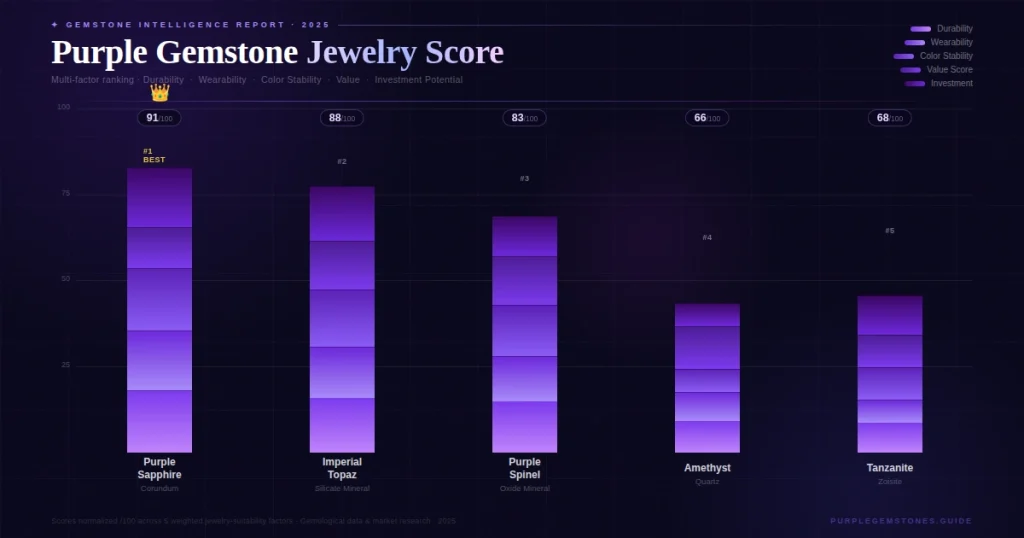
The most common purple gem is amethyst with purple sapphire, tanzanite and spinel being the biggest upmarket prices to rare. They are very different stones with very different levels of hardness, treatments and costs. “Purple” only describes the colour and nothing else.
Quickly: Best day ring – purple sapphire or spinel. Best for value and everyday wear – amethyst (loves pendants, earrings and careful rings). Best for occasional rings – tanzanite (soft, for pendants) – beautiful. For anything of value, always ask for disclosure of treatment and a lab report.
Knowyourgem has worked with gemstones for more than 5 years. Mostly customers ask same questions about every gemstone, like, Is this a real gemstone? Where does this stone come from? Does the seller have documentation?
What Are the Main Purple Gemstones?
Some minerals are purple and a few more are traded as purple stones at times. This is the list of the ones customers come across the most.
| Amethyst | Quartz | About 7 | Common, affordable, often large |
| Purple sapphire | Corundum | 9 | Hard and tough; heat treatment is common |
| Tanzanite | Zoisite | About 6.5–7 | Blue-violet; found commercially at one location; almost always heated |
| Purple spinel | Spinel | 8 | Durable, bright and often overlooked |
| Purple fluorite | Fluorite | 4 | Soft, with perfect cleavage; collector or pendant stone |
| Charoite | Silicate rock | About 5–6 | Opaque, swirling, silky |
| Sugilite | Silicate mineral is | About 5.5–6.5 | Opaque, used for beads and carvings |
| Violet topaz | Member of Topaz | 8 | Natural violet is rare; much of what’s sold is treated or coated |
Note – there is some slight difference in ranges from each source and each stone will vary slightly, treat these as approximate guides.
What Is Amethyst?
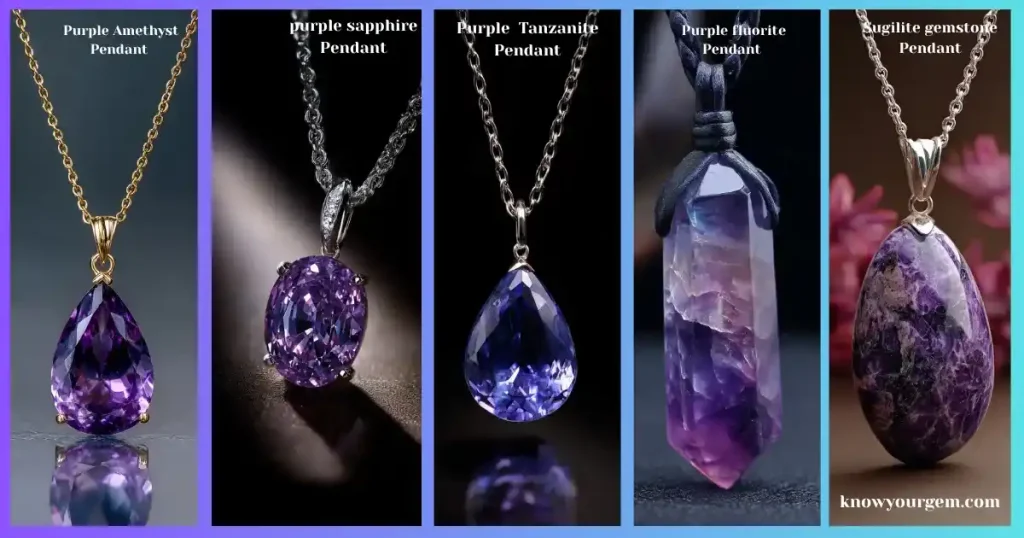
Amethyst is purple quartz. Its color is due to oxidation of iron and exposure to natural radiation, and the stones are found in many locations, such as Brazil, Uruguay and Zambia. Because it’s abundant, you can buy a large, clean stone at a price that would be impossible for most other gems.
It rates about 7, which means dust and household grit won’t mark it, though sapphire, spinel and topaz will. That’s good enough for pendants and earrings. For rings it’s fine if you’re careful, though the surface slowly picks up scratches over the years.
Two details trip people up. First, heating amethyst usually turns it yellow or orange, which is how citrine is made, and heating at different temperatures can even give green prasiolite.
So heat isn’t the standard way to enrich amethyst’s purple, despite what many pages claim. Most amethysts are sold as untreated. Secondly, a few amethysts will fade over time if they are held too long in intense heat or light. Never place an item on a sunny windowsill and ask the seller about the actual stone.
Amethyst also exists as a lab-grown stone, and lab-grown material is real quartz. It should be sold as lab-grown. A lab can tell the difference, and for a valuable stone it’s worth the check.
What Is Purple Sapphire?
The material of the purple sapphire is corundum; that is the same as ruby and blue sapphire. Its colour is caused by the traces of other elements contained in it in very small amounts, mainly titanium and iron. Chromium is more associated with pink and red, so it isn’t the main cause of violet.
It’s the toughest purple gem you can buy. It doesn’t scratch at 9, and it doesn’t have a cleavage so is more resilient to everyday damage than anything else in our list.
Less common than blue sapphire, the purple colour in this stone is considered by many to be even more beautiful than its blue counterpart. Purple sapphire can be sourced from regions as diverse as Sri Lanka and Madagascar.
Heat treatment is common and accepted when disclosed, and it’s used to improve color and clarity. Unheated stones with a lab report usually carry a premium.
Ask which you’re getting, and get it in writing. Verify also if the colour is “purple” or “violet”, as most stones are close to the boundaries with pink or blue, but different salespeople call the same stone differently.
What Is Tanzanite?
Tanzanite is the blue-violet name for the mineral zoisite. As it is only produced from one source in the earth, the Merelani Hills of Tanzania by Mount Kilimanjaro, tanzanite is often given the term ‘single-origin’.
The color is attributable to vanadium, and it is a strongly pleochroic stone and may exhibit blue, violet and sometimes reddish hues when viewed from different angles.
Almost all tanzanite available for sale has been heat-treated, changing the original brownish crystals into the blue-violet color familiar to most people. It’s standard practice and accepted when disclosed. Untreated stones exist, but they’re uncommon.
The weakness is hardness. At about 6.5 to 7, with cleavage, it scratches and chips more easily than sapphire or spinel.
A ring can be worn with a protector setting, it just needs to be treated carefully and probably isn’t the best choice for a rough user. A pendant, earring, or infrequent-use ring may be the most practical.
“Rarest purple gem” is a claim you’ll see often. I’d avoid repeating it flatly. Supply from a single area is limited, but “rare” isn’t a measurement, and you shouldn’t treat it as a promise of rising value.
What Is Purple Spinel?
Spinel is magnesium aluminum oxide and is available in several colors, including violet and purple. Its hardness is 8 with no cleavage, so it is durable and frequently brilliant. It is a lesser-known stone that has been underappreciated, in part because it was long confused with ruby and sapphire.
Available untreated, it’s generally nice to be able to offer the work in its natural state. High-quality purple spinels are sourced in locations such as Sri Lanka, Myanmar and Tanzania to name a few, with pricing based on size and color. It’s a strong alternative if you want a hard purple stone and a price below purple sapphire.
What Are the Rarer Purple Stones?
A few more purple stones deserve a mention, though none are everyday ring stones.
Purple fluorite is calcium fluoride from places such as China and Mexico. At 4, with perfect cleavage, it’s a collector or pendant stone. It fluoresces in blue-violet when exposed to UV light. Thanks to fluorite, we get the etymology for the word ‘fluorescence’.
Charoite is an opaque, silky, swirling purple stone that is found in the Murun massif of Yakutia, Russia. Charoite scores about 5 to 6 and has a fine luster, not a sharp star effect. The dark lines are usually aegirine and other minerals.
Sugilite is an opaque purple mineral known especially from the Wessels Mine in South Africa. It’s used for beads, cabochons and carvings. Look-alikes and dyed material exist, so ask what you’re buying.
Violet topaz is topaz, and topaz is hard at 8, but it has perfect cleavage and can split on a knock. Natural violet topaz is rare. A lot of colorful topaz is treated, and coatings (sold as “mystic” topaz) can wear away.
All imperial topaz is always referred to by the trade as orange to pink-orange, never purple. If you see “purple imperial topaz” from a seller, they’re either using the term loosely or they’re selling treated material. (Request lab documentation.)
Which Purple Gemstones Are Best for Rings?
Start with the hardness, then consider how tough and how cleavable it is.
| Purple sapphire | 9 | Yes | Hard, tough, no cleavage |
| Purple spinel | 8 | Yes, with care | Hard, no cleavage |
| Violet topaz | 8 | With care | Perfect cleavage can split on impact |
| Amethyst | About 7 | Possible with care | Scratches over time; some stones fade |
| Tanzanite | About 6.5–7 | Occasional wear | Softer, with cleavage |
| Fluorite, charoite, sugilite | 4–6.5 | No | Better as pendants, beads or collector pieces |
For necklaces and pendants, almost anything is fine, due to the minimal amount of force that they can take. Stud earrings are fine as well. Studs are more delicate than long drops, so softer stones like amethyst and tanzanite are usually happy in studs.
Whichever you choose, setting matters. Bezels and halos keep tenderer stones safe, while a low setting is suitable for every stone. Take your rings off when you are doing any serious work, playing sports and doing gardening.

Are Purple Gemstones Treated?
Often, and it’s usually fine as long as it’s disclosed.
| Heat treatment | Heat treatment is applied on Tanzanite (almost always), sapphire (common), some topaz and amethyst | Permanent and widely accepted when disclosed |
| Irradiation | Some topaz and quartz | Can be permanent, but must be disclosed |
| Coating | “Mystic” or colored topaz and quartz | Can wear off; should be disclosed |
| Fracture filling | Mainly other stones such as ruby and emerald | Lowers value; rare in purple stones |
| Dyeing | Porous stones, especially chalcedony and agate | Often sold as a purple stone it isn’t |
“Ask three questions: Whether this stone has been treated, how and whether you will get it in writing. If the seller doesn’t waffle and come up with something else he is a good one. Those who do are not so good.”
How Can You Tell Real Purple Gemstones from Fakes?
Real stones can still get a wrong name, so go by what the seller tells you it is, then do what you can. Natural inclusions, growth lines and colour zoning can be seen on many natural stones under a 10x loupe.
Colour banding can be seen in amethyst, and a clean flawless large stone may have been lab-grown or glass. Synthetic stones can look clean, and fake inclusions can be inserted into imitations, so the loupe is merely a first look, not an id.
Hold the stone to the light. Some stones (and glass) can appear flat or very clear, and others (like tanzanite) can flash different colors depending on the angle you are looking at the stone.
Weight helps too, since glass and plastic usually feel different from the real stone, but that’s only a clue. The old “cool to the touch” test is unreliable, because glass and several gems feel cool as well.
Lab testing is the single sure way to confirm identity, treatment and to know whether the stone is natural or lab-grown.
Ask to see a report from a known laboratory such as GIA or SSEF for all your high-value stones and check that you can verify the report number on the laboratory’s website. Some labs can laser inscribe a number onto the girdle of the stone, which links it to the report.
Color is the most important factor. A saturated, uniform purple usually surpasses a pale or uneven one, and stones with vivid, pure color are less common in most types. After color, other factors become important.
- Clarity: Eye-clean stones are the usual standard, though inclusions matter more in some stones than others. Amethyst is often clean even at low prices.
- Size: Large stones with good color cost more per carat, especially in rarer species.
- Cut: A well-cut stone shows color evenly and sparkles. A poor cut wastes good material.
- Treatment: Untreated stones with a report usually cost more than treated ones of similar look.
- Origin. It can add interest and sometimes price, but a lab can’t always prove it, so treat seller claims as something to verify.
- Documentation. A lab report adds confidence on expensive stones.
The table shows where each stone usually sits in the market. It’s a guide to relative position, not a price quote.
| Amethyst | Low | Abundant; price follows color and size |
| Purple spinel | Moderate | Color, size, clean untreated stones |
| Tanzanite | Moderate to higher | Saturated blue-violet color, size, clarity |
| Purple sapphire | Higher | Rarity of good color, treatment status, size |
| Charoite, sugilite, fluorite | Low to moderate | Pattern, color and finish |
I wouldn’t buy any of these as an investment. Gem prices can be hard to resell at what you paid, and no stone here comes with a guaranteed return. Buy the one you want to wear.
What Do Purple Gemstones Mean?
That’s all tradition and belief, not proven results. Purple has been associated with kings and queens for centuries because the dyes, such as the Romans or Byzantines’ tyrian purple,were so expensive that only the wealthy could afford to wear them.
The name amethyst comes from the Greek amethystos meaning ‘not intoxicated’. According to legend, the stone was believed to prevent drunkenness.
Crystal working An association with calm, clear thought and the third eye or crown chakra. Meditation practitioners often carry this stone or sleep with it beside the bed. Tanzanite and sapphire also garner associations with intuition and wisdom.
All of this has no basis in science and can’t replace any medical advice or treatment. But if the purple stone reminds you to take things slower, it’s certainly a reason to own one. Just avoid shelling out extra money for false healing claims.

Where Should You Buy Purple Gemstones?
There’s no substitute for a real person. Specialist gem dealers can address technical questions and show you treatment and origin reports. Local jewelers allow you to hold and examine a stone yourself, although their inventory tends to be much smaller.
Online vendors have an enormous selection and can be very good: Shop reputable ones that have easy to understand return policies and offer videos and high-res photos.
A market with a mix of sellers is more risky, because quality and honesty are inconsistent. Use a payment method with buyer protection, and don’t rely on a seller’s own certificate. Ask for an independent lab report on anything expensive.
Red flags include no paperwork, no return policy, a price far below comparable stones, healing claims instead of facts, and a seller who can’t tell you what the stone is or whether it’s treated.
What Is the Biggest Buyer Misconception About Purple Gemstones?
Many buyers believe a purple stone is automatically a good investment if it’s labeled rare, and that a higher Mohs number means a better ring stone.
Neither holds up. “Rare” and “investment-grade” are sales words. Purple stones can be hard to resell, prices swing, and no lab report predicts the market. Stories about an “undervalued” purple topaz or a stone about to appreciate are marketing, so don’t spend on them.
Hardness isn’t the whole story of durability, either. Topaz is 8 but can still cleave (split along its cleavage). Tanzanite is softer and does form cleaves. Sapphire and spinel have hardness but no cleavage, so they are very durable.
Buyer Checklist:
Think how you will wear it. For the everyday ring, wear a sapphire or a spinel, and for a pendant, earring or lighter wear, wear amethyst or tanzanite.
- Ask if it’s a natural stone, lab-grown, or treated – and get the answer in writing.
- Check the name of the stone. If it’s purple imperial topaz or mystic, ask the following questions:
- Another option is to see it in the daylight and in the white indoor lighting.
- Request for an independent lab report on expensive stones and check the quantity.
- Choose a protective setting for softer stones.
- Get the return policy before you pay.
Key Takeaways:
- Amethyst is the common, affordable purple. Sapphire and spinel are the durable choices for daily rings.
- Tanzanite is almost always heated and softer than most ring stones.
- Heating usually turns amethyst yellow, not purple. Some amethyst fades in strong light.
- “Purple imperial topaz” is a loose label. Ask for lab confirmation.
- Meanings are cultural beliefs. Investment claims about purple stones aren’t supported.
Sources:
Gemological Institute of America (GIA) for ID, treatment, and properties. (IGS)International Gem Society for ID, treatment and properties. Mindat for ID, treatment, and properties. Gem-A and SSEF for ID, treatment and properties.
FAQs About Purple Gemstones:
1. What is the most common purple gemstone?
Amethyst, a purple quartz. It is common and inexpensive, even in large sizes.
2. Which purple gemstone is best for an engagement ring?
Purple sapphire (9) is the hardiest. Purple spinel (8) is a close second at a better price point.
3. Is tanzanite a good ring stone?
Only with caution. About 6.5 – 7 with cleavage – more of a pendant, earring, or occasional-wear ring than a day-in-day-out ring.
4. Does amethyst fade?
A few amethysts discolour with prolonged exposure to bright, warm light. Query the seller about your specific stone and don’t place it in a sunny window.
5. Are purple gemstones treated?
Usually. The majority of tanzanite is heated; the majority of sapphires are heated. This must be clearly disclosed.
6. How can I tell if a purple stone is real?
A loupe and a light check are okay, but only a gem lab can confirm both identity and treatment. Anything expensive requires a report.
7. Is purple sapphire rare?
Fine, saturated purple sapphire is not as prevalent as blue sapphire, but unheated stones with lab report are even harder to come by.
8. Are purple gemstones a good investment?
I wouldn’t count on it. Prices can be hard to resell at what you paid, so buy the stone for what it is.
This content is published by Gemstone Expert and Enthusiast KamilHussain.

Welcome to KnowYourGem.com! your ultimate destination for uncovering the fascinating world of gems and their secrets! I'm Kamil Hussain, a passionate blogger with a Master’s degree in Economics, dedicated to bringing you insightful, well researched content that blends the beauty of gemstones with the art of storytelling. With a keen analytical mind and a love for discovering hidden treasures, I created this platform to help you explore the brilliance, history, and value of every gem.

