


Quick Answer: Black Zircon naturally occurs a gemstone (ZrSiO₄) which is valued for its adamantine luster and exceptional fire. It is not cubic Zirconia, it is a genuine mineral formed more than millions of years.
Most black zircon undergoes heat treatment to achieve its dark coloration, with prices ranging from $20-$150 per carat, but prices can change depending on quality, cut, and origin.
Introduction:
Black Zircon stone represents natural’s most misunderstanding gemstone. It is often confused with cubic zirconia or dismissed as a diamond sinulant. Since this genuine mineral deserves recognition for its unique optical properties and geological significance.
Whether Zircon is used in jewelry for centuries, black variety is gained a particular attention in recent year as consumer seek a distinctive luxury alternatives that balance beauty with affordability.
What Is black Zircon?
Naturally occurred black zircon nesolsilicate mineral with the chemical formula like ZrSiO₄ (zirconium silicate). Since this gemstone belongs to the zircon group.
And should never be confused with cubic zirconia which is a laboratory created diamond simulant. The two materials share similar names but posses entirely different chemical compositions, origins, and properties.
Mineral Classification And Structure:
Zircon is a mineral which grows in a beautiful tetragonal crystal system, it often forms long prisms topped with pyramed like points.
Although its structure is built from zirconium atoms which are linked with silicate groups which create most toughest mineral on the Earth.
Zircon is a special stone due to its age, but some crystals are more than 4 million years old, which means that such crystals have been existing on the Earth since Earth’s initial days.
Natural vs Treated Black Zircon:
True naturally black zircon is exceptionally rare. Since, most specimens are marketed as black zircon begin as brown zircon or reddish brown varieties that undergo controlled heat treatment to achieve their deep, opaque appearance.
Although, this process is hugely accepted within the gemological community and doesn’t diminish the stone’s authenticity as the natural mineral only the color has been enhanced.
Why black Zircon appears opaque:
It doesn’t match to transparent zircon varieties in blue, yellow, or any other forms, black zircon typically exhibits opacity. This characteristic results from dense internal inclusions, structural alterations from natural radiation exposure over geological time, or intentional heat. The opaque contributes to the stone’s dramatic visual impact in jewelry.
Geographic sources:
Major deposits of zircon suitable for black treatment include Cambodia, Sri Lanka, Myanmar, Thailand, and Madagascar.
While each origin can produce stones with slightly varying characteristics, becuase heat treatment tends to standardize final appearance across sources.
Black Zircon vs Cubic Zirconia:
It is must to understand the distinction between black zircon and cubic zirconia is informed to make purchasing decisions. With having similar names, these materials are fundamentally in composition, origin, value, and optical characteristics.
Comprehensive Comparison:
| Feature | Black Zircon | Cubic Zirconia |
| Origin | Natural mineral | Laboratory-synthesized |
| Chemical Formula | It owns chemical formula like ZrSiO₄ | ZrO₂ |
| Mohs Hardness | It ranks 6–7.5 on Mohs scale | 8–8.5 |
| Refractive Index | It has high refractive index like 1.81–2.01) | Lower (2.15–2.18) |
| Specific Gravity | Its specific gravit is 4.6–4.7 | 5.6–6.0 |
| Optical Character | Adamantine fire, strong dispersion | Glassy brilliance |
| Market Value | Genuine gemstone pricing | Inexpensive synthetic |
| Heat Sensitivity | Moderate | High |
| Age | Millions to billions of years | Days to weeks |
Why This Matters?
Retailers occasionally, whether through ignorance or deception, mislabel cubic zirconia as “zircon” to suggest natural origin. Gemstone seekers must need to request the stone’s certification and should also ask specific questions about the stone’s authenticity.
Because black zircon commands higher prices than zirconia precisely because it represents a genuine geological specimen rather than a manufactured product.
The confusion between these materials unfortunately damaged zircon’s reputation. Therefore, educated buyers recognize that authentic zircon offers distinctive optical properties.
However, synthetic alternatives can’t replicate, particularly the exceptionally high dispersion that creates brilliant flashes of color.
Physical & Optical Properties Of Black Zircon:
Hardness And Durability:
Zircon ranks 6 and 7.5 on the Mohs scale of hardness which means that the stone accommodates in modern jewelry. Since, it is suitable for many jewelry applications, because of owning durability.
However the stone needs more care than sapphire which rates 9 on Mohs or diamond which ranks 10 on the Mohs scale of hardness. The stone can develop surface scratches with prolonged daily wear, particularly in rings exposed to abrasive surfaces.
Brittleness Consideration: While having a reasonable hardness, zircon exhibits brittleness due to its crystal structure. Facet edges can chip if they are subjected to sharp impacts, which makes it protective settings advisable for rings and bracelets.
Refractive Index And Brilliance:
Black zircon possesses an exceptionally high refractive index ranges from 1.81 to 2.01, and depends on specimen composition and any structural modifications from radiation exposure.
This elevated index creates the distinctive adamantine luster, a diamond like surface brilliance that distinguishes zircon from most other gemstones.
Even in opaque black specimens, this high refractive index produces surface reflections and subtle depth that resist the stone from appearing flat or lifeless. When light interact with properly cut black zircon, the result is a sophisticated gleam rather than dull absorption.
Dispersion:
Zircon’s dispersion like the separation of white light into spectral colors measure 0.039, which nearly matches diamond’s 0.044. In transparent zircon varieties, it creates the spectacular rainbow flashes.
Whether less visible in opaque black specimens, named by underlying optical physics still contribute to the stone’s entire visual interest, particularly around facet edges where thin sections can transmit light.
Density and weight:
With a specific gravity between 4.5 and 4.7, zircon makes it feel noticeably heavier than most knowledgeable gemstones.
And this density provides a simple field test for identification. So, one carat black zircon will feel substantially heavier than a one carat cubic zirconia or glass imitation of the same dimensions.
Jewelry suitability analysis:
Ideal Applications:
- Earrings and pendants usually have low impact wear
- Cocktail rings are perfect for occasional use
- Men’s rings in protective settings can be better fit for daily wear
- Collector’s specimens
Use With Caution:
- Daily wear engagement rings
- Tennis bracelets or eternity bands
- Children’s jewelry (impact risk)
Black zircon performs the best in jewelry designs which showcase their beauty whether having minimum exposure to the hard knocks and abrasive contact.
Bezel settings, halo designs with protective borders, and pendant orientations that can keep the stone away from impact surfaces all extend longevity.
Origin & geological formation:
How Zircon Forms:
Zircon tends to form in igneous rocks like, granite, syenite, and Pegmatities. When these rocks cool slowly over time, they create the perfect conditions for zircon to grow into large, beautifully shaped crystals.
Although the mineral also appears in metamorphic environments where high temperatures and pressures recognize existing rock formations. As one of the earliest minerals to crystallize from cooling magma, zircon often becomes incorporated as an accessory mineral in various rock types.
The chemical resilience of zirconium silicate crystals survive weathering processes that destroy softer minerals. Consequently, zircon accumulates in alluvial deposits like, river gravels and beach sands where miners extract gem quality specimens through mining techniques.
Why black coloration cccurs:
Natural dark coloration in zircon results from several mechanisms:
Radiation-Induced Metamictization:
Trace amounts of radioactive elements like (uranium, thorium) within zircon’s crystal structure emit alpha particles for more than million years.
This internal radiation gradually damages the crystal lattice, and creates a metamict state where the orderly atomic arrangement becomes partially disrupted. The structural chaos absorbs light across the visible spectrum, which produces a dark brown to nearly black coloration.
Iron and Other Impurities:
Transition metal ions, particularly iron, can substitute for zirconium in the crystal structure, and creates color center that absorb a specific wavelengths and contributes to the dark appearance.
Heat Treatment:
Most commercial black zircon results from heating brown zircon to a particular temperature (typically 900-1000°C) in reducing atmospheres. This process modifies color centers and creates stable black coloration.
Ancient Crystal Age:
Zircon is resistance to chemical and mechanical weathering which enables an individual crystal to survive for extraordinary periods. Researches have identified zircon grains exceed 4.4 billion years in age, which make them the oldest known terrestrial materials.
Whether most gem quality specimens are considerably younger typically millions rather than billions of years old this geological heritage contributes to zircon’s scientific significance.
When you wear black zircon jewelry, means that you display a mineral that is formed within Earth’s crust during ancient geological events, potentially before complex life evolved on the planet’s surface.
Black Zircon Color Natural vs Heat Treated:
Natural Dark Zircon:
Naturally untreated black or relevant black zircon stone exists but remains scare in the gemstone market. These crystals are mostly found in various shades like dark brown.
Their natural darkness usually tells the story of transformation, evidence of metamictization, a process caused by radioactive decay gradually altering the crystal’s structure over immense spans of geological time
Heat Treatment Process:
The majority of black zircon in commercial jewelry undergoes controlled thermal treatment:
Process Details:
- Rough brown zircon is selected for treatment potential
- Stones are heated to temperatures between 900-1000°C
- Controlled atmosphere often like often reducing, prevents unwanted reactions.
- Gradual cooling preserves color stability
- Final color ranges from deep charcoal to the pure black
Since this treatment is permanent and stable under normal wearing conditions. The process doesn’t involve adding foreign materials or coatings; it simply modifies the exciting color center within the natural structure.
Industry Acceptance:
Gemological organizations including the Gemological Institute of America (GIA) recognize heat treatment as a standard, accepted enhancement for zircon.
The practice has been employed for over a century and is analogous to heat treating sapphires or aquamarines to improve color.
Disclosure Standards:
Ethics and gemologists should reveal heat treatment when they are selling black zircon. Whether the treatment doesn’t significant affect value as compared to hypothetical untreated equivalents (since untreated black zircon is so rare), transparency remains the professional standard.
What To Ask?
- “Has this zircon been heat treated?”
- “Can you provide treatment disclosure in writing?”
- “What is the origin of this stone?”
A reputable seller will answer these questions directly and include treatment information on certificates and invoices.
Black Zircon Meaning & Symbolism:
Historical Symbolism:
According to the history, people have turned into dark gemstones as symbols of strength and protection. They have often seen as grounding stones, believed to absorb negative energy and provide a sense of stability.
Whether black zircon itself doesn’t appear often in an ancient records, its broader zircon family has a rich past. Zircon is even mentioned in the Bible under the name “jacinth,” which is likely referring to its reddish variety, and it holds a place in Ayurvedic traditions as well.
Medieval Europeans have believed that zircon could induce sleep, drive away evil, and promote honor and wisdom in the wearer. These historical associations extended across colored varieties, with darker stones particularly linked to the protective qualities.
Modern Interpretations:
Contemporary crystal enthusiasts and jewelry consumers attribute several symbolic meaning to the black zircon:
- Ability to make Stable: The deep, opaque beauty of zircon is seen as a symbol of connection to the Earth and the physical world. It is not like lighter stones that evoke airy, spiritual qualities, its darkness conveys balance, grounding, and a steady presence.
- Sophistication and Power: In fashion and design, black gemstones are timeless emblems of elegance and authority. Black zircon, in particular, offers confident yet understated style an accessible alternative to the luxury of back diamonds, while still retaining all of their allure.
- Mystery and Depth: While having soft shine and dark tones, black zircon makes feel itself mysterious. So, it is perfect for people who like jewelry which is subtle elegant, hinting at depth and quiet sophistication.
Stories Across Cultures:
In some Asian traditions, dark stones are usually considered auspicious fr certain zodiac signs or during specific life circumstances. However, interpretations vary hugely across cultures, and no universal symbolism exists for black zircon specifically.
Luxury perception:
Luxury Perception:
As consumer interest in unique gemstones, black zircon has gained recognition as an accessible entry point to the colored gemstone collection.
Although, its legitimate geological origin and optical properties position it above synthetic alternative whether remaining affordable as compared to the black diamonds or rare black spinels.
Important Note: The symbolic meaning of black zircon represents cultural beliefs and personal association rather than scientifically verified properties.
Metaphysical properties:
Some spiritual and crystal healing practitioners believe black zircon has special energies. These ideas are shared for information only they are not medical advice and have not been scientifically proven.
Commonly cited associations:
- Boosting energy: Practitioners belief that black zircon helps anchor consciousness to physical reality, potentially useful during meditation or for individuals who feel disconnected or scattered.
- Protection Symbolism: It means that black zircon is thought to create energetic boundaries, shielding the wearer from negative influences or psychic disturbances.
- Associations: Some sources link back zircon to the root chakra which is the power house of body, which in yogic traditions relates to survival instincts, physical vitality, and foundational security.
- Emotional Balance: Believers suggest back zircon can help process grief, overcome loss, or negative, difficult emotional periods by providing a sense of stability.
Scientific Perspective:
Not peer reviewed scientific evidence can support metaphysical claims about gemstones which affect human health. Energy fields, or emotional sates beyond placebo effects.
The psychological comfort some people experience from wearing a meaningful jewelry is real, but it is different from the crystal which has inherent energetic properties.
Respectful Approach:
Many people find a personal meaning in gemstone symbolism without making empirical claims about measurable effects. Black zircon can serve as a meaningful personal reminder of intentions without requiring belief in specific metaphysical mechanisms.
Important Disclaimer: It is must to consider that user’s believe of, metaphysical properties should only for reflect spiritual or personal exploration only. They can’t replace professional scientific medical care or mental health treatment.
Black Zircon Stone Benefits:
Black zircon gemstone primarily offers powerful benefits which make it the most favorite among crystal enthusiasts and spiritual seekers. The stone is recognized for its strong protective and grounding qualities; this stone provides both emotional and energetic support. Given below are the black zircon stone benefits you can get benefited:
- Strong Protection from Negativity: Black zircon is often valued as a powerful shield. Many people believe that it safe its wearer against negative energies, psychic attacks, jealousy, and harmful influence from the environment, and helps the wearer feel safe and secure.
- Deep Grounding and Stability: The stone black zircon is deeply linked to the root chakra, the stone strengthens sense of stability of wearer and grounding positive energies. Although, the stone better supports during stressful times, moments of anxiety, or main life of transitions and keeps you centered and connected to the earth.
- Emotional Healing and Balance: Black zircon helps to discard old emotional wounds, fears, and negative thought patterns. It encourages internal peace.
- Personal Transformation: The stone is also associated with the growth and transformation. It has an ability to make you prepared for removing past and teaches you to start with stronger, and it is also ideal for anyone who navigates to big changes or personal development journeys.
- Increased Strength and Confidence: Consistent use of black zircon is believed to enhance mental strength, boost focus, and enhance confidence. Various people report that it makes their feeling more determined and capable when they are busy in their work.
- Energy Cleansing: Black zircon is also useful for absorbing negative energies while amplifying positivity.
Black Zircon in Jewelry:
The combination of visual drama and relative affordability of Black Zircon makes it increasingly popular across jewelry categories. So it is a must to understand the optical application which helps to maximize both aesthetic impact and stone longevity.
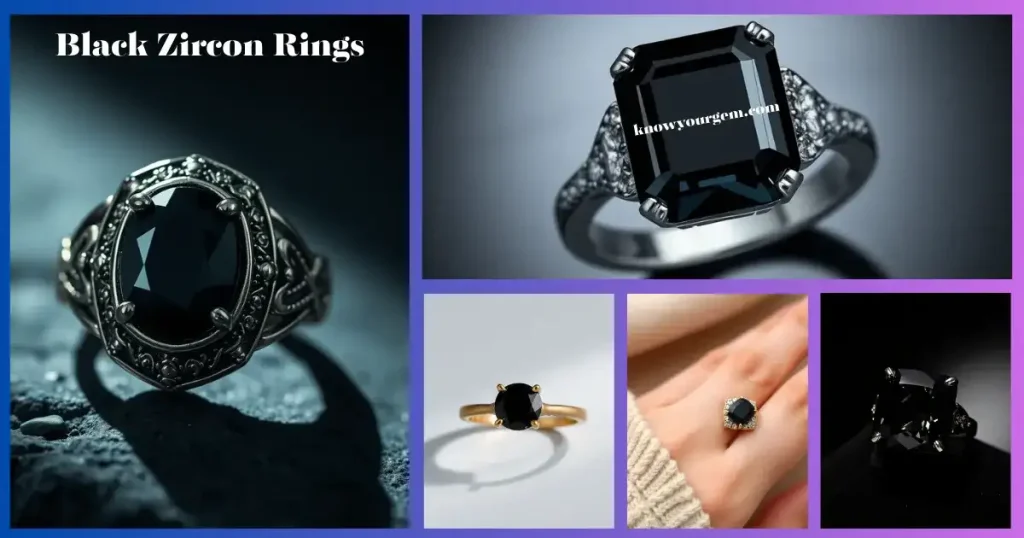
Rings:
Design Considerations:
Black zircon makes a bold statement in ring design, when it is paired with yellow gold, its dark beauty stands out as centerpiece and captures an attention with the elegance and depth, all without the high price tag of black diamonds.
Recommended Settings:
- Bezel settings provide maximum edge protection.
- Halo designs with having small diamond or white zircon accents to enhance visual impact
- East west orientations in horizontal bands offer a contemporary look.
- Cathedral or elevated settings minimize impact risk.
- Metal Pairings: The choice between metals dramatically affect the entire aesthetic. Although, Yellow gold (14K or 18K) creates warm, vintage inspired contrast, while white gold or platinum emphasizes the stone’s dark purity. Black rhodium plating over sterling silver produces a monochromatic Edge appearance popular in alternative bridal jewelry.
- Men’s Jewelry: Black zircon suits masculine ring designs particularly well, and offers substance and visual weight without feminine associations. Signet style rings, architectural settings, and minimalist bands all showcase the stone effectively.
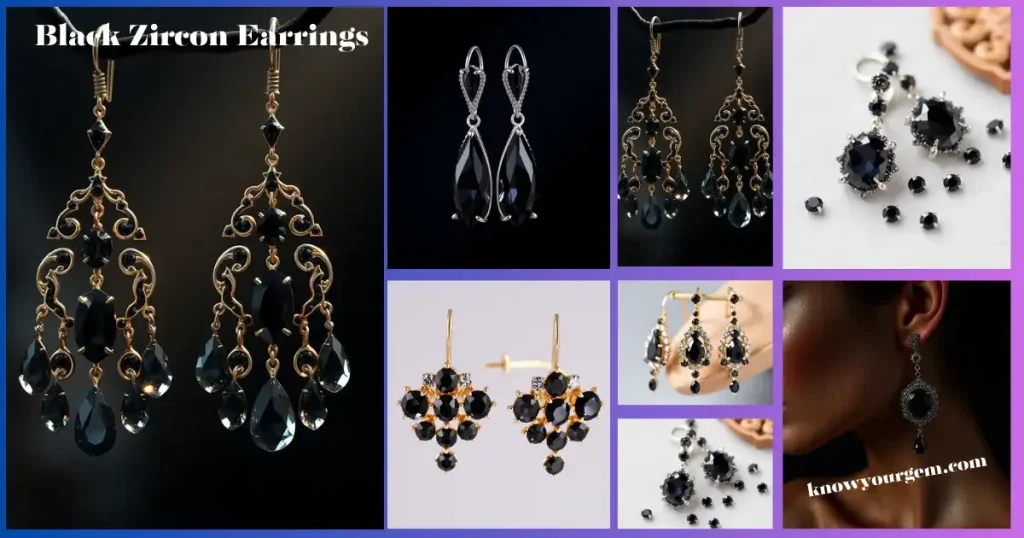
Earrings:
Earrings usually represent an ideal application for black zircon because they are believed to avoid most impact and abrasion risks. The stone’s brilliance catches light with head movement and creates a subtle visual interest.
Popular Styles:
- Stud earring styles like round, cushion, or princess cuts.
- Drop earring styles with having black zircon as the primary focus.
- Halo styles are believed to combine black centers with the clear accent stones.
- Chandelier designs generally incorporate multiple black zircon elements.
- Black and white earrings pair opaque black specimens with colorless zircon accents, maximizing fire and contrast.
Black and white earrings pair opaque black specimens with colorless zircon accents, maximizes fire and contrast.
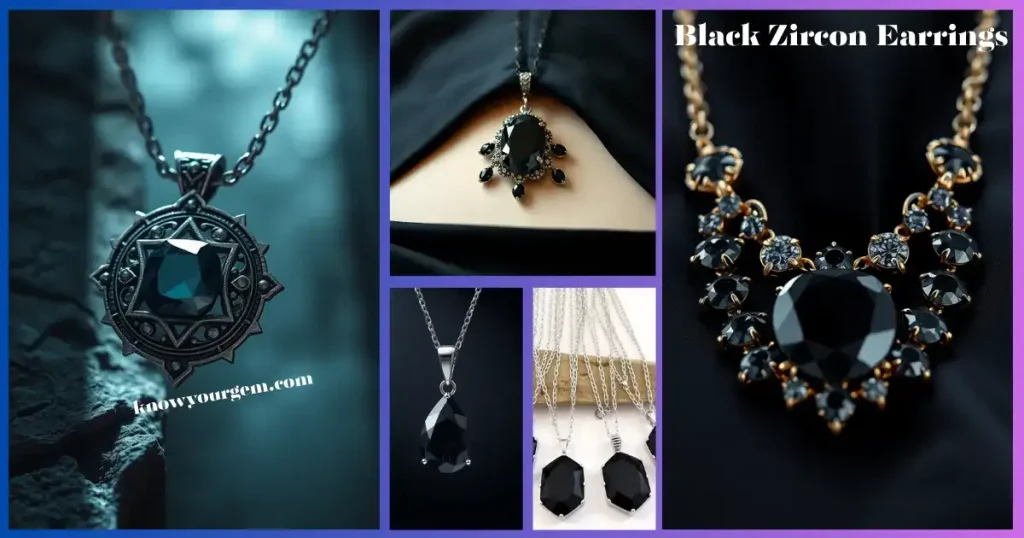
Pendants:
Versatile Applications:
Pendants enable larger stones to be showcased without structural concern. However, a substantial black zircon pendant can serve as a statement piece that can maintain a reasonable price even at sizes exceeding five carats.
Design options:
- Solitaire pendants highlight a single spectacular stone
- Geometric designs incorporating black zircon with architectural metalwork
- Vintage inspired settings with filigree or milgrain details
- Modern tension settings that appear to suspend the stone.
Black zircon necklace designs range from delicate chains with small accent stones to the bold statement pieces can feature large central gems which are surrounded by complementary materials.
Jewelry Sets:
These are coordinated sets and feature black zircon to establish cohesive personal style. Although black zircon jewelry set options typically include matching earrings, pendants, and rings, which allow wearers to choose pieces like individually or embrace the complete ensemble.
Cut styles that maximize brilliance:
Even in opaque materials, proper cutting can significantly impact visual appeal:
Optimal cuts:
- Round brilliant maximizes light reflection from surfaces.
- Cushion cuts blend traditional elegance with modern appeal.
- Emerald cuts create sleek, sophisticated linear refletion.
- Cabochon cuts emphasize smooth, lustrous surfaces. (less common for black zircon)
Black zircon stud earrings typically feature round brilliance visual from the front.
Difference Between Black Zircon Vs Black Diamond vs Black Spinel:
It is must to understand that how black zircon compares to the alternative dark gemstones help consumer select the option best suited to their priorities and budget.
Comprehensive Comparison:
| Property | Black Zircon | Black Diamond | Black Spinel |
| Natural Origin | Yes (usually heat-treated) | Yes (natural or treated) | Yes |
| Mohs Hardness | It ranks 6–7.5 on the Mohs scale of hardness | It ranks 10 on Mohs scale | It ranks 7.5–8 on Mohs scale |
| Brilliance Type | Adamantine luster | Adamantine luster | Vitreous luster |
| Price Range/Carat | $20–$150 | $300–$3,000+ | $50–$300 |
| Optical Character | High fire, strong dispersion | Reflective, less fire in opaque | Lower dispersion, smooth appearance |
| Durability | Moderate, brittle | Excellent | Good |
| Prestige Factor | Emerging recognition | High | Moderate, growing |
| Daily Wear Suitability | Requires care | Excellent | Good |
| Maintenance | Gentle cleaning needed | Durable | Moderate care |
| Market Availability | Good availability | Limited for quality | Moderate |
Detailed Analysis:
- Black Diamond: The prestige choice, natural black diamonds believed to offer unmatched durability and brand recognition. However, various black diamonds undergo irradiation or heat treatment to achieve color, and prices significantly exceed back zircon. Choose black diamond when durability is paramount and budget allows.
- Black Spinel: A middle ground option, spinel offers better hardness than zircon with the lower prices than black diamond. Natural black spinel provides excellent durability for daily wear. Some consumers prefer spinel’s smoother appearance, while others favor zircon’s higher fire.
- Black Zircon: The value leader, black zircon delivers genuine gemstone status and exceptional optical properties at accessible prices. So, it is best suited for occasional wear jewelry or consumers prioritizing visual impact over maximum durability.
Prestige Considerations:
Whether black diamonds are considered as the luxury market, educated consumers increasingly recognize black zircon and black spinel as legitimate alternatives rather than inferior substitutes.
Price & Value of Black Zircon:
It is must to understand that black zircon price helps to consumers set realistic budgets and identify fair market value versus overpriced offerings.
Price Per Carat Ranges:
General Market Pricing:
- Commercial quality: $20-$50 per carat
- Fine quality: $50-$100
- Exceptional specimens: $100–$150+ per carat
These ranges reflect retail prices for faceted, jewelry ready stones. Black zircon raw material costs significantly less but requires a professional cutting to achieve finished appearance.
Factors Affecting Value:
1. Cut Quality:
Professional cutting that maximizes brilliance and minimizes visible inclusions that command price, poorly proportioned stone with asymmetry or surface blemishes sell at discounts. Well executed cuts with an excellent polish demonstrate higher per carat values.
2. Origin:
Stones from historically significant sources like Cambodia, Sri Lanka sometimes carry modest premiums, since treatment standardizes appearance sufficiently that origin affects value less than with colored gemstone varieties like sapphire or emerald.
3. Treatment:
As we have discussed earlier, virtually all black zircon undergoes heat treatment. This is so standard that treated stones are valued the baseline, not at discounts. Genuinely untreated dark zircon might command premiums among collectors if the stone is properly certified, since market demand for this distinction remains limited.
4. Clarity:
In opaque black zircon, traditional clarity grading owns limited applicability. However, surface, quality, freedom from fractures, and structural integrity all influence desirability. Stones with having visible cracks or damages sell at significant discounts.
5. Size:
Not as same as diamonds, zircon doesn’t exhibit an exceptional price increases at the larger sizes. A well cut five carat black zircon can cost only 2-3 times whether one carat stone costs, rather than 25 times more as with diamonds which makes larger statement size stones remarkably affordable.
Investment vs Fashion Stone Reality:
Realistic Expectations:
Black zircon should be purchased primarily for its aesthetic appeal and personal enjoyment rather than investment potential. It is not like rubies, sapphires, or diamonds, zircon hasn’t established as a strong secondary market or demonstrated consistent appreciation.
Fashion Stone Status: Black zircon functions well as a fashion gemstone beautiful, and suitable for creating distinctive jewelry that reflects the personal style without significant financial risk.
Consumers who are seeking to invest on grading gems should consider established documented price appreciation, certification standards, and active resale channels. Black zircon excels as an accessibly priced gemstone for personal use, not as a financial asset.
Price Context:
Relative to other natural gemstones, but it is not expensive, because black zircon represents one of the affordable genuine options available, which makes it accessible to budget conscious consumers while still offers an authentic geological origin and attractive optical properties.
How To Identify A Real Black Zircon?
Authenticating black zircon can help to avoid purchasing misrepresented cubic zirconia, glass, or other simulants marked under misleading names.
Weight Test:
Black zircon’s high specific gravity like (4.6-4.7) provides the most accessible field test. So, one carat black zircon will feel noticeably heavier than cubic zirconia like (5.6-6.0) or glass (approximately 2.4-2.8) of the same apparent size.
How to Perform: You can compare suspect stone to the known materials of the similar size. Whether this test requires experience to the calibrate expectations, the density difference is significant enough that various people can detect it with practice.
Fire Observation:
When you are examining a faceted edges where thin sections allow light transmission, genuine zircon displays an exceptional dispersion flashes of rainbow color. Even predominantly opaque specimens can showcase this effect at the edges. Cubic zirconia exhibits brilliance but with vary optical characteristics.
Loupe Inspection:
Professional jewelers 10x magnification to know internal characteristics:
What To Look For?
- Natural growth patterns or included crystals that indicates natural origin
- Wear patterns consistent with hardness since, harder synthetic showcase different abrasion
- Doubling of facet edges when view through the stone.
Surface Luster:
Zircon’s adamantine luster produces a distinctive diamond like surface reflectivity. Glass and lower quality synthetics typically showcase vitreous (glassy) instead of luster.
Under Black-light:
Zircon under black light ultraviolet radiation sometimes exhibits fluorescence, since responses vary. This test alone can’t definitively identify zircon but can rule out certain glass simulants that fluoresce differently or not at all.
Certification Importance
For significant purchases, request certification from recognized gemological laboratories:
Trusted Certifiers:
- Gemological institute of America (GIA)
- American Gemological society (AGS)
- International Gemological Institute (IGI)
Certificates Should Specify:
- Natural zircon (not cubic zirconia)
- Treatment status (heat-treated)
- Measurements and weight
- Basic optical properties
Warning: Getting certificates from unknown laboratories can unreliable. Research any certifying organization before trusting their authentication.
Professional Testing:
When doubt exists, consultation with the certified gemologist provides definitive identification. Professionals use refractive index testing, specific gravity measurement, and spectroscopic analysis to the distinguish zircon from simulants with certainty.
Care, Cleaning & Maintenance:
Proper maintenance extends the life and appearance of the black zircon jewelry whether preventing damage from inappropriate handling.
Safe Cleaning Methods:
Cleaning schedule:
- Get ready lukewarm water with mild dish soap
- Keep jewelry in that water for 10-15 minutes
- Use soft toothbrush to gently remove debris from settings and behind stones
- Rinse thoroughly under running water
- Pat dry with lint-free cloth
- After done each thing you must need to dry it with air before you store it.
Frequency: If you want a shiny look on your jewelry you must need to clean it every week with regular wear, or whether visible soil accumulates.
Avoid:
Prohibited practices:
- Ultrasonic cleaners because vibrations can exploit existing fractures or cause brittleness issues.
- Steam cleaners because thermal shock risk from rapid temperature changes.
- Harsh chemicals because chlorine bleach, ammonia, or acidic cleaners can affect treatments or metal settings.
- Abrasive materials because rough cloths or brushes can scratch zircon’s moderately soft surface.
Storage tips:
Proper storage:
- Store black zircon stone in a separate place, since harder stones can damage it.
- Use fabric-lined jewelry boxes with individual compartments.
- Wrap pieces in a softer cloth if you are storing multiple items together.
- Avoid extreme temperature environments. (attics, car glove boxes)
Daily wear Precautions:
Best practices:
- Wear off rings before doing any heavy manual labor exercise, or cleaning with harsh chemicals.
- Applying lotions, perfumes, and hairspray is best before putting on black zircon jewelry.
- Wear off jewelry before swimming
- Avoid direct impact against hard surfaces
Professional Inspection:
Annually schedule professional inspections for frequently dairly wear jewelry because a Jeweler can detect:
- Loose settings requiring tightening
- Early fracture development
- Worn prongs needing rebuild
- Accumulated debris professional cleaning can address
Re cutting and Re-Polishing:
Surface scratches accumulate over years of wear can sometimes be removed through the professional re polishing. Although, this process removes a microscopic layer from the surface, restoring original brilliance. Be aware that repeated re-polishing gradually reduces the stone size.
Experience based advice:
Real-world Reality: Black zircon in protective settings (pendants, earrings) requires minimal special care beyond occasional cleaning. Rings worn daily will eventually show wear at facet edges regardless of care quality.
Alternatively, reserve back zircon rings are a better choice for special occasions.
Sustainability & Ethical Sourcing: (2026 Requirement)
As people grown more aware of jewelry ethics, it is must to know how black zircon is sourced to help people for buying it.
Mining Practices:
Zircon extraction typically involves placer mining, recovering stones from alluvial deposits using water-based separation techniques. Although this method generally creates less environmental disruption than hard rock mining requires excavation or chemical processing.
Environmental Considerations:
- Placer mining disturbs riverbeds and surround ecosystems.
- Water usage and potential contamination affect local watersheds.
- Land rehabilitation after mining determines long term environmental impact.
Many zircon comes from small mines in Southwest Asia, where conditions range from fair family work to exploitative practices.
Ethical Sourcing Concerns:
Colored gemstone like zircon doesn’t has the same certification systems as diamond, so it is bit tough to prove they are ethically sourced.
Key Questions:
- What is the mine of origin?
- Can the seller document supply chain?
- Were miners paid fairly?
- What environmental protections exist at source?
Transparency expectations:
In this current situation, consumer demand drives supply increases and chain transparency. Progressive jewelers respond by:
- Documenting source where possible
- Partnering with ethical mining operations
- Supporting third-party certification initiatives
- Educating customers about sourcing realities
Realistic Perspective: Complete supply chain visibility remains challenging for entering markets through the complex dealer networks. Perfect ethical purity is often unattainable, but supports businesses committed to continuous improvement and advancing industry standards.
Lab testing vs synthetic clarity:
Important Distinction: Black zircon virtually always natural material which has been heat treated , not laboratory created synthetic. True synthetic zircon exists but remain uncommon in jewelry markets due to production costs exceeding natural zircon prices.
Laboratory grown alternative to zircon include cubic zirconia (completely different material, or potentially synthetic moissanite (also different composition). These lab grown options eliminate mining related concerns but represent fundamentally different products from genuine zircon.
Consumer Action:
Supporting ethical practices:
- Ask retailers about source and encourage transparency.
- Support sellers who are committed to the ethical practices even at modest price premiums
- Value longevity: well-made pieces worn for decades reduce the entire consumption
- Consider antique or estate jewelry to avoid new extraction
The gemstone industry continues evolving toward accountability. Consumer demand for ethical source derives this progress more effectively than any other factor.
Frequently Ask Question:
1. Is black zircon rare?
Natural black zircon is pretty uncommon, but heat-treated zircon can create black zircon that looks stunning and is hugely available. So whether untreated stones are rare, you will not have trouble finding the treated version in stores.
2. Can black Zircon scratch?
Yes, it can, because it owns hardness of 6-7.5 which means that it is tougher than materials but still softer than quartz, sapphire or diamond means everyday dust or harder stones can leave marks. A protective setting and mindful wear go a long way in keeping it beautiful.
3. Is black zircon valuable?
Black zircon holds moderate value. Although it is a genuine, more valued than synthetics, but it is not in the same league as black diamonds or high end colored gems. Its work comes from its natural origin and eye catching look, not from rarity or investment potential.
4. Is it suitable for engagement rings?
Black zircon works well in engagement rings if you set realistic expectations, because it is not as like diamond, but it is best for rings which are worn on special occasions rather than every single day.
5. What is the difference between zircon and cubic Zirconia?
Zircona is a natural mineral formed for more than million of years. Cubic Zirconia, on the other hand, is man made in labs. Although, they sound similar, but zircon is true gemstone, whether cubic zirconia looks like diamond.
6. Does black zirconium fade its color?
Nope, the color of heat-treated black stays stable under normal wear. Just note: black zirconium used in wedding band are different material altogether; it is a metal, not a gemstone. both are durable but don’t confuse the two.
7. How does black Zircon compare to black Zirconium for Wedding Bands?
They are totally different. Since a zirconium band is made from metal treated to form a tough black ceramic layer. Although black zircon is a gemstone that can be set into rings but it is not used as the band itself.
9. Can Scorpios Wear Zircon?
Astrology owns mixed opinions here. Some traditions say zircon suits Scorpios, others suggest varying stones. There is no science behind it, so the best rule is simple: wear black zircon if you love how it looks, zodiac aside.
10. What are the benefits of black zircon?
Black zircon offers spiritual protection by shielding against negative and grounding the wearer through root chakra connection, whether the chakra can boost self confidence and emotional stability. Although, it also promotes prosperity, wisdom, and physical healing for issues like fever or stress which makes it a popular December linked Venus.
11. Is black Zirconia Expensive?
Black Zirconia, a synthetic lab grown stone, remains very affordable at around $20 per carat, far cheaper than the natural gems. It is not like as natural black zircon (up to $200 per carat), it lacks significant monetary value due to mass production.
12. Is Zircon a Fake Diamond?
Nor and and neither, because zircon is a natural gemstone with having its on mineral composition (zirconium silicate), distinct from diamonds in hardness and origin.
13. What is a Poor Man’s Diamond?
Cubic zirconia (CZ) is widely known as the “poor man’s diamond, ” sparkling at a fraction of the cost. Although it is a budget friendly synthetic alternative valued for its affordability without diamond rarity or durability.

Welcome to KnowYourGem.com! your ultimate destination for uncovering the fascinating world of gems and their secrets! I'm Kamil Hussain, a passionate blogger with a Master’s degree in Economics, dedicated to bringing you insightful, well researched content that blends the beauty of gemstones with the art of storytelling. With a keen analytical mind and a love for discovering hidden treasures, I created this platform to help you explore the brilliance, history, and value of every gem.

