

Quick Answer:
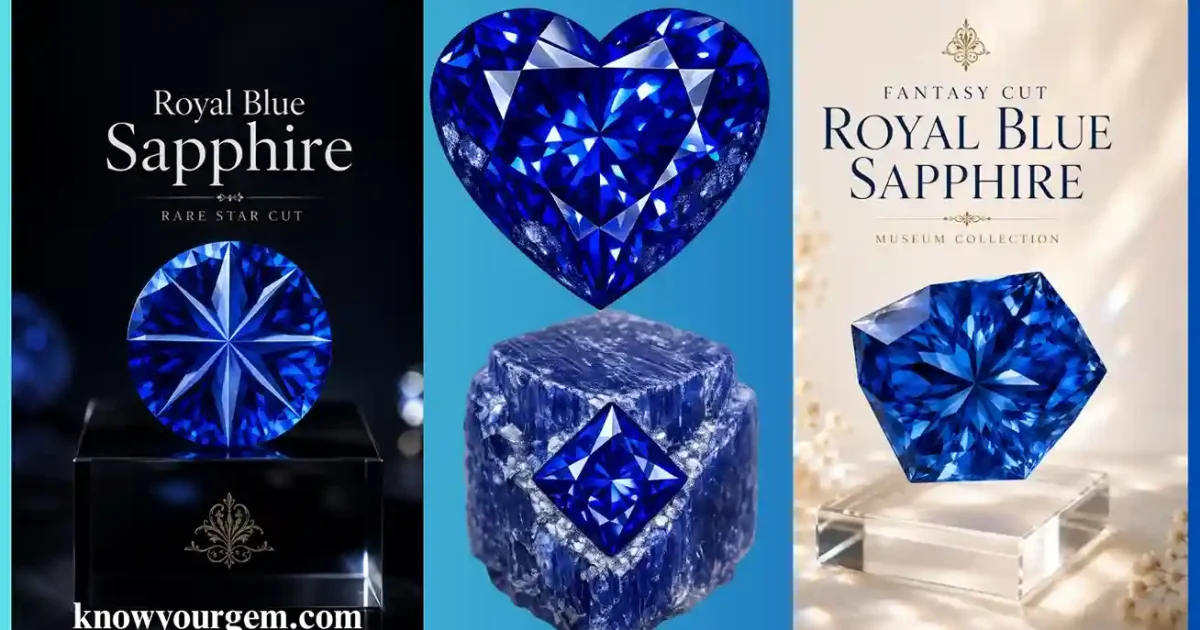
The Royal Blue Sapphire will have a pure deep blue color ranging to vivid, velvety, and uniformly colored without making the perception that it is too dark or grayish in tone. This color balancing is rarely found in raw sapphires, especially those originating from Ceylon or Burma, particularly.
Key Takeaways:
- Hardness: Royal Blue Sapphire is hard with a 9 Mohs scale.
- Color: An intense to medium dark, highly saturated velvety Blue stone establishes fine sapphire color.
- Price: The price of this can depend on its quality, color, size, and transparency. So a commercial-grade stone can command a few dollars per carat, but gem-quality material is sold for more than $10,000 per carat.
- Source: Mostly sapphire stones come from Ceylon and Burma, but their traditional, well-known source is Kashmir, where sapphires are relatively found in high-quality.
- Jewelry: The stone is popularly worn as engagement rings, tennis bracelets, halo earrings, and diamond satin bands.
- Certification: Buyers should go with those sellers who are reliable to have certification from laboratories such as GIA, AGL, Gübelin, or SSEF can charge extra.
- Lab-created: Some people call this a “synthetic” stone; it is a chemically produced stone that is made in a lab environment, but a lab-created stone can never compare to the meaning or value that a Royal Blue Sapphire holds.
Introduction:
The Royal Blue Sapphires have a reputation as only a few true matches. It is a variety of sapphire, yet the name itself tells us that it is a very deep, velvety quality for which jewellers use as their benchmark, and buyers essentially select a colour grade before the material.
On to price, there is no question; because in certain saturation, origin, and processing, the price of Royal Blue Sapphire can be ranging from a few hundred dollars per carat up to five figures each. Therefore, knowing such factors is a separate deal from paying the body of stones that look nice in photos.
What Is a Royal Blue Sapphire?
“Royal blue” is a commercial name given to blue corundum. It possesses a medium dark tone, a vivid saturation and no gray or black overtones. It is the usual color used by auction houses and laboratories to characterize the best shade of sapphire.
The most other sapphires appear to have too light and too washed out tones and appear to be too dark black however Royal blue appears remain cobalt tones in daylight, store illumination and candle light.
It creates the special and excellent royal blue and is irreplaceable without other scting or dull color components. It is rare to be obtained from several own locations that receive excellent grading.
Royal Blue Sapphire Color:
The hue, tone and intensity of blue sapphire is sometimes used to assess its color. This is based on the fact that although the term ‘Royal Blue’ describes a pure blue with very little violet and green, having a dark tone of about 75-85%. And vivid saturation, it has a velvety color weight.
It is a matter of consistency. The common sapphires can be rather, or too light or too dark or have a gray tint, while the stones of Royal Blue variety look more evenly saturated face-up and remain lively under any illumination; the virtually perfect stones were totally effective as well.
Royal Blue vs Sapphire Blue:
The term “sapphire blue” applies to all blue corundum, from pale cornflower to dark blue to “blackish blue”. All Royal Blue is a subset of “blue corundum” so-named: high overtones, strongly saturated, evenly distributed.
| Feature | Royal Blue | Sapphire Blue (general) |
| Tone | It has a color tone such as Medium to medium-dark(75-85%) | However its color is from very light to very dark. |
| Saturation | It is vibrant, bright, strong with little gray saturation. | It may be subdued, dull or grayish depending on the content. |
| Market value | It is sold for highest price. | But it sell by a wide range of different criteria (mostly by commercial grade) |
| Rarity | It is rare, principally when not treated. | It is more prevalent at all lower color grades. |
Rarity of the Carat: It is rare, principally when not treated. It is more prevalent at all lower color grades. Bottom line is this: all of the Royal Blue Sapphires are considered in the sapphire blue family, but very few of the sapphire blue stones are actually Royal Blue. Listings tend to overuse the term so it should always be verified in the lab report or viewed firsthand rather than go by title.
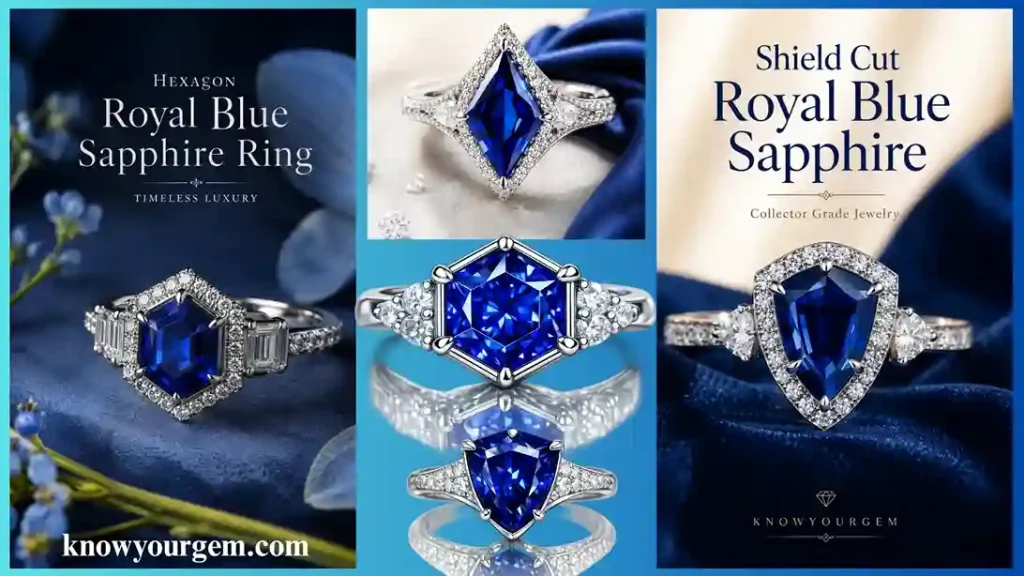
Royal Blue vs Other Blue Sapphire Color Names:
The use of overlapping color terms in the trade of sapphire is significant. Knowing how the ‘Royal Blue’ differs from other gems with that designation helps to prevent potential buyers from overpaying for a stone that is not actually in the highest color range.
| Color Name | Tone | Saturation | Typical Character |
| Royal Blue | Royal Blue Grid of medium to medium-dark | high, vivid. | It is rich, velvety saturated “blue38” |
| Cornflower Blue | Blue Light to Medium Light | Medium high soft | Color is Bright, semi-violet blue, to Kashmir. |
| Vivid Blue | Vivid Blue Medium is highly rated for the pure glow | Very high | But intense blue with holding a slight bluish-green cast and little to no gray is lower quality. |
| Velvety Blue | Velvety Blue Medium-dark | High | This describes a texture that is soft and glowing, which can be observed in Burma stones. |
| Dark Blue | Dark Blue Dark | Variable | It is a dark tone, and if the saturation gets lower, it may become dull. |
| Midnight Blue | Midnight Blue Very dark | Low to medium | It is almost black in dull illumination, tends to be used for high effect rather than accurate pictorial color correction. |
The cornflower is associated with the Kashmiri rubies which show a gentler, luminous blue, with faint mauve tones. As blue is for feel, not for colour, it is found in beautiful moulted fine heavy Burmese Royal Blue stones.
Midnight Blue and dark-to-dense blue sapphires are also not part of the Royal Blue range, since their heavy tone produces surface brilliance and light return that can still be appreciated by those seeking a bold, dramatic effect.
Where Are Royal Blue Sapphires From?
Origin is often responsible for both a higher character and a more expensive value for each Royal Blue Sapphire, with just a few origin accounts for most of the fine color market:
Ceylon (Sri Lanka):
The origin yields some of the most iconic Royal Blue material on the planet, often possessing a superb brilliance and just a touch deeper, brighter shade of blue than Burmese material, and a slightly lighter, livelier hue. Ceylon Royal Blue Sapphires are found in every grade of material from cheap commercial stones to museum quality specimens.
Burma (Myanmar:
It is associated historically with the most intense, highly saturated color of Royal Blue; it is sometimes referred to in commerce as “Burma Blue” or “Pigeon Blue”. Burma sapphire from Mogok Valley has a notably velvety surface quality and displays high degrees of fluorescence in some light sources.
Kashmir:
This is where in between 1870 and 1930, the world’s only source of sapphires was extracted on a small scale and was the rarest and most costly material in the world. The stones of Kashmir display a unique gentle, sleepy blue with a velvety sheen that, no matter the size, collectors and auctioneers were content to call the finest quality of sapphire color.
Madagascar:
This origin has now risen as an obligatory contemporary source, providing the Royal Blue material comparable to other more traditional sources for color quality but at greater attractiveness in price, as the deposits have only been known to the public from the 1990s and haven’t accumulated the same historic premium.
Australia:
It is capable of producing blue sapphire in large quantities because it typically produces darker secondary tones of green or back, making true Royal Blue material less common from the source. Like Thailand it has become primarily a cutting and treatment center rather than a mining country in recent times as early Thai deposits produced excellent blue material.
Which Gems Come From Burma?
Burma’s Mogok region is legendary for producing colored gemstones. In these varieties Ruby remains its most famous Burma (Mogok) is the world market to finest (colored) gemstones. Of those, in the rubies still top the export line by high value in the world market, even for centuries by an auction price, But selling out blue, as well as other colors of sapphire, is a geological belt.
The 4th position is for ‘Spinel’. For a long time, it was overshadowed by ruby; lately, it gets collectors’ attention as it has bright red, pink colors. Jadeite from north Myanmar is going to be the ‘King’ in the fine jade market (Chinese, Asian jewelry market).
As for this line, Burma Sapphires have a prestige, but the Mogok deposits are the deepest and most velvet, most royal blue, differing in their peculiar trace-element chemistry.
How Royal Blue Sapphire Forms?
Sapphires are a different gemstone type because they form through the same process as rubies. They are also a kind of Corundum with the formula of aluminum oxide (Al 2 O 3). Other elements such as iron and titanium, substituting the aluminum, account for the predominantly blue color.
The levels of these trace elements determine the ranging from a very light blue to a deep Royal Blue or nearly black, hence differing appearances of sapphires originating from one deposit.
Formed deep beneath the earth at incredible temperatures and pressures over thousands of years, sapphires are usually found in similar bands of metamorphic rocks, or associated with deposits of basalt. Because of their long formation period and their hot formation process, they can often be of greatly different colour even between sapphires from the same deposit.
Raw Sapphire:
Most rough sapphire crystals exhibit the shape of a six‐sided prism, barrel or snap‐shaped, with rough, flaky, blurred surface, obscuring the true color and clarity of the stone. This is the normal crystal habit of corundum, in some cases tapering or terminating with pyramidal points.
Prior to cutting, a sapphire just shows a foretaste of how beautiful it will be. Because a skilled cutter carefully examines the internal structure and color zoning and then angles the cut to achieve maximum brilliance and face-up color, choosing the cut can significantly affect the value of a Royal Blue Sapphire.
Royal Blue Sapphire Gemological Properties:
| Property | Value |
| Mineral family is | Corundum |
| Chemical composition | Royal blue sapphire’s chemical composition is Aluminum oxide (Al₂O₃) |
| Mohs scale on | 9 |
| Crystal system is | Trigonal |
| Transparency | Royal blue Sapphire is transparent to translucent |
| Cleavage | The stone has no cleavage |
| Durability | Sapphire is excellently durable; its 9 Mohs hardness allows it to be worn as daily rings. |
Also, different from diamond or emerald, because it has no cleavage, which means that it doesn’t split along weak planes, as this strong resistance to chipping generally adds to its reputation as a secure and lasting choice when it is set properly.
Royal Blue Sapphire Refractive Index:
Based on gemologists’ perspective tests, the most essential test for every stone is its refractive index; in this way, sapphire is read between 1.762 and 1.770, with birefringence about 0.008-0.009.
Royal Blue Sapphire Specific Gravity:
It is one of the most crucial properties of the natural stone. Specific gravity generally measures the stone’s density relative to water.
However, on average, the specific gravity of sapphire is measured as 3.85-5.03, but the SG of many other stones like spinel or blue topaz with similar appearance only have 3.60 and 3.53, which means that sapphire is heavier than others.
The most accurate method of testing, employing a refractometer, can distinguish royal blue sapphire from the other blue gems with similar intensity.
As in this case, all these stones need to be used with a polariscope and a test of specific gravity to measure the values of Refractive Index, Birefringence, optic character, and density of all these stones, which normally represent a distinctive diagnostic signature.
How to Tell if a Sapphire Is Real?
In general, many gemologists look into the natural inclusions with a loupe to authenticate whether the stone is genuine or not. Natural specimens can reveal silk, angular zoning, or tiny crystals, while glass reveals bubbles and synthetics reveal curved growth lines.
A hardness and a thermal conductivity test of a stone also help eliminate softer or glassy counterfeits, as hardness testing is not recommended for the amateur.
Fake Royal Blue Sapphire: What Buyers Run Into
Numerous knock-offs generally travel under the ‘Royal Blue Sapphire’ name. Imitations made of glass are easiest to identify, such as the appearance of bubbles, swirl lines, and single refraction, while flame-fusion synthetics illustrate curvy striae, along with generally clear clarity that is cleaner than for natural stones.
Hydrothermal synthetics are far more difficult to identify than flame-fusion, and so the inclusions will resemble the natural silk, resulting in their appearance being that convincing close to those of a mined Sapphire to casual inspection.
Hence, the composite stones don’t only cover six sapphire faces as composition, but also accentuate the gaps between the pair of layered sapphires, like several double- or triple-layer stones combined with glass or synthetic cell bases, as follows.
The most reliable protection is purchasing from sellers who reveal the treatments and origins, and demanding lab certification for anything for more casual purchases, as good synthetic and fiber blends can often escape the eye.
Royal Blue Sapphire Certificate:
A Ruby Blue Sapphire certificate is a lab report verifying the origin, identity, any treatment, and pivotal characteristics of the stone. So buyers are advised to ask sellers for certification from trusted lab sources like GIA, IGI, AGL, Gübelin, and SSEF.
Gübelin and SSEF are the best origin report providers, especially for rare Kashmir, Burma, and Ceylon sapphires. However, AGL is the most reliable source for the US, providing detailed options for color and origin. As for GIA, they do certify sapphires. Their reports have:
- Species: natural corundum
- Variety: sapphire
- Weight, size, and color description
- Treatments (like heat, which greatly affects value)
Although GIA is the most well-known of the other labs for diamonds, its colored stone reports are also recognized worldwide. These can be crucial for the identification of a natural sapphire and in the valuation of a Royal Blue.
Royal Blue Sapphire Treatments Explained:
No doubt other factors are essential, but treatment is also one of them that affects the value of the stone slightly. Nearly all sapphires are heat-treated to make their color shine more.
It is a prevalent method of boosting the color and clarity of the stones. So the color can be enhanced by dissolving natural inclusions and harmonizing the natural tone.
- Heated vs Unheated: Heated sapphires tend to be inexpensive. Unheated (with natural color) are much more difficult to find and cost a huge premium, particularly if a lab report states “no heat.”
- Beryllium diffusion: A more aggressive process in which the Beryllium is diffused in during heating so the color change is more drastic. High-quality stones can be made to look low quality, but this needs to be disclosed and will attract a lower price than heated only or unheated stones.
- Surface diffusion: An antiquated technique where only the surface is altered; it had to be topical paint, as the hue can peel off or appear patchy if the stone is re-cut, which makes it unstable and devalued.
- Filler for a fracture: infrequently used in sapphire. Can be filled with glass or resin to increase transparency. Such stones require delicate care, as heat or cleaning can cause damage to the filler.
In the trade, the labs like GIA, SSEF, and IGS do accept heat treatment, but they disclose diffusion and fracture filling. These cause a loss of value of the stone in comparison to the absence of any treatment or the heating at relatively low temperatures of the sapphires.
Natural vs Lab Grown Royal Blue Sapphire:
| Factor | Natural Sapphire | Lab-Grown Sapphire |
| Price | It commands moderate to high prices like $3,000 to $17,000 | It reasonably low, as it is usually under $50 to $200 |
| Appearance | There are natural inclusions, some zoning, may also be treated color | While it has perfect or close to or mechanically uniform color. |
| Value | It has maintained and can still be valued higher particularly for untreated fine stones | Because it has no resale or investment value. |
Since a synthesized Royal Blue Sapphire is formed in a controlled laboratory environment over hours or days instead of a natural environment over thousands or millions of years, chemically and structurally it is identical to a natural blue sapphire.
Provides comparable hardness, brilliance and the potential of color at a fraction of the price, which makes it an attractive alternative for those looking to buy the look without having to go through the label or investment expectation.
The tradeoff is permanence of value: lab-grown stones don’t bring with them the history of the geological process of formation, nor the long-term love potential that comes with an ‘heirloom’ quality stone, and professional traders must specify that the stone is lab-grown on the receipt and/or certificate that will accompany it.
Royal Blue Sapphire Carat Price:
| Carat Weight | Commercial Quality | Fine Untreated Quality (Ceylon/Burma) |
| For under 1 carat, Royal Blue sapphire ranges in price from | $150 – $600 each | while that of an untreated stone can be as high as $800 – $2,500 each |
| A 1-2 carat Sapphire typically sells between | $500- $1500 | An untreated stone can be sold for as much as $2,000 – $6,000. |
| Sapphires 2-3 carats can command | $1,200 – $3,000 | Untreated stone can command $5,000 – $12,000 |
| Stone 3-5 carats typically worth | $2,500 – $6,000 | Untreated stone retails for upwards of$10,000 – $25,000 |
| Stone with 5 or more carats | Can attract widely varying prices | Untreated stone can attract $ 20,000- $ 100,000 or more. |
Royal Blue Sapphire pricing can change significantly based on four elements such as origin, treatment, the cut quality, and the accuracy of color. Those stones that maintain all of these factors bring an especially high value to the seller.
Is Royal Blue Sapphire Expensive?
The average wholesale price is $200 per carat at a good retailer and at an ordinary dealer. As for a fine Royal Blue Sapphire, the price would be $2,500.
The top grades of Royal Blue Sapphire are likely to be very costly, as it is hard to find in nature in such a specific shade, and the higher market demand by collectors, auction and fine jewelry customers generally exceeds the supply. Untreated stone from historic sources commands the highest prices, as heat treatment is generally used in most sapphires.
Origin, however, can alter the price of a stone hugely: Two stones that appear similar can differ five times in cost if certified Kashmir or Burma and the unlabeled. Certification alone increases confidence and future resale, as a certified stone claim of “Royal Blue” can also be proved.
Royal Blue Sapphire Jewelry:
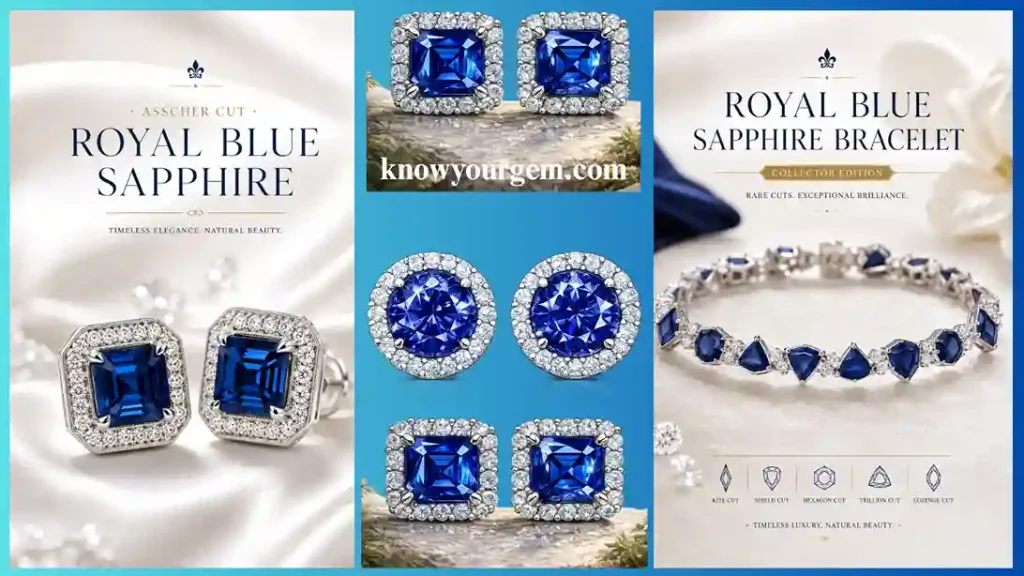
Royal Blue Sapphire has a presence in almost all types of jewelry, and is treasured for its true, classic blue hue. Rings remain the most prevalent type of jewelry, for example in the form of engagement rings and cocktail rings showing off the intense blue.
Necklaces & Pendants:
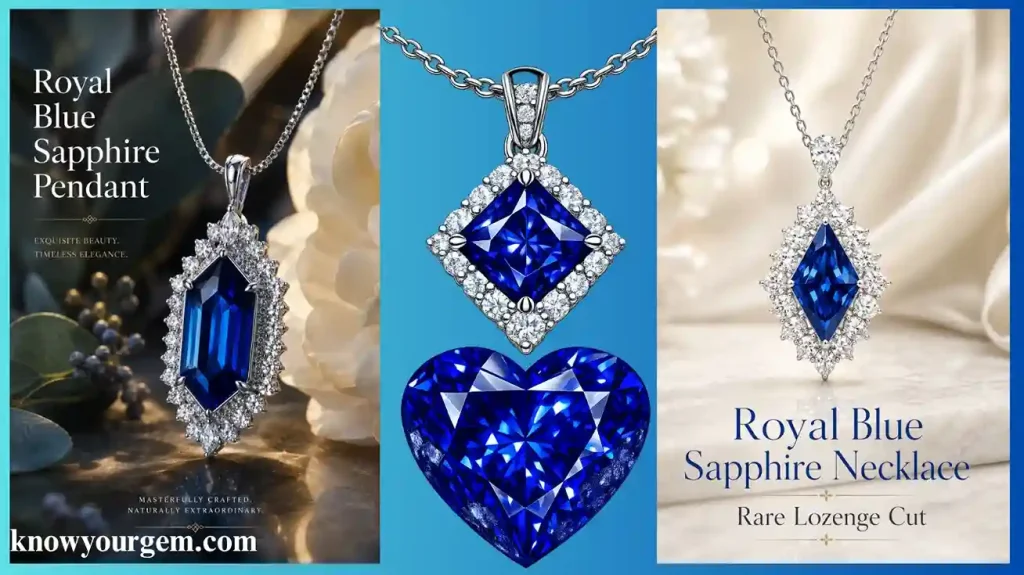
Usually a single sapphire but sometimes clusters paired with diamonds for contrast. Earrings – From the simplest studs to large, attention-catching dangle and halo effects, polished off with bracelets, often tennis-style bracelets showing a downward stream of color through matched stones.
Engagement Rings:
Royal blue sapphire is an alternative to a diamond, may be appreciated for its royal blue history and its hard durability of 9 Mohs. Picking the right protective setting, such as a bezel or sturdy prongs to pick up, is also useful.
Sapphire & Diamond Band:
It is a typical pair where diamond frame or alternative insides of sapphire add flash without orange counter-color to blue. It is most popular in wedding & anniversary bands.
Earrings:
Drop earrings with diamonds could be worn for formal occasions; nevertheless, halos with additional sparkle and loops could also be used for contemporary style in everyday life.
Stud Earrings:
One of the most popular and versatile jewelry pieces, it is often made in the glamorous platinum metal or white gold appealing tone, and this is a collector’s valued product.
Tennis Bracelets:
High, ornamental lines of matched sapphires, possibly interchanging with many matched gemstones of equal Royal blue color that provide expense and exclusivity.
Cushion Cut:
It is a preferable cut for sapphires as broad facets allow saturation to perform, whilst rounded corners lend it a plush appearance. It also retains more rough weight and so is often more economical / carat.
Cabochon Cut.
Sapphires with inclusions or displaying asterism are fashioned as smooth domes. Star sapphires are cut as a six-ray star and are almost hallowed as cabochons by collectors.
Blue Sapphire Royal Family:
Much of Blue sapphire‘s ‘royal’ connotation can be attributed to its association with the British Royal Family. The famous Ceylon Sapphire ‘engagement’ ring worn by Princess Diana of Wales was set with diamonds and was one of the world’s most celebrated stones in the 1980s and early 1990s.
It also passed on as Catherine, Princess of Wales, received the same ring from Prince William when he proposed. Since then, many sapphire engagement rings have been produced following high-profile engagements.
Royal Blue Sapphire Benefits:
The following reflect cultural and traditional beliefs rather than SCIENTIFIC fact. Ever since, it has been associated with wisdom, fidelity, and protection. In Vedic astrology, the blue corundum was linked to Saturn.
Market Trends:
Demand for fine color, untreated Royal Blue sapphires has grown throughout major auctions, with new records being established on rare Kashmir and Burma stones in the last ten years. Younger luxury buyers are using colored gems as a new way of both style and capital investment.
We only count the very top stones that are graded by color, clarity, and origin as investment-grade sapphires. Commercial Grade material, while collectible, is best enjoyed rather than appreciated.
Royal Blue Sapphire as an Investment:
The untreated sapphire will be the best for investment, most preferably if it can be sourced in Kashmir, Burma, or fine Ceylon, and has reliable certification from the GIA, SSEF, or the Gübelin. Thus, high-quality collector-grade stones with excellent clarity, a superb cut, and provenance will tend to be very highly priced.
Most common errors are to purchase sights unsold; believing you heated gemstones will respond as if they were untreated; return to seller without paperwork; be sure you research and crosscheck or have a knowledgeable party verify each of the 3 most important questions: Will my material respond favorably; Can I keep it long term for what I paid?
Buying Checklist for Royal Blue Sapphire:
- Color: Always search out bright blue, without gray or black tones, which shows best under daylight.
- Kind of Origin: It shows lab-verified origin, such as Kashmir, Burma, and fine Ceylon, which carry much higher prices.
- Treatment: Request the flame to be enhanced with blue heat or other visual effects.
- Certificate: Always request a reputable lab such as GIA, IGI, AGL, Gübelin, or SSEF to provide a report when making a purchase of significance.
- Cut: Need to test/observe the proportions and the symmetry; the cuts are not sharp enough and dull anything, including fine color
- Carat: It is essential to keep in mind that the price per carat increases significantly at higher ranges
Care & Cleaning:
- Cleaning: Just clean this with a gentle amount of lukewarm soapy water and a soft brush. Ultrasonic cleaners or steam cleaners are good for untreated or heat-treated material, but don’t use them on fracture-filled sapphires or stones with lots of inclusions.
- Storage: Keep sapphires in a way that they can not be scratched by other softer gems.
- Checks: Examine the points and settings regularly (by a jeweler) to prevent losses.
Pros & Cons:
| Pros | Cons |
| Sapphire has excellent hardness (9 Mohs) for everyday wear | But fine unheated gems can be very costly |
| The stone is Q width of pricing within each quality level | But the color quality is enormous, and it needs screening. |
| It can be traced back to its origin and treatment to gain a robust history and culture | However, the approach and source will be hard to prove without the certification. |
| It has no cleavage that makes it stronger scratch resistance | But lab grown alternatives can be misrepresented as natural without disclosure |
| It has no cleavage, which makes it more resistant to scratches | lab-grown equivalents can be passed off as naturally occurring without mention |
Conclusion:
Main reasons for the Royal Blue’s worth include its rarity, toughness and colour; however, its valuation is heavily weighted by factors like origin, treatments and certification- descriptors that you won’t be able to gauge just from a photo. It is important to purchase from a reputable retailer and seek an independent report.
FAQs:
1. What is a Royal Blue Sapphire?
It is a blue corundum with a medium to medium dark tone and a vivid, highly saturated color; it is considered the highest color grade for blue sapphire in the trade.
2. What is Royal Blue Sapphire Color?
It has a fixed balance of hue. Since value and saturation come from a true blue that can appear fairly yellowish, darkish, and bright without an excessive amount of grey masking.
3. Is Royal Blue Sapphire Expensive?
Commonly high-priced when found as a rough, particularly in the untreated state from Kashmir or Burma, but there is a readily available range of commercial-grade stones starting at a lower cost.
4. How to Tell if a Sapphire Is Real?
Initially, you should identify the presence of natural inclusions. A quartz stone with natural inclusions is real; it will be fake.
5. What is a Ceylon Royal Blue Sapphire?
Again, a royal blue sapphire but named differently, as it is only found in Sri Lanka.
6. What is a Burma Sapphire?
It’s a 9.02ct sapphire that generally comes from Mogok Valley, Myanmar, reputed to produce the most profound, most velvety Royal Blue in the trade.
7. What is a Raw Sapphire?
It is a natural, uncut stone body of sapphire, which is usually a purple or blue hexagonal prismatic crystal, with a dull, cloudy exterior before cutting and polishing.
8. What is a Lab Grown Royal Blue Sapphire?
It has the same chemical makeup; it has been man-made and gives the same hardness and look as natural sapphires and costs a lot less without any value of rarity.
9. Does GIA certify Royal Blue Sapphires?
The GIA colored stone report identifies the stone’s species, identifies any treatments, and records important quality parameters such as color and cut.
10. What is the Royal Blue Sapphire Carat Price?
It is valued at the rate of $150 per carat for quality stones, but for merchandise stones it may be up to USD 20,000 per carat depending on the size; if the size is larger, the rate becomes higher.
11. Which Royal Blue Sapphire Cut is Best?
Round and oval are also frequently used for color saturation purposes. Cushion cut is very much appreciated for this purpose.
12. Are Royal Blue Sapphire Earrings Good for Daily Wear?
Yes. It is tough enough for day-to-day wear jewelry, as the 9 Mohs hardness of the stone is appropriate for day-to-day wear jewelry. Especially in secure stud settings.
13. Is a Royal Blue Sapphire Engagement Ring Durable?
Yes. Because this stone has no cleavage and is less hard, it can be used for an engagement ring.
14. What is a Sapphire and Diamond Band?
It is a type of ring that combines the use of sapphire with accent diamonds, which is how it is most generally used: wedding, anniversary, and halo rings.
15. Are Royal Blue Sapphire Tennis Bracelets Valuable?
Yes, once the stones are carefully well matched in color and size, though matching different stones may take some time, which would be value-added.
16. Is Heat-Treated Sapphire Still Valuable?
Yes, of the untreated stones, heat-treated stones are most appraised as a good, permanent enhancement, like the untreated stones that sell at a high premium.
17. How Can You Spot a Fake Royal Blue Sapphire?
For checking a stone for gas bubbles or curved growth lines, removing magnification, and checking double refraction, ask for lab certification on anything that is not a low-value purchase.
Gemstone collectors are advised to verify their stones with trusted labs like, GIA ,IGI, SSEF for authenticity, refractive index, ethical sourcing, grading, and inclusions! Gems Enthusiast KamilHussain

Welcome to KnowYourGem.com! your ultimate destination for uncovering the fascinating world of gems and their secrets! I'm Kamil Hussain, a passionate blogger with a Master’s degree in Economics, dedicated to bringing you insightful, well researched content that blends the beauty of gemstones with the art of storytelling. With a keen analytical mind and a love for discovering hidden treasures, I created this platform to help you explore the brilliance, history, and value of every gem.


[…] it right. Larimar is about 4.5 to 5 on the Mohs scale, softer than quartz and much less hard than sapphire or […]