
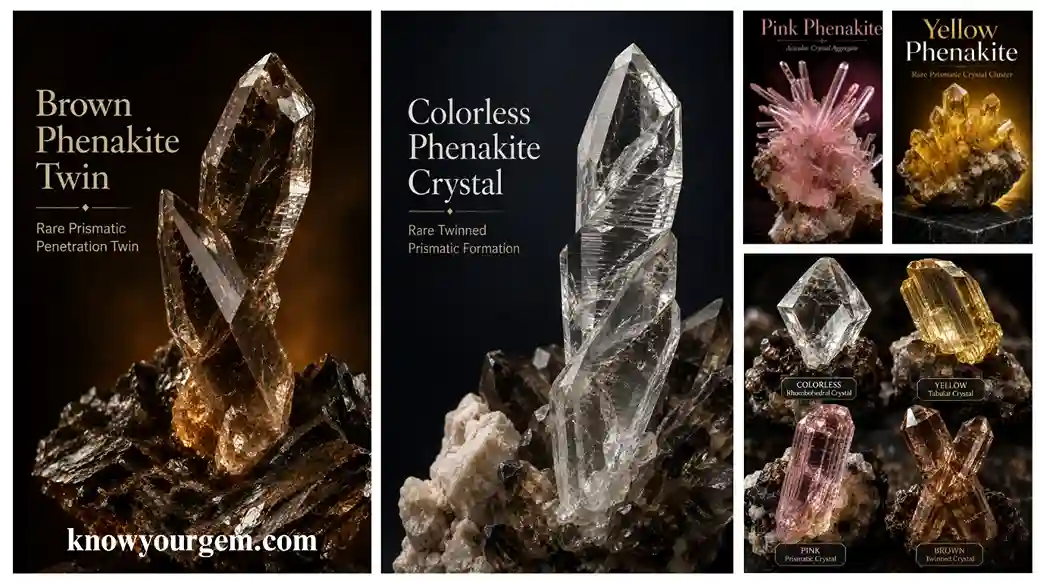

Phenakite sits between those stones that collectors always love to collect. It is a rare beryllium (Be₂SiO₄) that rockhounds rarely find. At first view, it can be confusing: brilliantly transparent and sparkling with high luster, it looks like quartz or even diamond.
The high refractive index, trigonal crystal symmetry, hardness of about 7.5-8, and limited supply of clean faceting rough make it an essential collector material.
This is not a mainstream gem, so there is no universal price-per-carat structure for this stone. It is difficult to find it as a faceted cut, clarity, size, and sparkle. But rough crystals are judged by their shape, terminations, locality, and overall aesthetics. The stone requires proper gemological tests to identify it because it looks like quartz or even a white diamond.
Quick answer:
| Question | Answer |
|---|---|
| What is phenakite? | It is a rare beryllium silicate mineral and so called collector gem. |
| Chemical formula | Be₂SiO₄ |
| Is phenakite rare? | Due to its acceptable transparency, nonfacetable materiality makes it rare and valuable. |
| Is phenakite expensive? | Its price doesn’t stay at a single frame, from modestly priced commercial material to expensive exceptional gems and collector specimens. |
| Main colors | Mainly it is colorless, but it can appear in yellow, pink, and brown, which are occasionally mottled varieties. |
| Where is it found? | It is ethically sourced in Russia, Brazil, Norway, Austria, the United States, Namibia, and Madagascar. |
| Mohs scale | It is rated approximately at 7.5- 8 on Mohs hardness. |
| Crystal symmetry | It forms in the trigonal crystal system, but mineral references can place it within the hexagonal crystal system. |
| How is it identified? | The stone is confirmed by inspecting its light behavior, weight, and optical features under a microscope and sometimes only a lab test can tell for sure. |
| Is it suitable for jewelry? | Yes, with protective settings and careful wearing for occasional designs like pendants and earrings; but daily-wear rings require caution. |
| Is it a birthstone? | No officially recognized birthstone status. |
What Is Phenakite?
Phenakite (Be₂SiO₄) is a rare mineral that displays a bright, diamond-like sparkle, which confuses most people. Its name is taken from the Greek word “phenakos,” which is called deceiver. Although its crystals form in a hexagonal system, which showcases rhombohedral, tabular, or prismatic shapes, sharp terminations get collectors’ attention.
Why the mineral matters?
Because the stone’s importance comes from the following combination:
- High transparency in the best material.
- A refractive index substantially higher than quartz.
- Strong vitreous luster.
- Good scratch resistance.
- Attractive crystal morphology.
- Scarcity of large, clean faceting rough.
- Collector interest in unusual localities and crystal forms.
The reputation of this mineral should nevertheless be kept in perspective. Due to its rarity in the fine-gem market, it is called a collector-grade stone with a flexible pricing structure. Since A scratched, poorly cut, included, or uncertified stone can be worth less compared to an attractive specimen of another quality category.
Physical and Gemological Properties
| Property | Phenakite |
|---|---|
| Chemical formula | Be₂SiO₄ |
| Mineral group | Phenakite group |
| Composition | Beryllium silicate |
| Crystal system | Hexagonal division; trigonal point group |
| Crystal class | Trigonal, point group 3 |
| Habit | Rhombohedral, tabular, prismatic, occasionally acicular |
| Color | Colorless, yellow, pink, brown, mottled |
| Diaphaneity | Transparent to translucent |
| Luster | Vitreous |
| Mohs hardness | 7.5–8 |
| Specific gravity | Approximately 2.93–3.00 |
| Refractive index | Approximately nωn_\omeganω 1.650–1.656; nεn_\varepsilonnε 1.667–1.670 |
| Birefringence | Approximately 0.016–0.017 |
| Optical character | Uniaxial positive |
| Fracture | Conchoidal |
| Tenacity | Brittle |
| Cleavage | Distinct on one direction and imperfect on another, according to mineral references |
| Dispersion | Low to moderate compared with diamond; published values may vary by reference |
| Fluorescence | Variable; some specimens show weak fluorescence, while others show little or none |
The Handbook of Mineralogy records phenakite as transparent to translucent, vitreous, brittle, and approximately 7.5–8 in hardness, with measured specific gravity around 2.93–3.00 and a uniaxial-positive optical character. It also documents rhombohedral to prismatic crystals and penetration twins.
Refractive index:
Its refractive index 1.650-1.670 is significantly one of the most helpful identification properties. This RI is normally higher than quartz, which shows 1.544-1.553.
This huge difference affects both identification and appearance. So, a well-cut phenakite can return more light compared to a similar cut with quartz stone, which gives it a greater visual brightness. A refractive-index reading outside the expected range should prompt the examiner to consider another mineral, a composite, or an inaccurate seller description.
Birefringence and optical character:
The stone is uniaxial positive and contains measurable birefringence of around 0.016–0.017. Based on practical testing, Phenakite has a double refractive index and can show diagnostic optical behavior through a polariscope, refractometer, or microscope.
Birefringence generally helps to separate this tone from some isotropic imitations, but it shouldn’t be used individually. Several transparent gemstones show double refractive index, so identification depends on the complete set of properties.
Specific gravity:
This mineral is heavier than quartz because it has a specific gravity of around 2.93–3.00, and quartz has around 2.65.
Specific gravity testing is particularly helpful when it is compared with a loose transparent quartz. It is less reliable for mounted stones, heavily included material, porous specimens, or those gems which have attached matrix.
Hardness, cleavage and toughness:
Its hardness of 7.5- 8 gives it good scratch resistance to ordinary scratching. Phenakite is harder than quartz and broadly comparable to some beryl and topaz material in scratch resistance.
Hardness is a different thing and shouldn’t be confused with toughness. The stone is brittle and has cleavage directions that are recorded in mineral references. So edges, culets, thin girdles, and sharp terminations can chip the stone under impact; for that, its ring shouldn’t be treated like a diamond or sapphire ring.
Luster and dispersion
It sparkles with a glass-like luster, generally called vitreous. And the stone also has brilliance that depends on its clarity and polishing. Phenakite looks like diamond in bright light but isn’t a true substitute, because diamond is much harder and displays stronger rainbow flashes.
Fluorescence:
Trusted lab like GIA-certified Russian Phenakite usually shows a strong green glow under long-wave UV light, but no reaction is determined under short-wave UV. Fluorescence can generally make specimens look slightly different, as it is only a supporting clue. It shouldn’t be considered as proof of a gem’s identity, origin, or it is natural.
Color, Clarity and Appearance:
The stone shows color varieties, but clarity and brightness often matter more.
Color:
Phenakite is primarily mined colorless, but its some varieties exhibit yellow, pink, brown, and mottled glow. Its colors are generated by trace elements, structural quirks, or the conditions where the crystal formed. But only a proper testing report can reveal the exact stone.
Colorless varieties in the stone are most popular for faceting because they sparkle brightly without body-color interference. Yellow and pink pieces can be attractive to collectors, but colored stones aren’t automatically more valuable than a clean, clear one.
Clarity:
Transparency in the stone is one of the principal determinants of faceted phenakite value. Clean, transparent crystals are suitable for cutting are less common than included or translucent material.
Possible internal features include:
- Growth structures.
- Fractures and partially healed fractures.
- Mineral inclusions.
- Negative crystals.
- Color zoning or mottling.
- Twinning-related features.
The effect of natural inclusions hinges on the market. However, a fracture that reduces the stone’s durability and value of a faceted gemstone can add visual interest to a mineral specimen. So an unusual natural inclusion can help establish locality that can be commercially useful even when it prevents a stone from being eye-clean.
Why phenakite can resemble diamond?
Because its clear, well-polished glow looks like white diamond, and the stone usually contains a high refractive index and glassy-like luster. But appearance can’t describe diamond’s purity. So, for clear identification of whether the stone is diamond or phenakite, it should be tested through a refractometer, which reveals the exact readings, through optical checks, density measurements, and spectroscopy or Roman analysis, which can separate this stone from diamond.
How Phenakite Forms?
The stone occurs primarily in geological environments that are associated with beryllium-rich fluids and silica. Documented settings include:
- Granite pegmatites.
- Greisen systems.
- Alpine-type fissures.
- Hydrothermal veins.
- Some metamorphic environments.
The stone can occur in quartz, chrysoberyl, fluorite, muscovite, and other minerals that make its connections strongly wth other stones. But due to being a separate mineral, it needs a handbook of mineralogy to make it separate from the list of pegmatites, greisens, alpine veins, and hydrothermal veins. And also from topaz, beryl, chrysoberyl, fluorite, muscovite, and quartz.
Geological meaning:
Its formasartion starts gradually in magmatic or hydrothermal systems, when beryllium-rich fluids attach to silica. In open cavities and fractures, crystals can grow with clear faces and terminations.
For those people who want to highlight an important point: their desirable specimen can only be one with the most complete and attractive crystal shape, but necessarily not the heaviest piece.
Origins and Localities:
This diamond-like stone has been found in many places worldwide. The importance of a locality can vary, as some specimens are noted mainly for fine mineral specimens, others for gem-quality rough, and a few for historically significant crystals.
Russia:
In Russia, the Ural Mountains, including areas near the Tokovaya River and the Ilmen Mountains, are historically essential sources of Phenakite. So, the Handbook of Mineralogy lists such sites among notable localities for fine crystals.
Moreover, Russian specimens are treasured for their history and well-formed crystal shapes. But still, a “Russian” label alone can’t guarantee premium worth. Crystal’s forming condition, transparency, documentation, and chain of ownership matter more.
Brazil:
In Brazil, the stone has been documented in Minas Gerais areas including São Miguel de Piracicaba and Catui as well as the Socotó mine in Bahia.
Brazilian varieties can generally appear in rough crystals, collector pieces, or as faceted stones. So, buyers need to distinguish them as a properly documented locality specimen from an unattributed stone that is simply labeled as “Brazilian.”
Madagascar:
Anjanaboina in Madagascar is listed as a phenakite source in the Handbook of Mineralogy. Mineral deposits from this country are famous for producing a wide range of collector-grade stones. This makes proper locality and specimen-specific documentation especially important.
Each collector claims that stone from Madagascar is unusually rare. But naturally pink or historically significant can always be backed by the seller’s documentation; they are not just assumed through the country.
Norway, Switzerland and Austria:
The mineral can also come from several European sites, like Kragerø in Norway, the Vosges and Framont in France, Reckingen and other Swiss localities, and Leckbachrinne in Austria.
Collectors especially valued such localities, and they are also interested in Alpine-type fissure minerals, crystal association, and historical locality labels.
United States:
Documentation clarifies that some varieties come from Florissant and Mount Antero in Colorado, North Chatham in New Hampshire, and Amelia in Virginia.
But their value depends on the specific locality, crystal quality, associated mineral, and provenance. So, a simple “U.S” label can’t outperform scientific or collector importance.
Other localities:
The stone isn’t only found in a single place, but it shows up in several countries and mining districts, including Namibia. Lists of localities in mineral databases are not generally complete, and what is available on the market can change over time. Collectors only value those stones which are ethically sourced from the mine pegmatite, or pocket, because it holds a historical record for producing quality gems.
Raw Phenakite Versus Faceted Phenakite:
The stone must be valued based on the market where it is sold.
Raw and mineral-specimen phenakite
Collectors may prioritize:
- Complete crystal form.
- Sharp, doesn’t contain damaged terminations.
- Attractive rhombohedral or prismatic habit.
- Twinning.
- Natural luster.
- Matrix contrast.
- Locality significance.
- Unusual inclusions.
- Size and visual balance.
- Documented provenance.
- No evidence of restoration.
From a collector’s point of view, rough stones are more valuable; it doesn’t matter even if they include fractures or are oddly shaped for faceting. So a smaller aesthetically excellent specimen can outperform a larger damaged fragment.
Faceted phenakite:
Gemstone buyers commonly focus on:
- Transparency.
- Eye cleanliness.
- Refractive brilliance.
- Cut proportions.
- Symmetry.
- Polish.
- Weight and dimensions.
- Color.
- Durability.
- Treatment disclosure.
- Laboratory documentation.
A faceted gem is not automatically more valuable compared to a rough piece of phenakite. Cutting can sometimes ruin a rare crystal shape, reduce its weight, or erase essential clues about where it came from. While rough or cut is “better” really depends on what the buyer cares about: whether performance or mineralogical collectability.
Inclusions, Twinning and Phenomenal:
Inclusions must be assessed rather than automatically praised or rejected.
Inclusions:
Mineral natural inclusions and growth features can:
- Lower transparency.
- Reduce brilliance.
- Create durability concerns.
- Help distinguish natural material from glass.
- Provide clues about geological formation.
- Support a locality interpretation when characteristic and properly documented.
- Increase collector interest in a rough specimen.
A most trusted lab GIA-recorded phenakite from Russia contained mineral inclusions and partially healed fractures, demonstrating that even documented gem-quality material can’t be inclusion-free.
Twinning:
Penetration twinning in the stone creates intergrown crystals that collectors often use. Well-formed twin groups add morphological interest and can be worth more as display specimens than as cutting rough.
Cat’s-eye phenakite:
Cat’s-eye phenakite is a tricky term. True chatoyancy needs parallel internal structures, and the effect should appear as a sharp band that shifts when the stone or light moves.
As genuine examples are rare and sellers can use the term loosely, any claimed cat’s-eye should be checked under controlled lighting and, for major purchases, can be verified by a gemologist. Do not assume a premium just because the label “cat’s-eye” is attached. Don’t assume a premium just because the label “cat’s‑eye” is attached.
How to Identify Phenakite?
The stone can’t be identified as phenakite from just one quick look. But the reliable way is to use a series of careful, non-destructive observations and measurements.
Practical identification sequence
Unknown transparent or colorless specimen
- Inspect crystal habit and luster
- Check transparency and visible inclusions
- Measure RI where practical
- Assess birefringence and optical character
- Determine SG when the sample permits
- Examine under magnification
- It is compared with quartz, danburite, topaz, beryl, sapphire, and diamond
- Because of using Raman spectroscopy or laboratory testing to identify the stone.
1. Visual inspection:
Look for:
- Vitreous luster.
- Transparent to translucent appearance.
- Rhombohedral or prismatic faces in rough.
- Sharp terminations.
- Conchoidal fracture.
- Possible twinning.
- Internal growth features.
Such are preliminary clues only. Quartz can imitate many of the same visual characteristics.
2. Refractive index:
A refractometer reading approximately 1.650–1.670, which strongly supports phenakite when it is considered with other properties, since quartz has a much lower RI. This makes RI testing the most practical way to separate the two, since results can be limited by small stones, curved surfaces, or mounted jewelry. Or readings outside the instrument’s range.
3. Optical character:
The stone is uniaxial positive and showcases double refraction. The stone can generally be confirmed with a polariscope and refractometer. Under a microscope, suitable stones can even disclose doubling of back facet edges, which is a clear sign of its optical behavior.
4. Specific gravity:
A specific gravity around 2.93–3.00 is a stronger indicator of phenakite. Quartz is lighter, while sapphire and topaz both are much denser. SG testing, however, should only be done when the stone is loose and suitable for the method; mounted or delicate pieces are not ideal for this measurement.
5. Microscopy:
Magnification can showcase:
- Growth lines.
- Mineral inclusions.
- Fractures.
- Negative crystals.
- Twinning.
- Its filling, evidence, coating, assembly, or repair.
Microscopy alone can’t generally prove the species, but it is useful for double-checking measurements and also looking clarity, durability, or possible treatments in the stone.
6. Fluorescence:
In this stone, UV light reaction can sometimes help to identify a genuine piece, but it is not diagnostic on its own. Responses vary widely among phenakite specimens, as clearly noted in GIA observations.
7. Raman and laboratory analysis:
Raman spectroscopy is a well-established method to confirm the identity of a mineral. However, valuable or disputed stones generally require methods like chemical analysis, spectroscopy, or microscopy. You should avoid destructive tests like chemical spot, uncontrolled heating, or scratch testing as they reflect risk damaging or lowering the stone’s value.
Phenakite and Its Lookalikes
| Material | Formula | Hardness | RI | SG | Crystal system / optical character | Useful distinction |
|---|---|---|---|---|---|---|
| Phenakite | Be₂SiO₄ | 7.5-8 | 1.650-1.670 | 2.93-3.00 | Trigonal crystal system; uniaxial positive | Higher RI than quartz; measurable birefringence |
| Quartz | SiO₂ | 7 | 1.544–1.553 | About 2.65 | Trigonal crystal system; uniaxial positive | Lower RI and SG |
| Danburite | CaB₂Si₂O₈ | 7–7.5 | About 1.630–1.636 | About 3.00 | Orthorhombic; biaxial | Biaxial optics; RI generally lower |
| Topaz | Al₂SiO₄(F,OH)₂ | 8 | About 1.610–1.638 | About 3.49–3.57 | Orthorhombic; biaxial | Much higher SG; cleavage requires care |
| Beryl | Be₃Al₂Si₆O₁₈ | 7.5–8 | About 1.577–1.583 | About 2.63–2.80 | Hexagonal; uniaxial | Lower RI and usually lower SG |
| Sapphire | Al₂O₃ | 9 | About 1.762-1.770 | About 3.95-4.03 | Trigonal crystal system; uniaxial negative | Much harder, denser, and higher RI |
| Diamond | C | 10 | About 2.417 | About 3.52 | Cubic crystal system, singly refractive | Much higher RI, hardness, and dispersion |
Given values on the table for this stone and other related stones can vary slightly depending on the measurement method, specimen, composition, or reference source. Any table of values should be treated as a screening aid, not a substitute for a full laboratory report.
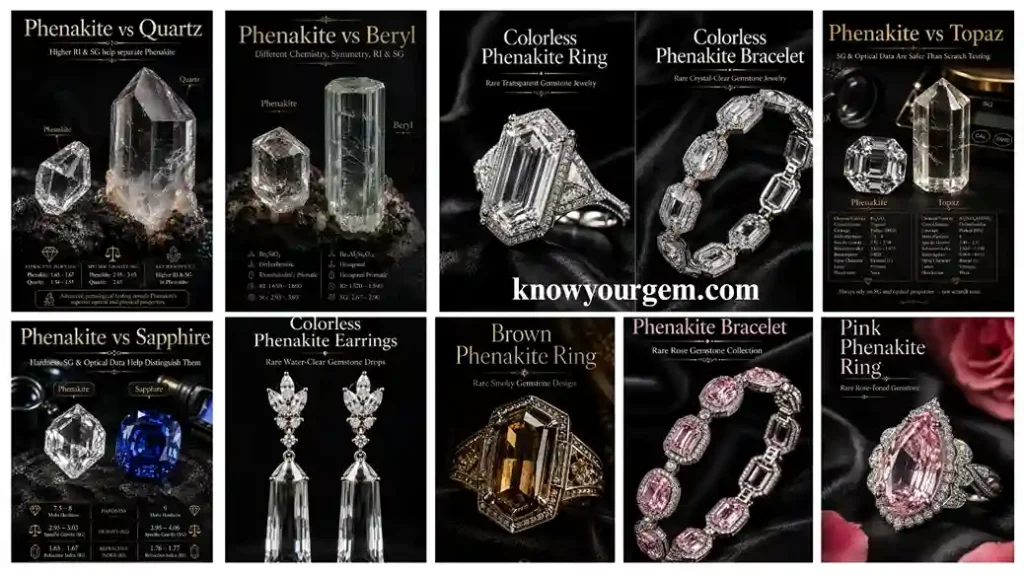
Phenakite versus quartz:
This is the most essential practical comparison. Both can be colorless, transparent, vitreous, and naturally crystallized. Phenakite is separated primarily by its higher RI and SG.
Phenakite versus danburite:
Danburite can generally have a similar appearance and density, but it is orthorhombic biaxial. Optical testing generally helps separate the two.
Phenakite versus topaz:
Topaz is heavier and contains important cleavage considerations. A scratch test is unnecessary and potentially damaging; its SG and optical data are safe and more useful.
Phenakite versus beryl:
Both gems contain beryllium, but each stone has a unique chemical makeup, hexagonal symmetry, lower refractive index, and usually specific gravity.
Phenakite versus sapphire:
Sapphire is generally harder, tougher, and significantly heavier than the other one. Its refractive index is also higher. Based on weight, optical tests, and hardness-related laboratory observations, one can distinguish the other.
Phenakite versus diamond:
Diamond has a cubic crystal system and has a refractive index; however, phenakite has a double refractive index. Diamond also has much higher RI, density, hardness, and dispersion. Since a thermal or electrical conductivity tester should not be treated as a complete identification method.
Is Phenakite Authentic?
It can be authentic or synthetic. Although authentic phenakite should match its expected chemical, optical, and internal traits. The main authenticity issue does not generally come from sophisticated syntheticity. It generally comes from misidentification; it is considered genuine phenakite without careful testing and observations.
When buying, be cautious about:
- Quartz described as phenakite without testing.
- Vague or unsupported locality claims.
- Stock photographs rather than photographs of the actual item.
- Missing weight and measurements.
- No treatment disclosure.
- A certificate whose weight or dimensions do not match the stone.
- A claimed rarity unsupported by documentation.
- A price that appears inconsistent with quality.
- Pressure to purchase immediately.
- A seller unwilling to provide a return period.
Such warning signs can’t prove deception, but they justify additional verification.
Phenakite Price and Value:
Is phenakite expensive?
The stone doesn’t carry a standardized mainstream market. Prices can depend heavily on the type of specimen; for example, commercial-grade stones can be affordable, while clean, large, unusual, documented, or optically interesting examples can be much more expensive.
Without specification of these factors, the stone’s price is incomplete:
- Rough or faceted format.
- Clarity and transparency.
- Color.
- Weight and dimensions.
- Cut quality.
- Phenomenon.
- Origin and provenance.
- Certification.
- Retail, dealer, auction, or wholesale context.
- Date of the observation.
Current market snapshot:
A chart which displays June 2026 to July 2026 lists; these are average retail prices for colorless phenakite with VVS clarity and an excellent cut at approx the stated reference level:
| Weight | Price |
|---|---|
| 1 carat | $29.23 per carat |
| 3 carats | $34.95 per carat |
| 5 carats | $40.66 per carat |
| 10 carats | $54.95 per carat |
| 30 carats | $112.10 per carat |
This chart applies lower factors to the stones with lower clarity, but these numbers are only a market snapshot; they can’t guarantee what a single stone is sold for. They shouldn’t be mistaken for the most trusted lab appraisal or an auction result; they are just examples of the current market.
Other sources showcase different ranges: for example, a 2024 dealer guide has listed approximately $ 50- $ 150 per carat for smaller clean stones, and several hundred dollars per carat or more for larger exceptional material.
Because reliable transaction data for phenakite is limited, no responsible article should be presented as a universal price structure as the market value. Instead, prices must always be tied to clarity, size, cut, documentation, and sales context.
Faceted-gem pricing structure:
| Factor | Effect on value |
|---|---|
| Transparency | The stone is transparent; generally more desirable than translucent or opaque material. |
| Clarity | Its eye-clean and loupe-clean varieties receive a premium pricing level. |
| Size | Its large pieces can receive a premium price per carat because faceting rough is limited. |
| Cut | The stone is cut in proportion; symmetry, polish, and brilliance affect appearance and resale appeal. |
| Color | It also displays attractive pink or yellow colors that can be collectible, but are not automatically premium. |
| Phenomenon | The stone’s attraction is its cat’s eye look that can maximize its pricing level. |
| Durability | The stone contains cleavage and fractures so it is less durable and can chip, fracture, and be vulnerable, which can reduce its suitability for jewelry. |
| Provenance | It must require documented locality or historical ownership, which can matter, especially to collectors. |
| Certification | A trusted lab report can mitigate identity risk but does not establish a fair price. |
| Demand | Specialist collector demand can generally cause large dif |
Mineral-specimen pricing structure:
Rough materials can generally be priced by the complete object rather than carat weight. Important factors include:
- Crystal size.
- Sharpness and completeness of terminations.
- Natural luster.
- Symmetry and morphology.
- Twinning.
- Matrix quality and contrast.
- Damage, repairs, or restoration.
- Locality significance.
- Collection history.
- Rarity of the association.
- Display quality.
- Scientific or historical importance.
It is a fact that the most valuable stone can’t always be found in the biggest cut. Sometimes a smaller crystal can be exceptional and, with a solid provenance, can outshine a larger gem with natural inclusions. Quality and rarity matter more than size.
Asking price versus actual value:
An advertised price can’t be proof of market structure. Sellers can list stones for negotiation, insurance replacement, or appeal to specialist collectors. Likewise, an auction estimate can’t be the same as a sale result.
For a serious purchase, compare the exact stone with similar verified examples and ask:
- Are the examples faceted or rough?
- Are they comparable in clarity and size?
- Are they certified?
- Are they asking prices or completed sales?
- Is the origin documented?
- Are commission, taxes, and shipping included in this price?
- Is the stone valuable for jewelry?
Phenakite should not be described as an investment gemstone without evidence of transparent, repeatable resale performance.
Buying Phenakite:
Before buying a faceted stone Request:
- Exact carat weight.
- Dimensions in millimeters.
- Clear photographs of the actual stone.
- Video showing brilliance and any windowing.
- Clarity description.
- Treatment disclosure.
- Origin claim and supporting documentation.
- Laboratory report for a significant purchase.
- Seller’s return policy.
- Information about chips, repairs, and fractures.
You should judge the stone based on more than one condition for authenticity. A colorless gem can look attractive under direct lighting but disclose a window, extinction, or durability issue when it is viewed from different angles.
Before buying rough phenakite:
Prioritize:
- Complete crystal form.
- Termination quality.
- Damage and repairs.
- Matrix stability.
- Natural versus artificially cleaned surfaces.
- Locality label.
- Provenance.
- Dimensions and weight.
- Whether the specimen is suitable for display or cutting.
Never assume that large rough crystals contain valuable faceting gem. Because cutting can destroy the specimen’s most essential value: its natural morphology.
Buyer’s checklist:
- Is it natural, synthetic, or unidentified?
- Is it rough, a mineral specimen, or faceted?
- Are the exact weight and dimensions provided?
- Are the photographs of the actual item?
- Is the locality specific and documented?
- Is the provenance credible?
- Are treatments or repairs disclosed?
- Does a certificate match the stone?
- Is the seller established and reachable?
- Is there a written return policy?
- Is the price being compared with the correct market category?
- Are you paying for gemstone quality, specimen quality, rarity, or a claimed origin?
Phenakite in Jewelry:
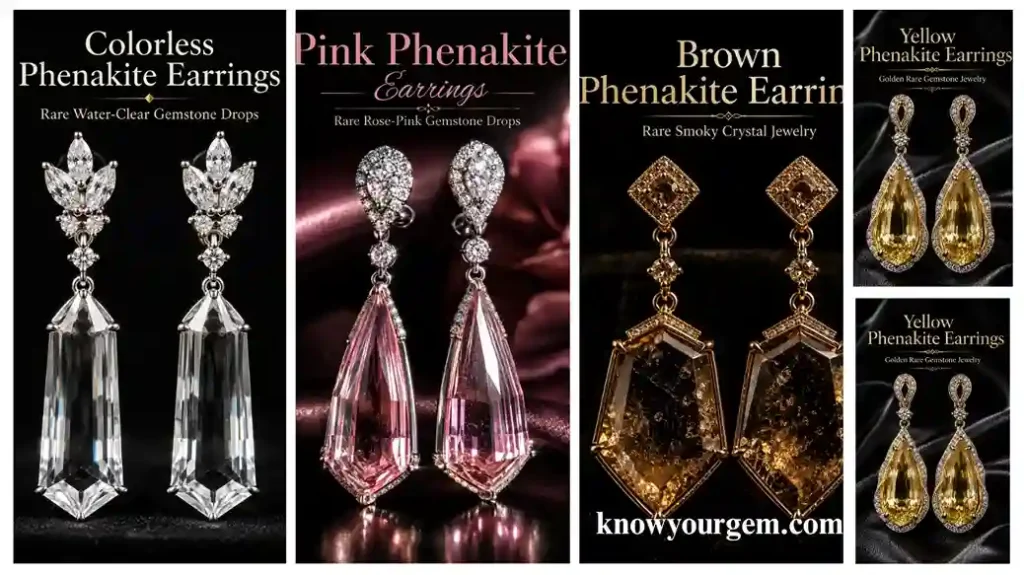
Phenakite generally looks beautiful in jewelry with protective settings due to its glass-like luster and brilliance. However, it is brittle; it should be chosen and set with care to avoid damage during wear.
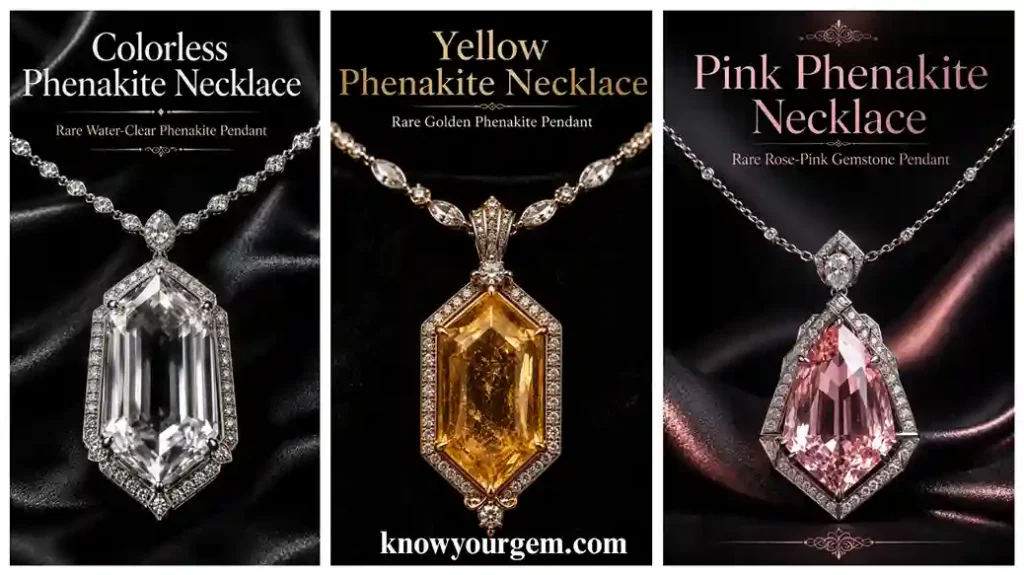
Pendants:
Pendants are the safest jewelry for this stone because the stone generally receives less direct impact than a ring. A secure setting and protection around the girdle can still be advisable.
Earrings and studs:
Earrings and studs usually expose the stone to less abrasion than rings or bracelets. They are practical choices for owners who desire to wear regularly while minimizing impact risk.
Bracelets:
Bracelets can take a lot of knocks from tables, watches, and tools. Phenakite requires protective settings in bracelets and careful wear to avoid chips or breaks.
Beads:
Phenakite beads are unusual. Lower-clarity or translucent material can be used, but drilled stones are vulnerable around the hole. Buyers should always inspect each bead for cracks, and don’t assume a strand is made from higher-grade faceting rough stone.
Engagement rings:
The stone is generally fit for a regular-wear engagement ring. No doubt its hardness is decent, but its brittleness, cleavage, and tendency to chip or scratch can make the stone less durable than diamond, ruby, emerald, and sapphire.
A buyer who chooses this stone for an engagement ring should consider:
- A bezel or protective setting.
- A low-profile design.
- Adequate girdle thickness.
- No exposed corners.
- Removing the ring during manual work, sports, and impact-prone activities.
- Regular inspection by a jeweler.
Suitable cuts:
Brilliant and mixed cuts generally highlight brightness, but step cuts showcase clarity and windowing more clearly. The best cut hinges on one “ideal design.
You should avoid cuts that have thin edges, fragile points, or proportions that leave the stone vulnerable to impact.
Phenakite Care and Cleaning:
Can phenakite get wet?
Brief contact with clean water is normal. But the bigger risks occur when we use harsh chemicals, loose settings, and expose it to sudden temperature.
Cleaning method
Use:
- Lukewarm water.
- A small amount of mild soap.
- A soft brush or lint-free cloth.
- Thorough rinsing.
- Gentle drying.
Avoid using harsh chemicals and hard brushes as they damage the stone.
Ultrasonic and steam cleaning:
As you know, the stone is brittle and contains fractures or inclusions, so it requires gentle cleaning. Only hardness can’t make ultrasonic or steam cleaning safe. Here’s a clear step‑by‑step guide for safe care:
Storage:
Store the stone separately from harder stones like diamond, sapphire, and ruby. A soft pouch or individual compartment is always suitable. Avoid allowing stones to strike one another.
Ring owners should remove phenakite jewelry before:
- Household cleaning.
- Gardening.
- Exercise and sports.
- Manual work.
- Handling tools.
- Sleeping if the setting is vulnerable.
- Activities involving sudden impact.
Is Phenakite Dangerous?
Phenakite isn’t dangerous to wear as finished jewelry. The risk only comes when it is cut or ground, which can release beryllium dust. OSHA generally says beryllium dust, fumes, and mists are workplace hazards; they need strict safety controls when materials are cut, ground, or polished.
Here’s a clear step‑by‑step safety outline:
Therefore:
- Normal handling of an intact specimen usually can’t involve the same risk as lapidary dust exposure.
- Do not sand, grind, crush, or dry-polish this stone casually.
- Use wet cutting methods and proper ventilation.
- Apply dust control and good housekeeping.
- Follow occupational safety rules.
- Do not inhale dust.
- Keep cutting waste away from food and living spaces.
- Follow local health requirements for lapidary work.
Phenakite Meaning and Metaphysical Belief:
Phenakite is a mineral that can heal spiritually but cannot be scientifically proven, as it is properly mentioned on the astrological calendar that the claims about healing frequencies are belief‑based, not scientific.
Within crystal‑healing traditions, practitioners often associate phenakite with:
- Mental clarity.
- Meditation.
- Intuition.
- Spiritual insight.
- Energetic alignment.
- A heightened or “high-vibration” experience.
Phenakite is a mineral with its own chemistry and its own crystal structure. It doesn’t give off healing energy, melt ice, or treat illness. It only claims “frequency”; it is not proven by science. A finished phenakite gem is safe to wear. The real risks are:
- Dust hazard when cutting or grinding
- Fragility from fractures or inclusions
- Unsafe cleaning methods like steam or ultrasonic without inspection
Collecting Phenakite:
Serious mineral collectors can value the stone for features that a jewelry buyer would overlook.
High-priority specimen characteristics include:
- Complete, sharp crystals.
- Attractive rhombohedral or prismatic morphology.
- Penetration twins.
- Excellent natural luster.
- Strong contrast against matrix.
- A documented and respected locality.
- It has unusual connections with other minerals such as quartz, topaz, beryl, chrysoberyl, fluorite, or muscovite.
- Minimal damage.
- Stable matrix.
- Old or credible provenance.
- Aesthetic balance and display quality.
The stone should be examined for repairs, reattachment, filled fractures, polished surfaces, and reconstructed crystals. So, restoration can’t always be a specimen’s worthlessness, but it should be revealed it affects scientific and commercial value.
Exceptional and Historic Material:
Phenakite is found in large, well-formed crystals in locations called the Ural Mountains and Brazilian pegmatites. The Handbook of Mineralogy notes crystals up to 20 cm and lists several localities for fine specimens.
It also claims that the “largest” crystal or most valuable faceted should be verified through a museum, mineralogical publication, auction house, or collection record.
- Exact locality.
- Mine or pegmatite.
- Dimensions.
- Weight.
- Condition.
- Repairs.
- Matrix.
- Collection history.
- Publication or exhibition history.
- Previous sale records.
Certification and Laboratory Reports:
A laboratory report may establish some or all of the following, depending on the laboratory and service:
- Mineral or gemstone identity.
- Weight and measurements.
- Color and transparency.
- Optical properties.
- Natural or synthetic status, when determinable.
- Detectable treatments.
- Inclusions and phenomena.
- Origin opinion, only when the laboratory has appropriate expertise and sufficient evidence.
A report does not automatically establish:
- Fair market value.
- A reasonable asking price.
- Investment potential.
- Future appreciation.
- Rarity in the global market.
- Authenticity of an unsupported historical story.
Certification is especially useful when:
- The stone is expensive.
- The seller claims a valuable origin.
- The gem is represented as cat’s-eye.
- The stone is unusually large or clean.
- The identity is disputed.
- Treatment status affects the price.
- The buyer is purchasing remotely.
For an inexpensive common specimen, certification may cost more than the stone. The level of testing should match the financial risk.
Frequently Asked Questions:
1. What is phenakite?
It is a rare beryllium silicate mineral with a chemical formula of (Be₂SiO₄).
2. Is phenakite rare?
Yes. Fine, facetable pieces are generally uncommon, especially if they are found in larger, clean, and well-cut.
3. What is phenakite worth per carat?
The stone doesn’t follow a fix pricing route. It can be sold for $29 per carat at 1 carat to more than $100 per carat at 30 ct.
4. What affects phenakite price?
Price-affecting factors are transparency, size, cut, color, brilliance, durability, origin, inclusions, rarity, and demand.
5. How do you identify phenakite?
Gemologists identify it through its refractive index, birefringence, specific gravity, optics, microscopy, and sometimes Raman.
6. How do you tell phenakite from quartz?
The stone generally hits a higher refractive index of around 1.650- 1.670, and higher SG, around 2.93- 3.00. But quartz is normally around a 1.544–1.553 refractive index and SG 2.65.
7. Is phenakite a diamond?
It is not a diamond it looks like a diamond with glass-like luster, but it is softer, less heavy, and lower in brilliance, and doubly refractive.
8. Where is phenakite found?
It is primarily found in Russia, Brazil, Madagascar, Norway, Switzerland, Austria, USA, and Namibia.
9. Is Russian phenakite valuable?
Valuable specimens usually come from Russia and Brazil if their quality and provenance are strong.
10. Is Brazilian phenakite valuable?
Yes, it is valuable if the stone is found as gem-quality.
11. Is raw phenakite valuable?
Yes, raw crystals can be valuable if they are complete, lustrous, well-formed, and come from a notable locality.
12. Is phenakite good for jewelry?
The stone can work well in pendants and earrings, but daily wear rings and bracelets require protective settings.
13. Does phenakite fluoresce?
Some of its pieces fluoresce weakly, but it varies and isn’t proof of identity.
14. Is phenakite dangerous?
Finished gems are generally safe, but cutting or grinding can create beryllium dust.
15. Is phenakite suitable for an engagement ring?
It is possible with protective settings like bezel and prongs but not ideal for daily wear.
16. Does phenakite have metaphysical properties?
Based on crystal healing, the stone is linked with symbols of clarity, meditation, and intuition. These are belief‑based, not scientific.
How This Guide Was Researched?
The overview separates mineralogical facts from market observations and metaphysical traditions. Since Technical properties and localities were checked against the Handbook of Mineralogy and GIA records, which include RI, SG, inclusions, and diamond misidentification cases. Price data is treated as market pricing level evidence, not fixed valuation; it is snapshot of June 2026 to July 2026 pricing structure rather than confirmed sales.
Buyers are advised to verify this stone with GIA, IGI, IGS, SSEF for authenticity, ethical source confirming.
Gem Enthusiasts KamilHussian!

Welcome to KnowYourGem.com! your ultimate destination for uncovering the fascinating world of gems and their secrets! I'm Kamil Hussain, a passionate blogger with a Master’s degree in Economics, dedicated to bringing you insightful, well researched content that blends the beauty of gemstones with the art of storytelling. With a keen analytical mind and a love for discovering hidden treasures, I created this platform to help you explore the brilliance, history, and value of every gem.

