

Quickview:
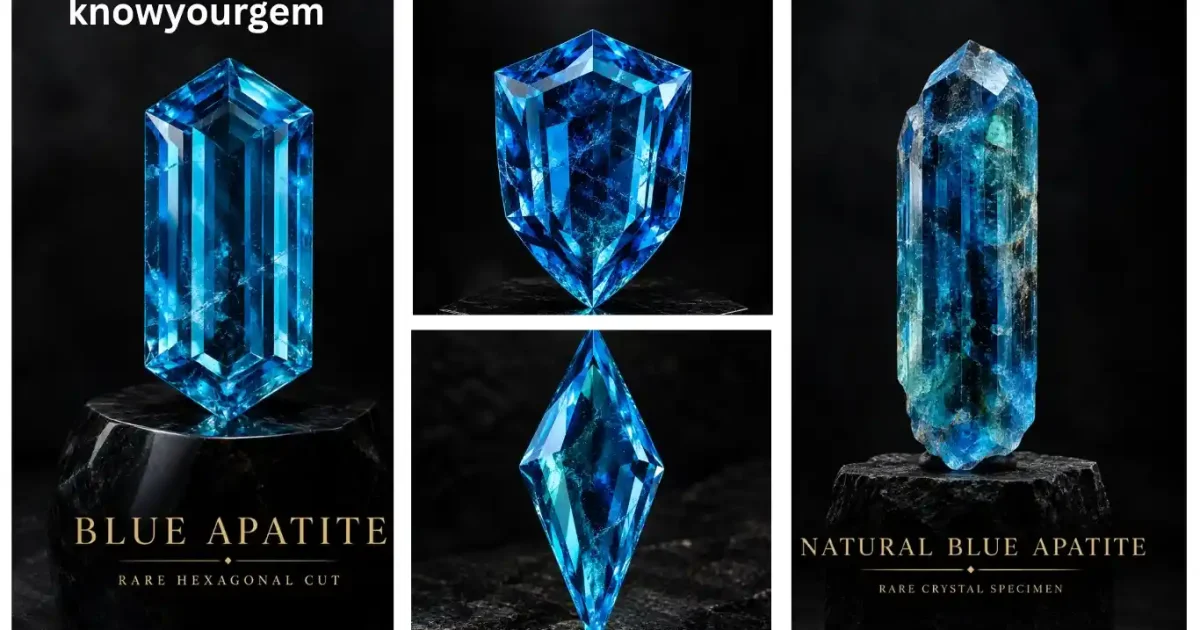
Blue apatite is a kind of apatite; it is loved for it its brilliant hue, but the stone is quite mediocre performance-wise due to its brilliant hue. The stone is quite mediocre performance-wise due to its moderate durability. With having hardness of about 5 Mohs scale, this stone is generally soft and can easily be scratched, and is appropriate for occasional-wear jewelry and as a traditional artifact.
Given below are fewer metaphysical properties of apatite, and one should read this article as an attempt to provide a standardized discussion on identity, identification, treatments, valuation factors, and buying considerations.
Blue Apatite at a Glance:
| Property | Apatite |
|---|---|
| Group | Apatite (commonly fluorapatite) |
| Formula | Calcium phosphate: Ca₅(PO₄)₃(F,Cl,OH) |
| Crystal structure | Hexagonal |
| Mohs hardness | ~5 |
| Refractive index | ~1.63–1.65 |
| Specific gravity | ~3.17–3.23 |
| Luster | Vitreous to sub-resinous |
| Transparency | Transparent to opaque |
| Typical colors | Blue, blue-green, teal, neon blue |
| Cleavage/parting | Poor/indistinct; fracture often uneven |
| Durability | Moderate to poor for everyday wear |
| Common treatments | Heat treatment may occur |
| Main uses | Faceted gemstones, cabochons, beads, mineral specimens |
What Is Blue Apatite?
Apatite is thought to be a commercially exotic, pale blue to electric/neon blue-green gem-quality version of the group of calcium phosphate minerals known as apatite. Blue apatite is appreciated for its colour but also for its size and prominence. However, this substance is not as hard as sapphire, aquamarine or topaz.
Understanding the Apatite Mineral Group
Mineralogically, the stone sits in a group of phosphate minerals that have the chemical formula of Ca₅(PO₄)₃(F,Cl,OH). The three major end-members are:
- Fluorapatite: Contains fluorine (F)
- Hydroxy-lapatite: Contains hydroxyl (OH)
- Chlorapatite: Contains chlorine (Cl)
Apatite a gem-quality variety of the apatite group of calcium phosphate minerals which can be found occurring naturally in a range of subtle shades from pale sky blue to intense electric/neon blue-green.
Some of the attractions of apatite include not only its stunning colouring, but also its size and prominence. However, also it is significantly softer than sapphire, aquamarine, or topaz.
What Gives Blue Apatite Its Color?
The blue tone can be due to trace elements or structural imperfections within the lattice. The precise chromophore, however, can be as variable and complex as the mineral, although the involvement of a rare-earth element or center of coloration is common. These sources can be, but are not limited to:
- Pale blue to medium blue
- Blue-green or teal
- Bright “neon” blue (occasionally promoted as “Paraíba color” apatite)
Its saturation and tone of color can enhance the object however, it doesn’t always mean there is a greater value of the item therefore, it has to be appealing.
Is Blue Apatite a Crystal or a Gemstone?
This distinction matters for buyers:
- Mineral: An inorganic, solid element or compound occurring naturally (apatite is a mineral group).
- Crystal: A mineral can be a sample with a crystalline, like all the apatite.
- Gem: A mineral that has been cut and polished to serve as a gem.
- Mineral sample: As produced without alteration or modification of natural conditions, perhaps by hand. A natural mineral (crystal or aggregate) left in its environment where it formed.
- The same blue apatite could be all: Mineral, crystal, gem if faceted or cabbed, sample if not cut.
Blue Apatite Properties:
Color and Appearance
Blue apatite exists in many blue shades from palish pastel blue all the way to vibrant electric blue. The best material will be bright in saturation with good transparency (not too cloudy) with very little gray or green modifiers. In some cases, stones may be cut as a cabochon with a cat’s-eye effect chatoyancy although this is not very common.
Crystal System:
The stone forms in a hexagonal structure, and its common crystal formation is prismatic or tabular. Since this regular arrangement of the crystal structure can generally result in the optical like the weak-moderate biaxial Birefringence.
Hardness:
Blue apatite is 5 Mohs hardness, quartz is 7Mohs, aquamarine is 7-8 Mohs, and sapphire 9 on the Mohs hardness scale. Thus, the stone is most likely to become abraded and scratched when it is set into rings or bracelets worn often.
Refractive Index and Specific Gravity:
Typical gemological constants for blue apatite:
- Refractive index (RI): ~1.63–1.65
- Specific gravity (SG): 3.17–3.23, 3.68
Such values can exclude the other minerals that can be mistaken for apatite, i.e. Aquamarine has a refractive index like 1.57 1.58, SG 2.72, and the most usual, blue topaz, has a refractive index of 1.6 1 1.62, SG 3.53.
Luster and Transparency:
The blue apatite has a vitreous (glassy) lustre when well polished. Translucence can range from transparent to translucent or opaque, with material being cut from face to faceted gems being cut from transparent material.
Birefringence and Dichroism:
Apatite will have either weak to moderate birefringence (~0.002–0.008). Its pleochroism is weak, and associated with possible weak dichroism (shown in varying colour when viewed from different angles); these are too subtle to be detected by the naked eye.
Cleavage, Fracture, and Parting:
Apatite- poor or indistinct cleavage, does not split readily along definite planes. It fractures irregularly; inclusions or fractures reaching the surface may weaken the apatite.
Fluorescence and UV Reaction:
Most apatite is fluorescent under UV light giving a yellow, greenish/yellow and bluish-white reaction for various trace activators. Fluorescence cannot be used as identification, but the results can aid other tests.
How to Identify Blue Apatite?
Visual Identification:
Key visual clues include:
- Blue to blue-green hue, sometimes with neon saturation
- Vitreous luster and moderate to good transparency
- Hexagonal crystal habit in rough material
- Inclusions: These are so-called fluid feathers, healed fractures, or mineral crystals (e.g., garnet, mica)
- Color zoning may be visible in some specimens.
It is impossible, however to make a correct identification solely based on visual assessment alone, and this is due to the color similarities which blue apatite can share with aquamarine, tourmaline, and Paraíba tourmaline.
Gemological Tests:
Professional identification may involve:
- Refractive index (RI) measurement (~1.63–1.65)
- Specific gravity (SG) testing (~3.17–3.23)
- Polariscope to confirm anisotropy (apatite is doubly refractive)
- Microscopic examination for inclusions and growth features
- UV fluorescence as a supporting characteristic
- Hardness testing (only on rough or girdle areas; not recommended on finished gems)
Such tests, are combined with visual observation, provide a more reliable basis for identification than appearance alone.
Common Inclusions in Blue Apatite:
Photographs can suggest color, cut quality, and transparency, but they cannot establish:
- Refractive index or specific gravity
- One example of a potential indicator of domestic treatment is the treatment status (e.g., heating)
- Knowing the mineral species precisely.
- Acheleira resistance to wear or impact.
- A photo might rule out certain options, but lab or gem testing is needed to confirm.
Can You Identify Blue Apatite From a Photograph?
Photographs can suggest color, cut quality, and transparency, but they cannot establish:
- Refractive index or specific gravity
- Treatment status (e.g., heating)
- Exact mineral identity
- Durability or structural integrity
A photo may help narrow possibilities, but laboratory or gemological testing is required for confirmation.
When Laboratory Testing Is Necessary?
Laboratory reports are advisable when:
- The stone is high-value or being sold as a specific variety.
- Treatment disclosure is critical (e.g., heated vs. untreated)
- Origin claims are made (e.g., “Brazilian,” “Madagascar”)
- The buyer requires independent verification for insurance or resale.
- Trusted laboratories like GIA, AGL, or Gübelin can provide detailed identification and treatment disclosure.
How to Tell if Blue Apatite Is Real?
Natural Blue Apatite:
This stone occurs naturally in igneous or metamorphic rocks where phosphate-bearing deposits of similar geology can be expected to lie. Such natural inclusions, like growth zoning and colour zones, can all be present in a natural apatite.
Treated Blue Apatite:
Color might be increased or stabilized through heat treatment. While heating is widely recognized in the trade, disclosure is advisable because it may influence value and treatment.
Imitation Material:
Blue apatite can be confused with:
- Glass or synthetic spinel: Often too clean, with gas bubbles or curved striae.
- Blue quartz or dyed howlite: Different RI/SG and optical properties
- Synthetic corundum or beryl: Higher hardness and different optical constants
Gemological testing methods generally distinguish these materials reliably.
Synthetic Material:
Deposits of synthetic apatite are very rare in the gem trade, but this mineral can be manufactured as a product for application at an industrial or research level. The majority of “blue apatite” that appears in the marketplace is natural, but does not necessarily have evidence of treatment.
What a Buyer Should Ask the Seller?
Before purchasing, ask:
- Is this a natural gemstone?
- Is it treated or not? If so, how?
- What is the origin, and is it documented?
- Is there any surface-reaching fractures or inclusions which can affect durability?
- Can sellers provide a return policy or identification?
Buyer verification checklist:
- Confirm mineral identity (not just color).
- Ask about treatments and request disclosure.
- Buyers should inspect, if stone contains inclusions, fractures, and cut quality.
- What jewelry is suitable for it: rings or pendants?
- Request return policy or lab report for high-value stones.
Blue Apatite Colors and Quality:
Common Blue Apatite Colors:
- Vivid electric blue (“neon”)
- Medium blue
- Pale sky blue
- Blue-green or teal
- Greenish-blue
Color saturation and tone are important to the visual quality but only as one factor.
What Makes Blue Apatite High Quality?
High-quality blue apatite typically exhibits:
- Attractive color with good saturation and minimal gray/green modifiers.
- High transparency with minimal visible inclusions.
- Good clarity (eye-clean or lightly included).
- Well-executed cut with good symmetry and polish.
- Appropriate size for the intended jewelry use.
- No surface-reaching fractures that compromise durability.
- Disclosure of any treatments.
Optical phenomena such as cat’s-eye effect can add value but are rare.
What Does “High Grade” Blue Apatite Mean?
Labels such as high grade or AAA are meaningless; they are marketing terms, not any such standardized laboratory grade. Although they may imply better color or clarity, ultimately the buyer should examine a stone for himself or herself or receive a gemological report.
Where Is Blue Apatite Found?
Brazil:
Brazilian blues and blue-greens seem to come mainly from the same places (e.g. Minas Gerais), and these tend to produce good saturation with transparency.
Madagascar:
Blue apatite is produced by Madagascar. It may sometimes have neon saturation. Materials are similar to Brazilian stones and may be slightly more included.
Norway, Mexico, and Other Localities:
Other prominent exports are Norway, Mexico, Myanmar, Sri Lanka, and the United States (Maine, California), among others; however, origin does not imply a higher value unless authenticated with evidence of provenance and excellent quality.
Does Blue Apatite Origin Affect Value?
Origin can influence value when:
- The locality is well-documented (e.g., via lab report)
- The material from that locality is consistently superior in color or clarity
- There is collector demand for specimens from specific mines.
These unsupported origin claims, however, should not inherently command a price premium. Buyers should be focused on be able to look at the product and determine quality.
Blue Apatite Treatments:
Is Blue Apatite Heat Treated?
Yes, some blue apatite is heat treated for enhancement or stabilization of color. Heating is generally accepted within the trade, however should be disclosed.
Why Is Apatite Heated?
Heating may:
- Intensify blue coloration.
- Reduce unwanted green or gray modifiers.
- Improve overall visual appeal.
- The process is typically stable under normal wear conditions.
Does Treatment Affect Value?
Naturally attractive colored gemstones. Selling untreated stones will be needed to communicate their natural hue may have higher prices; however, the market for apatite is not as treatment-sensitive as sapphires or rubies. Knowing and disclosing still has to be used to reassure and for transparency.
Natural Color vs Treated Color
Separated heated from unheated apatite can be very difficult without advanced testing (e.g., spectroscopy, microscopic testing). Buyers should accept disclosure by the seller or independent lab reports rather than trying to determine by eye.
Treatment Disclosure When Buying:
Ethical sellers should disclose:
- Whether the stone has been heated
- The purpose of the treatment
- Any special care requirements resulting from treatment
- Unrevealed treatments can generally mislead buyers about value and durability.
Blue Apatite Value and Price:
Is Blue Apatite Expensive?
No blue apatite is not more costly than blue sapphire, aquamarine or Paraiba tourmaline; it’s not that costly. However, costs are going to fluctuate a lot depending on the piece quality, size, and treatment status but it is still reasonably costly for the most part.
Blue Apatite Price Per Carat:
| Apatite Quality | Typical Price Range (2025–2026) | Description |
|---|---|---|
| Commercial grade | $5–$30 per carat | Marketable apatite suitable for general gemstone use. |
| Fine quality | $30–$100+ per carat | Brilliant color and good clarity. |
| Neon apatite | $100–$300+ per carat | Scarce material with highly desirable neon color. |
The following are approximations. The actual value will vary depending on the seller, the market and the properties of the individual stone.
What Determines Blue Apatite Value?
Key value factors include:
- Color: Saturation, tone, and hue
- Transparency: Clarity and light performance
- Clarity: Eye-clean vs. visibly included
- Cut quality: Symmetry, polish, and proportions
- Carat weight: Larger stones are rarer but not always proportionally more valuable
- Treatment: Untreated may command a premium
- Origin: Documented provenance can add collector value
- Optical phenomena: Cat’s-eye effect (rare)
- Market demand: Fashion trends and availability
- Durability considerations: Affect jewelry suitability
Why Two Blue Apatites of the Same Weight Can Have Different Prices?
Two 2ct blue apatites can be very different in price even from the same supplier. It will depend on the color saturation, clarity, cut, if it has any treatment, and where it has been originating from to decide how much the stone should be valued.
Blue Apatite vs More Expensive Blue Gemstones:
| Gemstone | Mohs Hardness | Typical Price Range (per carat) | Key Distinction |
|---|---|---|---|
| Blue Apatite | ~5 | $5–$300+ | The stone is affordable with vivid color and moderate durability |
| Aquamarine | 7.5–8 | $50–$500+ | Its higher durability and lighter blue color make it desirable |
| Blue Sapphire | 9 | $300–$10,000+ | This stone has exceptional durability, that’s why it is sold for premium prices. |
| Blue Topaz | 8 | $10–$100+ | This stone is very affordable because it is often found as treated, with high durability. |
| Iolite | 7–7.5 | $20–$150+ | Pleochroic (violet-blue), good durability |
Apatite usually offers vivid coloration with an accessible prices, however, the stone generally requires careful wear compared to harder stones.
Blue Apatite Jewelry and Durability:
Is Blue Apatite Suitable for Jewelry?
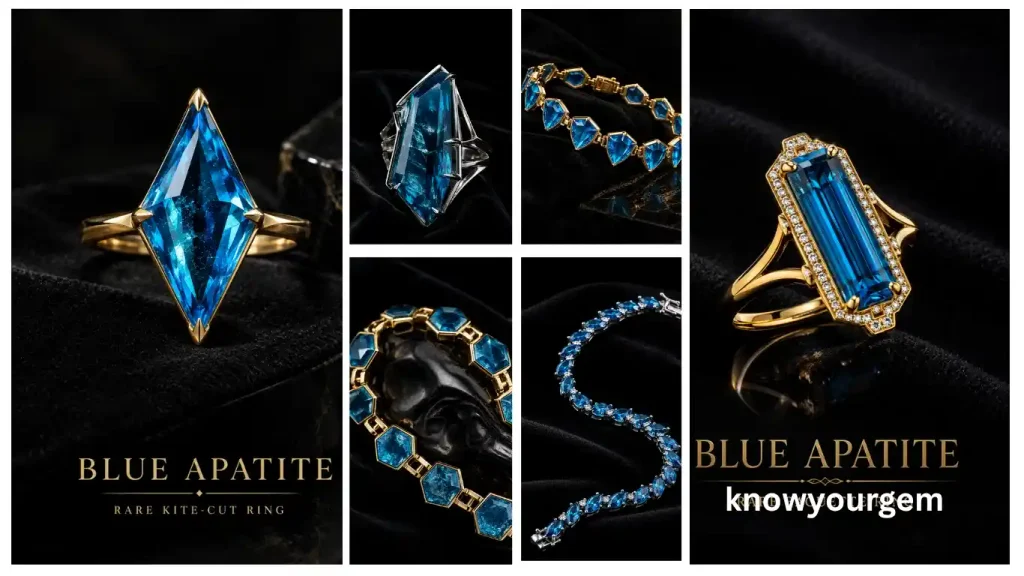
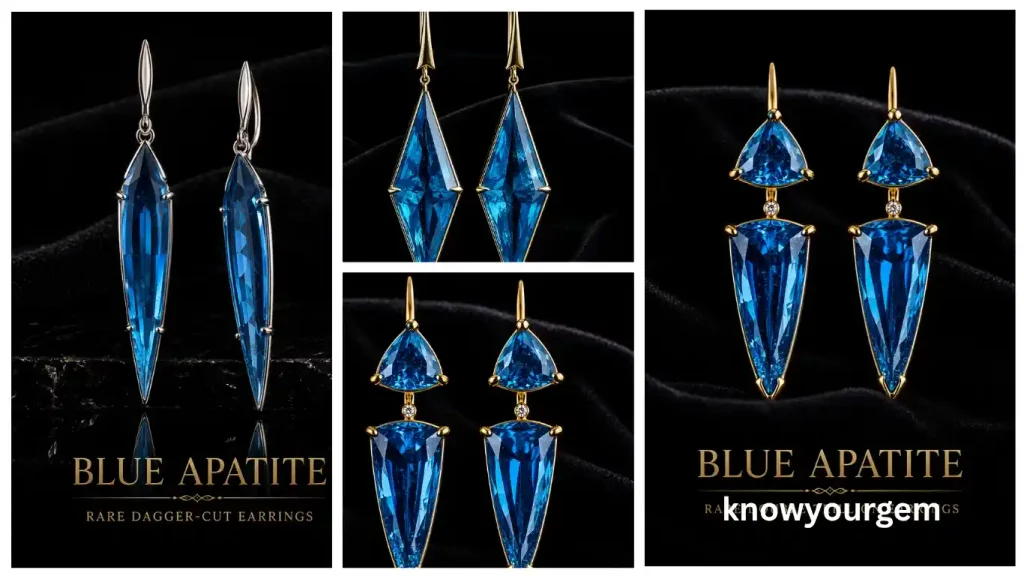
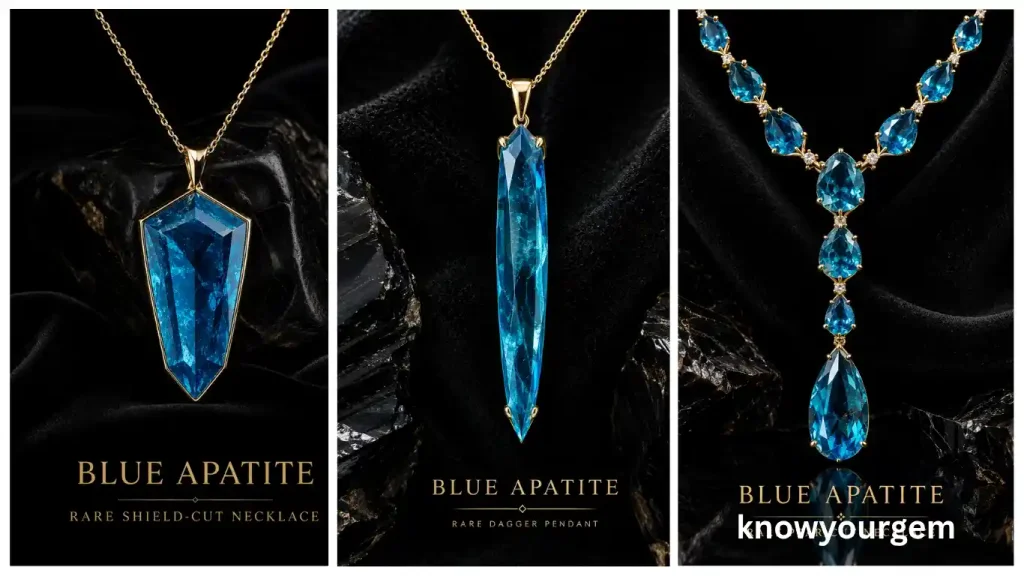
Yes, but some concerns with its hardness that is estimated with 5, this stone is best for simple jewelry piece of pendants, earrings, and brooches. So wearing this stone and enjoying it as a ring or bracelet can be possible with good protection.
Jewelry Suitability Table:
| Jewelry Type | Suitability | Notes |
|---|---|---|
| Ring | Low | Because the stone can get scratched easily if it is worn everyday as ring. |
| Engagement Ring | Low | This stone is not recommended for long-term everyday wear. |
| Bracelet | Moderate | Bracelets are acceptable with protective settings. |
| Earrings | Good | Earrings are generally good with low impact; suitable for regular wear |
| Pendant | Good | Pendants are protected and abrasion. |
| Necklace/Beads | Good | They are minimal exposure to impact that’s why they are good. |
Can You Wear Blue Apatite Every Day?
Yes, though there are reservations. With a Mohs hardness of approximately 5, it is suitable as an everyday jewelry item in the form of pendants, earrings and brooches. It certainly can be worn as a ring or bracelet with a suitably protective setting.
Blue Apatite vs Similar Blue Stones:
Comparison Main Distinction:
| Comparison | Key Difference |
|---|---|
| Apatite (Blue) compared with Topaz (Blue) | Topaz harder (8); higher SG (~3.53); easier to treat, change of color. |
| Blue Apatite versus Blue Sapphire | Sapphire is considered among the hardest gemstone as it ranks 9 on the Mohs hardness scale. |
| Blue Apatite vs Turquoise | Turquoise is an opaque, lower with low hardness like (~5–6), different structure(aggregate) |
| Comparison of Blue Apatite and Amazonite | Amazonite is a form of feldspar. It has a hardness of 6-6.5 on the Mohs scale. The stone is either transparent or opaque but usually translucent. |
| Blue Apatite vs. Lapis Lazuli | This stone is a blend of rock. It is opaque in appearance with inclusions of pyrite. |
| Blue Apatite versus Iolite | It contains very intense pleochroic color from violet-blue and a bit higher in hardness like 7-7.5. |
Blue Apatite vs Aquamarine:
Aquamarine(beryl group) is harder, more stable, and generally a shade lighter. Blue apatite can be more vibrant, more neon, but more likely to wear with constant wear.
Blue Apatite vs Blue Sapphire:
Sapphire is certainly more expensive and harder. Blue apatite is cheap and can give the desired colour but it would not be practical as an engagement band in hard conditions.
Blue Apatite vs Blue Topaz:
Sapphire is by far harder and more costly. Blue apatite is a cheaper alternative to attain color, but would not be suitable in an environment under high stress, such as an engagement ring.
How to Clean and Care for Blue Apatite?
Can Blue Apatite Go in Water?
Yes. Short immersion in water is regarded as extremely safe to clean. But don’t soak it for long-time, use powerful chemicals or use ultrasonic cleaning of fractured or heat-treated stones.
How to Clean Blue Apatite?
- An application of very mild soap and diluted lukewarm water.
- Rinse thoroughly and then pat dry with a soft cloth.
- Avoid ultrasonic or steam-cleaning aparatus.
That’s enough fine abrasives too. Avoid the rougher stones as well don’t scratch or damage the work.
Can Blue Apatite Go in Sunlight?
Avoid excessive sunlight exposure for too long… while exploring the need for heat, some stones may be new, dying, or otherwise treated and may eventually fade. Most natural apatite should be stable, but keep it away from excessive heat.
How Should Blue Apatite Be Stored?
- Can be kept in a soft bag or in a selected compartment.
- Avoid roughing against heavier stones such as sapphire, topaz, quartz etc.
- Protection from impacts and abrasion.
Can You Sleep With Blue Apatite?
There is nothing in the field of gemology that indicates that it would be any problem to wear blue apatite at night as long as the setting is properly secure and the stone is not exposed to any impact can occur. Other gemstones or traditions can generally have other meanings, but these can’t scientifically be proven.
Blue Apatite Meaning:
Descriptions below refer to present day crystals’ traditions and spiritual practices. These statements are not known medical science.
Blue Apatite Meaning in Crystal Traditions:
Among many crystal traditions, blue apatite’s energy is assigned. Communication and self-expression: communication skills (effective listening; effective questioning; effective speaking and writing; appropriate communication; effective non-verbal communication) and self-expressive (I find it easy to communicate myself to others either verbally or in writing; I am comfortable being myself in any situation).
Motivation and personal improvement:
Creativity & Inspiration. From the moment I conceived of the piece, I noticed a new sense of creativity and inspiration that I had never experienced before. This played a major part in involving myself within the piece to give it a reflection of my own senses and emotion.
Connection with spirituality and meditation:
Such properties are based on tradition don’t compare them with scientific laws.
What Is Blue Apatite Good For? (Crystal Traditions)
Spiritual practitioners use blue apatite stone for:
- It improves communication skills.
- It can enhance confidence and discards apathy.
- It enhances creative and critical thinking to solve every problem in a minute.
- It supports for meditation and spiritual practices.
Blue Apatite connections with Apatite Chakra and Zodiac linkage:
- Chakra: Which is commonly linked to throat chakra (communication) and third eye (intuition)
- Zodiac: Sometimes associated with the following signs, though not always two or only one of them: Pisces, Aquarius, Sagittarius.
- Planetary affinity: It refers to Venus. Sometimes to Jupiter or Mercury.
These associations are representational and are valued differently in different systems.
Blue Apatite Crystal Combinations
- Combination Traditional Association
- Blue Apatite plus Amethyst Meditation and spiritual practice
- Blue Apatite plus Sunstone Motivation and positivity
- Blue Apatite plus Citrine Creativity and confidence
- Blue Apatite plus Labradorite Intuition and transformation
- Blue Apatite plus Lapis Lazuli Communication and wisdom
- Blue Apatite plus Malachite Growth and change
- Blue Apatite plus Tiger’s Eye Focus and confidence
Such combinations are generally based on crystal traditions, not scientific evidence.
Toxic, or Radioactive?
Is Blue Apatite Dangerous?
Does blue apatite pose any hazard to work with or to wear as a gem? No. Apatite in the blue form we work with is not hazardous chemically and is physically stable at room temperature.
Is Blue Apatite Toxic?
Apatite minerals are non-toxic in the solid state. We strongly recommend not breathing in apatite dust (cutting and grinding, etc.), just as you would other mineral dusts. After being made into a finished gem, it is 100% non-toxic.
Is Blue Apatite Radioactive?
No. In rare cases there are a variety of phosphate minerals that show small quantities of uranium or thorium, but these apatite jewellery grades are not radioactive.
Is Blue Apatite Safe to Wear?
Yes, the usual rules apply; don’t eat the small stones, keep them away from sharp blows and keep them away from small children or animals.
FAQs:
1. What is blue apatite?
It is a blue-green mineral belongs to apatite group. It is known for its color, but constarined by medium (~5).
2. How much does blue apatite cost?
It is often affordable, costing a carat from $5 to $300+ (depending on quality, color, and treatment.).
3. What is the hardness of apatite?
It has 5 Mohs hardness and it is softer than quartz, aquamarine, and sapphire.
4. What distinguishes the genuine blue apatite from a fake?
By using gemological analysis (RI ~1.63–1.65, SG ~3.17–3.23), microscopic analysis and a few laboratory reports when appropriate. Visual appearance in itself is not adequate.
5. Is there a blue apatite fluorescence?
Yes,54 out of 62 apatites show a yellow fluorescence, greenish yellow fluorescence or bluish white fluorescence under UV light, but it varies from sample to sample.
6. Where is blue apatite found?
Among the major sources are Brazil, Madagascar, Norway, Mexico, Myanmar and Sri Lanka.
7. Is Blue apatite safe in water?
Yes, light water washing (preferably in mild temperatures, seldom>37), low water pressure and under gloved hands is acceptable; avoid aggressive chemicals, ultrasonic cleaners, or soak for a long time.
8. Is blue Apatite good for rings blue apatite?
Suitable but not desirable for everyday wear rings, as this is of moderate hardness. Pendants and earrings work better. langantiques
9. Is blue apatite heat treated?
Yes, some material is heat-treated to improve color. Because of the significant effect heat treatment can have it should be disclosed for transparency and identification/certification purposes.
Sources and Editorial Methodology:
This article is based on authoritative geological and mineralogical sources, including:
- GIA (Gemological Institute of America): Gemological properties, identification methods, fluorescence data
- Mindat: Mineral composition, localities, crystallography
- GemSelect, Lang Antiques, Rock Identifier: Practical buying guides, durability, carelangantiques+1
- Peer-reviewed literature: Apatite chemistry, fluorescence mechanisms
Key editorial principles:
- Physical properties are ba
- sed on gemological/mineralogical sources.
- Price information is market-dependent and indicative only.
- Origin claims should be supported by evidence (e.g., lab reports).
- Metaphysical claims are presented as traditions, not scientific facts.
- Treatment disclosure is emphasized as an ethical and practical necessity.

Welcome to KnowYourGem.com! your ultimate destination for uncovering the fascinating world of gems and their secrets! I'm Kamil Hussain, a passionate blogger with a Master’s degree in Economics, dedicated to bringing you insightful, well researched content that blends the beauty of gemstones with the art of storytelling. With a keen analytical mind and a love for discovering hidden treasures, I created this platform to help you explore the brilliance, history, and value of every gem.

