
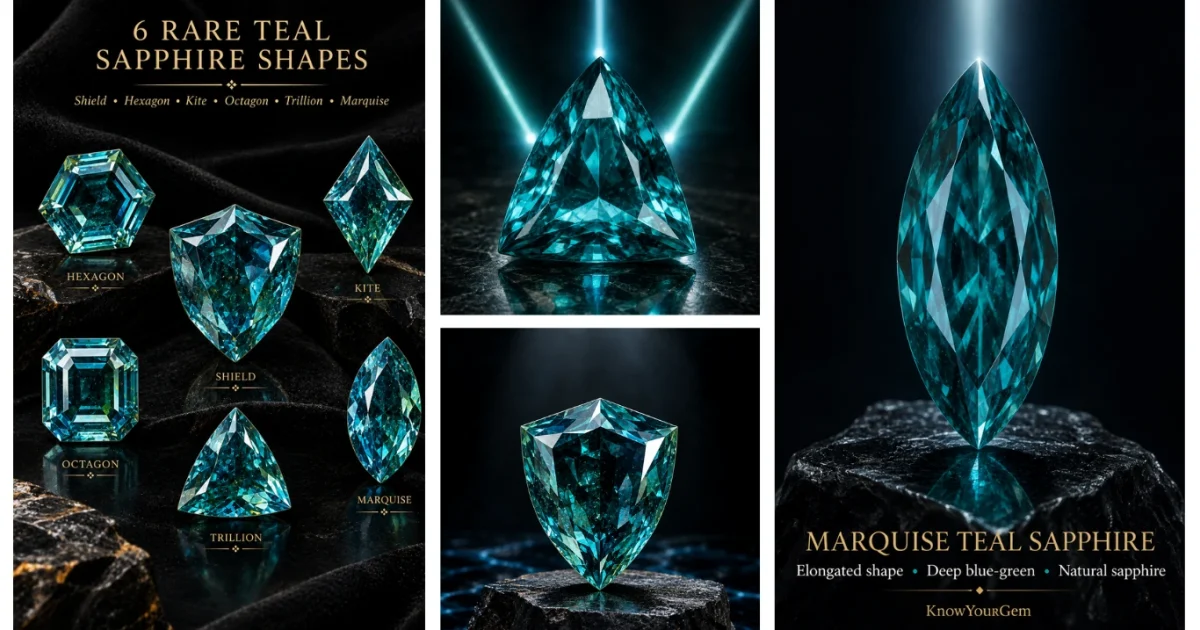

A teal sapphire is a member of the sapphire family with a mixture of blue and green color tones. This stone generally lies between both classic blue and pure green in color spectrum. The word “teal” is just a trade name for the color, not a different mineral or special lab-grade.
Quick Answer:
Teal sapphire corundum is colored by small traces of elements like iron and titanium. This coloration results in Teal sapphire being corundum colored by iron and titanium, producing a mixture of bluish green.
The stone occurs naturally in Madagascar, Sri Lanka, Australia, and Montana, and it can also occur as a lab-grown stone. A Gem-quality stone displays good color and good clarity, and the value of the stone depends on its full package, such as color, clarity, cut, treatment, and size; not merely the name ‘teal’.
What Is a Teal Sapphire?
The generic name for the diverse minerals of corundum is commonly aluminum oxide and only rubies are red. This implies that everything else (like yellow, green, blue, pink, teal are sapphires).
Teal sapphire is similarly influenced by these elements (such as iron and titanium) and often straddles two influences. This is where this precious stone’s color shifting is often viewable by light, cut, or angle.
Do not assume this stone for pure blue sapphire, because it always showcases a visible green tone. The name “teal” is just kept for trade term for the color gem labs that still identify the stone simply as sapphire, with the color description in geological terms rather than labeled “teal” on a certificate.
What Color Is a Teal Sapphire?
Teal sapphire stone is usually not a true one, specific color. The shade or tone of the stone is comprised of hue, tone, and color saturation.
Blue-Dominant Teal:
Leans closer to blue sapphire, with a secondary green modifier visible mainly at certain angles.
Balanced Blue-Green Teal:
Shows blue and green in close to equal measure. Such a balanced look is often the most desirable expression of color, but “color balancing” is a visual impression, not a fixed ratio.
Green-Dominant Teal:
Carries more visible green, edging toward what a lab might call a blue-green or green sapphire.
Grayish or Dark Teal:
Lower saturation or darker tone mutes the color, which is generally less prized than a brighter, cleaner blue-green.
There is no universally acceptable grading standard no official “50/50” benchmark that generally defines a true teal. The market’s occasional comparison ratio to judge gems is looking for color, clarity, treatment, size, ethical sourcing, and cut.
Why Does Teal Sapphire Look Different Under Different Lighting?
It’s more lighting-sensitive, and precisely because of this reason, purchasing a teal sapphire based on just that one image is a bit of a gamble.
Under daylight, more blue wavelengths will be visible in the stone as the blue component of teal sapphires is more defined, and they tend to appear bright and warm. On a warm interior light or under incandescent light, the same sample frequently turns blue. A slight loss of green, which was recorded outdoors, can occur.
Camera white balance and lighting setup will only exaggerate or mute the blue-green balance in photography. Even the surrounding metal in a ring mounting can influence the image. An image under a ring light and an image that is taken in open shade can make the same stone look like two different gems.
That isn’t enough the same as a color-change gem. Teal sapphire doesn’t shift between two distinct colors depending on the light source the way alexandrite does a matter of how the existing blue-green blend reads under different conditions, along with some pleochroism (different color intensity depending on viewing direction) that’s typical of sapphire generally.
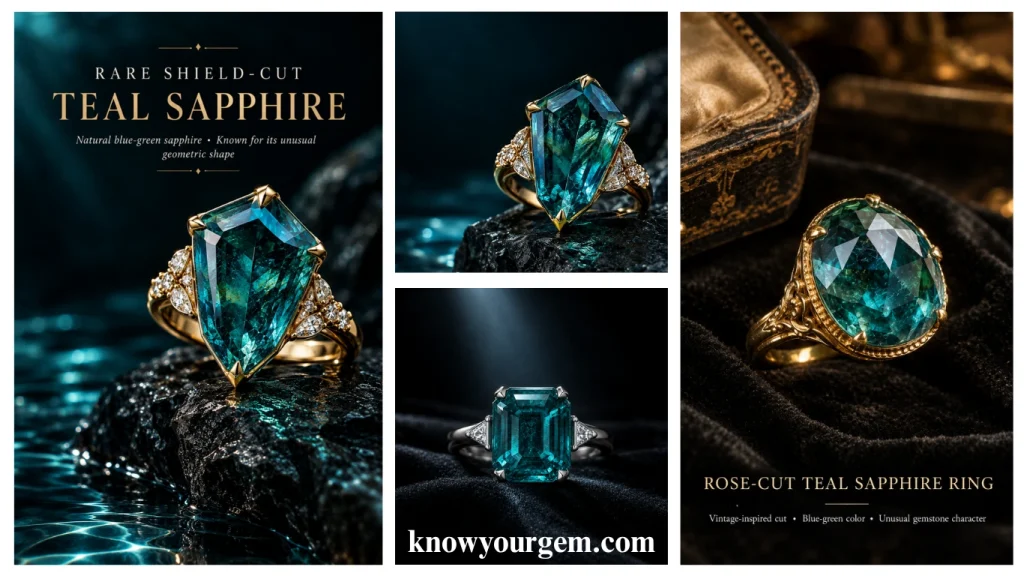
Teal Sapphire vs. Parti Sapphire:
It is considered as one of the most common points of confusion for buyers, and knowing its worth can be right before spending.
- Teal sapphire shows a blended blue-green appearance-the colors mix together across the stone rather than sitting in separate zones.
- Parti sapphire (also called bi-color sapphire) shows two or more distinct colors in visible zones or bands for example, a blue section and a yellow or green section with a visible boundary between them.
| Feature | Teal Sapphire | Parti Sapphire |
| Overall appearance | Blue-green blend | Two or more distinct colors |
| Color boundaries | Usually blended | Visible zoning |
| Main appeal | Unified blue-green color | Distinct color pattern |
| Can overlap? | Yes | Yes |
| Is “teal” a lab grade? | No | “Parti” describes color zoning |
A gem with having weak or fuzzy zoning can be sold as either, depending on the seller; however, mixing them up is a mistake.
So, experienced buyers won’t judge a stone by its image, but they also check structure, clarity, and treatment. However, less experienced buyers generally confuse teal with parti when they commonly rely on the stone’s image.
Where Do Teal Sapphires Come From?
Teal is a color description, so all over-tone sapphires are found from many sapphire sources. There is no one country that “makes” teal sapphire, and origin alone does not define quality or value.
Madagascar Teal Sapphire:
Madagascar has become a major commercial source of teal sapphire in today’s market, producing significant volume across a range of qualities.
Montana Teal Sapphire:
Montana, particularly deposits like Rock Creek and the Missouri River gravels, produces sapphire in a range of blues, greens, and teal tones and has become closely associated with the teal and parti sapphire trend in the U.S. market, though not every teal sapphire is Montana material, and assuming otherwise is a common buyer mistake.
Australian Teal Sapphire:
Sapphires from Queensland (Australia) can generally offer darker, more saturated, and teal-toned material that is well documented from this source.
Sri Lankan (Ceylon) Teal Sapphire:
Ceylon materials generally create teal sapphire with a different brightness and clarity. And collectors value such fine color, which comes from a reputable source.
Other Sources:
Teal-range sapphire has also been documented from other localities; it isn’t exclusive to the sources above. Origin can matter to collectors and to pricing when it’s independently documented by a laboratory, but a claimed origin without supporting documentation shouldn’t carry a price premium on its own.
Origin determination itself is a specialized laboratory service, separate from basic identification, and it isn’t always possible to determine with certainty.
How Rare Is Teal Sapphire?
Teal-toned material exists across multiple sources, so teal sapphire as a broad color category isn’t inherently scarce. What is genuinely less common is the combination buyers actually want: an attractive, well-balanced blue-green color, good saturation, a pleasing tone, decent size, clean clarity, and, for buyers who prioritize it unheated, well-documented material.
Beware of the certain rarity stats that seem to pop up all over the internet (eg “1% of sapphires are teal,” etc). These are not referenced in a reputable source and should not be relied upon as a hard fact.
The more defensible statement is that good quality large-size, strongly coloured, clean teal sapphire is more difficult to source than crap Thai sapphires, which pretty much applies to most coloured stones.
Is Teal Sapphire Natural?
“Natural”, “untreated” and “unheated” are three different things, and any confusion of the three is actually one of the easiest ways to pay more than you should:
- Natural teal sapphire was formed within the earth; it was not grown in a laboratory; it can still be treated. Lab-grown teal sapphire has the same chemical composition and crystal system as natural corundum. It is manufactured and generally much cheaper.
- Treated teal sapphire is natural material that has had its color or clarity altered or improved, most commonly through heat. Imitations glass, doublets, or other simulants are not corundum at all and are a different category from both natural and synthetic sapphire.
- A stone can be natural and heated, natural and unheated, or lab-grown “natural” only answers one of the questions a buyer needs answered.
Are Teal Sapphires Heated?
Many are. Heat treatment is a long-accepted practice in the sapphire trade and is not considered a defect when properly disclosed:
Unheated teal sapphire has not been heat-treated to modify the color and is confirmed no heat treatment. Lab-proven, it can contribute to the rarity and value of otherwise fine-quality material.
Heat-treated teal sapphire: Heated to enhance its color or clarity. This test result is considered to be a standard, acceptable enhancement that doesn’t usually need to be disclosed unless noted on a lab report.
Diffusion-treated form of heating the stone with chemicals or by a blast-flame burner to enhance or alter the color at or near the surface. If the dye is introduced, then sometimes this may penetrate deeper into the stone. Diffused stones tend to be less valuable than undiffused and should be declared.
For buyers, the bottom line here is that treatment is what altered the price of what you are paying for. Two visually indistinguishable teal sapphires can have vastly different prices, and this is an example of the decision-making process that should be double-checked up front instead of after a sale.
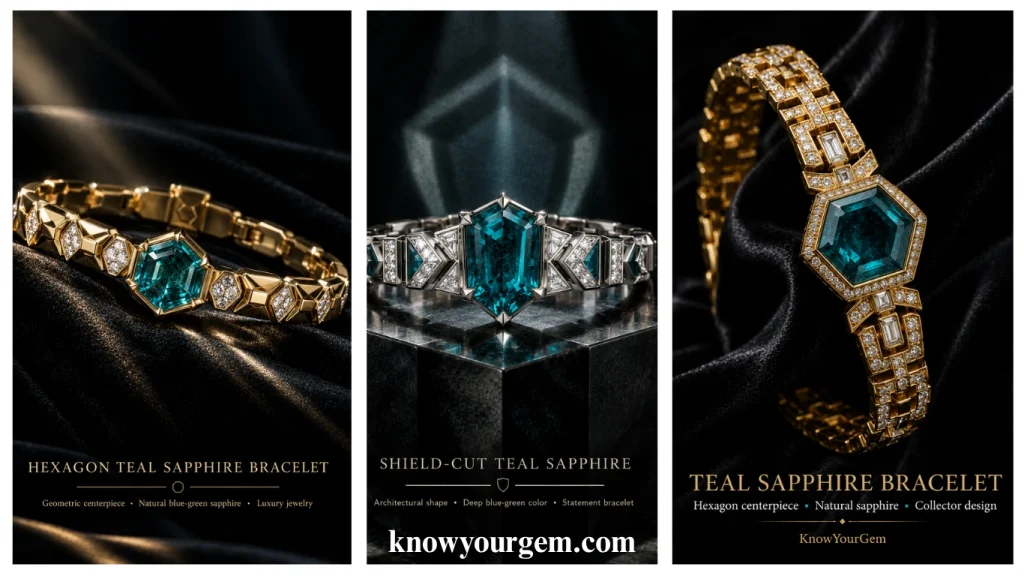
How to Identify a Teal Sapphire?
To identify natural teal sapphire you will need to look at its important key factors:
- Color across the stone, checking for even blending versus zoning
- The stone from multiple angles, since pleochroism and lighting change the apparent color
- Inclusions under magnification, which can offer clues about natural origin and treatment history
- Refractive index of sapphire can typically read around 1.762–1.770.
- Specific gravity is approximately 3.95–4.03 for corundum.
- Spectroscopic examination is used by trained gemologists use to help distinguish natural color from certain treatments.
None of the above home or loupe-level tests alone can definitively verify natural vs. Lab-grown, treatment, or origin. Those require a lab report. Visual images can help determine a general appearance, but a photograph (or even a thorough visual inspection) is definitely not enough to determine origin or treatment.
This is the point when an online ID tool is truly handy for ruling out then confirming certain possibilities, but it is just a starting place, not a strong final ID.
Teal Sapphire Inclusions: What to Look For
In its natural form, corundum usually displays one or more of a few internal features-crystal inclusions, long thin needle shapes (sometimes called silk), color zoning, healed fissures called fingerprints, and some clouds.
An appearance that appears perfect under a microscope is only a reason to be cautious rather than reassured; natural stones nearly always show some form of evidence of their natural formation-; inclusions, small fissures, and in some stones even cleavage planes.
Rocks that seem to be ‘too perfect’ are certainly one of the benchmarks experienced buyers look for in separating possible fakes and simulants.
Inclusions can support an origin opinion when combined with other evidence, but no single inclusion “proves” a stone is from a particular country. To find authentic origin can be a more complex process involving multiple observations and tests together, carried out through a specialized laboratory.
How Much Is a Teal Sapphire Worth?
There are no consistent online seller guides consistently printing the same “average” prices per carat. Their range would be wildly different. This alone indicates that there is no one “correct” appraisal figure. Factors that determine the level of these marks include:
- Color means (hue, tone, saturation, and overall balance)
- Clarity
- Cut quality
- Carat weight
- Treatment status
- Origin (when documented)
- Certification
- Overall market demand
Unheated teal sapphire generally commands a premium over comparably colored heated material, when confirmed by a lab. Documented origin from a well-regarded source can add value, particularly for larger or finer stones, but only when it’s backed by paperwork rather than a seller’s claim.
A GIA or similar lab report does not equate to “quality” it simply identifies identity and treatment, and origin in some cases, but not a quality grade, as GIA did not and does not grade or impart quality analysis for sapphire.
This is precisely where the problem lies. Two sapphires of comparable size and hue can have very disparate prices due to a single heat treatment that is unreported, whereas the other is unheated and supported by a lab report as to treatment status and country of origin.
What Makes a Teal Sapphire Valuable?
In most cases, the difference between a common teal sapphire and a very desirable one is: a pleasing medium tone; pleasing location of tone; a pleasing and balanced saturation; good brilliance and a good cut which allows the color to be seen evenly; a good natural stone for the price with good clarity;
naturality (as opposed to a lab-created); if treated, unheated material; an appropriate size; and paperwork from an acknowledged laboratory.
Best Cuts for Teal Sapphire:
No single cut is universally “best” the right choice depends on what you want to emphasize.
- There isn’t any one cut which is “best”: It really depends on what you want to stress.
- Oval shape: It is used for the teal sapphires, as it displays good color and maximizes the visual size.
- More intense color saturation is possible: Very helpful for working with whiter colored stones.
- Emerald cut: it enhances Clarity and Color, though its large, flat facets are more suitable for cleaner stones, as they tend to conceal inclusions.
- Round and Young in popularity: The round is the brightest shape of all, but it is less frequently discounted for carat weight in the teal material.
- The pear has a distinctive shape: In fact, it is one of the most common shapes seen in earrings and pendants,
- Cabochon: These are used for stones that have a heavier inclusion or the desired glow rather than the facetted brilliance.
- Firework cut: It is a modern faceting style. It was created to get the most possible light back and pattern (firework) as possible. It is. Characteristically, it displays color and brilliance in a different way than other facets.
Zoning, clarity, and the stone’s natural color distribution should guide the cutting choice more than trend alone.
Teal Sapphire Certification: What Should a Report Tell You?
A useful gemological report for a teal sapphire should address:
- Natural versus laboratory-grown status
- Disclosed treatments (heat, diffusion, or none detected)
- Weight and measurements
- Color description in standardized gemological terms
- A geographic origin opinion, when requested and when determinable
It’s worth being precise here: GIA does not grade sapphire or provide a quality analysis. Its identification reports establish identity, natural or lab-grown status, and detectable treatments, and can include an origin opinion on request when the evidence supports one. ” GIA certified” means that the stone has been looked at and recorded by GIA.
Teal Sapphire vs. Blue Sapphire:
Blue sapphire has traditionally been the dominant stone for the longest period of time, which means that it could hold a more established market and more widespread name recognition.
Teal is a more unique, unusual appearance, with validity in the gemological field it’s still sapphire, still a 9 on the 10-point scale and capable of withstanding everyday use.
There is no any clear-cut advantage in terms of rarity or price; both can vary greatly in price depending on the quality. As a rule of thumb, blue sapphire hovers on the traditional market and bridal side, while teal has been working it since attending to the curious collector and individualist.
Neither is explicitly “better”, it depends solely on the individual tastes of the buyer and the quality of the individual stone.
Is Teal Sapphire Good for an Engagement Ring?
These being the type of strength sapphire that can be worn on an everyday basis, even for general wear, is why sapphires as a replacement for diamonds in engagement rings have been so popular. As for a specific teal sapphire:
- Check inclusions carefully, since surface-reaching fractures can be a durability concern in a ring worn daily.
- Confirm treatment status, since it affects both value and, in some cases, care requirements.
- Select a setting (prong, bezel, or halo) that will retain the stone while displaying the color of the stone as much as possible.
- Pair with white or yellow gold or platinum, depending on which way you want to temper the stone; the change of the color of the gold can affect how the teal reads.
- A diamond halo or diamond accents can brighten a darker-toned teal sapphire.
Teal Sapphire Meaning and Symbolism:
This section covers traditional and belief-based associations, not scientifically established properties.
This shade of blue, categorized as “teal,” is linked in many cultures to themes of serenity, equilibrium, and emotional transparency all qualities non-diamantine holders frequently equate, haphazardly, with teal sapphire.
In general birthstone lore, sapphire is the native birthstone for September, but outside jewel marking, the specific category“teal sapphire” does not exist.
Any type of zodiac sign linkage can claim the teal sapphire to fall under horoscope of sagittarius or another sign that belong to the realm of gemstone superstition and can’t be derived from concile genetics.
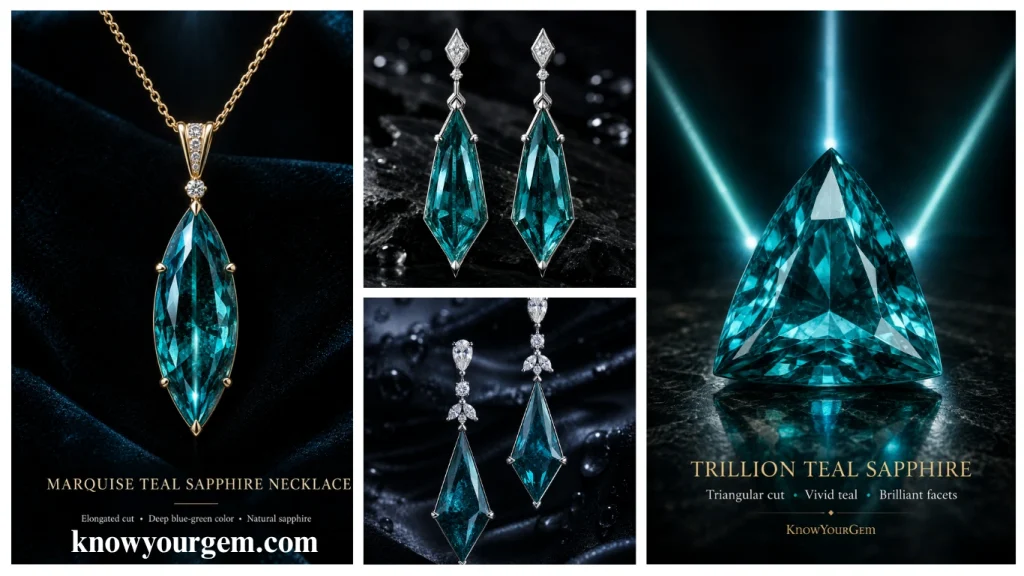
How to Buy a Teal Sapphire Without Overpaying?
Before buying, ask:
- Is this stone natural or synthetic?
- Is this stone treated, and if so, how?
- What is the stated origin, and is it independently documented?
- What does the certificate actually say identity, treatment, ethical sourcing?
- How does the color look in different lighting, not just the seller’s photos?
- Is the color evenly blended, or is it closer to visible zoning (parti)?
- How good is the cut does it show the color evenly?
- Are inclusions visible, and are they consistent with a natural stone?
- Is the price of this stone fair compared to similar stones?
- Can a seller reliable with a proven record?
Avoid someone who cannot or will not comfortably answer these questions, and mostly be aware of the picture of a stone, which is perfect because no stones can be perfect. A natural stone should show, at the very least, some evidence of the places it has been when viewed through a magnifier.
- Assuming teal means Montana: Teal sapphire comes from multiple sources; Montana is one of several, not the definition.
- Assuming natural means unheated: Such are separate questions that require separate answers.
- Confusing teal with parti: Blended color and zoned color are different categories, even when they sit close together.
- Buying from one photograph: Lighting changes teal’s appearance more than most sapphire colors.
- Ignoring tone and saturation: “Teal” alone doesn’t tell you whether a stone is attractively balanced or muddy and dark.
- Paying an origin premium without documentation: A claimed origin isn’t the same as a documented one.
- Assuming a lab report means top quality: Identification isn’t grading.
- Comparing prices without comparing treatment: For two stones such as these, which are approximately the same cost, there can be great disparities between one another once the treatment has been taken into consideration.
Frequently Asked Questions:
1. What is a teal sapphire?
It is a corundum variety with unique blue-green display that results from subtle amounts of Iron and titanium.
2. Is teal sapphire a real sapphire?
Yes. Similar makeup; all are color varieties of corundum, which is the same mineral series as blue and pink sapphire.
3. Is teal sapphire the same as parti sapphire?
False. Teal is actually a mix of blue and green, and the word parti means a mixture of two or more distinct and separate colors.
4. How rare is teal sapphire?
There are several sources of teal-toned materials, and that is not rare under this broad category, excellent, balanced, saturated, and clean stones in a large size are really rare.
5. Are teal sapphires heated?
Many are, as heat treatment is a common practice in the sapphire trade. The unheated material (grounded by a lab) generally is more expensive.
6. Does GIA certify teal sapphire?
Eligibility of the product/dealer for GIA certification is one of the many advantages of GIA certification, as mentioned above, is knowing the eligibility of the product that has to be GIA certified. So, beginning with the eligibility of the product for GIA certification.
7. Is teal sapphire good for an engagement ring?
GIA is able to identify the species of a sapphire, whether it has been treated, give a country or geographic origin opinion, and if it is a natural or synthetic sapphire; but GIA will not be able to grade the quality.
Sources used for factual verification:
- GIA “Is GIA grading sapphire or other colored stones?” (gia.edu/gia-faq-grade-sapphires)
- GIA – “What is a lattice diffusion sapphire?” (gia.edu/FAQ/gia-faq-lattice-diffusion-sapphire)
- GIA Gems & Gemology known literature on sapphire treatment and identifying inclusions
- International Gem Society “Teal Sapphires: Gemstones of Harmony” Cross-checked industry’s color-science sourcing of iron/titanium chromophores in corundum found in industry gem-trade publication.
Written and Published By Kamil Hussain (Gemstones Expert and Enthusiast)

Welcome to KnowYourGem.com! your ultimate destination for uncovering the fascinating world of gems and their secrets! I'm Kamil Hussain, a passionate blogger with a Master’s degree in Economics, dedicated to bringing you insightful, well researched content that blends the beauty of gemstones with the art of storytelling. With a keen analytical mind and a love for discovering hidden treasures, I created this platform to help you explore the brilliance, history, and value of every gem.

