
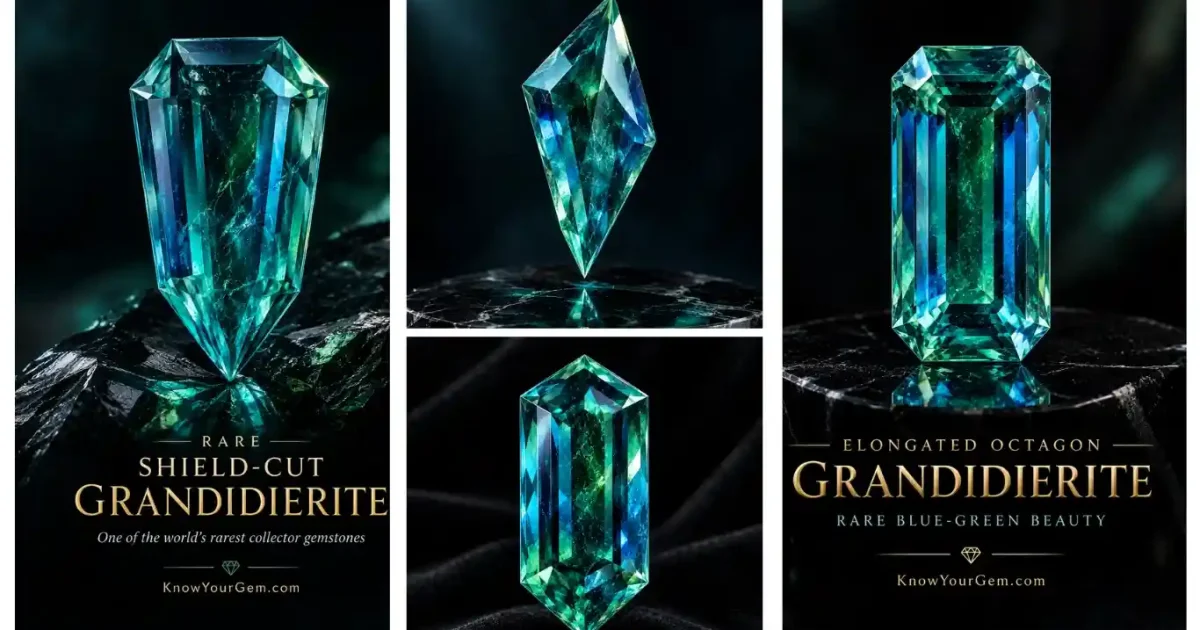

Overview:
Ask five gem dealers what the rarest stone they’ve ever handled was, and Grandidierite shows up more than you’d think. Not because it’s expensive in the way a fabulous ruby is, because most of them have simply never come across an unblemished, transparent one.
This is a blue-green to teal borosilicate mineral from Madagascar, with a Sri Lankan load to boot, and the material that makes it to a bench in transparent facetable slice thickness is so thin that whole lives go by without one ever coming through a gemologist’s door.
Here’s what it is, what it costs, how to tell it from the handful of stones that are mistaken for it. And, because this gets ignored all the time, what it takes to wear one of these without cracking it.
What Is Grandidierite?
Chemically, it’s (Mg, Fe)Al₃(BO₃)(SiO₄)O₂, a magnesium-iron-aluminum borosilicate, orthorhombic, tabular in habit. It sits in the nesosilicate family alongside relatives like kornerupine and dumortierite, close enough in structure that the resemblance isn’t a coincidence.
French mineralogist Alfred Lacroix described it in 1902, pulled from a small pegmatite at Cap Andrahomana on Madagascar’s southern coast. The name honors Alfred Grandidier, an explorer who’d spent decades cataloguing the island’s natural history, worth knowing, because people assume the name belongs to whoever found the stone, and it doesn’t.
Here’s the part that actually explains the rarity, though: Grandidierite doesn’t form in the kind of broad, predictable veins that give you steady commercial supply.
It shows up in small, irregular pockets. The original 1902 site was revisited in 1960 and was already tapped out. For most of the century after Lacroix’s description, virtually everything found was translucent to opaque, fine for a cabochon, useless for faceting. That only changed in the early 2000s.
Is Grandidierite Rare?
Genuinely, yes, but the word does a lot of sloppy work in gem marketing, and it’s worth being precise about what’s actually rare.
The mineral itself has turned up in over a dozen countries. Gem-quality material, only from Madagascar and Sri Lanka. Transparent, facetable rough, a genuinely small global population. Large, clean, transparent stones over a carat or two. You could probably count the well-documented examples without running out of fingers twice over.
How rare is gem-quality material, specifically?
GIA’s own researchers described facetable Grandidierite, before mid-2015, as almost unheard of. A deposit found near Tranomaro in May 2014 loosened that a little. A few dozen transparent crystals came out of it over the following couple of years, some genuinely gem-grade.
Total output, even counting that discovery, stayed in the low hundreds of carats. For context, that’s nothing next to any commercially mined colored stone.
Why does transparent material matter so much more than translucent?
Because translucent is the norm and transparent is the exception. Most of what’s been dug up historically goes into cabochons. Faceted stones are the round brilliants, and step cuts you’d actually want in a ring come from a tiny slice of total production.
Is it really one of the rarest gemstones in the world?
You’ll see it on plenty of “rarest gems” lists, and I don’t think that’s unreasonable ultra-rare facetable material belongs in that conversation. But there’s no official body that ranks gemstone rarity, full stop.
“Third rarest” in particular is a number that gets posted everywhere on the net without anyone ever citing a source to where anyone counted to that number. (Use it as commercial folklore, not gospel.)
Where Is Grandidierite Found?
Over a dozen countries have turned up specimens. Such as Malawi, Algeria, Canada, Antarctica, Norway, and the U.S. Almost none of it is gem quality. Facetable rough over a few millimeters has only ever come out of two places.
Madagascar is the type locality and, practically speaking, the source of nearly all commercially meaningful gem material. Cap Andrahomana gave up the first specimens and ran dry decades ago.
Tranomaro, found in May 2014 about 60 kilometers northwest of that original site in the Anosy region, is the deposit that actually put transparent rough into circulation and by most accounts, it was largely worked out within a couple of years.
The contribution mainly from Sri Lanka through water-worn material in the gem gravels of the Ratnapura region, with transparent gem as defined stone, is only traced to Putthady, Kolonne region (+/- 2000).
The stone that created a true calling card for Grandidierite, the 0.29 carat faceted stone, was purchased in 2003.
Does origin change the price? Indirectly. It’s not a stamped premium the way Kashmir origin is for sapphire, but since Madagascar and Sri Lanka are the only two places that have ever produced meaningful transparent rough, any credible transparent faceted stone traces to one of them. A stone claiming a different origin is a stone worth questioning.
Grandidierite Color: What Is the Best Color?
Blue-green through teal through green, sometimes sliding into the grayish in weak saturation. Iron is the main contributor of color more iron pushes the hue toward blue and less toward green, thus two stones from the same general location can test significantly different based on their individual chemistry.
Here’s the property that confuses people: the same stone will show three completely different colors-dark blue-green, dark green, and a light so near-colorless (sometimes slightly yellow).
This is trichroic pleochroism, which is one of the most strongly trichroic colors that you can find in gemology; it’s not a mistake or a flaw. It’s real optical physics, and it happens to be one of the most useful diagnostic tools for confirming a stone actually is Grandidierite, since few lookalikes pleochroise this hard.
That property also decides value in a way people don’t expect. A cutter orienting the rough to favor the best pleochroic face can turn mediocre-looking rough into a strong-colored finished stone and get it wrong just as easily, turning good rough into a disappointing one. Two crystals of identical size and clarity can finish at very different values purely on that orientation call.
Grandidierite Properties & Gemological Facts:
| Property | Grandidierite |
|---|---|
| Composition | (Mg,Fe)Al₃(BO₃)(SiO₄)O₂ |
| Belongs to | Borosilicate (nesosilicate) |
| Crystal sstructure | Orthorhombic |
| Typical colors | Blue-green, teal, green, occasionally grayish |
| Scale | 7 to 7.5 |
| Specific gravity is around | ~2.85 to 3.00 |
| Refractive index is about | Approximately 1.58 to 1.64 (sources vary slightly) |
| Birefringence is about | ~0.035 |
| Luster Is | Vitreous |
| Transparency | The stone is transparent to translucent (rarely opaque) |
| Pleochroism | It has strong trichroism, like blue-green, near colorless |
| Cleavage | It has perfect cleavage in two directions |
| Fracture | It has Brittle |
High 2.8’s to 3.0’s specific gravity, considered light for a colored-gem, means shy of corundum by a fair amount, would seem to place it roughly in the realm of tourmaline and is one of the first numbers examined by the gemologist to distinguish a Grandidierite from a denser blue-green stone such as lazulite.
The orthorhombic structure is doing double duty here: it’s what gives the stone its tabular habit and its pronounced pleochroism, and it’s also exactly why the cleavage is a real concern. Same atomic planes, two consequences are good for identification, one bad for durability.
Composition-wise, iron substitutes for magnesium at a variable rate, and that substitution is the whole story behind the color range. It’s also the link to ominelite, Grandidierite’s more iron-heavy chemical cousin.
How to Identify Grandidierite:
Color alone won’t get you there, with too many other minerals share this territory. Work through it properly:
- Note the color family: Blue-green, teal, or green, as a starting point only.
- Check transparency: Transparent, translucent, or opaque changes both the identification path and the value conversation.
- Test pleochroism using a dichroscope: Three blue/green/orange and so on is your single strongest clue.
- Refractive index measurement: the reading should be around 1.58–1.64 (biaxial negative).
- Check specific gravity: Around 2.85–3.00 from hydrostatic weighing.
- They confirmed the hardness very carefully: approximately 7 to 7.5, but never use N9 for scratch-testing of a precious stone if you do not have an alternative.
- Look at inclusions: locality-dependent, useful supporting evidence rather than a standalone answer.
- Run a polariscope check: confirms biaxial character.
- Send it to a lab for anything serious: Raman spectroscopy or EDXRF settles it definitively, especially against a close relative like kornerupine.
A photo can suggest Grandidierite. It can’t confirm Lazulite, kornerupine, and some tourmalines occupy close enough color territory that only instruments actually close the case.
Quick identification checklist:
- Strong trichroism under a dichroscope
- RI around 1.58–1.64, biaxial negative
- SG around 2.85–3.00
- Lazulite and kornerupine specifically ruled out
- Lab documentation for anything of real value
Real vs Fake Grandidierite:
There is no generally available fake Grandidierite on the jewelry market, so “fake” in this context is most often of this more mundane variety: just another turquoise-blue-green stone sold by this name, whether knowingly or unknowingly.
The trichroic test is a good start a stone that will not change color significantly by direction should almost certainly not be Grandidierite, but after that it takes instruments, not eyes. RI & SG tests are also useful for this and decide what the color cannot be.
Lazulite is the lookalike that comes up most, sharing the blue-green tone and pleochroic behavior but reading higher on RI and density, lower on hardness. Kornerupine needs the same instrumental separation. Some tourmaline colors overlap superficially with paler Grandidierite too.
Any rare, unfamiliar gemstone name creates room for mislabeling glass, dyed material, or simply a different natural mineral sold under a name buyers don’t know well enough to question.
Request a laboratory report from a recognized lab for anything priced like genuine rarity. Considering how narrow the legitimate supply actually is, Documentation weighs more than just about any other colored stone here.
Grandidierite Price: How Much Is It Worth?
There’s no honest single number. The spread here is wider than nearly anything else discussed on collector forums.
At the low end, in wholesale, cabochons cut from translucent rough have averaged maybe $5-10 a carat, with the best material occasionally exceeding $2,000 a carat. At the high end, in top-notch transparent faceted stones with true clarity, specialist dealers have been asking $20,000-$26,000 a carat.
And then there’s the outlier everyone points to: the first known transparent faceted stone, 0.29 carats, sold in 2003 for around $50,000– or about $170,000 a carat if you do the math. Although that figure reflects a benchmark, record-setting, one-time sale, as opposed to any true market level.
What exactly distinguishes costly Grandidierite from nothing else is merely the sum, not the combination, of some of the above: transparency, saturated color, eye-clean clarity, and a cut out to the optimal pleochroic face.
The size generally adds all of it. Material over a carat is literally rare, so a clean, large stone commands a premium far beyond the extra weight would seem to justify.
An additional reason why two stones of equal carat weight may fall into completely different price ranges. You are not getting the same item purchasing a one carat cabochon as you are purchasing a one carat faceted, eye-clean, laboratory documentation stone.
| Example | Reported figure | Note |
|---|---|---|
| First transparent faceted stone (2003, Sri Lanka, 0.29 ct) | ~$50,000 total (~$172,000/ct) | Landmark sale, not typical market pricing |
| Fine faceted transparent stones, current market | ~$20,000–$26,000/ct | Reported by specialist dealers |
| Retail listings, teal faceted stones | ~$50 to $10,000+/ct | Wide range by size, clarity, color |
| Wholesale cabochons | ~$5–$10/ct, up to $2,000+ for fine pieces | Translucent, non-transparent rough. |
One thing worth being blunt about: every figure above is an asking price or a dealer’s quote, not a completed auction result and not a professional appraisal. Those are three different things.
Mixing them up is probably the single most common way buyers end up misjudging what “fair” actually looks like for a gem this thinly traded.
Grandidierite Value Decoder:
Rather than leaning on carat weight or one quoted number, it helps to run a given stone through six factors and see where it actually lands. This isn’t an official grading system think of it as a practical framework, the KnowYourGem Grandidierite Value Decoder:
- Transparency: Opaque and then translucency and ultimately transparency (this being the largest step in the entire framework)
- Color: Grayish/washed-out-moderate blue-green – bright saturated blue-green or teal
- Clarity: heavily included → lightly included → eye-clean
- Cut: basic or poorly oriented → good proportions → precision faceting favoring the strongest pleochroic face
- Size: under 0.5 ct → 0.5–1 ct → over 1 ct (genuinely uncommon)
- Documentation: none → seller’s description → independent lab report
These interact, they don’t stack in isolation. A small, transparent, vivid, eye-clean, documented stone will routinely outvalue a bigger one that’s merely translucent with average color. Size is one input here, not the dominant one.
Is Grandidierite a Good Investment?
Treat it as a collectible, not a financial position. Rarity on its own has never reliably predicted resale performance that needs liquidity, an established secondary market, price transparency, and consistent documentation standards behind it, and Grandidierite has none of those to the degree that genuine investment-grade gems like fine or Kashmir-origin sapphire do.
Where it does make sense as a collector’s stone is specifically in transparent, faceted form, not as a store of value, and not in cabochon or specimen form, where the collector base thins out even further.
What actually makes an exceptional piece collectible is the same list from the Value Decoder: confirmed transparency, strong saturated color, real size, and independent documentation. And rarity alone guaranteeing returns is a myth worth retiring.
Grandidierite’s own price history proves it, with collector forum threads showing wildly inconsistent asking prices for superficially comparable stones over the years. Rarity drives desire. It doesn’t manufacture a buyer pool by itself.
Grandidierite at Auction:
It surfaces at auction far less than established colored gems, and you’ll see both faceted stones and raw specimens depending on the sale. Mineral auctions and gem/jewelry auctions genuinely draw different buyers for this material.
Evaluating a listing means the same checks as anywhere else: transparency and color from the photos, confirmed carat weight, any certification attached, and provenance where it’s given.
Given how few large, clean, faceted stones actually exist, a listing claiming something exceptional deserves more scrutiny, not less.
Starting bids often sit well under typical retail asking prices. Final hammer prices can go the other way entirely once two motivated collectors both want the same rare stone. Neither number, alone, tells you what the thing is actually worth in any lasting sense.
Grandidierite vs Other Gemstones:
A comparison of gems on price per carat only overlooks most of what counts different species are currently selling in totally different markets and you need to factor durability & optical quality into the equation as well.
Vs aquamarine: Both can be in the blue-green range, but aquamarine (a beryl) is much more accessible, pleochroism is not anywhere near as drastic, and it has no risk of cleavage.
Vs alexandrite: Alexandrite‘s signature trick is a color shift between light sources, a genuinely different phenomenon from Grandidierite’s angle-dependent pleochroism. It’s also considerably tougher for daily wear.
Vs emerald: Emerald’s green comes from chromium or vanadium in a beryl lattice, and it’s almost always oiled to improve apparent clarity, a treatment with no real equivalent in untreated Grandidierite.
Vs diamond: Not meaningful substitutes for most buyers. Diamond has a liquid, standardized global market; Grandidierite doesn’t.
At the very top end, exceptional transparent material can outprice a lower-grade diamond of similar size, but that’s really a comment on how wide diamond’s own quality range runs, not a statement that Grandidierite generally beats diamond on price.
| Feature | Grandidierite | Aquamarine | Alexandrite | Emerald |
|---|---|---|---|---|
| Typical color | Blue-green, teal | Pale blue | Green (changes under different light) | Green |
| Mohs hardness | 7–7.5 | 7.5–8 | 8.5 | 7.5–8 |
| Pleochroism | Strong trichroism | Weak to moderate | Present, secondary to color change | Weak |
| Transparency | Transparent to translucent | Typically transparent | Typically transparent | Typically transparent, usually treated |
| Major value factor | Transparency + rarity | Color saturation | Strength of color change | Color, clarity, minimal oil treatment |
| Typical jewelry use | Protected settings, collector pieces | Everyday wear | Fine jewelry, collector interest | Fine jewelry, often protected settings |
Grandidierite Jewelry:
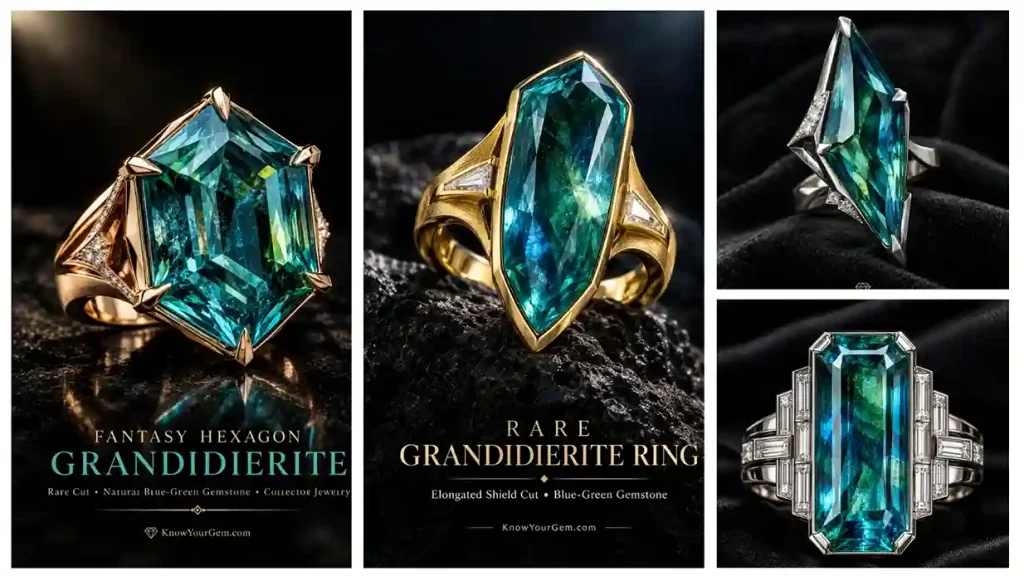
A ring is wearable, but only in a protective setting-more on why below. An engagement ring specifically isn’t a conventional pick, and it’s not a decision to make lightly, given that daily-wear rings are exactly where cleavage risk stops being theoretical; anyone set on it should insist on a bezel or halo.
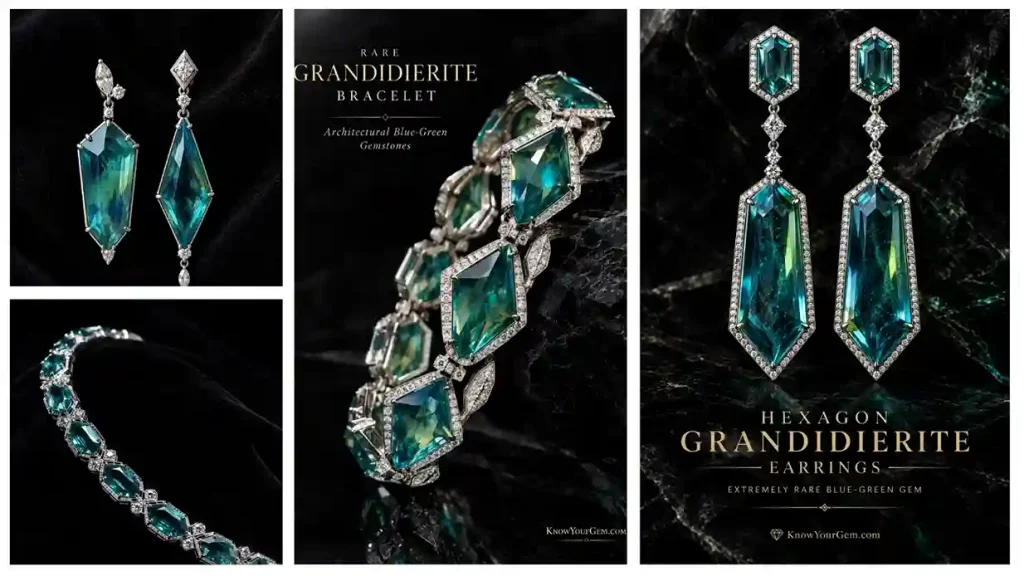
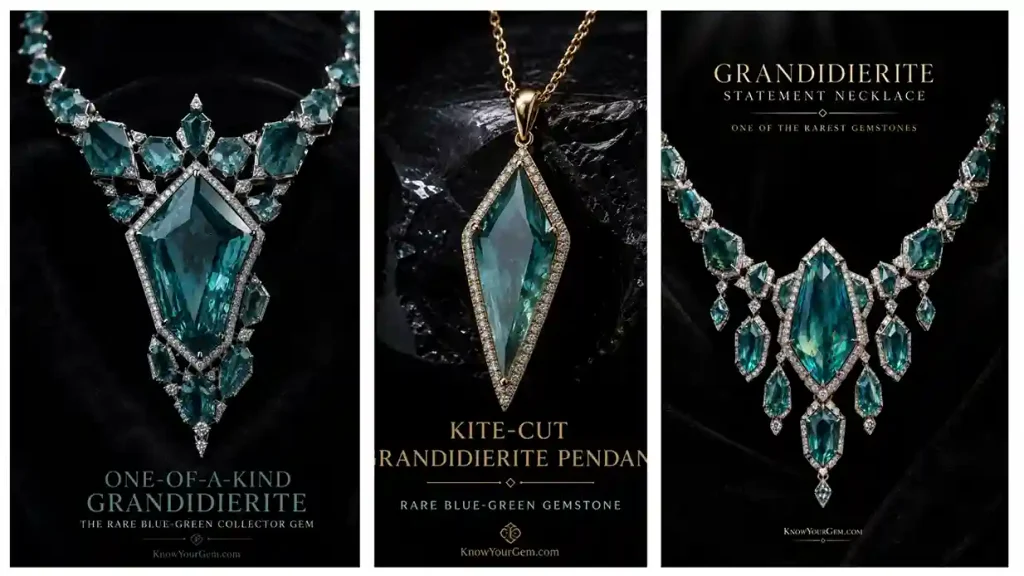
Earrings are a genuinely strong option low impact exposure suits the stone well. A bracelet sees more knocks than earrings or a pendant, closer to ring-level risk.
Beads and bead necklaces are typically cut from more available, less-transparent material, making them the accessible end of owning the gem.
A cabochon is still the traditional and more common cut for translucent rough, while faceted stones-reserved for transparent material-carry essentially all of the gem’s serious collector value.
Is Grandidierite Suitable for Everyday Jewelry?
7 to 7.5 on the Mohs scale, which would seem to be sufficient on its own for everyday jewelry, actually is for everyday wear, if used alone.
The tricky part is the perfect two directions of the cleavage (that is, easy to split) on the stone’s surface. If hit at the wrong angle, a stone with good cleavage would chip or even split.
Even though a perfectly hard, non-cleavable stone would walk away from the blow. This would be why a single number of good hardness isn’t the best for choosing a stone for everyday wear.
For rings, the setting does as much work as the stone itself. A bezel, wrapping metal fully around the girdle, or a halo, which surrounds and shields it, both cut the odds of a direct hit ever reaching a cleavage plane.
A standard prong setting, which leaves the edges exposed, is a genuine risk here in a way it wouldn’t be for a tougher, cleavage-free gem.
| Jewelry | Suitability | Why |
|---|---|---|
| Pendant | High | Minimal impact exposure |
| Earrings | High | Well protected in daily wear |
| Bracelet | Moderate | More exposure to knocks |
| Ring | Moderate | Frequent impact risk |
| Engagement ring | Depends | Requires bezel or halo setting and a wearer mindful of lifestyle |
Grandidierite Meaning & Benefits:
In newer crystal-healing circles, some readers and sellers liken this to mental clarity, resilience, and belief in oneself. A short amount of time in consciousness has meant almost none of the myth built up around the centuries-old ones.
In some energy-work systems. Although the blue-green hue meditations likewise become associable with soothing and stabilizing associations respectively through the same color-symbolic reasoning used in most colored gems in that system.
None of this is scientifically established. These are belief-based, culturally and commercially generated associations, not documented effects, and there’s no peer-reviewed evidence behind any of them. Worth treating as personal or cultural meaning rather than fact.
One factual note that’s easy to miss: there are no known standard treatments applied to Grandidierite in the trade. That’s actually unusual-treatment disclosure is such a routine part of buying most colored stones that its absence here is worth stating plainly. What you’re looking at, with this gem, is generally what came out of the ground.
Grandidierite Facts:
- Originally described as a mineral in 1902 by French mineralogist Alfred Lacroix.
- Named for the explorer Alfred Grandidier, not the individual who discovered it.
- Chemical formula: (Mg, Fe)Al3(BO3) (SiO4)O2.
- A borosilicate mineral, nesosilicate group.
- In the orthorhombic crystal system.
- Mohs hardness 7-7.5.
- High trichroism- three different colors strong by the line of sight.
- Color: 1 color is determined by the quantity of iron in the stone; the more iron, the bluer it is; the less iron, the greener it is.
- Good to perfect cleavage in 2 directions-brittle in spite of reasonably high hardness.
- By 1960 the original 1902 site was completely depleted.
- Known from more than a dozen countries; only from Madagascar and Sri Lanka for gem-quality material.
- Transparent Sri Lankan material dates to around 2000, mainly the Kolonne area.
- The Tranomaro deposit, found May 2014, produced the first real modern supply of transparent rough.
- The first confirmed transparent faceted stone sold in 2003-0.29 carats, roughly $50,000.
- No known standard treatments exist for this gem.
- Ominelite is its iron-dominant chemical relative.
- Most historical material has been translucent, better suited to cabochons than faceting.
- Specific gravity runs 2.85–3.00, on the lighter end for a colored gem.
- Lazulite and kornerupine are the two most-cited lookalikes.
- Even after a century-plus of documentation, most working gemologists have never handled a faceted example.
Grandidierite Care & Cleaning:
Use cold water with mild soap and a soft brush, nothing more aggressive. Skip ultrasonic cleaners and steam entirely-both the vibration and the heat carry real risk given the cleavage.
Store it apart from harder stones so it doesn’t pick up surface abrasion, and guard against sudden impacts above almost everything else on this list.
If it needs professional attention, find a jeweler who actually works with fragile colored stones rather than a general drop-off counter.
Frequently Asked Questions:
1. Is Grandidierite rare?
Yes, scarcity. Gem quality material is rare enough, but the transparent facetable form that most collectors desire is even more difficult to find since it is restricted to Madagascar and Sri Lanka.
2. How much does Grandidierite cost?
From roughly $5 a carat for wholesale cabochons up to $20,000–$26,000 a carat for fine transparent faceted stones, with one historic sale reaching well past that ceiling.
3. Where is Grandidierite found?
Commercially, only southern Madagascar and Sri Lanka. Documented elsewhere as a mineral, but not in gem quality.
4. What is the best Grandidierite color?
Vivid, saturated blue-green or teal, shown to best advantage by a cut oriented toward the strongest pleochroic face.
5. Is Grandidierite more expensive than diamond?
Only at the very top of its range against lower-grade diamond material that says more about diamond’s quality spread than about Grandidierite generally.
6. Is Grandidierite a good investment?
In addition, treat it more like a collectible rather than an investment. Being a rare, fine piece doesn’t make the rare, fine piece more liquid and less volatile in price.
7. Can Grandidierite be used in an engagement ring?
Yes, with a bezel or halo setting, and the wearer being aware that the rings you wear on a daily basis present a higher risk to this type of stone than other types of jewellery.
8. How can you tell if Grandidierite is real?
Through RI, SG, and its strong trichroic pleochroism, not by eye alone.
9. What does Grandidierite mean?
Modern-day crystal-healing assumes that the stone embodies clarity and resilience is an article of faith.
10. What is Grandidierite’s chemical formula?
(Mg,Fe)Al₃(BO₃)(SiO₄)O₂.
11. What is Grandidierite’s hardness?
The stone is 7 to 7.5 on the Mohs hardness.
12. Is Grandidierite suitable for everyday wear?
Yes. Especially for earrings and pendants; rings require a bezel or halo setting, particularly because of the cleavage.
Verify this gemstone with trusted labs like GIA, IGI, IGS and SSEF for authenticity.
Written and published by enthusiast and gemstone expert {KamilHussain}.

Welcome to KnowYourGem.com! your ultimate destination for uncovering the fascinating world of gems and their secrets! I'm Kamil Hussain, a passionate blogger with a Master’s degree in Economics, dedicated to bringing you insightful, well researched content that blends the beauty of gemstones with the art of storytelling. With a keen analytical mind and a love for discovering hidden treasures, I created this platform to help you explore the brilliance, history, and value of every gem.

