

Quick Answer: What Is Poudretteite?
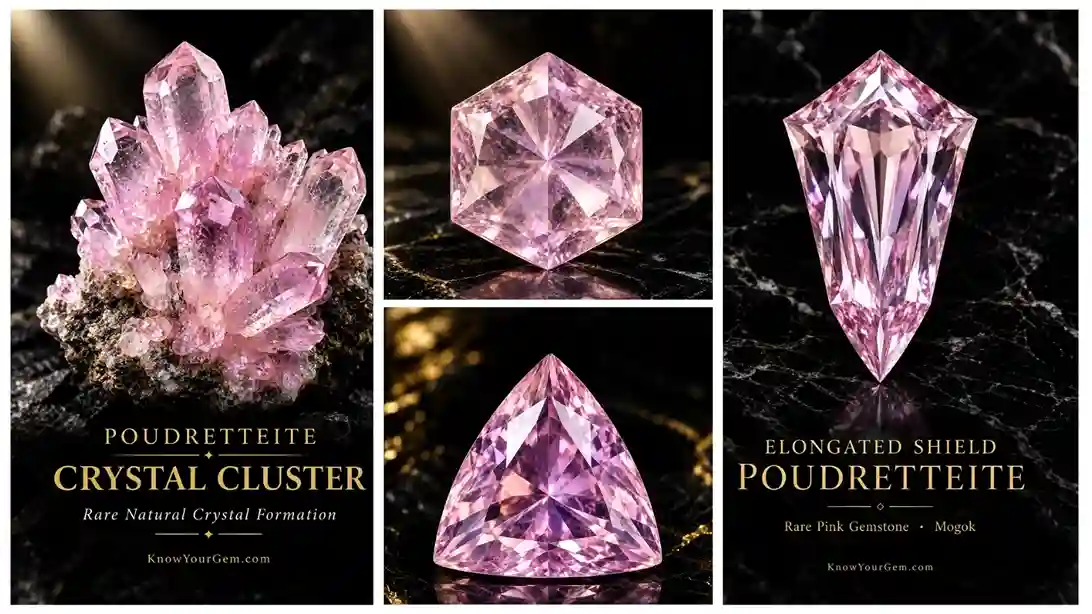
The rarest of all gemstones is poudretteite, which was first discovered in tiny crystals at Mont Saint-Hilaire, Quebec, in the early 1960s. Gem-quality stones are primarily from Mogok, Myanmar. It is often either colorless or a pretty light pink, but sometimes purplish pink, and has a Mohs hardness of 5.
Osumilite is mainly a collector’s stone due to its extreme rarity rather than a durable one. GIA has even stated that anyone who encounters a faceted osumilite should consider themselves lucky.
Is Poudretteite Rare? How Rare Is It?
Yes. It is one of the rarest faceted gemstones a buyer can realistically hear about.
Osumilite rarity comes from several things stacking up:
- The original crystals from Quebec were tiny.
- Gem-quality, transparent material only surfaced in Mogok in 2000.
- Very few faceted stones exist, and most are small.
- Clean stones over a few carats are exceptional.
Makes for confusion: The mineral can be rare, the transparent material rarer, the faceted stones rarer again, and the large, clean, and gem-quality stones quite extremely rare. It is also rare in the jewelry world, where most jewelers have never sold one.
I’m not going to rank it against other rare gems. Rankings depend on which kind of rarity you measure, and I couldn’t find a reliable source that ranks poudretteite by an agreed method.
One caution: One trade source suggests early stones were often mistaken for scapolite, so it may be less rare than assumed. That is a hypothesis, not a finding. For now, treat faceted poudretteite as extremely scarce.
Osumilite History and Discovery:
The mineral came first, the gemstone decades later.
- 1960s: Scant crystals of Pocahontasite are discovered at Mont Saint-Hilaire, Quebec. The mineral is named for the Poudrette family, owners of the quarry.
- 1986: Osumiliteis recognized and registered as a new mineral.
- 2000: An unfamiliar gemstone bought in Mogok proves to be poudretteite, previously known only as tiny Quebec crystals. Gems & Gemology published a full gemological description in Spring 2003.
The Mogok stone mattered because it changed poudretteite’s status. Before it, the mineral was a curiosity for mineralogists. After it, poudretteite existed as a cut gem that could be measured, photographed, and collected.
Where Is Poudretteite Found?
Two places there’s just no comparison: Mont Saint-Hilaire, Quebec, and the Mogok Valley of Myanmar.
The important difference is between mineral occurrence and gem-quality occurrence. Quebec gave science the mineral, but as very small crystals. Osumilite from Myanmar, and specifically Mogok, is where cuttable, transparent material has come from.
So “found in Canada” doesn’t mean a stone for sale came from Canada. When a seller says “osumilite origin: Mogok,” ask for a lab report that supports it. Origin claims on rare stones are easy to make and hard to check.
Poudretteite Color and Appearance:
The color of Osumilite ranges from colorless to light pink, and faceted stones often have a pale pink or purplish pink coloration. The stone is transparent with a vitreous (glassy) luster. It is pleochroic in the sense that it appears colorless to pink! Thus, the stone may vary slightly in appearance when viewed from different angles.
Photographs cause problems here. Pale stones are often edited or shot under strong light to look more saturated. Ask for video in daylight and under a neutral LED before you trust a color.
What Does Raw Poudretteite Look Like?
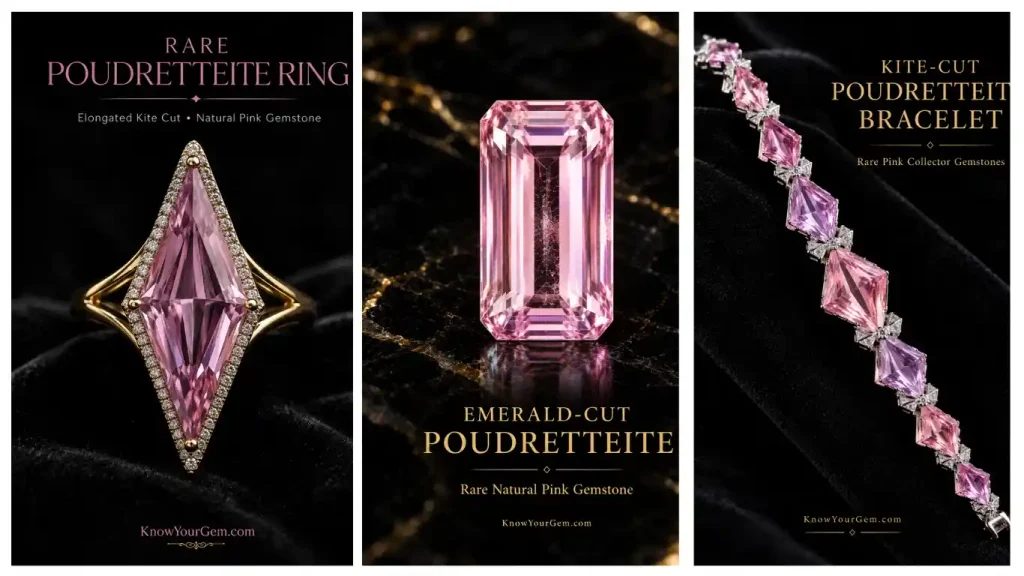
Raw Osumilite crystals are small. The habit is roughly equant, barrel-shaped prismatic crystals. Quebec crystals are minute and mostly of interest to mineral collectors. Gem-quality rough from Myanmar is scarce, so you will rarely see it offered.
Osumilite Properties and Gemological Specifications:
| Composition | KNa₂B₃Si₁₂O₃₀ |
| Crystal structure | Hexagonal |
| Mohs scale | 5 |
| Specific gravity | 2.51 |
| Refractive index | 1.511–1.532 |
| Birefringence | 0.021 |
| Optical character | Uniaxial positive |
| Cleavage | None |
| Fracture / tenacity | Conchoidal to splintery / brittle |
| Luster | Vitreous |
| Color | Colorless to light pink |
These values follow the mineral data compiled from Mindat, Webmineral and other references. Check them against the 2003 Gems & Gemology paper before you publish or quote them in a contract.
One correction that should be made: This page gives a formula, a different specific gravity (about 3.17–3.20), and also says it is a member of the spodumene group. It is incorrect on these points. Poudretteite is a borosilicate that is related to the milarite-type structure.
Poudretteite Crystal Structure:
In mineralogy, a crystal is a solid in which the atoms are regularly disposed in a pattern. Osumilite has a hexagonal crystal system. It appears as small barrel-shaped prisms. “Crystal meaning” is a different subject. The structure is a measurable fact. Any meaning attached to it is a belief, so I keep the two apart.
Poudretteite Meaning and Spiritual Meaning:
Name. Poudretteite, derived from the Poudrette family who own the quarry in which the mineral was discovered. This is the accepted meaning.
Spiritual meaning: Some crystal-healing communities link pink stones in general with emotional calm and the heart. These are modern beliefs and are not specific to osumilite. Gem-quality stones only appeared in 2000, so there is no long tradition of lore, and no scientific evidence supports healing effects.
Poudretteite Benefits: What Is Actually Known?
Gemological benefits:
- It is extremely rare and has collector appeal.
- It has a delicate pale pink color.
- Interest for mineralogists and museums.
Metaphysical claims: Calmness and emotional balance are sometimes attributed to it. Treat these as personal belief, not proven effects.
There are no verified health benefits. If a seller promises them, that seller is not a reliable source.
Poudretteite Price and Value: How Much Is Poudretteite Worth?
No standard osumilite price per carat. Availability is very limited, individual crystals are very different, and not many trades are known. Price factors include color, term, transparency, carat size, cut, origin, G. I. A certification, and sample state.
Here are the figures I could actually document, with sources. They show a wide spread, not one number.
| 0.93 ct poudretteite, retail listing | The Gem Trader, checked Sept 2026 | $1,675 | ~$1,800 |
| 1.54 ct poudretteite, marked sold out | The Gem Trader, checked Sept 2026 | $5,852 | ~$3,800 |
| High-quality pale pink, general estimate | FIV Magazine, undated | n/a | ~$3,000 |
| Few inclusions, saturated color, “said to be” | Trade blog citing GIA-era coverage, 2021 | n/a | $6,000+ |
These are dealer asking prices and secondary estimates, not verified auction results. I found no reliable public auction record. Prices at a private sale can differ.
Watch out for extreme numbers in both directions. One site quotes $23,000 to $52,000 per carat for top stones, but it gives no transaction to back that up, and I would not repeat it.
At the other end, an eBay listing for a “flawless certified” 7.15 ct poudretteite ended at $1.35. That is not a real osumilite price.
Poudretteite Jewelry:
The sample from Mohs 5 is more easily scratched by osumilite than by sapphire, ruby, or diamond, and the dust generated by ordinary daily wear is harder again. It also chips from knocks, as it is a brittle material. It has no cleavage, which in itself doesn‘t make it tough, but discussed later.
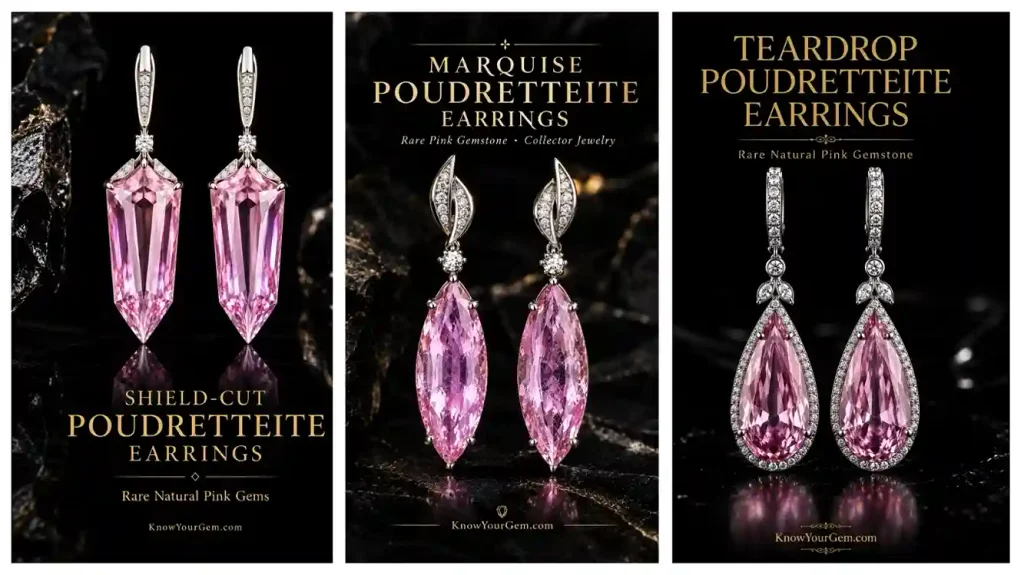
- Poudretteite ring: Possible, but it needs a protective setting such as a bezel or halo. Keep it for occasional wear.
- Poudretteite wedding ring: I don’t recommend it. A wedding ring is worn every day, and at Mohs 5 the stone would scratch and chip. Jewelers citing GIA also describe it as unsuitable for rings but usable with care in earrings, pendants or pins.
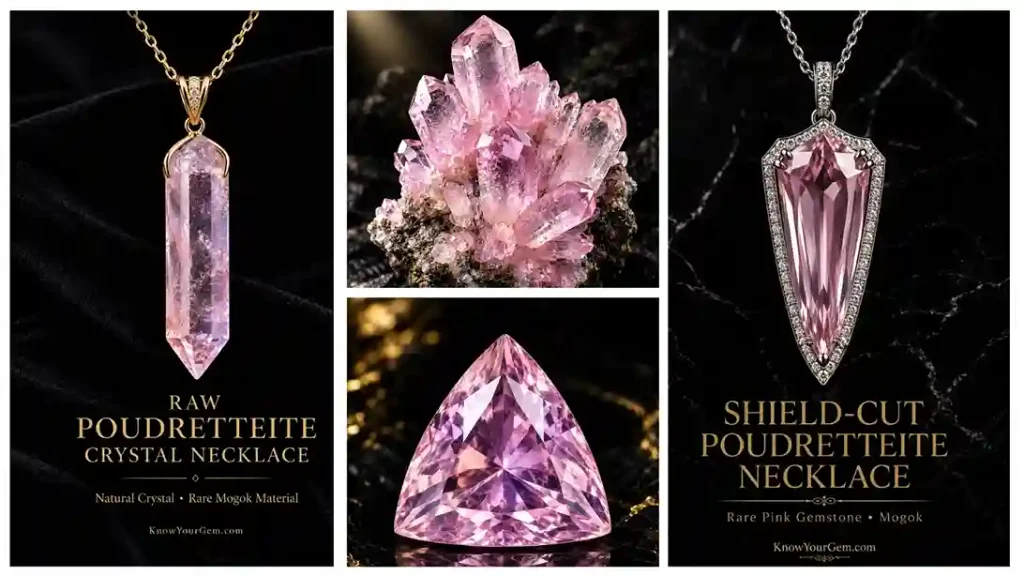
- Poudretteite earrings: The most practical option. Ears take fewer knocks than hands.
- Poudretteite necklace: A pendant is a good choice, since the stone rests against clothing and gets little abrasion.
- Poudretteite bracelet: Risky. Wrists hit tables and doors all day.
Poudretteite for Sale: What Should Buyers Check?
Start with a simple question: Is it actually poudretteite? Then check:
- A laboratory report from a recognized lab that confirms species.
- Weight and dimensions.
- Color under different lights.
- Clarity and any visible inclusions.
- Origin or provenance, and how it is documented.
- Any treatment disclosure.
- The return policy.
- Seller reputation and history with rare stones.
- Sharp photographs and video.
Why rare-gemstone identification matters: The stones are so uncommon that fewer people can verify them. Look-alikes exist, and a buyer without a lab report has little way to tell. On rare gems, identification is the purchase.
Biggest Buyer Misconception:
- What people believe: a pretty pink color and a “poudretteite” label mean a good buy.
- What is true: Color is just one aspect. Traders need to confirm rarity, clarity and cut, treatment, ethical supply, any fractures and inclusions, documentation, and the price. It is the documentation that proves the identity.
- Why it matters: with a stone this rare and this hard to test, you are paying for identity, not just color. And rare doesn’t automatically mean a good investment. Resale is thin, and few buyers exist. If you buy one, buy it because you want it.
osumilite vs other stones:
Poudretteite vs Quartz:
Buyers sometimes search this pairing because they want a visual comparison, or because the two are confused in listings. They are unrelated minerals.
| Composition | Borosilicate | Silicon dioxide |
| Hardness | ~5 | 7 |
| Specific gravity | 2.51 | ~2.65 |
| Refractive index | 1.511–1.532 | ~1.544–1.553 |
A pale pink quartz (rose quartz) can look similar in photos. Hardness, refractive index and lab testing settle it.
Poudretteite vs Scapolite:
Confusion can occur because pale scapolite and poudretteite overlap in color and both are relatively soft. Scapolite is generally around Mohs 5.5–6, and its refractive index usually runs higher. It is uniaxial negative, where poudretteite is uniaxial positive.
Those numbers are useful but not a shortcut. Ranges overlap in places, so a refractometer and specific gravity check are a start, not proof. Spectroscopy or chemical analysis from a lab is what confirms it.
Famous osumilite Specimens: The 9.41-Carat Stone
The 9.41-carat light pink oval in the Smithsonian is one of the largest, if not the largest, faceted poudretteite known. It was donated to the Smithsonian in 2007 by Frances Miller Seay and is the only poudretteite in the National Gem Collection.
Most faceted stones are far smaller, often under 2 carats. This is why a 9-carat stone is remarkable. I would avoid “world’s rarest” wording, which the sources don’t support.
How to Say Poudretteite?
What is true: Color is just one aspect. Traders need to confirm rarity, clarity and cut, treatment, ethical supply, any fractures and inclusions, documentation and the price. It is the documentation that proves the identity.
What Is Poudretteite Used For?
- Collector specimens: the main use
- Faceted gemstones: cut mostly by specialists
- Jewelry: limited, because of hardness
- Mineralogical research
- Museum specimens
Buyer Checklist:
- Ask for a lab report that names poudretteite.
- Compare weight, dimensions and color across photos and video.
- Ask about treatment and how the seller knows.
- Confirm origin claims in writing.
- Check return terms before paying.
- Plan for a protective setting or a pendant, not a daily ring.
- Be skeptical of any price that looks too low, or a sales pitch that leans on “investment.”
FAQ:
1. Is poudretteite rare?
Yes. Faceted gem-quality stones are extremely scarce.
2. How rare is poudretteite?
Very. Few gemologists will ever see one, and most stones are small.
3. How much is poudretteite worth?
It depends. It goes on at the dealers shown above $1,800 and $3,800 per carat, with a number of computer simulations even more expensive.
4. What is the poudretteite price per carat?
It does not have a standard price. It is influenced by (a) colour, (b) clarity, (c) Size, and documentation.
5. Where is poudretteite found?
The stone is usually found in Mont Saint-Hilaire, Quebec (mineral), and Mogok, Myanmar (gem-quality).
6. What color is poudretteite?
It can be colorless to pale pink, sometimes purplish-pink.
7. How hard is poudretteite?
About 5 on the Mohs scale.
8. How do you pronounce poudretteite?
Usually “poo-DRET-ite.”
9. Is poudretteite good for a ring?
Not for everyday wear. Use a protective setting and wear it occasionally.
10. Is poudretteite used in jewelry?
Yes, but the stone is rare and mostly used in earrings and pendants.
The content is written and published by gemstone expert and enthusiast: {KamilHussain}

Welcome to KnowYourGem.com! your ultimate destination for uncovering the fascinating world of gems and their secrets! I'm Kamil Hussain, a passionate blogger with a Master’s degree in Economics, dedicated to bringing you insightful, well researched content that blends the beauty of gemstones with the art of storytelling. With a keen analytical mind and a love for discovering hidden treasures, I created this platform to help you explore the brilliance, history, and value of every gem.

